ETHANOL -BIOFUELS -
BIODIESEL
Growing fuel in the fields of farmers not from oil wells
Dr.K.Rajendran Ph.D
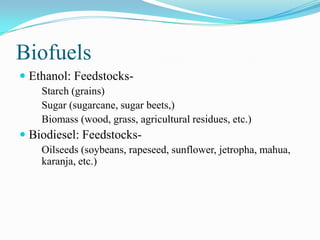
Biofuels
 Ethanol: Feedstocks-
Starch (grains)
Sugar (sugarcane, sugar beets,)
Biomass (wood, grass, agricultural residues, etc.)
 Biodiesel: Feedstocks-
Oilseeds (soybeans, rapeseed, sunflower, jetropha, mahua,
karanja, etc.)
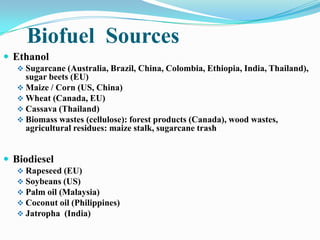
Biofuel Sources
 Ethanol
 Sugarcane (Australia, Brazil, China, Colombia, Ethiopia, India, Thailand),
sugar beets (EU)
 Maize / Corn (US, China)
 Wheat (Canada, EU)
 Cassava (Thailand)
 Biomass wastes (cellulose): forest products (Canada), wood wastes,
agricultural residues: maize stalk, sugarcane trash
 Biodiesel
 Rapeseed (EU)
 Soybeans (US)
 Palm oil (Malaysia)
 Coconut oil (Philippines)
 Jatropha (India)
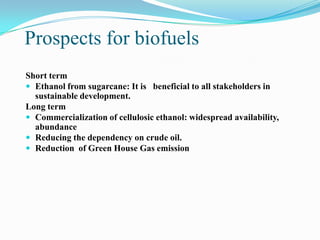
Prospects for biofuels
Short term
 Ethanol from sugarcane: It is beneficial to all stakeholders in
sustainable development.
Long term
 Commercialization of cellulosic ethanol: widespread availability,
abundance
 Reducing the dependency on crude oil.
 Reduction of Green House Gas emission
What is Ethanol Fuel?
 Ethanol is used as vehicle fuel mainly as biofuel
additive for gasoline.
 Ethanol, unlike petroleum, is a form of renewable
energy that can be produced from agricultural crops
such as sugar cane, potato, and corn.
 Ethanol is widely used in Brazil and in the US and
together both countries are responsible for 89 percent
of the world’s ethanol fuel production in 2009.
ETHANOL-HISTORICAL PERSPECTIVE
 In 1880 Henry Ford designed a car solely on ethanol
 Subsequently Ford designed its popular model ―T‖
operable on ethanol and or gasoline.
 Extensively used during World War II in GermanyFrom
1920-1924,Standard Oil Company marketed 25% by
vol. of absolute ethanol in Gasoline in Baltimore area.
Project stopped because of
 High corn prices
 Problems of transportation and storage
Why biofuels are attractive?
 Energy security: eco-friendly, renewable energy. locally
produced, wider availability, ―grow your own oil‖
 Lower emissions of harmful pollutants
 Liquid fuels: conducive to existing infrastructure, storage,
distribution
 Bioethanol: cars, light trucks, motorcycles
 Biodiesel: commercial vehicles, buses, pumps, isolated electricity
generation
Import of Crude can be reduced thereby foreign exchange
outflow will be saved substantially.
Ethanol as Transport Fuel
 Ethanol advantages as Transport Fuel;
 Octane enhancer
 No engine modification required for E10 and lower blends
 Environmental benefits;
 Lower emissions of CO and hydrocabons
 Lower CO2 emissions with high compression ratio
 Higher biodegradability coupled with low toxicity
Raw materials required for ethanol
production
 Sugarcane, Beet, Sweet Sorghun, Corn, wheat, rice,
potato.
 Cellulose material such as wood, waste paper, crop
residue, etc
ETHANOLADDED TO PETROL IS ALSO
REFERRED AS
 Absolute Alcohol
 Anhydrous Alcohol
 Dehydrated Alcohol
 Power Alcohol
BLENDING WITH PETROL
 Ethanol can be blended in various proportions
with Petrol
 Usually blended from 5 % to 10% by volume to
Gasoline
 Brazil has an experience of over 70 years in
blending and now they have 24% of ethanol by
volume added to Gasoline.
Economic Impacts
 Creation of demand for agricultural products and mills can
come out of sugar cycle.
 Increases farmers income
 Creation of employment opportunities in rural areas
 Energy Independence
International Experience on use of Ethanol
 Brazil started commercial use of ethanol as automotive fuel
in 1989 as neat hydrated ethanol and 24% ethanol -gasoline
blend
 US Clean Air Act of 1990 made use of oxygenates
mandatory in 41 most polluted cities during winter months
to reduce emissions
 Studies in the U.S. and Canada ---replacement of gasoline with
ethanol means a reduction in total life cycle emissions of
greenhouse gases (expressed as ―carbon dioxide equivalents‖) of
at least 25%.
ETHANOL: WORLD PERSPECTIVE
 In France, ethanol is produced from grapes also.
 In USA, presently ethanol-blended fuels represent more than
12% of motor gasoline sales. Since ethanol-blended Gasoline
was introduced in US, production was more than doubled—from
20 million barrels in 1996 to over 40 million barrels in 2001.
 In US, gasoline is blended with 10% Ethanol whereas in Brazil
the blending percentages are 22-26%.
 In Thailand, approximately 564 million litres per annum–mostly
from Molasses is produced. Additionally Tapioca (Cassava)
being studied as raw material.
 Brazil consumes nearly 4 billion gallons of ethanol annually. In
addition to consumption, Brazil also exports ethanol to other
countries.
 Canada's annual ethanol production is approximately 225
million litres per year,E10 (10% ethanol and 90% gasoline)
available in 1000 retail stations in Canada.Ethanol is widely
available in proportions of 5-10% ethanol blended with gasoline
ETHANOL: WORLD PERSPECTIVE
• The bulk of production comes from Brazil and USA.
• In European countries and in US Ethanol is produced mainly
from Corn (Maize). In Brazil sugarcane which is available in
abundance is used as raw material for Ethanol production.
India being the largest sugarcane producer in the world and
has got enormous potential which can be exploited for the
production of Ethanol. India and Brazil produces about 2/3 of
world total sugarcane production. However Brazil leads in
production and consumption of Ethanol.
Studies on Ethanol in Gasoline
 Elaborative R&D studies conducted on 5% and 10% ethanol gasoline
blends
 Physico-Chemical tests
 Identification of additive needs
 Material Compatibility
 Cold / hot startability and drivability
 Mass Emission tests and field trials on Bajaj 2 wheelers and Maruti
Zen Cars
R&D Studies on the use of Ethanol in India
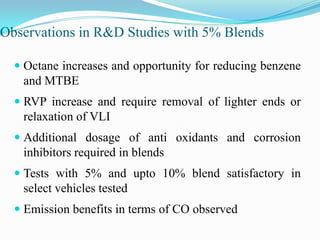
Observations in R&D Studies with 5% Blends
 Octane increases and opportunity for reducing benzene
and MTBE
 RVP increase and require removal of lighter ends or
relaxation of VLI
 Additional dosage of anti oxidants and corrosion
inhibitors required in blends
 Tests with 5% and upto 10% blend satisfactory in
select vehicles tested
 Emission benefits in terms of CO observed
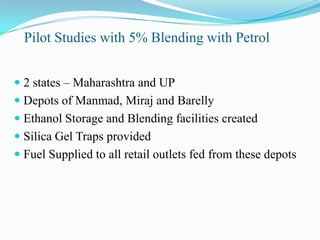
Pilot Studies with 5% Blending with Petrol
 2 states – Maharashtra and UP
 Depots of Manmad, Miraj and Barelly
 Ethanol Storage and Blending facilities created
 Silica Gel Traps provided
 Fuel Supplied to all retail outlets fed from these depots
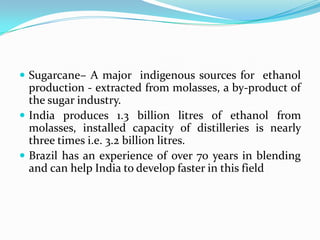
 Sugarcane– A major indigenous sources for ethanol
production - extracted from molasses, a by-product of
the sugar industry.
 India produces 1.3 billion litres of ethanol from
molasses, installed capacity of distilleries is nearly
three times i.e. 3.2 billion litres.
 Brazil has an experience of over 70 years in blending
and can help India to develop faster in this field
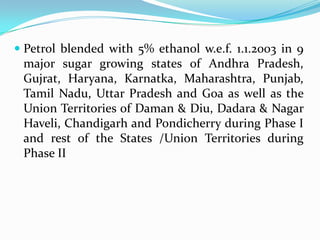
 Petrol blended with 5% ethanol w.e.f. 1.1.2003 in 9
major sugar growing states of Andhra Pradesh,
Gujrat, Haryana, Karnatka, Maharashtra, Punjab,
Tamil Nadu, Uttar Pradesh and Goa as well as the
Union Territories of Daman & Diu, Dadara & Nagar
Haveli, Chandigarh and Pondicherry during Phase I
and rest of the States /Union Territories during
Phase II
 5% blend of ethanol and petrol would be
extended to the entire country in second phase.
 No modification is required in vehicles with 10%
ethanol blend.
 In the next phase ethanol will also be blended in
diesel.
 India use 80% diesel and 20% petrol against
Brazil pattern of consumption of 10% diesel and
90% petrol.
ETHANOL PRODUCTION ROUTES
 Fuel ethanol or absolute Alcohol is produced by
dehydration (removal of water molecules) of
Rectified Spirit (RS)or Industrial alcohol
 Commercial routes of dehydration of RS
-Molecular sieve Technology
-Pervaporation (membrane technology)
-Azeotropic distillation
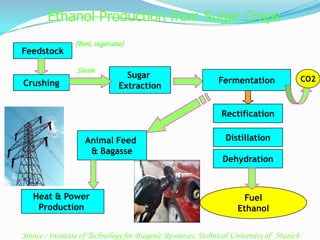
Ethanol Production from Sugar Crops
Crushing
Sugar
Extraction
Distillation
Rectification
Dehydration
Fuel
Ethanol
Animal Feed
& Bagasse
(Beet, sugarcane)
Feedstock
Heat & Power
Production
Fermentation CO2
Steam
Source : Institute of Technology for Biogenic Resources, Technical University of Munich
BIOMASS-BASED ETHANOL
 Agricultural crops and wastes
Rice straw, Wheat straw, bagasse etc
 Municipal Solid waste
Paper, cardboard,municipal sludge etc
 Industrial waste
Wood chips, saw dust, food processing waste
paper mill sludge etc
BIO-DIESEL
“ The use of vegetable oils for engine may seem
insignificant to-day, but such oils may become in
course of time as important as petroleum and the coal
tar products of the present time ”
Rudolf Diesel (1912)
 The bi-fuel system developed by the Prof H. A.
Havemann and his colleagues at the Indian Institute of
Science (IISc) Bangalore, in the early 1950s, was the
subject of the earliest original published work in
technical literature regarding alcohol diesels.
 Essentially, this method involves giving carburetor
benefits to a diesel engine.
 Since alcohol and diesel oil does not mix, these fuels are
sent through two different routes - by induction and
injection. Part of the fuel-energy is supplied by
inducting ethanol through a carburetor, while only a
small quantity of diesel fuel is injected in the
conventional injection system. Alcohol Tests for
Internal combustion Engines in IISc, Bangalore in 1950s
 Studies on neat alcohol and blends carried out in IOC
R&D,IIT D,IIT M, IIP and many other research
/academic institutes
ETHANOL & DIESEL BLEND
 Ethanol has limited solubility in diesel
 Pure Energy Corporation, AAE Technologies and
Betz-Dearborn use different additive packages for
stability
 IOC ,R&D has recently developed an additive
package to solubilize 5% of Ethanol in
commercially available diesel
BIO-DIESEL
Biodiesel
 A fuel comprising of Mono-alkyl esters of long
chain fatty acids derived from vegetable oils or
animal fats, designated B100
Biodiesel Blend
 A blend of Biodiesel fuel with petroleum-
based diesel fuel designated BXX, where XX is
the volume percent Biodiesel
EXPERIMENTS WITH BIODIESEL
 Biodiesel is totally miscible with diesel oil in any
proportion.
 Biodiesel viscosity is close to diesel
 Calorific value of biodiesel is also very close to
diesel oil.
BIO-DIESEL POTENTIAL OF INDIA
 From about 100 varieties of oil seeds, only 10-12
varieties have been tapped so far.
 Only a few million tonnes have been utilized
against the estimated potential of about 20
Million tonnes per annum. There is lack of
demand for industrial use for biodiesel in the
country.
Road ahead…..
Remunerative uniform pricing policy throughout India for Ethanol like Petrol.
Sugar factories should be permitted to use cane juice partly or fully like Brazil to
produce Ethanol since sugarcane control order was amended.
Financial assistance from the sugar development fund for the establis-hment of
Ethanol plant.
At 5% blending rate the requirement of Ethanol will be around 450 million ltrs.
When the blending rate is increased to 10% and taking into account of growth of
consumption of Ethanol, demand for Ethanol will be around 1000 million ltrs.

Ethanol biofuel and biodiesel

  • 1.
    ETHANOL -BIOFUELS - BIODIESEL Growingfuel in the fields of farmers not from oil wells Dr.K.Rajendran Ph.D
  • 2.
    Biofuels  Ethanol: Feedstocks- Starch(grains) Sugar (sugarcane, sugar beets,) Biomass (wood, grass, agricultural residues, etc.)  Biodiesel: Feedstocks- Oilseeds (soybeans, rapeseed, sunflower, jetropha, mahua, karanja, etc.)
  • 3.
    Biofuel Sources  Ethanol Sugarcane (Australia, Brazil, China, Colombia, Ethiopia, India, Thailand), sugar beets (EU)  Maize / Corn (US, China)  Wheat (Canada, EU)  Cassava (Thailand)  Biomass wastes (cellulose): forest products (Canada), wood wastes, agricultural residues: maize stalk, sugarcane trash  Biodiesel  Rapeseed (EU)  Soybeans (US)  Palm oil (Malaysia)  Coconut oil (Philippines)  Jatropha (India)
  • 4.
    Prospects for biofuels Shortterm  Ethanol from sugarcane: It is beneficial to all stakeholders in sustainable development. Long term  Commercialization of cellulosic ethanol: widespread availability, abundance  Reducing the dependency on crude oil.  Reduction of Green House Gas emission
  • 5.
    What is EthanolFuel?  Ethanol is used as vehicle fuel mainly as biofuel additive for gasoline.  Ethanol, unlike petroleum, is a form of renewable energy that can be produced from agricultural crops such as sugar cane, potato, and corn.  Ethanol is widely used in Brazil and in the US and together both countries are responsible for 89 percent of the world’s ethanol fuel production in 2009.
  • 6.
    ETHANOL-HISTORICAL PERSPECTIVE  In1880 Henry Ford designed a car solely on ethanol  Subsequently Ford designed its popular model ―T‖ operable on ethanol and or gasoline.  Extensively used during World War II in GermanyFrom 1920-1924,Standard Oil Company marketed 25% by vol. of absolute ethanol in Gasoline in Baltimore area. Project stopped because of  High corn prices  Problems of transportation and storage
  • 7.
    Why biofuels areattractive?  Energy security: eco-friendly, renewable energy. locally produced, wider availability, ―grow your own oil‖  Lower emissions of harmful pollutants  Liquid fuels: conducive to existing infrastructure, storage, distribution  Bioethanol: cars, light trucks, motorcycles  Biodiesel: commercial vehicles, buses, pumps, isolated electricity generation Import of Crude can be reduced thereby foreign exchange outflow will be saved substantially.
  • 8.
    Ethanol as TransportFuel  Ethanol advantages as Transport Fuel;  Octane enhancer  No engine modification required for E10 and lower blends  Environmental benefits;  Lower emissions of CO and hydrocabons  Lower CO2 emissions with high compression ratio  Higher biodegradability coupled with low toxicity
  • 9.
    Raw materials requiredfor ethanol production  Sugarcane, Beet, Sweet Sorghun, Corn, wheat, rice, potato.  Cellulose material such as wood, waste paper, crop residue, etc
  • 10.
    ETHANOLADDED TO PETROLIS ALSO REFERRED AS  Absolute Alcohol  Anhydrous Alcohol  Dehydrated Alcohol  Power Alcohol
  • 11.
    BLENDING WITH PETROL Ethanol can be blended in various proportions with Petrol  Usually blended from 5 % to 10% by volume to Gasoline  Brazil has an experience of over 70 years in blending and now they have 24% of ethanol by volume added to Gasoline.
  • 12.
    Economic Impacts  Creationof demand for agricultural products and mills can come out of sugar cycle.  Increases farmers income  Creation of employment opportunities in rural areas  Energy Independence
  • 13.
    International Experience onuse of Ethanol  Brazil started commercial use of ethanol as automotive fuel in 1989 as neat hydrated ethanol and 24% ethanol -gasoline blend  US Clean Air Act of 1990 made use of oxygenates mandatory in 41 most polluted cities during winter months to reduce emissions  Studies in the U.S. and Canada ---replacement of gasoline with ethanol means a reduction in total life cycle emissions of greenhouse gases (expressed as ―carbon dioxide equivalents‖) of at least 25%.
  • 14.
    ETHANOL: WORLD PERSPECTIVE In France, ethanol is produced from grapes also.  In USA, presently ethanol-blended fuels represent more than 12% of motor gasoline sales. Since ethanol-blended Gasoline was introduced in US, production was more than doubled—from 20 million barrels in 1996 to over 40 million barrels in 2001.  In US, gasoline is blended with 10% Ethanol whereas in Brazil the blending percentages are 22-26%.  In Thailand, approximately 564 million litres per annum–mostly from Molasses is produced. Additionally Tapioca (Cassava) being studied as raw material.  Brazil consumes nearly 4 billion gallons of ethanol annually. In addition to consumption, Brazil also exports ethanol to other countries.  Canada's annual ethanol production is approximately 225 million litres per year,E10 (10% ethanol and 90% gasoline) available in 1000 retail stations in Canada.Ethanol is widely available in proportions of 5-10% ethanol blended with gasoline
  • 15.
    ETHANOL: WORLD PERSPECTIVE •The bulk of production comes from Brazil and USA. • In European countries and in US Ethanol is produced mainly from Corn (Maize). In Brazil sugarcane which is available in abundance is used as raw material for Ethanol production. India being the largest sugarcane producer in the world and has got enormous potential which can be exploited for the production of Ethanol. India and Brazil produces about 2/3 of world total sugarcane production. However Brazil leads in production and consumption of Ethanol.
  • 16.
    Studies on Ethanolin Gasoline  Elaborative R&D studies conducted on 5% and 10% ethanol gasoline blends  Physico-Chemical tests  Identification of additive needs  Material Compatibility  Cold / hot startability and drivability  Mass Emission tests and field trials on Bajaj 2 wheelers and Maruti Zen Cars R&D Studies on the use of Ethanol in India
  • 17.
    Observations in R&DStudies with 5% Blends  Octane increases and opportunity for reducing benzene and MTBE  RVP increase and require removal of lighter ends or relaxation of VLI  Additional dosage of anti oxidants and corrosion inhibitors required in blends  Tests with 5% and upto 10% blend satisfactory in select vehicles tested  Emission benefits in terms of CO observed
  • 18.
    Pilot Studies with5% Blending with Petrol  2 states – Maharashtra and UP  Depots of Manmad, Miraj and Barelly  Ethanol Storage and Blending facilities created  Silica Gel Traps provided  Fuel Supplied to all retail outlets fed from these depots
  • 19.
     Sugarcane– Amajor indigenous sources for ethanol production - extracted from molasses, a by-product of the sugar industry.  India produces 1.3 billion litres of ethanol from molasses, installed capacity of distilleries is nearly three times i.e. 3.2 billion litres.  Brazil has an experience of over 70 years in blending and can help India to develop faster in this field
  • 20.
     Petrol blendedwith 5% ethanol w.e.f. 1.1.2003 in 9 major sugar growing states of Andhra Pradesh, Gujrat, Haryana, Karnatka, Maharashtra, Punjab, Tamil Nadu, Uttar Pradesh and Goa as well as the Union Territories of Daman & Diu, Dadara & Nagar Haveli, Chandigarh and Pondicherry during Phase I and rest of the States /Union Territories during Phase II
  • 21.
     5% blendof ethanol and petrol would be extended to the entire country in second phase.  No modification is required in vehicles with 10% ethanol blend.  In the next phase ethanol will also be blended in diesel.  India use 80% diesel and 20% petrol against Brazil pattern of consumption of 10% diesel and 90% petrol.
  • 22.
    ETHANOL PRODUCTION ROUTES Fuel ethanol or absolute Alcohol is produced by dehydration (removal of water molecules) of Rectified Spirit (RS)or Industrial alcohol  Commercial routes of dehydration of RS -Molecular sieve Technology -Pervaporation (membrane technology) -Azeotropic distillation
  • 23.
    Ethanol Production fromSugar Crops Crushing Sugar Extraction Distillation Rectification Dehydration Fuel Ethanol Animal Feed & Bagasse (Beet, sugarcane) Feedstock Heat & Power Production Fermentation CO2 Steam Source : Institute of Technology for Biogenic Resources, Technical University of Munich
  • 24.
    BIOMASS-BASED ETHANOL  Agriculturalcrops and wastes Rice straw, Wheat straw, bagasse etc  Municipal Solid waste Paper, cardboard,municipal sludge etc  Industrial waste Wood chips, saw dust, food processing waste paper mill sludge etc
  • 25.
    BIO-DIESEL “ The useof vegetable oils for engine may seem insignificant to-day, but such oils may become in course of time as important as petroleum and the coal tar products of the present time ” Rudolf Diesel (1912)
  • 26.
     The bi-fuelsystem developed by the Prof H. A. Havemann and his colleagues at the Indian Institute of Science (IISc) Bangalore, in the early 1950s, was the subject of the earliest original published work in technical literature regarding alcohol diesels.  Essentially, this method involves giving carburetor benefits to a diesel engine.  Since alcohol and diesel oil does not mix, these fuels are sent through two different routes - by induction and injection. Part of the fuel-energy is supplied by inducting ethanol through a carburetor, while only a small quantity of diesel fuel is injected in the conventional injection system. Alcohol Tests for Internal combustion Engines in IISc, Bangalore in 1950s  Studies on neat alcohol and blends carried out in IOC R&D,IIT D,IIT M, IIP and many other research /academic institutes
  • 27.
    ETHANOL & DIESELBLEND  Ethanol has limited solubility in diesel  Pure Energy Corporation, AAE Technologies and Betz-Dearborn use different additive packages for stability  IOC ,R&D has recently developed an additive package to solubilize 5% of Ethanol in commercially available diesel
  • 28.
    BIO-DIESEL Biodiesel  A fuelcomprising of Mono-alkyl esters of long chain fatty acids derived from vegetable oils or animal fats, designated B100 Biodiesel Blend  A blend of Biodiesel fuel with petroleum- based diesel fuel designated BXX, where XX is the volume percent Biodiesel
  • 29.
    EXPERIMENTS WITH BIODIESEL Biodiesel is totally miscible with diesel oil in any proportion.  Biodiesel viscosity is close to diesel  Calorific value of biodiesel is also very close to diesel oil.
  • 30.
    BIO-DIESEL POTENTIAL OFINDIA  From about 100 varieties of oil seeds, only 10-12 varieties have been tapped so far.  Only a few million tonnes have been utilized against the estimated potential of about 20 Million tonnes per annum. There is lack of demand for industrial use for biodiesel in the country.
  • 31.
    Road ahead….. Remunerative uniformpricing policy throughout India for Ethanol like Petrol. Sugar factories should be permitted to use cane juice partly or fully like Brazil to produce Ethanol since sugarcane control order was amended. Financial assistance from the sugar development fund for the establis-hment of Ethanol plant. At 5% blending rate the requirement of Ethanol will be around 450 million ltrs. When the blending rate is increased to 10% and taking into account of growth of consumption of Ethanol, demand for Ethanol will be around 1000 million ltrs.