By Homework Guru
www.homeworkguru.com
 The responsiveness of one variable to changes
in another
 When price rises what happens to demand?
 Demand falls
 BUT!
 How much does demand fall?
 If price rises by 10% - what happens to
demand?
 We know demand will fall
 By more than 10%?
 By less than 10%?
 Elasticity measures the extent to which
demand will change
… is a measure of how much buyers and
sellers respond to changes in market
conditions
… allows us to analyze supply and
demand with greater precision.
Price elasticity of demand is the percentage
change in quantity demanded given a percent
change in the price.
It is a measure of how much the quantity
demanded of a good responds to a change in
the price of that good.
Necessities versus Luxuries
Availability of Close Substitutes
Definition of the Market
Time Horizon
Demand tends to be more elastic :
if the good is a luxury.
the longer the time period.
the larger the number of close
substitutes.
the more narrowly defined the market.
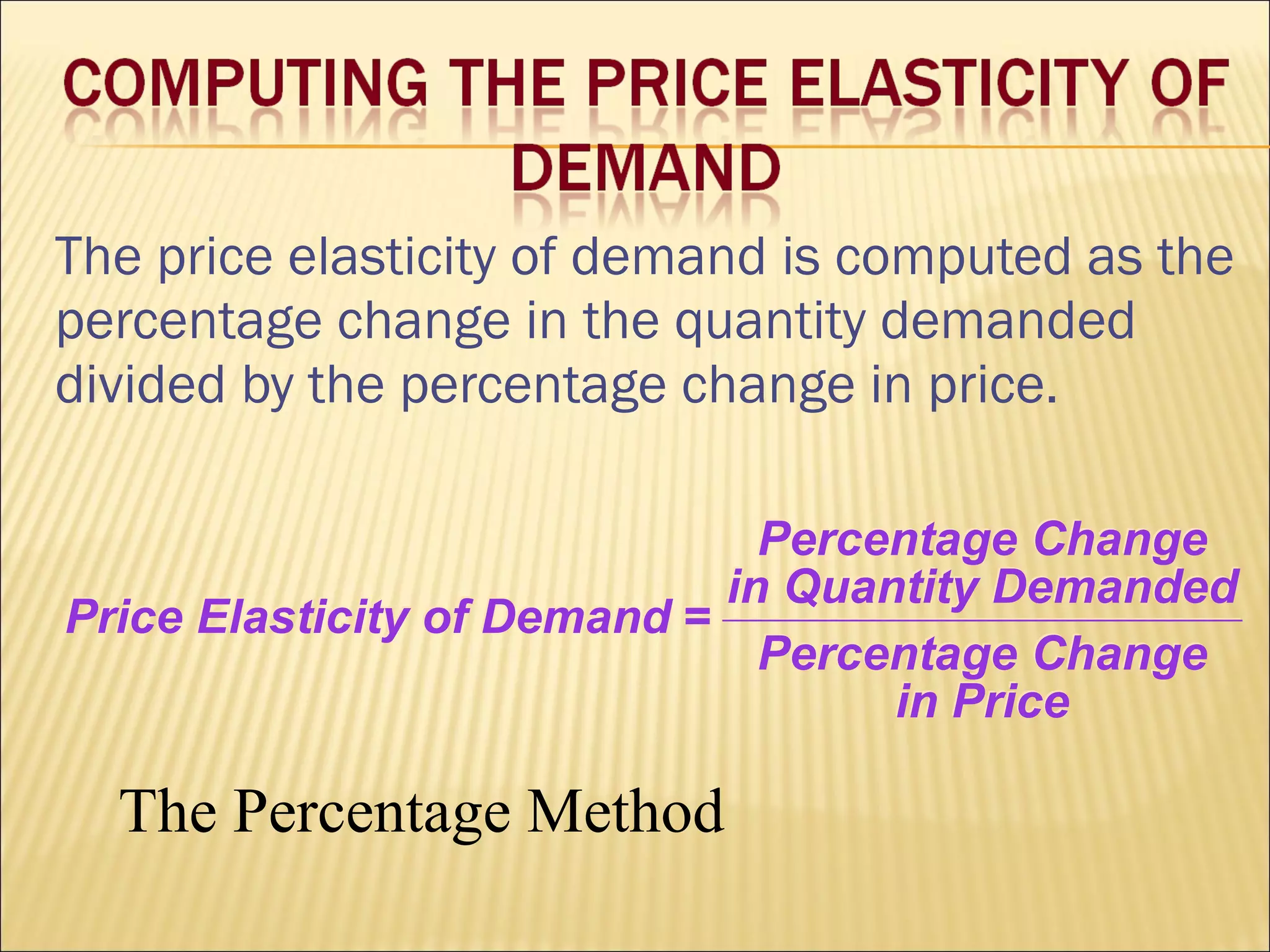
The price elasticity of demand is computed as the
percentage change in the quantity demanded
divided by the percentage change in price.
Price Elasticity of Demand =
Percentage Change
in Quantity Demanded
Percentage Change
in Price
Price Elasticity of Demand =
Percentage Change
in Quantity Demanded
Percentage Change
in Price
The Percentage Method
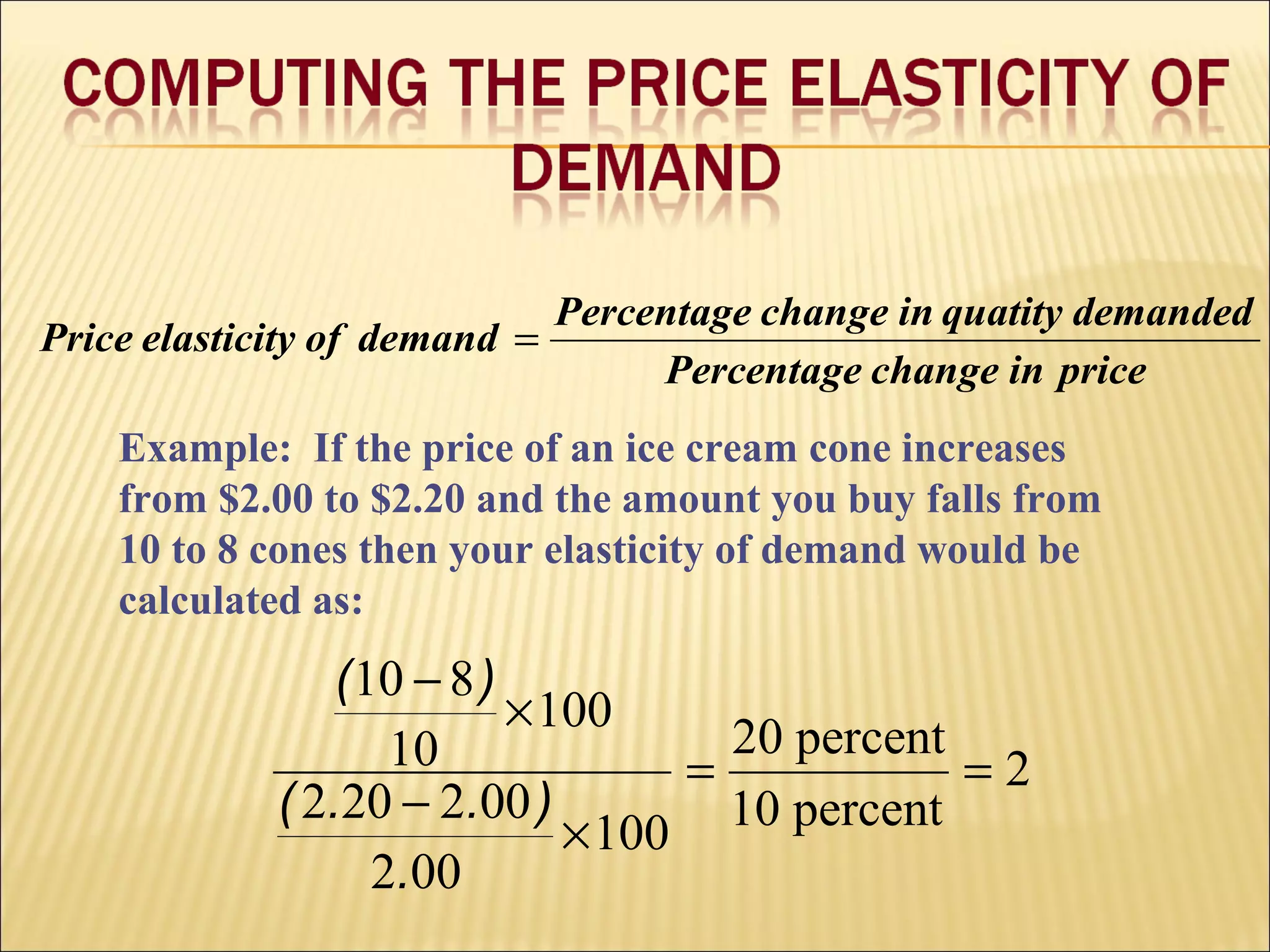
priceinchangePercentage
demandedquatityinchangePercentage
demandofelasticityPrice =
Example: If the price of an ice cream cone increases
from $2.00 to $2.20 and the amount you buy falls from
10 to 8 cones then your elasticity of demand would be
calculated as:
2
percent10
percent20
100
002
002202
100
10
810
==
×
−
×
−
.
)..(
)(
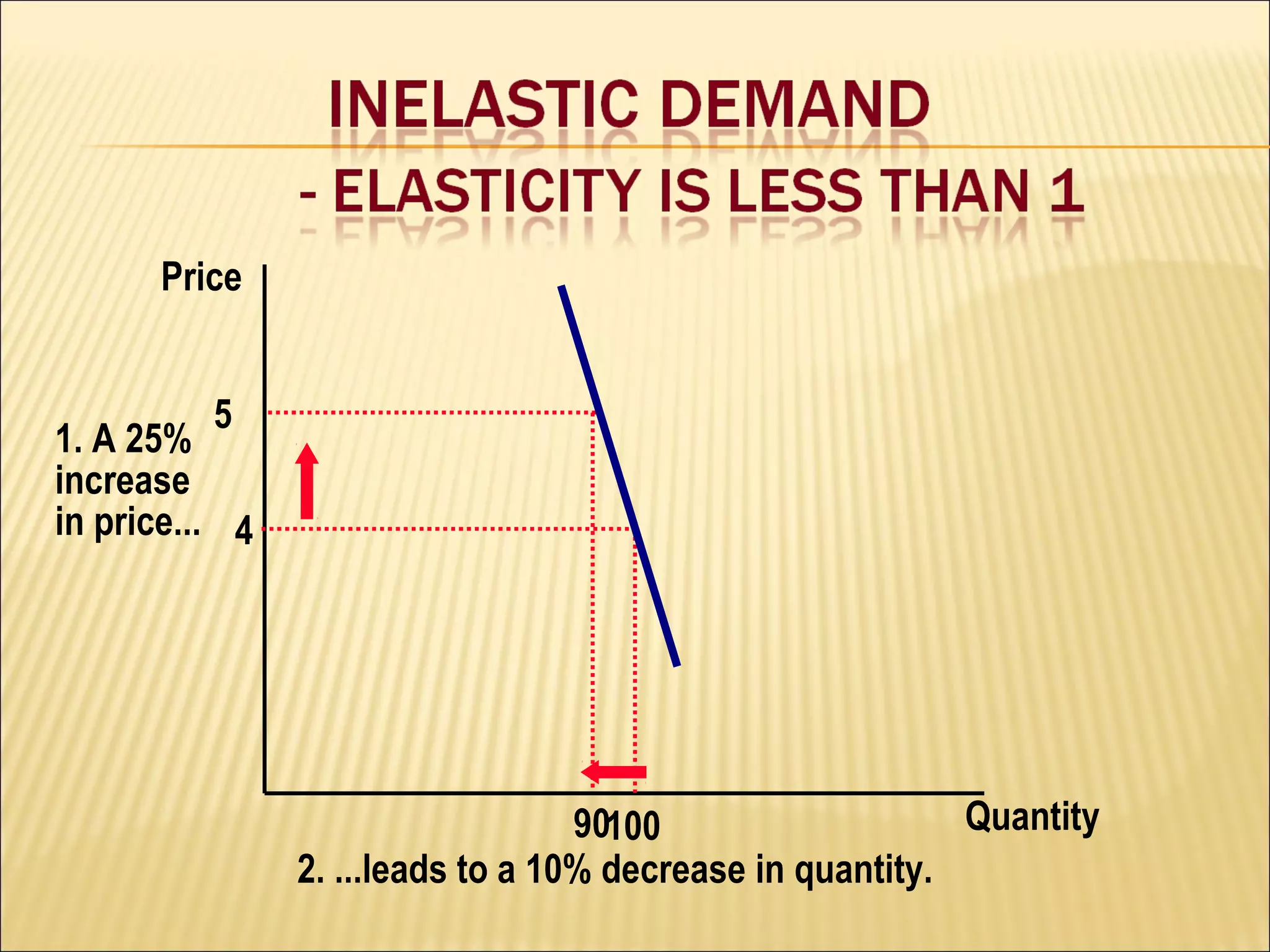
Inelastic Demand
Quantity demanded does not respond strongly to
price changes.
Price elasticity of demand is less than one.
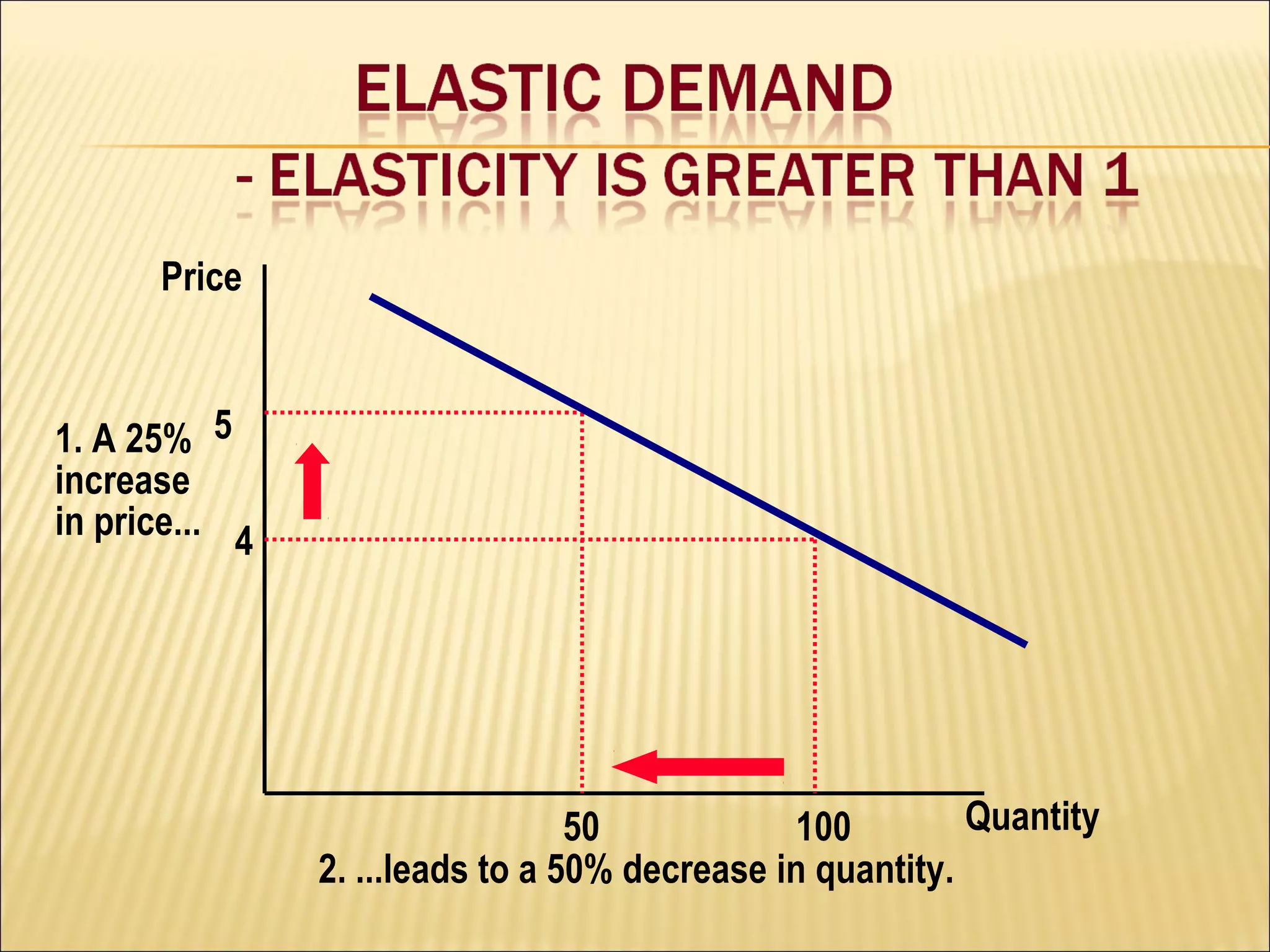
Elastic Demand
Quantity demanded responds strongly to
changes in price.
Price elasticity of demand is greater than one.
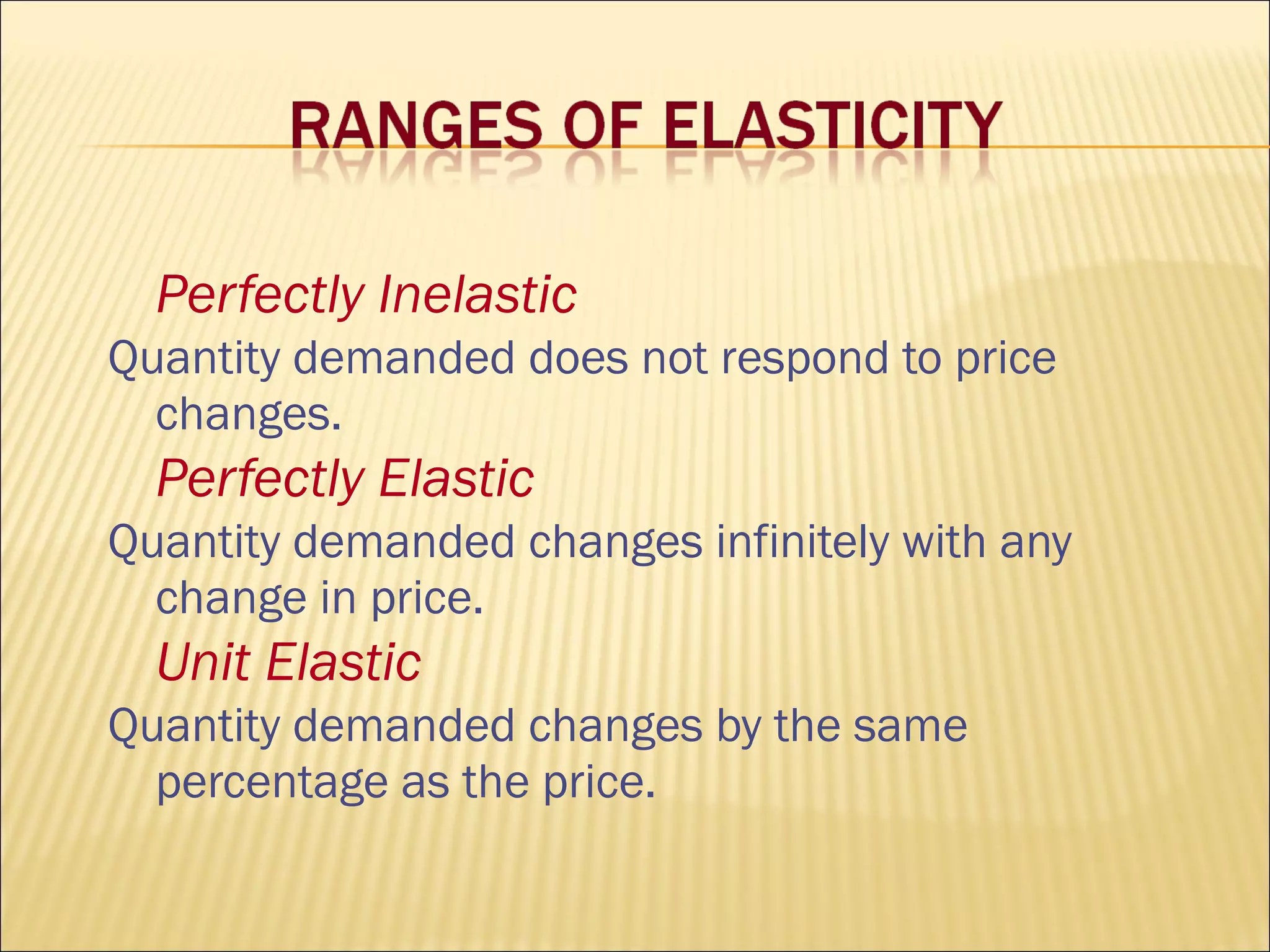
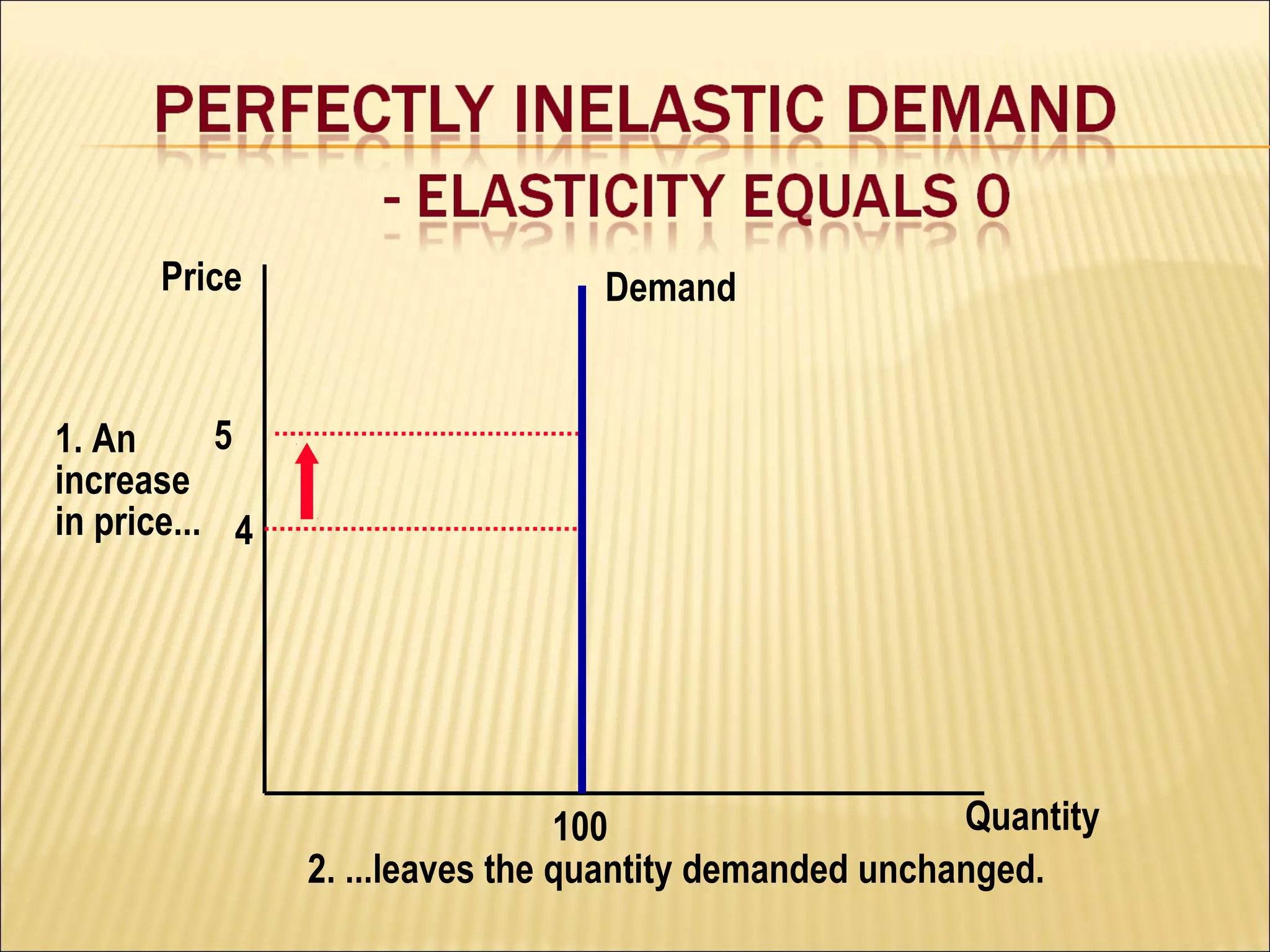
Perfectly Inelastic
Quantity demanded does not respond to price
changes.
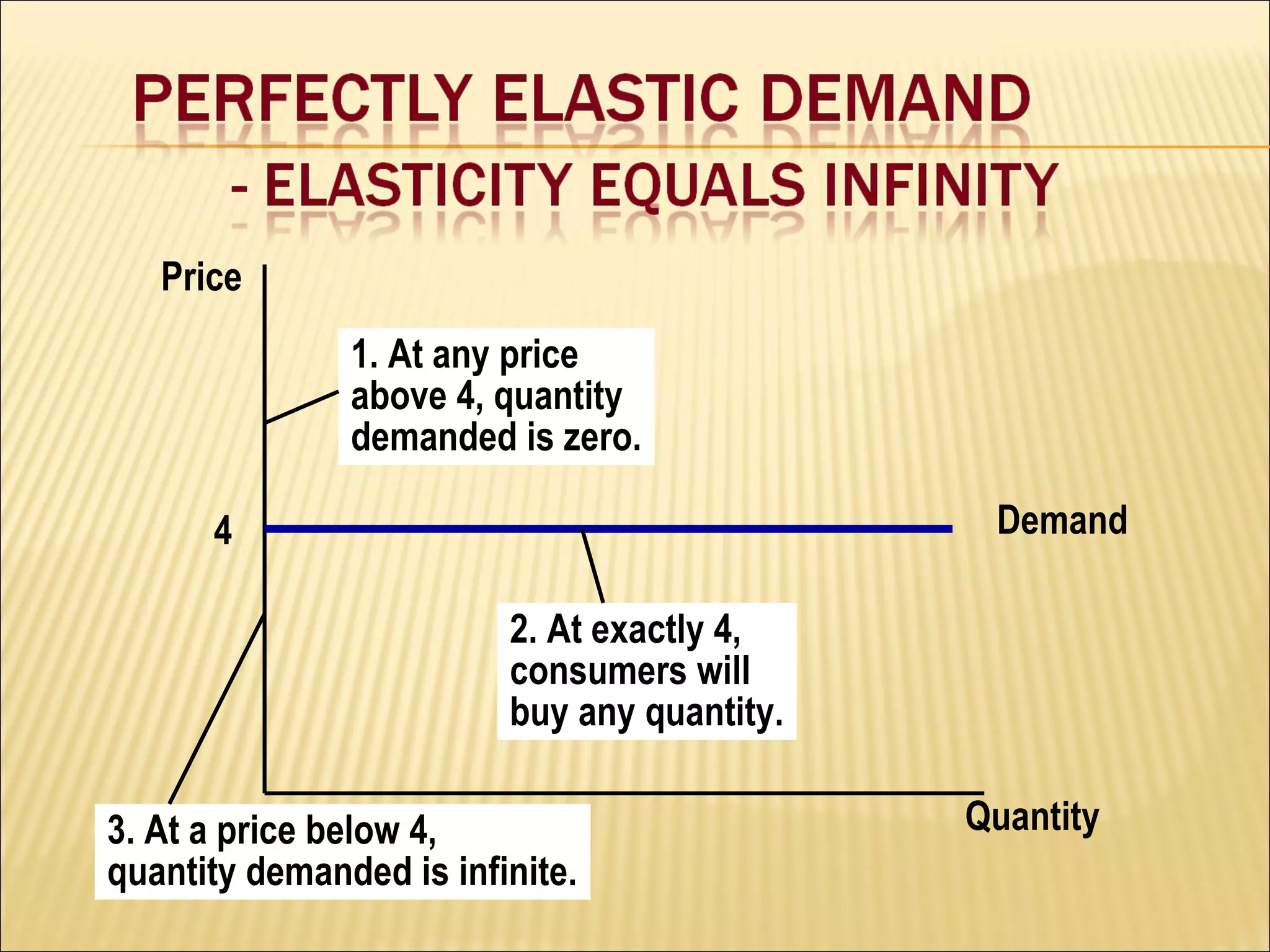
Perfectly Elastic
Quantity demanded changes infinitely with any
change in price.
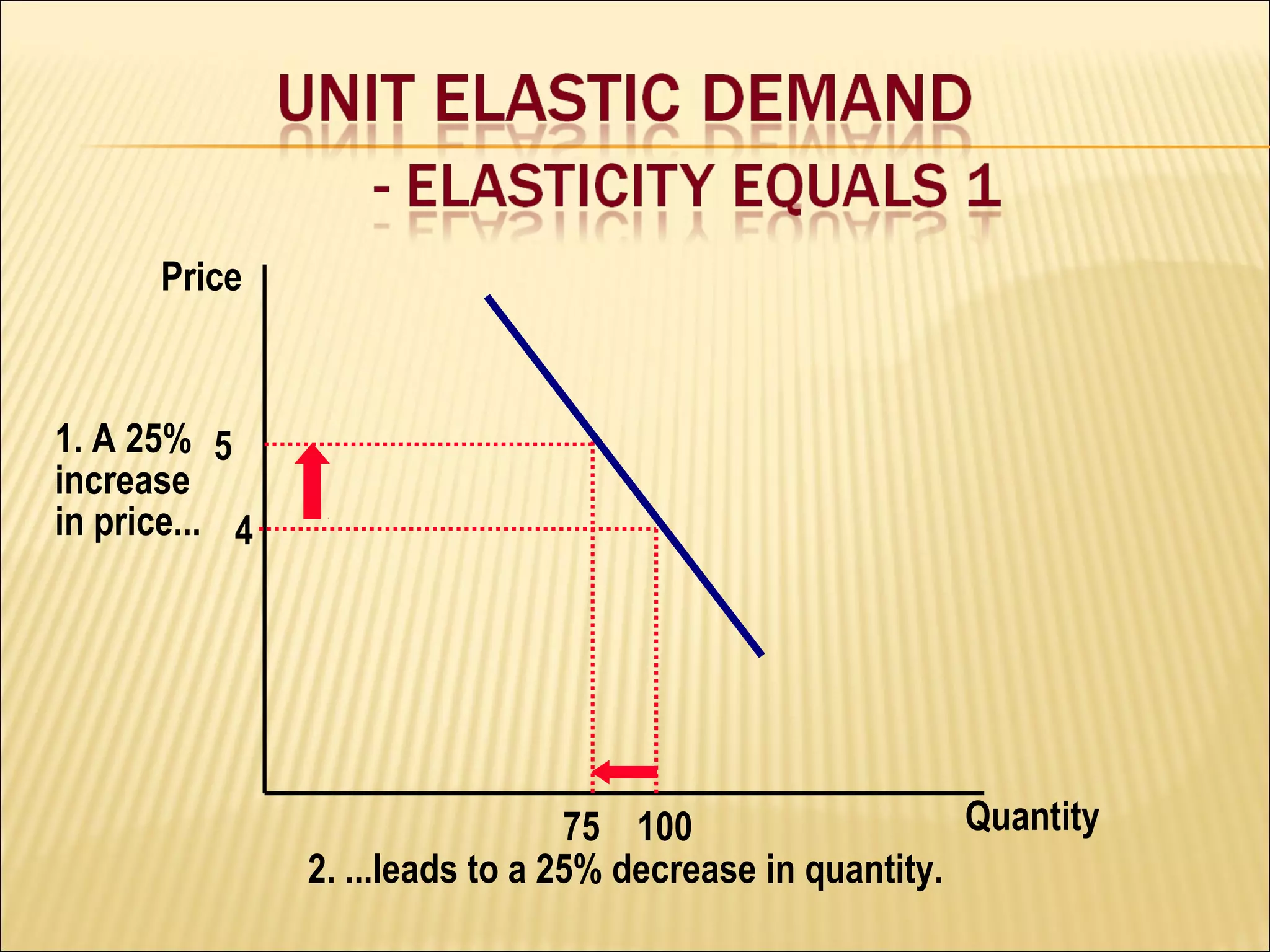
Unit Elastic
Quantity demanded changes by the same
percentage as the price.
Because the price elasticity
of demand measures how
much quantity demanded
responds to the price, it is
closely related to the slope of
the demand curve.
Quantity
Price
4
5
Demand
100
2. ...leaves the quantity demanded unchanged.
1. An
increase
in price...
Quantity
Price
4
5
1. A 25%
increase
in price...
10090
2. ...leads to a 10% decrease in quantity.
Quantity
Price
4
51. A 25%
increase
in price...
10075
2. ...leads to a 25% decrease in quantity.
Quantity
Price
4
51. A 25%
increase
in price...
10050
2. ...leads to a 50% decrease in quantity.
Quantity
Price
Demand4
1. At any price
above 4, quantity
demanded is zero.
2. At exactly 4,
consumers will
buy any quantity.
3. At a price below 4,
quantity demanded is infinite.
 Price elasticity of demand can also be
calculated by a few other methods. These
methods are :
 Total Outlay Method
 Midpoint Formula
 Geometric Method
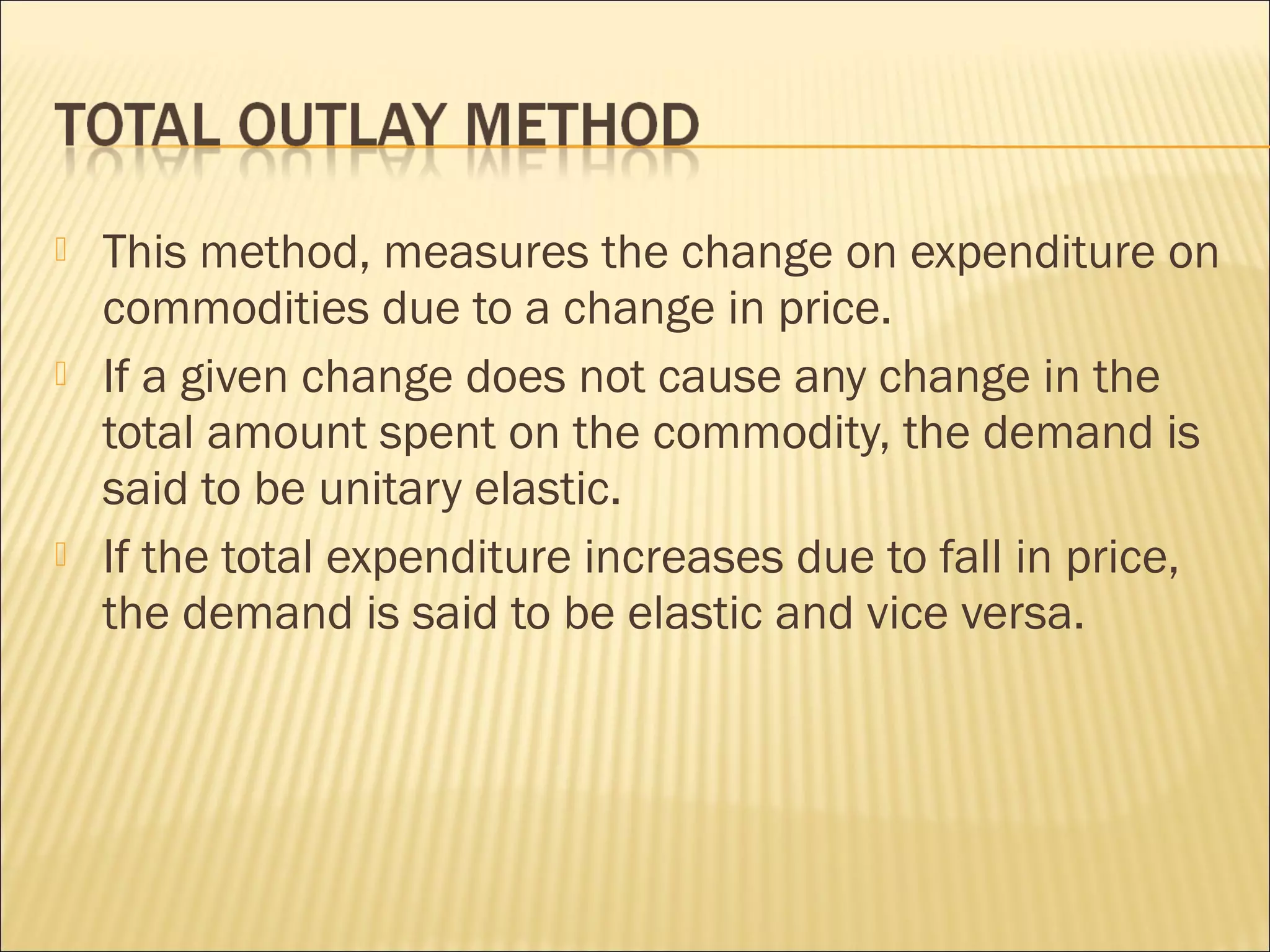
 This method, measures the change on expenditure on
commodities due to a change in price.
 If a given change does not cause any change in the
total amount spent on the commodity, the demand is
said to be unitary elastic.
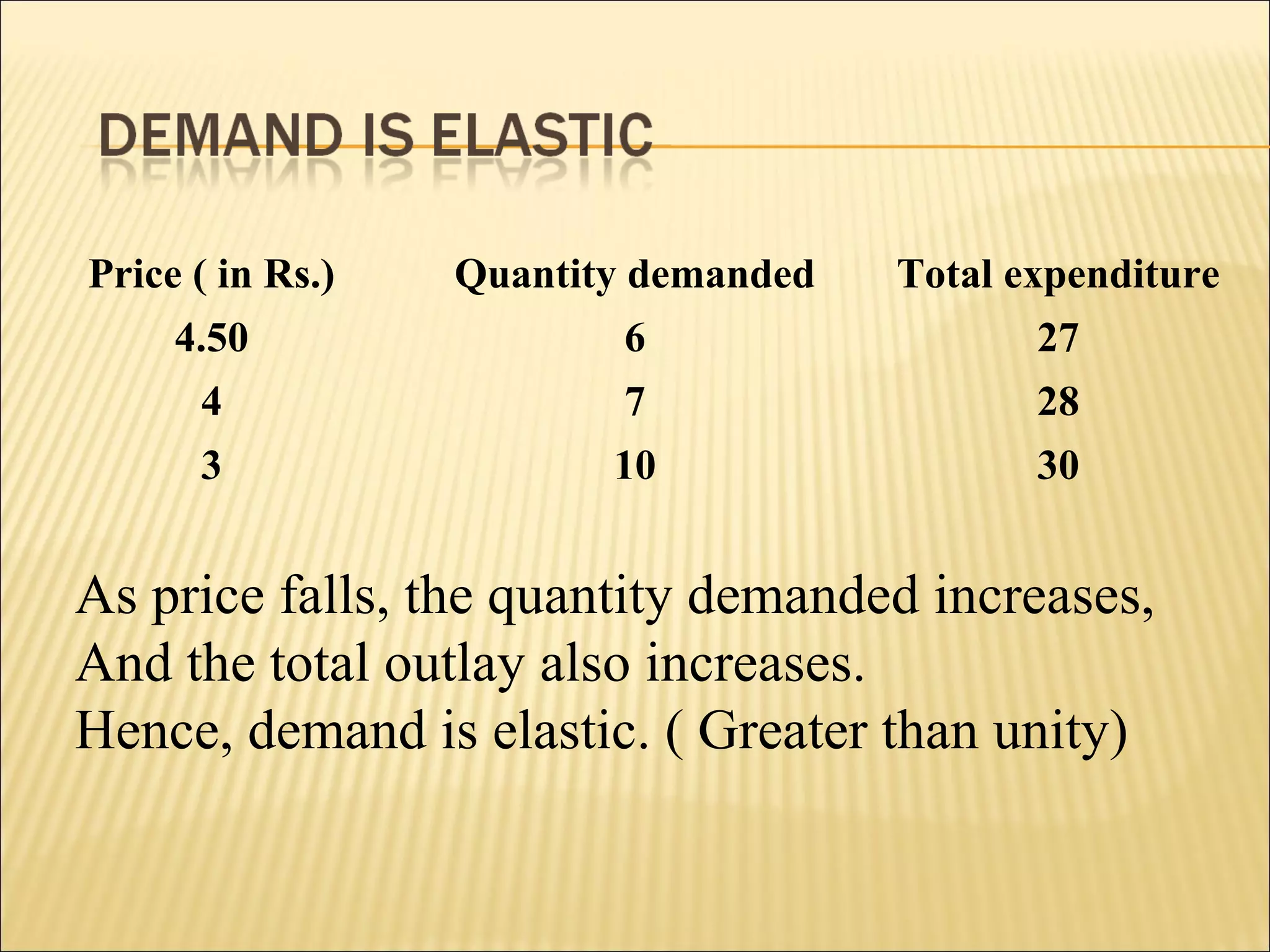
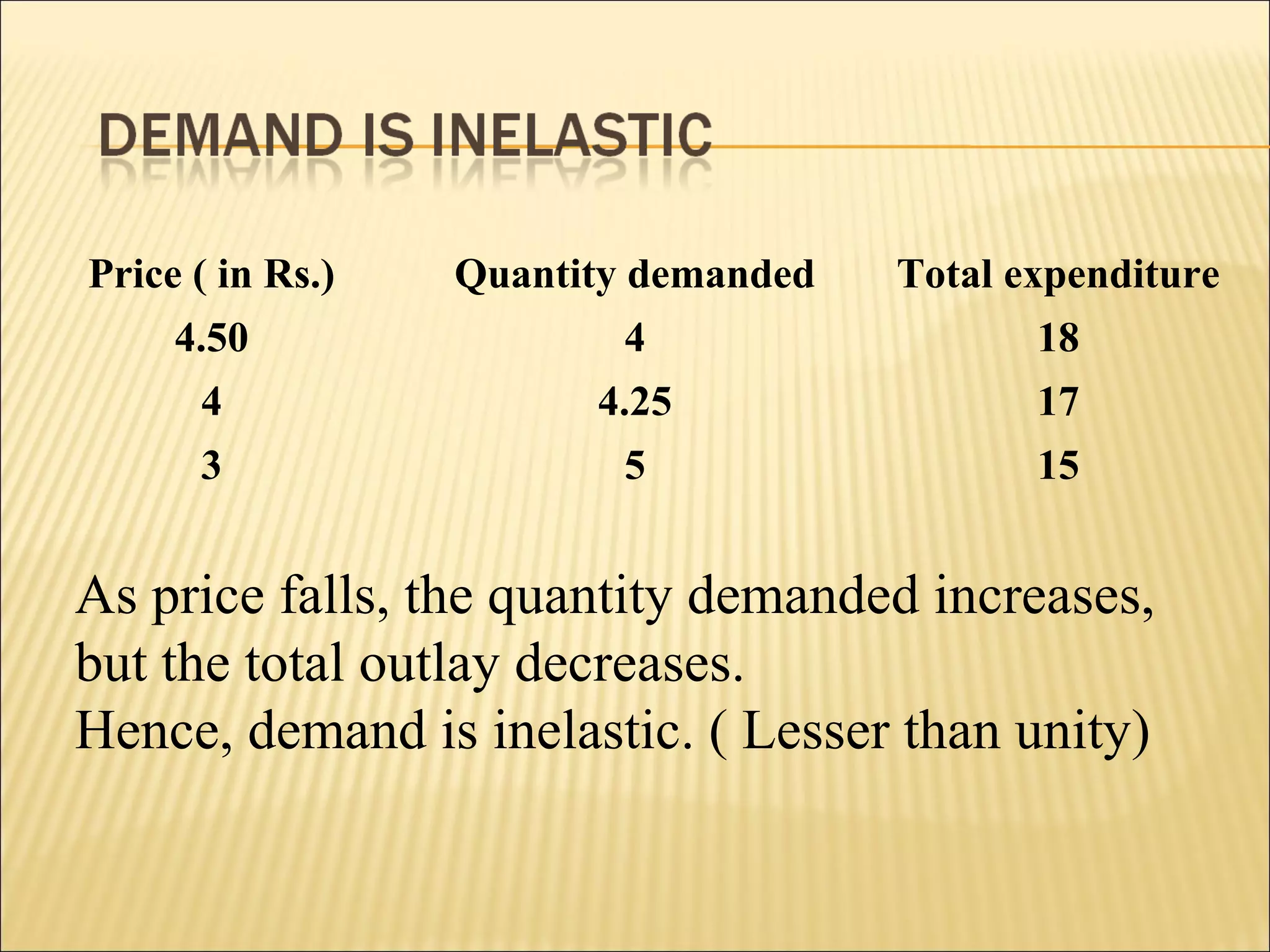
 If the total expenditure increases due to fall in price,
the demand is said to be elastic and vice versa.
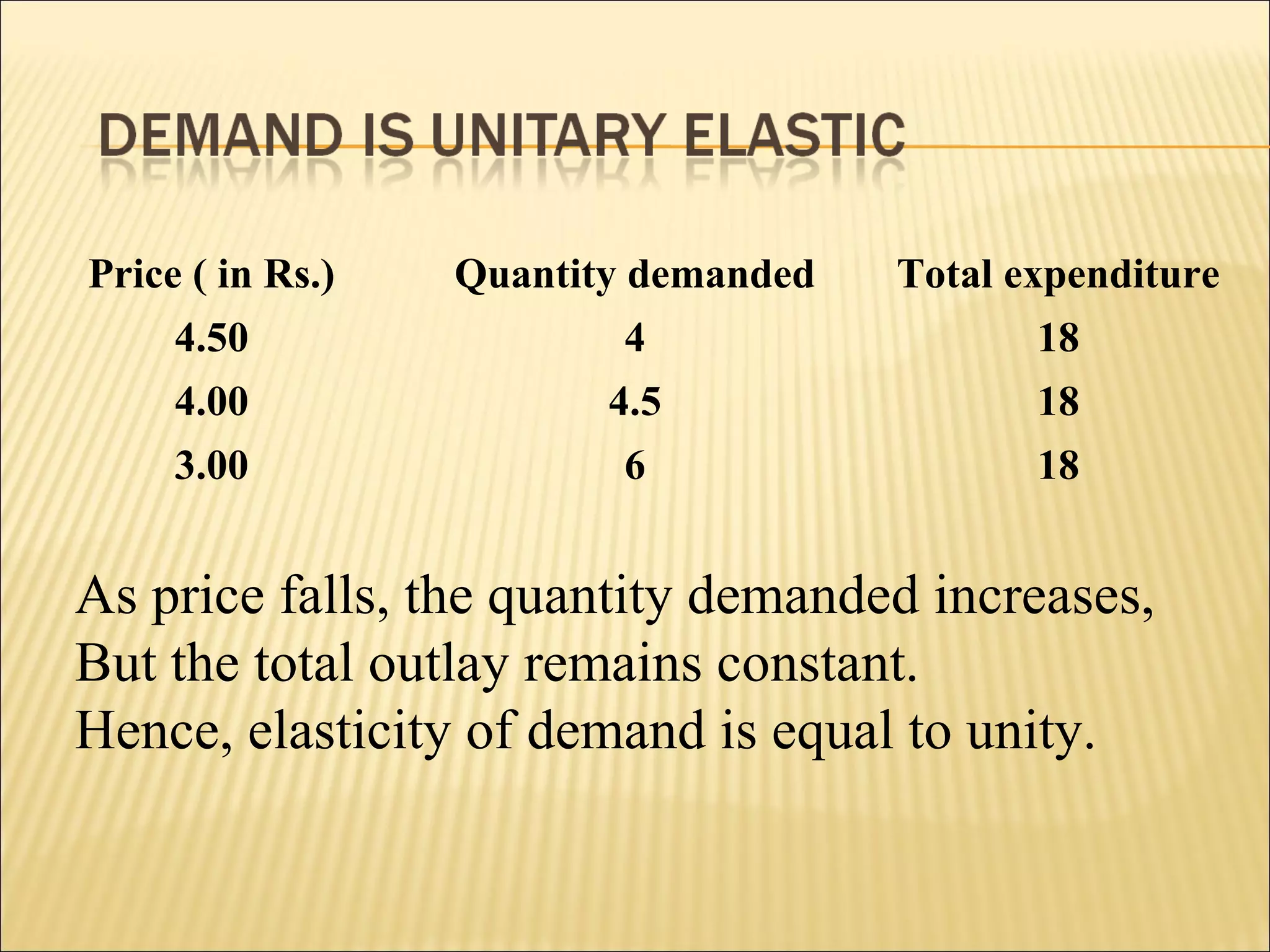
Price ( in Rs.) Quantity demanded Total expenditure
4.50 4 18
4.00 4.5 18
3.00 6 18
As price falls, the quantity demanded increases,
But the total outlay remains constant.
Hence, elasticity of demand is equal to unity.
Price ( in Rs.) Quantity demanded Total expenditure
4.50 6 27
4 7 28
3 10 30
As price falls, the quantity demanded increases,
And the total outlay also increases.
Hence, demand is elastic. ( Greater than unity)
Price ( in Rs.) Quantity demanded Total expenditure
4.50 4 18
4 4.25 17
3 5 15
As price falls, the quantity demanded increases,
but the total outlay decreases.
Hence, demand is inelastic. ( Lesser than unity)
The midpoint formula is preferable when calculating the
price elasticity of demand because it gives the same answer
regardless of the direction of the change.
)/2]P)/[(PP(P
)/2]Q)/[(QQ(Q
=DemandofElasticityPrice
1212
1212
+−
+−
Example: If the price of an ice cream cone increases
from 2.00 to 2.20 and the amount you buy falls from 10
to 8 cones the your elasticity of demand, using the
midpoint formula, would be calculated as:
32.2
5.9
22
2/)00.220.2(
)00.220.2(
2/)810(
)810(
==
+
−
+
−
percent
percent
)/2]P)/[(PP(P
)/2]Q)/[(QQ(Q
=DemandofElasticityPrice
1212
1212
+−
+−
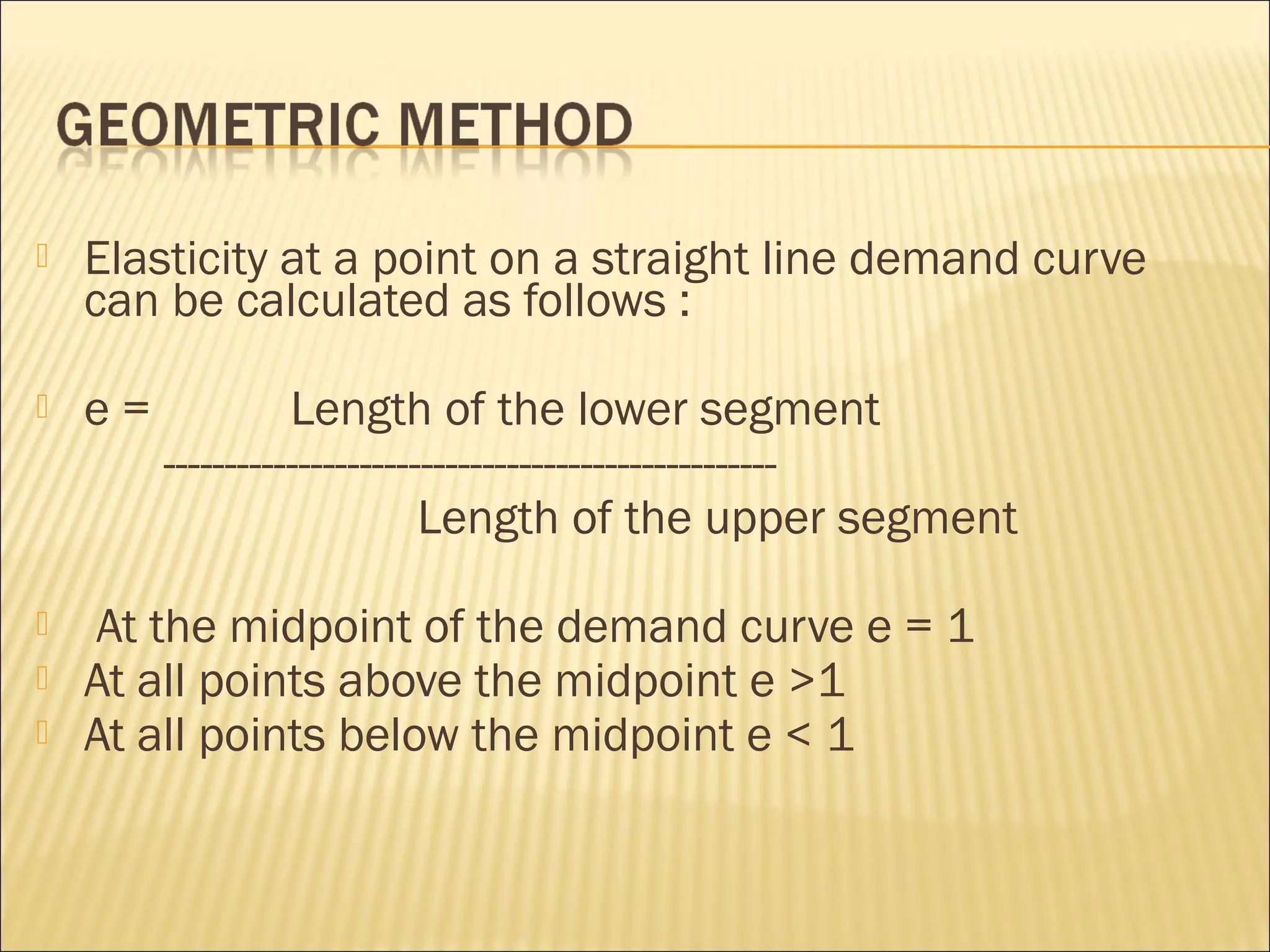
 Elasticity at a point on a straight line demand curve
can be calculated as follows :
 e = Length of the lower segment
--------------------------------------------------
Length of the upper segment
 At the midpoint of the demand curve e = 1
 At all points above the midpoint e >1
 At all points below the midpoint e < 1
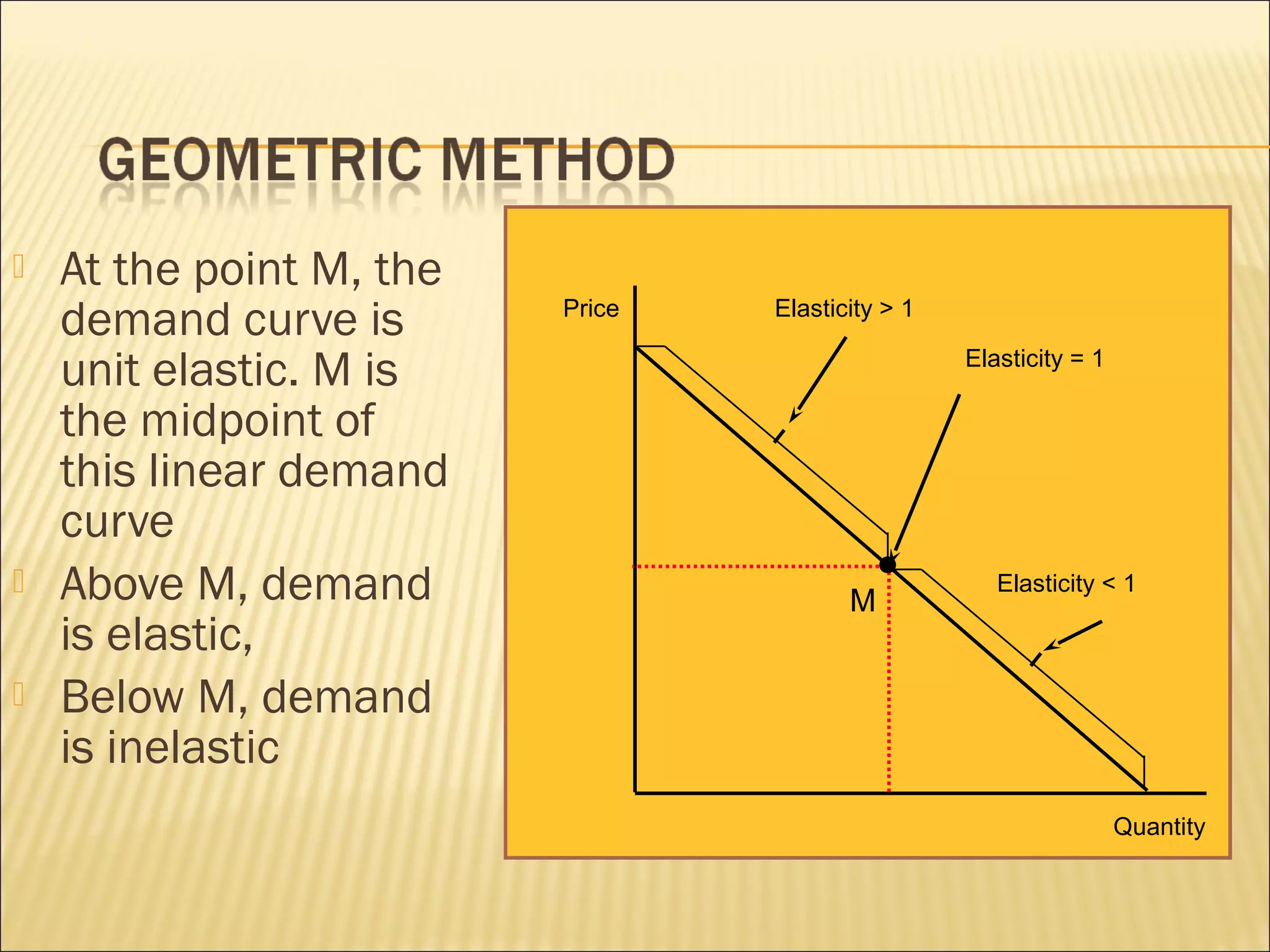
 At the point M, the
demand curve is
unit elastic. M is
the midpoint of
this linear demand
curve
 Above M, demand
is elastic,
 Below M, demand
is inelastic
Price
Quantity
M
Elasticity = 1
Elasticity > 1
Elasticity < 1
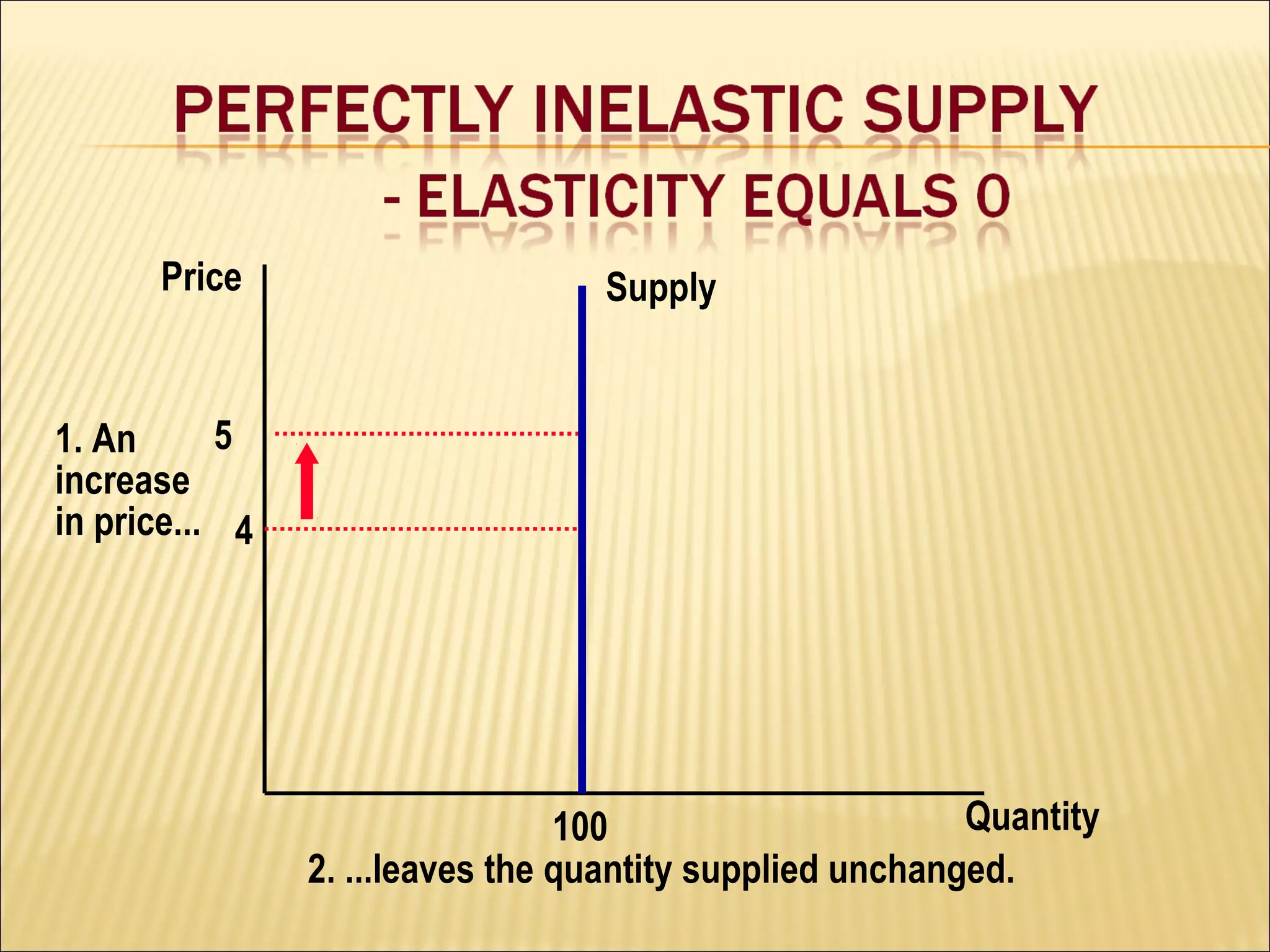
Quantity
Price
4
5
Supply
100
2. ...leaves the quantity supplied unchanged.
1. An
increase
in price...
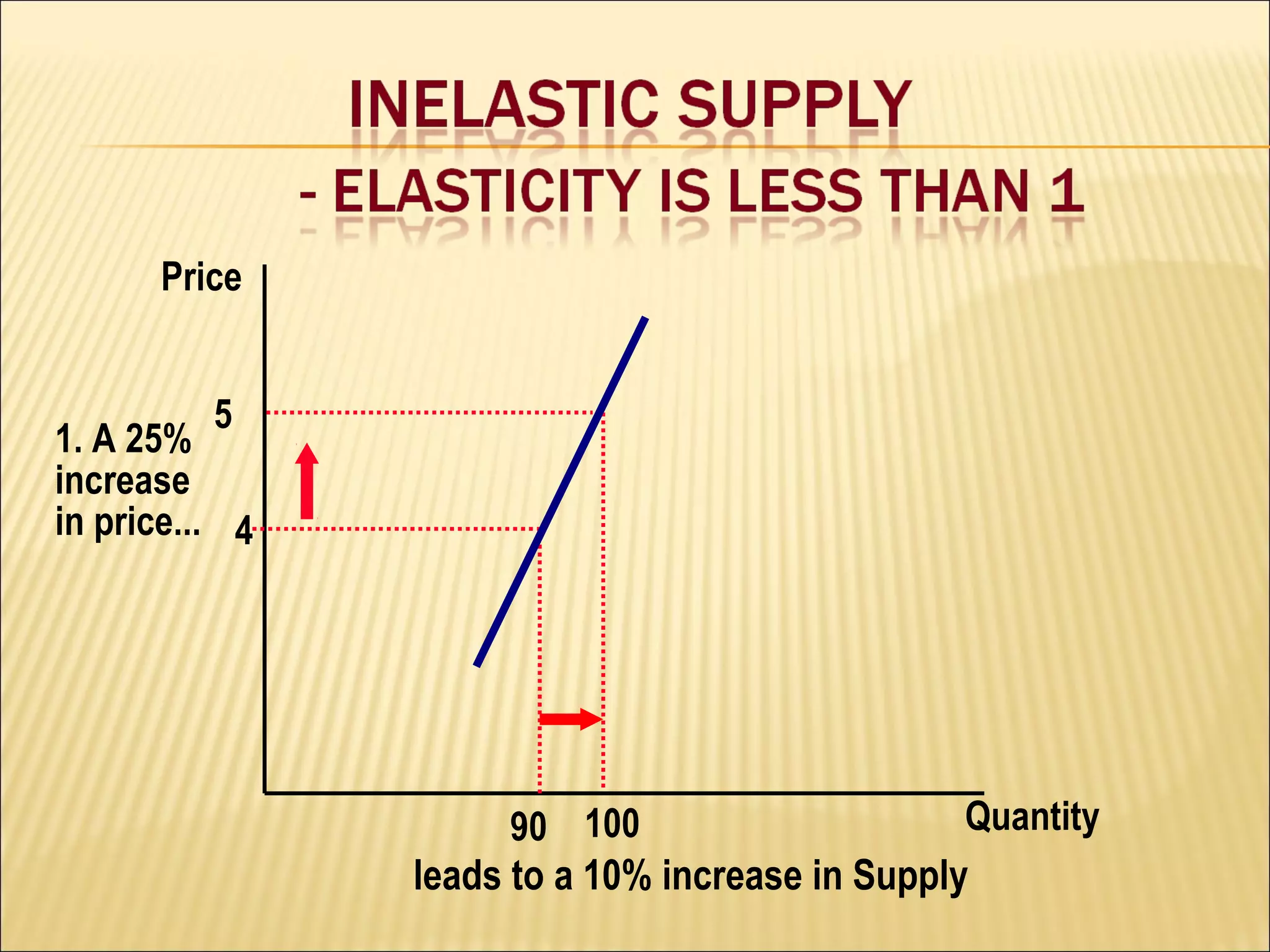
Quantity
Price
4
5
1. A 25%
increase
in price...
90 100
leads to a 10% increase in Supply
Quantity
Price
4
51. A 25%
increase
in price...
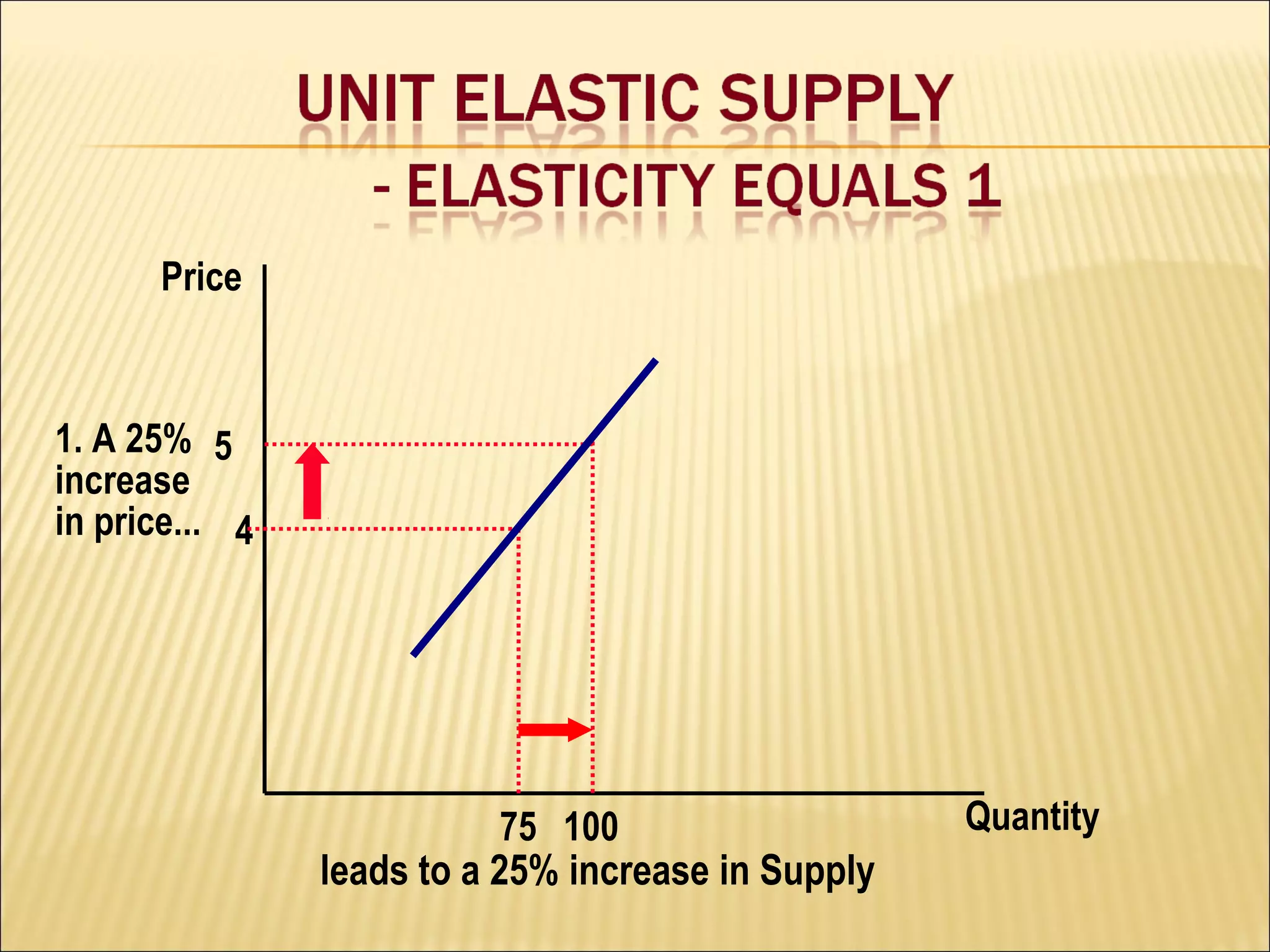
75 100
leads to a 25% increase in Supply
Quantity
Price
1. A 25%
increase
in price...
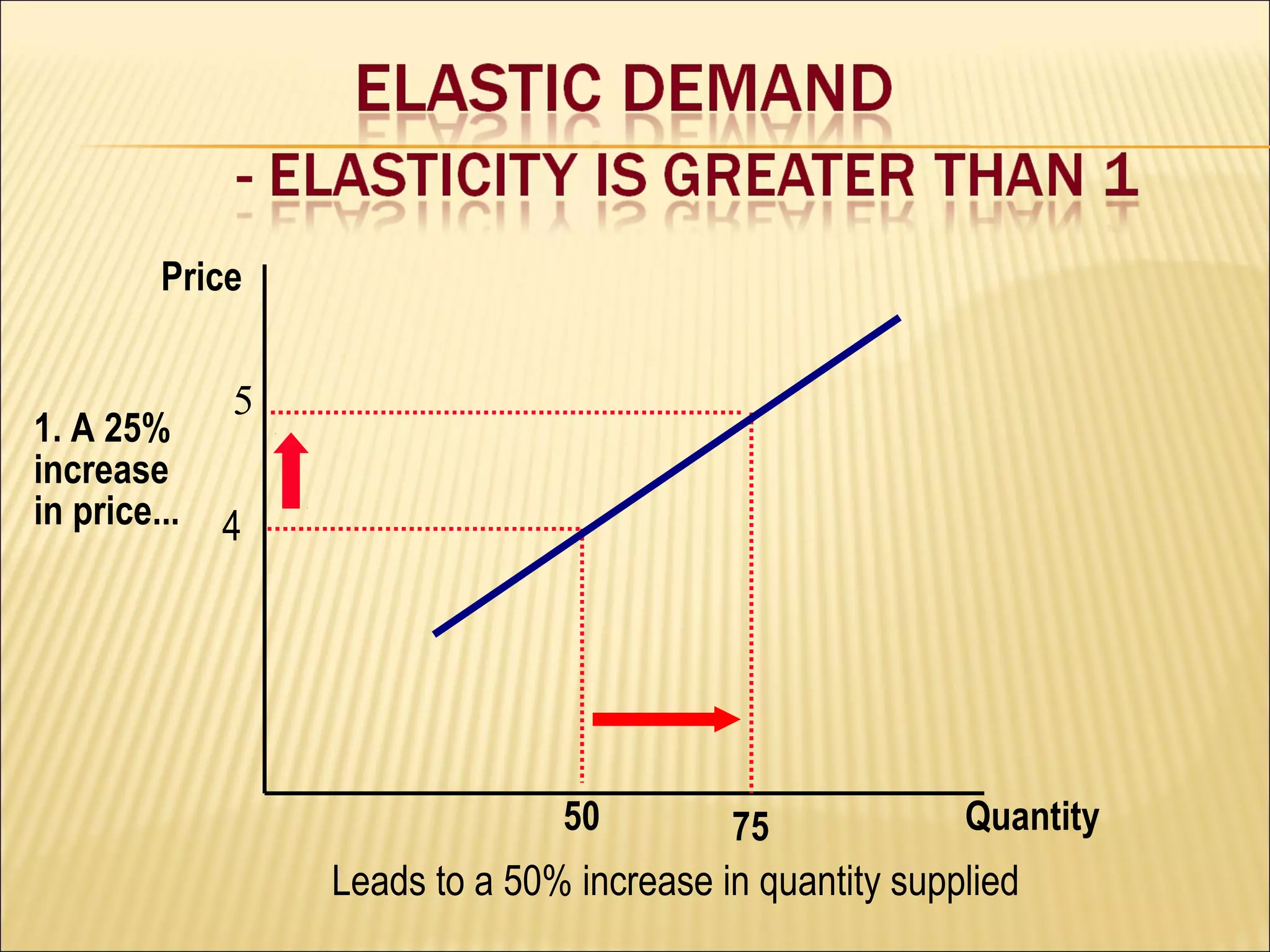
50 75
4
5
Leads to a 50% increase in quantity supplied
Quantity
Price
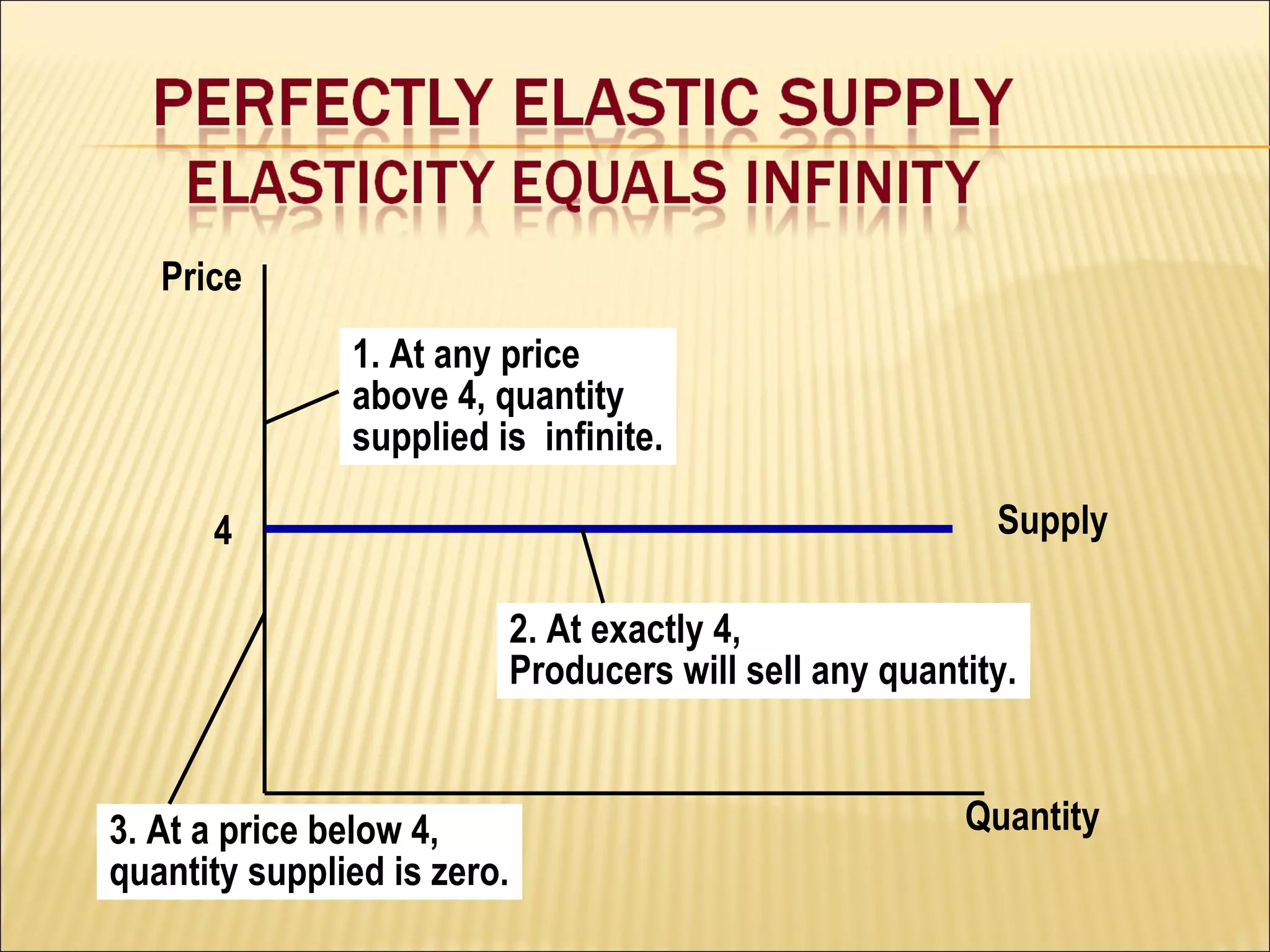
Supply4
1. At any price
above 4, quantity
supplied is infinite.
2. At exactly 4,
Producers will sell any quantity.
3. At a price below 4,
quantity supplied is zero.
Price
Quantity Demanded
D
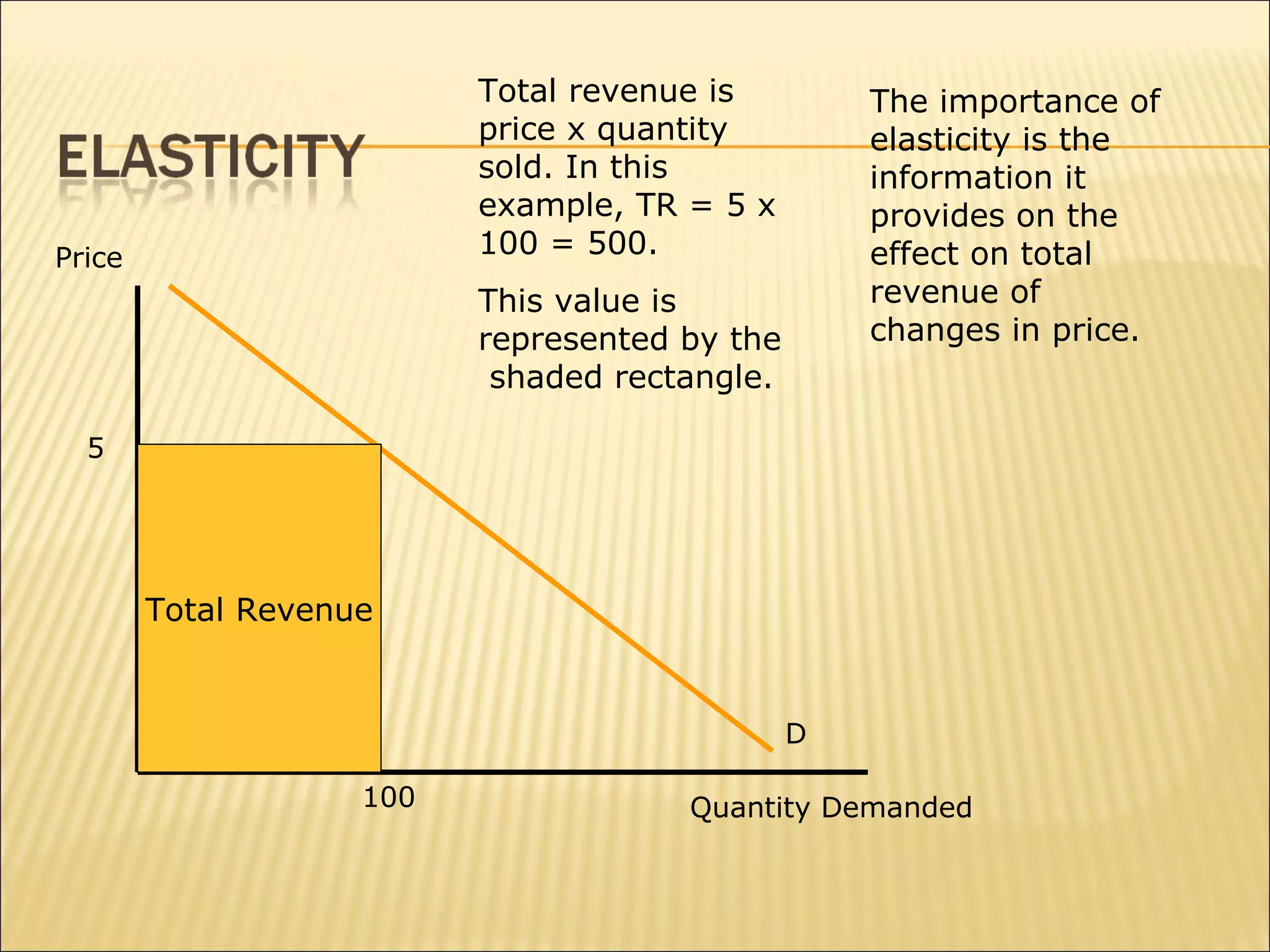
The importance of
elasticity is the
information it
provides on the
effect on total
revenue of
changes in price.
5
100
Total revenue is
price x quantity
sold. In this
example, TR = 5 x
100 = 500.
This value is
represented by the
shaded rectangle.
Total Revenue
Elasticity
Price
Quantity Demanded
D
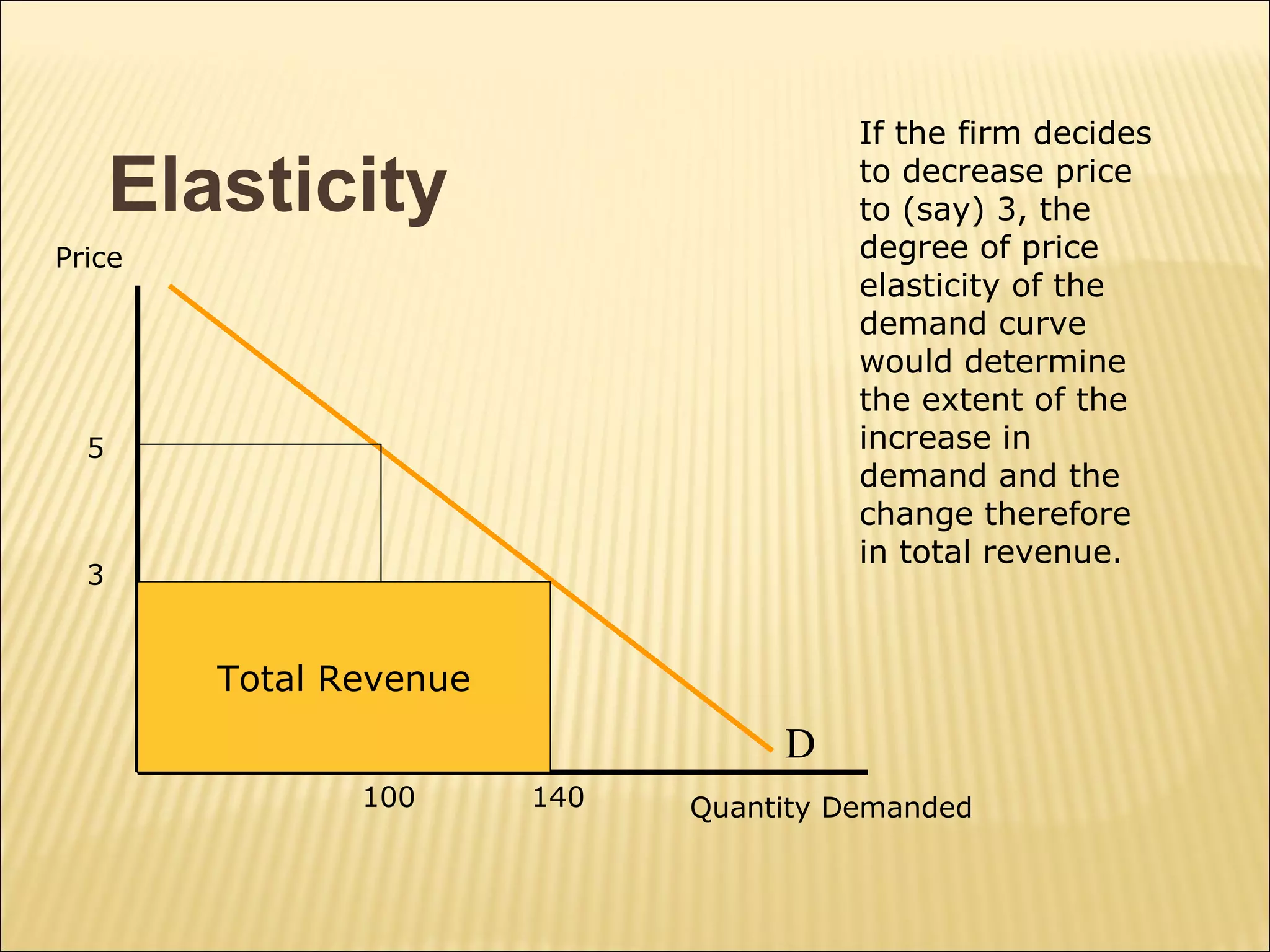
If the firm decides
to decrease price
to (say) 3, the
degree of price
elasticity of the
demand curve
would determine
the extent of the
increase in
demand and the
change therefore
in total revenue.
5
100
3
140
Total Revenue
Price
Quantity Demanded
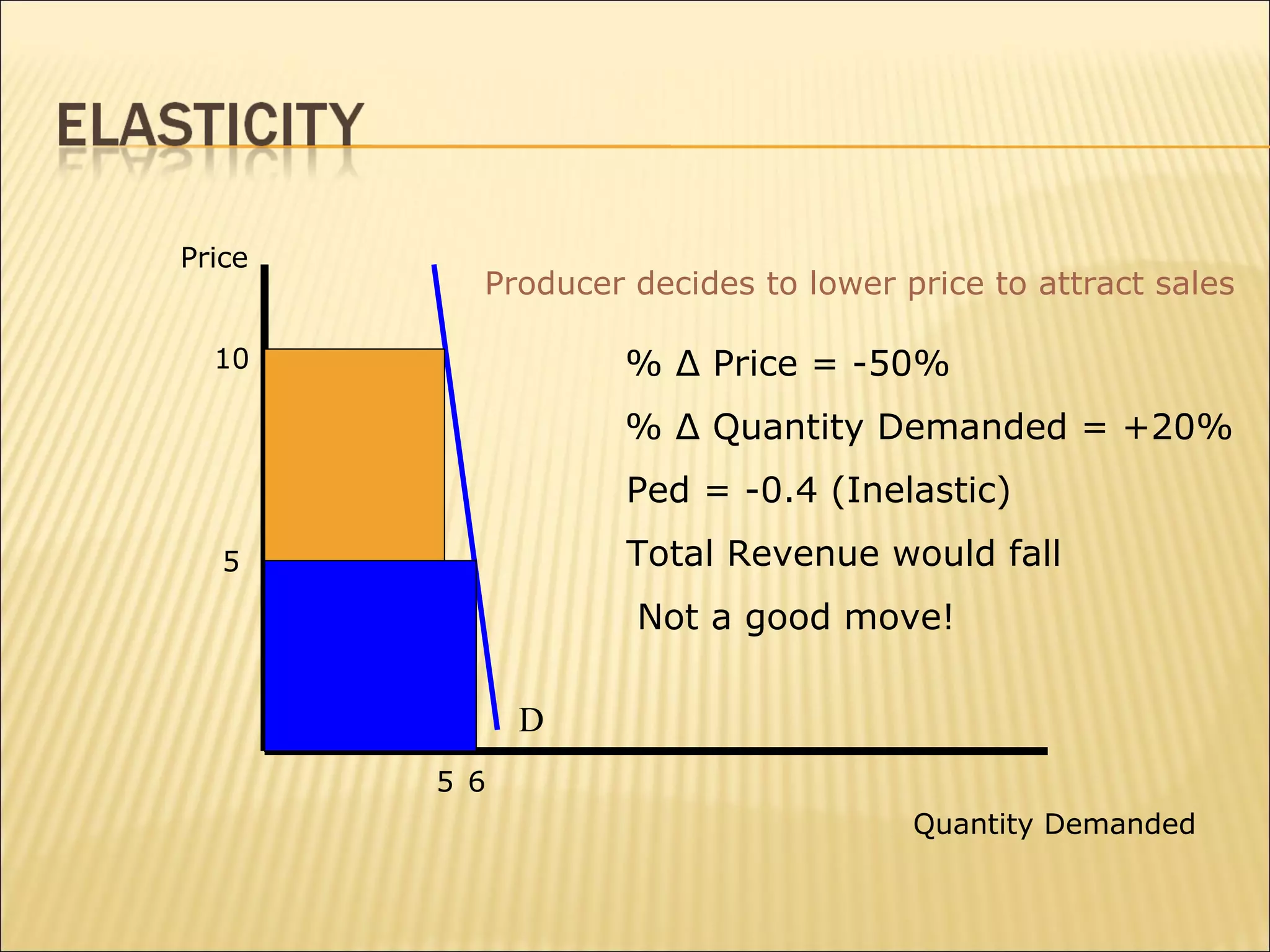
10
D
5
5
6
% Δ Price = -50%
% Δ Quantity Demanded = +20%
Ped = -0.4 (Inelastic)
Total Revenue would fall
Producer decides to lower price to attract sales
Not a good move!
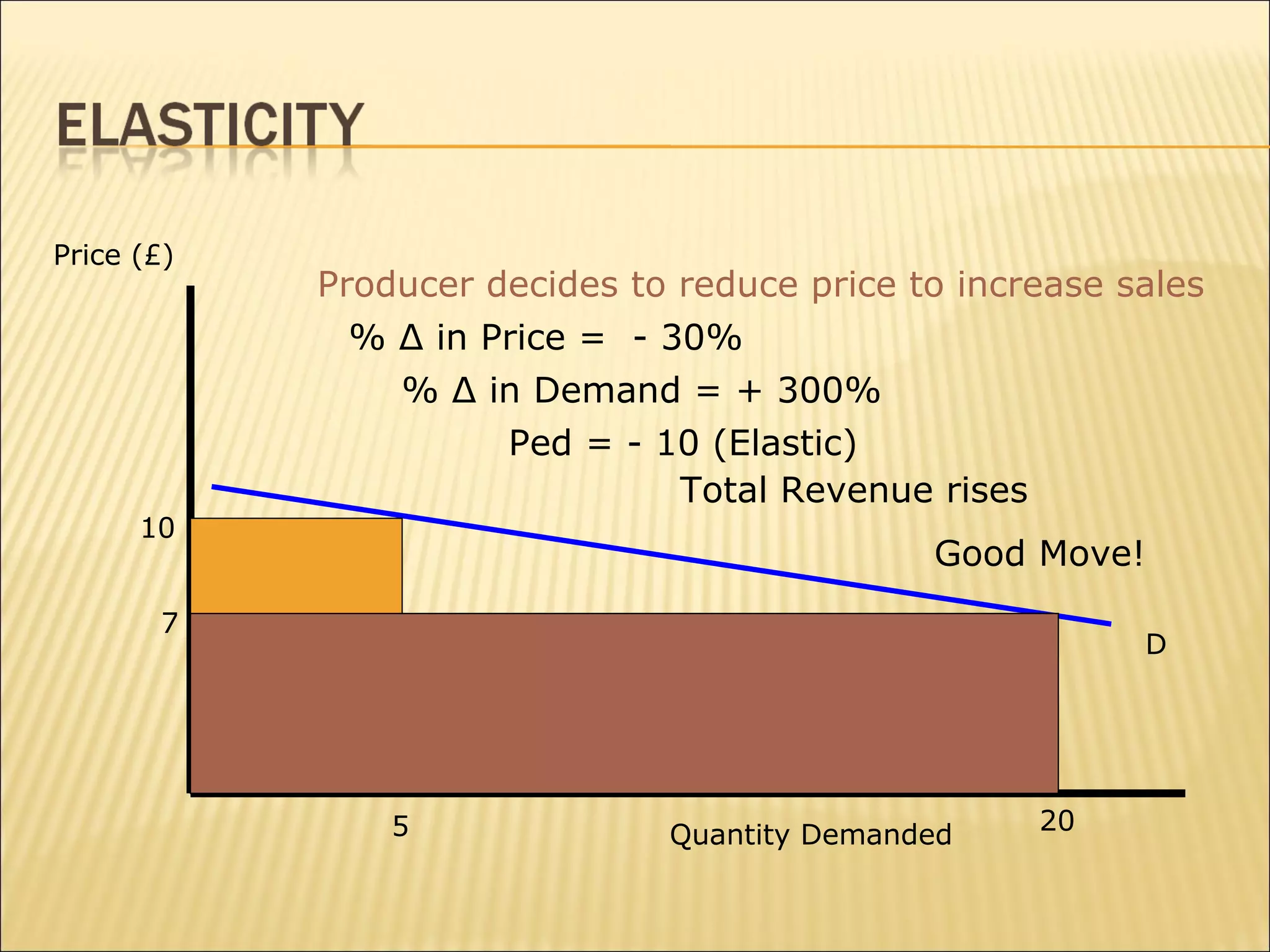
Price (£)
Quantity Demanded
D
10
5 20
Producer decides to reduce price to increase sales
7
% Δ in Price = - 30%
% Δ in Demand = + 300%
Ped = - 10 (Elastic)
Total Revenue rises
Good Move!
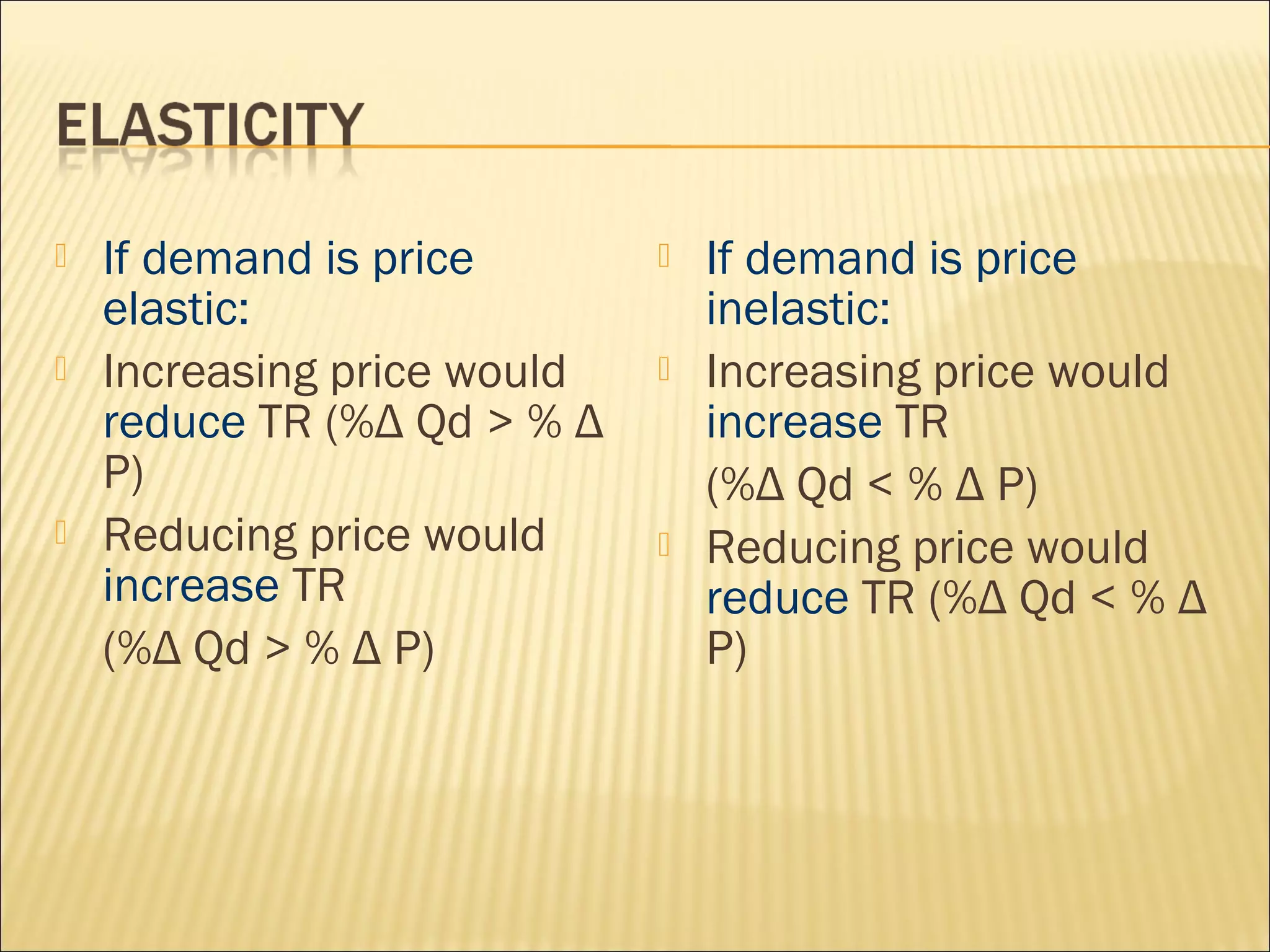
 If demand is price
elastic:
 Increasing price would
reduce TR (%Δ Qd > % Δ
P)
 Reducing price would
increase TR
(%Δ Qd > % Δ P)
 If demand is price
inelastic:
 Increasing price would
increase TR
(%Δ Qd < % Δ P)
 Reducing price would
reduce TR (%Δ Qd < % Δ
P)
 Relationship between changes in price and
total revenue
 Importance in determining what goods to tax
(tax revenue)
 Importance in analysing time lags in production
 Influences the behaviour of a firm
 For a Businessman : If a businessman finds that the
demand is inelastic, he is free to increase prices. In
case if the demand is elastic, by slightly reducing the
price, the demand will increase sharply and hence the
total revenue will also increase.
 The better a company can assess future demand, the
better it can plan its resources. Each company is
exposed to three types of factors influencing demand:
company, competitive and macroeconomic factors. 
 A forecast is a prediction or anticipation of any
event which is likely to happen in future.
 Demand forecast is the prediction of the future
demand for a firm’s product.
 It can either be made through experience or by
statistical methods.
 Fulfillment of the objectives.
 Preparations of budgets.
 Stabilization of employment and production.
 Decisions about expansion of a firm.
 Other decisions like long term investment
plans, warehousing and inventory decisions.
1. A forecast becomes a basis for setting and maintaining a
production schedule – manufacturing.
2. It determines the quantity and timing of needs for labor,
equipment, tools, parts, and raw materials – purchasing,
personnel.
3. It influences the amount of borrowed capital needed to finance
the production and the necessary cash flow to operate the
business – controller.
4. It provides a basis for sales quota assignments to various
segments of the sales force – sales management.
5. It is the overall base that determines the company’s business and
marketing plans, which are further broken down into specific
goals – marketing offer.
A forecast is important for at least five reasons:
 There are two different sets of methods for
demand forecasting :
 Interview & survey methods ( for short term
forecasts )
 Projection Approach ( for long term forecasts )
 To anticipate the demand for a product,
information needs to be collected about the
expected expenditure patterns of consumers.
Depending on the various approaches to collect
this information, different sub – methods are
formulated.
 We will study them one by one.
 Executive Opinion :
 In small companies, usually the owner takes
the responsibility of forecasting.
 As a result of the experience and knowledge he
is expected to have, he can predict what would
be the course of activities in future and plan
his own activities accordingly.
 Opinion polling method : Information about the
consumer’s expenditure can be collected either
by the market research department or through
the wholesalers and retailers.
 As a result of technological advancements, it is
now possible to collect this information by the
means of internet.
 Collective opinion method :
 Jury is a group of individuals, usually the top bosses
or sales, production, marketing managers having
experience in different fields.
 The advantage of this method is that instead of
basing the forecast on the opinion of one single
individual, a more accurate forecast can be drawn.
 Sample survey method :
 The total number of customers of a company is
called as its population. When this number is
more, it is not possible to collect information for
all the customers. When only a few customers
are contacted, it is called as a Sample Survey.
User’s Expectations
Consumer and industrial companies
often poll their actual or potential
customers.
Some Industrial manufacturers ask
about the quantities of products
their customers may purchase in
future and take this as their forecast.
Delphi Method
Administering a series of questionnaires to
panels of experts. This method gathers
information from all experts and the opinion of
all the experts is shared by all other experts.
In case if an expert finds that his own forecast
is unrealistic, after going through the opinion
of other experts, there is a chance for
corrections.
 In this method, the past experience is projected
for the future. This can be done by tow
methods :
 Correlation or regression analysis.
 Time series analysis.
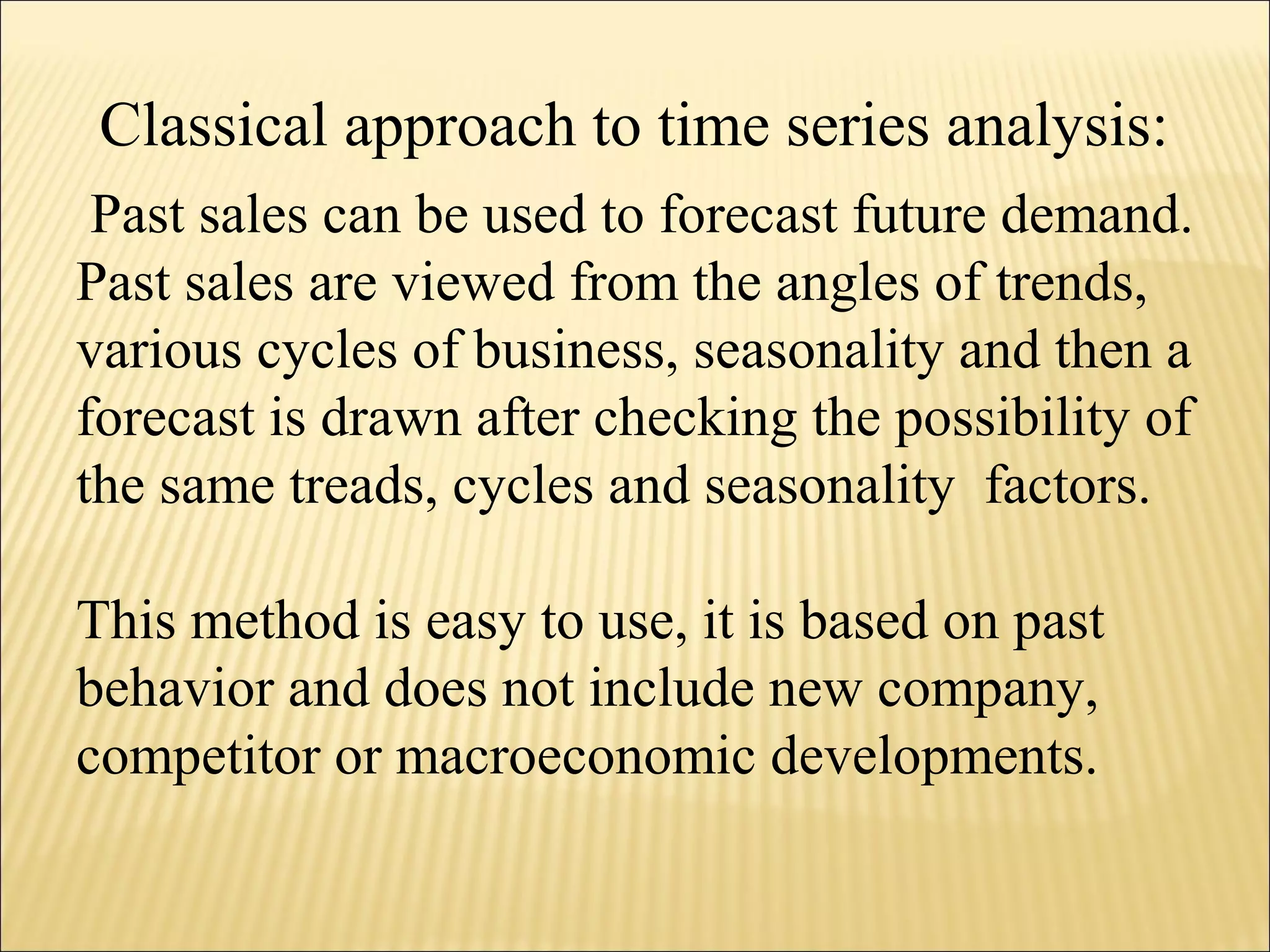
Past sales can be used to forecast future demand.
Past sales are viewed from the angles of trends,
various cycles of business, seasonality and then a
forecast is drawn after checking the possibility of
the same treads, cycles and seasonality factors.
This method is easy to use, it is based on past
behavior and does not include new company,
competitor or macroeconomic developments.
Classical approach to time series analysis:
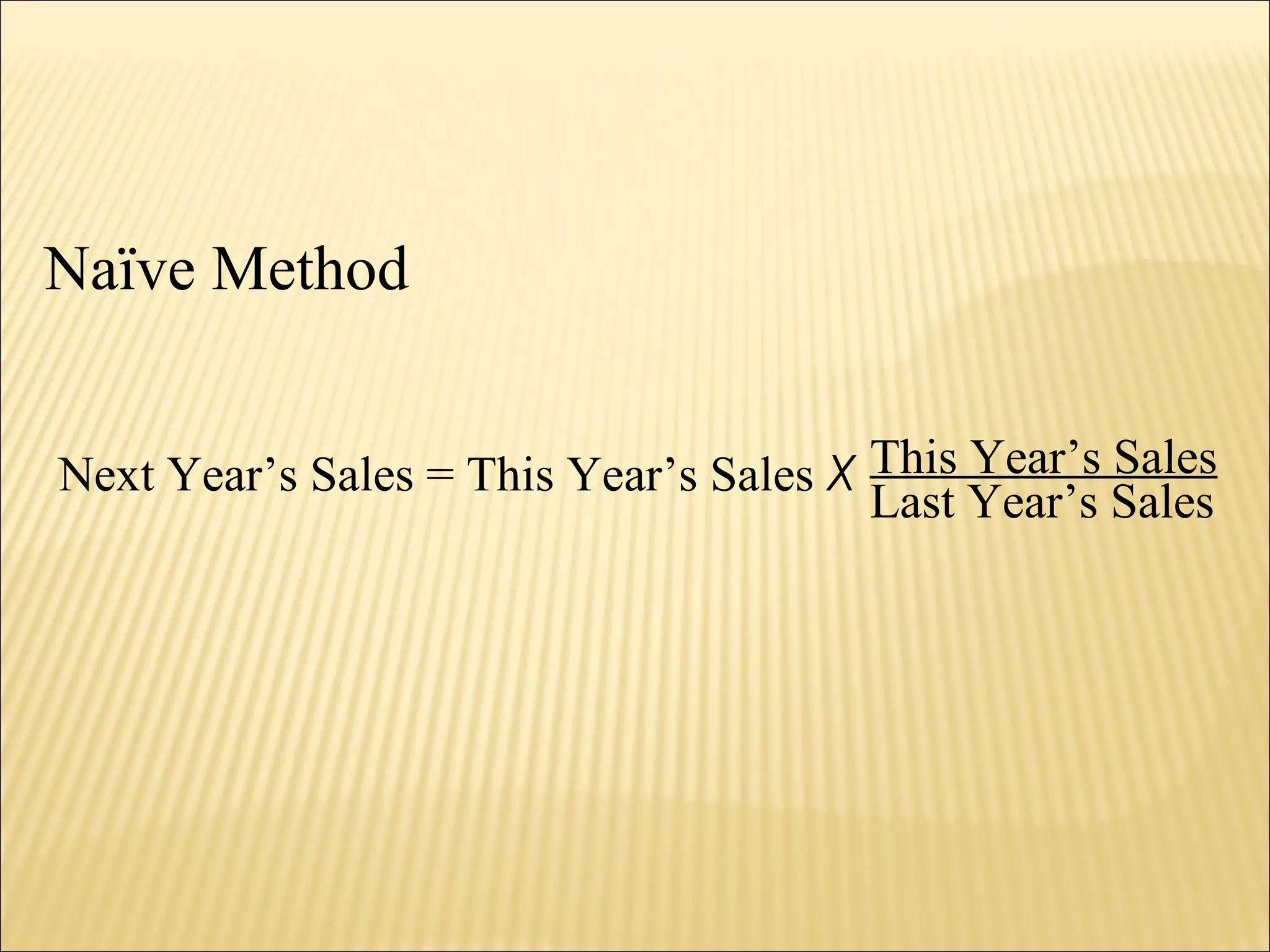
Naïve Method
Next Year’s Sales = This Year’s Sales X This Year’s Sales
Last Year’s Sales
Moving Average
Moving averages are used to allow for
marketplace factors changing at different
rates and at different times.
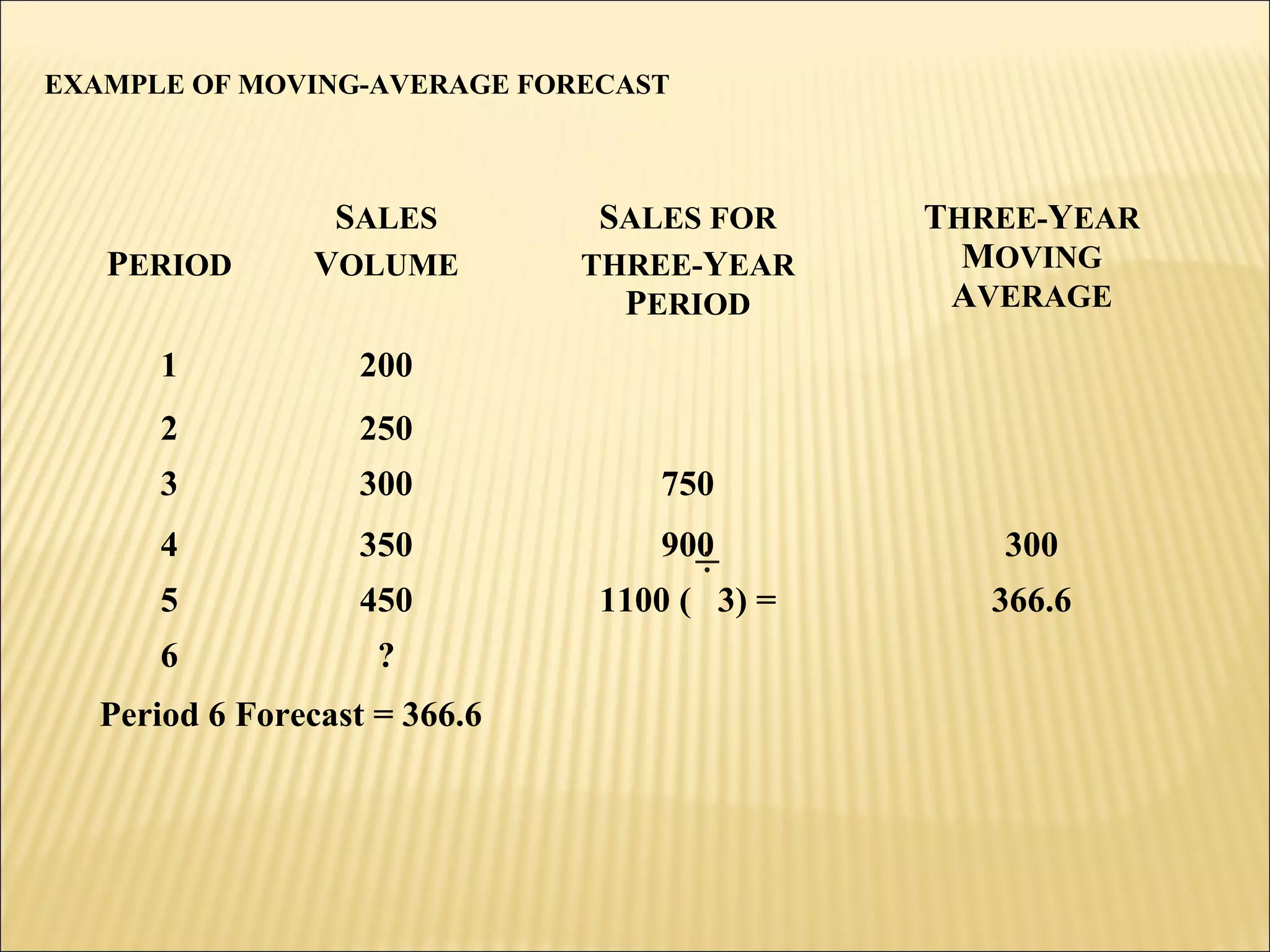
PERIOD
SALES
VOLUME
SALES FOR
THREE-YEAR
PERIOD
THREE-YEAR
MOVING
AVERAGE
1 200
2 250
3 300 750
4 350 900 300
5 450 1100 ( 3) = 366.6
6 ?
Period 6 Forecast = 366.6
EXAMPLE OF MOVING-AVERAGE FORECAST
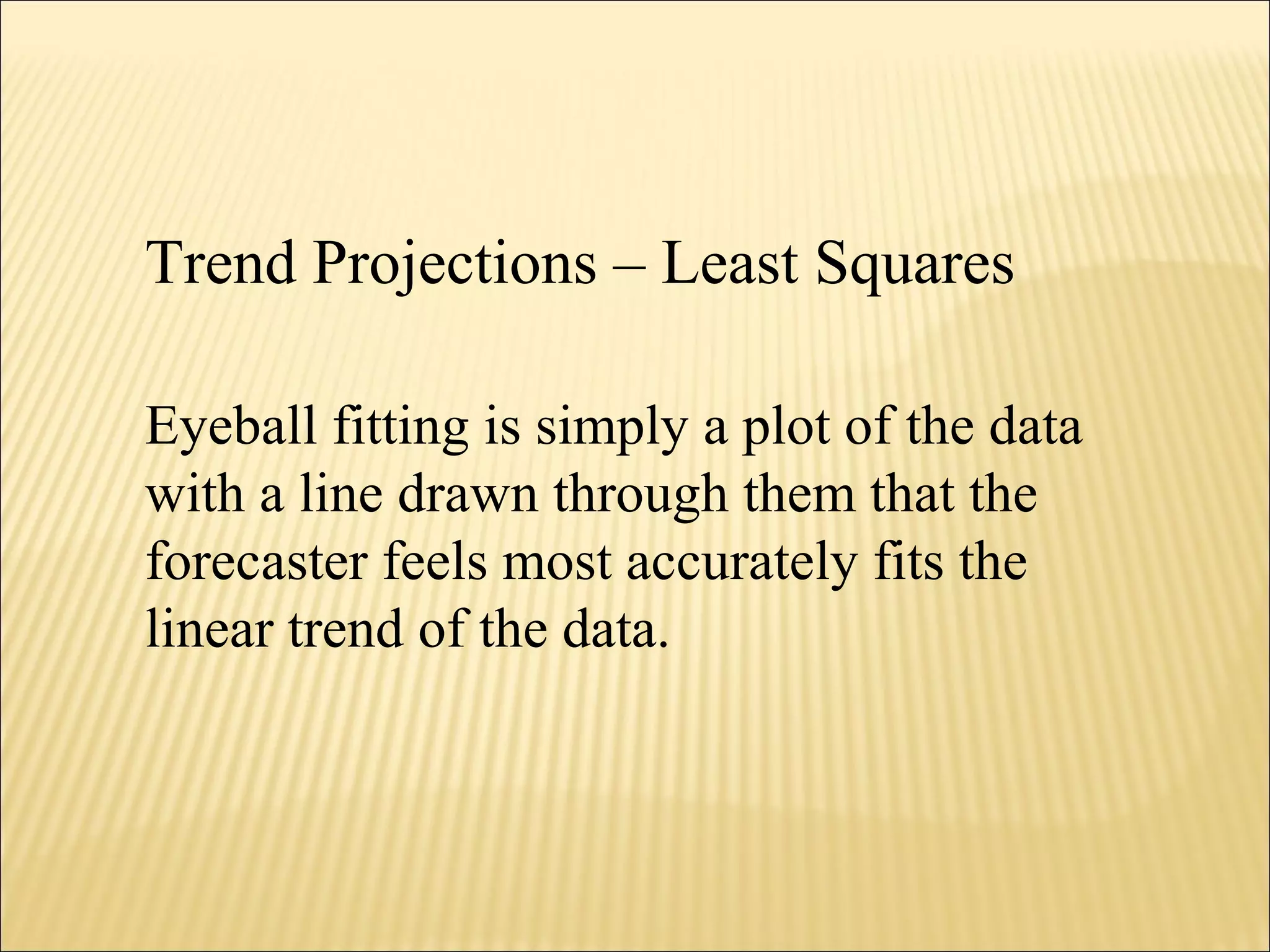
Trend Projections – Least Squares
Eyeball fitting is simply a plot of the data
with a line drawn through them that the
forecaster feels most accurately fits the
linear trend of the data.
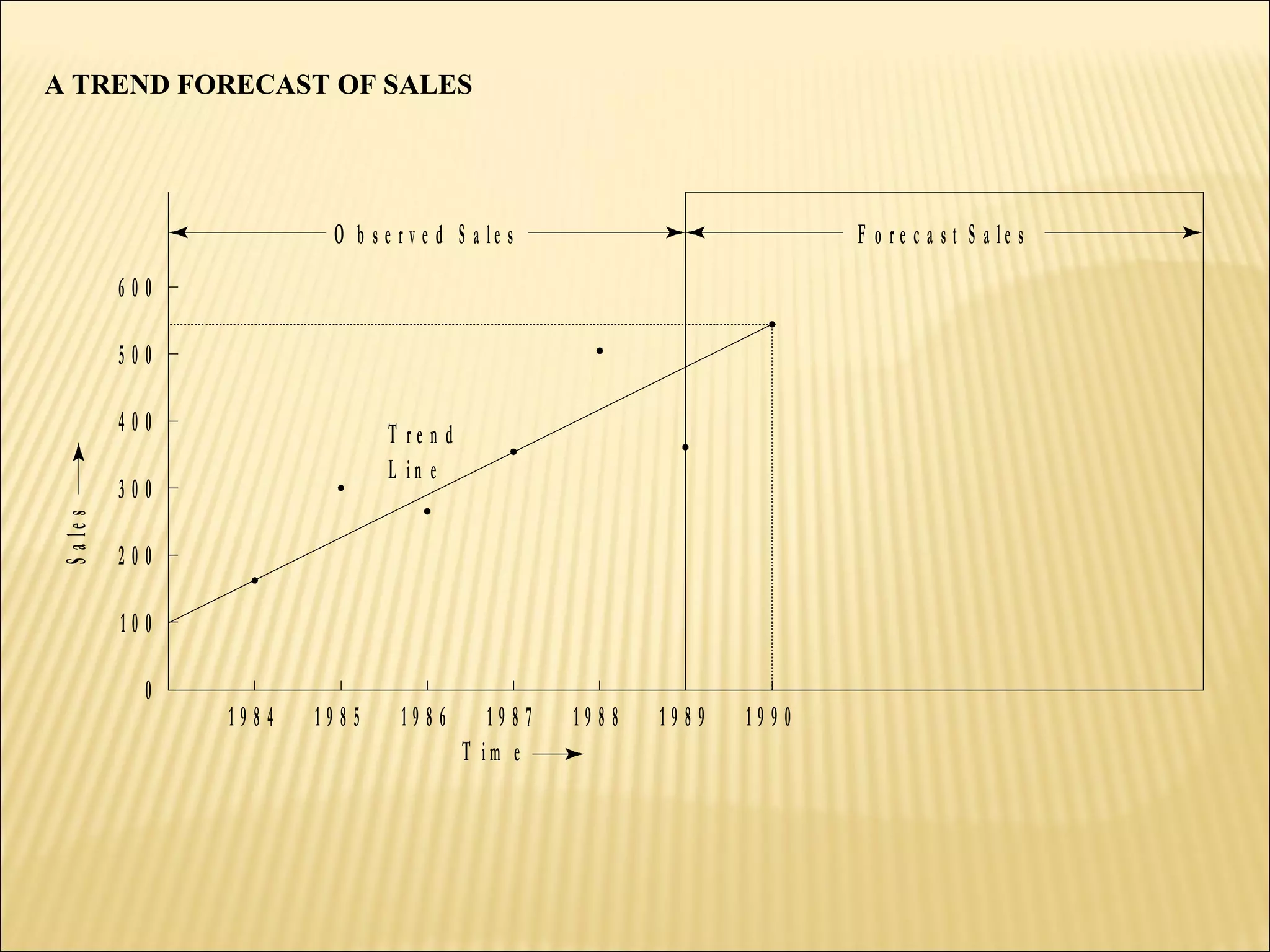
6 0 0
5 0 0
4 0 0
3 0 0
2 0 0
1 0 0
0
1 9 8 4
T i m e
1 9 8 5 1 9 8 6 1 9 8 7 1 9 8 8 1 9 8 9 1 9 9 0
O b s e r v e d S a l e s F o r e c a s t S a l e s
Sales
T r e n d
L i n e
A TREND FORECAST OF SALES
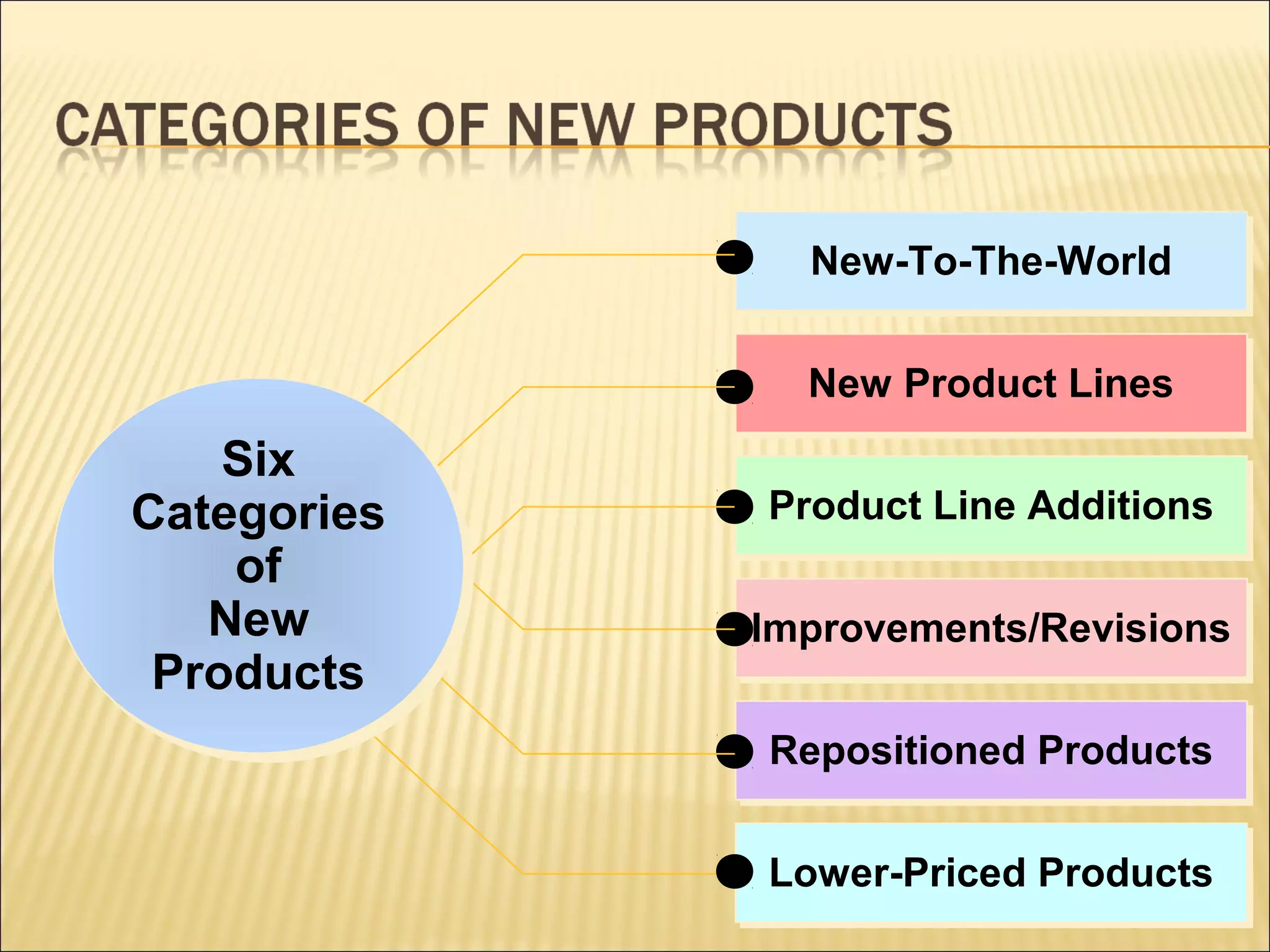
New-To-The-WorldNew-To-The-World
New Product LinesNew Product Lines
Product Line AdditionsProduct Line Additions
Improvements/RevisionsImprovements/Revisions
Repositioned ProductsRepositioned Products
Lower-Priced ProductsLower-Priced Products
Six
Categories
of
New
Products
Six
Categories
of
New
Products
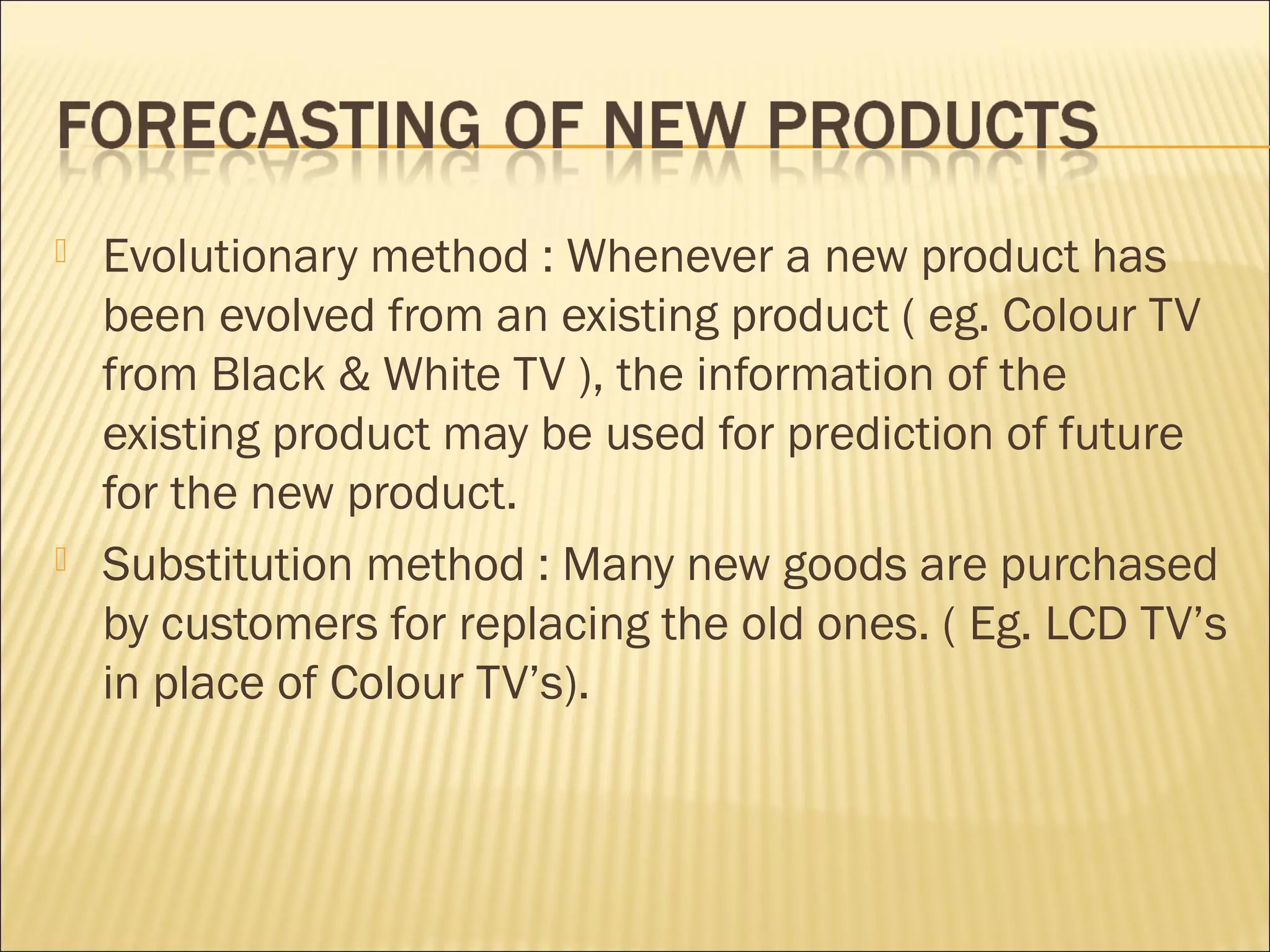
 Evolutionary method : Whenever a new product has
been evolved from an existing product ( eg. Colour TV
from Black & White TV ), the information of the
existing product may be used for prediction of future
for the new product.
 Substitution method : Many new goods are purchased
by customers for replacing the old ones. ( Eg. LCD TV’s
in place of Colour TV’s).
 Growth pattern methods : To predict the demand for a
new product, the growth pattern of an established
related goods can be understood.
 Opinion polling method : This method advocates the
direct questioning to the probable buyers or the
influencers of sales of such products. (Eg. demand for
drugs can be ascertained by asking the doctors )
 Sample survey method : A product is first
introduced in a test market ( small city having
profiles of customers of metros ). Responses
from these markets are taken as a base for
forecasts.
 Indirect opinion polling : Instead of asking the
probable buyers, here, the resellers are
consulted.
For Homework Help visit
www.homeworkguru.com or
send us an email at
support@homeworkguru.com

Elasticity &amp; forecasting

  • 1.
  • 2.
     The responsivenessof one variable to changes in another  When price rises what happens to demand?  Demand falls  BUT!  How much does demand fall?
  • 3.
     If pricerises by 10% - what happens to demand?  We know demand will fall  By more than 10%?  By less than 10%?  Elasticity measures the extent to which demand will change
  • 4.
    … is ameasure of how much buyers and sellers respond to changes in market conditions … allows us to analyze supply and demand with greater precision.
  • 5.
    Price elasticity ofdemand is the percentage change in quantity demanded given a percent change in the price. It is a measure of how much the quantity demanded of a good responds to a change in the price of that good.
  • 6.
    Necessities versus Luxuries Availabilityof Close Substitutes Definition of the Market Time Horizon
  • 7.
    Demand tends tobe more elastic : if the good is a luxury. the longer the time period. the larger the number of close substitutes. the more narrowly defined the market.
  • 8.
    The price elasticityof demand is computed as the percentage change in the quantity demanded divided by the percentage change in price. Price Elasticity of Demand = Percentage Change in Quantity Demanded Percentage Change in Price Price Elasticity of Demand = Percentage Change in Quantity Demanded Percentage Change in Price The Percentage Method
  • 9.
    priceinchangePercentage demandedquatityinchangePercentage demandofelasticityPrice = Example: Ifthe price of an ice cream cone increases from $2.00 to $2.20 and the amount you buy falls from 10 to 8 cones then your elasticity of demand would be calculated as: 2 percent10 percent20 100 002 002202 100 10 810 == × − × − . )..( )(
  • 10.
    Inelastic Demand Quantity demandeddoes not respond strongly to price changes. Price elasticity of demand is less than one. Elastic Demand Quantity demanded responds strongly to changes in price. Price elasticity of demand is greater than one.
  • 11.
    Perfectly Inelastic Quantity demandeddoes not respond to price changes. Perfectly Elastic Quantity demanded changes infinitely with any change in price. Unit Elastic Quantity demanded changes by the same percentage as the price.
  • 12.
    Because the priceelasticity of demand measures how much quantity demanded responds to the price, it is closely related to the slope of the demand curve.
  • 13.
    Quantity Price 4 5 Demand 100 2. ...leaves thequantity demanded unchanged. 1. An increase in price...
  • 14.
    Quantity Price 4 5 1. A 25% increase inprice... 10090 2. ...leads to a 10% decrease in quantity.
  • 15.
    Quantity Price 4 51. A 25% increase inprice... 10075 2. ...leads to a 25% decrease in quantity.
  • 16.
    Quantity Price 4 51. A 25% increase inprice... 10050 2. ...leads to a 50% decrease in quantity.
  • 17.
    Quantity Price Demand4 1. At anyprice above 4, quantity demanded is zero. 2. At exactly 4, consumers will buy any quantity. 3. At a price below 4, quantity demanded is infinite.
  • 18.
     Price elasticityof demand can also be calculated by a few other methods. These methods are :  Total Outlay Method  Midpoint Formula  Geometric Method
  • 19.
     This method,measures the change on expenditure on commodities due to a change in price.  If a given change does not cause any change in the total amount spent on the commodity, the demand is said to be unitary elastic.  If the total expenditure increases due to fall in price, the demand is said to be elastic and vice versa.
  • 20.
    Price ( inRs.) Quantity demanded Total expenditure 4.50 4 18 4.00 4.5 18 3.00 6 18 As price falls, the quantity demanded increases, But the total outlay remains constant. Hence, elasticity of demand is equal to unity.
  • 21.
    Price ( inRs.) Quantity demanded Total expenditure 4.50 6 27 4 7 28 3 10 30 As price falls, the quantity demanded increases, And the total outlay also increases. Hence, demand is elastic. ( Greater than unity)
  • 22.
    Price ( inRs.) Quantity demanded Total expenditure 4.50 4 18 4 4.25 17 3 5 15 As price falls, the quantity demanded increases, but the total outlay decreases. Hence, demand is inelastic. ( Lesser than unity)
  • 23.
    The midpoint formulais preferable when calculating the price elasticity of demand because it gives the same answer regardless of the direction of the change. )/2]P)/[(PP(P )/2]Q)/[(QQ(Q =DemandofElasticityPrice 1212 1212 +− +−
  • 24.
    Example: If theprice of an ice cream cone increases from 2.00 to 2.20 and the amount you buy falls from 10 to 8 cones the your elasticity of demand, using the midpoint formula, would be calculated as: 32.2 5.9 22 2/)00.220.2( )00.220.2( 2/)810( )810( == + − + − percent percent )/2]P)/[(PP(P )/2]Q)/[(QQ(Q =DemandofElasticityPrice 1212 1212 +− +−
  • 25.
     Elasticity ata point on a straight line demand curve can be calculated as follows :  e = Length of the lower segment -------------------------------------------------- Length of the upper segment  At the midpoint of the demand curve e = 1  At all points above the midpoint e >1  At all points below the midpoint e < 1
  • 26.
     At thepoint M, the demand curve is unit elastic. M is the midpoint of this linear demand curve  Above M, demand is elastic,  Below M, demand is inelastic Price Quantity M Elasticity = 1 Elasticity > 1 Elasticity < 1
  • 27.
    Quantity Price 4 5 Supply 100 2. ...leaves thequantity supplied unchanged. 1. An increase in price...
  • 28.
    Quantity Price 4 5 1. A 25% increase inprice... 90 100 leads to a 10% increase in Supply
  • 29.
    Quantity Price 4 51. A 25% increase inprice... 75 100 leads to a 25% increase in Supply
  • 30.
    Quantity Price 1. A 25% increase inprice... 50 75 4 5 Leads to a 50% increase in quantity supplied
  • 31.
    Quantity Price Supply4 1. At anyprice above 4, quantity supplied is infinite. 2. At exactly 4, Producers will sell any quantity. 3. At a price below 4, quantity supplied is zero.
  • 32.
    Price Quantity Demanded D The importanceof elasticity is the information it provides on the effect on total revenue of changes in price. 5 100 Total revenue is price x quantity sold. In this example, TR = 5 x 100 = 500. This value is represented by the shaded rectangle. Total Revenue
  • 33.
    Elasticity Price Quantity Demanded D If thefirm decides to decrease price to (say) 3, the degree of price elasticity of the demand curve would determine the extent of the increase in demand and the change therefore in total revenue. 5 100 3 140 Total Revenue
  • 34.
    Price Quantity Demanded 10 D 5 5 6 % ΔPrice = -50% % Δ Quantity Demanded = +20% Ped = -0.4 (Inelastic) Total Revenue would fall Producer decides to lower price to attract sales Not a good move!
  • 35.
    Price (£) Quantity Demanded D 10 520 Producer decides to reduce price to increase sales 7 % Δ in Price = - 30% % Δ in Demand = + 300% Ped = - 10 (Elastic) Total Revenue rises Good Move!
  • 36.
     If demandis price elastic:  Increasing price would reduce TR (%Δ Qd > % Δ P)  Reducing price would increase TR (%Δ Qd > % Δ P)  If demand is price inelastic:  Increasing price would increase TR (%Δ Qd < % Δ P)  Reducing price would reduce TR (%Δ Qd < % Δ P)
  • 37.
     Relationship betweenchanges in price and total revenue  Importance in determining what goods to tax (tax revenue)  Importance in analysing time lags in production  Influences the behaviour of a firm
  • 38.
     For aBusinessman : If a businessman finds that the demand is inelastic, he is free to increase prices. In case if the demand is elastic, by slightly reducing the price, the demand will increase sharply and hence the total revenue will also increase.  The better a company can assess future demand, the better it can plan its resources. Each company is exposed to three types of factors influencing demand: company, competitive and macroeconomic factors. 
  • 39.
     A forecastis a prediction or anticipation of any event which is likely to happen in future.  Demand forecast is the prediction of the future demand for a firm’s product.  It can either be made through experience or by statistical methods.
  • 40.
     Fulfillment ofthe objectives.  Preparations of budgets.  Stabilization of employment and production.  Decisions about expansion of a firm.  Other decisions like long term investment plans, warehousing and inventory decisions.
  • 41.
    1. A forecastbecomes a basis for setting and maintaining a production schedule – manufacturing. 2. It determines the quantity and timing of needs for labor, equipment, tools, parts, and raw materials – purchasing, personnel. 3. It influences the amount of borrowed capital needed to finance the production and the necessary cash flow to operate the business – controller. 4. It provides a basis for sales quota assignments to various segments of the sales force – sales management. 5. It is the overall base that determines the company’s business and marketing plans, which are further broken down into specific goals – marketing offer. A forecast is important for at least five reasons:
  • 42.
     There aretwo different sets of methods for demand forecasting :  Interview & survey methods ( for short term forecasts )  Projection Approach ( for long term forecasts )
  • 43.
     To anticipatethe demand for a product, information needs to be collected about the expected expenditure patterns of consumers. Depending on the various approaches to collect this information, different sub – methods are formulated.  We will study them one by one.
  • 44.
     Executive Opinion:  In small companies, usually the owner takes the responsibility of forecasting.  As a result of the experience and knowledge he is expected to have, he can predict what would be the course of activities in future and plan his own activities accordingly.
  • 45.
     Opinion pollingmethod : Information about the consumer’s expenditure can be collected either by the market research department or through the wholesalers and retailers.  As a result of technological advancements, it is now possible to collect this information by the means of internet.
  • 46.
     Collective opinionmethod :  Jury is a group of individuals, usually the top bosses or sales, production, marketing managers having experience in different fields.  The advantage of this method is that instead of basing the forecast on the opinion of one single individual, a more accurate forecast can be drawn.
  • 47.
     Sample surveymethod :  The total number of customers of a company is called as its population. When this number is more, it is not possible to collect information for all the customers. When only a few customers are contacted, it is called as a Sample Survey.
  • 48.
    User’s Expectations Consumer andindustrial companies often poll their actual or potential customers. Some Industrial manufacturers ask about the quantities of products their customers may purchase in future and take this as their forecast.
  • 49.
    Delphi Method Administering aseries of questionnaires to panels of experts. This method gathers information from all experts and the opinion of all the experts is shared by all other experts. In case if an expert finds that his own forecast is unrealistic, after going through the opinion of other experts, there is a chance for corrections.
  • 50.
     In thismethod, the past experience is projected for the future. This can be done by tow methods :  Correlation or regression analysis.  Time series analysis.
  • 51.
    Past sales canbe used to forecast future demand. Past sales are viewed from the angles of trends, various cycles of business, seasonality and then a forecast is drawn after checking the possibility of the same treads, cycles and seasonality factors. This method is easy to use, it is based on past behavior and does not include new company, competitor or macroeconomic developments. Classical approach to time series analysis:
  • 52.
    Naïve Method Next Year’sSales = This Year’s Sales X This Year’s Sales Last Year’s Sales
  • 53.
    Moving Average Moving averagesare used to allow for marketplace factors changing at different rates and at different times.
  • 54.
    PERIOD SALES VOLUME SALES FOR THREE-YEAR PERIOD THREE-YEAR MOVING AVERAGE 1 200 2250 3 300 750 4 350 900 300 5 450 1100 ( 3) = 366.6 6 ? Period 6 Forecast = 366.6 EXAMPLE OF MOVING-AVERAGE FORECAST
  • 55.
    Trend Projections –Least Squares Eyeball fitting is simply a plot of the data with a line drawn through them that the forecaster feels most accurately fits the linear trend of the data.
  • 56.
    6 0 0 50 0 4 0 0 3 0 0 2 0 0 1 0 0 0 1 9 8 4 T i m e 1 9 8 5 1 9 8 6 1 9 8 7 1 9 8 8 1 9 8 9 1 9 9 0 O b s e r v e d S a l e s F o r e c a s t S a l e s Sales T r e n d L i n e A TREND FORECAST OF SALES
  • 57.
    New-To-The-WorldNew-To-The-World New Product LinesNewProduct Lines Product Line AdditionsProduct Line Additions Improvements/RevisionsImprovements/Revisions Repositioned ProductsRepositioned Products Lower-Priced ProductsLower-Priced Products Six Categories of New Products Six Categories of New Products
  • 58.
     Evolutionary method: Whenever a new product has been evolved from an existing product ( eg. Colour TV from Black & White TV ), the information of the existing product may be used for prediction of future for the new product.  Substitution method : Many new goods are purchased by customers for replacing the old ones. ( Eg. LCD TV’s in place of Colour TV’s).
  • 59.
     Growth patternmethods : To predict the demand for a new product, the growth pattern of an established related goods can be understood.  Opinion polling method : This method advocates the direct questioning to the probable buyers or the influencers of sales of such products. (Eg. demand for drugs can be ascertained by asking the doctors )
  • 60.
     Sample surveymethod : A product is first introduced in a test market ( small city having profiles of customers of metros ). Responses from these markets are taken as a base for forecasts.  Indirect opinion polling : Instead of asking the probable buyers, here, the resellers are consulted.
  • 61.
    For Homework Helpvisit www.homeworkguru.com or send us an email at support@homeworkguru.com

Editor's Notes

  • #27 your graph
  • #38 This slide also has an automatic response with ten second gaps in between each point. At this stage we have tried to keep things as simple as possible but to introduce issues that will be dealt with later in the course.