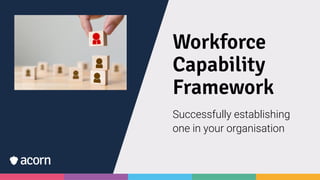
Workforce
Capability
Framework
Successfully establishing
one in your organisation
Workforce capability frameworks
A workforce’s capability framework defines the common
processes relating to workforce development that support an
organisation’s purpose.
Most capability frameworks are written to describe the
behaviours, skills and knowledge expected of employees in both
their day-to-day work and specific job roles.
How to implement one
Successfully implementing a workforce capability framework
into your organisation can be achieved with a 3-step plan:
• Build your capability framework
• Implement your framework
• Monitor impact.
Step 1: Building
Your Capability
Framework
Define Process Owners
Process owners need to volunteer time for end-to-end
activities involved in not only capability development, but
maintenance of a framework. Your owners will need to
manage process maturity and its impact on alignment with
business processes, too.
Outline The Purpose
To define your purpose and vision, you need to think about
what your framework is being used for and how.
What’s common in public sector frameworks is how a
framework can be a blueprint for optimal job performance.
Effective performance provides early warning signs of
problems that could affect business direction.
Market To Employees
A capability framework needs buy-in from all business
levels to be successful and sustainable.
The most influential factor in managing a change initiative
is how honest and open leaders are from the outset. Let
your people know what’s happening and why. Utilise support
resources to help unpack capability language.
Pick A Lane
Trying to be good at too many things or trying to suddenly
change too many things at once could leave you falling flat
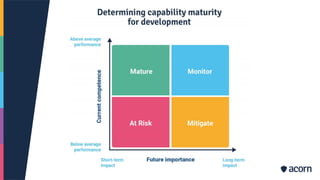
on key capabilities. Prioritising capabilities can be done by
assessing their risk against their future importance.
Step 2:
Implementation
Training & Development
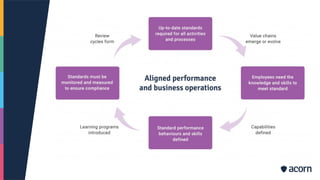
If we refer to the cycle of aligning employee performance
and business, we know that L&D is a key spoke that keeps
the wheel moving. Without training and development, you
lose the necessary skills and knowledge that support value
chains, and in turn, the business itself.
Workforce Planning
In essence, capabilities support your future workforce
plans because they are the building blocks that ensure
your employees can deliver on your mission. A capability
analysis may uncover gaps in current job families or
team structures.
Step 3:
Monitoring
Impact
Training & Development
This is the truest test of capability. Any of the goals you set
for a framework should be observable in one way or
another. It’s important to repeatedly assess support for
capability development. There should be bigger objectives
related to behavioural changes.
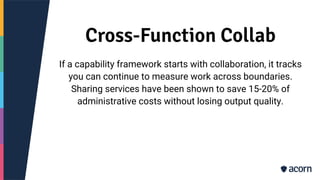
Cross-Function Collab
If a capability framework starts with collaboration, it tracks
you can continue to measure work across boundaries.
Sharing services have been shown to save 15-20% of
administrative costs without losing output quality.
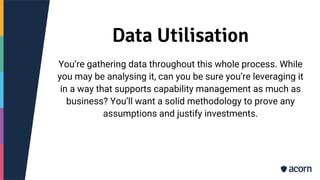
Data Utilisation
You’re gathering data throughout this whole process. While
you may be analysing it, can you be sure you’re leveraging it
in a way that supports capability management as much as
business? You’ll want a solid methodology to prove any
assumptions and justify investments.
You can learn more about this
topic by checking out the full
article:
https://acornlms.com/resources/workforce-
capability-framework

Establishing Your Workforce Capability Framework

  • 1.
  • 2.
    Workforce capability frameworks Aworkforce’s capability framework defines the common processes relating to workforce development that support an organisation’s purpose. Most capability frameworks are written to describe the behaviours, skills and knowledge expected of employees in both their day-to-day work and specific job roles.
  • 3.
    How to implementone Successfully implementing a workforce capability framework into your organisation can be achieved with a 3-step plan: • Build your capability framework • Implement your framework • Monitor impact.
  • 4.
    Step 1: Building YourCapability Framework
  • 5.
    Define Process Owners Processowners need to volunteer time for end-to-end activities involved in not only capability development, but maintenance of a framework. Your owners will need to manage process maturity and its impact on alignment with business processes, too.
  • 6.
    Outline The Purpose Todefine your purpose and vision, you need to think about what your framework is being used for and how. What’s common in public sector frameworks is how a framework can be a blueprint for optimal job performance. Effective performance provides early warning signs of problems that could affect business direction.
  • 8.
    Market To Employees Acapability framework needs buy-in from all business levels to be successful and sustainable. The most influential factor in managing a change initiative is how honest and open leaders are from the outset. Let your people know what’s happening and why. Utilise support resources to help unpack capability language.
  • 9.
    Pick A Lane Tryingto be good at too many things or trying to suddenly change too many things at once could leave you falling flat on key capabilities. Prioritising capabilities can be done by assessing their risk against their future importance.
  • 11.
  • 12.
    Training & Development Ifwe refer to the cycle of aligning employee performance and business, we know that L&D is a key spoke that keeps the wheel moving. Without training and development, you lose the necessary skills and knowledge that support value chains, and in turn, the business itself.
  • 14.
    Workforce Planning In essence,capabilities support your future workforce plans because they are the building blocks that ensure your employees can deliver on your mission. A capability analysis may uncover gaps in current job families or team structures.
  • 15.
  • 16.
    Training & Development Thisis the truest test of capability. Any of the goals you set for a framework should be observable in one way or another. It’s important to repeatedly assess support for capability development. There should be bigger objectives related to behavioural changes.
  • 17.
    Cross-Function Collab If acapability framework starts with collaboration, it tracks you can continue to measure work across boundaries. Sharing services have been shown to save 15-20% of administrative costs without losing output quality.
  • 18.
    Data Utilisation You’re gatheringdata throughout this whole process. While you may be analysing it, can you be sure you’re leveraging it in a way that supports capability management as much as business? You’ll want a solid methodology to prove any assumptions and justify investments.
  • 19.
    You can learnmore about this topic by checking out the full article: https://acornlms.com/resources/workforce- capability-framework