4 Capability
Framework
Examples
And how they are used in
organisational strategy
What is a capability framework?
A capability framework outlines the skills, knowledge and
behaviours an organisation needs to achieve its goals.
Done right, a capability framework should be accessible and
understandable for everyone in the organisation.
Key Elements of
a Capability
Framework
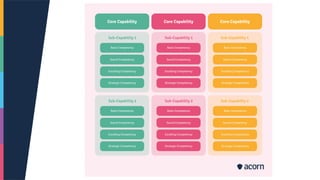
Core Capabilities
These are the overarching groups of capabilities in your
framework. They are defined by looking at business drivers
or functions and their reinforcing activities. Without even one
core capability, your organisation would be flying blind, which
is why they sit at the top of your framework.
Example: Governance.
Sub-capabilities
Under each core capability will be a collection of sub-
capabilities that further anatomise critical key skills,
behaviours and knowledge. The number of sub-capabilities
under a core capability is really up to your organisational
needs.
Example: Coaching Talent.
Competency Levels
Managing performance of capabilities comes courtesy of
competencies – generally in the form of a scale or spectrum.
To define competency levels, break capabilities into
behaviours or job roles.
Example: Sharing own knowledge and experience to develop
others.
Specialist Capabilities
These are optional. They essentially add a specialist stream
of capabilities to better reflect organisational requirements.
The time to do this is when there are additional or
potentially complex expertise and behaviours tied to job
roles or families e.g., leadership capabilities or legal
department.
Enterprise
Framework
Examples
What’s available?
Enterprise capability frameworks are hard to come by, and for
good reason. They are an organisation’s secret sauce recipe.
So, we have to look to consultants.
Deloitte’s Leadership
Capability Model
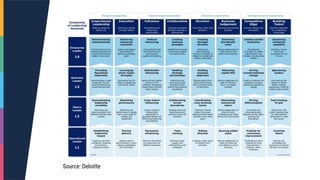
This one is a good example of using strategic drivers as the
tentpoles of your framework.
Core capabilities are derived from the most complex leadership
responsibilities, grouped under people, relationship and business
leadership. But from there, sub-capabilities – not just
competencies – are linked to specific levels of leadership.
Source: Deloitte
The Learning and Performance
Institute (LPI) Capability Framework
This framework uses 5 core capability groups for 25 sub-
capabilities, each with 4 measurable levels of competency (and
the baseline competency of no experience).
These measures of competency aren’t tied to job roles but are
ultimately a strategic display of performance.
Takeaway
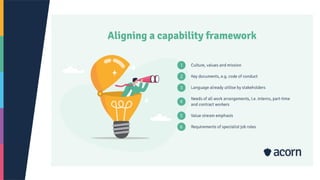
At its core, a capability framework should effectively align
performance with organisational outcomes. Just remember that
for every behaviour, skill, process or expertise noted, there
should be a strategic impact felt by the performance of that
capability.
Public Sector
Framework
Examples
How do they differ?
Public sector capability frameworks differ slightly from private
sector ones. They need to be reviewed in the interests of not
just employees, but also the community they serve, which
means they need to be agile.
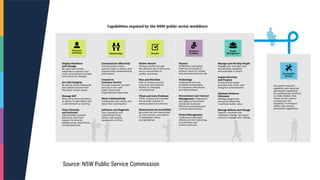
NSW Public Service Commission
Capability Framework
Outlines 20 organisational capabilities organised into 5 groups,
where each sub-capability has 5 levels of competence.
In their guide, each sub-capability is denoted by its core capability,
a performance descriptor of the sub-capability itself and its
competency levels.
Source: NSW Public Service Commission
Office of Personnel Management
Competency Approach
The American vernacular uses competency, but we and many
industry thinkers prefer capability.
This approach’s capabilities are created and framed within the
context of nearly 200 federal job roles. They offer ready-made
frameworks for certain functions and a list of capabilities HR can
utilise to manage performance.
Takeaway
Both of these examples act simply as a pool from which
functional managers and human resources can draw from for
processes like job role design, performance management, talent
mobility and career planning.
You can learn more about this
topic by checking out the full
article:
https://acornlms.com/enterprise-learning-
management/capability-framework-examples

4 Capability Framework Examples

  • 1.
    4 Capability Framework Examples And howthey are used in organisational strategy
  • 2.
    What is acapability framework? A capability framework outlines the skills, knowledge and behaviours an organisation needs to achieve its goals. Done right, a capability framework should be accessible and understandable for everyone in the organisation.
  • 3.
    Key Elements of aCapability Framework
  • 4.
    Core Capabilities These arethe overarching groups of capabilities in your framework. They are defined by looking at business drivers or functions and their reinforcing activities. Without even one core capability, your organisation would be flying blind, which is why they sit at the top of your framework. Example: Governance.
  • 5.
    Sub-capabilities Under each corecapability will be a collection of sub- capabilities that further anatomise critical key skills, behaviours and knowledge. The number of sub-capabilities under a core capability is really up to your organisational needs. Example: Coaching Talent.
  • 6.
    Competency Levels Managing performanceof capabilities comes courtesy of competencies – generally in the form of a scale or spectrum. To define competency levels, break capabilities into behaviours or job roles. Example: Sharing own knowledge and experience to develop others.
  • 7.
    Specialist Capabilities These areoptional. They essentially add a specialist stream of capabilities to better reflect organisational requirements. The time to do this is when there are additional or potentially complex expertise and behaviours tied to job roles or families e.g., leadership capabilities or legal department.
  • 10.
  • 11.
    What’s available? Enterprise capabilityframeworks are hard to come by, and for good reason. They are an organisation’s secret sauce recipe. So, we have to look to consultants.
  • 12.
    Deloitte’s Leadership Capability Model Thisone is a good example of using strategic drivers as the tentpoles of your framework. Core capabilities are derived from the most complex leadership responsibilities, grouped under people, relationship and business leadership. But from there, sub-capabilities – not just competencies – are linked to specific levels of leadership.
  • 13.
  • 14.
    The Learning andPerformance Institute (LPI) Capability Framework This framework uses 5 core capability groups for 25 sub- capabilities, each with 4 measurable levels of competency (and the baseline competency of no experience). These measures of competency aren’t tied to job roles but are ultimately a strategic display of performance.
  • 15.
    Takeaway At its core,a capability framework should effectively align performance with organisational outcomes. Just remember that for every behaviour, skill, process or expertise noted, there should be a strategic impact felt by the performance of that capability.
  • 16.
  • 17.
    How do theydiffer? Public sector capability frameworks differ slightly from private sector ones. They need to be reviewed in the interests of not just employees, but also the community they serve, which means they need to be agile.
  • 18.
    NSW Public ServiceCommission Capability Framework Outlines 20 organisational capabilities organised into 5 groups, where each sub-capability has 5 levels of competence. In their guide, each sub-capability is denoted by its core capability, a performance descriptor of the sub-capability itself and its competency levels.
  • 19.
    Source: NSW PublicService Commission
  • 20.
    Office of PersonnelManagement Competency Approach The American vernacular uses competency, but we and many industry thinkers prefer capability. This approach’s capabilities are created and framed within the context of nearly 200 federal job roles. They offer ready-made frameworks for certain functions and a list of capabilities HR can utilise to manage performance.
  • 21.
    Takeaway Both of theseexamples act simply as a pool from which functional managers and human resources can draw from for processes like job role design, performance management, talent mobility and career planning.
  • 22.
    You can learnmore about this topic by checking out the full article: https://acornlms.com/enterprise-learning- management/capability-framework-examples