Public Sector
Capability
Frameworks
What they are and what the
private sector could learn
from them
What are they?
A public sector capability (PSC) framework outlines the
knowledge, skills and behaviours or attributes required by those
working in a public service or enterprise.
The combined capabilities are defined by behavioural indicators
considered necessary to achieve the objectives of a department
now and into the future.
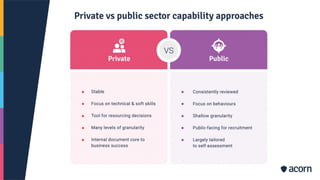
How do they differ from private?
If you’re familiar with frameworks used in private organisations,
you’ll find that their public sector counterparts are a little
different.
The major distinction is in purpose. PSC frameworks are
formulated and reviewed in the interests of not just employees
and the sector, but also the community they serve.
PSC frameworks need to be agile
What affects the community is ever evolving, which means
workforce capabilities need to:
• Be viewed in the interest of developing employees as highly
skilled, diverse and capable for the benefit of the public
• Describe whole-of-sector expectations as much as a singular
agency or department’s needs
• Respond to cultural, social, environmental, and economic
changes.
PSC
Framework
Advantages
For Individual Contributors
A PSC framework helps align performance and organisational
outcomes. It shows employees how they need to consistently
perform in their role to achieve career goals in line with their
organisation’s objectives.
For Human Resources
HR in the public sector often operates under much stricter
boundaries. A PSC framework provides the ‘how’ of a role, giving
HR the tools to identify accountabilities for every position –
providing clear recruitment and retention standards.
For Executives
Many senior executives are held to high moral standards in the
public sector. A PSC framework provides clarity of these
standards and give executives a better look at how the
workforce is managed and structured, which can inform future
projects and resourcing.
Global
Similarities of
PSC Frameworks
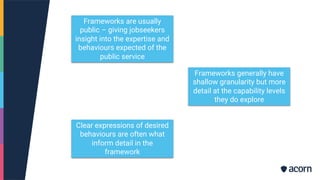
Frameworks are usually
public – giving jobseekers
insight into the expertise and
behaviours expected of the
public service
Frameworks generally have
shallow granularity but more
detail at the capability levels
they do explore
Clear expressions of desired
behaviours are often what
inform detail in the
framework
Public Service
Commission
Framework
Examples
NSW Public Sector Capability
Framework (Aus)
Used by the NSW Public Service Commission. Provides a
shared language to describe the capabilities needed to perform
at different levels across various occupation groups. It
supports a high-performance culture, prepares individual
agencies for future workforce needs and develops leaders.
WA Public Sector Capability
Profiles (Aus)
Used by the WA Public Sector Commission. A framework that
identifies the critical capabilities at each level across the WA
public sector. It is used primarily for recruitment, with
workforce planning and performance management a
secondary outcome.
QLD Capability and Leadership
Framework (Aus)
Used by the QLD Public Service Commission. Intended to
create a public service that encourages staff to contribute their
ideas and help improve the way they do things. Underpins
performance evaluations and professional development, and
drives continuous improvement.
Success
Profiles (UK)
Used by the UK Civil Service. The framework was designed to
attract and retain people of talent and experience from a range
of sectors and walks of life. It is primarily used for effective
recruitment by hiring managers.
MOSAIC Competency
Approach (US)
Used by the US Office of Personnel Management. Described as
a common set of tasks and competencies to structure job
design, recruitment selection, performance management,
training and career development.
Government
Framework
Examples
NSW Local Government
Capability Framework (Aus)
Used by the NSW Local Government. Describes the core
knowledge, skills, abilities and other attributes expected of
elected members and employees. It narrows in on desired
behaviours, acting as a guide for performance expectations.
ACTPS Shared Capability
Framework (Aus)
Used by the ACT Public Service. Developed to describe the
skills, knowledge and behaviour that can universally be
expected of every ACT Public Servant at different
organisational levels and in every workplace. The framework
zeroes in on an individual perspective of performance.
GLA Competency
Framework (UK)
Used by the Greater London Authority. Described as a
framework that forms the basis of people management
processes and provides a common language for how daily work
is performed. It is used to ensure fair and efficient processes
that are clear.
Lessons To
Take Away
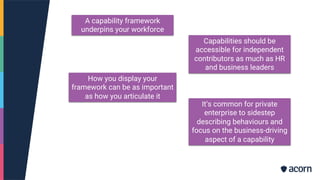
A capability framework
underpins your workforce
Capabilities should be
accessible for independent
contributors as much as HR
and business leaders
How you display your
framework can be as important
as how you articulate it
It’s common for private
enterprise to sidestep
describing behaviours and
focus on the business-driving
aspect of a capability
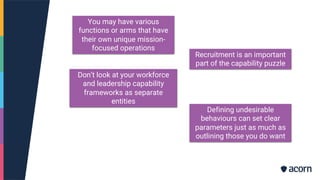
You may have various
functions or arms that have
their own unique mission-
focused operations
Don’t look at your workforce
and leadership capability
frameworks as separate
entities
Defining undesirable
behaviours can set clear
parameters just as much as
outlining those you do want
Recruitment is an important
part of the capability puzzle
You can learn more about this
topic by checking out these 2
articles:
An introduction: https://acornlms.com/resources/public-
sector-capability-framework
A deep dive: https://acornlms.com/resources/psc-
framework

What Private Enterprise Can Learn From Public Sector Capability Frameworks

  • 1.
    Public Sector Capability Frameworks What theyare and what the private sector could learn from them
  • 2.
    What are they? Apublic sector capability (PSC) framework outlines the knowledge, skills and behaviours or attributes required by those working in a public service or enterprise. The combined capabilities are defined by behavioural indicators considered necessary to achieve the objectives of a department now and into the future.
  • 3.
    How do theydiffer from private? If you’re familiar with frameworks used in private organisations, you’ll find that their public sector counterparts are a little different. The major distinction is in purpose. PSC frameworks are formulated and reviewed in the interests of not just employees and the sector, but also the community they serve.
  • 5.
    PSC frameworks needto be agile What affects the community is ever evolving, which means workforce capabilities need to: • Be viewed in the interest of developing employees as highly skilled, diverse and capable for the benefit of the public • Describe whole-of-sector expectations as much as a singular agency or department’s needs • Respond to cultural, social, environmental, and economic changes.
  • 6.
  • 7.
    For Individual Contributors APSC framework helps align performance and organisational outcomes. It shows employees how they need to consistently perform in their role to achieve career goals in line with their organisation’s objectives.
  • 8.
    For Human Resources HRin the public sector often operates under much stricter boundaries. A PSC framework provides the ‘how’ of a role, giving HR the tools to identify accountabilities for every position – providing clear recruitment and retention standards.
  • 9.
    For Executives Many seniorexecutives are held to high moral standards in the public sector. A PSC framework provides clarity of these standards and give executives a better look at how the workforce is managed and structured, which can inform future projects and resourcing.
  • 10.
  • 11.
    Frameworks are usually public– giving jobseekers insight into the expertise and behaviours expected of the public service Frameworks generally have shallow granularity but more detail at the capability levels they do explore Clear expressions of desired behaviours are often what inform detail in the framework
  • 12.
  • 13.
    NSW Public SectorCapability Framework (Aus) Used by the NSW Public Service Commission. Provides a shared language to describe the capabilities needed to perform at different levels across various occupation groups. It supports a high-performance culture, prepares individual agencies for future workforce needs and develops leaders.
  • 14.
    WA Public SectorCapability Profiles (Aus) Used by the WA Public Sector Commission. A framework that identifies the critical capabilities at each level across the WA public sector. It is used primarily for recruitment, with workforce planning and performance management a secondary outcome.
  • 15.
    QLD Capability andLeadership Framework (Aus) Used by the QLD Public Service Commission. Intended to create a public service that encourages staff to contribute their ideas and help improve the way they do things. Underpins performance evaluations and professional development, and drives continuous improvement.
  • 16.
    Success Profiles (UK) Used bythe UK Civil Service. The framework was designed to attract and retain people of talent and experience from a range of sectors and walks of life. It is primarily used for effective recruitment by hiring managers.
  • 17.
    MOSAIC Competency Approach (US) Usedby the US Office of Personnel Management. Described as a common set of tasks and competencies to structure job design, recruitment selection, performance management, training and career development.
  • 18.
  • 19.
    NSW Local Government CapabilityFramework (Aus) Used by the NSW Local Government. Describes the core knowledge, skills, abilities and other attributes expected of elected members and employees. It narrows in on desired behaviours, acting as a guide for performance expectations.
  • 20.
    ACTPS Shared Capability Framework(Aus) Used by the ACT Public Service. Developed to describe the skills, knowledge and behaviour that can universally be expected of every ACT Public Servant at different organisational levels and in every workplace. The framework zeroes in on an individual perspective of performance.
  • 21.
    GLA Competency Framework (UK) Usedby the Greater London Authority. Described as a framework that forms the basis of people management processes and provides a common language for how daily work is performed. It is used to ensure fair and efficient processes that are clear.
  • 22.
  • 23.
    A capability framework underpinsyour workforce Capabilities should be accessible for independent contributors as much as HR and business leaders How you display your framework can be as important as how you articulate it It’s common for private enterprise to sidestep describing behaviours and focus on the business-driving aspect of a capability
  • 24.
    You may havevarious functions or arms that have their own unique mission- focused operations Don’t look at your workforce and leadership capability frameworks as separate entities Defining undesirable behaviours can set clear parameters just as much as outlining those you do want Recruitment is an important part of the capability puzzle
  • 25.
    You can learnmore about this topic by checking out these 2 articles: An introduction: https://acornlms.com/resources/public- sector-capability-framework A deep dive: https://acornlms.com/resources/psc- framework