Leading Workforce Development and
        Planning Solutions


                                       Presented by Wendy Perry,
                        Head Workforce Planner, Workforce BluePrint

© Workforce BluePrint
Outline

  • Move from VET to Workforce Development
  • Workforce Productivity theory
  • Business case
  • Definitions
  • 5 step model
  • Case studies and examples – breadth of
    organisations
  • RTOs leading
  • Common workforce development gaps and
    strategies
  • Skills and Competencies vs. Capabilities   2


  •
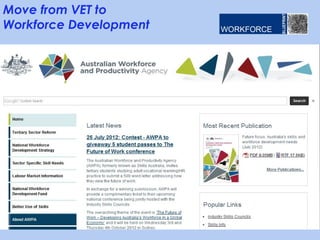
Move from VET to
Workforce Development

 •   x


                        3
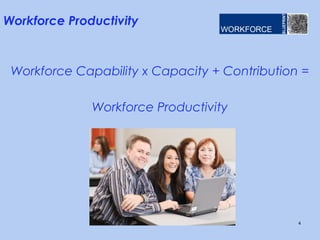
Workforce Productivity


 Workforce Capability x Capacity + Contribution =

              Workforce Productivity


                                               4
Why? = Business case

  • Significant employer or small employer?
  • Dynamic and complex economic, legislative and
      contractual environment, growth
  •   Challenges with shift in demographics and age profile
  •   Industry and policy directions (national, state, local)
  •   Strategic and business plan, new project, site, facility
  •   Problems attracting, recruiting and retaining staff
  •   Increase workforce productivity, quality, skills
      shortages, workplace health and safety, risk
  •   Example of good practice and increasing skill levels
      for service contracts/client expectations
  •   Evidence based approach for capability, tenders 5
      and proposals
What is workforce planning?

Workforce planning relates to analysing workforce
profile data and trends; forecasting demand;
analysing supply; and undertaking a gap analysis.

Data analysis, knowledge management, scenario
planning and Imagineering are relevant
approaches.

Workforce profiling and analysis
should reflect organisational structure
now and into the future…


                                                    6
What is workforce development?


Workforce development bridges the gap between
the current workforce and the desired workforce.

Workforce development is underpinned by
competency profiling, prioritisation and hot spot
analysis.


                                                    7
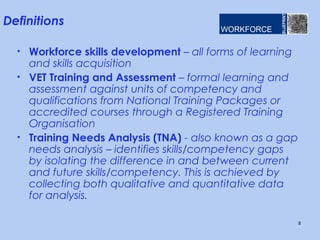
Definitions

  • Workforce skills development – all forms of learning
    and skills acquisition
  • VET Training and Assessment – formal learning and
    assessment against units of competency and
    qualifications from National Training Packages or
    accredited courses through a Registered Training
    Organisation
  • Training Needs Analysis (TNA) - also known as a gap
    needs analysis – identifies skills/competency gaps
    by isolating the difference in and between current
    and future skills/competency. This is achieved by
    collecting both qualitative and quantitative data
    for analysis.

                                                           8
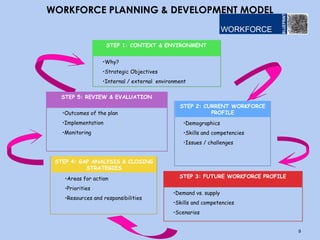
WORKFORCE PLANNING & DEVELOPMENT MODEL


                     STEP 1: CONTEXT & ENVIRONMENT


                   •Why?
                   •Strategic Objectives
                   •Internal / external environment

  STEP 5: REVIEW & EVALUATION
                                                STEP 2: CURRENT WORKFORCE
   •Outcomes of the plan                                  PROFILE
   •Implementation                                •Demographics
   •Monitoring                                    •Skills and competencies
                                                  •Issues / challenges


 STEP 4: GAP ANALYSIS & CLOSING
           STRATEGIES
    •Areas for action                           STEP 3: FUTURE WORKFORCE PROFILE

    •Priorities
                                              •Demand vs. supply
    •Resources and responsibilities
                                              •Skills and competencies
                                              •Scenarios


                                                                                   9
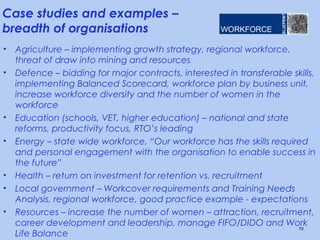
Case studies and examples –
breadth of organisations
•   Agriculture – implementing growth strategy, regional workforce,
    threat of draw into mining and resources
•   Defence – bidding for major contracts, interested in transferable skills,
    implementing Balanced Scorecard, workforce plan by business unit,
    increase workforce diversity and the number of women in the
    workforce
•   Education (schools, VET, higher education) – national and state
    reforms, productivity focus, RTO’s leading
•   Energy – state wide workforce, “Our workforce has the skills required
    and personal engagement with the organisation to enable success in
    the future”
•   Health – return on investment for retention vs. recruitment
•   Local government – Workcover requirements and Training Needs
    Analysis, regional workforce, good practice example - expectations
•   Resources – increase the number of women – attraction, recruitment,
    career development and leadership, manage FIFO/DIDO and Work       10
    Life Balance
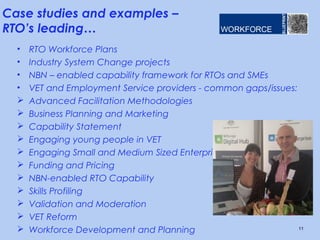
Case studies and examples –
RTO’s leading…
  •   RTO Workforce Plans
  •   Industry System Change projects
  •   NBN – enabled capability framework for RTOs and SMEs
  •   VET and Employment Service providers - common gaps/issues:
     Advanced Facilitation Methodologies
     Business Planning and Marketing
     Capability Statement
     Engaging young people in VET
     Engaging Small and Medium Sized Enterprises
     Funding and Pricing
     NBN-enabled RTO Capability
     Skills Profiling
     Validation and Moderation
     VET Reform
     Workforce Development and Planning                         11
Common Workforce Development
Gaps and Strategies
• Ageing particularly outside workforce, WHS
• Retention, succession planning, knowledge management,
    communication, career paths
•   Training needs analysis, learning and development plans,
    leadership development
•   Work Life Balance – packaging benefits of flexible working
    arrangements, phased retirement
•   Employer of Choice, reward and recognition
•   Barriers – not feeling valued and respected, attract a
    higher salary elsewhere, politics
•   Check on excessive hours, stress management
•   Competency or Capability Framework
•   Under or over supply for specific job roles, workforce 12
    participation
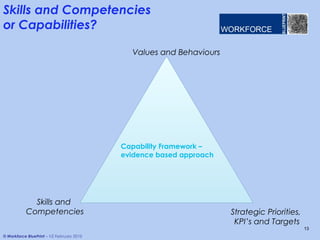
Skills and Competencies
or Capabilities?

                                             Values and Behaviours


                                           Capability Framework –
                                           evidence based approach


             Skills and
           Competencies                                              Strategic Priorities,
                                                                      KPI’s and Targets
                                                                                             13
© Workforce BluePrint – V2 February 2010
Links and info

 • YOUR ACTION PLAN
 • Develop a Workforce Plan in 5 easy steps
 • Workforce Plan Tools – Workforce Architect
   partner package, training version available
 • wendy@workforceblueprint.com.au for a basic
   workforce plan template in word
 • @WorkforcePlan on Twitter
 • Workforce Planning Tools on Facebook
 • Workforce Planning Tools LinkedIn group
 • NBN Enabled Capability Development Network
                                            14
 • Australian VET Leaders LinkedIn group

Leading workforce development and planning solutions v0.2 wp 20.8.12

  • 1.
    Leading Workforce Developmentand Planning Solutions Presented by Wendy Perry, Head Workforce Planner, Workforce BluePrint © Workforce BluePrint
  • 2.
    Outline •Move from VET to Workforce Development • Workforce Productivity theory • Business case • Definitions • 5 step model • Case studies and examples – breadth of organisations • RTOs leading • Common workforce development gaps and strategies • Skills and Competencies vs. Capabilities 2 •
  • 3.
    Move from VETto Workforce Development • x 3
  • 4.
    Workforce Productivity WorkforceCapability x Capacity + Contribution = Workforce Productivity 4
  • 5.
    Why? = Businesscase • Significant employer or small employer? • Dynamic and complex economic, legislative and contractual environment, growth • Challenges with shift in demographics and age profile • Industry and policy directions (national, state, local) • Strategic and business plan, new project, site, facility • Problems attracting, recruiting and retaining staff • Increase workforce productivity, quality, skills shortages, workplace health and safety, risk • Example of good practice and increasing skill levels for service contracts/client expectations • Evidence based approach for capability, tenders 5 and proposals
  • 6.
    What is workforceplanning? Workforce planning relates to analysing workforce profile data and trends; forecasting demand; analysing supply; and undertaking a gap analysis. Data analysis, knowledge management, scenario planning and Imagineering are relevant approaches. Workforce profiling and analysis should reflect organisational structure now and into the future… 6
  • 7.
    What is workforcedevelopment? Workforce development bridges the gap between the current workforce and the desired workforce. Workforce development is underpinned by competency profiling, prioritisation and hot spot analysis. 7
  • 8.
    Definitions •Workforce skills development – all forms of learning and skills acquisition • VET Training and Assessment – formal learning and assessment against units of competency and qualifications from National Training Packages or accredited courses through a Registered Training Organisation • Training Needs Analysis (TNA) - also known as a gap needs analysis – identifies skills/competency gaps by isolating the difference in and between current and future skills/competency. This is achieved by collecting both qualitative and quantitative data for analysis. 8
  • 9.
    WORKFORCE PLANNING &DEVELOPMENT MODEL STEP 1: CONTEXT & ENVIRONMENT •Why? •Strategic Objectives •Internal / external environment STEP 5: REVIEW & EVALUATION STEP 2: CURRENT WORKFORCE •Outcomes of the plan PROFILE •Implementation •Demographics •Monitoring •Skills and competencies •Issues / challenges STEP 4: GAP ANALYSIS & CLOSING STRATEGIES •Areas for action STEP 3: FUTURE WORKFORCE PROFILE •Priorities •Demand vs. supply •Resources and responsibilities •Skills and competencies •Scenarios 9
  • 10.
    Case studies andexamples – breadth of organisations • Agriculture – implementing growth strategy, regional workforce, threat of draw into mining and resources • Defence – bidding for major contracts, interested in transferable skills, implementing Balanced Scorecard, workforce plan by business unit, increase workforce diversity and the number of women in the workforce • Education (schools, VET, higher education) – national and state reforms, productivity focus, RTO’s leading • Energy – state wide workforce, “Our workforce has the skills required and personal engagement with the organisation to enable success in the future” • Health – return on investment for retention vs. recruitment • Local government – Workcover requirements and Training Needs Analysis, regional workforce, good practice example - expectations • Resources – increase the number of women – attraction, recruitment, career development and leadership, manage FIFO/DIDO and Work 10 Life Balance
  • 11.
    Case studies andexamples – RTO’s leading… • RTO Workforce Plans • Industry System Change projects • NBN – enabled capability framework for RTOs and SMEs • VET and Employment Service providers - common gaps/issues:  Advanced Facilitation Methodologies  Business Planning and Marketing  Capability Statement  Engaging young people in VET  Engaging Small and Medium Sized Enterprises  Funding and Pricing  NBN-enabled RTO Capability  Skills Profiling  Validation and Moderation  VET Reform  Workforce Development and Planning 11
  • 12.
    Common Workforce Development Gapsand Strategies • Ageing particularly outside workforce, WHS • Retention, succession planning, knowledge management, communication, career paths • Training needs analysis, learning and development plans, leadership development • Work Life Balance – packaging benefits of flexible working arrangements, phased retirement • Employer of Choice, reward and recognition • Barriers – not feeling valued and respected, attract a higher salary elsewhere, politics • Check on excessive hours, stress management • Competency or Capability Framework • Under or over supply for specific job roles, workforce 12 participation
  • 13.
    Skills and Competencies orCapabilities? Values and Behaviours Capability Framework – evidence based approach Skills and Competencies Strategic Priorities, KPI’s and Targets 13 © Workforce BluePrint – V2 February 2010
  • 14.
    Links and info • YOUR ACTION PLAN • Develop a Workforce Plan in 5 easy steps • Workforce Plan Tools – Workforce Architect partner package, training version available • wendy@workforceblueprint.com.au for a basic workforce plan template in word • @WorkforcePlan on Twitter • Workforce Planning Tools on Facebook • Workforce Planning Tools LinkedIn group • NBN Enabled Capability Development Network 14 • Australian VET Leaders LinkedIn group

Editor's Notes

  • #2 Leading workforce development and planning solutions highlight that national and state/territory policy directions are moving from VET into workforce development.  They demonstrate what employers, enterprises, industry sectors and regions want, with case studies and examples. The objectives of this session are to: build participants’ understanding of workforce development and planning, underpinning theories and a simple 5 step model to use with clients; link policy with practice and market driven services, where RTOs lead with workforce planning and development for themselves, and as a basis for funding proposals and submissions; and show the breadth of organisations interested in workforce development and planning services and what they want assistance with. Participants will gain an insight into leading edge workforce development and planning practices plus emerging business trends and impacts, including the roll out of the NBN; identifying industry sectors to watch for increasing demand; and gaining hints on how to position themselves (as individuals and service providers) in this market.
  • #4 Link policy with practice and market driven services, where RTOs lead with workforce planning and development for themselves, and as a basis for funding proposals and submissions
  • #5 The equation… and underpinning theory for workforce planning and development What components do RTOs assist with?
  • #6 Why undertake workforce planning? Refer to Strategic, Business and/or HR plan – why for you?
  • #7 The right people in the right places with the right skills doing the right jobs – take an evidence based approach (theory)
  • #8 Workforce development strategies to close the gaps identified may include: Attraction, Capabilities, Capacity, Change Management, Communication, Competency Frameworks, Leadership Development, Knowledge Management, Learning and Development, Mission Critical Job roles, Organisational Development/Learning, Professional Development, Recruitment, Retention, Reward and Recognition, Skills, Staff Development, Succession Planning, Team Development, Training and Development, Transition, Values and Behaviours, Work Life Balance.
  • #9 Compare definitions, link with theory and model
  • #10 Work around the model = underpinning approach and theory basis
  • #11 Outline: Who is interested in Workforce Development and Planning and Why? What do they want assistance with? Work through each example and show the breadth of organisations interested in workforce development and planning services and what they want assistance with… Link policy with practice and market driven services e.g. does your RTO provide this style of service?
  • #12 Talk through examples of RTOs leading with workforce planning and development for themselves, and as a basis for funding proposals and submissions e.g. National Workforce Development Fund, state/territory funding Link policy with practice and market driven services e.g. does your RTO have a workforce plan? Are these gaps similar for your RTO?
  • #13 Q. What do you think would be your organisation’s priorities or action areas? Succession planning – processes that ensure that preferred staff will stay with the organisation Check on bullying Link policy with practice and market driven services e.g. could your RTO help enterprise clients with these gaps?
  • #14 RTO focus on Skills and Competencies - enterprises/employers want the whole capability picture including Values and Behaviours, and Strategic Priorities, KPI’s and Targets Refer to John Buchanan’s report/s