1
Thur, 2nd November 2017 12-1 PM, Sydney
Ways to participate:
• Q&A Box - comment, whinge & share
• Twitter Backchannel - @capabilitycafe #Future #Capabilities
Knowledge
Sharing
Better
Practices
Experienced
Panel
Defining Future Capabilities
Beyond Guesswork
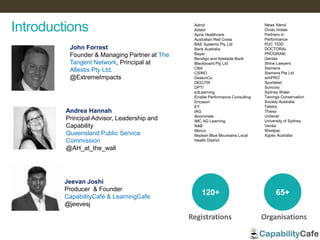
Introductions Adroit
Adslot
Apria Healthcare
Australian Red Cross
BAE Systems Pty Ltd
Bank Australia
Bayer
Bendigo and Adelaide Bank
Blackboard Pty Ltd
CBA
CSIRO
DeakinCo.
DEDJTR
DPTI
e3Learning
Enable Performance Consulting
Ericsson
EY
IAG
illoominate
IMC AG Learning
NAB
Nbnco
Nepean Blue Mountains Local
Health District
Registrations Organisations
Jeevan Joshi
Producer & Founder
CapabilityCafé & LearningCafe
@jeevesj
News Xtend
Ovolo Hotels
Partners in
Performance
PUC TIDD
DOCTORAL
PROGRAM
Qantas
Shine Lawyers
Siemens
Siemens Pte Ltd
simPRO
Sportsbet
Suncorp
Sydney Water
Taronga Conservation
Society Australia
Telstra
Thiess
Unilever
University of Sydney
Ventia
Westpac
Xypex Australia
Andrea Hannah
Principal Advisor, Leadership and
Capability
Queensland Public Service
Commission
@AH_at_the_wall
John Forrest
Founder & Managing Partner at The
Tangent Network, Principal at
Allestis Pty Ltd.
@ExtremeImpacts
120+ 65+
Blog
Magazine
Webinar
Discussions
UnConference
Twitter
Linkedin
Facebook
Coffee Catch
Ups
Capability
Building
Workshops
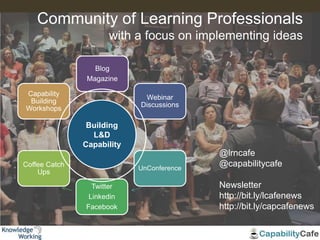
Community of Learning Professionals
with a focus on implementing ideas
Building
L&D
Capability
@lrncafe
@capabilitycafe
Newsletter
http://bit.ly/lcafenews
http://bit.ly/capcafenews
Register –learningcafe.com.au or ask for info
enquiry@knowledgeworking,com or at site
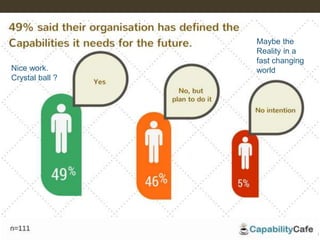
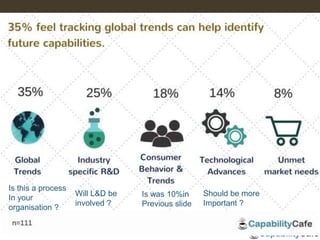
Maybe the
Reality in a
fast changing
worldNice work.
Crystal ball ?
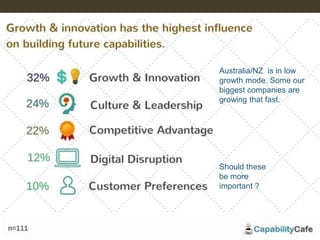
Should these
be more
important ?
Australia/NZ is in low
growth mode. Some our
biggest companies are
growing that fast.
Is this a process
In your
organisation ?
Will L&D be
involved ?
Is was 10%in
Previous slide
Should be more
Important ?
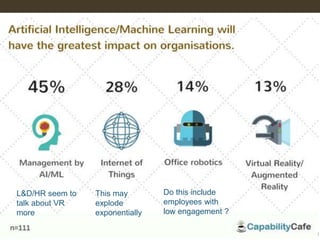
L&D/HR seem to
talk about VR
more
This may
explode
exponentially
Do this include
employees with
low engagement ?
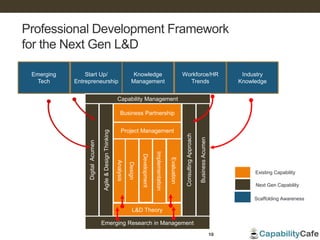
Professional Development Framework
for the Next Gen L&D
10
Business Partnership
Project Management
L&D Theory
Analysis
Design
Development
Implementation
Evaluation
DigitalAcumen
ConsultingApproach
BusinessAcumen
Agile&DesignThinking
Emerging
Tech
Start Up/
Entrepreneurship
Knowledge
Management
Workforce/HR
Trends
Emerging Research in Management
Industry
Knowledge
Capability Management
Existing Capability
Next Gen Capability
Scaffolding Awareness
JOHN FORREST
Founder & Managing Partner at The Tangent Network,
Principal at Allestis Pty Ltd
SCENARIO BASED CAPABILITY PLANNING
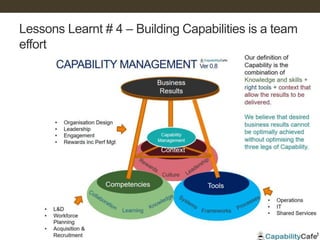
CAPABILITY MANAGEMENT Ver 0.8
Business
Results
Capability
Management
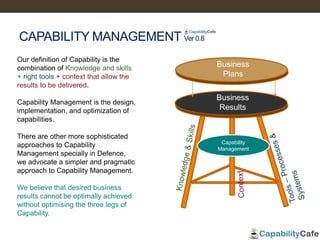
Our definition of Capability is the
combination of Knowledge and skills
+ right tools + context that allow the
results to be delivered.
Capability Management is the design,
implementation, and optimization of
capabilities.
There are other more sophisticated
approaches to Capability
Management specially in Defence,
we advocate a simpler and pragmatic
approach to Capability Management.
We believe that desired business
results cannot be optimally achieved
without optimising the three legs of
Capability.
Business
Plans
Business
Results
Capability
Management
Business
Plans
Current
Planning Horizon
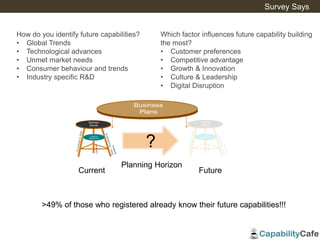
How do you identify future capabilities?
• Global Trends
• Technological advances
• Unmet market needs
• Consumer behaviour and trends
• Industry specific R&D
Which factor influences future capability building
the most?
• Customer preferences
• Competitive advantage
• Growth & Innovation
• Culture & Leadership
• Digital Disruption
Future
?
Survey Says
>49% of those who registered already know their future capabilities!!!
Defining Successful Future Capabilities
• Successful future capabilities are those that allow an organisation to
influence and respond to changes in the external environment to
achieve desirable outcomes
• Capabilities need to support customer and/or usurp competitor
capabilities
• Operating environments are constantly evolving; successful
organisations have a “requisite variety” of capabilities that adapt (and
exapt) and which can be reconfigured in response to changing
conditions
• Future success will require you to know what your customer and
competitor capabilities are and how they see these evolving
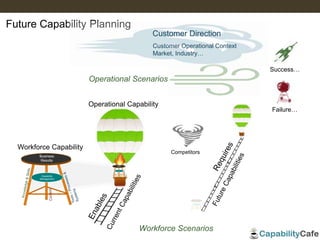
Workforce and Operational Capabilities
• Workforce Capabilities enable Operational Capabilities
• Operational Capabilities shape and are shaped by the external environment
• Workforce Capabilities and Operational Capabilities need to be managed as an
integrated portfolio
• A Capability Family or Taxonomy should support traceability from high level
strategic operational capabilities down to low level individual workforce
capabilities
Operational Capability
Business
Results
Capability
Management
Business
Results
Capability
Management
Competitors
Workforce Capability
Success…
Failure…
Operational Scenarios
Future Capability Planning
Customer Direction
Customer Operational Context
Market, Industry…
Workforce Scenarios
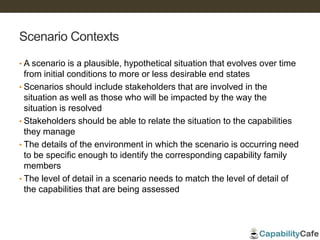
Scenario Contexts
• A scenario is a plausible, hypothetical situation that evolves over time
from initial conditions to more or less desirable end states
• Scenarios should include stakeholders that are involved in the
situation as well as those who will be impacted by the way the
situation is resolved
• Stakeholders should be able to relate the situation to the capabilities
they manage
• The details of the environment in which the scenario is occurring need
to be specific enough to identify the corresponding capability family
members
• The level of detail in a scenario needs to match the level of detail of
the capabilities that are being assessed
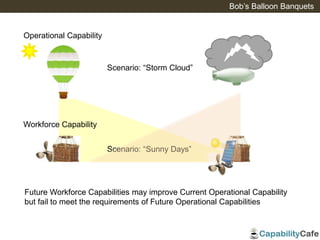
Operational Capability
Scenario: “Storm Cloud”
Workforce Capability
Scenario: “Sunny Days”
Future Workforce Capabilities may improve Current Operational Capability
but fail to meet the requirements of Future Operational Capabilities
Bob’s Balloon Banquets
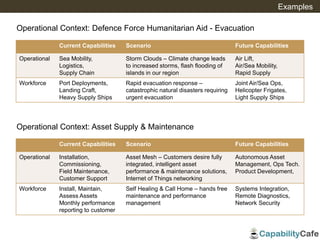
Examples
Operational Context: Defence Force Humanitarian Aid - Evacuation
Current Capabilities Scenario Future Capabilities
Operational Sea Mobility,
Logistics,
Supply Chain
Storm Clouds – Climate change leads
to increased storms, flash flooding of
islands in our region
Air Lift,
Air/Sea Mobility,
Rapid Supply
Workforce Port Deployments,
Landing Craft,
Heavy Supply Ships
Rapid evacuation response –
catastrophic natural disasters requiring
urgent evacuation
Joint Air/Sea Ops,
Helicopter Frigates,
Light Supply Ships
Operational Context: Asset Supply & Maintenance
Current Capabilities Scenario Future Capabilities
Operational Installation,
Commissioning,
Field Maintenance,
Customer Support
Asset Mesh – Customers desire fully
integrated, intelligent asset
performance & maintenance solutions,
Internet of Things networking
Autonomous Asset
Management, Ops Tech.
Product Development,
Workforce Install, Maintain,
Assess Assets
Monthly performance
reporting to customer
Self Healing & Call Home – hands free
maintenance and performance
management
Systems Integration,
Remote Diagnostics,
Network Security
DEFINING FUTURE CAPABILITIES
Andrea Hannah
Principal Advisor, Leadership & Capability
Queensland Public Service Commission
Identifying future capabilities – 10 year Human Capital
Outlook and 3 year human capital strategic roadmap
Strategy implementation
•Awareness
•Acceptance
•Action
JEEVAN JOSHI
Future Capability Adviser
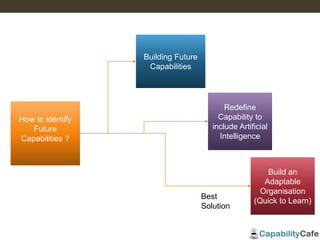
How to identify
Future
Capabilities ?
Building Future
Capabilities
Redefine
Capability to
include Artificial
Intelligence
Build an
Adaptable
Organisation
(Quick to Learn)
Best
Solution
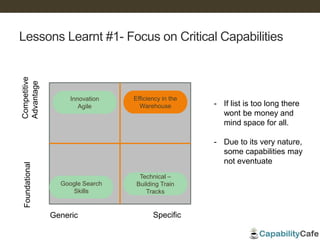
Lessons Learnt #1- Focus on Critical Capabilities
Competitive
Advantage
Foundational
Generic Specific
Google Search
Skills
Technical –
Building Train
Tracks
Innovation
Agile
Efficiency in the
Warehouse - If list is too long there
wont be money and
mind space for all.
- Due to its very nature,
some capabilities may
not eventuate
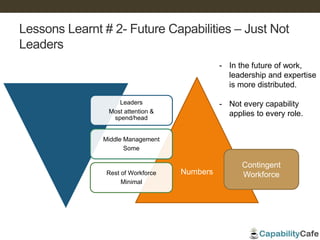
Numbers
Lessons Learnt # 2- Future Capabilities – Just Not
Leaders
Leaders
Most attention &
spend/head
Middle Management
Some
Rest of Workforce
Minimal
- In the future of work,
leadership and expertise
is more distributed.
- Not every capability
applies to every role.
Contingent
Workforce
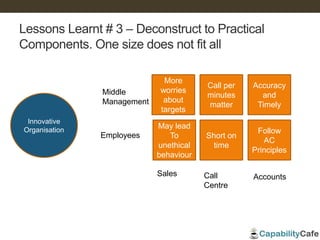
Lessons Learnt # 3 – Deconstruct to Practical
Components. One size does not fit all
Innovative
Organisation
More
worries
about
targets
Call per
minutes
matter
Accuracy
and
Timely
May lead
To
unethical
behaviour
Short on
time
Follow
AC
Principles
Sales Call
Centre
Accounts
Middle
Management
Employees
Lessons Learnt # 4 – Building Capabilities is a team
effort
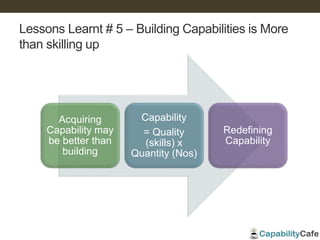
Lessons Learnt # 5 – Building Capabilities is More
than skilling up
Acquiring
Capability may
be better than
building
Capability
= Quality
(skills) x
Quantity (Nos)
Redefining
Capability
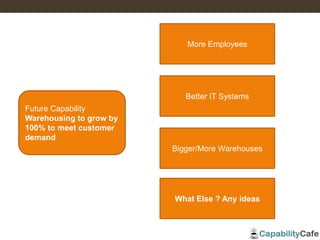
More Employees
Future Capability
Warehousing to grow by
100% to meet customer
demand
Better IT Systems
Bigger/More Warehouses
What Else ? Any ideas
40
• Value
• Engagement
• Topical
• Needs at
least a 3.5
rating
https://www.nytimes.com/2017/09/10/technology/amazon-robots-workers.html
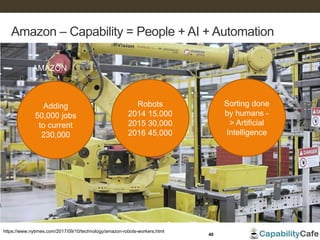
Amazon – Capability = People + AI + Automation
Adding
50,000 jobs
to current
230,000
Robots
2014 15,000
2015 30,000
2016 45,000
Sorting done
by humans -
> Artificial
Intelligence
AMAZON
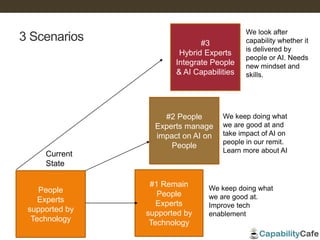
3 Scenarios
People
Experts
supported by
Technology
#1 Remain
People
Experts
supported by
Technology
We keep doing what
we are good at.
Improve tech
enablement
#2 People
Experts manage
impact on AI on
People
We keep doing what
we are good at and
take impact of AI on
people in our remit.
Learn more about AI
#3
Hybrid Experts
Integrate People
& AI Capabilities
We look after
capability whether it
is delivered by
people or AI. Needs
new mindset and
skills.
Current
State
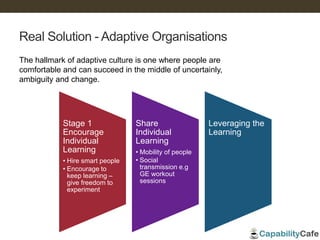
Real Solution - Adaptive Organisations
Stage 1
Encourage
Individual
Learning
• Hire smart people
• Encourage to
keep learning –
give freedom to
experiment
Share
Individual
Learning
• Mobility of people
• Social
transmission e.g
GE workout
sessions
Leveraging the
Learning
The hallmark of adaptive culture is one where people are
comfortable and can succeed in the middle of uncertainly,
ambiguity and change.
LET US TALK TO THE PANEL AND
YOU
www.capabilitycafe.com
@capabilitycafe
http://bit.ly/lcafefb
blogs
capability conversations
free resources
workshops
UnConference 2017
Sydney Melbourne
Webinar recording, ebooks, capability frameworks
Building Effective Employee Social Networks
44
Ideas@work Collaborations

Defining Future Capabilities – Beyond Guesswork

  • 1.
    1 Thur, 2nd November2017 12-1 PM, Sydney Ways to participate: • Q&A Box - comment, whinge & share • Twitter Backchannel - @capabilitycafe #Future #Capabilities Knowledge Sharing Better Practices Experienced Panel Defining Future Capabilities Beyond Guesswork
  • 2.
    Introductions Adroit Adslot Apria Healthcare AustralianRed Cross BAE Systems Pty Ltd Bank Australia Bayer Bendigo and Adelaide Bank Blackboard Pty Ltd CBA CSIRO DeakinCo. DEDJTR DPTI e3Learning Enable Performance Consulting Ericsson EY IAG illoominate IMC AG Learning NAB Nbnco Nepean Blue Mountains Local Health District Registrations Organisations Jeevan Joshi Producer & Founder CapabilityCafé & LearningCafe @jeevesj News Xtend Ovolo Hotels Partners in Performance PUC TIDD DOCTORAL PROGRAM Qantas Shine Lawyers Siemens Siemens Pte Ltd simPRO Sportsbet Suncorp Sydney Water Taronga Conservation Society Australia Telstra Thiess Unilever University of Sydney Ventia Westpac Xypex Australia Andrea Hannah Principal Advisor, Leadership and Capability Queensland Public Service Commission @AH_at_the_wall John Forrest Founder & Managing Partner at The Tangent Network, Principal at Allestis Pty Ltd. @ExtremeImpacts 120+ 65+
  • 3.
    Blog Magazine Webinar Discussions UnConference Twitter Linkedin Facebook Coffee Catch Ups Capability Building Workshops Community ofLearning Professionals with a focus on implementing ideas Building L&D Capability @lrncafe @capabilitycafe Newsletter http://bit.ly/lcafenews http://bit.ly/capcafenews
  • 4.
    Register –learningcafe.com.au orask for info enquiry@knowledgeworking,com or at site
  • 6.
    Maybe the Reality ina fast changing worldNice work. Crystal ball ?
  • 7.
    Should these be more important? Australia/NZ is in low growth mode. Some our biggest companies are growing that fast.
  • 8.
    Is this aprocess In your organisation ? Will L&D be involved ? Is was 10%in Previous slide Should be more Important ?
  • 9.
    L&D/HR seem to talkabout VR more This may explode exponentially Do this include employees with low engagement ?
  • 10.
    Professional Development Framework forthe Next Gen L&D 10 Business Partnership Project Management L&D Theory Analysis Design Development Implementation Evaluation DigitalAcumen ConsultingApproach BusinessAcumen Agile&DesignThinking Emerging Tech Start Up/ Entrepreneurship Knowledge Management Workforce/HR Trends Emerging Research in Management Industry Knowledge Capability Management Existing Capability Next Gen Capability Scaffolding Awareness
  • 11.
    JOHN FORREST Founder &Managing Partner at The Tangent Network, Principal at Allestis Pty Ltd SCENARIO BASED CAPABILITY PLANNING
  • 12.
    CAPABILITY MANAGEMENT Ver0.8 Business Results Capability Management Our definition of Capability is the combination of Knowledge and skills + right tools + context that allow the results to be delivered. Capability Management is the design, implementation, and optimization of capabilities. There are other more sophisticated approaches to Capability Management specially in Defence, we advocate a simpler and pragmatic approach to Capability Management. We believe that desired business results cannot be optimally achieved without optimising the three legs of Capability. Business Plans
  • 13.
    Business Results Capability Management Business Plans Current Planning Horizon How doyou identify future capabilities? • Global Trends • Technological advances • Unmet market needs • Consumer behaviour and trends • Industry specific R&D Which factor influences future capability building the most? • Customer preferences • Competitive advantage • Growth & Innovation • Culture & Leadership • Digital Disruption Future ? Survey Says >49% of those who registered already know their future capabilities!!!
  • 14.
    Defining Successful FutureCapabilities • Successful future capabilities are those that allow an organisation to influence and respond to changes in the external environment to achieve desirable outcomes • Capabilities need to support customer and/or usurp competitor capabilities • Operating environments are constantly evolving; successful organisations have a “requisite variety” of capabilities that adapt (and exapt) and which can be reconfigured in response to changing conditions • Future success will require you to know what your customer and competitor capabilities are and how they see these evolving
  • 15.
    Workforce and OperationalCapabilities • Workforce Capabilities enable Operational Capabilities • Operational Capabilities shape and are shaped by the external environment • Workforce Capabilities and Operational Capabilities need to be managed as an integrated portfolio • A Capability Family or Taxonomy should support traceability from high level strategic operational capabilities down to low level individual workforce capabilities
  • 16.
    Operational Capability Business Results Capability Management Business Results Capability Management Competitors Workforce Capability Success… Failure… OperationalScenarios Future Capability Planning Customer Direction Customer Operational Context Market, Industry… Workforce Scenarios
  • 17.
    Scenario Contexts • Ascenario is a plausible, hypothetical situation that evolves over time from initial conditions to more or less desirable end states • Scenarios should include stakeholders that are involved in the situation as well as those who will be impacted by the way the situation is resolved • Stakeholders should be able to relate the situation to the capabilities they manage • The details of the environment in which the scenario is occurring need to be specific enough to identify the corresponding capability family members • The level of detail in a scenario needs to match the level of detail of the capabilities that are being assessed
  • 18.
    Operational Capability Scenario: “StormCloud” Workforce Capability Scenario: “Sunny Days” Future Workforce Capabilities may improve Current Operational Capability but fail to meet the requirements of Future Operational Capabilities Bob’s Balloon Banquets
  • 19.
    Examples Operational Context: DefenceForce Humanitarian Aid - Evacuation Current Capabilities Scenario Future Capabilities Operational Sea Mobility, Logistics, Supply Chain Storm Clouds – Climate change leads to increased storms, flash flooding of islands in our region Air Lift, Air/Sea Mobility, Rapid Supply Workforce Port Deployments, Landing Craft, Heavy Supply Ships Rapid evacuation response – catastrophic natural disasters requiring urgent evacuation Joint Air/Sea Ops, Helicopter Frigates, Light Supply Ships Operational Context: Asset Supply & Maintenance Current Capabilities Scenario Future Capabilities Operational Installation, Commissioning, Field Maintenance, Customer Support Asset Mesh – Customers desire fully integrated, intelligent asset performance & maintenance solutions, Internet of Things networking Autonomous Asset Management, Ops Tech. Product Development, Workforce Install, Maintain, Assess Assets Monthly performance reporting to customer Self Healing & Call Home – hands free maintenance and performance management Systems Integration, Remote Diagnostics, Network Security
  • 20.
    DEFINING FUTURE CAPABILITIES AndreaHannah Principal Advisor, Leadership & Capability Queensland Public Service Commission
  • 21.
    Identifying future capabilities– 10 year Human Capital Outlook and 3 year human capital strategic roadmap
  • 30.
  • 32.
  • 33.
    How to identify Future Capabilities? Building Future Capabilities Redefine Capability to include Artificial Intelligence Build an Adaptable Organisation (Quick to Learn) Best Solution
  • 34.
    Lessons Learnt #1-Focus on Critical Capabilities Competitive Advantage Foundational Generic Specific Google Search Skills Technical – Building Train Tracks Innovation Agile Efficiency in the Warehouse - If list is too long there wont be money and mind space for all. - Due to its very nature, some capabilities may not eventuate
  • 35.
    Numbers Lessons Learnt #2- Future Capabilities – Just Not Leaders Leaders Most attention & spend/head Middle Management Some Rest of Workforce Minimal - In the future of work, leadership and expertise is more distributed. - Not every capability applies to every role. Contingent Workforce
  • 36.
    Lessons Learnt #3 – Deconstruct to Practical Components. One size does not fit all Innovative Organisation More worries about targets Call per minutes matter Accuracy and Timely May lead To unethical behaviour Short on time Follow AC Principles Sales Call Centre Accounts Middle Management Employees
  • 37.
    Lessons Learnt #4 – Building Capabilities is a team effort
  • 38.
    Lessons Learnt #5 – Building Capabilities is More than skilling up Acquiring Capability may be better than building Capability = Quality (skills) x Quantity (Nos) Redefining Capability
  • 39.
    More Employees Future Capability Warehousingto grow by 100% to meet customer demand Better IT Systems Bigger/More Warehouses What Else ? Any ideas
  • 40.
    40 • Value • Engagement •Topical • Needs at least a 3.5 rating https://www.nytimes.com/2017/09/10/technology/amazon-robots-workers.html Amazon – Capability = People + AI + Automation Adding 50,000 jobs to current 230,000 Robots 2014 15,000 2015 30,000 2016 45,000 Sorting done by humans - > Artificial Intelligence AMAZON
  • 41.
    3 Scenarios People Experts supported by Technology #1Remain People Experts supported by Technology We keep doing what we are good at. Improve tech enablement #2 People Experts manage impact on AI on People We keep doing what we are good at and take impact of AI on people in our remit. Learn more about AI #3 Hybrid Experts Integrate People & AI Capabilities We look after capability whether it is delivered by people or AI. Needs new mindset and skills. Current State
  • 42.
    Real Solution -Adaptive Organisations Stage 1 Encourage Individual Learning • Hire smart people • Encourage to keep learning – give freedom to experiment Share Individual Learning • Mobility of people • Social transmission e.g GE workout sessions Leveraging the Learning The hallmark of adaptive culture is one where people are comfortable and can succeed in the middle of uncertainly, ambiguity and change.
  • 43.
    LET US TALKTO THE PANEL AND YOU
  • 44.
    www.capabilitycafe.com @capabilitycafe http://bit.ly/lcafefb blogs capability conversations free resources workshops UnConference2017 Sydney Melbourne Webinar recording, ebooks, capability frameworks Building Effective Employee Social Networks 44 Ideas@work Collaborations

Editor's Notes

  • #43 Shaping the Adaptive Organisation – William E Fulmer