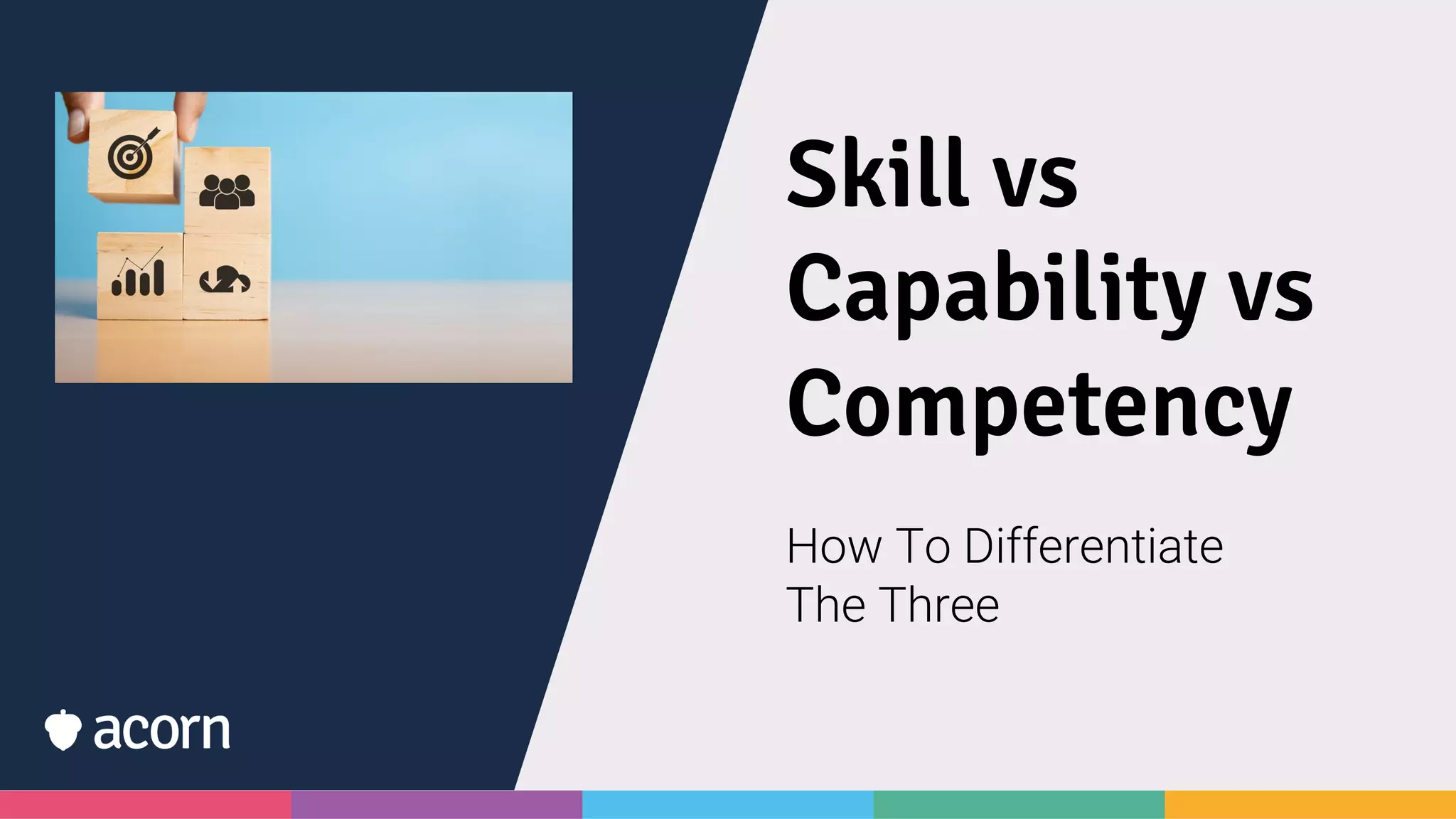
Skill vs
Capability vs
Competency
How To Differentiate
The Three
Are they different?
Skills, capabilities and competency each have their own place
in business planning activities. In fact, they are rather co-
dependant.
It’s easy to use the terms as synonyms for one another without
thinking, but shifting your mindset can help you understand the
true difference and the impacts each has on your business.
Skills
Definition
A learned ability, talent or expertise needed to perform a task, usually to an
industry standard or without supervision.
Examples
• Data Analysis
• Graphic Design
• Critical Thinking
• Determination
Use
Used for role-related things like skill statements and job descriptions, so
employers can assess if a person has the foundational abilities for a role. Skills
gaps are also used to shape professional development.
Importance
Skills matter most to recruitment, specific training initiatives and workplace
culture. They are usually bucketed into hard skills (technical and quantifiable)
and soft skills (behaviours, traits and habits).
Competency
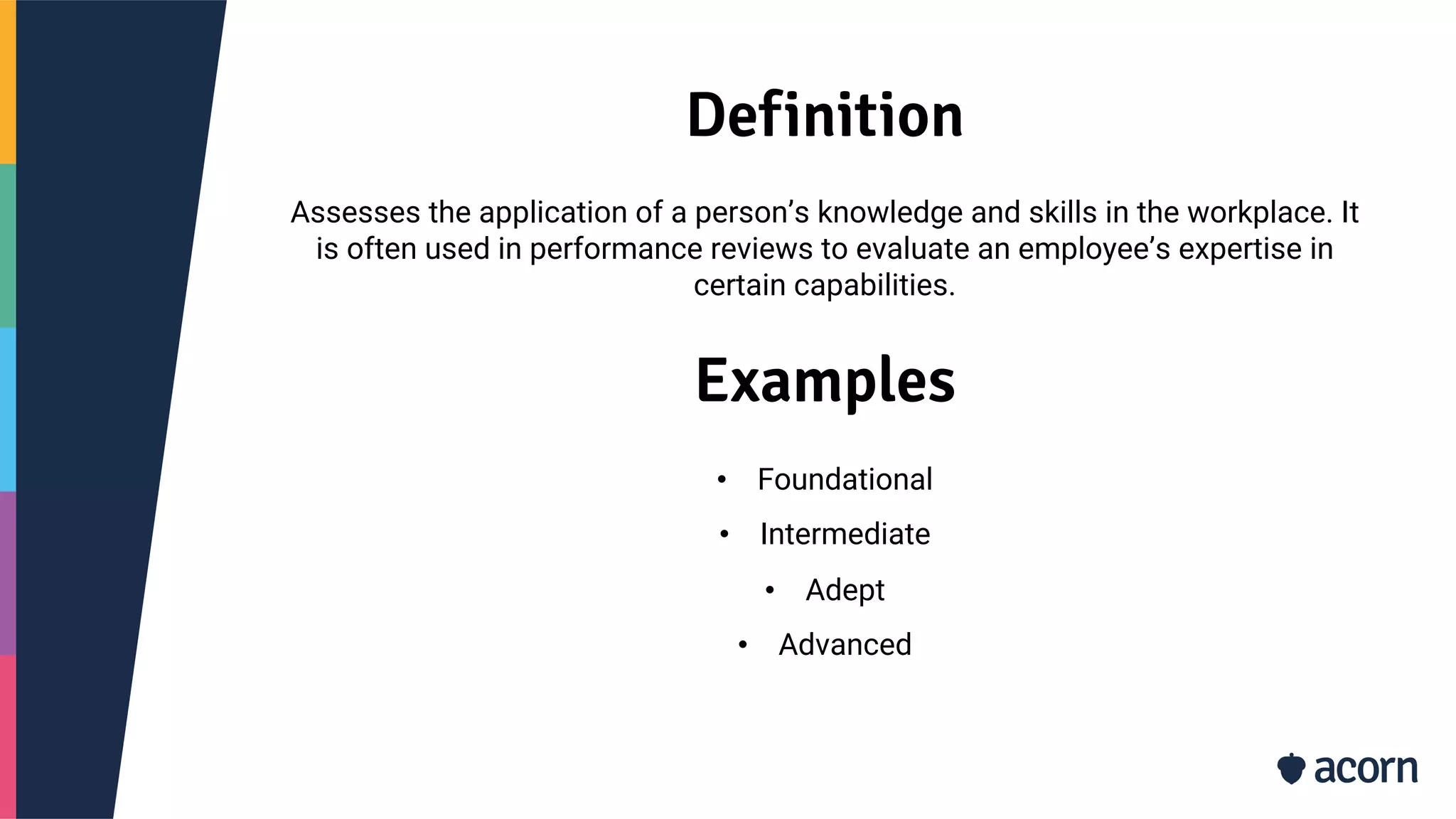
Definition
Assesses the application of a person’s knowledge and skills in the workplace. It
is often used in performance reviews to evaluate an employee’s expertise in
certain capabilities.
Examples
• Foundational
• Intermediate
• Adept
• Advanced
Use
Competence exists only to measure skills or capabilities. They operate as a fixed
scale of performance within which employees are expected to work.
Importance
They create a universal set of expectations. Clear communication on
expectations means that progress can effectively be monitored by L&D leaders
and employees can accurately self-assess their abilities.
Capability
Definition
A combination of personal and technical skills, knowledge, processes, tools and
behaviours that are critical to an organisation’s success and future needs.
Examples
• Manage Resources
• Deliver Results
• Change Management
Points of Difference
Capabilities are inherently stable. What you define as a core capability now will
be a key driver for your organisation in the future too, even if your business goals
change. This provides a sustainable framework for future business success.
Capabilities aren’t easily replicable in other organisations, unlike skills and
measures of competence. While two companies might rely on a capability, how
that capability is combined with mission-critical knowledge, internal tools and
processes, and cultural behaviours makes the difference.
You can learn more about this
topic by checking out the full
article:
https://acornlms.com/enterprise-learning-
management/skill-vs-capability-vs-competency

Skill vs Capability vs Competency

  • 1.
    Skill vs Capability vs Competency HowTo Differentiate The Three
  • 2.
    Are they different? Skills,capabilities and competency each have their own place in business planning activities. In fact, they are rather co- dependant. It’s easy to use the terms as synonyms for one another without thinking, but shifting your mindset can help you understand the true difference and the impacts each has on your business.
  • 3.
  • 4.
    Definition A learned ability,talent or expertise needed to perform a task, usually to an industry standard or without supervision. Examples • Data Analysis • Graphic Design • Critical Thinking • Determination
  • 5.
    Use Used for role-relatedthings like skill statements and job descriptions, so employers can assess if a person has the foundational abilities for a role. Skills gaps are also used to shape professional development. Importance Skills matter most to recruitment, specific training initiatives and workplace culture. They are usually bucketed into hard skills (technical and quantifiable) and soft skills (behaviours, traits and habits).
  • 6.
  • 7.
    Definition Assesses the applicationof a person’s knowledge and skills in the workplace. It is often used in performance reviews to evaluate an employee’s expertise in certain capabilities. Examples • Foundational • Intermediate • Adept • Advanced
  • 8.
    Use Competence exists onlyto measure skills or capabilities. They operate as a fixed scale of performance within which employees are expected to work. Importance They create a universal set of expectations. Clear communication on expectations means that progress can effectively be monitored by L&D leaders and employees can accurately self-assess their abilities.
  • 9.
  • 10.
    Definition A combination ofpersonal and technical skills, knowledge, processes, tools and behaviours that are critical to an organisation’s success and future needs. Examples • Manage Resources • Deliver Results • Change Management
  • 11.
    Points of Difference Capabilitiesare inherently stable. What you define as a core capability now will be a key driver for your organisation in the future too, even if your business goals change. This provides a sustainable framework for future business success. Capabilities aren’t easily replicable in other organisations, unlike skills and measures of competence. While two companies might rely on a capability, how that capability is combined with mission-critical knowledge, internal tools and processes, and cultural behaviours makes the difference.
  • 12.
    You can learnmore about this topic by checking out the full article: https://acornlms.com/enterprise-learning- management/skill-vs-capability-vs-competency