Capitalizing on Capabilities   Presented by Mariam Khan
"Our only limitations are those which we set up in our minds or permit others to establish for us."  –  Elizabeth Arden
Capability defined   Capability represents the identity of your firm as perceived by both your employees and your customers. It is your ability to perform better than competitors using a distinctive and difficult to replicate set of business attributes. Capability is a capacity for a set of resources to integratively perform a stretch task
Purpose  Although they may differ in degree, number, or type, intangible assets are important to all companies. However, because they are difficult to measure, we do not often hear about ways in which to measure them or even how important it is to measure them. Ulrich and Smallwood assert that a capabilities audit can make capabilities visible and meaningful to companies’ stakeholders (p. 127). This article describes what a capabilities audit is and gives a step-by-step method on how to conduct
Building Capability through Leadership Attributes    Leaders are responsible for building organizational capability. You need the ability to translate organizational direction into  roadmaps ,  vision  into action, and purpose into process. To do so, you must demonstrate at least five abilities:  To build your organizational infrastructure To  leverage diversity To  deploy teams To  design human resource systems To  make change happen .
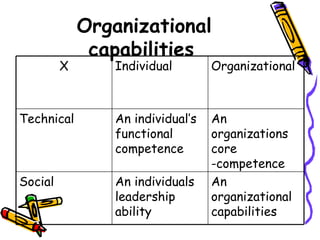
Organizational capabilities   An organizational capabilities  An individuals leadership ability  Social  An organizations core -competence  An individual’s functional competence  Technical  Organizational Individual  X
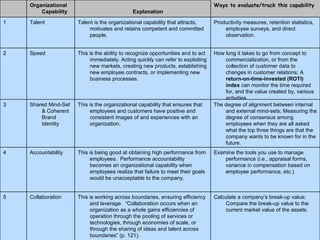
Calculate a company’s break-up value; Compare the break-up value to the current market value of the assets.  This is working across boundaries, ensuring efficiency and leverage.  “Collaboration occurs when an organization as a whole gains efficiencies of operation through the pooling of services or technologies, through economies of scale, or through the sharing of ideas and talent across boundaries” (p. 121).      Collaboration 5 Examine the tools you use to manage performance (i.e., appraisal forms, variance in compensation based on employee performance, etc.)  This is being good at obtaining high performance from employees.  Performance accountability becomes an organizational capability when employees realize that failure to meet their goals would be unacceptable to the company.     Accountability 4 The degree of alignment between internal and external mind-sets; Measuring the degree of consensus among employees when they are all asked what the top three things are that the company wants to be known for in the future.  This is the organizational capability that ensures that employees and customers have positive and consistent images of and experiences with an organization.     Shared Mind-Set & Coherent Brand Identity 3 How long it takes to go from concept to commercialization, or from the collection of customer data to changes in customer relations; A  return-on-time-invested (ROTI) index  can monitor the time required for, and the value created by, various activities.  This is the ability to recognize opportunities and to act immediately. Acting quickly can refer to exploiting new markets, creating new products, establishing new employee contracts, or implementing new business processes.     Speed  2 Productivity measures, retention statistics, employee surveys, and direct observation.      Talent is the organizational capability that attracts, motivates and retains competent and committed people.      Talent  1 Ways to evaluate/track this capability  Explanation  Organizational Capability
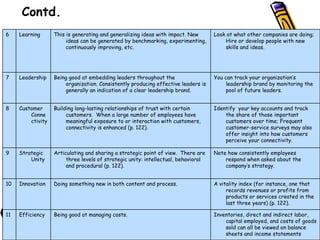
Contd. Inventories, direct and indirect labor, capital employed, and costs of goods sold can all be viewed on balance sheets and income statements Being good at managing costs.  Efficiency 11 A vitality index (for instance, one that records revenues or profits from products or services created in the last three years) (p. 122).  Doing something new in both content and process.     Innovation 10 Note how consistently employees respond when asked about the company’s strategy.  Articulating and sharing a strategic point of view.  There are three levels of strategic unity: intellectual, behavioral and procedural (p. 122).     Strategic Unity 9 Identify  your key accounts and track the share of those important customers over time; Frequent customer-service surveys may also offer insight into how customers perceive your connectivity.  Building long-lasting relationships of trust with certain customers.  When a large number of employees have meaningful exposure to or interaction with customers, connectivity is enhanced (p. 122).     Customer Connectivity 8 You can track your organization’s leadership brand by monitoring the pool of future leaders.  Being good at embedding leaders throughout the organization. Consistently producing effective leaders is generally an indication of a clear leadership brand.     Leadership 7 Look at what other companies are doing; Hire or develop people with new skills and ideas.  This is generating and generalizing ideas with impact. New ideas can be generated by benchmarking, experimenting, continuously improving, etc.        Learning 6
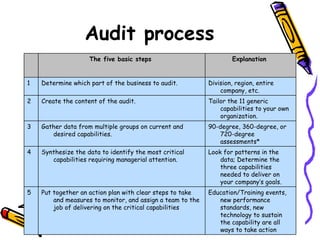
Audit process Education/Training events, new performance standards, new technology to sustain the capability are all ways to take action Put together an action plan with clear steps to take and measures to monitor, and assign a team to the job of delivering on the critical capabilities 5 Look for patterns in the data; Determine the three capabilities needed to deliver on your company’s goals. Synthesize the data to identify the most critical capabilities requiring managerial attention. 4 90-degree, 360-degree, or 720-degree assessments* Gather data from multiple groups on current and desired capabilities. 3 Tailor the 11 generic capabilities to your own organization. Create the content of the audit. 2 Division, region, entire company, etc. Determine which part of the business to audit. 1 Explanation  The five basic steps   
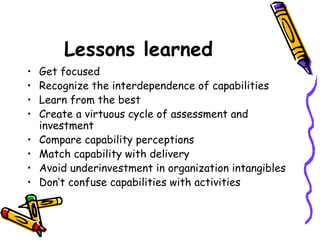
Lessons learned   Get focused Recognize the interdependence of capabilities Learn from the best Create a virtuous cycle of assessment and investment  Compare capability perceptions Match capability with delivery Avoid underinvestment in organization intangibles  Don’t confuse capabilities with activities
Thank you …

Capitalizing On Capabilities

  • 1.
    Capitalizing on Capabilities Presented by Mariam Khan
  • 2.
    "Our only limitationsare those which we set up in our minds or permit others to establish for us." – Elizabeth Arden
  • 3.
    Capability defined Capability represents the identity of your firm as perceived by both your employees and your customers. It is your ability to perform better than competitors using a distinctive and difficult to replicate set of business attributes. Capability is a capacity for a set of resources to integratively perform a stretch task
  • 4.
    Purpose Althoughthey may differ in degree, number, or type, intangible assets are important to all companies. However, because they are difficult to measure, we do not often hear about ways in which to measure them or even how important it is to measure them. Ulrich and Smallwood assert that a capabilities audit can make capabilities visible and meaningful to companies’ stakeholders (p. 127). This article describes what a capabilities audit is and gives a step-by-step method on how to conduct
  • 5.
    Building Capability throughLeadership Attributes   Leaders are responsible for building organizational capability. You need the ability to translate organizational direction into roadmaps , vision into action, and purpose into process. To do so, you must demonstrate at least five abilities: To build your organizational infrastructure To leverage diversity To deploy teams To design human resource systems To make change happen .
  • 6.
    Organizational capabilities An organizational capabilities An individuals leadership ability Social An organizations core -competence An individual’s functional competence Technical Organizational Individual X
  • 7.
    Calculate a company’sbreak-up value; Compare the break-up value to the current market value of the assets. This is working across boundaries, ensuring efficiency and leverage. “Collaboration occurs when an organization as a whole gains efficiencies of operation through the pooling of services or technologies, through economies of scale, or through the sharing of ideas and talent across boundaries” (p. 121).   Collaboration 5 Examine the tools you use to manage performance (i.e., appraisal forms, variance in compensation based on employee performance, etc.) This is being good at obtaining high performance from employees. Performance accountability becomes an organizational capability when employees realize that failure to meet their goals would be unacceptable to the company.   Accountability 4 The degree of alignment between internal and external mind-sets; Measuring the degree of consensus among employees when they are all asked what the top three things are that the company wants to be known for in the future. This is the organizational capability that ensures that employees and customers have positive and consistent images of and experiences with an organization.   Shared Mind-Set & Coherent Brand Identity 3 How long it takes to go from concept to commercialization, or from the collection of customer data to changes in customer relations; A return-on-time-invested (ROTI) index can monitor the time required for, and the value created by, various activities. This is the ability to recognize opportunities and to act immediately. Acting quickly can refer to exploiting new markets, creating new products, establishing new employee contracts, or implementing new business processes.   Speed 2 Productivity measures, retention statistics, employee surveys, and direct observation.   Talent is the organizational capability that attracts, motivates and retains competent and committed people.   Talent 1 Ways to evaluate/track this capability Explanation Organizational Capability
  • 8.
    Contd. Inventories, directand indirect labor, capital employed, and costs of goods sold can all be viewed on balance sheets and income statements Being good at managing costs. Efficiency 11 A vitality index (for instance, one that records revenues or profits from products or services created in the last three years) (p. 122). Doing something new in both content and process.   Innovation 10 Note how consistently employees respond when asked about the company’s strategy. Articulating and sharing a strategic point of view. There are three levels of strategic unity: intellectual, behavioral and procedural (p. 122).   Strategic Unity 9 Identify your key accounts and track the share of those important customers over time; Frequent customer-service surveys may also offer insight into how customers perceive your connectivity. Building long-lasting relationships of trust with certain customers. When a large number of employees have meaningful exposure to or interaction with customers, connectivity is enhanced (p. 122).   Customer Connectivity 8 You can track your organization’s leadership brand by monitoring the pool of future leaders. Being good at embedding leaders throughout the organization. Consistently producing effective leaders is generally an indication of a clear leadership brand.   Leadership 7 Look at what other companies are doing; Hire or develop people with new skills and ideas. This is generating and generalizing ideas with impact. New ideas can be generated by benchmarking, experimenting, continuously improving, etc.     Learning 6
  • 9.
    Audit process Education/Trainingevents, new performance standards, new technology to sustain the capability are all ways to take action Put together an action plan with clear steps to take and measures to monitor, and assign a team to the job of delivering on the critical capabilities 5 Look for patterns in the data; Determine the three capabilities needed to deliver on your company’s goals. Synthesize the data to identify the most critical capabilities requiring managerial attention. 4 90-degree, 360-degree, or 720-degree assessments* Gather data from multiple groups on current and desired capabilities. 3 Tailor the 11 generic capabilities to your own organization. Create the content of the audit. 2 Division, region, entire company, etc. Determine which part of the business to audit. 1 Explanation The five basic steps  
  • 10.
    Lessons learned Get focused Recognize the interdependence of capabilities Learn from the best Create a virtuous cycle of assessment and investment Compare capability perceptions Match capability with delivery Avoid underinvestment in organization intangibles Don’t confuse capabilities with activities
  • 11.