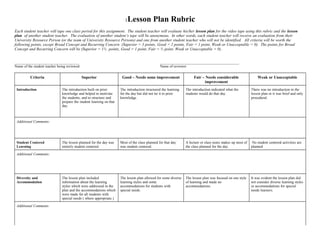
1Lesson Plan Rubric
Each student teacher will tape one class period for this assignment. The student teacher will evaluate his/her lesson plan for the video tape using this rubric and the lesson
plan of another student teacher. The evaluation of another student’s tape will be anonymous. In other words, each student teacher will receive an evaluation from their
University Resource Person (or the team of University Resource Persons) and one from another student teacher who will not be identified. All criteria will be worth the
following points, except Broad Concept and Recurring Concern (Superior = 3 points, Good = 2 points, Fair = 1 point, Weak or Unacceptable = 0). The points for Broad
Concept and Recurring Concern will be (Superior = 1½ points, Good = 1 point, Fair = ½ point, Weak or Unacceptable = 0).
___________________________________ ___________________________________________
Name of the student teacher being reviewed Name of reviewer
Criteria Superior Good – Needs some improvement Fair – Needs considerable
improvement
Weak or Unacceptable
Introduction The introduction built on prior
knowledge and helped to motivate
the students, and to structure and
prepare the student learning on that
day.
The introduction structured the learning
for the day but did not tie it to prior
knowledge.
The introduction indicated what the
students would do that day.
There was no introduction in the
lesson plan or it was brief and only
procedural.
Additional Comments:
Student Centered
Learning
The lesson planned for the day was
entirely student centered.
Most of the class planned for that day
was student centered.
A lecture or class notes makes up most of
the class planned for the day
No student centered activities are
planned
Additional Comments:
Diversity and
Accommodation
The lesson plan included
information about the learning
styles which were addressed in the
plan and the accommodations which
were made for all students with
special needs ( where appropriate.)
The lesson plan allowed for some diverse
learning styles and some
accommodations for students with
special needs.
The lesson plan was focused on one style
of learning and made no
accommodations.
It was evident the lesson plan did
not consider diverse learning styles
or accommodations for special
needs learners.
Additional Comments
Recurring Concern The lesson plan includes a well
written appropriate recurring
concern. It contains all the essential
characteristics: no right answer and
solved through reflection/judgment;
recurs generation after generation;
value related; multiple perspectives
The lesson plan included an appropriate
recurring concern. It could be written in
a more appropriate manner. It lacks one
or two essential characteristics.
The lesson plan included an appropriate
recurring concern. It is not well written
and it lacks three or more essential
characteristics.
No recurring concern is included or
it is a technical, not reflective
problem.
Additional Comments:
Broad Concept An appropriate broad concept for
the recurring concern has been
identified. The lesson CLEARLY
addresses the broad concept.
Students would know the broad
concept they are working on by the
end of the lesson. It allows for
un-coverage; it has lasting value;
and it allows students to become
engaged in learning.
An appropriate broad concept for the
recurring concern has been identified.
The lesson CLEARLY addresses the
broad concept. More attention should be
paid to the students understanding of the
concept by the end of the lesson.
The lesson vaguely addresses a broad
concept. Students will not be aware of
this broad concept. It meets only two of
the criteria.
The concept does not relate to the
lesson. It meets less than two of
the criteria.
Additional Comments:
Learner Outcomes Learner outcomes are:
• well developed and clearly stated.
• written in the appropriate form
• require a higher level of thinking
• represent more than one domain
of learning or facet of
understanding
The lesson is designed so the
learner outcomes can be
accomplished. Learner outcomes are
appropriately linked to standards.
Learner outcomes are correctly stated.
Most of the outcomes can be
accomplished by the end of the lesson.
The level of thinking is not at the
appropriate level and could be higher.
Some learner outcomes are linked
appropriately to standards.
Learner outcomes are written but could
be improved greatly. The lesson will not
allow the student to accomplish the
learner outcomes. The outcomes are
written at a lower level of thinking
Learner outcomes were not linked to
standards.
There are no learner outcomes or
they are very poorly written. The
lesson is not connected to the
learner outcomes. Thinking is at a
factual or knowledge level.
Learner outcomes were not linked
to standards.
Additional Comments:
Transitions and
Organization
Transitions are written and well
planned to move the students from
one concept or activity to another.
The transitions and organization of
the lesson will help the student to
structure their learning and build
upon their knowledge.
Some transitions are written, but most
are just to notify the student of a change
in topic, they do not help the student
structure their learning or build upon
their knowledge.
Few transitions are written. The plan
does not show a logical progression of
learning. The activities seem to jump
from on concept to another with little
connection.
There are no written transitions.
Poor organization of activities with
no connections.
Additional Comments:
Key Questions Key questions are planned to help
the student reach higher levels of
thinking and understanding. The
key questions
• are open ended
• help the student better understand
the lesson,
• examine the relationships
between concepts ,
• transfer concepts to everyday life
• help examine the conditions of
society.
Questions are sequenced
appropriately.
Some questions are planned to help the
students understand lesson. Some are
open ended, but some are closed. Most
are sequenced appropriately. They seem
to focus mostly on “surface” learning
without depth.
Few key questions are planned. Most
are closed questions or focus on surface
learning. They do not help the student
better understand the lesson or go
beyond the surface.
Key questions are not planned.
Additional Comments:
Assessment The lesson plan identifies strategies
for assessment. The strategy is
targeted toward collecting data to
assess progress toward the day/units
learner outcome(s). The planned
strategy should provide information
about student progress.
The lesson plan identifies at least one
strategy for assessment. The strategy
may be useful but could be improved.
The lesson plan includes an assessment
strategy but it will not obtain the data
needed to assess progress toward the
learner outcome for that day/unit.
The teacher does not use a strategy
for assessment.
Additional Comments:
Closure The lesson plan includes an
effective closure to the class.
Students will be able to summarize
or reflect on their learning. It plans
for concluding today’s learning and
the connection to tomorrow.
The lesson plan includes a closure to the
class. Students will be able to
summarize or reflect on their learning.
The plan does not have a connection to
tomorrow’s learning.
The closure given in the lesson plan is
procedural or gives the students the
assignments for the next day.
The lesson plan does not include a
closure.
Additional Comments:
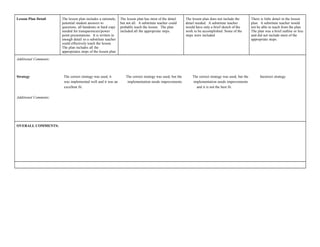
Lesson Plan Detail The lesson plan includes a rationale,
potential student answers to
questions, all handouts or hard copy
needed for transparencies/power
point presentations. It is written in
enough detail so a substitute teacher
could effectively teach the lesson.
The plan includes all the
appropriates steps of the lesson plan
The lesson plan has most of the detail
but not all. A substitute teacher could
probably teach the lesson. The plan
included all the appropriate steps.
The lesson plan does not include the
detail needed. A substitute teacher
would have only a brief sketch of the
work to be accomplished. Some of the
steps were included
There is little detail in the lesson
plan. A substitute teacher would
not be able to teach from the plan.
The plan was a brief outline or less
and did not include most of the
appropriate steps.
Additional Comments:
Strategy The correct strategy was used, it The correct strategy was used, but the The correct strategy was used, but the Incorrect strategy
was implemented well and it was an implementation needs improvements. implementation needs improvements
excellent fit. and it is not the best fit.
Additional Comments:
OVERALL COMMENTS:

Lesson plan rubric (1)

  • 1.
    1Lesson Plan Rubric Eachstudent teacher will tape one class period for this assignment. The student teacher will evaluate his/her lesson plan for the video tape using this rubric and the lesson plan of another student teacher. The evaluation of another student’s tape will be anonymous. In other words, each student teacher will receive an evaluation from their University Resource Person (or the team of University Resource Persons) and one from another student teacher who will not be identified. All criteria will be worth the following points, except Broad Concept and Recurring Concern (Superior = 3 points, Good = 2 points, Fair = 1 point, Weak or Unacceptable = 0). The points for Broad Concept and Recurring Concern will be (Superior = 1½ points, Good = 1 point, Fair = ½ point, Weak or Unacceptable = 0). ___________________________________ ___________________________________________ Name of the student teacher being reviewed Name of reviewer Criteria Superior Good – Needs some improvement Fair – Needs considerable improvement Weak or Unacceptable Introduction The introduction built on prior knowledge and helped to motivate the students, and to structure and prepare the student learning on that day. The introduction structured the learning for the day but did not tie it to prior knowledge. The introduction indicated what the students would do that day. There was no introduction in the lesson plan or it was brief and only procedural. Additional Comments: Student Centered Learning The lesson planned for the day was entirely student centered. Most of the class planned for that day was student centered. A lecture or class notes makes up most of the class planned for the day No student centered activities are planned Additional Comments: Diversity and Accommodation The lesson plan included information about the learning styles which were addressed in the plan and the accommodations which were made for all students with special needs ( where appropriate.) The lesson plan allowed for some diverse learning styles and some accommodations for students with special needs. The lesson plan was focused on one style of learning and made no accommodations. It was evident the lesson plan did not consider diverse learning styles or accommodations for special needs learners. Additional Comments
  • 2.
    Recurring Concern Thelesson plan includes a well written appropriate recurring concern. It contains all the essential characteristics: no right answer and solved through reflection/judgment; recurs generation after generation; value related; multiple perspectives The lesson plan included an appropriate recurring concern. It could be written in a more appropriate manner. It lacks one or two essential characteristics. The lesson plan included an appropriate recurring concern. It is not well written and it lacks three or more essential characteristics. No recurring concern is included or it is a technical, not reflective problem. Additional Comments: Broad Concept An appropriate broad concept for the recurring concern has been identified. The lesson CLEARLY addresses the broad concept. Students would know the broad concept they are working on by the end of the lesson. It allows for un-coverage; it has lasting value; and it allows students to become engaged in learning. An appropriate broad concept for the recurring concern has been identified. The lesson CLEARLY addresses the broad concept. More attention should be paid to the students understanding of the concept by the end of the lesson. The lesson vaguely addresses a broad concept. Students will not be aware of this broad concept. It meets only two of the criteria. The concept does not relate to the lesson. It meets less than two of the criteria. Additional Comments: Learner Outcomes Learner outcomes are: • well developed and clearly stated. • written in the appropriate form • require a higher level of thinking • represent more than one domain of learning or facet of understanding The lesson is designed so the learner outcomes can be accomplished. Learner outcomes are appropriately linked to standards. Learner outcomes are correctly stated. Most of the outcomes can be accomplished by the end of the lesson. The level of thinking is not at the appropriate level and could be higher. Some learner outcomes are linked appropriately to standards. Learner outcomes are written but could be improved greatly. The lesson will not allow the student to accomplish the learner outcomes. The outcomes are written at a lower level of thinking Learner outcomes were not linked to standards. There are no learner outcomes or they are very poorly written. The lesson is not connected to the learner outcomes. Thinking is at a factual or knowledge level. Learner outcomes were not linked to standards. Additional Comments: Transitions and Organization Transitions are written and well planned to move the students from one concept or activity to another. The transitions and organization of the lesson will help the student to structure their learning and build upon their knowledge. Some transitions are written, but most are just to notify the student of a change in topic, they do not help the student structure their learning or build upon their knowledge. Few transitions are written. The plan does not show a logical progression of learning. The activities seem to jump from on concept to another with little connection. There are no written transitions. Poor organization of activities with no connections.
  • 3.
    Additional Comments: Key QuestionsKey questions are planned to help the student reach higher levels of thinking and understanding. The key questions • are open ended • help the student better understand the lesson, • examine the relationships between concepts , • transfer concepts to everyday life • help examine the conditions of society. Questions are sequenced appropriately. Some questions are planned to help the students understand lesson. Some are open ended, but some are closed. Most are sequenced appropriately. They seem to focus mostly on “surface” learning without depth. Few key questions are planned. Most are closed questions or focus on surface learning. They do not help the student better understand the lesson or go beyond the surface. Key questions are not planned. Additional Comments: Assessment The lesson plan identifies strategies for assessment. The strategy is targeted toward collecting data to assess progress toward the day/units learner outcome(s). The planned strategy should provide information about student progress. The lesson plan identifies at least one strategy for assessment. The strategy may be useful but could be improved. The lesson plan includes an assessment strategy but it will not obtain the data needed to assess progress toward the learner outcome for that day/unit. The teacher does not use a strategy for assessment. Additional Comments: Closure The lesson plan includes an effective closure to the class. Students will be able to summarize or reflect on their learning. It plans for concluding today’s learning and the connection to tomorrow. The lesson plan includes a closure to the class. Students will be able to summarize or reflect on their learning. The plan does not have a connection to tomorrow’s learning. The closure given in the lesson plan is procedural or gives the students the assignments for the next day. The lesson plan does not include a closure. Additional Comments:
  • 4.
    Lesson Plan DetailThe lesson plan includes a rationale, potential student answers to questions, all handouts or hard copy needed for transparencies/power point presentations. It is written in enough detail so a substitute teacher could effectively teach the lesson. The plan includes all the appropriates steps of the lesson plan The lesson plan has most of the detail but not all. A substitute teacher could probably teach the lesson. The plan included all the appropriate steps. The lesson plan does not include the detail needed. A substitute teacher would have only a brief sketch of the work to be accomplished. Some of the steps were included There is little detail in the lesson plan. A substitute teacher would not be able to teach from the plan. The plan was a brief outline or less and did not include most of the appropriate steps. Additional Comments: Strategy The correct strategy was used, it The correct strategy was used, but the The correct strategy was used, but the Incorrect strategy was implemented well and it was an implementation needs improvements. implementation needs improvements excellent fit. and it is not the best fit. Additional Comments: OVERALL COMMENTS: