Targeting the TAKS  Open-Ended Response Hitting the Mark in the ELA Classroom TCTELA  41st Annual Conference January 20, 2006
Welcome! Diane Peterson  Education Specialist, Secondary Language Arts   dpeterson@esc4.net  713.744.6829
Writing Responses for the TAKS Open-Ended Items Examine open-ended item student responses to identify the qualities and components of a successful response.  Participants will analyze the TAKS Reading Rubrics and discuss the resultant “best practices” in the ELA classroom.
Plans Successful responses—what should be included? 2.  Content scoring—what skills does the open-ended item assess? 3.  Best practices—what should I see in the ELA classroom?
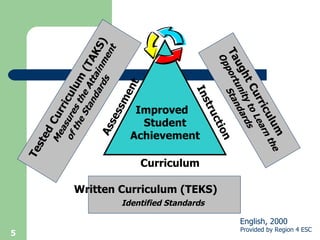
Curriculum Assessment Instruction Improved  Student Achievement English, 2000 Written Curriculum (TEKS)  Identified Standards   Taught Curriculum  Opportunity to Learn the Standards Tested Curriculum (TAKS)  Measures the Attainment of the Standards
Successful Responses What should be included?
What Is the “ OER ”? The TAKS open-ended items are three short answer questions that require the student to write  a multi-sentence response .  These items are based upon the “triplet” found in the Reading/ELA section of TAKS assessments for grades 9-11 Exit.  OER  =  O pen- E nded  R esponse
What Is the Triplet? 1 st  Part :   a published literary work, either a short story or an excerpt from a novel
What Is the Triplet? 2 nd  Part :   a published expository (informational, nonfiction) passage, either an article from a newspaper or magazine, an excerpt from a memoir, a journal entry, essay, editorial, or an excerpt from a biography or autobiography
What Is the Triplet? 3 rd  Part :   a visual media selection reflecting a web page, advertisement, or poster which enables students to make visual connections to the other two passages
What Is the Triplet? 1 st  part (literary) +  2 nd  part (expository) +  3 rd  part (visual media) = a thematically-linked triplet!
What “Parts” Are Needed for a Successful Response? TWO-PARTER :  Students must offer a reasonable idea and pull textual evidence that  validates  that idea.  THREE-PARTER :  Change questions call for two pieces of evidence. FOUR-PARTER :  Cross-over responses must include analysis from each piece and evidence from each piece.
Crafting a Response 1.  Provide a clear  answer  to the question. 2.  Provide multiple pieces of  support  directly from the passage.  Direct quotations (usually partial), paraphrases (author’s words in student writer’s own words), or synopses (specific summary) are acceptable. All sentences should connect to each other and it should be clear why the evidence given is significant to the answer. 3.  Connect  the answer to the support.  This is not done with a separate sentence but should be clear from the idea and choice of evidence. 4.  Craft  the answer into a  coherent ,  logical progression of ideas  and  evidence  that  answers the question fully  and  proves the statement .
Why Use OER Items? TAKS open-ended items are short answer questions such as those typically asked of English/Language Arts students in class.  They are linked to TAKS Objectives 2 and 3 and the corresponding foundational TEKS (10B).  This provides a clear connection between the TAKS assessment and classroom instruction.
Content Scoring What skills does the  open-ended item assess?
Content Scoring Items are part of the  reading  portion of the TAKS and are  content  scored.  Responses must include a reasonable  idea  (analysis) and textual  support  (evidence). Writing skills are not assessed here.  Only  clarity  is mentioned in the rubrics.  These responses are judged  conceptually , not  contextually .
What Skill is Tested (TEKS)? (10) Reading/literary response.  The student  expresses and supports responses to  various types of texts.  The student is  expected to: (B) use elements of text to defend,  clarify, and negotiate responses and  interpretations.
Types of Items Objective 2:   The student will apply knowledge of literary elements to understand culturally diverse written texts. The  first  open-ended item is based on the  literary  selection.    
Types of Items   Objective 3:   The student will demonstrate the ability to analyze and critically evaluate culturally diverse written texts and visual representations.  The  second  item is based on the  expository  selection.
Types of Items   Objective 3:   The student will demonstrate the ability to analyze and critically evaluate culturally diverse written texts and visual representations.  The  third  item is based on  both  selections.
What Are Rubrics? Powerful instructional tools that clarify expectations Explicitly worded descriptions for each score point Teaching is t argeted . Student performance is  focused .
Three Rubrics There is a specific rubric for each open-ended item.  Examine each rubric  (literary, expository, and crossover)  for similarities and differences  of each score point.
Students as Self-Assessors “ Students who are taught to use criteria know when they are doing well, without waiting for outside confirmation, and when things go wrong, they know what to do about it.” Spandel, 2001
0  Insufficient Too general or vague to determine whether it is reasonable   ~OR~ Incorrect interpretation not based on text   ~OR~ Plot summary
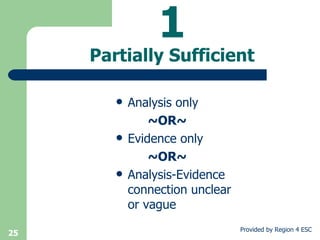
1 Partially Sufficient Analysis only ~OR~ Evidence only ~OR~ Analysis-Evidence connection unclear or vague
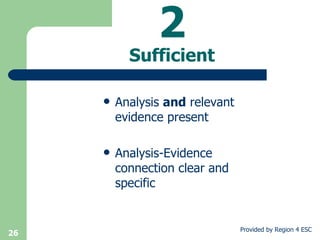
2 Sufficient Analysis  and  relevant evidence present Analysis-Evidence connection clear and specific
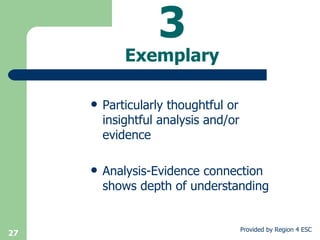
3 Exemplary Particularly thoughtful or insightful analysis and/or evidence Analysis-Evidence connection shows depth of understanding
Using Student Responses Read the passage, annotate, discuss. 3.  View the appropriate rubric. 4.  Answer the item with a partner, save responses.  5.  View the components of a successful answer. 7.  Evaluate responses in light of samples. 2.  View the Open-Ended Item. 6.  View the samples and discuss their scoring.
Best Practices What should I see in the ELA classroom?
Research Confirms All students benefit from a strong reading and writing connection. When students respond through writing to what they have read, writing  and  reading improve. Written responses require higher-order thinking and critical-thinking skills.
“Thoughtful Literacy” Remembering  ≠ Understanding ______________________________________ Recitation of Texts ≠ Consideration and Discussion of Texts Alllington, 2001
We should “construct lessons that help make the comprehension processes visible.” Students need “demonstrations of effective strategy use.” “Thoughtful Literacy” Alllington, 2001
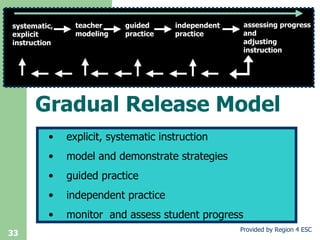
systematic,  explicit  instruction teacher  modeling guided  practice independent  practice assessing progress  and  adjusting  instruction systematic,  explicit  instruction teacher  modeling guided  practice independent  practice assessing progress  and  adjusting  instruction explicit, systematic instruction  model and demonstrate strategies guided practice independent practice monitor  and assess student progress Gradual Release Model
Finding Evidence Citing Evidence using quotes, paraphrase, and synopsis learning when to use each type of evidence Connecting evidence to analysis (or answer) Remember—this is not a connection to “real world” or a new idea! Comparing works of literature (or art) Teaching the OER
Students need multiple, frequent opportunities to  practice  the skills involved in successfully responding to an open-ended item. Teachers must  model  the skills involved and provide opportunities for guided practice before independent practice or assessment. Since multiple skills are involved, teachers must focus on the discrete  skills  as well as the “big picture.” Teaching the OER
Since multiple skills are involved, teachers must focus on the  discrete skills  as well as the “big picture.” Analyzing texts to find an answer  (close reading, annotating, graphic organizers,  discussion, questioning) Forming a coherent answer What About the Writing Process?
What About the Writing Process? (1) Writing/purposes.   The student writes in a variety  of forms, including business, personal, literary, and  persuasive texts, for various audiences and purposes.  The student is expected to: (B) write in a voice and style appropriate to  audience and purpose; and (C) organize ideas in writing to ensure coherence,  logical progression, and support for ideas.
What About the Writing Process? Writing/writing processes.   The student uses  recursive writing processes when appropriate.  The student is expected to: (B) develop drafts by organizing and  reorganizing content and by refining style  to suit occasion, audience, and purpose; and (C) proofread writing for appropriateness of  organization, content, style, and  conventions.
What About the Writing Process? Even though the open-ended item is part of the  reading  assessment, the  writing  process still applies as the students  craft  their responses. 1.  Prewriting the parts 2.  Rough draft in test booklet 3.  Final copy in the lined boxes
CLOSE READING is a careful application of a “microscope” or “binoculars” to a text, enabling the reader to go beyond literal meaning and experience the author’s craft.  ANNOTATING is the backbone of close reading.  Close Reading
What is Annotating? For use while reading or rereading Helps readers reach a deeper level of  engagement Promotes active reading “ Dialogue with the text” (Probst) A visible record of the thoughts that emerge while making sense of the reading A writing-to-learn strategy
Ask students to identify the ways readers think about text while reading, such as: Teaching the OER Making predictions Asking questions Stating opinions Analyzing the author’s craft Making connections Reflecting on the content Reflecting on their own reading process
Annotation Bookmark BEFORE READING: Examine the front and back covers (books) Read the title and any subtitles Examine the illustrations Examine the print (bold, italics, etc.) Examine the way the text is set up (book, short story, diary, dialogue, article, etc.) As you examine and read these, write questions, and make predictions and/or connections near these parts of the text.
DURING READING: Mark in the text: Characters  (who) When (setting) Where (setting) Vocabulary  ~~~~~ _______  Important information   Annotation Bookmark
DURING READING: Write in the margins: Summarize Make predictions Formulate opinions Make connections Ask questions Analyze the author’s craft Write reflections/reactions/comments Look for patterns/repetitions  Annotation Bookmark
Annotation Bookmark AFTER READING: Reread annotations—draw conclusions Reread introduction and conclusion—try to figure out something new Examine patterns/repetitions—determine possible meanings Determine what the title might mean   Use the “After Reading” strategies to write a notebook entry.
Use short story that can be read in one period Make each student a copy of story Make a transparency of each page Give students Annotating Bookmarks Make a transparency of Bookmark Create a coding system with different marks for surface meaning and deep-meaning ideas How to Teach Annotating
Annotation Lesson Have students mark text using coding system. Stop at end of page. Allow students to go back and add marks. Ask students to share what they have marked. Make the same marks on the transparency. Ask for comments and write in margin. Read first page to students while they  read along.
Annotation Methods Photocopy the document. Use a dialectical journal. Use index cards. Use Post-it ®  notes or flags. Use highlighter tape.
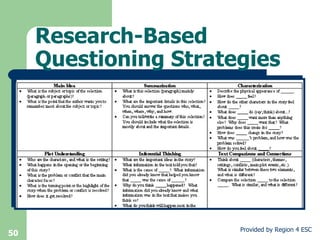
Research-Based Questioning Strategies
Creating Questions Use question stems to create questions for literary pieces you are reading in class. Literary Stems What was one conflict ____ faced in “_____”?  In “____” how does ____ connect to _____?  How does _____ change from the beginning to the end of “___”?  What is the major conflict _____ faces in “_____”? 
Creating Questions Literary Stems In “______,” what does ____ learn from his/her experience with ____? In “_____,” why does  ____   ____? (character)  (action)  
Creating Questions Expository Stems In “_____,” has ____ fulfilled his/her dream? In “_____,” how have the author’s experiences shaped his/her attitude toward others? How does the author’s attitude toward _____ change over the course of “_____”?
Creating Questions Expository Stems Why is “_____” a good title for this selection? Why are memories of _____ important to _____? In “____,” who do you think is more successful, ____ or ____?
Creating Questions Crossover Stems How does the idea of taking a risk apply to both “___” and “___”? How do the parents in “___” and “____” attempt to share their cultural heritage with their children? Which of the siblings from “____” and “____” would you like to have as a brother/sister?  
Creating Questions Crossover Stems How is the concept of __ important in both “___” and “__”? How is the idea of ____important in both “___” and “___”? What is one characteristic shared by (____) and (____).      char. from lit. passage  char. from exp. Passage How is ___ an important theme in both “___” and “___”?
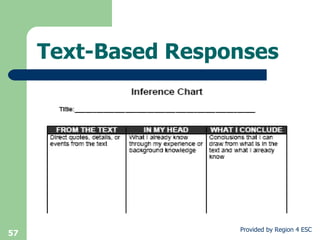
Text-Based Responses
Types of Evidence DIRECT QUOTATION What?  verbatim words, phrases, or parts of sentences from the text When?  author’s exact words are necessary and will add depth, precision, or reliability to the response
Types of Evidence PARAPHRASE What? restatement of author’s words preserving the main ideas and key details When? ideas could be clarified or original word choice is irrelevant
Types of Evidence  SPECIFIC SYNOPSIS What?  a focused choice of linked portions; not a plot summary When? several portions are needed to serve as textual evidence
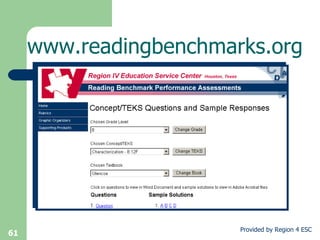
www.readingbenchmarks.org
Pairing Works Use paired works in class frequently. Genres/Forms to consider in pairing works Films/“Movies” Television Shows  Songs Poems Research Findings Magazine Articles Artwork Web Pages
Pairing Works The Catcher in the Rye   “Acquainted with the Night” by J.D. Salinger by Robert Frost Novel Poem Example Connection:  The city as a lonely, uncomfortable place
Pairing Works To Kill a Mockingbird  Radio by Harper Lee  By Mike Rich Novel Film Example Connection:  Men attempting to effect a change in racial tolerance
Pairing Works Romeo and Juliet  “Teen Love Hurts:  Falling  In Love Makes Teens Prone  to Depression and Alcohol  Abuse” by William Shakespeare  by Malcolm Ritter Novel News Article Example Connection:  The negative effects of teenagers falling in love
Pairing Works “ The Gettysburg Address”  “Frederick Douglass” by Abraham Lincoln  by Robert Hayden Speech Poem Example Connection:  Leaving legacies beyond physical monuments
Resources Allington, Richard L.  What Really Matters for Struggling Readers:  Designing Research-Based Programs .  New York:  Longman, 2001.  Berthoff, Ann E.  “Dialectical Notebooks and the Audit of Meaning.”  The Journal Book . Ed. Toby Fulwieler. Portsmouth: Boynton/Cook, 1987.  11-18. English, Fenwick W.  Deciding What to Teach and Test:  Developing, Aligning, and Auditing the Curriculum .  Thousand Oaks, CA:  Corwin Press, Inc., 2000. Porter-O’Donnell.  “Beyond the Yellow Highlighter.”  English Journal  93.5 (2004):  82-89. Probst, Robert E.  “Dialogue with a Text.”  English Journal  77.1 (1988):  32-38. Spandel, Vicki.  Creating Writers Through 6-Trait Writing Assessment and Instruction.   New York:  Addison Wesley Longman, 2001.
Thank you! If you design or observe teaching strategies that really work for the OER, please let me know! Diane Peterson 713-744-6829 [email_address]

Open ended Responses

  • 1.
    Targeting the TAKS Open-Ended Response Hitting the Mark in the ELA Classroom TCTELA 41st Annual Conference January 20, 2006
  • 2.
    Welcome! Diane Peterson Education Specialist, Secondary Language Arts dpeterson@esc4.net 713.744.6829
  • 3.
    Writing Responses forthe TAKS Open-Ended Items Examine open-ended item student responses to identify the qualities and components of a successful response. Participants will analyze the TAKS Reading Rubrics and discuss the resultant “best practices” in the ELA classroom.
  • 4.
    Plans Successful responses—whatshould be included? 2. Content scoring—what skills does the open-ended item assess? 3. Best practices—what should I see in the ELA classroom?
  • 5.
    Curriculum Assessment InstructionImproved Student Achievement English, 2000 Written Curriculum (TEKS) Identified Standards Taught Curriculum Opportunity to Learn the Standards Tested Curriculum (TAKS) Measures the Attainment of the Standards
  • 6.
    Successful Responses Whatshould be included?
  • 7.
    What Is the“ OER ”? The TAKS open-ended items are three short answer questions that require the student to write a multi-sentence response . These items are based upon the “triplet” found in the Reading/ELA section of TAKS assessments for grades 9-11 Exit. OER = O pen- E nded R esponse
  • 8.
    What Is theTriplet? 1 st Part : a published literary work, either a short story or an excerpt from a novel
  • 9.
    What Is theTriplet? 2 nd Part : a published expository (informational, nonfiction) passage, either an article from a newspaper or magazine, an excerpt from a memoir, a journal entry, essay, editorial, or an excerpt from a biography or autobiography
  • 10.
    What Is theTriplet? 3 rd Part : a visual media selection reflecting a web page, advertisement, or poster which enables students to make visual connections to the other two passages
  • 11.
    What Is theTriplet? 1 st part (literary) + 2 nd part (expository) + 3 rd part (visual media) = a thematically-linked triplet!
  • 12.
    What “Parts” AreNeeded for a Successful Response? TWO-PARTER : Students must offer a reasonable idea and pull textual evidence that validates that idea. THREE-PARTER : Change questions call for two pieces of evidence. FOUR-PARTER : Cross-over responses must include analysis from each piece and evidence from each piece.
  • 13.
    Crafting a Response1. Provide a clear answer to the question. 2. Provide multiple pieces of support directly from the passage. Direct quotations (usually partial), paraphrases (author’s words in student writer’s own words), or synopses (specific summary) are acceptable. All sentences should connect to each other and it should be clear why the evidence given is significant to the answer. 3. Connect the answer to the support. This is not done with a separate sentence but should be clear from the idea and choice of evidence. 4. Craft the answer into a coherent , logical progression of ideas and evidence that answers the question fully and proves the statement .
  • 14.
    Why Use OERItems? TAKS open-ended items are short answer questions such as those typically asked of English/Language Arts students in class. They are linked to TAKS Objectives 2 and 3 and the corresponding foundational TEKS (10B). This provides a clear connection between the TAKS assessment and classroom instruction.
  • 15.
    Content Scoring Whatskills does the open-ended item assess?
  • 16.
    Content Scoring Itemsare part of the reading portion of the TAKS and are content scored. Responses must include a reasonable idea (analysis) and textual support (evidence). Writing skills are not assessed here. Only clarity is mentioned in the rubrics. These responses are judged conceptually , not contextually .
  • 17.
    What Skill isTested (TEKS)? (10) Reading/literary response. The student expresses and supports responses to various types of texts. The student is expected to: (B) use elements of text to defend, clarify, and negotiate responses and interpretations.
  • 18.
    Types of ItemsObjective 2: The student will apply knowledge of literary elements to understand culturally diverse written texts. The first open-ended item is based on the literary selection.  
  • 19.
    Types of Items  Objective 3: The student will demonstrate the ability to analyze and critically evaluate culturally diverse written texts and visual representations. The second item is based on the expository selection.
  • 20.
    Types of Items  Objective 3: The student will demonstrate the ability to analyze and critically evaluate culturally diverse written texts and visual representations. The third item is based on both selections.
  • 21.
    What Are Rubrics?Powerful instructional tools that clarify expectations Explicitly worded descriptions for each score point Teaching is t argeted . Student performance is focused .
  • 22.
    Three Rubrics Thereis a specific rubric for each open-ended item. Examine each rubric (literary, expository, and crossover) for similarities and differences of each score point.
  • 23.
    Students as Self-Assessors“ Students who are taught to use criteria know when they are doing well, without waiting for outside confirmation, and when things go wrong, they know what to do about it.” Spandel, 2001
  • 24.
    0 InsufficientToo general or vague to determine whether it is reasonable ~OR~ Incorrect interpretation not based on text ~OR~ Plot summary
  • 25.
    1 Partially SufficientAnalysis only ~OR~ Evidence only ~OR~ Analysis-Evidence connection unclear or vague
  • 26.
    2 Sufficient Analysis and relevant evidence present Analysis-Evidence connection clear and specific
  • 27.
    3 Exemplary Particularlythoughtful or insightful analysis and/or evidence Analysis-Evidence connection shows depth of understanding
  • 28.
    Using Student ResponsesRead the passage, annotate, discuss. 3. View the appropriate rubric. 4. Answer the item with a partner, save responses. 5. View the components of a successful answer. 7. Evaluate responses in light of samples. 2. View the Open-Ended Item. 6. View the samples and discuss their scoring.
  • 29.
    Best Practices Whatshould I see in the ELA classroom?
  • 30.
    Research Confirms Allstudents benefit from a strong reading and writing connection. When students respond through writing to what they have read, writing and reading improve. Written responses require higher-order thinking and critical-thinking skills.
  • 31.
    “Thoughtful Literacy” Remembering ≠ Understanding ______________________________________ Recitation of Texts ≠ Consideration and Discussion of Texts Alllington, 2001
  • 32.
    We should “constructlessons that help make the comprehension processes visible.” Students need “demonstrations of effective strategy use.” “Thoughtful Literacy” Alllington, 2001
  • 33.
    systematic, explicit instruction teacher modeling guided practice independent practice assessing progress and adjusting instruction systematic, explicit instruction teacher modeling guided practice independent practice assessing progress and adjusting instruction explicit, systematic instruction model and demonstrate strategies guided practice independent practice monitor and assess student progress Gradual Release Model
  • 34.
    Finding Evidence CitingEvidence using quotes, paraphrase, and synopsis learning when to use each type of evidence Connecting evidence to analysis (or answer) Remember—this is not a connection to “real world” or a new idea! Comparing works of literature (or art) Teaching the OER
  • 35.
    Students need multiple,frequent opportunities to practice the skills involved in successfully responding to an open-ended item. Teachers must model the skills involved and provide opportunities for guided practice before independent practice or assessment. Since multiple skills are involved, teachers must focus on the discrete skills as well as the “big picture.” Teaching the OER
  • 36.
    Since multiple skillsare involved, teachers must focus on the discrete skills as well as the “big picture.” Analyzing texts to find an answer (close reading, annotating, graphic organizers, discussion, questioning) Forming a coherent answer What About the Writing Process?
  • 37.
    What About theWriting Process? (1) Writing/purposes. The student writes in a variety of forms, including business, personal, literary, and persuasive texts, for various audiences and purposes. The student is expected to: (B) write in a voice and style appropriate to audience and purpose; and (C) organize ideas in writing to ensure coherence, logical progression, and support for ideas.
  • 38.
    What About theWriting Process? Writing/writing processes. The student uses recursive writing processes when appropriate. The student is expected to: (B) develop drafts by organizing and reorganizing content and by refining style to suit occasion, audience, and purpose; and (C) proofread writing for appropriateness of organization, content, style, and conventions.
  • 39.
    What About theWriting Process? Even though the open-ended item is part of the reading assessment, the writing process still applies as the students craft their responses. 1. Prewriting the parts 2. Rough draft in test booklet 3. Final copy in the lined boxes
  • 40.
    CLOSE READING isa careful application of a “microscope” or “binoculars” to a text, enabling the reader to go beyond literal meaning and experience the author’s craft. ANNOTATING is the backbone of close reading. Close Reading
  • 41.
    What is Annotating?For use while reading or rereading Helps readers reach a deeper level of engagement Promotes active reading “ Dialogue with the text” (Probst) A visible record of the thoughts that emerge while making sense of the reading A writing-to-learn strategy
  • 42.
    Ask students toidentify the ways readers think about text while reading, such as: Teaching the OER Making predictions Asking questions Stating opinions Analyzing the author’s craft Making connections Reflecting on the content Reflecting on their own reading process
  • 43.
    Annotation Bookmark BEFOREREADING: Examine the front and back covers (books) Read the title and any subtitles Examine the illustrations Examine the print (bold, italics, etc.) Examine the way the text is set up (book, short story, diary, dialogue, article, etc.) As you examine and read these, write questions, and make predictions and/or connections near these parts of the text.
  • 44.
    DURING READING: Markin the text: Characters (who) When (setting) Where (setting) Vocabulary ~~~~~ _______ Important information Annotation Bookmark
  • 45.
    DURING READING: Writein the margins: Summarize Make predictions Formulate opinions Make connections Ask questions Analyze the author’s craft Write reflections/reactions/comments Look for patterns/repetitions Annotation Bookmark
  • 46.
    Annotation Bookmark AFTERREADING: Reread annotations—draw conclusions Reread introduction and conclusion—try to figure out something new Examine patterns/repetitions—determine possible meanings Determine what the title might mean   Use the “After Reading” strategies to write a notebook entry.
  • 47.
    Use short storythat can be read in one period Make each student a copy of story Make a transparency of each page Give students Annotating Bookmarks Make a transparency of Bookmark Create a coding system with different marks for surface meaning and deep-meaning ideas How to Teach Annotating
  • 48.
    Annotation Lesson Havestudents mark text using coding system. Stop at end of page. Allow students to go back and add marks. Ask students to share what they have marked. Make the same marks on the transparency. Ask for comments and write in margin. Read first page to students while they read along.
  • 49.
    Annotation Methods Photocopythe document. Use a dialectical journal. Use index cards. Use Post-it ® notes or flags. Use highlighter tape.
  • 50.
  • 51.
    Creating Questions Usequestion stems to create questions for literary pieces you are reading in class. Literary Stems What was one conflict ____ faced in “_____”? In “____” how does ____ connect to _____?  How does _____ change from the beginning to the end of “___”?  What is the major conflict _____ faces in “_____”? 
  • 52.
    Creating Questions LiteraryStems In “______,” what does ____ learn from his/her experience with ____? In “_____,” why does ____ ____? (character) (action)  
  • 53.
    Creating Questions ExpositoryStems In “_____,” has ____ fulfilled his/her dream? In “_____,” how have the author’s experiences shaped his/her attitude toward others? How does the author’s attitude toward _____ change over the course of “_____”?
  • 54.
    Creating Questions ExpositoryStems Why is “_____” a good title for this selection? Why are memories of _____ important to _____? In “____,” who do you think is more successful, ____ or ____?
  • 55.
    Creating Questions CrossoverStems How does the idea of taking a risk apply to both “___” and “___”? How do the parents in “___” and “____” attempt to share their cultural heritage with their children? Which of the siblings from “____” and “____” would you like to have as a brother/sister?  
  • 56.
    Creating Questions CrossoverStems How is the concept of __ important in both “___” and “__”? How is the idea of ____important in both “___” and “___”? What is one characteristic shared by (____) and (____). char. from lit. passage char. from exp. Passage How is ___ an important theme in both “___” and “___”?
  • 57.
  • 58.
    Types of EvidenceDIRECT QUOTATION What? verbatim words, phrases, or parts of sentences from the text When? author’s exact words are necessary and will add depth, precision, or reliability to the response
  • 59.
    Types of EvidencePARAPHRASE What? restatement of author’s words preserving the main ideas and key details When? ideas could be clarified or original word choice is irrelevant
  • 60.
    Types of Evidence SPECIFIC SYNOPSIS What? a focused choice of linked portions; not a plot summary When? several portions are needed to serve as textual evidence
  • 61.
  • 62.
    Pairing Works Usepaired works in class frequently. Genres/Forms to consider in pairing works Films/“Movies” Television Shows Songs Poems Research Findings Magazine Articles Artwork Web Pages
  • 63.
    Pairing Works TheCatcher in the Rye  “Acquainted with the Night” by J.D. Salinger by Robert Frost Novel Poem Example Connection: The city as a lonely, uncomfortable place
  • 64.
    Pairing Works ToKill a Mockingbird  Radio by Harper Lee By Mike Rich Novel Film Example Connection: Men attempting to effect a change in racial tolerance
  • 65.
    Pairing Works Romeoand Juliet  “Teen Love Hurts: Falling In Love Makes Teens Prone to Depression and Alcohol Abuse” by William Shakespeare by Malcolm Ritter Novel News Article Example Connection: The negative effects of teenagers falling in love
  • 66.
    Pairing Works “The Gettysburg Address”  “Frederick Douglass” by Abraham Lincoln by Robert Hayden Speech Poem Example Connection: Leaving legacies beyond physical monuments
  • 67.
    Resources Allington, RichardL. What Really Matters for Struggling Readers: Designing Research-Based Programs . New York: Longman, 2001. Berthoff, Ann E. “Dialectical Notebooks and the Audit of Meaning.” The Journal Book . Ed. Toby Fulwieler. Portsmouth: Boynton/Cook, 1987. 11-18. English, Fenwick W. Deciding What to Teach and Test: Developing, Aligning, and Auditing the Curriculum . Thousand Oaks, CA: Corwin Press, Inc., 2000. Porter-O’Donnell. “Beyond the Yellow Highlighter.” English Journal 93.5 (2004): 82-89. Probst, Robert E. “Dialogue with a Text.” English Journal 77.1 (1988): 32-38. Spandel, Vicki. Creating Writers Through 6-Trait Writing Assessment and Instruction. New York: Addison Wesley Longman, 2001.
  • 68.
    Thank you! Ifyou design or observe teaching strategies that really work for the OER, please let me know! Diane Peterson 713-744-6829 [email_address]

Editor's Notes

  • #6 A district-aligned curriculum is defined as total and complete alignment between the curriculum, assessment, and instruction for all students to achieve the highest level of student achievement. (mouse click) The written curriculum or the identified standards, (mouse click) the taught curriculum or the opportunity to learn the standards, (mouse click) and the tested curriculum or the system that measures student attainment of these standards must all be the same. Region IV ESC uses this symbol for all products and professional development to focus this important concept as the core for all services for students. (mouse click) We have added the circular symbol to acknowledge the importance of using assessment data to plan subsequent instruction. English, 2000; Steffy, 1995
  • #29 Use this slide and the next to examine the literary, the expository, and the crossover sections of an appropriate TAKS scoring guide.
  • #31 For reading and language arts, performance assessments make the reading and writing connection overt to teachers and students. Research confirms that all students benefit from a strong reading and writing connection. When students respond through writing to what they have read, writing and reading improve. Written responses require higher-order thinking and critical-thinking skills.
  • #51 As instruction is delivered throughout the six-weeks curriculum “chunks” questioning strategies are critical. They are a critical piece of the actual delivery of the instructional plans. The Research-Based Questioning Strategies Handout gives effective questioning strategies that mirror the assessment questioning strategies, and these are the same ones that should be used during the delivery of instruction. Trainer Notes: Allow participants to review and discuss the Research-Based Questioning Strategies Handout and how this handout can be used during the delivery of instruction.
  • #62 Because there is no one correct answer for a performance assessment, sample student responses that have been scored can be helpful to both the teacher and the student. For the student, examining models of good, quality writing is an effective learning strategy. Research suggests that the provision of good models and actively engaging students in assessing and discussing the samples is one of the most effective methods of teaching writing. For teachers, student sample responses can serve as sample baseline papers to use when scoring responses to the performance assessments. Additional performance assessments and scored student samples for those assessments can be found online at www.readingbenchmarks.org. This website is referenced as an instructional resource in the Region IV ESC Scope and Sequence. On the website, you choose the grade level, the process to be assessed, and the textbook. Sample solution A for the question shows a score point 4 paper while sample solution D shows a score point 1 paper. Each of the scored samples on the website has an annotation to explain the scoring. Davis & Hill, 2003