1 
ESCALATING BURDEN OF CHD-an 
overview 
DR HARIVANSH CHOPRA 
D.C.H.,M.D 
PROFESSOR 
COMMUNITY MEDICINE 
LLRM MEDICAL COLLEGE MEERUT
THREE REAL STORIES 
Eighteen year old 
smart boy son of a 
doctor suffered from 
myocardial infarction 
and could not be 
saved despite getting 
best available 
treatment 
2
Thirty eight year old a 
famous specialist doctor, 
son of professor of 
Medicine Died at home on 
the first floor. 
Unfortunately no medical 
assistance was possible due 
to acuteness of episode 
3 
THREE REAL STORIES
THREE REAL STORIES 
Fourty two year old 
faculty member of a 
medical college had an 
episode of impending 
infarction and fortunately 
was given treatment in 
private sector in first 
thirty minutes and 
survived. 
4
5 
Facts 
50% of Mortality in MI / CHD occurs in 
first thirty minutes 
CHD is occurring a decade earlier in 
india as compared to developed 
countries. 
Risk factor assessment is not 
prevalent in public health system
Deaths below 70 Years 
Deaths due to NCDs 
Deaths below 70 Years age 
23% 
52% 
• Gupta R. Burden of coronary heart disease in India. Indian Heart J 2005; 57 : 632-8. 
• Ghaffar A, Reddy KS, Singhi M. Burden of non-communicable diseases in South Asia. BMJ 2004; 328 : 
807-10. 
Western countries India 
7
Estimated percentage of deaths by cause in India, 2008 
Non 
communicable 
diseases 
50% 
Communicable 
diseases 
40% 
Injuries 
10% 
Source: Global Health Observatory. World Heath organization 2011 8
Trends in estimated percentage of deaths by cause of death, 
80% 
70% 
60% 
50% 
40% 
30% 
20% 
10% 
0% 
South-East Asia region, 2004 and 2030 
Communicable 
Disease 
75% 
Non communicable 
disease 
Injuries 
38% 
50% 
15% 16% 
14% 
2004 
2030 
Source: Mathers CD, Loncar D. Projections of global mortality and burden of disease from 2002 to 2030. PloS Medicine, 2006, 3(11):e442. 
9
10 
Estimated burden of CHD in India 
2.5 
2 
1.5 
1 
0.5 
0 
1.17 
1990 
2.03 
2010 
CHDs Burden In millions 
Ghaffar A, Reddy KS, Singhi M. Burden of non-communicable diseases in South 
Asia. BMJ 2004; 328 : 807-10.
Percentage of deaths due to CVDs* of subtype CVD, 
12% 
9% 
3% 
1% 
14% 
12% 
10% 
8% 
6% 
4% 
2% 
0% 
Ischaemic heart 
disease 
Cerebrovascular 
disesases 
Hypertensive heart 
disease 
Other 
cardiovascular 
diseases 
India, 2008 
CVDs: Cardiovascular diseases 
Source: Global Health Observatory. World Heath Organization 2011. 
11
TRADITIONAL RISK FACTORS 
AGE 
DIABETES 
SMOKING 
HYPERTENSION 
DYSLIPIDEMIA 
OBESITY/ 
LACK OF EXERCISE 
PREMATURE 
FAMILY HISTORY OF 
CAD 
12
Schematic representation of an iceberg for NCDs 
14
28% 
72% 
IDSP DATA 
Medicine OPD LLRM MEDICAL COLLEGE,MEERUT 2012-13 
NCD CD 
15
57% 
5% 
22% 
16% 
IDSP DATA OF MEDICINE OPD 
(Aug.2012-July 2013) 
HT 
IHD 
DM I 
DM II 
16
OPD DATA ANALYSIS UHC,COMMUNITY 
MEDICINE,LLRM medical college,meerut 
17% 
3% 
80% 
2008 
HT 
HT+DM 
OTHERS 
17
OPD DATA ANALYSIS UHC,COMMUNITY MEDICINE,LLRM 
25% 
9% 
66% 
medical college,meerut 
2009 
HT 
HT+DM 
OTHER 
18
TRADITIONAL RISK FACTORS 
DIABETES DIABETES 
DIABETES 
19
20 
Diabetes mellitus: In India 
19.3 
57.2 
DM in Millions 
1995 2025 
King H, Aubert RE, Herman WH. Global burden of diabetes, 1995-2025: prevalence, numerical estimates, and 
projections. Diabetes Care 1998; 21 : 1414-31. 
20
21 
ICMR estimates 
Prevalence of Diabetes 
3.80% 
Rural area 
11.80% 
Urban area 
Reddy KS, Shah B, Varghese C, Ramadoss A. Responding to the threat of chronic diseases in 
India. Lancet 2005; 366 : 1746-51. 
21
Percentage of adult population with raised 
12% 
10% 
8% 
6% 
4% 
2% 
0% 
blood glucose level*, India, 2008 
Males 
Females 
11% 
11% 
* Fasting glucose> 7.0 mmol/L or on medication for diabetes 
Source: World Health Organization. Global status report on non communicable diseases, 2010. Geneva, 2011 
22
23 
Diabetes: Top 10 Countries (absolute numbers)
24 
PECULARITY OF CHD IN DIABETES 
DIABETIC SUBJECTS HAVE 2-4 
TIMES MORE RISK OF CHD 
CHD MAY BE SILENT 
OCCURS AT YOUNGER AGE 
RESULT IN MICROVASCULAR 
ANGINA 
WORSE OUTCOME 
FOLLOWING 
REVASCULARISATION
TRADITIONAL RISK FACTORS 
HYPERTENSION HYPERTENSION 
HYPERTENSION 
25
Percentage of adult population with high blood pressure*, 
36% 
34% 
40% 
35% 
30% 
25% 
20% 
15% 
10% 
5% 
0% 
India, 2008 
Males Females 
Source: World Health Organization. Global status report on non communicable diseases 2010. Geneva, 2011. 
Data adjusted for 2008 for comparability 
*Systolic BP>140 mmHg and stroke or diastolic BP>90 mmHg or using medication to lower BP 26
27 
Hypertension: 
40% 
30% 
20% 
10% 
0% 
40% 
17% 
Urban Rural 
• Gupta R. Trends in hypertension epidemiology in India. J Hum Hypertens 2004; 18 : 73-8.
28 
Rising Chronic Disease Burdens 
2000 2025 
No. of Persons with 
HYPERTENSION 
118 Million 214 Million 
No. of Persons Dying 
from TOBACCO 
900,000 2 Million + 
Source: Jha et al, NEJM, Feb 2008 . WHO infobase
TRADITIONAL RISK FACTORS 
SMOKING SMOKING 
SMOKING 
29
30 
Cigarette smoking 
An alarming 
rate of current 
tobacco use of 
56 % among 
Indian men aged 
12-60 yr.
Survey of sixth and eighth 
graders attending school 
in an urban setting 
revealed that the 
prevalence of tobacco use 
(any history of use or 
current use) was 2-3 times 
higher among sixth 
graders compared with 
eighth graders. 
Reddy KS, Shah B, Varghese C, Ramadoss A. Responding to the threat of 
chronic diseases in India. Lancet 2005; 366 : 1746-51. 
31
70% 
60% 
50% 
40% 
30% 
20% 
Percentage of adults, who are current users of tobacco 
products, by education, India, 2009 
0% Females 
Males 
10% 
No formal 
schooling 
Less than 
Primary 
Primary 
but less 
than 
secondary 
Secondary 
and above 
68% 
61% 
49% 
30% 
32% 
22% 
11% 
4% 
Males 
Females 
Source: India Global Adult Tobacco Survey 2009 
32
TRADITIONAL RISK FACTORS 
NUTRITIONAL 
DYSLIPIDEMIA 
FAMILIAL 
DYSLIPIDEMIA 
METABOLIC 
DYSLIPIDEMIA 33
Percentage of adult population with raised total cholesterol, 
30% 
25% 
20% 
15% 
10% 
5% 
0% 
26% 
29% 
India, 2008 
Males Females 
Source: World Health Organization. Global status report on non communicable diseases 2010. Geneva, 2011. 
Data adjusted for 2008 for comparability 
34
TRADITIONAL RISK FACTORS 
FAMILIAL METABOLIC 
OBESITY 
ENDOCRINAL 35
36 
OBESITY RUNS IN THE FAMILY 
NO BODY RUNS IN THE FAMILY
Percentage of adult population that is overweight and obese, 
14% 
12% 
10% 
8% 
6% 
4% 
2% 
0% 
Overweight(BMI>=25 
kg/m2) 
Overweight(BMI>=30 
kg/m2) 
10% 
1.30% 
13% 
2.50% 
11% 
1.90% 
India, 2008 
Male 
Female 
Both sexes 
Source: World Health Organization. Global status report on noncommunicable diseases 2010. Geneva, 2011. 
Data adjusted for 2008 for comparability 37
 Childhood obesity is an 
emerging issue. 
 In a Mysore (India) study 
on 43 152 school children, 
obesity and overweight 
prevalence was 3.4% and 
8.5%, respectively. 
38
39 
NUTRITIONAL STATUS OF CHILDREN (5-15 YRS) 
IN URBAN MEERUT 
48% 
38% 
10% 
4% 
Under weight 
Normal weight 
Over weight 
Obese
40 
Physical activity 
Daily moderate 
intensity physical 
activity (e.g., the 
equivalent of briskly 
walking 35-40 min per 
day) is associated with 
a 55 percent lower 
risk for CHD. 
Rastogi T, Vaz M, Spiegelman D, Reddy KS, Bharathi AV, Stampfer MJ, et al. Physical 
activity and risk of coronary heart disease in India. Int J Epidemiol 2004; 33 : 759-67.
Percentage of adults with insufficient 
20% 
18% 
16% 
14% 
12% 
10% 
8% 
6% 
4% 
2% 
0% 
physical activity, India, 2008 
14% 
19% 
Male Female 
Source: World Health Organization. Global status report on non communicable diseases 2010. Geneva, 2011. 
Data adjusted for 2008 based for comparability 
41
Percentage of adults consuming 
alcohol*, by sex, India, 2007 
21% 
2% 
25% 
20% 
15% 
10% 
5% 
0% 
Males Females 
Source: National NCD risk-factor surveys in Member countries 
*People who have consumed alcohol in the past 30 days. 
42
Projected mid-year population, residing 
60% 
50% 
40% 
30% 
20% 
10% 
0% 
in urban areas, 
India, 2010-2050 
30% 
55% 
2010 2050 
2010 
2050 
Source: World Urbanization Prospects. The 2007 Revision. Highlights. Department of Economic and Social Affairs 
Population Division.United Nations New York, 2008. 
43
20 
16 
12 
8 
4 
0 
2006 2015 Cumulative GDP 
loss by 2015 
1.35 1.96 
17 
Foregone GDP*(US$ billions) 
Projected cost of cardiovascular disease in terms of lost GDP, 
India, 2006 and 2015 
Source: Abegunde DO, et al. The burden and cost of chronic diseases in low-income and middle-income countries. 
Lancet 2007;370:1929-38. 
*GDP: Gross Domestic product 
44
140 
120 
100 
80 
60 
40 
20 
0 
Cardiovascular 
disease 
Hypertension Diabetes 
80 
130 
110 
42 
32 
55 
20 
0 1 
Income loss (billion rupees) 
Annual income loss from missed work, time for caregiving, 
and premature death among household with a member 
suffering from NCD, India, 2004 
Missed work 
Caregiving 
Premature 
death 
45
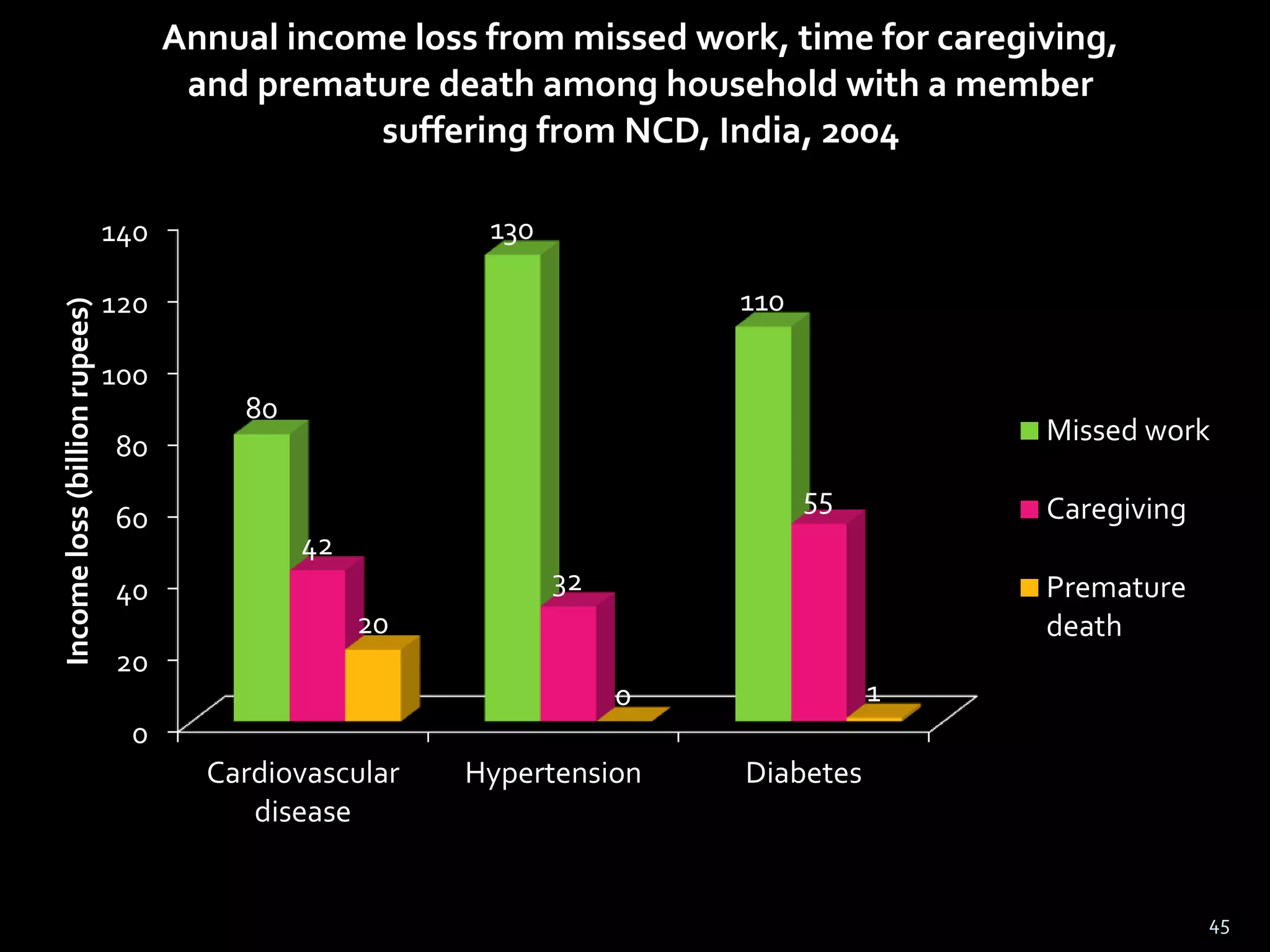
 The total income loss due to chronic diseases 
in India was between Indian Rupee (INR) 1094– 
1113 billion. 
 Income loss due to hypertension : INR 199 
billion 
 Due to diabetes: INR 163 billion 
 Due to CVDs : INR 144–158 billion 
46
Physicians 
2000-2010 
Health workforce in India 
Nursing and 
midwifery personnel 
2000-2010 
Public health 
workers 
2000-2010 
Community health 
workers 
2000-2010 
Number Density* Number Density* Number Density* Number Density* 
660801 6.0 1430555 13 --- --- 507150 0.5 
Source: World Health Statistics 2011, World Health Organization 
2011 
*per 10 000 population 
47
Annual Intake of medical students in India and Uttar Pradesh 
All India Uttar Pradesh 
Source: Global Health Observatory. World Heath organization 2011 
Medical 
Colleges 
381 27 
M.B.B.S seats 44,418 2909 
M.D- General 
2266 122 
Medicine 
D.M- Cardiology 269 23 
Mch- Cardio-thorasic 
surgery 
80 3 
Source: Medical Council of India
49 
National Programme for Prevention and Control of 
Cancer, Diabetes, CVDs and Stroke 
(NPCDCS) 
Ministry of Health & Family Welfare 
GOI 
c.
50 
Objectives of NPCDCS 
Prevent and control common NCDs through 
behavior and life style changes, 
 Provide early diagnosis and management of 
common NCDs, 
 Build capacity at various levels of health 
care for prevention, diagnosis and treatment 
of common NCDs,
51 
Objectives of NPCDCS 
Train human resource within the public health 
setup viz doctors, paramedics and nursing staff to 
cope with the increasing burden of NCDs, and 
 Establish and develop capacity for palliative & 
rehabilitative care.
52 
India Map showing the States 
to implement NPCDCS 
21 STATES 
100 DISTRICTS
53 
Packages of services to be 
made available at different 
levels under NPCDCS 
At Sub Center Level: 
 Health promotion for behavior change 
 ‘Opportunistic’ Screening using B.P 
measurement and blood glucose by strip 
method 
 Referral of suspected cases to CHC
54 
At CHC Level: 
 Prevention and health 
promotion including 
counseling 
 Early diagnosis through 
clinical 
and laboratory 
investigations (Common 
lab investigations: 
Blood Sugar, lipid profile, 
ECG, Ultrasound, X ray 
etc.)
55 
At CHC Level: 
 Management of common 
CVD, diabetes and 
stroke cases (out patient and 
in patients.) 
 Home based care for bed 
ridden chronic cases 
Referral of difficult cases to 
District Hospital/ 
higher health care facility
At District Hospital Level: 
Early diagnosis of diabetes, CVDs, Stroke 
and Cancer 
 Investigations: Blood Sugar, lipid profile, Kidney 
Function Test (KFT),Liver Function Test ( LFT), ECG, 
Ultrasound, X ray, colposcopy , mammography etc. (if 
not available, will be outsourced) 
 Medical management of cases (out patient , 
inpatient and intensive Care ) 
56
57 
At District Hospital Level: 
 Follow up and care of 
bed ridden cases 
 Day care facility 
 Referral of difficult 
cases to higher health 
care facility 
 Health promotion for 
behavior change
58 
Cardiac Care Unit (CCU) 
 Support of Rs. 1.5 crores 
 Functional in 20 districts so far 
CCU at Pattanamthita, Kerala CCU at Kupwara, J&K 
Issues: 
Procurement of equipments 
 Non availability of specialists 
 Lack of space in some district hospitals
60 
During 2010-12: 
 The strategies proposed will be 
implemented in 
20,000 Sub Centres and 
700 Community Health Centre 
in 100 Districts 
 across 21 States
61 
Districts Covered during 
2010-11 
 TOTAL 
States- 21 
Distt.- 30 
CHCs- 205 
Sub Centers- 6482
62 
Uttar Pradesh 
 Distt. Rae Bareli 
 CHCs-11 
 Sub Centers-377 
 Distt. Sultanpur 
 CHCs-14 
 Sub Centers-403
63 
Screening for Diabetes and Hypertension -1 
Logistics & training provided: 
2010-11 2011-12 Total 
Glucometers 6617 21500 28117 
Glucostrips 1.3crore 4.3 crore 5.6crore 
Lancets 1.6crore 4.9crore 6.5crore 
Training to Health Workers : completed in 82 districts (out of 100 
districts, 4 districts of TN : logistics not required) 
Target population : 5.6 crore 
Screened: 1.02 crore, 3.48 to be screened 
 Suspected for diabetes : 7.5 lakh (7.4%) 
Suspected for hypertension :6.5 lakh (6.5%)
64 
MISSING LINK 
Traffic 
control 
SStrtenrgetshs 
RSEeuSdrrrhaeesasnirgedener 
STRESS 
to God
“Live sensibly - 
among a thousand 
people, only one 
dies a natural 
death; the rest 
succumb to 
irrational modes of 
living.” 
- 
Maimonides 
65
66 
Being healthy is as easy as ABCDE 
Avoid alcohol 
Be physically active 
Cut down on salt and sugar 
Don’t use tobacco products 
Eat plenty of fruits and vegetables
67

Escalating burden of chd (1) key note address

  • 1.
    1 ESCALATING BURDENOF CHD-an overview DR HARIVANSH CHOPRA D.C.H.,M.D PROFESSOR COMMUNITY MEDICINE LLRM MEDICAL COLLEGE MEERUT
  • 2.
    THREE REAL STORIES Eighteen year old smart boy son of a doctor suffered from myocardial infarction and could not be saved despite getting best available treatment 2
  • 3.
    Thirty eight yearold a famous specialist doctor, son of professor of Medicine Died at home on the first floor. Unfortunately no medical assistance was possible due to acuteness of episode 3 THREE REAL STORIES
  • 4.
    THREE REAL STORIES Fourty two year old faculty member of a medical college had an episode of impending infarction and fortunately was given treatment in private sector in first thirty minutes and survived. 4
  • 5.
    5 Facts 50%of Mortality in MI / CHD occurs in first thirty minutes CHD is occurring a decade earlier in india as compared to developed countries. Risk factor assessment is not prevalent in public health system
  • 6.
    Deaths below 70Years Deaths due to NCDs Deaths below 70 Years age 23% 52% • Gupta R. Burden of coronary heart disease in India. Indian Heart J 2005; 57 : 632-8. • Ghaffar A, Reddy KS, Singhi M. Burden of non-communicable diseases in South Asia. BMJ 2004; 328 : 807-10. Western countries India 7
  • 7.
    Estimated percentage ofdeaths by cause in India, 2008 Non communicable diseases 50% Communicable diseases 40% Injuries 10% Source: Global Health Observatory. World Heath organization 2011 8
  • 8.
    Trends in estimatedpercentage of deaths by cause of death, 80% 70% 60% 50% 40% 30% 20% 10% 0% South-East Asia region, 2004 and 2030 Communicable Disease 75% Non communicable disease Injuries 38% 50% 15% 16% 14% 2004 2030 Source: Mathers CD, Loncar D. Projections of global mortality and burden of disease from 2002 to 2030. PloS Medicine, 2006, 3(11):e442. 9
  • 9.
    10 Estimated burdenof CHD in India 2.5 2 1.5 1 0.5 0 1.17 1990 2.03 2010 CHDs Burden In millions Ghaffar A, Reddy KS, Singhi M. Burden of non-communicable diseases in South Asia. BMJ 2004; 328 : 807-10.
  • 10.
    Percentage of deathsdue to CVDs* of subtype CVD, 12% 9% 3% 1% 14% 12% 10% 8% 6% 4% 2% 0% Ischaemic heart disease Cerebrovascular disesases Hypertensive heart disease Other cardiovascular diseases India, 2008 CVDs: Cardiovascular diseases Source: Global Health Observatory. World Heath Organization 2011. 11
  • 11.
    TRADITIONAL RISK FACTORS AGE DIABETES SMOKING HYPERTENSION DYSLIPIDEMIA OBESITY/ LACK OF EXERCISE PREMATURE FAMILY HISTORY OF CAD 12
  • 13.
    Schematic representation ofan iceberg for NCDs 14
  • 14.
    28% 72% IDSPDATA Medicine OPD LLRM MEDICAL COLLEGE,MEERUT 2012-13 NCD CD 15
  • 15.
    57% 5% 22% 16% IDSP DATA OF MEDICINE OPD (Aug.2012-July 2013) HT IHD DM I DM II 16
  • 16.
    OPD DATA ANALYSISUHC,COMMUNITY MEDICINE,LLRM medical college,meerut 17% 3% 80% 2008 HT HT+DM OTHERS 17
  • 17.
    OPD DATA ANALYSISUHC,COMMUNITY MEDICINE,LLRM 25% 9% 66% medical college,meerut 2009 HT HT+DM OTHER 18
  • 18.
    TRADITIONAL RISK FACTORS DIABETES DIABETES DIABETES 19
  • 19.
    20 Diabetes mellitus:In India 19.3 57.2 DM in Millions 1995 2025 King H, Aubert RE, Herman WH. Global burden of diabetes, 1995-2025: prevalence, numerical estimates, and projections. Diabetes Care 1998; 21 : 1414-31. 20
  • 20.
    21 ICMR estimates Prevalence of Diabetes 3.80% Rural area 11.80% Urban area Reddy KS, Shah B, Varghese C, Ramadoss A. Responding to the threat of chronic diseases in India. Lancet 2005; 366 : 1746-51. 21
  • 21.
    Percentage of adultpopulation with raised 12% 10% 8% 6% 4% 2% 0% blood glucose level*, India, 2008 Males Females 11% 11% * Fasting glucose> 7.0 mmol/L or on medication for diabetes Source: World Health Organization. Global status report on non communicable diseases, 2010. Geneva, 2011 22
  • 22.
    23 Diabetes: Top10 Countries (absolute numbers)
  • 23.
    24 PECULARITY OFCHD IN DIABETES DIABETIC SUBJECTS HAVE 2-4 TIMES MORE RISK OF CHD CHD MAY BE SILENT OCCURS AT YOUNGER AGE RESULT IN MICROVASCULAR ANGINA WORSE OUTCOME FOLLOWING REVASCULARISATION
  • 24.
    TRADITIONAL RISK FACTORS HYPERTENSION HYPERTENSION HYPERTENSION 25
  • 25.
    Percentage of adultpopulation with high blood pressure*, 36% 34% 40% 35% 30% 25% 20% 15% 10% 5% 0% India, 2008 Males Females Source: World Health Organization. Global status report on non communicable diseases 2010. Geneva, 2011. Data adjusted for 2008 for comparability *Systolic BP>140 mmHg and stroke or diastolic BP>90 mmHg or using medication to lower BP 26
  • 26.
    27 Hypertension: 40% 30% 20% 10% 0% 40% 17% Urban Rural • Gupta R. Trends in hypertension epidemiology in India. J Hum Hypertens 2004; 18 : 73-8.
  • 27.
    28 Rising ChronicDisease Burdens 2000 2025 No. of Persons with HYPERTENSION 118 Million 214 Million No. of Persons Dying from TOBACCO 900,000 2 Million + Source: Jha et al, NEJM, Feb 2008 . WHO infobase
  • 28.
    TRADITIONAL RISK FACTORS SMOKING SMOKING SMOKING 29
  • 29.
    30 Cigarette smoking An alarming rate of current tobacco use of 56 % among Indian men aged 12-60 yr.
  • 30.
    Survey of sixthand eighth graders attending school in an urban setting revealed that the prevalence of tobacco use (any history of use or current use) was 2-3 times higher among sixth graders compared with eighth graders. Reddy KS, Shah B, Varghese C, Ramadoss A. Responding to the threat of chronic diseases in India. Lancet 2005; 366 : 1746-51. 31
  • 31.
    70% 60% 50% 40% 30% 20% Percentage of adults, who are current users of tobacco products, by education, India, 2009 0% Females Males 10% No formal schooling Less than Primary Primary but less than secondary Secondary and above 68% 61% 49% 30% 32% 22% 11% 4% Males Females Source: India Global Adult Tobacco Survey 2009 32
  • 32.
    TRADITIONAL RISK FACTORS NUTRITIONAL DYSLIPIDEMIA FAMILIAL DYSLIPIDEMIA METABOLIC DYSLIPIDEMIA 33
  • 33.
    Percentage of adultpopulation with raised total cholesterol, 30% 25% 20% 15% 10% 5% 0% 26% 29% India, 2008 Males Females Source: World Health Organization. Global status report on non communicable diseases 2010. Geneva, 2011. Data adjusted for 2008 for comparability 34
  • 34.
    TRADITIONAL RISK FACTORS FAMILIAL METABOLIC OBESITY ENDOCRINAL 35
  • 35.
    36 OBESITY RUNSIN THE FAMILY NO BODY RUNS IN THE FAMILY
  • 36.
    Percentage of adultpopulation that is overweight and obese, 14% 12% 10% 8% 6% 4% 2% 0% Overweight(BMI>=25 kg/m2) Overweight(BMI>=30 kg/m2) 10% 1.30% 13% 2.50% 11% 1.90% India, 2008 Male Female Both sexes Source: World Health Organization. Global status report on noncommunicable diseases 2010. Geneva, 2011. Data adjusted for 2008 for comparability 37
  • 37.
     Childhood obesityis an emerging issue.  In a Mysore (India) study on 43 152 school children, obesity and overweight prevalence was 3.4% and 8.5%, respectively. 38
  • 38.
    39 NUTRITIONAL STATUSOF CHILDREN (5-15 YRS) IN URBAN MEERUT 48% 38% 10% 4% Under weight Normal weight Over weight Obese
  • 39.
    40 Physical activity Daily moderate intensity physical activity (e.g., the equivalent of briskly walking 35-40 min per day) is associated with a 55 percent lower risk for CHD. Rastogi T, Vaz M, Spiegelman D, Reddy KS, Bharathi AV, Stampfer MJ, et al. Physical activity and risk of coronary heart disease in India. Int J Epidemiol 2004; 33 : 759-67.
  • 40.
    Percentage of adultswith insufficient 20% 18% 16% 14% 12% 10% 8% 6% 4% 2% 0% physical activity, India, 2008 14% 19% Male Female Source: World Health Organization. Global status report on non communicable diseases 2010. Geneva, 2011. Data adjusted for 2008 based for comparability 41
  • 41.
    Percentage of adultsconsuming alcohol*, by sex, India, 2007 21% 2% 25% 20% 15% 10% 5% 0% Males Females Source: National NCD risk-factor surveys in Member countries *People who have consumed alcohol in the past 30 days. 42
  • 42.
    Projected mid-year population,residing 60% 50% 40% 30% 20% 10% 0% in urban areas, India, 2010-2050 30% 55% 2010 2050 2010 2050 Source: World Urbanization Prospects. The 2007 Revision. Highlights. Department of Economic and Social Affairs Population Division.United Nations New York, 2008. 43
  • 43.
    20 16 12 8 4 0 2006 2015 Cumulative GDP loss by 2015 1.35 1.96 17 Foregone GDP*(US$ billions) Projected cost of cardiovascular disease in terms of lost GDP, India, 2006 and 2015 Source: Abegunde DO, et al. The burden and cost of chronic diseases in low-income and middle-income countries. Lancet 2007;370:1929-38. *GDP: Gross Domestic product 44
  • 44.
    140 120 100 80 60 40 20 0 Cardiovascular disease Hypertension Diabetes 80 130 110 42 32 55 20 0 1 Income loss (billion rupees) Annual income loss from missed work, time for caregiving, and premature death among household with a member suffering from NCD, India, 2004 Missed work Caregiving Premature death 45
  • 45.
     The totalincome loss due to chronic diseases in India was between Indian Rupee (INR) 1094– 1113 billion.  Income loss due to hypertension : INR 199 billion  Due to diabetes: INR 163 billion  Due to CVDs : INR 144–158 billion 46
  • 46.
    Physicians 2000-2010 Healthworkforce in India Nursing and midwifery personnel 2000-2010 Public health workers 2000-2010 Community health workers 2000-2010 Number Density* Number Density* Number Density* Number Density* 660801 6.0 1430555 13 --- --- 507150 0.5 Source: World Health Statistics 2011, World Health Organization 2011 *per 10 000 population 47
  • 47.
    Annual Intake ofmedical students in India and Uttar Pradesh All India Uttar Pradesh Source: Global Health Observatory. World Heath organization 2011 Medical Colleges 381 27 M.B.B.S seats 44,418 2909 M.D- General 2266 122 Medicine D.M- Cardiology 269 23 Mch- Cardio-thorasic surgery 80 3 Source: Medical Council of India
  • 48.
    49 National Programmefor Prevention and Control of Cancer, Diabetes, CVDs and Stroke (NPCDCS) Ministry of Health & Family Welfare GOI c.
  • 49.
    50 Objectives ofNPCDCS Prevent and control common NCDs through behavior and life style changes,  Provide early diagnosis and management of common NCDs,  Build capacity at various levels of health care for prevention, diagnosis and treatment of common NCDs,
  • 50.
    51 Objectives ofNPCDCS Train human resource within the public health setup viz doctors, paramedics and nursing staff to cope with the increasing burden of NCDs, and  Establish and develop capacity for palliative & rehabilitative care.
  • 51.
    52 India Mapshowing the States to implement NPCDCS 21 STATES 100 DISTRICTS
  • 52.
    53 Packages ofservices to be made available at different levels under NPCDCS At Sub Center Level:  Health promotion for behavior change  ‘Opportunistic’ Screening using B.P measurement and blood glucose by strip method  Referral of suspected cases to CHC
  • 53.
    54 At CHCLevel:  Prevention and health promotion including counseling  Early diagnosis through clinical and laboratory investigations (Common lab investigations: Blood Sugar, lipid profile, ECG, Ultrasound, X ray etc.)
  • 54.
    55 At CHCLevel:  Management of common CVD, diabetes and stroke cases (out patient and in patients.)  Home based care for bed ridden chronic cases Referral of difficult cases to District Hospital/ higher health care facility
  • 55.
    At District HospitalLevel: Early diagnosis of diabetes, CVDs, Stroke and Cancer  Investigations: Blood Sugar, lipid profile, Kidney Function Test (KFT),Liver Function Test ( LFT), ECG, Ultrasound, X ray, colposcopy , mammography etc. (if not available, will be outsourced)  Medical management of cases (out patient , inpatient and intensive Care ) 56
  • 56.
    57 At DistrictHospital Level:  Follow up and care of bed ridden cases  Day care facility  Referral of difficult cases to higher health care facility  Health promotion for behavior change
  • 57.
    58 Cardiac CareUnit (CCU)  Support of Rs. 1.5 crores  Functional in 20 districts so far CCU at Pattanamthita, Kerala CCU at Kupwara, J&K Issues: Procurement of equipments  Non availability of specialists  Lack of space in some district hospitals
  • 58.
    60 During 2010-12:  The strategies proposed will be implemented in 20,000 Sub Centres and 700 Community Health Centre in 100 Districts  across 21 States
  • 59.
    61 Districts Coveredduring 2010-11  TOTAL States- 21 Distt.- 30 CHCs- 205 Sub Centers- 6482
  • 60.
    62 Uttar Pradesh  Distt. Rae Bareli  CHCs-11  Sub Centers-377  Distt. Sultanpur  CHCs-14  Sub Centers-403
  • 61.
    63 Screening forDiabetes and Hypertension -1 Logistics & training provided: 2010-11 2011-12 Total Glucometers 6617 21500 28117 Glucostrips 1.3crore 4.3 crore 5.6crore Lancets 1.6crore 4.9crore 6.5crore Training to Health Workers : completed in 82 districts (out of 100 districts, 4 districts of TN : logistics not required) Target population : 5.6 crore Screened: 1.02 crore, 3.48 to be screened  Suspected for diabetes : 7.5 lakh (7.4%) Suspected for hypertension :6.5 lakh (6.5%)
  • 62.
    64 MISSING LINK Traffic control SStrtenrgetshs RSEeuSdrrrhaeesasnirgedener STRESS to God
  • 63.
    “Live sensibly - among a thousand people, only one dies a natural death; the rest succumb to irrational modes of living.” - Maimonides 65
  • 64.
    66 Being healthyis as easy as ABCDE Avoid alcohol Be physically active Cut down on salt and sugar Don’t use tobacco products Eat plenty of fruits and vegetables
  • 65.