

EPIDEMIOLOGY OF NON-COMMUNICABLE
DISEASES
AB RAJAR
ASSOCIATE PROFESSOR
COMMUNITY MEDICINE.
Muhammad Medical College
OVERVIEW
i. Definition and characteristics of NCD.
ii. Types of NCDs
iii. Global trends of NCDs.
iv. NCDs Pakistan’s next major health challenge.
v. Gaps in the natural history of NCD.
vi. Definition of risk factors and metabolic risk factors.
vii. Common risk factors of NCDs
viii. Prevention & control of NCDs.
DEFINITION
• Chronic conditions that do not result from an acute infectious process
and hence are “not communicable”.
• A disease that have prolonged course, that doses not resolve
spontaneously and for which a complete care is rarely achieved
CHARACTERISTICS OF NCDS
• Complex etiology (causes)
• Multiple risk factors.
• Long latency period.
• Non-contagious origin (Non-communicable )
• Prolonged course of illness
• Functional impairment or disability.
TYPES OF NCDS
• Cardiovascular diseases.
• Renal diseases.
• Nervous & Mental disorders.
• Musculo-Skeletal conditions.
• Chronic Non-specific Respiratory
diseases.
• Permanent results of Accidents.
• Senility.(The bodily & mental
deterioration associated with old
age )
• Blindness.
• Cancer.
• Diabetes.
• Obesity.
• Other metabolic & degenerative
diseases.
• Disorders of unknown cause &
progressive course are often
labeled as “degenerative”.
Global trends of NCDs.{Global Health Observatory (GHO) data }
• NCDs kill 41 million people each year, equivalent to 71% of all deaths
globally.
• Each year, 15 million people die from a NCD between the ages of 30
and 69 years.
• 85% of these "premature" deaths occur in low- and middle-income
countries.
• Cardiovascular diseases account for most NCD deaths, or 17.9 million
(44%) people annually, followed by cancers 9.0 million (22%),
respiratory diseases 3.9million (9%) , and diabetes 1.6 million.
• These 4 groups of diseases account for over 80% of all premature
NCD deaths.
•
Global trends of NCDs.{Global Health Observatory (GHO) data}
• Every year 5m people die because of tobacco use.
• About 2.8m die from being overweight.
• High cholesterol accounts for roughly 2.6m deaths.
• 7.5m die because of high blood pressure.
• About 46% of deaths occurring before the age of 70 in Middle Income
countries.
• By 2030,deaths due to chronic NCDs are expected to increase to 52m
per year.
NCDs PAKISTAN’s NEXT MAJOR HEALTH CHALLENGE.
• 1.AGING CHANGES IN PAKISTAN’S POPULATION WILL INCREASE THE
BURDEN OF NCDS:
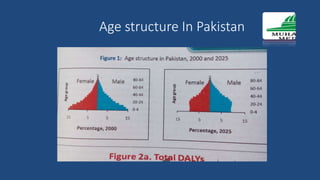
• The proportion of the population 65 years & older-particularly prone
to NCDs-will move from 3.9% in 2000 to 5.4% in 2025.
• Thus the health burden of NCDs will rise in parallel with age.
Age structure In Pakistan
NCDs PAKISTAN’s NEXT MAJOR HEALTH CHALLENGE.
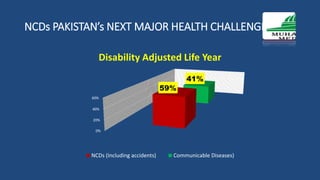
• 2.NCDs impose the largest health burden in Pakistan:
• In terms of the number of lives lost due to ill-health, disability,& early
death (DALYs..Disability adjusted life year),NCDs (Inclusive of injuries )
account for 59% of the total disease burden while 41% is from
communicable diseaaes,maternal & child health & nutrition issues all
combined.
NCDs PAKISTAN’s NEXT MAJOR HEALTH CHALLENGE.
0%
20%
40%
60%
59%
41%
Disability Adjusted Life Year
NCDs (Including accidents) Communicable Diseases)
NCDs PAKISTAN’s NEXT MAJOR HEALTH CHALLENGE.
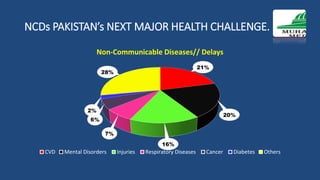
• 3.The major NCDs are Cardiocasular,Cancer & Respiratory Diseases,
Mental ill Health, injuries…
• Around 10-16% of the population suffers from mild to moderate
Psychiatric illness.
• Injuries are the 4TH leading cause of un natural death,
• Pakistan ranks 3rd in road accidents, in Karachi, about 42% of the
vehicle crashes involved public transport or heavy good vehicles.
NCDs PAKISTAN’s NEXT MAJOR HEALTH CHALLENGE.
21%
20%
16%
7%
6%
2%
28%
Non-Communicable Diseases// Delays
CVD Mental Disorders Injuries Respiratory Diseases Cancer Diabetes Others
Gaps in the Natural history of NCD
• There are many gaps in our knowledge about the natural history of
chronic diseases.
• 1.ABSENCE OF A KNOWN AGENT:
• The absence of a known agent makes both diagnosis & specific
prevention difficult.
• 2.MULTIFACTORIAL CUASATION:
• Most chronic diseases are the result of multiple causes-rarely is
there a simple one-to-one cause-effect relationship.
Gaps in the Natural history of NCD
• 3.LONG LATENT PERIOD:
• It is the period between the first exposure to “suspected cause” and
eventual development of disease.
• This makes it difficult to link suspected causes with outcomes:
• E.g. possible relation between oral contraceptives & the occurrence of cervical
cancer.
• 4.INDEFINITE ONSET:
• Most NCDs are slow in onset & development,& the distinction
between diseased & non-diseased states may be difficult to establish
• E.g. diabetes & hypertension.
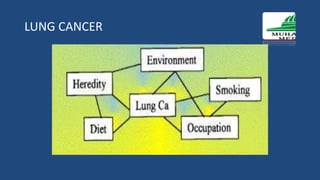
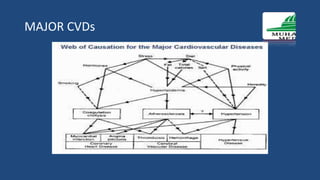
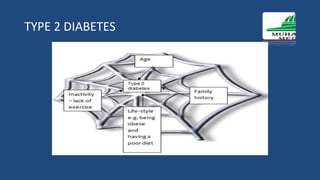
WEB OF CAUSATION
• According to this concept, "Effects never depend on single cause but
rather develop as a result of chain of causation.”
• Risk factors are also suggesstive,but an absolute proof of cause &
effect between a risk factor & disease is usually lacking:
• i.e. presence of a risk factor does not imply that the disease will occur &
absence does not imply that the disease will not occur.
LUNG CANCER
MAJOR CVDs
TYPE 2 DIABETES
RISK FACTORS:
• In the absence of a known agent, the term “risk factor(s)” is used to
describe certain factors in a person’s background or life style.
• DEFINITIONS:
An attribute or exposure that is significantly associated with
development of disease.
If determinant is modified by intervention, it reduces possibility of
occurrence of disease or other specified outcomes.
Modifiable Risk Factor
• A risk factor that can be reduced or controlled by intervention,
thereby reducing the probability of disease.
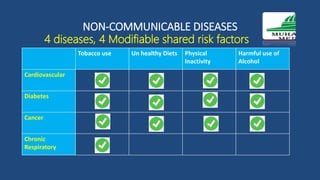
• The WHO has prioritized the following four:
 Physical inactivity
 Tobacco use
 Alcohol use
 Unhealthy diets
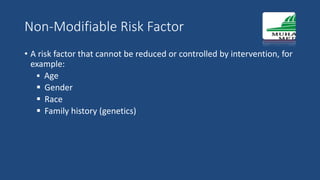
Non-Modifiable Risk Factor
• A risk factor that cannot be reduced or controlled by intervention, for
example:
 Age
 Gender
 Race
 Family history (genetics)
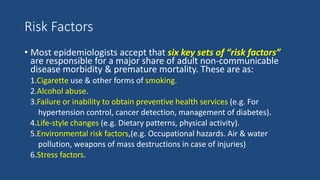
Risk Factors
• Most epidemiologists accept that six key sets of “risk factors”
are responsible for a major share of adult non-communicable
disease morbidity & premature mortality. These are as:
1.Cigarette use & other forms of smoking.
2.Alcohol abuse.
3.Failure or inability to obtain preventive health services (e.g. For
hypertension control, cancer detection, management of diabetes).
4.Life-style changes (e.g. Dietary patterns, physical activity).
5.Environmental risk factors,(e.g. Occupational hazards. Air & water
pollution, weapons of mass destructions in case of injuries)
6.Stress factors.
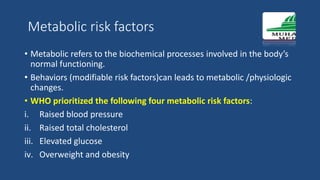
Metabolic risk factors
• Metabolic refers to the biochemical processes involved in the body’s
normal functioning.
• Behaviors (modifiable risk factors)can leads to metabolic /physiologic
changes.
• WHO prioritized the following four metabolic risk factors:
i. Raised blood pressure
ii. Raised total cholesterol
iii. Elevated glucose
iv. Overweight and obesity
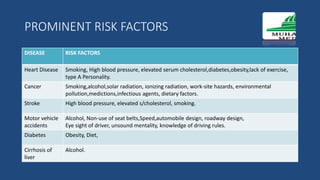
PROMINENT RISK FACTORS
DISEASE RISK FACTORS
Heart Disease Smoking, High blood pressure, elevated serum cholesterol,diabetes,obesity,lack of exercise,
type A Personality.
Cancer Smoking,alcohol,solar radiation, ionizing radiation, work-site hazards, environmental
pollution,medictions,infectious agents, dietary factors.
Stroke High blood pressure, elevated s/cholesterol, smoking.
Motor vehicle
accidents
Alcohol, Non-use of seat belts,Speed,automobile design, roadway design,
Eye sight of driver, unsound mentality, knowledge of driving rules.
Diabetes Obesity, Diet,
Cirrhosis of
liver
Alcohol.
NON-COMMUNICABLE DISEASES
Tobacco use Un healthy Diets Physical
Inactivity
Harmful use of
Alcohol
Cardiovascular
Diabetes
Cancer
Chronic
Respiratory
4 diseases, 4 Modifiable shared risk factors
PREVENTION & CONTROL OF NCDs
• Without action, the NCDs epidemic is projected to kill 52m people
annually by 2030.
• The prevention & control of NCDs is becoming increasingly important
on the global health agenda.
• In 2008,the 193 Member States of the WHO approved a six- year plan
to address non-communicable diseases,espacially the rapidly
increasing burden in low & middle-income countries.
• In Sep:2011,the UN hosted its first General Assembly Special Summit
on the issue of NCDs.
• Noting that NCDs are the cause of some 35m deaths each year.
Non Communicable Diseases Lecture

Non Communicable Diseases Lecture

  • 1.
    EPIDEMIOLOGY OF NON-COMMUNICABLE DISEASES ABRAJAR ASSOCIATE PROFESSOR COMMUNITY MEDICINE. Muhammad Medical College
  • 2.
    OVERVIEW i. Definition andcharacteristics of NCD. ii. Types of NCDs iii. Global trends of NCDs. iv. NCDs Pakistan’s next major health challenge. v. Gaps in the natural history of NCD. vi. Definition of risk factors and metabolic risk factors. vii. Common risk factors of NCDs viii. Prevention & control of NCDs.
  • 3.
    DEFINITION • Chronic conditionsthat do not result from an acute infectious process and hence are “not communicable”. • A disease that have prolonged course, that doses not resolve spontaneously and for which a complete care is rarely achieved
  • 4.
    CHARACTERISTICS OF NCDS •Complex etiology (causes) • Multiple risk factors. • Long latency period. • Non-contagious origin (Non-communicable ) • Prolonged course of illness • Functional impairment or disability.
  • 5.
    TYPES OF NCDS •Cardiovascular diseases. • Renal diseases. • Nervous & Mental disorders. • Musculo-Skeletal conditions. • Chronic Non-specific Respiratory diseases. • Permanent results of Accidents. • Senility.(The bodily & mental deterioration associated with old age ) • Blindness. • Cancer. • Diabetes. • Obesity. • Other metabolic & degenerative diseases. • Disorders of unknown cause & progressive course are often labeled as “degenerative”.
  • 6.
    Global trends ofNCDs.{Global Health Observatory (GHO) data } • NCDs kill 41 million people each year, equivalent to 71% of all deaths globally. • Each year, 15 million people die from a NCD between the ages of 30 and 69 years. • 85% of these "premature" deaths occur in low- and middle-income countries. • Cardiovascular diseases account for most NCD deaths, or 17.9 million (44%) people annually, followed by cancers 9.0 million (22%), respiratory diseases 3.9million (9%) , and diabetes 1.6 million. • These 4 groups of diseases account for over 80% of all premature NCD deaths. •
  • 7.
    Global trends ofNCDs.{Global Health Observatory (GHO) data} • Every year 5m people die because of tobacco use. • About 2.8m die from being overweight. • High cholesterol accounts for roughly 2.6m deaths. • 7.5m die because of high blood pressure. • About 46% of deaths occurring before the age of 70 in Middle Income countries. • By 2030,deaths due to chronic NCDs are expected to increase to 52m per year.
  • 8.
    NCDs PAKISTAN’s NEXTMAJOR HEALTH CHALLENGE. • 1.AGING CHANGES IN PAKISTAN’S POPULATION WILL INCREASE THE BURDEN OF NCDS: • The proportion of the population 65 years & older-particularly prone to NCDs-will move from 3.9% in 2000 to 5.4% in 2025. • Thus the health burden of NCDs will rise in parallel with age.
  • 9.
  • 10.
    NCDs PAKISTAN’s NEXTMAJOR HEALTH CHALLENGE. • 2.NCDs impose the largest health burden in Pakistan: • In terms of the number of lives lost due to ill-health, disability,& early death (DALYs..Disability adjusted life year),NCDs (Inclusive of injuries ) account for 59% of the total disease burden while 41% is from communicable diseaaes,maternal & child health & nutrition issues all combined.
  • 11.
    NCDs PAKISTAN’s NEXTMAJOR HEALTH CHALLENGE. 0% 20% 40% 60% 59% 41% Disability Adjusted Life Year NCDs (Including accidents) Communicable Diseases)
  • 12.
    NCDs PAKISTAN’s NEXTMAJOR HEALTH CHALLENGE. • 3.The major NCDs are Cardiocasular,Cancer & Respiratory Diseases, Mental ill Health, injuries… • Around 10-16% of the population suffers from mild to moderate Psychiatric illness. • Injuries are the 4TH leading cause of un natural death, • Pakistan ranks 3rd in road accidents, in Karachi, about 42% of the vehicle crashes involved public transport or heavy good vehicles.
  • 13.
    NCDs PAKISTAN’s NEXTMAJOR HEALTH CHALLENGE. 21% 20% 16% 7% 6% 2% 28% Non-Communicable Diseases// Delays CVD Mental Disorders Injuries Respiratory Diseases Cancer Diabetes Others
  • 14.
    Gaps in theNatural history of NCD • There are many gaps in our knowledge about the natural history of chronic diseases. • 1.ABSENCE OF A KNOWN AGENT: • The absence of a known agent makes both diagnosis & specific prevention difficult. • 2.MULTIFACTORIAL CUASATION: • Most chronic diseases are the result of multiple causes-rarely is there a simple one-to-one cause-effect relationship.
  • 15.
    Gaps in theNatural history of NCD • 3.LONG LATENT PERIOD: • It is the period between the first exposure to “suspected cause” and eventual development of disease. • This makes it difficult to link suspected causes with outcomes: • E.g. possible relation between oral contraceptives & the occurrence of cervical cancer. • 4.INDEFINITE ONSET: • Most NCDs are slow in onset & development,& the distinction between diseased & non-diseased states may be difficult to establish • E.g. diabetes & hypertension.
  • 16.
    WEB OF CAUSATION •According to this concept, "Effects never depend on single cause but rather develop as a result of chain of causation.” • Risk factors are also suggesstive,but an absolute proof of cause & effect between a risk factor & disease is usually lacking: • i.e. presence of a risk factor does not imply that the disease will occur & absence does not imply that the disease will not occur.
  • 17.
  • 18.
  • 19.
  • 20.
    RISK FACTORS: • Inthe absence of a known agent, the term “risk factor(s)” is used to describe certain factors in a person’s background or life style. • DEFINITIONS: An attribute or exposure that is significantly associated with development of disease. If determinant is modified by intervention, it reduces possibility of occurrence of disease or other specified outcomes.
  • 21.
    Modifiable Risk Factor •A risk factor that can be reduced or controlled by intervention, thereby reducing the probability of disease. • The WHO has prioritized the following four:  Physical inactivity  Tobacco use  Alcohol use  Unhealthy diets
  • 22.
    Non-Modifiable Risk Factor •A risk factor that cannot be reduced or controlled by intervention, for example:  Age  Gender  Race  Family history (genetics)
  • 23.
    Risk Factors • Mostepidemiologists accept that six key sets of “risk factors” are responsible for a major share of adult non-communicable disease morbidity & premature mortality. These are as: 1.Cigarette use & other forms of smoking. 2.Alcohol abuse. 3.Failure or inability to obtain preventive health services (e.g. For hypertension control, cancer detection, management of diabetes). 4.Life-style changes (e.g. Dietary patterns, physical activity). 5.Environmental risk factors,(e.g. Occupational hazards. Air & water pollution, weapons of mass destructions in case of injuries) 6.Stress factors.
  • 24.
    Metabolic risk factors •Metabolic refers to the biochemical processes involved in the body’s normal functioning. • Behaviors (modifiable risk factors)can leads to metabolic /physiologic changes. • WHO prioritized the following four metabolic risk factors: i. Raised blood pressure ii. Raised total cholesterol iii. Elevated glucose iv. Overweight and obesity
  • 25.
    PROMINENT RISK FACTORS DISEASERISK FACTORS Heart Disease Smoking, High blood pressure, elevated serum cholesterol,diabetes,obesity,lack of exercise, type A Personality. Cancer Smoking,alcohol,solar radiation, ionizing radiation, work-site hazards, environmental pollution,medictions,infectious agents, dietary factors. Stroke High blood pressure, elevated s/cholesterol, smoking. Motor vehicle accidents Alcohol, Non-use of seat belts,Speed,automobile design, roadway design, Eye sight of driver, unsound mentality, knowledge of driving rules. Diabetes Obesity, Diet, Cirrhosis of liver Alcohol.
  • 26.
    NON-COMMUNICABLE DISEASES Tobacco useUn healthy Diets Physical Inactivity Harmful use of Alcohol Cardiovascular Diabetes Cancer Chronic Respiratory 4 diseases, 4 Modifiable shared risk factors
  • 27.
    PREVENTION & CONTROLOF NCDs • Without action, the NCDs epidemic is projected to kill 52m people annually by 2030. • The prevention & control of NCDs is becoming increasingly important on the global health agenda. • In 2008,the 193 Member States of the WHO approved a six- year plan to address non-communicable diseases,espacially the rapidly increasing burden in low & middle-income countries. • In Sep:2011,the UN hosted its first General Assembly Special Summit on the issue of NCDs. • Noting that NCDs are the cause of some 35m deaths each year.