National Nutrition Programmes
Dr. Harivansh Chopra,
DCH, MD
Professor,
Dept. of Community Medicine,
LLRM Medical College, Meerut.
harichop@gmail.com
OBJECTIVE
• to study the various national nutritional
programmes aimed at combating
specific nutritional deficiencies as well
as to promote overall nutritional status
of the community.
29-07-2020 DR HARIVANSH CHOPRA 2
Special Nutrition Programme
1. Launched in 1970.
2. Support:
1. Originally launched as Central
programme.
2. Transferred to state sector in 5th five-year
plan as part of Minimum Needs
Programme.
3. Gradually being merged into ICDS
programme.
29-07-2020 DR HARIVANSH CHOPRA 3
Beneficiaries
Children < 6 years of age Pregnant & Nursing women
Residing in:
• Urban Slums.
• Tribal Areas.
• Backward Rural Areas.
29-07-2020 DR HARIVANSH CHOPRA 4
Beneficiaries of Programme
Child up to 6 years of age
300 Calories/day 10-12 grams/day
29-07-2020 DR HARIVANSH CHOPRA 5
Beneficiaries of Programme
Pregnant & Nursing Women
500 Calories/day 25 grams/day
29-07-2020 DR HARIVANSH CHOPRA 6
Balwadi Nutrition Programme
1. Launched in 1970.
2. Support:
1. Overall charge –
Department of Social
Welfare.
2. Grants – four National
level organisations
including “Indian Council
of Child Welfare”.
29-07-2020 DR HARIVANSH CHOPRA 7
Beneficiaries
Children in age group 3 – 6 years in rural
areas.
29-07-2020 DR HARIVANSH CHOPRA 8
Organisation
Balwadi
Functions
Food Supplementation
1. 300 kcal per day,
2. 10 gms protein per day;
for 270 days an year.
Pre-primary School
Education to children.
Merged with icds in 197529-07-2020 DR HARIVANSH CHOPRA 9
Applied Nutrition Programme
1. Launched as pilot scheme in Orissa in
1963, later extended to Uttar Pradesh
and Tamil Nadu.
2. Extended to all states in 1973.
29-07-2020 DR HARIVANSH CHOPRA 10
Beneficiaries
1. Children between 2-6 years of age.
2. Pregnant and Lactating mothers.
29-07-2020 DR HARIVANSH CHOPRA 11
Aims
Nutritional Education: teaching
rural communities how to produce
foods for their own consumption
through their own efforts.
Promoting production of
protective foods eg.
vegetables and fruits.
Ensuring their consumption
by pregnant and nursing
mothers and children
THROUGH
29-07-2020 DR HARIVANSH CHOPRA 12
Integrated Child Development
Scheme (ICDS)
1. Launch – 2nd October, 1975.
2. Ministries involved:
1. Central:
1. Department of Women and Child Development.
2. Ministry of Human Resources Development.
2. Nodal departments at state:
1. Social Welfare.
2. Rural Development.
3. Tribal Welfare.
4. Health and Family Welfare.
5. Women and Child Development.
29-07-2020 DR HARIVANSH CHOPRA 13
Beneficiaries of ICDS
1. Children below 6 years.
2. Pregnant and Lactating Women.
3. Women in the age group of 15 – 45
years.
4. Adolescent girls (11-18 years) in
selected blocks.
29-07-2020 DR HARIVANSH CHOPRA 14
Objectives of ICDS
1. Improve the nutrition and health status
of children in the age group of 0-6
years.
2. Lay the foundation for proper
psychological, physical and social
development of the child.
29-07-2020 DR HARIVANSH CHOPRA 15
Objectives of ICDS
3.To reduce morbidity, mortality,
malnutrition and school drop out
29-07-2020 DR HARIVANSH CHOPRA 16
Objectives of ICDS
4. Effective
coordination
and
implementati
on of policy
amongst
various
departments.
29-07-2020 DR HARIVANSH CHOPRA 17
Objectives of ICDS
4. Enhance the
capability of the
mother to look after
the normal health
and nutrition needs
through proper
nutrition and health
education.
29-07-2020 DR HARIVANSH CHOPRA 18
Organisation
ANGANWADI
Anganwadi Worker
RUN BY
1/1000 Population
Rural & Urban areas
1/700 Population
Tribal areas
Mukhya Sevika
Child Development
Project Officer
HEADED BY
HEADED BY
Helper
29-07-2020 DR HARIVANSH CHOPRA 19
Organisation
ANGANWADI
Anganwadi Worker (25)
RUN BY
1/400-800 Population
Rural & Urban areas
1/300-800 Population
Tribal areas
Mukhya Sevika (4)
Child Development
Project Officer (1)
HEADED BY
HEADED BY
Helper
1MINI AWC/150- 400
Population
Rural & Urban areas
1MINI AWC/150- 300
Population
Tribal areas
29-07-2020 DR HARIVANSH CHOPRA 20
Functions of Anganwadi
1. Health:
1. Immunisation.
2. Health check-
up.
3. Referral
services.
4. Treatment of
minor
illnesses.
29-07-2020 DR HARIVANSH CHOPRA 21
Functions of Anganwadi
2. Nutrition:
1. Supplementary Nutrition.
2. Growth monitoring and promotion.
3. Nutrition and Health education.
3. Early Childhood care and Pre-School
Education to children of 3 – 6 years.
4. Convergence of other supportive
services.
29-07-2020 DR HARIVANSH CHOPRA 22
Nutritional Services –
Supplementary Nutrition (New)
Child up to 6 years of age
500 Calories/day 12-15 grams/day
Financial norm of rupees 8 per child per day
29-07-2020 DR HARIVANSH CHOPRA 23
Nutritional Services –
Supplementary Nutrition
Adolescent Girls
600 Calories/day 18-20 grams/day
29-07-2020 DR HARIVANSH CHOPRA 24
Nutritional Services –
Supplementary Nutrition
Pregnant & Nursing Mothers
600 Calories/day 18-20grams/day
29-07-2020 DR HARIVANSH CHOPRA 25
Nutritional Services – Supplementary
Nutrition (new norms)
Pregnant & Nursing Mothers
600 Calories/day 18-20 grams/day
Financial norm of rupees 9.5 per day
29-07-2020 DR HARIVANSH CHOPRA 26
Nutritional Services –
Supplementary Nutrition
Malnourished Children
Double the daily supplement provided to other
children + Special Nutrients on medical
recommendation.
29-07-2020 DR HARIVANSH CHOPRA 27
Nutritional Services –
Supplementary Nutrition (new
norms)
Malnourished Children
800 calories/ day 20-25 grams/ day
Financial norm of rupees 12 per child per day
29-07-2020 DR HARIVANSH CHOPRA 28
Revised nutritional and feeding
Norms
• More than 1 meal is to be provided
• morning snack e.g. banana, milk, egg,
seasonal fruit, etc.
• followed by a hot cooked meal
• Take home ration is to be provided for
• Children below 3 years
• Pregnant and lactating mothers
29-07-2020 DR HARIVANSH CHOPRA 29
1. Weighing each child under 3 years of
age every month.
2. Maintenance of Growth Chart of every
child.
Nutritional Services –
Growth Monitoring & Promotion
29-07-2020 DR HARIVANSH CHOPRA 30
3. Children over 3 years of age assessed
with MUAC.
4. A child falling in yellow or red zone is
weighed every month.
Nutritional Services –
Growth Monitoring & Promotion
29-07-2020 DR HARIVANSH CHOPRA 31
5. Organisation of teaching of mothers
on health and nutrition.
Nutritional Services –
Nutrition and Health Education
29-07-2020 DR HARIVANSH CHOPRA 32
Schemes being run for
adolescent under ICDS
• Kishori Shakti Yojna
• Nutritional Program For Adolescent
Girls
• Rajiv Gandhi Scheme for Empowerment
of Adolescent Girls-SABLA
• Indira Gnadhi Matratva Sahyog Yojna
(IGMSY)
29-07-2020 DR HARIVANSH CHOPRA 33
Mid-Day Meal Programme
1. “National Programme
of Nutritional Support
to Primary Education”
is popularly known as
“Mid-Day Meal
Scheme”.
2. Launch – 15th
August, 1995.
29-07-2020 DR HARIVANSH CHOPRA 34
3. Aims at launch:
1. Improving School
Attendance.
2. Reducing school
dropouts.
3. Beneficial impact
on children’s
nutrition.
Mid-Day Meal Programme
29-07-2020 DR HARIVANSH CHOPRA 35
Beneficiaries of Mid-Day Meal
1. Children of class I – V of government
schools (states like Gujrat and Tamil
Nadu include children of classes I –
VIII).
2. Programme extended to children of
government supported schools from
October, 2002.
29-07-2020 DR HARIVANSH CHOPRA 36
Support
1. Central Government:
Provision of foodgrains at 3 Kgs. minimum per child
per month for 10 months (300 kcal and 8-12 gms
protein per child per day).
2. Panchayats and Nagarpalikas:
Setting up of necessary infrastructure for
preparing cooked food.
29-07-2020 DR HARIVANSH CHOPRA 37
Support
3. NGOs, Women’s group, & Parent-
Teacher Council:
Preparation of cooked food.
4. Poverty Alleviation Programme:
Assistance for total charges for cooking,
supervision and kitchen.
29-07-2020 DR HARIVANSH CHOPRA 38
Mid -day School Meal model menu
Foodstuffs g/day/child
Cereals and millets
Pulses
Oils and fats
Leafy vegetables
Non-leafy vegetables
75
30
8
30
30
29-07-2020 DR HARIVANSH CHOPRA 39
29-07-2020 DR HARIVANSH CHOPRA 40
National Nutritional Anaemia
Prophylaxis Programme
1. Launched in 1970.
2. Aims at launch:
1. Prevent nutritional
anaemia in
mothers.
2. Prevent nutritional
anaemia in
children.
29-07-2020 DR HARIVANSH CHOPRA 41
Support
1. Maternal and Child Health (MCH)
division of Ministry of Health and
Family Welfare (MoHFW).
2. Now it is a part of RCH Programme.
29-07-2020 DR HARIVANSH CHOPRA 42
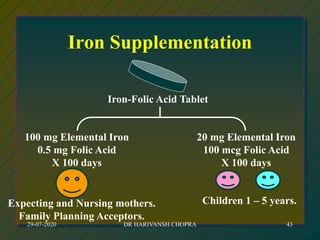
Iron Supplementation
Iron-Folic Acid Tablet
100 mg Elemental Iron
0.5 mg Folic Acid
X 100 days
20 mg Elemental Iron
100 mcg Folic Acid
X 100 days
Expecting and Nursing mothers.
Family Planning Acceptors.
Children 1 – 5 years.
29-07-2020 DR HARIVANSH CHOPRA 43
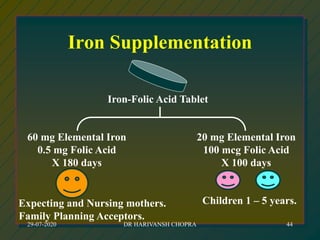
Iron Supplementation
Iron-Folic Acid Tablet
60 mg Elemental Iron
0.5 mg Folic Acid
X 180 days
20 mg Elemental Iron
100 mcg Folic Acid
X 100 days
Expecting and Nursing mothers.
Family Planning Acceptors.
Children 1 – 5 years.
29-07-2020 DR HARIVANSH CHOPRA 44
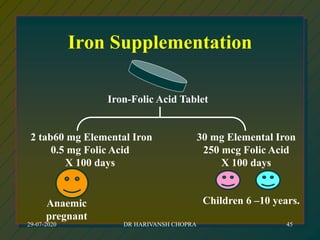
Iron Supplementation
Iron-Folic Acid Tablet
2 tab60 mg Elemental Iron
0.5 mg Folic Acid
X 100 days
30 mg Elemental Iron
250 mcg Folic Acid
X 100 days
Anaemic
pregnant
Children 6 –10 years.
29-07-2020 DR HARIVANSH CHOPRA 45
TWELVE BY TWELVE INITIATIVE
Initiative launched by FOGSI in collaboration with GOI,WHO
and unicef
By 2012 every child should have 12gm% Hb by 12 years of age
29-07-2020 DR HARIVANSH CHOPRA 46
National Programme for Prophylaxis
against Blindness in Children caused
due to Vitamin A Deficiency
1. Launched by Ministry
of Health and Family
Welfare in 1970 on
basis of technology
developed at
National Institute of
Nutrition, Hyderabad.
29-07-2020 DR HARIVANSH CHOPRA 47
Beneficiaries
Children of age group 9 months –5
years.
29-07-2020 DR HARIVANSH CHOPRA 48
Vitamin A Prophylaxis
9 months – 1 lac IU Vit. A
15 months – 2 lac IU Vit. A
2 lac IU Vit. A every 6 months
till 5 yrs of age.
1st Dose
2nd Dose
7 Doses
17 lac IU of Vit. A – Total 9 doses
29-07-2020 DR HARIVANSH CHOPRA 49
Recommended Daily Intakes
1. Adults:
Retinol
(mcg)
Β-Carotene
(mcg)
Man
Woman
Pregnancy
Lactation
600
600
800
950
4800
6400
29-07-2020 DR HARIVANSH CHOPRA
Recommended Daily Intakes
2. Children and Adolescents:
Retinol
(mcg)
Β-Carotene
(mcg)
0-12 months
1-6 years
7-12 years
13-19 years
350
400
600
600
2800
3200
4800
4800
29-07-2020 DR HARIVANSH CHOPRA
Vitamin A deficiency –
Ocular Manifestations
Night blindness
Conjunctival Xerosis
& Bitot’s Spots
Corneal Xerosis
Keratomalacia
29-07-2020 DR HARIVANSH CHOPRA
W.H.O.CLASSIFICATION
PRIMARY SIGNS
1. XIA- Conjunctival Xerosis
2. XIB- Bitot’s Spots Conjunctival
Xerosis
3. X2 - Corneal Xerosis
4. X3A- Corneal Ulceration with
Xerosis
5. X3B- Keratomalacia29-07-2020 DR HARIVANSH CHOPRA
W.H.O.CLASSIFICATION
SECONDARY SIGNS
1. XN-Night Blindness only
2. XB-Bitot’s Spots only
3. XF-Typical Fundus changes
4. XS-Corneal scar attributable to
Xeropthalmia
29-07-2020 DR HARIVANSH CHOPRA
Vitamin A deficiency –
Ocular Manifestations
Night Blindness:
1. First ocular
symptom of Vitamin
A deficiency.
2. Inability to see in
dim light.
3. It is due to
impairment in dark
adaptation.
29-07-2020 DR HARIVANSH CHOPRA
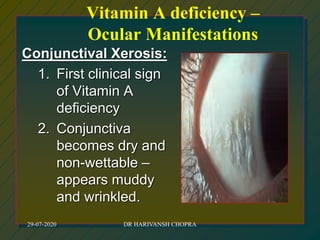
Conjunctival Xerosis:
1. First clinical sign
of Vitamin A
deficiency
2. Conjunctiva
becomes dry and
non-wettable –
appears muddy
and wrinkled.
Vitamin A deficiency –
Ocular Manifestations
29-07-2020 DR HARIVANSH CHOPRA
Vitamin A deficiency –
Ocular Manifestations
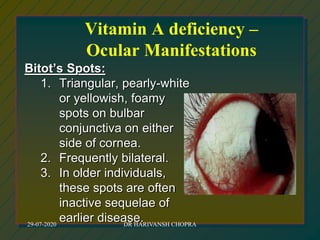
Bitot’s Spots:
1. Triangular, pearly-white
or yellowish, foamy
spots on bulbar
conjunctiva on either
side of cornea.
2. Frequently bilateral.
3. In older individuals,
these spots are often
inactive sequelae of
earlier disease.29-07-2020 DR HARIVANSH CHOPRA
Vitamin A deficiency –
Ocular Manifestations
Corneal Xerosis:
1. Cornea appears
dull, dry and non-
wettable, and
eventually
opaque.
2. Severe deficiency
leads to corneal
ulceration.
29-07-2020 DR HARIVANSH CHOPRA
Vitamin A deficiency –
Ocular Manifestations
Corneal
Xerosis:
3. Corneal
ulcer may
heal with
scar –
vision
affected.
29-07-2020 DR HARIVANSH CHOPRA
Vitamin A deficiency –
Ocular ManifestationsKeratomalacia:
1. Medical
emergency.
2. The cornea may
become soft and
burst open.
3. Eye may
collapse with
total loss of
vision.
29-07-2020 DR HARIVANSH CHOPRA
Vitamin A deficiency –
Extra-Ocular Manifestations
Epithelium:
1. Skin – Dry and
Scaly.
2. Follicular
hyperkeratosis
on shoulders,
buttocks, and
extensor
surfaces of
extremities.29-07-2020 DR HARIVANSH CHOPRA
Diagnosis
1. Dark adaptation test.
2. Biomicroscopic examination of
conjunctiva may reveal conjunctival
xerosis.29-07-2020 DR HARIVANSH CHOPRA
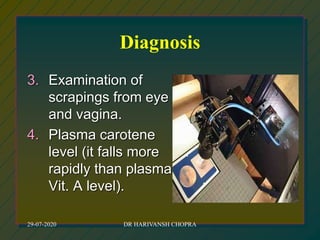
Diagnosis
3. Examination of
scrapings from eye
and vagina.
4. Plasma carotene
level (it falls more
rapidly than plasma
Vit. A level).
29-07-2020 DR HARIVANSH CHOPRA
Treatment
1. All early stages of
Xerophthalmia reversed
by 200,000 IU or 110 mg
of retinol plamitate orally
for two successive days.
2. All children with corneal
ulcers should receive Vit.
A, whether or not a
deficiency is suspected.
29-07-2020 DR HARIVANSH CHOPRA
National Iodine Deficiency
Disorders Control Programme
Launch of National Goitre
Control Programme, 1962
OBJECTIVES:
1. Identification of Goitre
endemic areas & supply of
iodised salt in these areas.
2. To assess the impact of
goitre control measures over
a period of time.
Iodine Deficiency Disorder
Control Programme, 1986
OBJECTIVE:
1. To replace entire edible
salt by iodine salt, in phased
manner by 1992.
RENAMED
29-07-2020 DR HARIVANSH CHOPRA 65
Objectives of NIDDCP
1. To conduct survey to identify
magnitude of problem in country.
2. Production and supply of iodised salt
in place of common salt.
3. To improve Health Education and
Publicity (IEC).
29-07-2020 DR HARIVANSH CHOPRA 66
Objectives of NIDDCP
4. To undertake monitoring of the quality
of iodated salt assessing urinary iodine
excretion pattern and monitoring of
Iodine Deficiency Disorder.
5. To resurvey in goitre endemic regions
after five years continuous supply of
iodised salt to assess impact of control
programme.
29-07-2020 DR HARIVANSH CHOPRA 67
DR HARIVANSH CHOPRA
• In India the level of iodization is fixed
under the Prevention of Food
Adulteration (PFA) Act.
AT PRODUCTION POINT AT CONSUMER LEVEL
30 PPM 15 PPM
29-07-2020 68
DR HARIVANSH CHOPRA
Iodine testing Kit
• It contains a vial with
a chemical solution.
• 1 drop of chemical
solution turns a salt
sample from light
blue to dark violet if it
contains iodine.
29-07-2020 69
Conclusion
• The various nutritional programmes are
covering the vulnerable age groups in
which the nutritional needs are more.
29-07-2020 DR HARIVANSH CHOPRA 70
Conclusion
But unfortunately effective implementation
and supportive supervision is lacking due
to which still both macro and
micronutrients deficiencies are still quite
high in the community
29-07-2020 DR HARIVANSH CHOPRA 71
1. Who are the beneficiaries of
bawadi nutrition program?
1. 0-3 years of age
2. 3-6 years of age
3. 0-6 years of age
4. Pregnant women
Ans . 2
29-07-2020 DR HARIVANSH CHOPRA 72
Which of the following is the
aim of applied nutrition
program?
1. Promoting the production of protective
foods
2. Health education
3. Increasing the awareness about
malnutrition
4. Providing adequate calories and proteins
Ans . 1
29-07-2020 DR HARIVANSH CHOPRA 73
When was ICDS launched?
1. 2nd October, 1975
2. 30th January, 1975
3. 15th august. 1975
4. 26th January, 1975
Ans . 1
29-07-2020 DR HARIVANSH CHOPRA 74
Malnourished children are
provided food at a rate of
1. Rs. 8 per day
2. Rs. 5 per day
3. Rs. 4 per day
4. Rs. 3 per day
Ans . 1
29-07-2020 DR HARIVANSH CHOPRA 75
How many AWW are
supervised by 1 Mukhya Sevika
1. 20
2. 25
3. 50
4. 100
Ans . 2
29-07-2020 DR HARIVANSH CHOPRA 76
29-07-2020 DR HARIVANSH CHOPRA 77

National nutrition programmes.

  • 1.
    National Nutrition Programmes Dr.Harivansh Chopra, DCH, MD Professor, Dept. of Community Medicine, LLRM Medical College, Meerut. harichop@gmail.com
  • 2.
    OBJECTIVE • to studythe various national nutritional programmes aimed at combating specific nutritional deficiencies as well as to promote overall nutritional status of the community. 29-07-2020 DR HARIVANSH CHOPRA 2
  • 3.
    Special Nutrition Programme 1.Launched in 1970. 2. Support: 1. Originally launched as Central programme. 2. Transferred to state sector in 5th five-year plan as part of Minimum Needs Programme. 3. Gradually being merged into ICDS programme. 29-07-2020 DR HARIVANSH CHOPRA 3
  • 4.
    Beneficiaries Children < 6years of age Pregnant & Nursing women Residing in: • Urban Slums. • Tribal Areas. • Backward Rural Areas. 29-07-2020 DR HARIVANSH CHOPRA 4
  • 5.
    Beneficiaries of Programme Childup to 6 years of age 300 Calories/day 10-12 grams/day 29-07-2020 DR HARIVANSH CHOPRA 5
  • 6.
    Beneficiaries of Programme Pregnant& Nursing Women 500 Calories/day 25 grams/day 29-07-2020 DR HARIVANSH CHOPRA 6
  • 7.
    Balwadi Nutrition Programme 1.Launched in 1970. 2. Support: 1. Overall charge – Department of Social Welfare. 2. Grants – four National level organisations including “Indian Council of Child Welfare”. 29-07-2020 DR HARIVANSH CHOPRA 7
  • 8.
    Beneficiaries Children in agegroup 3 – 6 years in rural areas. 29-07-2020 DR HARIVANSH CHOPRA 8
  • 9.
    Organisation Balwadi Functions Food Supplementation 1. 300kcal per day, 2. 10 gms protein per day; for 270 days an year. Pre-primary School Education to children. Merged with icds in 197529-07-2020 DR HARIVANSH CHOPRA 9
  • 10.
    Applied Nutrition Programme 1.Launched as pilot scheme in Orissa in 1963, later extended to Uttar Pradesh and Tamil Nadu. 2. Extended to all states in 1973. 29-07-2020 DR HARIVANSH CHOPRA 10
  • 11.
    Beneficiaries 1. Children between2-6 years of age. 2. Pregnant and Lactating mothers. 29-07-2020 DR HARIVANSH CHOPRA 11
  • 12.
    Aims Nutritional Education: teaching ruralcommunities how to produce foods for their own consumption through their own efforts. Promoting production of protective foods eg. vegetables and fruits. Ensuring their consumption by pregnant and nursing mothers and children THROUGH 29-07-2020 DR HARIVANSH CHOPRA 12
  • 13.
    Integrated Child Development Scheme(ICDS) 1. Launch – 2nd October, 1975. 2. Ministries involved: 1. Central: 1. Department of Women and Child Development. 2. Ministry of Human Resources Development. 2. Nodal departments at state: 1. Social Welfare. 2. Rural Development. 3. Tribal Welfare. 4. Health and Family Welfare. 5. Women and Child Development. 29-07-2020 DR HARIVANSH CHOPRA 13
  • 14.
    Beneficiaries of ICDS 1.Children below 6 years. 2. Pregnant and Lactating Women. 3. Women in the age group of 15 – 45 years. 4. Adolescent girls (11-18 years) in selected blocks. 29-07-2020 DR HARIVANSH CHOPRA 14
  • 15.
    Objectives of ICDS 1.Improve the nutrition and health status of children in the age group of 0-6 years. 2. Lay the foundation for proper psychological, physical and social development of the child. 29-07-2020 DR HARIVANSH CHOPRA 15
  • 16.
    Objectives of ICDS 3.Toreduce morbidity, mortality, malnutrition and school drop out 29-07-2020 DR HARIVANSH CHOPRA 16
  • 17.
    Objectives of ICDS 4.Effective coordination and implementati on of policy amongst various departments. 29-07-2020 DR HARIVANSH CHOPRA 17
  • 18.
    Objectives of ICDS 4.Enhance the capability of the mother to look after the normal health and nutrition needs through proper nutrition and health education. 29-07-2020 DR HARIVANSH CHOPRA 18
  • 19.
    Organisation ANGANWADI Anganwadi Worker RUN BY 1/1000Population Rural & Urban areas 1/700 Population Tribal areas Mukhya Sevika Child Development Project Officer HEADED BY HEADED BY Helper 29-07-2020 DR HARIVANSH CHOPRA 19
  • 20.
    Organisation ANGANWADI Anganwadi Worker (25) RUNBY 1/400-800 Population Rural & Urban areas 1/300-800 Population Tribal areas Mukhya Sevika (4) Child Development Project Officer (1) HEADED BY HEADED BY Helper 1MINI AWC/150- 400 Population Rural & Urban areas 1MINI AWC/150- 300 Population Tribal areas 29-07-2020 DR HARIVANSH CHOPRA 20
  • 21.
    Functions of Anganwadi 1.Health: 1. Immunisation. 2. Health check- up. 3. Referral services. 4. Treatment of minor illnesses. 29-07-2020 DR HARIVANSH CHOPRA 21
  • 22.
    Functions of Anganwadi 2.Nutrition: 1. Supplementary Nutrition. 2. Growth monitoring and promotion. 3. Nutrition and Health education. 3. Early Childhood care and Pre-School Education to children of 3 – 6 years. 4. Convergence of other supportive services. 29-07-2020 DR HARIVANSH CHOPRA 22
  • 23.
    Nutritional Services – SupplementaryNutrition (New) Child up to 6 years of age 500 Calories/day 12-15 grams/day Financial norm of rupees 8 per child per day 29-07-2020 DR HARIVANSH CHOPRA 23
  • 24.
    Nutritional Services – SupplementaryNutrition Adolescent Girls 600 Calories/day 18-20 grams/day 29-07-2020 DR HARIVANSH CHOPRA 24
  • 25.
    Nutritional Services – SupplementaryNutrition Pregnant & Nursing Mothers 600 Calories/day 18-20grams/day 29-07-2020 DR HARIVANSH CHOPRA 25
  • 26.
    Nutritional Services –Supplementary Nutrition (new norms) Pregnant & Nursing Mothers 600 Calories/day 18-20 grams/day Financial norm of rupees 9.5 per day 29-07-2020 DR HARIVANSH CHOPRA 26
  • 27.
    Nutritional Services – SupplementaryNutrition Malnourished Children Double the daily supplement provided to other children + Special Nutrients on medical recommendation. 29-07-2020 DR HARIVANSH CHOPRA 27
  • 28.
    Nutritional Services – SupplementaryNutrition (new norms) Malnourished Children 800 calories/ day 20-25 grams/ day Financial norm of rupees 12 per child per day 29-07-2020 DR HARIVANSH CHOPRA 28
  • 29.
    Revised nutritional andfeeding Norms • More than 1 meal is to be provided • morning snack e.g. banana, milk, egg, seasonal fruit, etc. • followed by a hot cooked meal • Take home ration is to be provided for • Children below 3 years • Pregnant and lactating mothers 29-07-2020 DR HARIVANSH CHOPRA 29
  • 30.
    1. Weighing eachchild under 3 years of age every month. 2. Maintenance of Growth Chart of every child. Nutritional Services – Growth Monitoring & Promotion 29-07-2020 DR HARIVANSH CHOPRA 30
  • 31.
    3. Children over3 years of age assessed with MUAC. 4. A child falling in yellow or red zone is weighed every month. Nutritional Services – Growth Monitoring & Promotion 29-07-2020 DR HARIVANSH CHOPRA 31
  • 32.
    5. Organisation ofteaching of mothers on health and nutrition. Nutritional Services – Nutrition and Health Education 29-07-2020 DR HARIVANSH CHOPRA 32
  • 33.
    Schemes being runfor adolescent under ICDS • Kishori Shakti Yojna • Nutritional Program For Adolescent Girls • Rajiv Gandhi Scheme for Empowerment of Adolescent Girls-SABLA • Indira Gnadhi Matratva Sahyog Yojna (IGMSY) 29-07-2020 DR HARIVANSH CHOPRA 33
  • 34.
    Mid-Day Meal Programme 1.“National Programme of Nutritional Support to Primary Education” is popularly known as “Mid-Day Meal Scheme”. 2. Launch – 15th August, 1995. 29-07-2020 DR HARIVANSH CHOPRA 34
  • 35.
    3. Aims atlaunch: 1. Improving School Attendance. 2. Reducing school dropouts. 3. Beneficial impact on children’s nutrition. Mid-Day Meal Programme 29-07-2020 DR HARIVANSH CHOPRA 35
  • 36.
    Beneficiaries of Mid-DayMeal 1. Children of class I – V of government schools (states like Gujrat and Tamil Nadu include children of classes I – VIII). 2. Programme extended to children of government supported schools from October, 2002. 29-07-2020 DR HARIVANSH CHOPRA 36
  • 37.
    Support 1. Central Government: Provisionof foodgrains at 3 Kgs. minimum per child per month for 10 months (300 kcal and 8-12 gms protein per child per day). 2. Panchayats and Nagarpalikas: Setting up of necessary infrastructure for preparing cooked food. 29-07-2020 DR HARIVANSH CHOPRA 37
  • 38.
    Support 3. NGOs, Women’sgroup, & Parent- Teacher Council: Preparation of cooked food. 4. Poverty Alleviation Programme: Assistance for total charges for cooking, supervision and kitchen. 29-07-2020 DR HARIVANSH CHOPRA 38
  • 39.
    Mid -day SchoolMeal model menu Foodstuffs g/day/child Cereals and millets Pulses Oils and fats Leafy vegetables Non-leafy vegetables 75 30 8 30 30 29-07-2020 DR HARIVANSH CHOPRA 39
  • 40.
  • 41.
    National Nutritional Anaemia ProphylaxisProgramme 1. Launched in 1970. 2. Aims at launch: 1. Prevent nutritional anaemia in mothers. 2. Prevent nutritional anaemia in children. 29-07-2020 DR HARIVANSH CHOPRA 41
  • 42.
    Support 1. Maternal andChild Health (MCH) division of Ministry of Health and Family Welfare (MoHFW). 2. Now it is a part of RCH Programme. 29-07-2020 DR HARIVANSH CHOPRA 42
  • 43.
    Iron Supplementation Iron-Folic AcidTablet 100 mg Elemental Iron 0.5 mg Folic Acid X 100 days 20 mg Elemental Iron 100 mcg Folic Acid X 100 days Expecting and Nursing mothers. Family Planning Acceptors. Children 1 – 5 years. 29-07-2020 DR HARIVANSH CHOPRA 43
  • 44.
    Iron Supplementation Iron-Folic AcidTablet 60 mg Elemental Iron 0.5 mg Folic Acid X 180 days 20 mg Elemental Iron 100 mcg Folic Acid X 100 days Expecting and Nursing mothers. Family Planning Acceptors. Children 1 – 5 years. 29-07-2020 DR HARIVANSH CHOPRA 44
  • 45.
    Iron Supplementation Iron-Folic AcidTablet 2 tab60 mg Elemental Iron 0.5 mg Folic Acid X 100 days 30 mg Elemental Iron 250 mcg Folic Acid X 100 days Anaemic pregnant Children 6 –10 years. 29-07-2020 DR HARIVANSH CHOPRA 45
  • 46.
    TWELVE BY TWELVEINITIATIVE Initiative launched by FOGSI in collaboration with GOI,WHO and unicef By 2012 every child should have 12gm% Hb by 12 years of age 29-07-2020 DR HARIVANSH CHOPRA 46
  • 47.
    National Programme forProphylaxis against Blindness in Children caused due to Vitamin A Deficiency 1. Launched by Ministry of Health and Family Welfare in 1970 on basis of technology developed at National Institute of Nutrition, Hyderabad. 29-07-2020 DR HARIVANSH CHOPRA 47
  • 48.
    Beneficiaries Children of agegroup 9 months –5 years. 29-07-2020 DR HARIVANSH CHOPRA 48
  • 49.
    Vitamin A Prophylaxis 9months – 1 lac IU Vit. A 15 months – 2 lac IU Vit. A 2 lac IU Vit. A every 6 months till 5 yrs of age. 1st Dose 2nd Dose 7 Doses 17 lac IU of Vit. A – Total 9 doses 29-07-2020 DR HARIVANSH CHOPRA 49
  • 50.
    Recommended Daily Intakes 1.Adults: Retinol (mcg) Β-Carotene (mcg) Man Woman Pregnancy Lactation 600 600 800 950 4800 6400 29-07-2020 DR HARIVANSH CHOPRA
  • 51.
    Recommended Daily Intakes 2.Children and Adolescents: Retinol (mcg) Β-Carotene (mcg) 0-12 months 1-6 years 7-12 years 13-19 years 350 400 600 600 2800 3200 4800 4800 29-07-2020 DR HARIVANSH CHOPRA
  • 52.
    Vitamin A deficiency– Ocular Manifestations Night blindness Conjunctival Xerosis & Bitot’s Spots Corneal Xerosis Keratomalacia 29-07-2020 DR HARIVANSH CHOPRA
  • 53.
    W.H.O.CLASSIFICATION PRIMARY SIGNS 1. XIA-Conjunctival Xerosis 2. XIB- Bitot’s Spots Conjunctival Xerosis 3. X2 - Corneal Xerosis 4. X3A- Corneal Ulceration with Xerosis 5. X3B- Keratomalacia29-07-2020 DR HARIVANSH CHOPRA
  • 54.
    W.H.O.CLASSIFICATION SECONDARY SIGNS 1. XN-NightBlindness only 2. XB-Bitot’s Spots only 3. XF-Typical Fundus changes 4. XS-Corneal scar attributable to Xeropthalmia 29-07-2020 DR HARIVANSH CHOPRA
  • 55.
    Vitamin A deficiency– Ocular Manifestations Night Blindness: 1. First ocular symptom of Vitamin A deficiency. 2. Inability to see in dim light. 3. It is due to impairment in dark adaptation. 29-07-2020 DR HARIVANSH CHOPRA
  • 56.
    Conjunctival Xerosis: 1. Firstclinical sign of Vitamin A deficiency 2. Conjunctiva becomes dry and non-wettable – appears muddy and wrinkled. Vitamin A deficiency – Ocular Manifestations 29-07-2020 DR HARIVANSH CHOPRA
  • 57.
    Vitamin A deficiency– Ocular Manifestations Bitot’s Spots: 1. Triangular, pearly-white or yellowish, foamy spots on bulbar conjunctiva on either side of cornea. 2. Frequently bilateral. 3. In older individuals, these spots are often inactive sequelae of earlier disease.29-07-2020 DR HARIVANSH CHOPRA
  • 58.
    Vitamin A deficiency– Ocular Manifestations Corneal Xerosis: 1. Cornea appears dull, dry and non- wettable, and eventually opaque. 2. Severe deficiency leads to corneal ulceration. 29-07-2020 DR HARIVANSH CHOPRA
  • 59.
    Vitamin A deficiency– Ocular Manifestations Corneal Xerosis: 3. Corneal ulcer may heal with scar – vision affected. 29-07-2020 DR HARIVANSH CHOPRA
  • 60.
    Vitamin A deficiency– Ocular ManifestationsKeratomalacia: 1. Medical emergency. 2. The cornea may become soft and burst open. 3. Eye may collapse with total loss of vision. 29-07-2020 DR HARIVANSH CHOPRA
  • 61.
    Vitamin A deficiency– Extra-Ocular Manifestations Epithelium: 1. Skin – Dry and Scaly. 2. Follicular hyperkeratosis on shoulders, buttocks, and extensor surfaces of extremities.29-07-2020 DR HARIVANSH CHOPRA
  • 62.
    Diagnosis 1. Dark adaptationtest. 2. Biomicroscopic examination of conjunctiva may reveal conjunctival xerosis.29-07-2020 DR HARIVANSH CHOPRA
  • 63.
    Diagnosis 3. Examination of scrapingsfrom eye and vagina. 4. Plasma carotene level (it falls more rapidly than plasma Vit. A level). 29-07-2020 DR HARIVANSH CHOPRA
  • 64.
    Treatment 1. All earlystages of Xerophthalmia reversed by 200,000 IU or 110 mg of retinol plamitate orally for two successive days. 2. All children with corneal ulcers should receive Vit. A, whether or not a deficiency is suspected. 29-07-2020 DR HARIVANSH CHOPRA
  • 65.
    National Iodine Deficiency DisordersControl Programme Launch of National Goitre Control Programme, 1962 OBJECTIVES: 1. Identification of Goitre endemic areas & supply of iodised salt in these areas. 2. To assess the impact of goitre control measures over a period of time. Iodine Deficiency Disorder Control Programme, 1986 OBJECTIVE: 1. To replace entire edible salt by iodine salt, in phased manner by 1992. RENAMED 29-07-2020 DR HARIVANSH CHOPRA 65
  • 66.
    Objectives of NIDDCP 1.To conduct survey to identify magnitude of problem in country. 2. Production and supply of iodised salt in place of common salt. 3. To improve Health Education and Publicity (IEC). 29-07-2020 DR HARIVANSH CHOPRA 66
  • 67.
    Objectives of NIDDCP 4.To undertake monitoring of the quality of iodated salt assessing urinary iodine excretion pattern and monitoring of Iodine Deficiency Disorder. 5. To resurvey in goitre endemic regions after five years continuous supply of iodised salt to assess impact of control programme. 29-07-2020 DR HARIVANSH CHOPRA 67
  • 68.
    DR HARIVANSH CHOPRA •In India the level of iodization is fixed under the Prevention of Food Adulteration (PFA) Act. AT PRODUCTION POINT AT CONSUMER LEVEL 30 PPM 15 PPM 29-07-2020 68
  • 69.
    DR HARIVANSH CHOPRA Iodinetesting Kit • It contains a vial with a chemical solution. • 1 drop of chemical solution turns a salt sample from light blue to dark violet if it contains iodine. 29-07-2020 69
  • 70.
    Conclusion • The variousnutritional programmes are covering the vulnerable age groups in which the nutritional needs are more. 29-07-2020 DR HARIVANSH CHOPRA 70
  • 71.
    Conclusion But unfortunately effectiveimplementation and supportive supervision is lacking due to which still both macro and micronutrients deficiencies are still quite high in the community 29-07-2020 DR HARIVANSH CHOPRA 71
  • 72.
    1. Who arethe beneficiaries of bawadi nutrition program? 1. 0-3 years of age 2. 3-6 years of age 3. 0-6 years of age 4. Pregnant women Ans . 2 29-07-2020 DR HARIVANSH CHOPRA 72
  • 73.
    Which of thefollowing is the aim of applied nutrition program? 1. Promoting the production of protective foods 2. Health education 3. Increasing the awareness about malnutrition 4. Providing adequate calories and proteins Ans . 1 29-07-2020 DR HARIVANSH CHOPRA 73
  • 74.
    When was ICDSlaunched? 1. 2nd October, 1975 2. 30th January, 1975 3. 15th august. 1975 4. 26th January, 1975 Ans . 1 29-07-2020 DR HARIVANSH CHOPRA 74
  • 75.
    Malnourished children are providedfood at a rate of 1. Rs. 8 per day 2. Rs. 5 per day 3. Rs. 4 per day 4. Rs. 3 per day Ans . 1 29-07-2020 DR HARIVANSH CHOPRA 75
  • 76.
    How many AWWare supervised by 1 Mukhya Sevika 1. 20 2. 25 3. 50 4. 100 Ans . 2 29-07-2020 DR HARIVANSH CHOPRA 76
  • 77.