Strategies for
assessment of global
disease burden
Dr. Nagula Praveen
 WHO was founded in 1948.
 GBD study – Global Burden of Diseases study (1997)
 Standardized approach to the epidemiological assessment of medical conditions
and risk factors.
 The main categories are
 1. communicable, maternal, neonatal, and nutritional diseases
 2. non- communicable diseases
 3. injuries
 Risk factors associated with these conditions under the main categories are
 A. Environmental risks
 B. Behavioural risks
 C. Metabolic risks
Dis Mod - MR
• Can be used to estimate age- , sex-, and country –
specific prevalence from heterogenous and often sparse
data sets.
• Burden associated with each condition is measured as
disability – adjusted life years (DALYs)
DALYs
• Combine information regarding premature death (years of
life lost, YLLs) as well as disability caused by the condition
(years lived with disability, YLDs)
• One DALY corresponds to one lost year of health and is
calculated as YLL plus YLD.
• YLDs- multiplying the estimated number of incident cases
by the average duration of the disease and a disability
weight factor (range 0-1 where 0 is total health and 1 is
total disability)
Epidemiology and global
burden of hypertension
Introduction
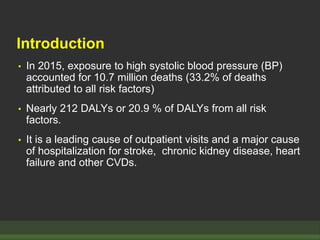
• In 2015, exposure to high systolic blood pressure (BP)
accounted for 10.7 million deaths (33.2% of deaths
attributed to all risk factors)
• Nearly 212 DALYs or 20.9 % of DALYs from all risk
factors.
• It is a leading cause of outpatient visits and a major cause
of hospitalization for stroke, chronic kidney disease, heart
failure and other CVDs.
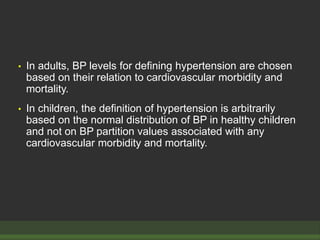
• In adults, BP levels for defining hypertension are chosen
based on their relation to cardiovascular morbidity and
mortality.
• In children, the definition of hypertension is arbitrarily
based on the normal distribution of BP in healthy children
and not on BP partition values associated with any
cardiovascular morbidity and mortality.
Hypertension
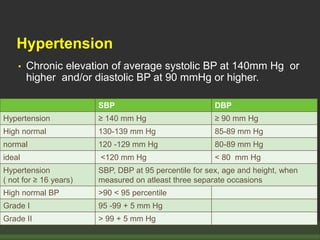
• Chronic elevation of average systolic BP at 140mm Hg or
higher and/or diastolic BP at 90 mmHg or higher.
SBP DBP
Hypertension ≥ 140 mm Hg ≥ 90 mm Hg
High normal 130-139 mm Hg 85-89 mm Hg
normal 120 -129 mm Hg 80-89 mm Hg
ideal <120 mm Hg < 80 mm Hg
Hypertension
( not for ≥ 16 years)
SBP, DBP at 95 percentile for sex, age and height, when
measured on atleast three separate occasions
High normal BP >90 < 95 percentile
Grade I 95 -99 + 5 mm Hg
Grade II > 99 + 5 mm Hg
Primary, secondary and resistant
hypertension
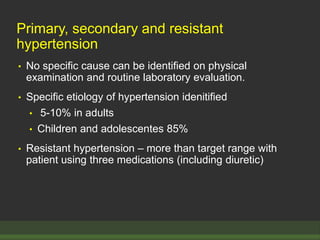
• No specific cause can be identified on physical
examination and routine laboratory evaluation.
• Specific etiology of hypertension idenitified
• 5-10% in adults
• Children and adolescentes 85%
• Resistant hypertension – more than target range with
patient using three medications (including diuretic)
White coat hypertension
• Average BPs in the doctors office are routinely in the
hypertension range while home BP measurements or 24
hour ambulatory BP measurements show normotension.
• Masked hypertension or white coat normotension
• 23% for SBP , 24% for DBP
• 40% in some studies
• Selenta and colleagues – coined the term
WHO STEP wise approach to
surveillance
• Age standardized prevalence of hypertension was 33.2%.
• Prevalence is highest in Africa in the range of 30% for all adults
combined
• Lowest in America at 18%.
• Adverse intrauterine environment and low birth weight
contribute to high BP in children.
• 2.6% increase in risk of high SBP in overweight children
compared with non-overweight children.
• Sedentary lifestyle and physical inactivity were risk factors
• Boys more than girls affected.
• Three out of four adults – family history of hypertension
• Half of children – family history of hypertension
• Association is even greater when both parents have
hypertension.
•
• Risk of CVD doubles for each increment of 30 m mHg of
SBP or 10mm Hg DBP.
• 40-9 years – increment in BP is associated with two fold
difference in the stroke death rate, and ischaemic heart
disease and from other vascular causes.
• Lower BP does not confer protection against CVD
• >57% of all myocardial infarctions and nearly half of all
strokes occur in persons with BP in the normal range.
• Rapsomaniki et al
• 5.2 year median follow up
• Association with high systolic BP were strongest for
intracerebral hemorrhage, sub arachnoid hemorrhage and
stable angina
• Weakest for abdominal aortic aneurysm

Global disease burden assessment

  • 1.
    Strategies for assessment ofglobal disease burden Dr. Nagula Praveen
  • 2.
     WHO wasfounded in 1948.  GBD study – Global Burden of Diseases study (1997)  Standardized approach to the epidemiological assessment of medical conditions and risk factors.  The main categories are  1. communicable, maternal, neonatal, and nutritional diseases  2. non- communicable diseases  3. injuries  Risk factors associated with these conditions under the main categories are  A. Environmental risks  B. Behavioural risks  C. Metabolic risks
  • 3.
    Dis Mod -MR • Can be used to estimate age- , sex-, and country – specific prevalence from heterogenous and often sparse data sets. • Burden associated with each condition is measured as disability – adjusted life years (DALYs)
  • 4.
    DALYs • Combine informationregarding premature death (years of life lost, YLLs) as well as disability caused by the condition (years lived with disability, YLDs) • One DALY corresponds to one lost year of health and is calculated as YLL plus YLD. • YLDs- multiplying the estimated number of incident cases by the average duration of the disease and a disability weight factor (range 0-1 where 0 is total health and 1 is total disability)
  • 5.
  • 6.
    Introduction • In 2015,exposure to high systolic blood pressure (BP) accounted for 10.7 million deaths (33.2% of deaths attributed to all risk factors) • Nearly 212 DALYs or 20.9 % of DALYs from all risk factors. • It is a leading cause of outpatient visits and a major cause of hospitalization for stroke, chronic kidney disease, heart failure and other CVDs.
  • 7.
    • In adults,BP levels for defining hypertension are chosen based on their relation to cardiovascular morbidity and mortality. • In children, the definition of hypertension is arbitrarily based on the normal distribution of BP in healthy children and not on BP partition values associated with any cardiovascular morbidity and mortality.
  • 8.
    Hypertension • Chronic elevationof average systolic BP at 140mm Hg or higher and/or diastolic BP at 90 mmHg or higher. SBP DBP Hypertension ≥ 140 mm Hg ≥ 90 mm Hg High normal 130-139 mm Hg 85-89 mm Hg normal 120 -129 mm Hg 80-89 mm Hg ideal <120 mm Hg < 80 mm Hg Hypertension ( not for ≥ 16 years) SBP, DBP at 95 percentile for sex, age and height, when measured on atleast three separate occasions High normal BP >90 < 95 percentile Grade I 95 -99 + 5 mm Hg Grade II > 99 + 5 mm Hg
  • 9.
    Primary, secondary andresistant hypertension • No specific cause can be identified on physical examination and routine laboratory evaluation. • Specific etiology of hypertension idenitified • 5-10% in adults • Children and adolescentes 85% • Resistant hypertension – more than target range with patient using three medications (including diuretic)
  • 10.
    White coat hypertension •Average BPs in the doctors office are routinely in the hypertension range while home BP measurements or 24 hour ambulatory BP measurements show normotension. • Masked hypertension or white coat normotension • 23% for SBP , 24% for DBP • 40% in some studies • Selenta and colleagues – coined the term
  • 11.
    WHO STEP wiseapproach to surveillance • Age standardized prevalence of hypertension was 33.2%. • Prevalence is highest in Africa in the range of 30% for all adults combined • Lowest in America at 18%. • Adverse intrauterine environment and low birth weight contribute to high BP in children. • 2.6% increase in risk of high SBP in overweight children compared with non-overweight children. • Sedentary lifestyle and physical inactivity were risk factors • Boys more than girls affected.
  • 12.
    • Three outof four adults – family history of hypertension • Half of children – family history of hypertension • Association is even greater when both parents have hypertension. •
  • 13.
    • Risk ofCVD doubles for each increment of 30 m mHg of SBP or 10mm Hg DBP. • 40-9 years – increment in BP is associated with two fold difference in the stroke death rate, and ischaemic heart disease and from other vascular causes. • Lower BP does not confer protection against CVD • >57% of all myocardial infarctions and nearly half of all strokes occur in persons with BP in the normal range.
  • 14.
    • Rapsomaniki etal • 5.2 year median follow up • Association with high systolic BP were strongest for intracerebral hemorrhage, sub arachnoid hemorrhage and stable angina • Weakest for abdominal aortic aneurysm