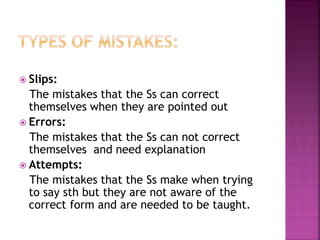
 Slips:
The mistakes that the Ss can correct
themselves when they are pointed out
 Errors:
The mistakes that the Ss can not correct
themselves and need explanation
 Attempts:
The mistakes that the Ss make when trying
to say sth but they are not aware of the
correct form and are needed to be taught.
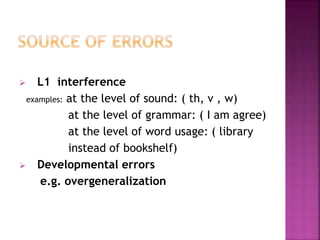
 L1 interference
examples: at the level of sound: ( th, v , w)
at the level of grammar: ( I am agree)
at the level of word usage: ( library
instead of bookshelf)
 Developmental errors
e.g. overgeneralization
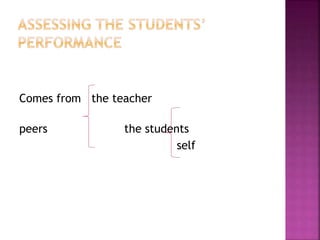
Comes from the teacher
peers the students
self
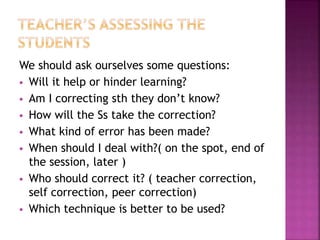
We should ask ourselves some questions:
 Will it help or hinder learning?
 Am I correcting sth they don’t know?
 How will the Ss take the correction?
 What kind of error has been made?
 When should I deal with?( on the spot, end of
the session, later )
 Who should correct it? ( teacher correction,
self correction, peer correction)
 Which technique is better to be used?
 Comments
 Grades and marks
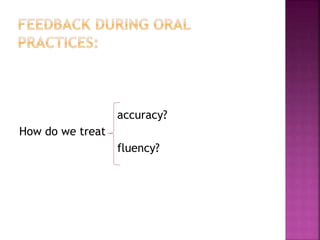
accuracy?
How do we treat
fluency?
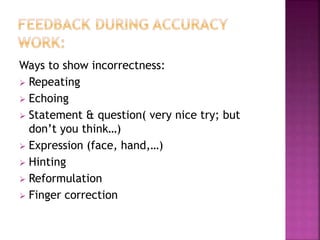
Ways to show incorrectness:
 Repeating
 Echoing
 Statement & question( very nice try; but
don’t you think…)
 Expression (face, hand,…)
 Hinting
 Reformulation
 Finger correction
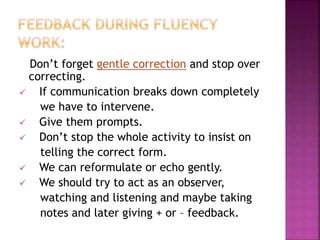
Don’t forget gentle correction and stop over
correcting.
 If communication breaks down completely
we have to intervene.
 Give them prompts.
 Don’t stop the whole activity to insist on
telling the correct form.
 We can reformulate or echo gently.
 We should try to act as an observer,
watching and listening and maybe taking
notes and later giving + or – feedback.
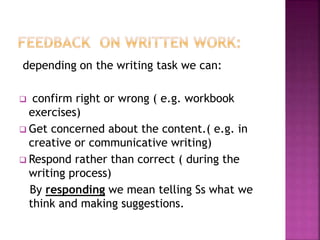
depending on the writing task we can:
 confirm right or wrong ( e.g. workbook
exercises)
 Get concerned about the content.( e.g. in
creative or communicative writing)
 Respond rather than correct ( during the
writing process)
By responding we mean telling Ss what we
think and making suggestions.
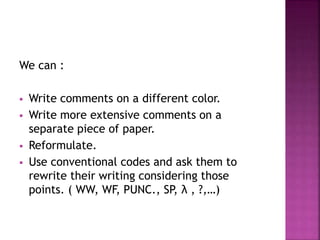
We can :
 Write comments on a different color.
 Write more extensive comments on a
separate piece of paper.
 Reformulate.
 Use conventional codes and ask them to
rewrite their writing considering those
points. ( WW, WF, PUNC., SP, λ , ?,…)
You can :
 tell them how well they did.
 ask them to tell what parts were easy or
difficult ( self-assessment).
 put the most frequent mistakes on the board
and ask the Ss to correct them.
 re-teach the frequently mistaken parts.
Let’s make better mistakes tomorrow.

Error correction slideshare

  • 2.
     Slips: The mistakesthat the Ss can correct themselves when they are pointed out  Errors: The mistakes that the Ss can not correct themselves and need explanation  Attempts: The mistakes that the Ss make when trying to say sth but they are not aware of the correct form and are needed to be taught.
  • 3.
     L1 interference examples:at the level of sound: ( th, v , w) at the level of grammar: ( I am agree) at the level of word usage: ( library instead of bookshelf)  Developmental errors e.g. overgeneralization
  • 4.
    Comes from theteacher peers the students self
  • 5.
    We should askourselves some questions:  Will it help or hinder learning?  Am I correcting sth they don’t know?  How will the Ss take the correction?  What kind of error has been made?  When should I deal with?( on the spot, end of the session, later )  Who should correct it? ( teacher correction, self correction, peer correction)  Which technique is better to be used?
  • 6.
  • 7.
    accuracy? How do wetreat fluency?
  • 8.
    Ways to showincorrectness:  Repeating  Echoing  Statement & question( very nice try; but don’t you think…)  Expression (face, hand,…)  Hinting  Reformulation  Finger correction
  • 9.
    Don’t forget gentlecorrection and stop over correcting.  If communication breaks down completely we have to intervene.  Give them prompts.  Don’t stop the whole activity to insist on telling the correct form.  We can reformulate or echo gently.  We should try to act as an observer, watching and listening and maybe taking notes and later giving + or – feedback.
  • 10.
    depending on thewriting task we can:  confirm right or wrong ( e.g. workbook exercises)  Get concerned about the content.( e.g. in creative or communicative writing)  Respond rather than correct ( during the writing process) By responding we mean telling Ss what we think and making suggestions.
  • 11.
    We can : Write comments on a different color.  Write more extensive comments on a separate piece of paper.  Reformulate.  Use conventional codes and ask them to rewrite their writing considering those points. ( WW, WF, PUNC., SP, λ , ?,…)
  • 12.
    You can : tell them how well they did.  ask them to tell what parts were easy or difficult ( self-assessment).  put the most frequent mistakes on the board and ask the Ss to correct them.  re-teach the frequently mistaken parts.
  • 13.
    Let’s make bettermistakes tomorrow.