10/12/2014 1
10/12/2014 2
 Errors are integral parts of learning process. It 
demands a lot of expertise and patience while 
checking notebooks. Do not create error 
threatening environment; at the same time 
sensitize your learners gradually to write 
accurately and fluently. In order to achieve an 
effective error correction method, it is very 
important for teachers to have a clear 
understanding of the nature of errors. As 
Corder (1967, cited in Cook, 1995: 22). In fact, 
Teaching is an art. 
10/12/2014 3
10/12/2014 4
Teachers should identify common errors learners make so 
that they have some thought of what to do next with 
their teaching methodology (Leech, 1994). 
 Roles in error correction, 
 What errors to correct, 
 How much, who, and how, 
 In addition, learners’ level and attitudes need to be taken 
into consideration, 
10/12/2014 5
10/12/2014 6
Concern what is best for his learners 
Ready to exchange information and 
experience with peers to develop insight 
about learners’ error 
Understanding the source of errors to make 
the way for the learner the way s/he 
understand(simplifies content according to 
learners’ level) 
10/12/2014 7
“Teachers have to inspire and convince 
learners that teachers welcome their 
questions and worries. Positive comments 
on their work are also accommodating to 
motivate learners to pursue more (Wright, 
1987; Richards & Lockhart, 1996)”. 
10/12/2014 8
 The students in too many cases fails to look beyond the 
general comment or word or grade and generally and 
rarely examines into the nature of his individual errors. 
 Learners can make more progress when they are given 
chances to respond to correction and contribute to the 
process. (Meng Tian) 
 Learners need to be engaged in the error correction 
process. 
10/12/2014 9
Providing Feedback to Learners:- “involves learners in the 
self-correction process and helps them learn more 
effectively (Gower, Phillips & Walters, 1995)” 
A. Coded instruction for the desired correction i.e. (SM-Spelling 
Mistakes) 
Direct Correction:- Direct correction gives learners right 
answers beside the marked errors, learners especially 
those with low proficiency find direction correction less 
threatening and thus helpful before they have acquired 
the ability to correct their own errors (Ferris 2002). (Note-sometimes 
learners become passive and lazy as well as 
irresponsible to correct mistakes by themselves) 
10/12/2014 10
Apart from methods, teacher needs to take care at emotional 
level i.e. 
Positive motivation to achieve an effective error correction 
method. 
Avoid error threaten circumstance because fear of not knowing 
what to do with the correction given by the teacher may be 
lead to become passive or least bother about desired 
correction. 
Self correction / Peer correction: - Give students a chance, and 
time, to correct themselves, Students can also correct one 
another. Peer correction often helps to create a positive class 
atmosphere as students realise you are not the only source of 
error correction and they can learn a lot from one another. 
10/12/2014 11
Good appearing notebooks increases self 
confidence of students 
Develop positive attitude among students 
Saves time 
10/12/2014 12
10/12/2014 13
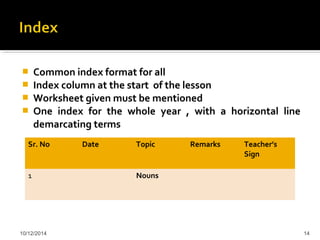
 Common index format for all 
 Index column at the start of the lesson 
 Worksheet given must be mentioned 
 One index for the whole year , with a horizontal line 
demarcating terms 
Sr. No Date Topic Remarks Teacher’s 
Sign 
1 Nouns 
10/12/2014 14
10/12/2014 15
10/12/2014 16
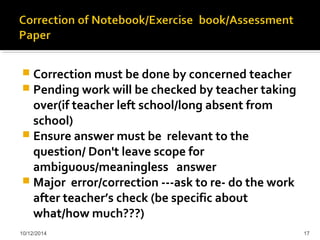
 Correction must be done by concerned teacher 
 Pending work will be checked by teacher taking 
over(if teacher left school/long absent from 
school) 
 Ensure answer must be relevant to the 
question/ Don't leave scope for 
ambiguous/meaningless answer 
 Major error/correction ---ask to re- do the work 
after teacher’s check (be specific about 
what/how much???) 
10/12/2014 17
10/12/2014 18
Spelling errors to be written correctly 
Don't encourage students to 
overwrite/stop this bad habit of student 
Underline the incorrect and tick or a double 
placed under the error 
Indicate the type of errors ; Missing word 
,Incorrect construction, Ambiguous answer 
10/12/2014 19
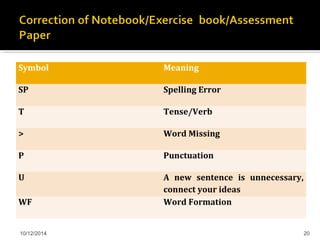
Symbol Meaning 
SP Spelling Error 
T Tense/Verb 
> Word Missing 
P Punctuation 
U A new sentence is unnecessary, 
connect your ideas 
WF Word Formation 
10/12/2014 20
 When a student realizes just what his 
weakness is, his study for examination as 
well as his regular work assumes his 
definiteness that keeps him floundering 
around. He knows exactly where he must 
apply his best effort. (Stith Thomson, 
Jastor , E Journal ) 
10/12/2014 21
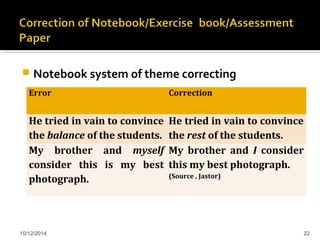
•English/Hindi:-Minute observation of Spelling and capitalization/punctuation and form/grammar/diction/sentence-structure 
•Notebook system of theme correcting 
 Notebook system of theme correcting 
Error Correction 
He tried in vain to convince 
the balance of the students. 
He tried in vain to convince 
the rest of the students. 
My brother and myself 
consider this is my best 
photograph. 
My brother and I consider 
this my best photograph. 
(Source , Jastor) 
10/12/2014 22
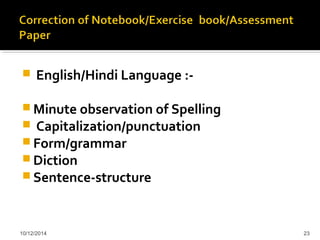
 English/Hindi Language :- 
Minute observation of Spelling 
 Capitalization/punctuation 
Form/grammar 
Diction 
Sentence-structure 
10/12/2014 23
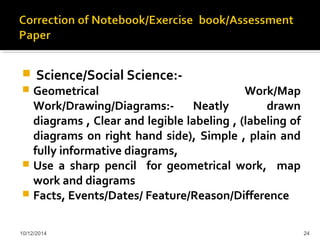
 Science/Social Science:- 
 Geometrical Work/Map 
Work/Drawing/Diagrams:- Neatly drawn 
diagrams , Clear and legible labeling , (labeling of 
diagrams on right hand side), Simple , plain and 
fully informative diagrams, 
 Use a sharp pencil for geometrical work, map 
work and diagrams 
 Facts, Events/Dates/ Feature/Reason/Difference 
10/12/2014 24
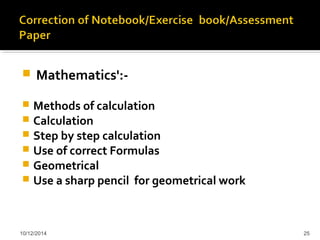
 Mathematics':- 
 Methods of calculation 
 Calculation 
 Step by step calculation 
 Use of correct Formulas 
 Geometrical 
 Use a sharp pencil for geometrical work 
10/12/2014 25
10/12/2014 26
10/12/2014 27
10/12/2014 28
 Notebook must be corrected/checked on regular 
interval or decided by higher authority or within a 
time frame 
 Incomplete work must be rechecked after 
completion; even if a student is absent for 1-2-3 
days, or student is weak/not interested to write, 
or make excuses for not submission of notebooks 
 Teacher must ensure completion of notebook and 
checking of the notebook, otherwise it is counted 
as teacher’s fault /negligence of duty ) 
10/12/2014 29
10/12/2014 30
Rajeev Ranjan 
B.Ed(English), PGDTE & PGDPC 
English and Foreign Languages University, Hyderabad 
Email .Id : rajeevbhuvns@gmail.com 
10/13/14 " Teaching is an art". Rajeev Ranjan 31
 Ester D. Jimena, Central Philippine University, Philippines, Herwindy Maria Tedjaatmadja, 
Petra Christian University, Indonesia, Meng Tian, Shanxi Teachers University, China 
 Bartram, M. & R. Walton (1991) Correction. London: LanguageTeaching Publications. 
 Gower, R., D. Phillips & S. Walters (1995) Teaching Practice Handbook. Oxford: Macmillan 
Education 
 Krashen, S. D. (1987) Principles and Practice in Second Language Acquisition 
 Leech, G. (1994). Students’ Grammar – Teachers’ Grammar – Learners’ Grammar in 
Grammar and The Language teachers, edited by Martin Bygate, Alan Tonkyn 
 Wright, T. (1987) Roles of Teachers & Learners. Oxford: Oxford University Press 
 http://www.jstor.org/stable/801169?seq=5 
 Pictures (Personal ) 
10/13/14 " Teaching is an art". Rajeev Ranjan 32

Notebook Correction/Exercise Book Correction Methods

  • 1.
  • 2.
  • 3.
     Errors areintegral parts of learning process. It demands a lot of expertise and patience while checking notebooks. Do not create error threatening environment; at the same time sensitize your learners gradually to write accurately and fluently. In order to achieve an effective error correction method, it is very important for teachers to have a clear understanding of the nature of errors. As Corder (1967, cited in Cook, 1995: 22). In fact, Teaching is an art. 10/12/2014 3
  • 4.
  • 5.
    Teachers should identifycommon errors learners make so that they have some thought of what to do next with their teaching methodology (Leech, 1994).  Roles in error correction,  What errors to correct,  How much, who, and how,  In addition, learners’ level and attitudes need to be taken into consideration, 10/12/2014 5
  • 6.
  • 7.
    Concern what isbest for his learners Ready to exchange information and experience with peers to develop insight about learners’ error Understanding the source of errors to make the way for the learner the way s/he understand(simplifies content according to learners’ level) 10/12/2014 7
  • 8.
    “Teachers have toinspire and convince learners that teachers welcome their questions and worries. Positive comments on their work are also accommodating to motivate learners to pursue more (Wright, 1987; Richards & Lockhart, 1996)”. 10/12/2014 8
  • 9.
     The studentsin too many cases fails to look beyond the general comment or word or grade and generally and rarely examines into the nature of his individual errors.  Learners can make more progress when they are given chances to respond to correction and contribute to the process. (Meng Tian)  Learners need to be engaged in the error correction process. 10/12/2014 9
  • 10.
    Providing Feedback toLearners:- “involves learners in the self-correction process and helps them learn more effectively (Gower, Phillips & Walters, 1995)” A. Coded instruction for the desired correction i.e. (SM-Spelling Mistakes) Direct Correction:- Direct correction gives learners right answers beside the marked errors, learners especially those with low proficiency find direction correction less threatening and thus helpful before they have acquired the ability to correct their own errors (Ferris 2002). (Note-sometimes learners become passive and lazy as well as irresponsible to correct mistakes by themselves) 10/12/2014 10
  • 11.
    Apart from methods,teacher needs to take care at emotional level i.e. Positive motivation to achieve an effective error correction method. Avoid error threaten circumstance because fear of not knowing what to do with the correction given by the teacher may be lead to become passive or least bother about desired correction. Self correction / Peer correction: - Give students a chance, and time, to correct themselves, Students can also correct one another. Peer correction often helps to create a positive class atmosphere as students realise you are not the only source of error correction and they can learn a lot from one another. 10/12/2014 11
  • 12.
    Good appearing notebooksincreases self confidence of students Develop positive attitude among students Saves time 10/12/2014 12
  • 13.
  • 14.
     Common indexformat for all  Index column at the start of the lesson  Worksheet given must be mentioned  One index for the whole year , with a horizontal line demarcating terms Sr. No Date Topic Remarks Teacher’s Sign 1 Nouns 10/12/2014 14
  • 15.
  • 16.
  • 17.
     Correction mustbe done by concerned teacher  Pending work will be checked by teacher taking over(if teacher left school/long absent from school)  Ensure answer must be relevant to the question/ Don't leave scope for ambiguous/meaningless answer  Major error/correction ---ask to re- do the work after teacher’s check (be specific about what/how much???) 10/12/2014 17
  • 18.
  • 19.
    Spelling errors tobe written correctly Don't encourage students to overwrite/stop this bad habit of student Underline the incorrect and tick or a double placed under the error Indicate the type of errors ; Missing word ,Incorrect construction, Ambiguous answer 10/12/2014 19
  • 20.
    Symbol Meaning SPSpelling Error T Tense/Verb > Word Missing P Punctuation U A new sentence is unnecessary, connect your ideas WF Word Formation 10/12/2014 20
  • 21.
     When astudent realizes just what his weakness is, his study for examination as well as his regular work assumes his definiteness that keeps him floundering around. He knows exactly where he must apply his best effort. (Stith Thomson, Jastor , E Journal ) 10/12/2014 21
  • 22.
    •English/Hindi:-Minute observation ofSpelling and capitalization/punctuation and form/grammar/diction/sentence-structure •Notebook system of theme correcting  Notebook system of theme correcting Error Correction He tried in vain to convince the balance of the students. He tried in vain to convince the rest of the students. My brother and myself consider this is my best photograph. My brother and I consider this my best photograph. (Source , Jastor) 10/12/2014 22
  • 23.
     English/Hindi Language:- Minute observation of Spelling  Capitalization/punctuation Form/grammar Diction Sentence-structure 10/12/2014 23
  • 24.
     Science/Social Science:-  Geometrical Work/Map Work/Drawing/Diagrams:- Neatly drawn diagrams , Clear and legible labeling , (labeling of diagrams on right hand side), Simple , plain and fully informative diagrams,  Use a sharp pencil for geometrical work, map work and diagrams  Facts, Events/Dates/ Feature/Reason/Difference 10/12/2014 24
  • 25.
     Mathematics':- Methods of calculation  Calculation  Step by step calculation  Use of correct Formulas  Geometrical  Use a sharp pencil for geometrical work 10/12/2014 25
  • 26.
  • 27.
  • 28.
  • 29.
     Notebook mustbe corrected/checked on regular interval or decided by higher authority or within a time frame  Incomplete work must be rechecked after completion; even if a student is absent for 1-2-3 days, or student is weak/not interested to write, or make excuses for not submission of notebooks  Teacher must ensure completion of notebook and checking of the notebook, otherwise it is counted as teacher’s fault /negligence of duty ) 10/12/2014 29
  • 30.
  • 31.
    Rajeev Ranjan B.Ed(English),PGDTE & PGDPC English and Foreign Languages University, Hyderabad Email .Id : rajeevbhuvns@gmail.com 10/13/14 " Teaching is an art". Rajeev Ranjan 31
  • 32.
     Ester D.Jimena, Central Philippine University, Philippines, Herwindy Maria Tedjaatmadja, Petra Christian University, Indonesia, Meng Tian, Shanxi Teachers University, China  Bartram, M. & R. Walton (1991) Correction. London: LanguageTeaching Publications.  Gower, R., D. Phillips & S. Walters (1995) Teaching Practice Handbook. Oxford: Macmillan Education  Krashen, S. D. (1987) Principles and Practice in Second Language Acquisition  Leech, G. (1994). Students’ Grammar – Teachers’ Grammar – Learners’ Grammar in Grammar and The Language teachers, edited by Martin Bygate, Alan Tonkyn  Wright, T. (1987) Roles of Teachers & Learners. Oxford: Oxford University Press  http://www.jstor.org/stable/801169?seq=5  Pictures (Personal ) 10/13/14 " Teaching is an art". Rajeev Ranjan 32

Editor's Notes