ERROR CORRECTION BASICS
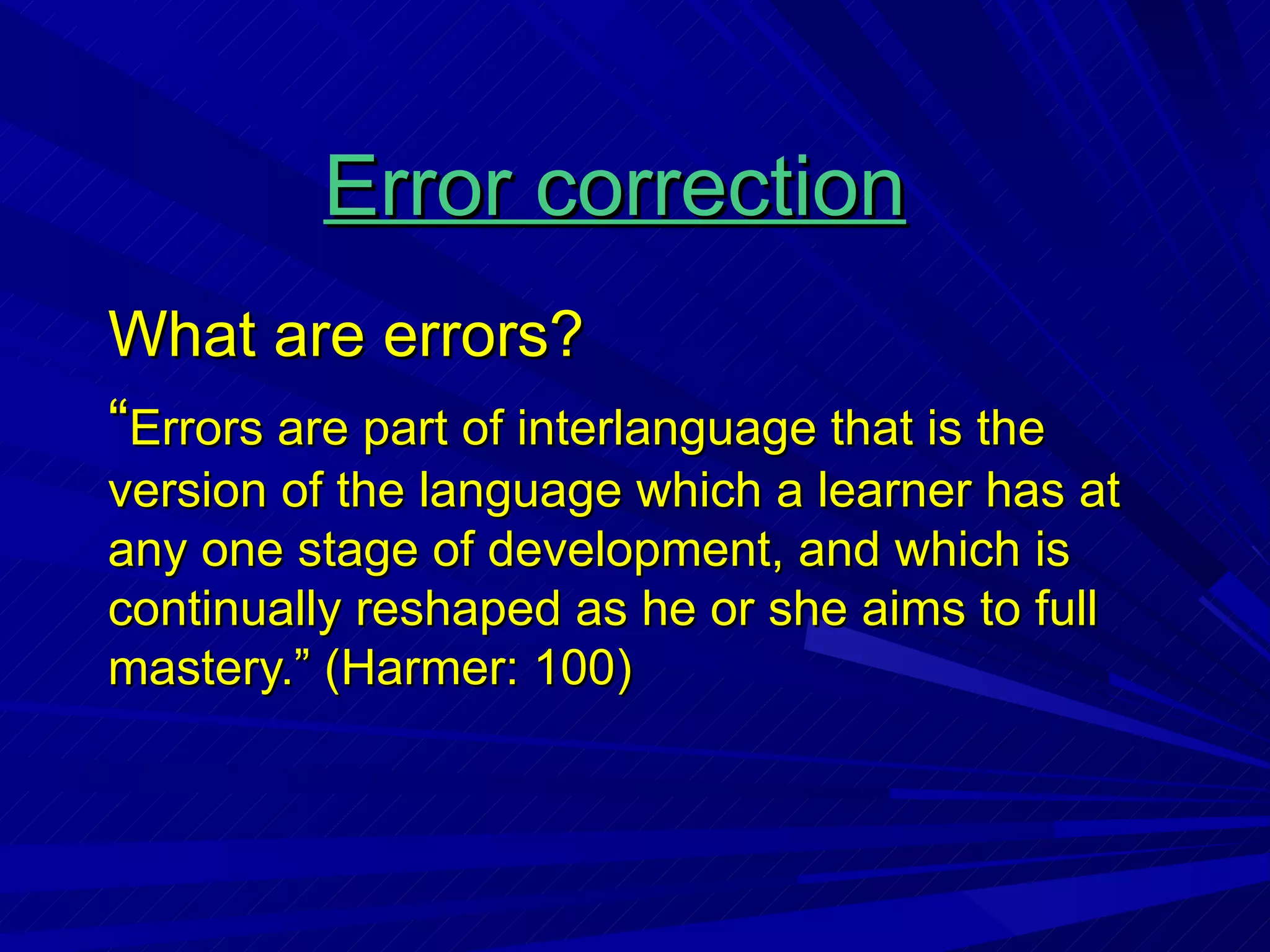
Error correction What are errors? “ Errors are part of interlanguage that is the version of the language which a learner has at any one stage of development, and which is continually reshaped as he or she aims to full mastery.” (Harmer: 100)
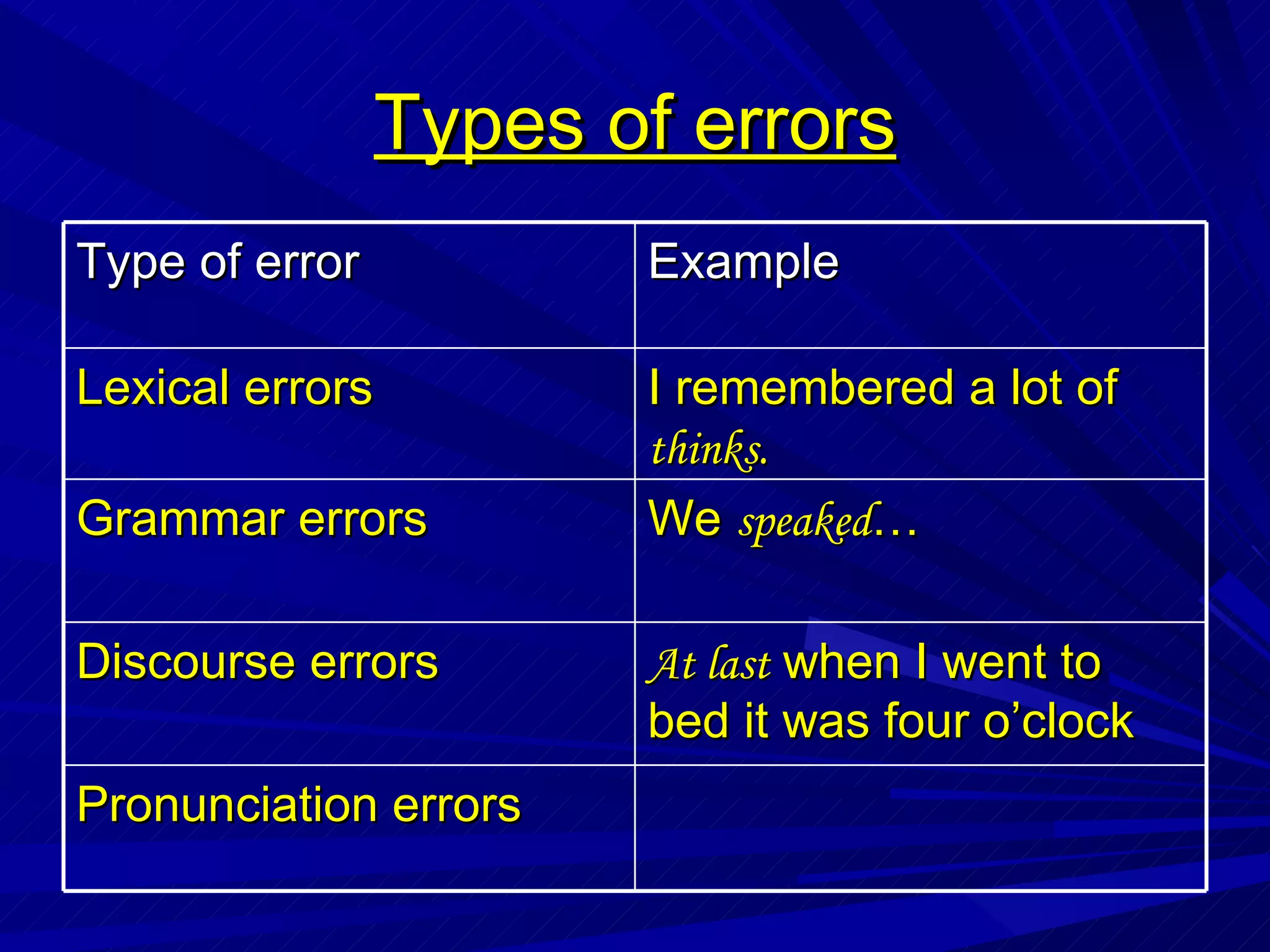
Types of errors Type of error Example Lexical errors I  remembered a lot of  thinks. Grammar errors We  speaked … Discourse errors At last  when I went to bed it was four o’clock Pronunciation errors
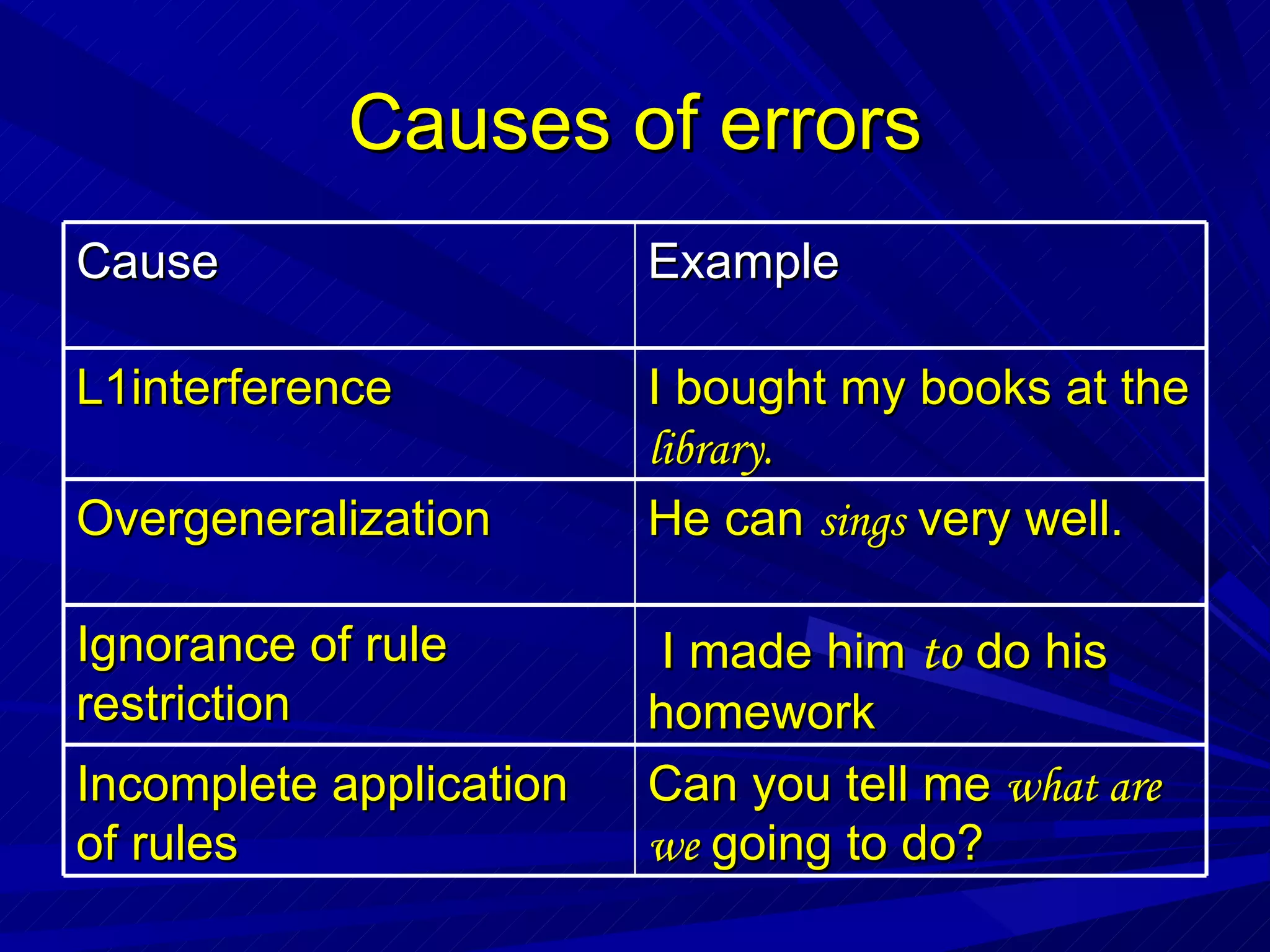
Causes of errors Cause Example L1interference I bought my books at the  library. Overgeneralization He can  sings  very well. Ignorance of rule restriction I made him  to   do his homework Incomplete application of rules Can you tell me  what are we  going to do?
Feedback during accuracy work
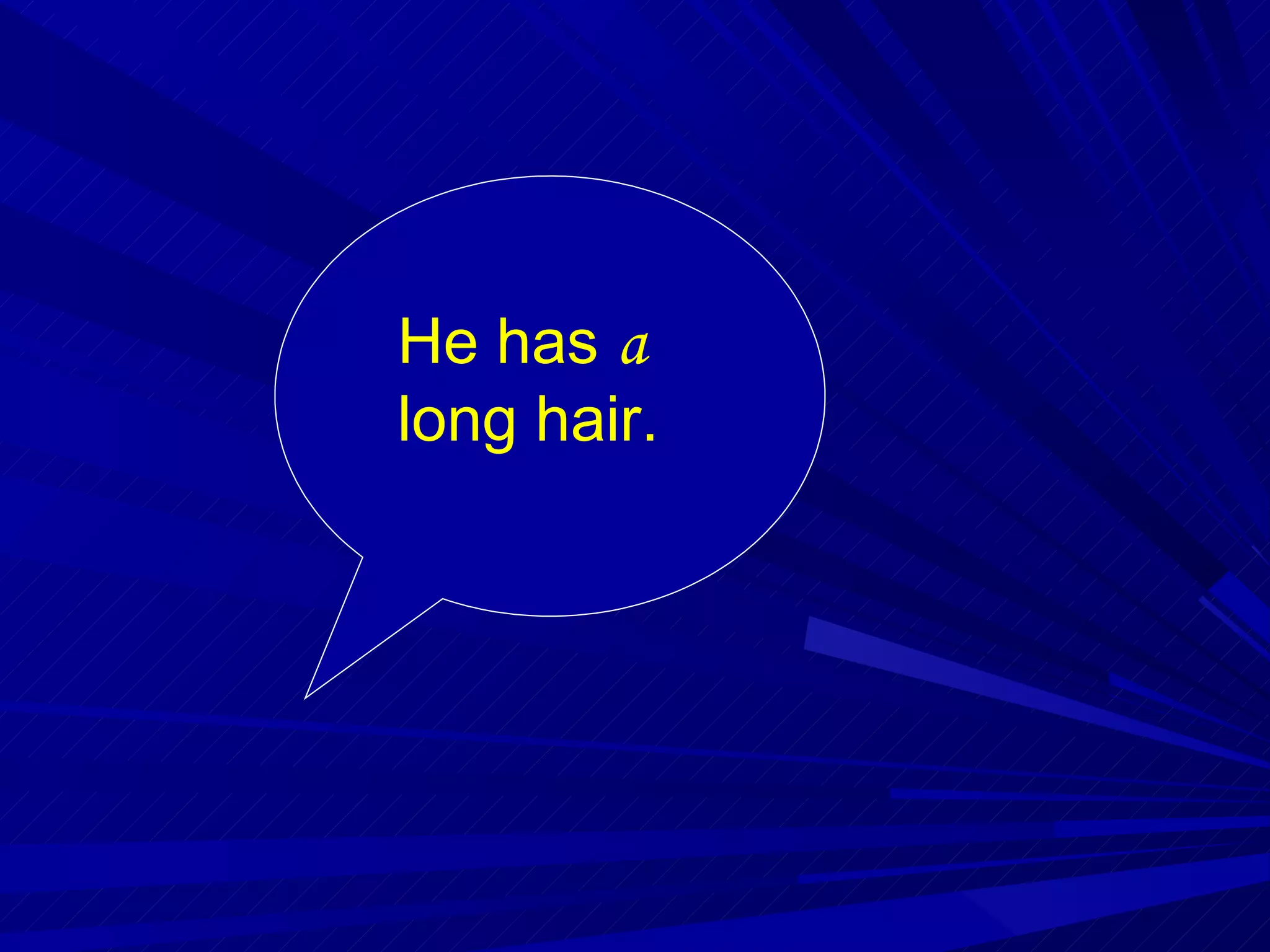
He has  a  long hair.
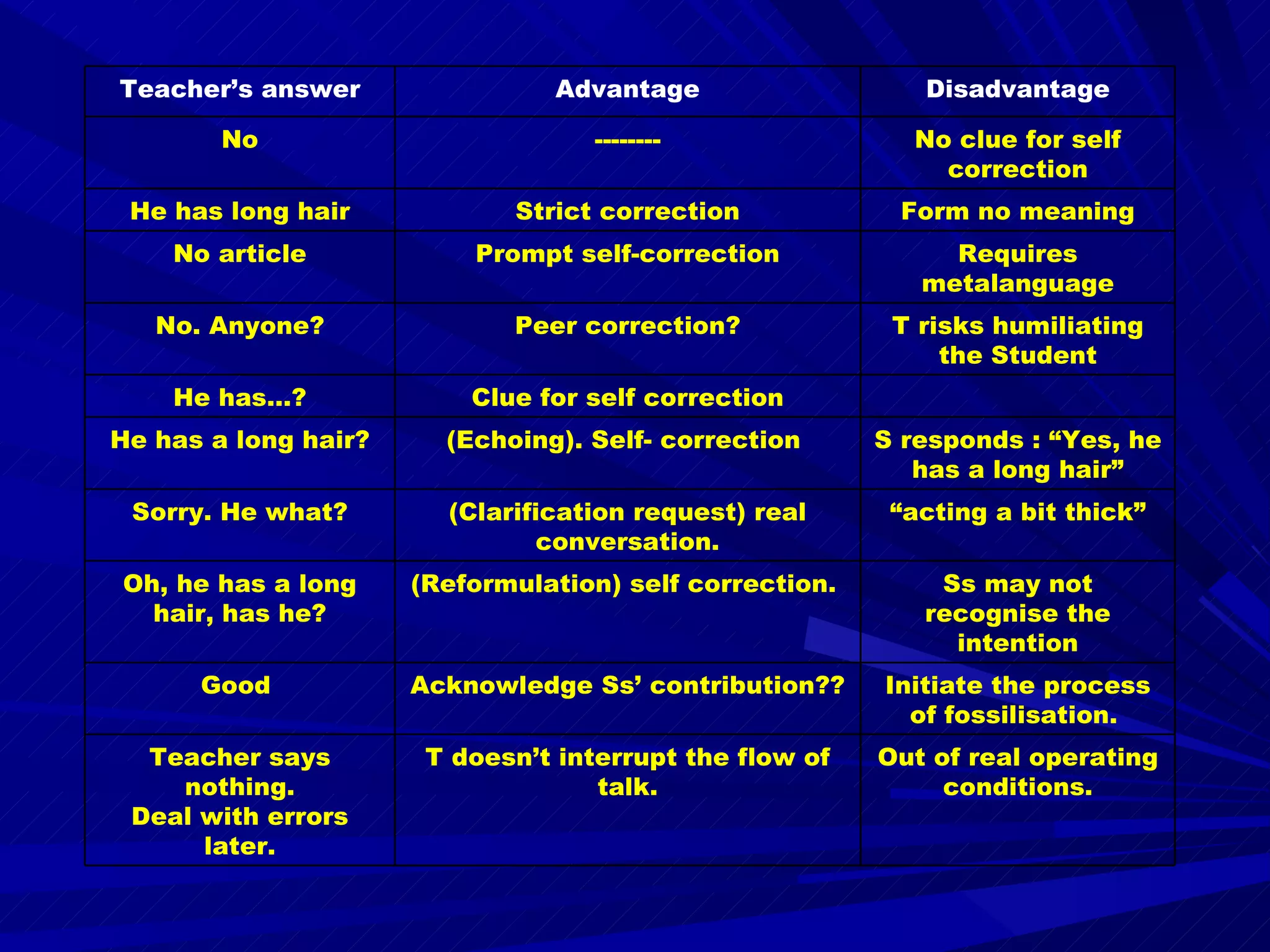
Teacher’s answer Advantage Disadvantage No -------- No clue for self correction He has long hair Strict correction Form no meaning No article Prompt self-correction Requires metalanguage No. Anyone? Peer correction? T risks humiliating the Student He has…? Clue for self correction He has a long hair? (Echoing). Self- correction  S responds : “Yes, he has a long hair” Sorry. He what? (Clarification request) real conversation. “ acting a bit thick” Oh, he has a long hair, has he? (Reformulation) self correction.  Ss may not recognise the intention Good  Acknowledge Ss’ contribution?? Initiate the process of fossilisation.  Teacher says nothing. Deal with errors later. T doesn’t interrupt the flow of talk. Out of real operating conditions.
Feedback during fluency work
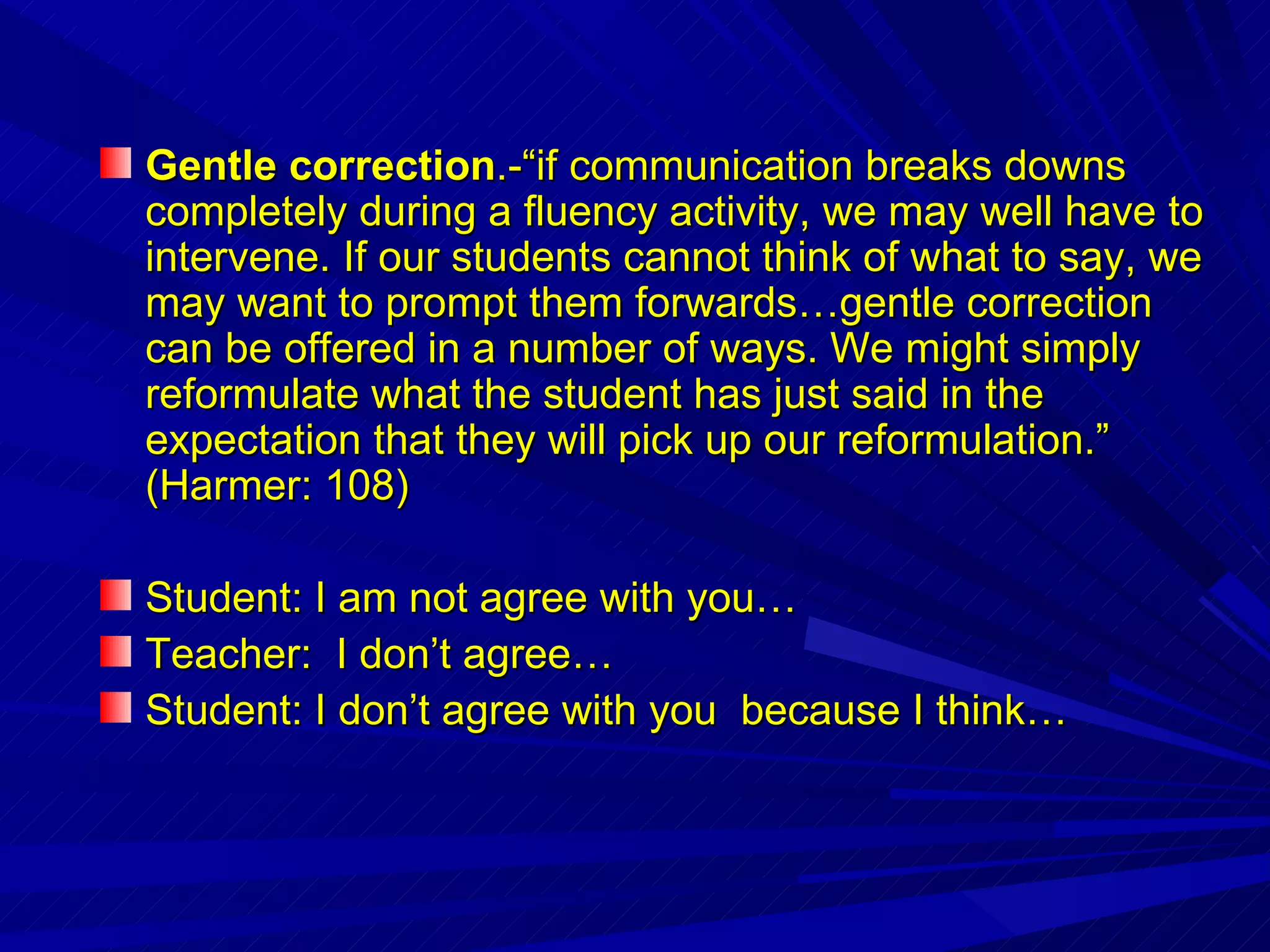
Gentle correction .-“if communication breaks downs completely during a fluency activity, we may well have to intervene. If our students cannot think of what to say, we may want to prompt them forwards…gentle correction can be offered in a number of ways. We might simply reformulate what the student has just said in the expectation that they will pick up our reformulation.” (Harmer: 108) Student: I am not agree with you… Teacher:  I don’t agree… Student: I don’t agree with you  because I think…
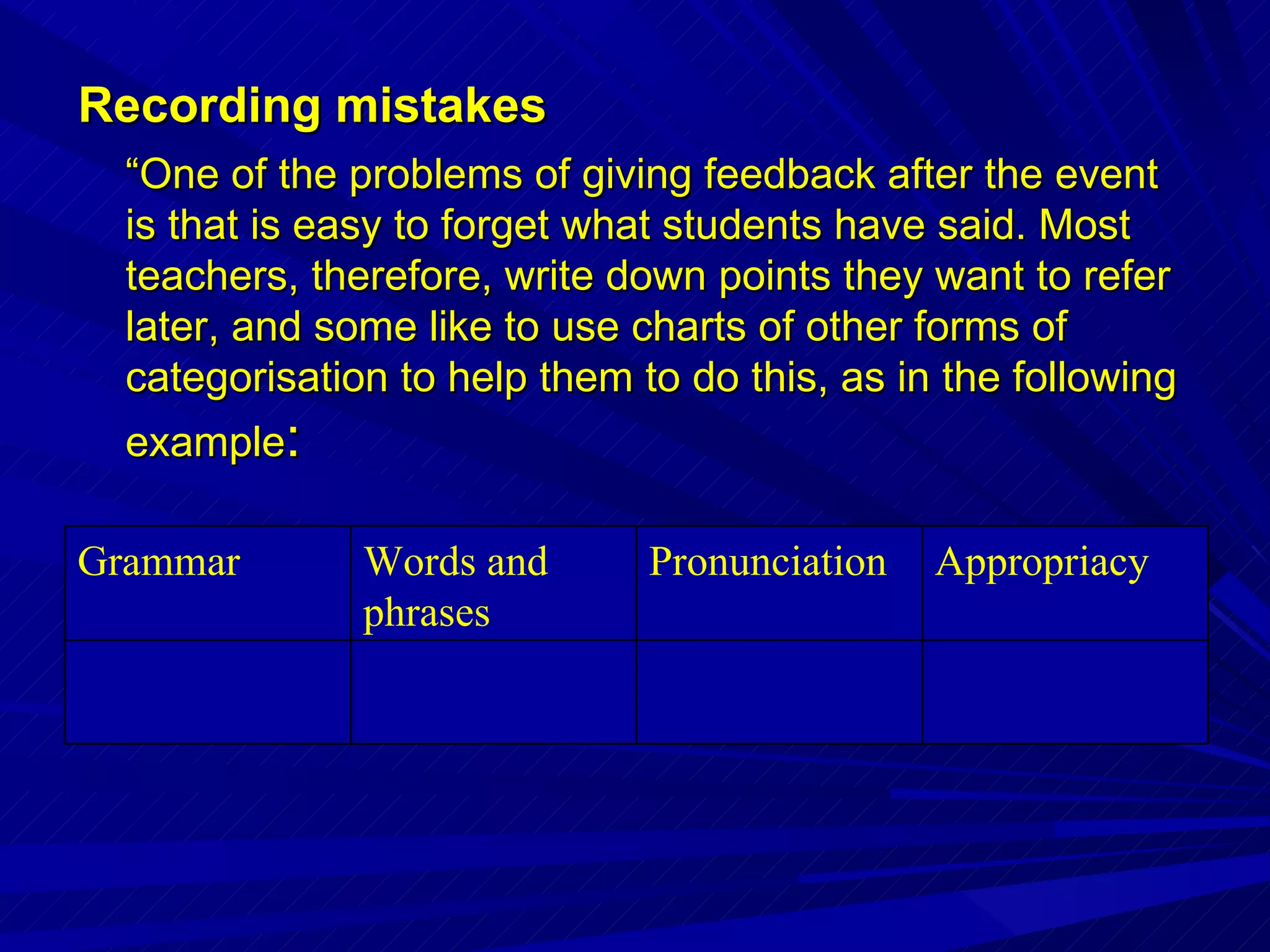
Recording mistakes  “ One of the problems of giving feedback after the event is that is easy to forget what students have said. Most teachers, therefore, write down points they want to refer later, and some like to use charts of other forms of categorisation to help them to do this, as in the following example : Grammar Words and phrases Pronunciation Appropriacy
After the event When we have recorded student performance we will want to give feedback to the class. We can do this in a number of ways. We might want to give an assessment of an activity, saying how well we thought the students did in it, getting students to tell us what they found easiest or most difficult. We can put some of the mistakes we have recorded up on the board and ask students firstly if they can recognise the problem, and then whether they can put it right” (Harmer: 109)

Error correction basics

  • 1.
  • 2.
    Error correction Whatare errors? “ Errors are part of interlanguage that is the version of the language which a learner has at any one stage of development, and which is continually reshaped as he or she aims to full mastery.” (Harmer: 100)
  • 3.
    Types of errorsType of error Example Lexical errors I remembered a lot of thinks. Grammar errors We speaked … Discourse errors At last when I went to bed it was four o’clock Pronunciation errors
  • 4.
    Causes of errorsCause Example L1interference I bought my books at the library. Overgeneralization He can sings very well. Ignorance of rule restriction I made him to do his homework Incomplete application of rules Can you tell me what are we going to do?
  • 5.
  • 6.
    He has a long hair.
  • 7.
    Teacher’s answer AdvantageDisadvantage No -------- No clue for self correction He has long hair Strict correction Form no meaning No article Prompt self-correction Requires metalanguage No. Anyone? Peer correction? T risks humiliating the Student He has…? Clue for self correction He has a long hair? (Echoing). Self- correction S responds : “Yes, he has a long hair” Sorry. He what? (Clarification request) real conversation. “ acting a bit thick” Oh, he has a long hair, has he? (Reformulation) self correction. Ss may not recognise the intention Good Acknowledge Ss’ contribution?? Initiate the process of fossilisation. Teacher says nothing. Deal with errors later. T doesn’t interrupt the flow of talk. Out of real operating conditions.
  • 8.
  • 9.
    Gentle correction .-“ifcommunication breaks downs completely during a fluency activity, we may well have to intervene. If our students cannot think of what to say, we may want to prompt them forwards…gentle correction can be offered in a number of ways. We might simply reformulate what the student has just said in the expectation that they will pick up our reformulation.” (Harmer: 108) Student: I am not agree with you… Teacher: I don’t agree… Student: I don’t agree with you because I think…
  • 10.
    Recording mistakes “ One of the problems of giving feedback after the event is that is easy to forget what students have said. Most teachers, therefore, write down points they want to refer later, and some like to use charts of other forms of categorisation to help them to do this, as in the following example : Grammar Words and phrases Pronunciation Appropriacy
  • 11.
    After the eventWhen we have recorded student performance we will want to give feedback to the class. We can do this in a number of ways. We might want to give an assessment of an activity, saying how well we thought the students did in it, getting students to tell us what they found easiest or most difficult. We can put some of the mistakes we have recorded up on the board and ask students firstly if they can recognise the problem, and then whether they can put it right” (Harmer: 109)