By Olga Kozar
English-by-Skype coordinator
   The goal – simply share my thoughts


   I don’t have the “ right” answers


   I hope this presentation will raise your
    awareness of some issues in error correction
    and will encourage you ask / answer some
    questions
   How do we deal with students’ mistakes?


   WHAT should we correct?
   HOW should we do it ?
   WHEN should we make the corrections?
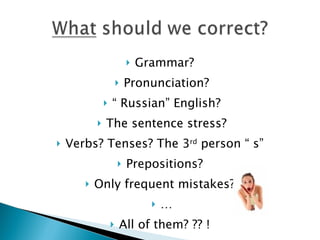
   Grammar?
                          Pronunciation?
                  “ Russian” English?
              The sentence stress?
   Verbs? Tenses? The 3rd person “ s”
                          Prepositions?
          Only frequent mistakes?
                                    …
                      All of them? ?? !
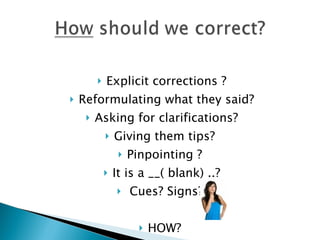
   Explicit corrections ?
   Reformulating what they said?
        Asking for clarifications?
                Giving them tips?
                     Pinpointing ?
                It is a __( blank) ..?
                     Cues? Signs?

                           HOW?
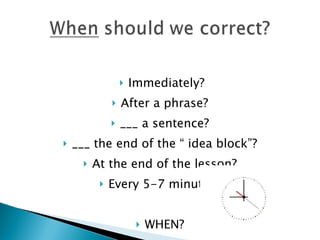
   Immediately?
                  After a phrase?
                  ___ a sentence?
   ___ the end of the “ idea block”?
         At the end of the lesson?
              Every 5-7 minutes?


                           WHEN?
There seem to be 2 main
                            options:


Trying to correct everything, or as much as we
                               can
                               Or
                    “ Selective” corrections

Interesting fact:
the research shows that there is a discrepancy between
  students’ and teachers’ perceptions of the RIGHT way to
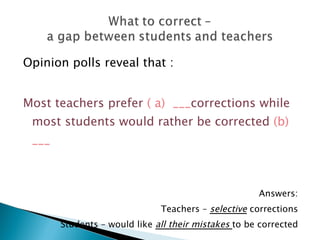
Opinion polls reveal that :


Most teachers prefer ( a) ___corrections while
 most students would rather be corrected (b)
 ___


                                                     Answers:
                              Teachers – selective corrections
       Students – would like all their mistakes to be corrected
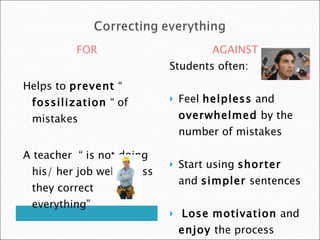
FOR                         AGAINST
                            Students often:
Helps to prevent “
 fossilization “ of            Feel helpless and
 mistakes                       overwhelmed by the
                                number of mistakes

A teacher “ is not doing
                               Start using shorter
 his/ her job well unless
                                and simpler sentences
 they correct
 everything”
                               Lose motivation and
                                enjoy the process
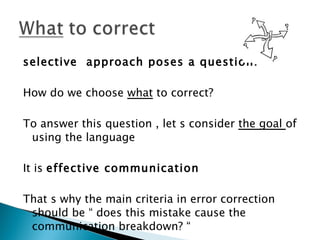
selective approach poses a question:

How do we choose what to correct?

To answer this question , let s consider the goal of
 using the language

It is effective communication

That s why the main criteria in error correction
 should be “ does this mistake cause the
 communication breakdown? “
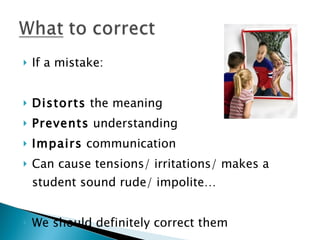
   If a mistake:


   Distorts the meaning
   Prevents understanding
   Impairs communication
   Can cause tensions/ irritations/ makes a
    student sound rude/ impolite…


   We should definitely correct them

Error Correction Ppt

  • 1.
  • 2.
    The goal – simply share my thoughts  I don’t have the “ right” answers  I hope this presentation will raise your awareness of some issues in error correction and will encourage you ask / answer some questions
  • 3.
    How do we deal with students’ mistakes?  WHAT should we correct?  HOW should we do it ?  WHEN should we make the corrections?
  • 4.
    Grammar?  Pronunciation?  “ Russian” English?  The sentence stress?  Verbs? Tenses? The 3rd person “ s”  Prepositions?  Only frequent mistakes?  …  All of them? ?? !
  • 5.
    Explicit corrections ?  Reformulating what they said?  Asking for clarifications?  Giving them tips?  Pinpointing ?  It is a __( blank) ..?  Cues? Signs?  HOW?
  • 6.
    Immediately?  After a phrase?  ___ a sentence?  ___ the end of the “ idea block”?  At the end of the lesson?  Every 5-7 minutes?  WHEN?
  • 7.
    There seem tobe 2 main options: Trying to correct everything, or as much as we can Or “ Selective” corrections Interesting fact: the research shows that there is a discrepancy between students’ and teachers’ perceptions of the RIGHT way to
  • 8.
    Opinion polls revealthat : Most teachers prefer ( a) ___corrections while most students would rather be corrected (b) ___ Answers: Teachers – selective corrections Students – would like all their mistakes to be corrected
  • 9.
    FOR AGAINST Students often: Helps to prevent “ fossilization “ of  Feel helpless and mistakes overwhelmed by the number of mistakes A teacher “ is not doing  Start using shorter his/ her job well unless and simpler sentences they correct everything”  Lose motivation and enjoy the process
  • 10.
    selective approach posesa question: How do we choose what to correct? To answer this question , let s consider the goal of using the language It is effective communication That s why the main criteria in error correction should be “ does this mistake cause the communication breakdown? “
  • 11.
    If a mistake:  Distorts the meaning  Prevents understanding  Impairs communication  Can cause tensions/ irritations/ makes a student sound rude/ impolite…  We should definitely correct them