http://www.free-powerpoint-templates-design.com
Second Language Acquisition
Learner Language?
Learner langugae is
what learners produce
when they are trying
to communicate using
a second (or non
primary) langugae
Laguage learner are
students who are
unable to communicate
fluently or learn effective
ly in English, who often
come from non-English-
speaking homes and
bacground.
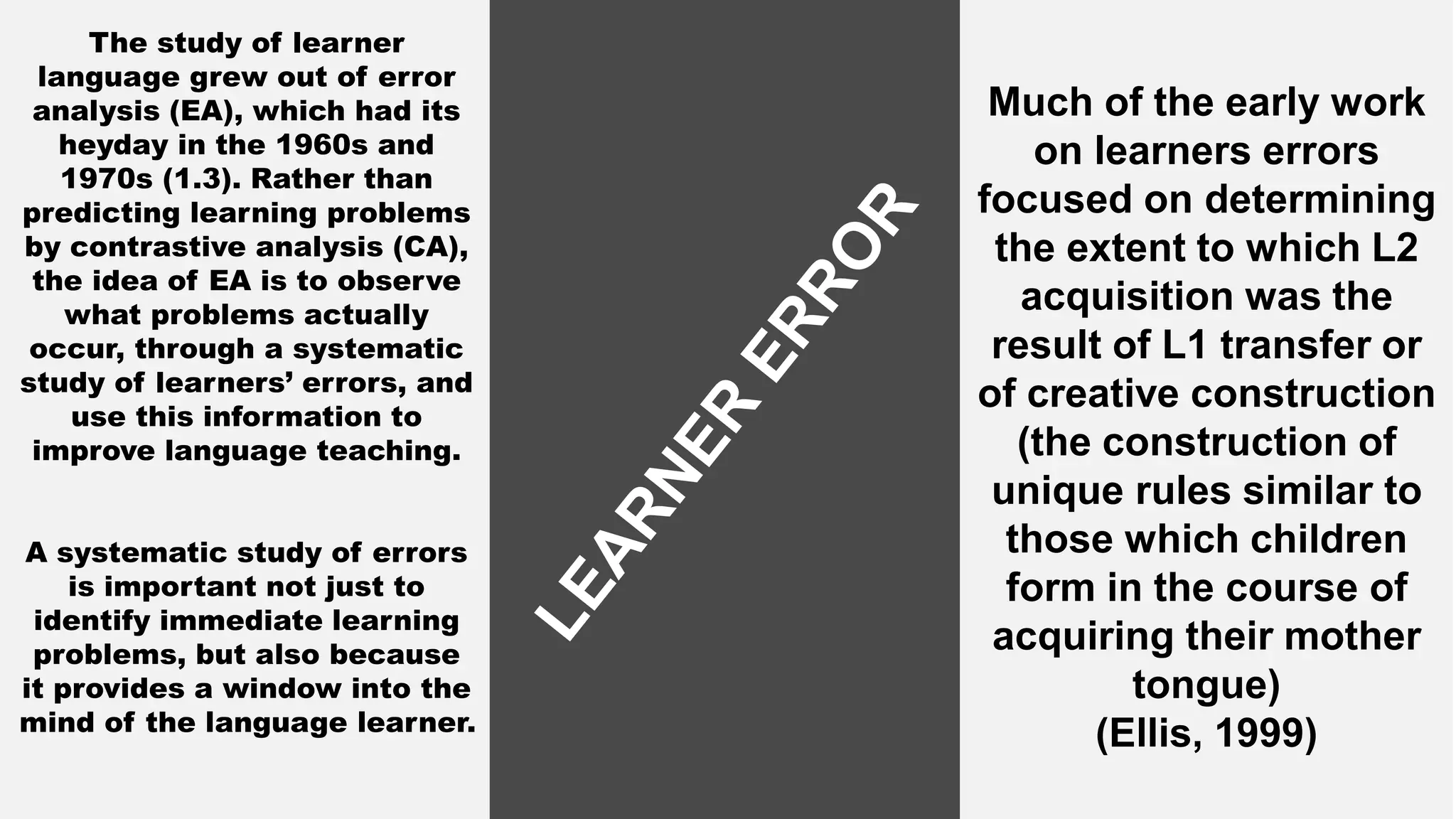
The study of learner
language grew out of error
analysis (EA), which had its
heyday in the 1960s and
1970s (1.3). Rather than
predicting learning problems
by contrastive analysis (CA),
the idea of EA is to observe
what problems actually
occur, through a systematic
study of learners’ errors, and
use this information to
improve language teaching.
A systematic study of errors
is important not just to
identify immediate learning
problems, but also because
it provides a window into the
mind of the language learner.
Much of the early work
on learners errors
focused on determining
the extent to which L2
acquisition was the
result of L1 transfer or
of creative construction
(the construction of
unique rules similar to
those which children
form in the course of
acquiring their mother
tongue)
(Ellis, 1999)
Types of Error
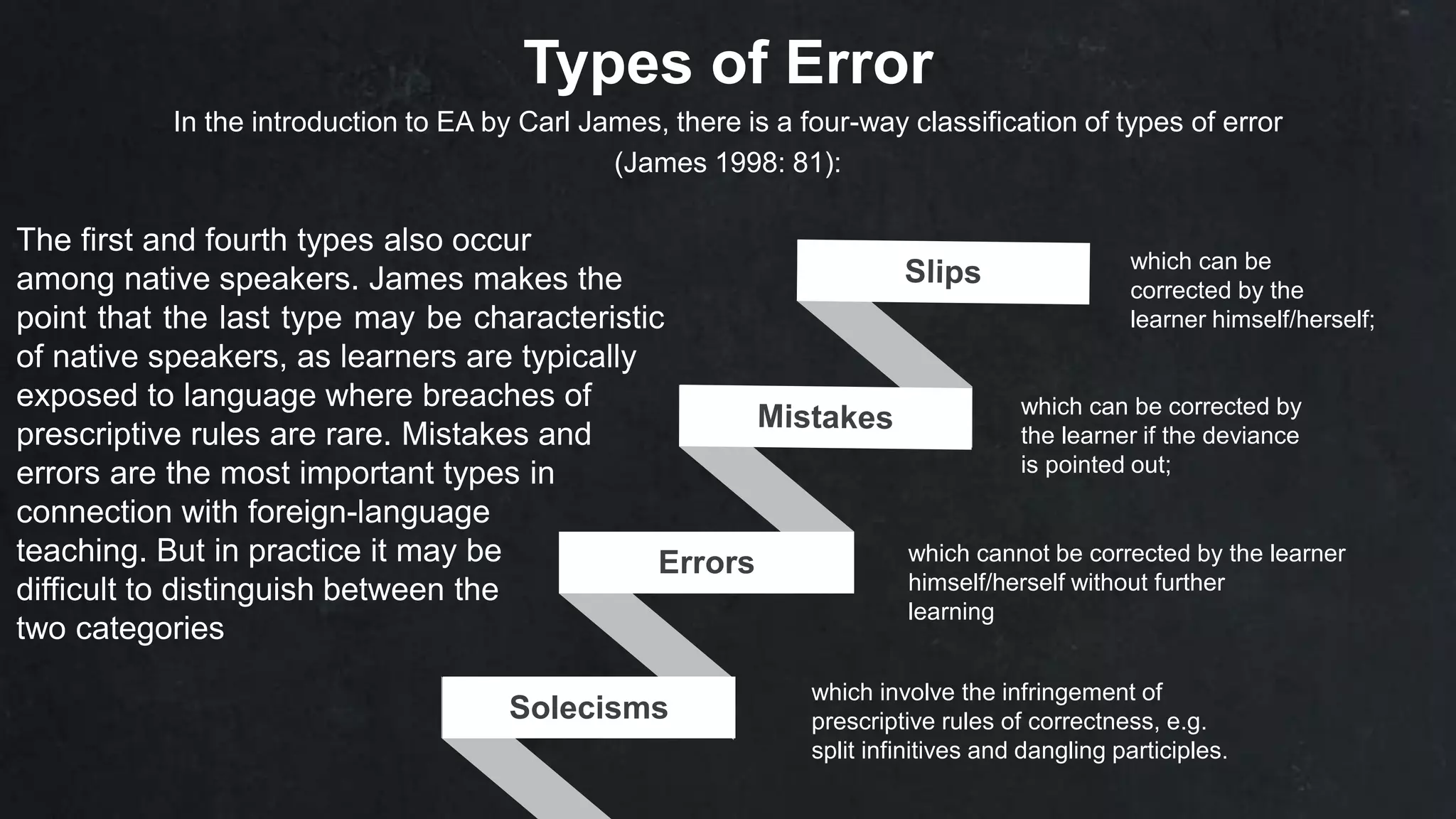
In the introduction to EA by Carl James, there is a four-way classification of types of error
(James 1998: 81):
which can be corrected by
the learner if the deviance
is pointed out;
which cannot be corrected by the learner
himself/herself without further
learning
which involve the infringement of
prescriptive rules of correctness, e.g.
split infinitives and dangling participles.
Errors
Solecisms
which can be
corrected by the
learner himself/herself;
The first and fourth types also occur
among native speakers. James makes the
point that the last type may be characteristic
of native speakers, as learners are typically
exposed to language where breaches of
prescriptive rules are rare. Mistakes and
errors are the most important types in
connection with foreign-language
teaching. But in practice it may be
difficult to distinguish between the
two categories
Causes of Error
50%
15%
35%
50% Errors may occur for a number of reasons. Many errors are interlingual
(lit. ‘between languages’, in this case between the mother tongue and the
target language) and result from influence from the mother tongue.
Informations and advices (for information and advice) and the society
and the nature (for society and nature used in a general sense).
Another kind of error can be described as intralingual (lit.
‘within language’, in this case within the target language).
Such errors are a result of over generalization from what has
already been learnt. Examples are regularized forms of nouns
and verbs, e.g. sheeps and payed (for sheep and paid).
Paradoxically, errors may also be a result of language teaching, or
transfer of training. An example is the overuse of the progressive
aspect, which may have something to do with inadequate
teaching.
25%
Often it is impossible to identify one source of error. For example, the use of the
progressive may be problematic due to mother-tongue influence. On the other
hand, the overuse of the progressive is intralingual in that it reflects what has
already been learned and has been over generalised. And the problem could be
partially teaching-induced.
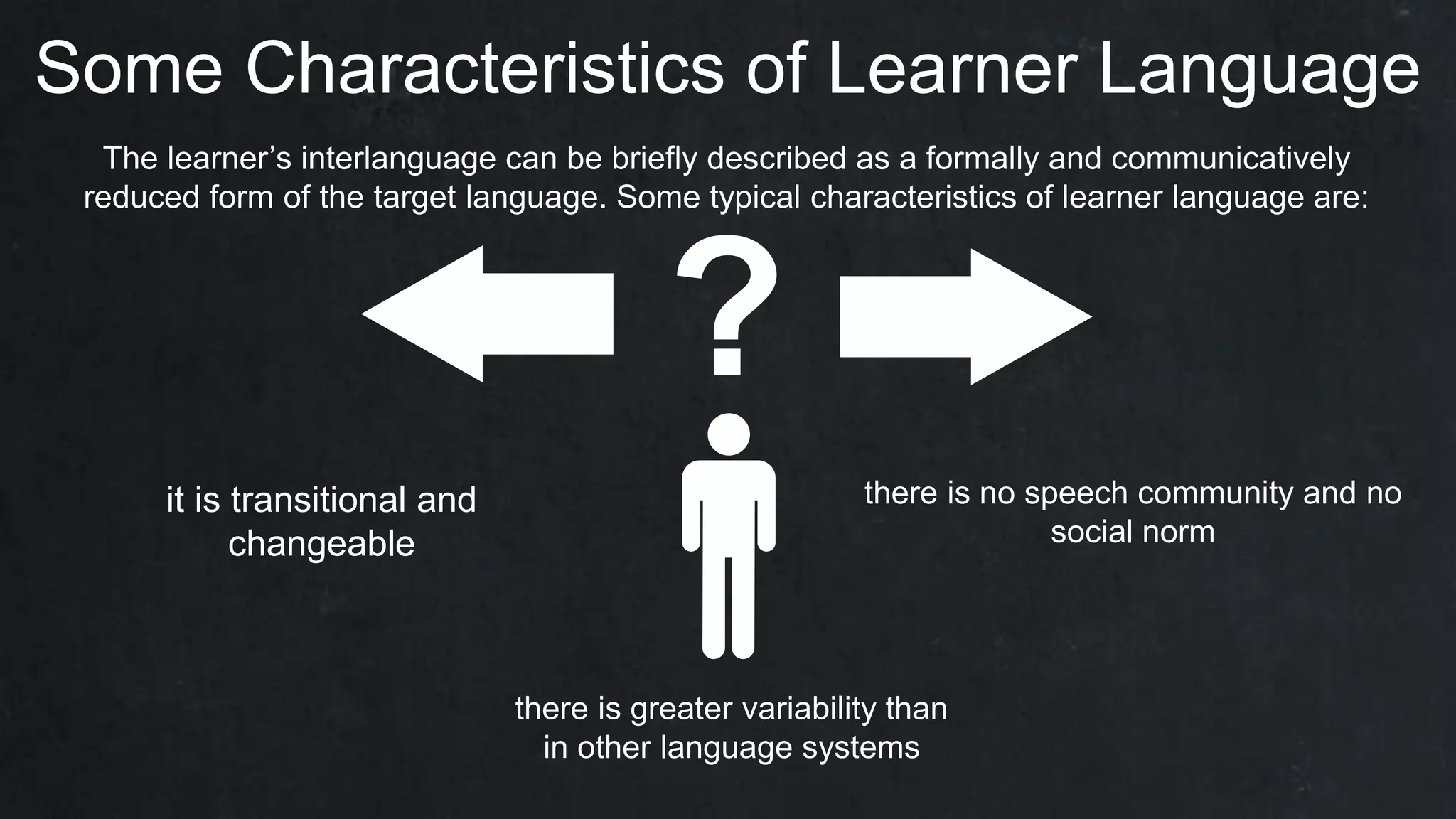
Some Characteristics of Learner Language
?
there is no speech community and no
social norm
it is transitional and
changeable
there is greater variability than
in other language systems
The learner’s interlanguage can be briefly described as a formally and communicatively
reduced form of the target language. Some typical characteristics of learner language are:
Errors and Errors Analysis
There are four steps in analysing learner errors
1
Identifying Errors
We have to compare the
setences learners produce with
what seem to be the normal or
‘correct’ sentences in the target
langugae which correspond with
them.
2
Describing Errors
Two ways of describing errors:
a. Classify errors into
grammatical categories
b. Try to identify general ways
in which the learners’
utterances differ from the
reconstructed target
language utterances.
3
Explaining Errors
- Errors are predictable
- Errors are not only systematic, many
of them also universal
- Some errors are common only to
learners who share the same mother
tongue or whose mother tongue
manifest the same linguistic property
4
Error Evaluation
- Some errors known as global errors, violate
the overall structure of a sentence and for
this reason may make it difficult to process.
- Other errors known as local errors, affect
only a single constituent in the sentence
and less likely to create any processing
problems.
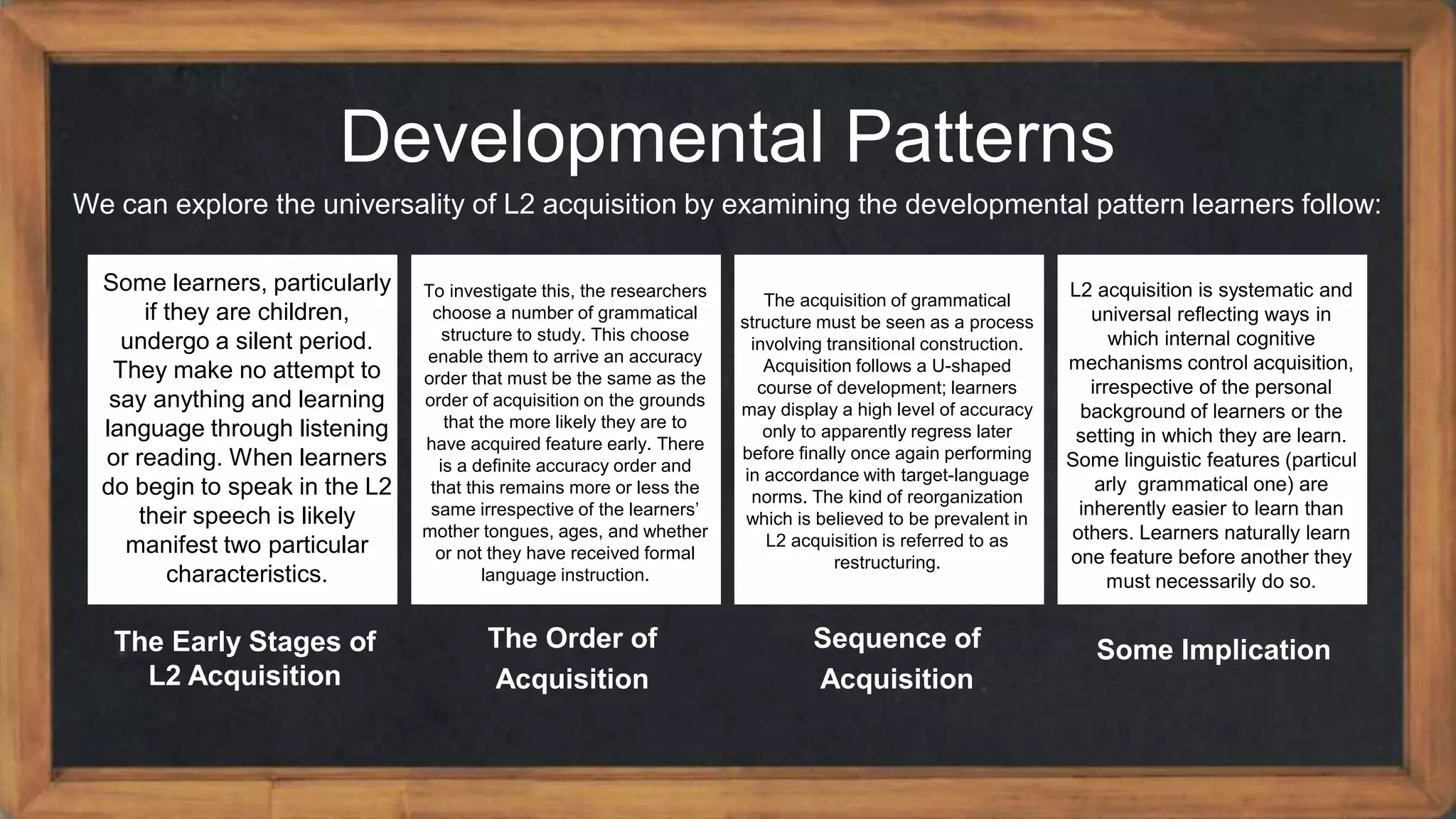
Developmental Patterns
We can explore the universality of L2 acquisition by examining the developmental pattern learners follow:
The Early Stages of
L2 Acquisition
The Order of
Acquisition
Sequence of
Acquisition
Some Implication
Some learners, particularly
if they are children,
undergo a silent period.
They make no attempt to
say anything and learning
language through listening
or reading. When learners
do begin to speak in the L2
their speech is likely
manifest two particular
characteristics.
To investigate this, the researchers
choose a number of grammatical
structure to study. This choose
enable them to arrive an accuracy
order that must be the same as the
order of acquisition on the grounds
that the more likely they are to
have acquired feature early. There
is a definite accuracy order and
that this remains more or less the
same irrespective of the learners’
mother tongues, ages, and whether
or not they have received formal
language instruction.
The acquisition of grammatical
structure must be seen as a process
involving transitional construction.
Acquisition follows a U-shaped
course of development; learners
may display a high level of accuracy
only to apparently regress later
before finally once again performing
in accordance with target-language
norms. The kind of reorganization
which is believed to be prevalent in
L2 acquisition is referred to as
restructuring.
L2 acquisition is systematic and
universal reflecting ways in
which internal cognitive
mechanisms control acquisition,
irrespective of the personal
background of learners or the
setting in which they are learn.
Some linguistic features (particul
arly grammatical one) are
inherently easier to learn than
others. Learners naturally learn
one feature before another they
must necessarily do so.
“Why Lao students weak in English?”
This question was administered to 30 English studen
ts-teachers in order to respond with their own views
. Each respondent listed ten reasons that mentioned
why students are poor in English language performa
nce.
Method : interview
 First, the majority of students stated that the English teachers are not
well-trained; for instance, they use Lao language when teaching, so th
ey cannot perform well to attract the interest of the student.
 Secondly, students lack of English foundation background.
 Third, students lack of confidence to use English because they are afra
id of mistakes and shy feeling.
 Fourth, the curriculum is inappropriate for helping students to improve t
heir English proficiency.
 English language is difficult to learn due to students are not well-motiv
ated, encouraged and gained learning strategy.
 Furthermore, students do not practice speaking English with English n
ative speakers, and class environment is crowded and noisy that is not
fulfilled with teaching pedagogy.
The “Good Language Learner”
• Has desire to learning and accurate guesser.
• Is willing to make mistakes.
• Practices as often as possible.
• Analyses his or her own speech and the speech of others
.
• Attends to whether his or her performance meets the sta
ndards he or she has learned.
• Enjoys grammar exercises.
• Begins learning in childhood.
• Has a good self-image and lots of confidence.
According to Adrian Helnet (2008)
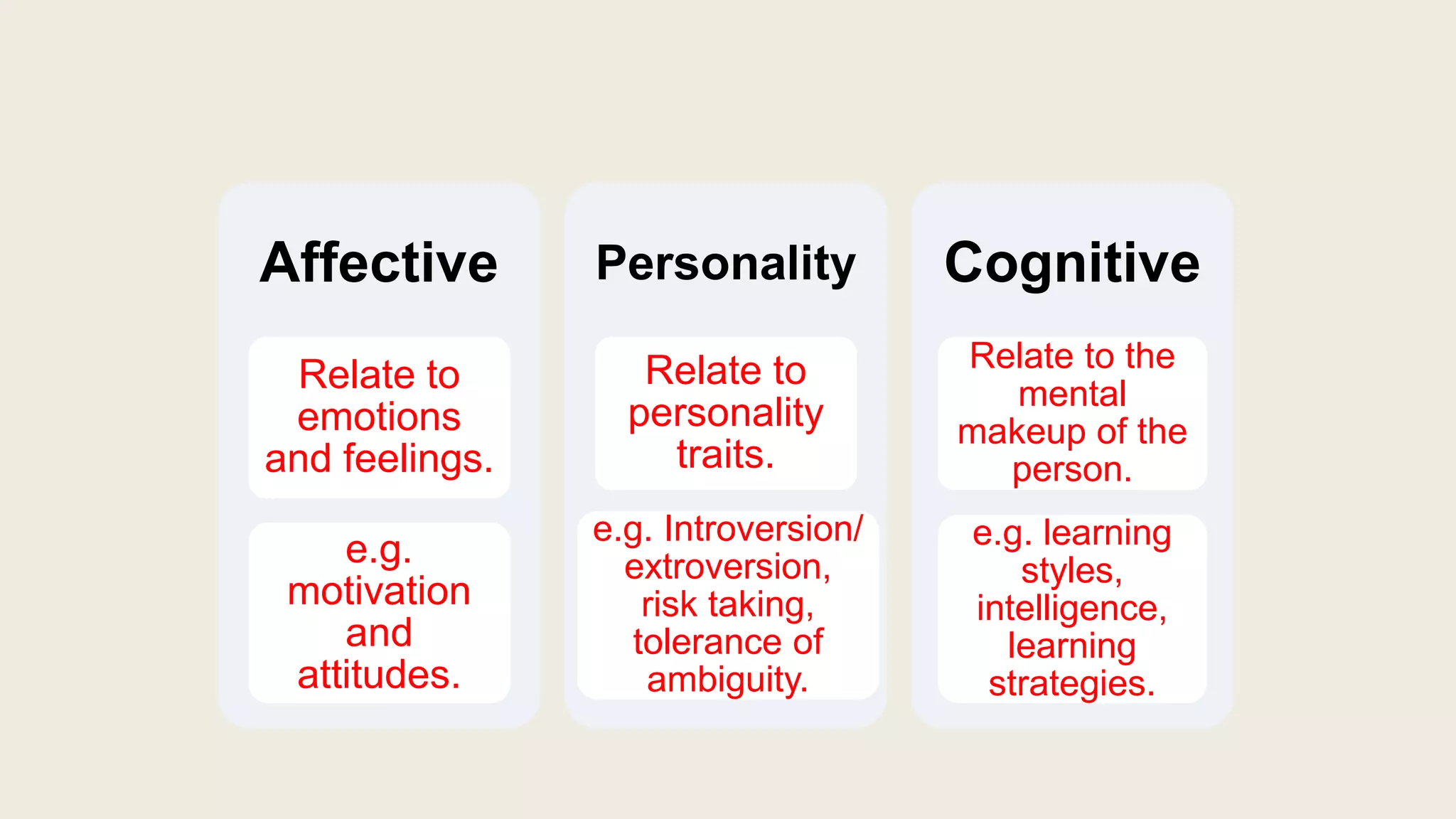
Affective
Relate to
emotions
and feelings.
e.g.
motivation
and
attitudes.
Personality
Relate to
personality
traits.
e.g. Introversion/
extroversion,
risk taking,
tolerance of
ambiguity.
Cognitive
Relate to the
mental
makeup of the
person.
e.g. learning
styles,
intelligence,
learning
strategies.
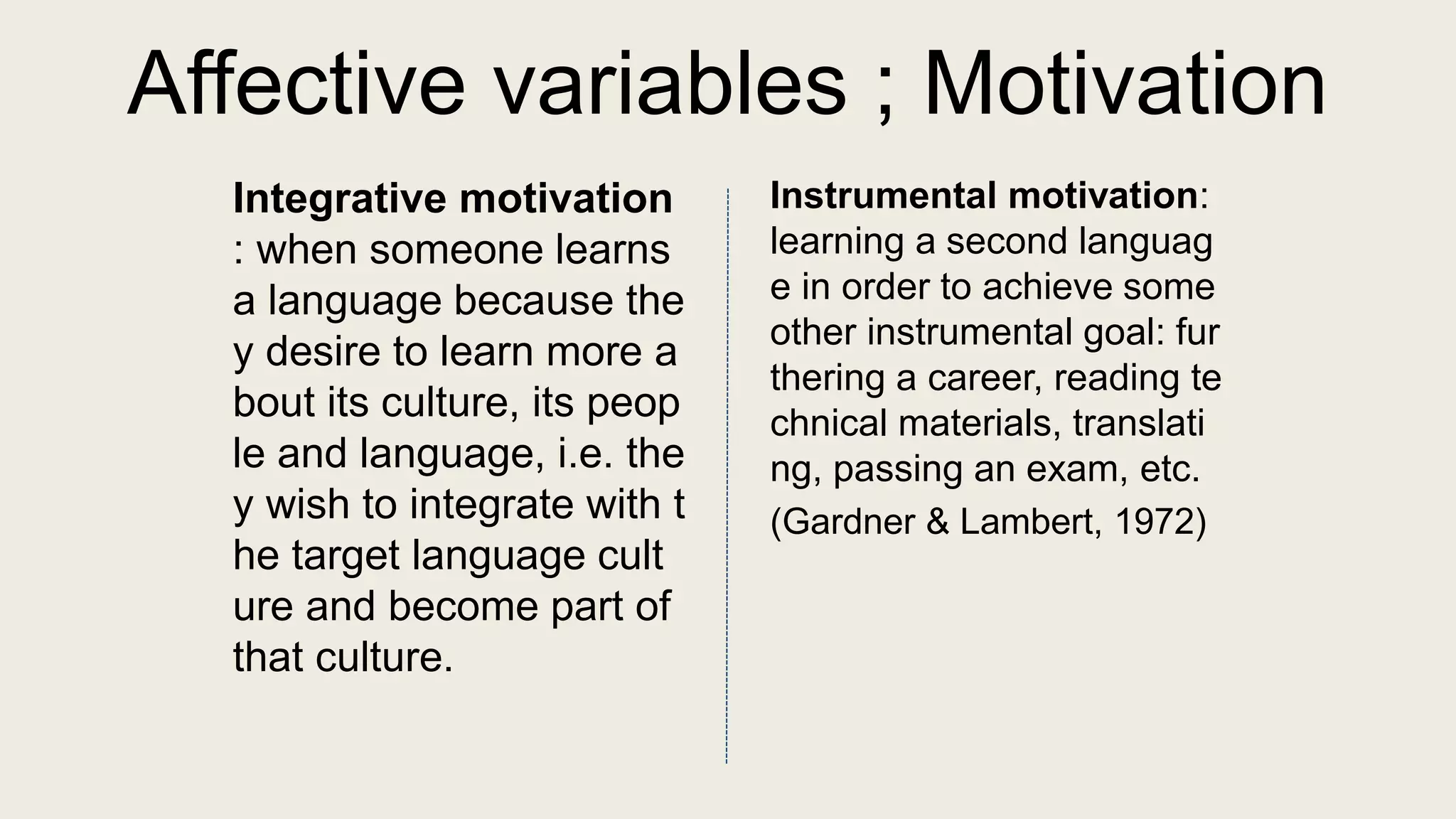
Affective variables ; Motivation
Integrative motivation
: when someone learns
a language because the
y desire to learn more a
bout its culture, its peop
le and language, i.e. the
y wish to integrate with t
he target language cult
ure and become part of
that culture.
Instrumental motivation:
learning a second languag
e in order to achieve some
other instrumental goal: fur
thering a career, reading te
chnical materials, translati
ng, passing an exam, etc.
(Gardner & Lambert, 1972)
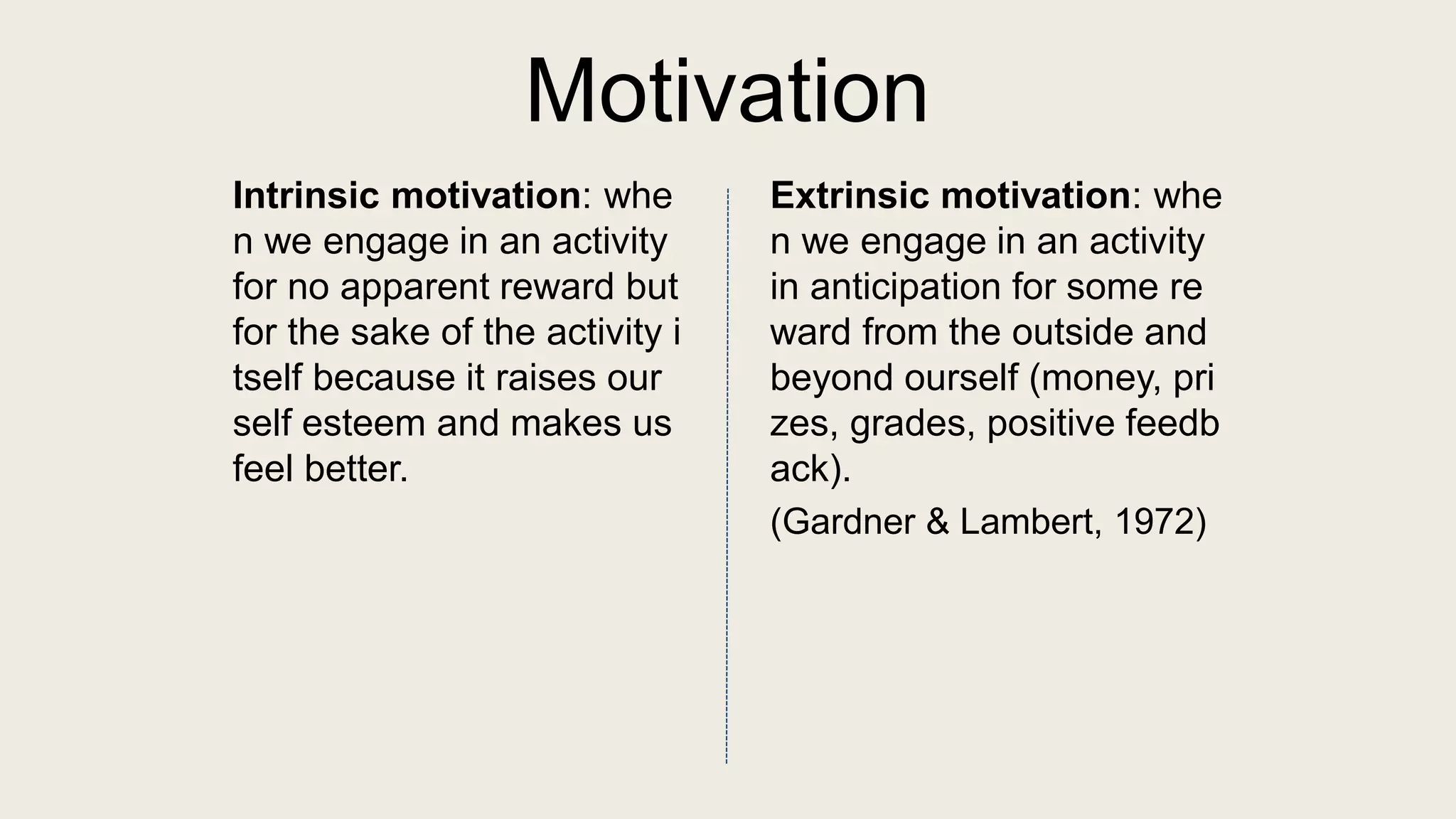
Motivation
Intrinsic motivation: whe
n we engage in an activity
for no apparent reward but
for the sake of the activity i
tself because it raises our
self esteem and makes us
feel better.
Extrinsic motivation: whe
n we engage in an activity
in anticipation for some re
ward from the outside and
beyond ourself (money, pri
zes, grades, positive feedb
ack).
(Gardner & Lambert, 1972)
• Both integrative and instrumental types of mo
tivation are related to success in L2 learning. M
ost L2 learning situations involve a mixture of e
ach type of motivation.
• Research strongly favours intrinsic motivatio
n, especially for long-term retention. Intrinsicall
y motivated learners are striving for excellence,
autonomy, and self-actualization.
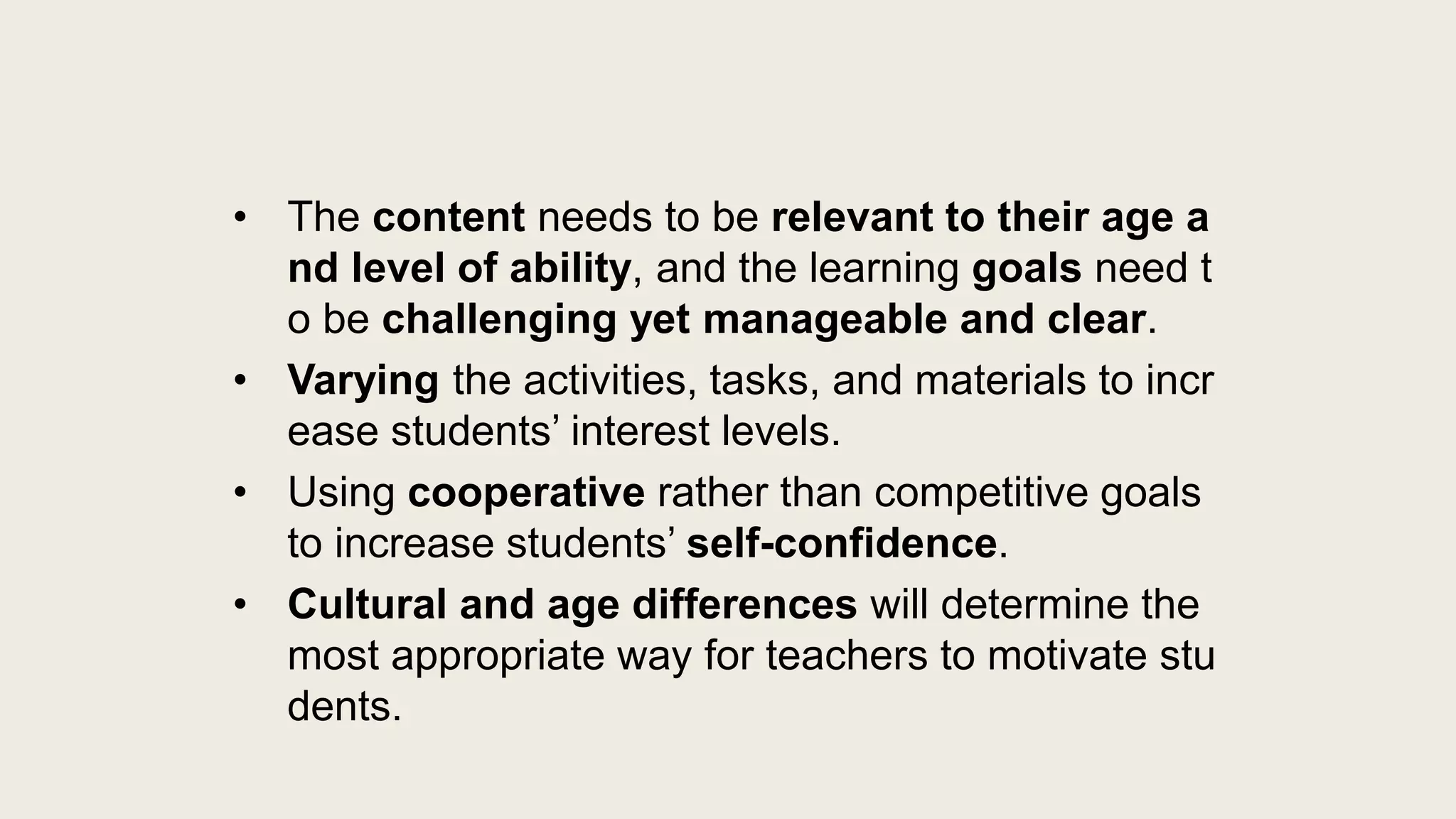
• The content needs to be relevant to their age a
nd level of ability, and the learning goals need t
o be challenging yet manageable and clear.
• Varying the activities, tasks, and materials to incr
ease students’ interest levels.
• Using cooperative rather than competitive goals
to increase students’ self-confidence.
• Cultural and age differences will determine the
most appropriate way for teachers to motivate stu
dents.
Ethnocentricity: a belief in the superiority of your own country.
If you are ethnocentric you believe that other people should learn you
r language and not you theirs.
Anomie:
Feeling a lack of attachment to your own country. Many i
ndividuals yearn to be a part of another country and to b
e living somewhere else. If that somewhere else happen
s to speak the language you are learning, you will be str
ongly motivated to learn the language.
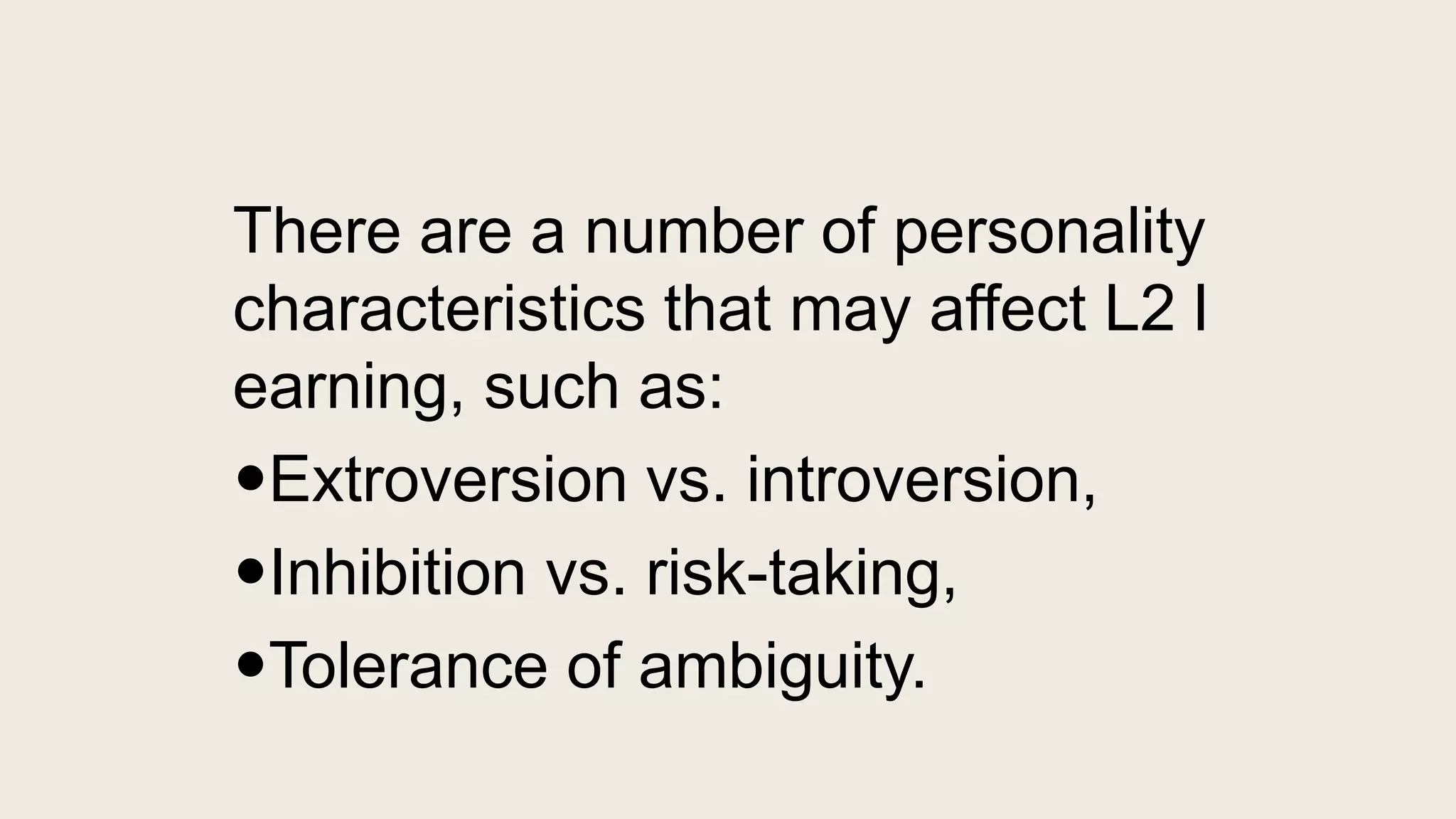
There are a number of personality
characteristics that may affect L2 l
earning, such as:
Extroversion vs. introversion,
Inhibition vs. risk-taking,
Tolerance of ambiguity.
Extroverts Introverts
Are sociable person, do not lik
e studying by themselves, like
the company of other people.
They always have a ready ans
wer and like change. Extrovert
s find difficulty concentrating,
are easily distracted from stud
y but like taking part in conver
sations and seek to expose th
emselves to input and do not f
ear producing output.
Are quiet, fond of books r
ather than people, reserv
ed and distant. They tend
to plan ahead, do not like
change and do not like a
cting on impulse.
• It has been suggested that inhibition discourages risk-taking, w
hich is necessary for progress in language learning.
• Inhibition is often considered to be a particular problem for adoles
cents, who are more self-conscious than younger learners.
• Inhibition is a negative force, at least for second language pronu
nciation performance.
• Inhibition may have more influence in language performance tha
n in language learning.
Learning style refers to an individu
al’s natural, habitual, and preferre
d way of absorbing, processing, a
nd retaining new information and
skills (Reid, 1995).
Types of learning styles related to L2 learning
Perceptual learning style
s:
 visual,
 aural/auditory,
 haptic (kinesthetic and ta
ctile).
Cognitive learning style
s:
 field-independent vs. fie
ld-dependent, (tendenc
y to see the trees or the
forest).
• Field independence is related to classroom l
anguage learning that involves analysis, atten
tion to details, and mastering of exercise, drill
s, and other focused activities.
• Field dependence is related to the communic
ative aspects of language learning that requir
e social outreach, empathy, perception of othe
r people, and communicative skills.
• Field dependence and independ
ence may also prove to be a val
uable tool for differentiating ch
ild and adult language acquisi
tion due to the fact that field in
dependence increases as a ch
ild matures to adulthood.
• Traditionally, intelligence refers to the mental
abilities that are measured by an IQ (intelligen
ce quotient) test. It usually measures only two
types of intelligence: verbal/linguistic and m
athematical/logical intelligence.
• There are other types of intelligence such as s
patial intelligence, bodily-kinesthetic intelligen
ce, musical intelligence, interpersonal intellige
nce, and intrapersonal intelligence.
• Intelligence, especially measured by verbal IQ t
ests, may be a strong factor when it comes to le
arning that involves language analysis and rule
learning.
• On the other hand, intelligence may play a less i
mportant role in language learning that focuses
more on communication and interaction.
• It is important to keep in mind that “intelligence”
is complex and that a person has many kinds of
abilities and strengths.
• Learning strategies are steps t
aken by students to enhance th
eir own learning.
• They are moment to moment t
echniques that we employ to s
olve problems posed by secon
d language input and output.
Learning strategies relate to inp
DIRECT STRATEGIES
To work with the language itself
INDIRECT STRATEGIES
To manage learning in general
Memory strategies
They are used for
remembering and retrieving
new information.
Metacognitive strategies
They are used for coordinating
the learning process.
Cognitive strategies
They are used for
understanding and producing
the language.
Affective strategies
They are used for regulating
emotions.
Compensation strategies
They are employed when using
the language despite
knowledge gaps.
Social strategies
They are employed when
communicating and learning
with others.
• All students use some strategies.
• Beginer students need learning strategies
as much than advanced students.
• Teachers can teach learning strategies
and learners can learn them.
THANK YOU

Second Language Acquisition

  • 1.
  • 2.
  • 3.
    Learner langugae is whatlearners produce when they are trying to communicate using a second (or non primary) langugae Laguage learner are students who are unable to communicate fluently or learn effective ly in English, who often come from non-English- speaking homes and bacground.
  • 4.
    The study oflearner language grew out of error analysis (EA), which had its heyday in the 1960s and 1970s (1.3). Rather than predicting learning problems by contrastive analysis (CA), the idea of EA is to observe what problems actually occur, through a systematic study of learners’ errors, and use this information to improve language teaching. A systematic study of errors is important not just to identify immediate learning problems, but also because it provides a window into the mind of the language learner. Much of the early work on learners errors focused on determining the extent to which L2 acquisition was the result of L1 transfer or of creative construction (the construction of unique rules similar to those which children form in the course of acquiring their mother tongue) (Ellis, 1999)
  • 5.
    Types of Error Inthe introduction to EA by Carl James, there is a four-way classification of types of error (James 1998: 81): which can be corrected by the learner if the deviance is pointed out; which cannot be corrected by the learner himself/herself without further learning which involve the infringement of prescriptive rules of correctness, e.g. split infinitives and dangling participles. Errors Solecisms which can be corrected by the learner himself/herself; The first and fourth types also occur among native speakers. James makes the point that the last type may be characteristic of native speakers, as learners are typically exposed to language where breaches of prescriptive rules are rare. Mistakes and errors are the most important types in connection with foreign-language teaching. But in practice it may be difficult to distinguish between the two categories
  • 6.
    Causes of Error 50% 15% 35% 50%Errors may occur for a number of reasons. Many errors are interlingual (lit. ‘between languages’, in this case between the mother tongue and the target language) and result from influence from the mother tongue. Informations and advices (for information and advice) and the society and the nature (for society and nature used in a general sense). Another kind of error can be described as intralingual (lit. ‘within language’, in this case within the target language). Such errors are a result of over generalization from what has already been learnt. Examples are regularized forms of nouns and verbs, e.g. sheeps and payed (for sheep and paid). Paradoxically, errors may also be a result of language teaching, or transfer of training. An example is the overuse of the progressive aspect, which may have something to do with inadequate teaching. 25% Often it is impossible to identify one source of error. For example, the use of the progressive may be problematic due to mother-tongue influence. On the other hand, the overuse of the progressive is intralingual in that it reflects what has already been learned and has been over generalised. And the problem could be partially teaching-induced.
  • 7.
    Some Characteristics ofLearner Language ? there is no speech community and no social norm it is transitional and changeable there is greater variability than in other language systems The learner’s interlanguage can be briefly described as a formally and communicatively reduced form of the target language. Some typical characteristics of learner language are:
  • 8.
    Errors and ErrorsAnalysis There are four steps in analysing learner errors 1 Identifying Errors We have to compare the setences learners produce with what seem to be the normal or ‘correct’ sentences in the target langugae which correspond with them. 2 Describing Errors Two ways of describing errors: a. Classify errors into grammatical categories b. Try to identify general ways in which the learners’ utterances differ from the reconstructed target language utterances. 3 Explaining Errors - Errors are predictable - Errors are not only systematic, many of them also universal - Some errors are common only to learners who share the same mother tongue or whose mother tongue manifest the same linguistic property 4 Error Evaluation - Some errors known as global errors, violate the overall structure of a sentence and for this reason may make it difficult to process. - Other errors known as local errors, affect only a single constituent in the sentence and less likely to create any processing problems.
  • 9.
    Developmental Patterns We canexplore the universality of L2 acquisition by examining the developmental pattern learners follow: The Early Stages of L2 Acquisition The Order of Acquisition Sequence of Acquisition Some Implication Some learners, particularly if they are children, undergo a silent period. They make no attempt to say anything and learning language through listening or reading. When learners do begin to speak in the L2 their speech is likely manifest two particular characteristics. To investigate this, the researchers choose a number of grammatical structure to study. This choose enable them to arrive an accuracy order that must be the same as the order of acquisition on the grounds that the more likely they are to have acquired feature early. There is a definite accuracy order and that this remains more or less the same irrespective of the learners’ mother tongues, ages, and whether or not they have received formal language instruction. The acquisition of grammatical structure must be seen as a process involving transitional construction. Acquisition follows a U-shaped course of development; learners may display a high level of accuracy only to apparently regress later before finally once again performing in accordance with target-language norms. The kind of reorganization which is believed to be prevalent in L2 acquisition is referred to as restructuring. L2 acquisition is systematic and universal reflecting ways in which internal cognitive mechanisms control acquisition, irrespective of the personal background of learners or the setting in which they are learn. Some linguistic features (particul arly grammatical one) are inherently easier to learn than others. Learners naturally learn one feature before another they must necessarily do so.
  • 11.
    “Why Lao studentsweak in English?” This question was administered to 30 English studen ts-teachers in order to respond with their own views . Each respondent listed ten reasons that mentioned why students are poor in English language performa nce. Method : interview
  • 12.
     First, themajority of students stated that the English teachers are not well-trained; for instance, they use Lao language when teaching, so th ey cannot perform well to attract the interest of the student.  Secondly, students lack of English foundation background.  Third, students lack of confidence to use English because they are afra id of mistakes and shy feeling.  Fourth, the curriculum is inappropriate for helping students to improve t heir English proficiency.  English language is difficult to learn due to students are not well-motiv ated, encouraged and gained learning strategy.  Furthermore, students do not practice speaking English with English n ative speakers, and class environment is crowded and noisy that is not fulfilled with teaching pedagogy.
  • 13.
    The “Good LanguageLearner” • Has desire to learning and accurate guesser. • Is willing to make mistakes. • Practices as often as possible. • Analyses his or her own speech and the speech of others . • Attends to whether his or her performance meets the sta ndards he or she has learned. • Enjoys grammar exercises. • Begins learning in childhood. • Has a good self-image and lots of confidence. According to Adrian Helnet (2008)
  • 14.
    Affective Relate to emotions and feelings. e.g. motivation and attitudes. Personality Relateto personality traits. e.g. Introversion/ extroversion, risk taking, tolerance of ambiguity. Cognitive Relate to the mental makeup of the person. e.g. learning styles, intelligence, learning strategies.
  • 15.
    Affective variables ;Motivation Integrative motivation : when someone learns a language because the y desire to learn more a bout its culture, its peop le and language, i.e. the y wish to integrate with t he target language cult ure and become part of that culture. Instrumental motivation: learning a second languag e in order to achieve some other instrumental goal: fur thering a career, reading te chnical materials, translati ng, passing an exam, etc. (Gardner & Lambert, 1972)
  • 16.
    Motivation Intrinsic motivation: whe nwe engage in an activity for no apparent reward but for the sake of the activity i tself because it raises our self esteem and makes us feel better. Extrinsic motivation: whe n we engage in an activity in anticipation for some re ward from the outside and beyond ourself (money, pri zes, grades, positive feedb ack). (Gardner & Lambert, 1972)
  • 17.
    • Both integrativeand instrumental types of mo tivation are related to success in L2 learning. M ost L2 learning situations involve a mixture of e ach type of motivation. • Research strongly favours intrinsic motivatio n, especially for long-term retention. Intrinsicall y motivated learners are striving for excellence, autonomy, and self-actualization.
  • 18.
    • The contentneeds to be relevant to their age a nd level of ability, and the learning goals need t o be challenging yet manageable and clear. • Varying the activities, tasks, and materials to incr ease students’ interest levels. • Using cooperative rather than competitive goals to increase students’ self-confidence. • Cultural and age differences will determine the most appropriate way for teachers to motivate stu dents.
  • 19.
    Ethnocentricity: a beliefin the superiority of your own country. If you are ethnocentric you believe that other people should learn you r language and not you theirs. Anomie: Feeling a lack of attachment to your own country. Many i ndividuals yearn to be a part of another country and to b e living somewhere else. If that somewhere else happen s to speak the language you are learning, you will be str ongly motivated to learn the language.
  • 20.
    There are anumber of personality characteristics that may affect L2 l earning, such as: Extroversion vs. introversion, Inhibition vs. risk-taking, Tolerance of ambiguity.
  • 21.
    Extroverts Introverts Are sociableperson, do not lik e studying by themselves, like the company of other people. They always have a ready ans wer and like change. Extrovert s find difficulty concentrating, are easily distracted from stud y but like taking part in conver sations and seek to expose th emselves to input and do not f ear producing output. Are quiet, fond of books r ather than people, reserv ed and distant. They tend to plan ahead, do not like change and do not like a cting on impulse.
  • 22.
    • It hasbeen suggested that inhibition discourages risk-taking, w hich is necessary for progress in language learning. • Inhibition is often considered to be a particular problem for adoles cents, who are more self-conscious than younger learners. • Inhibition is a negative force, at least for second language pronu nciation performance. • Inhibition may have more influence in language performance tha n in language learning.
  • 23.
    Learning style refersto an individu al’s natural, habitual, and preferre d way of absorbing, processing, a nd retaining new information and skills (Reid, 1995).
  • 24.
    Types of learningstyles related to L2 learning Perceptual learning style s:  visual,  aural/auditory,  haptic (kinesthetic and ta ctile). Cognitive learning style s:  field-independent vs. fie ld-dependent, (tendenc y to see the trees or the forest).
  • 25.
    • Field independenceis related to classroom l anguage learning that involves analysis, atten tion to details, and mastering of exercise, drill s, and other focused activities. • Field dependence is related to the communic ative aspects of language learning that requir e social outreach, empathy, perception of othe r people, and communicative skills.
  • 26.
    • Field dependenceand independ ence may also prove to be a val uable tool for differentiating ch ild and adult language acquisi tion due to the fact that field in dependence increases as a ch ild matures to adulthood.
  • 27.
    • Traditionally, intelligencerefers to the mental abilities that are measured by an IQ (intelligen ce quotient) test. It usually measures only two types of intelligence: verbal/linguistic and m athematical/logical intelligence. • There are other types of intelligence such as s patial intelligence, bodily-kinesthetic intelligen ce, musical intelligence, interpersonal intellige nce, and intrapersonal intelligence.
  • 28.
    • Intelligence, especiallymeasured by verbal IQ t ests, may be a strong factor when it comes to le arning that involves language analysis and rule learning. • On the other hand, intelligence may play a less i mportant role in language learning that focuses more on communication and interaction. • It is important to keep in mind that “intelligence” is complex and that a person has many kinds of abilities and strengths.
  • 29.
    • Learning strategiesare steps t aken by students to enhance th eir own learning. • They are moment to moment t echniques that we employ to s olve problems posed by secon d language input and output. Learning strategies relate to inp
  • 30.
    DIRECT STRATEGIES To workwith the language itself INDIRECT STRATEGIES To manage learning in general Memory strategies They are used for remembering and retrieving new information. Metacognitive strategies They are used for coordinating the learning process. Cognitive strategies They are used for understanding and producing the language. Affective strategies They are used for regulating emotions. Compensation strategies They are employed when using the language despite knowledge gaps. Social strategies They are employed when communicating and learning with others.
  • 31.
    • All studentsuse some strategies. • Beginer students need learning strategies as much than advanced students. • Teachers can teach learning strategies and learners can learn them.
  • 32.