PHYSICAL PROPERTIES OF PRE-
FORMULATION STUDY
Presented By:
Rahul Pal*, Prachi Pandey
M. Pharm (Pharmaceutics)
Department of Pharmaceutics
NIMS Institute of Pharmacy, NIMS University, Jaipur, Rajasthan, India
PRE-FORMULATION
๏ต It is define as the phase of research and development in which pre-
formulation studies characterized physical and chemical properties of a
drug in order to develop safe, effective and stable dosages form.
PHYSICAL PROPERTIES OF PRE-
FORMULATION
๏ต Particle form
๏ต Particle size
๏ต Particle shape
๏ต Flow properties
๏ต Stability profile (pKa , pH, partial coefficient)
๏ต Polymorphism
PARTICLE FORM
๏ต Solid is one of the three classical states of matter. It is characterised by the
structural rigidity and resistance to changes in shape or volume . A solid
molecule is made up of atoms tightly bound to each other either in a
regular geometric lattice or irregularly. It could be divided two type.
๏‚ง Crystalline
๏‚ง Amorphous
PARTICLE SIZE
๏ต Particle size is characterised to express the geometrical shape and surface
regularity of the material. Moreover, particle shape affected the surface area,
flow, packing and compaction properties of particle.
๏ต The particle shape either spherical or asymmetrical can be determined.in order
to differentiate the shape of spherical or asymmetrical objects, it is necessary to
know that the sphere has minimum surface area per unit volume.
FLOW PROPERTIES
๏ต Powder flows properties can be affected by change in particle size, shape and
density.
๏ต The flows properties depend upon following:-
โ€ข Force of friction
โ€ข Cohesion between one particle to another
๏ต Fine particle posses poor flow by filling void spaces between larger particle causing
packing & densification of particle.
๏ต By using glidant we can alter the flow properties e.g. talc.
SOLUBILITY PROFILE
๏ต The drug-solvent systems through which the drug is delivered helps in the
pre-formulation solubility studies. For example, solubility of an orally
administered drug in media with isotonic chloride ion concentration and
acidic pH can be determined.
๏ต The administration route are not clearly defined at this point, still the
formulation work can be carried out by understanding the solubility profile
of the drug and mechanism of solubility.
pH AND PKa SOLUBILITY PROFILE
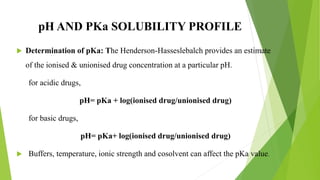
๏ต Determination of pKa: The Henderson-Hasseslebalch provides an estimate
of the ionised & unionised drug concentration at a particular pH.
for acidic drugs,
pH= pKa + log(ionised drug/unionised drug)
for basic drugs,
pH= pKa+ log(ionised drug/unionised drug)
๏ต Buffers, temperature, ionic strength and cosolvent can affect the pKa value.
PARTIAL COEFFICIENT
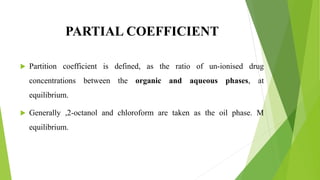
๏ต Partition coefficient is defined, as the ratio of un-ionised drug
concentrations between the organic and aqueous phases, at
equilibrium.
๏ต Generally ,2-octanol and chloroform are taken as the oil phase. M
equilibrium.
POLYMORPHISM
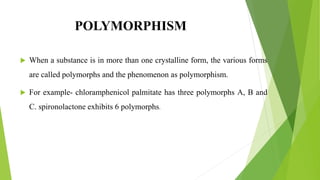
๏ต When a substance is in more than one crystalline form, the various forms
are called polymorphs and the phenomenon as polymorphism.
๏ต For example- chloramphenicol palmitate has three polymorphs A, B and
C. spironolactone exhibits 6 polymorphs.
THANK YOU

Physical Properties of Pre-formulation.pptx

  • 1.
    PHYSICAL PROPERTIES OFPRE- FORMULATION STUDY Presented By: Rahul Pal*, Prachi Pandey M. Pharm (Pharmaceutics) Department of Pharmaceutics NIMS Institute of Pharmacy, NIMS University, Jaipur, Rajasthan, India
  • 2.
    PRE-FORMULATION ๏ต It isdefine as the phase of research and development in which pre- formulation studies characterized physical and chemical properties of a drug in order to develop safe, effective and stable dosages form.
  • 3.
    PHYSICAL PROPERTIES OFPRE- FORMULATION ๏ต Particle form ๏ต Particle size ๏ต Particle shape ๏ต Flow properties ๏ต Stability profile (pKa , pH, partial coefficient) ๏ต Polymorphism
  • 4.
    PARTICLE FORM ๏ต Solidis one of the three classical states of matter. It is characterised by the structural rigidity and resistance to changes in shape or volume . A solid molecule is made up of atoms tightly bound to each other either in a regular geometric lattice or irregularly. It could be divided two type. ๏‚ง Crystalline ๏‚ง Amorphous
  • 5.
    PARTICLE SIZE ๏ต Particlesize is characterised to express the geometrical shape and surface regularity of the material. Moreover, particle shape affected the surface area, flow, packing and compaction properties of particle. ๏ต The particle shape either spherical or asymmetrical can be determined.in order to differentiate the shape of spherical or asymmetrical objects, it is necessary to know that the sphere has minimum surface area per unit volume.
  • 6.
    FLOW PROPERTIES ๏ต Powderflows properties can be affected by change in particle size, shape and density. ๏ต The flows properties depend upon following:- โ€ข Force of friction โ€ข Cohesion between one particle to another ๏ต Fine particle posses poor flow by filling void spaces between larger particle causing packing & densification of particle. ๏ต By using glidant we can alter the flow properties e.g. talc.
  • 7.
    SOLUBILITY PROFILE ๏ต Thedrug-solvent systems through which the drug is delivered helps in the pre-formulation solubility studies. For example, solubility of an orally administered drug in media with isotonic chloride ion concentration and acidic pH can be determined. ๏ต The administration route are not clearly defined at this point, still the formulation work can be carried out by understanding the solubility profile of the drug and mechanism of solubility.
  • 8.
    pH AND PKaSOLUBILITY PROFILE ๏ต Determination of pKa: The Henderson-Hasseslebalch provides an estimate of the ionised & unionised drug concentration at a particular pH. for acidic drugs, pH= pKa + log(ionised drug/unionised drug) for basic drugs, pH= pKa+ log(ionised drug/unionised drug) ๏ต Buffers, temperature, ionic strength and cosolvent can affect the pKa value.
  • 9.
    PARTIAL COEFFICIENT ๏ต Partitioncoefficient is defined, as the ratio of un-ionised drug concentrations between the organic and aqueous phases, at equilibrium. ๏ต Generally ,2-octanol and chloroform are taken as the oil phase. M equilibrium.
  • 10.
    POLYMORPHISM ๏ต When asubstance is in more than one crystalline form, the various forms are called polymorphs and the phenomenon as polymorphism. ๏ต For example- chloramphenicol palmitate has three polymorphs A, B and C. spironolactone exhibits 6 polymorphs.
  • 11.