M. PHARM, 2ND SEMESTER
EQUIPMENTS
What is an equipments..???
Equipment may be defined as a
physical entity which is used to
carry out a general or specific
activity in the plant.
Types of Equipments
 Single piece
E.g- tablet compression m/c, a mixer,
HPLC, FTIR, weighing balance etc.
 Integrated system
E.g- water demineralising plants, an air
handling system etc.
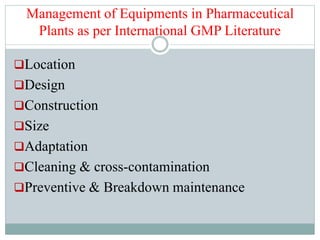
Management of Equipments in Pharmaceutical
Plants as per International GMP Literature
Location
Design
Construction
Size
Adaptation
Cleaning & cross-contamination
Preventive & Breakdown maintenance
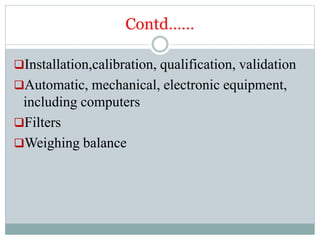
Contd……
Installation,calibration, qualification, validation
Automatic, mechanical, electronic equipment,
including computers
Filters
Weighing balance
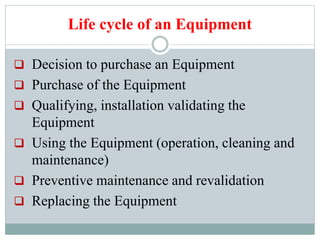
Life cycle of an Equipment
 Decision to purchase an Equipment
 Purchase of the Equipment
 Qualifying, installation validating the
Equipment
 Using the Equipment (operation, cleaning and
maintenance)
 Preventive maintenance and revalidation
 Replacing the Equipment
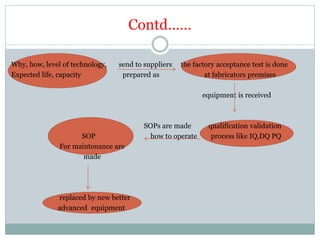
Contd……
Why, how, level of technology, send to suppliers the factory acceptance test is done
Expected life, capacity prepared as at fabricators premises
equipment is received
SOPs are made qualification validation
SOP how to operate process like IQ,DQ PQ
For maintenance are
made
replaced by new better
advanced equipment
WHO Guidelines for Equipments
Equipments must be located, designed, adapted and
maintained to suit the operation to be carried out.
Equipments should be installed in such a way as to
minimize any risk of error or of contamination.
Production equipment should be designed , located, and
maintained to serve its intended purpose.
Production equipment should be designed, so that it can
be easily and thoroughly cleaned on schedule basis.
Production equipments should not present any hazard to
the products.
Equipment Identification
WHO Guidelines:
 Fixed pipe work should be clearly labeled to indicate
the contents and, where acceptable, the direction of
flow.
 All service piping and devices should be adequately
marked and special attention paid to the provision of
non-interchangeable connections or adaptors for
dangerous gases and liquids.
Equipment Cleaning & Maintenance
WHO Guidelines
 The layout and design of the equipment must aim to
minimize the risk of errors and permit effective cleaning and
maintenance.
 Washing and cleaning equipment should be chosen and used
so as not to be source of contamination.
 Defective equipment should, if possible, be removed from
production and Q.C. or at least clearly labeled as defective.
Filters
As a part of GMP, filters should be considered from
the following points-
1) Types of filter and filtration process
2) Compatibility of filter media with processing
materials
3) Cleaning of reusable filters and their sanitation
4) Validation of filters
5) Disposal of filters
Weighing Balance
WHO Guidelines
Balances and other measuring equipment of an
appropriate range and precision should be available for
production and control operation and should be
calibrated on a scheduled basis.
 Weighing balance should be made with
following details
1. Description of balance
2. Model no.
3. Manufacturer name
4. Weighing range
5. Least count
6. Frequency of calibration
7. Location of balance
Documents and formats to be maintained for every
equipment
 Name and unique identification number of the
equipment
 Equipment manufacturers, name and address.
Additional information on contact persons and their
mobile phone numbers may be useful
 Equipments capacity in terms of holding and output
Contd….
 Materials of construction of drug contact parts
 Electric power requirement details
 Utilities required to operate the equipment e.g.- water,
steam, compressed air etc
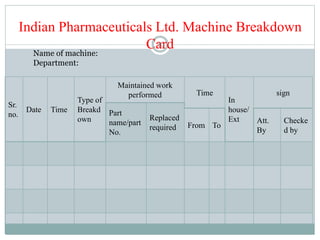
Indian Pharmaceuticals Ltd. Machine Breakdown
Card
Sr.
no.
Date Time
Type of
Breakd
own
Maintained work
performed Time
In
house/
Ext
sign
Part
name/part
No.
Replaced
required From To
Att.
By
Checke
d by
16
Name of machine:
Department:
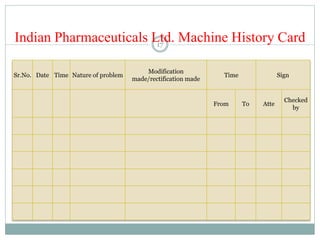
Indian Pharmaceuticals Ltd. Machine History Card
Sr.No. Date Time Nature of problem
Modification
made/rectification made
Time Sign
From To Atte
Checked
by
17
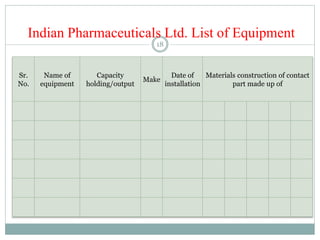
Indian Pharmaceuticals Ltd. List of Equipment
Sr.
No.
Name of
equipment
Capacity
holding/output
Make
Date of
installation
Materials construction of contact
part made up of
18
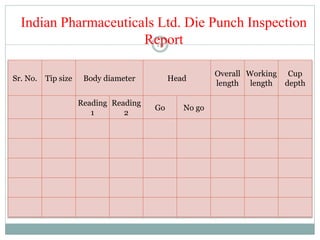
Indian Pharmaceuticals Ltd. Die Punch Inspection
Report
Sr. No. Tip size Body diameter Head
Overall
length
Working
length
Cup
depth
Reading
1
Reading
2
Go No go
19
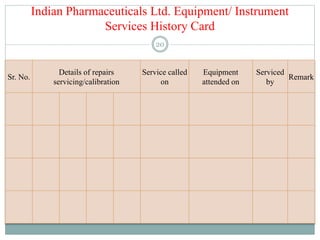
Indian Pharmaceuticals Ltd. Equipment/ Instrument
Services History Card
Sr. No.
Details of repairs
servicing/calibration
Service called
on
Equipment
attended on
Serviced
by
Remark
20
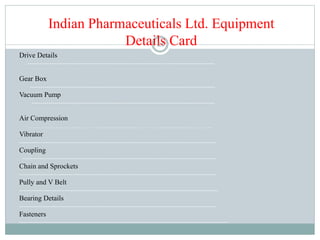
Indian Pharmaceuticals Ltd. Equipment
Details Card
Drive Details
-------------------------------------------------------------------------------------------
Gear Box
------------------------------------------------------------------------------------------
Vacuum Pump
-----------------------------------------------------------------------------------------
Air Compression
……………………………………………………………………………..
Vibrator
------------------------------------------------------------------------------------------------
Coupling
----------------------------------------------------------------------------------------------
Chain and Sprockets
------------------------------------------------------------------------------------------------
Pully and V Belt
-------------------------------------------------------------------------------------------------
Bearing Details
------------------------------------------------------------------------------------------------
Fasteners
------------------------------------------------------------------------------------------------------------
21
REFERENCES
1. Potdar A. M., “CURRENT GOOD MANUFACTURING
PRACTICES for Pharmaceuticals”, Equipment (Chapter 3),
PharmaMed Press, Hyderabad, 1st Edition, 2008, pp- 85-100
2. Sharma P. P., “How to Practice GLP”, Practice of GLP (Equipment)
Chapter 7, Vandana Publications Pvt. Ltd., Delhi, 2nd Edition, 2008,
pp- 245-261
3. Shah H.D., “QA MANUAL”, Equipment (Chapter 5), Business
Horizons, New Delhi, 1st Edition (2nd Reprint), 2007, pp- 68-89
4. Sharma P. P., “How to Practice GMPs”, Practice of GMPs
(Equipment) Chapter 3, Vandana Publications Pvt. Ltd., Delhi, 4th
Edition, 2004, pp- 187-193

Equipments

  • 1.
    M. PHARM, 2NDSEMESTER EQUIPMENTS
  • 2.
    What is anequipments..??? Equipment may be defined as a physical entity which is used to carry out a general or specific activity in the plant.
  • 3.
    Types of Equipments Single piece E.g- tablet compression m/c, a mixer, HPLC, FTIR, weighing balance etc.  Integrated system E.g- water demineralising plants, an air handling system etc.
  • 4.
    Management of Equipmentsin Pharmaceutical Plants as per International GMP Literature Location Design Construction Size Adaptation Cleaning & cross-contamination Preventive & Breakdown maintenance
  • 5.
    Contd…… Installation,calibration, qualification, validation Automatic,mechanical, electronic equipment, including computers Filters Weighing balance
  • 6.
    Life cycle ofan Equipment  Decision to purchase an Equipment  Purchase of the Equipment  Qualifying, installation validating the Equipment  Using the Equipment (operation, cleaning and maintenance)  Preventive maintenance and revalidation  Replacing the Equipment
  • 7.
    Contd…… Why, how, levelof technology, send to suppliers the factory acceptance test is done Expected life, capacity prepared as at fabricators premises equipment is received SOPs are made qualification validation SOP how to operate process like IQ,DQ PQ For maintenance are made replaced by new better advanced equipment
  • 8.
    WHO Guidelines forEquipments Equipments must be located, designed, adapted and maintained to suit the operation to be carried out. Equipments should be installed in such a way as to minimize any risk of error or of contamination. Production equipment should be designed , located, and maintained to serve its intended purpose. Production equipment should be designed, so that it can be easily and thoroughly cleaned on schedule basis. Production equipments should not present any hazard to the products.
  • 9.
    Equipment Identification WHO Guidelines: Fixed pipe work should be clearly labeled to indicate the contents and, where acceptable, the direction of flow.  All service piping and devices should be adequately marked and special attention paid to the provision of non-interchangeable connections or adaptors for dangerous gases and liquids.
  • 10.
    Equipment Cleaning &Maintenance WHO Guidelines  The layout and design of the equipment must aim to minimize the risk of errors and permit effective cleaning and maintenance.  Washing and cleaning equipment should be chosen and used so as not to be source of contamination.  Defective equipment should, if possible, be removed from production and Q.C. or at least clearly labeled as defective.
  • 11.
    Filters As a partof GMP, filters should be considered from the following points- 1) Types of filter and filtration process 2) Compatibility of filter media with processing materials 3) Cleaning of reusable filters and their sanitation 4) Validation of filters 5) Disposal of filters
  • 12.
    Weighing Balance WHO Guidelines Balancesand other measuring equipment of an appropriate range and precision should be available for production and control operation and should be calibrated on a scheduled basis.
  • 13.
     Weighing balanceshould be made with following details 1. Description of balance 2. Model no. 3. Manufacturer name 4. Weighing range 5. Least count 6. Frequency of calibration 7. Location of balance
  • 14.
    Documents and formatsto be maintained for every equipment  Name and unique identification number of the equipment  Equipment manufacturers, name and address. Additional information on contact persons and their mobile phone numbers may be useful  Equipments capacity in terms of holding and output
  • 15.
    Contd….  Materials ofconstruction of drug contact parts  Electric power requirement details  Utilities required to operate the equipment e.g.- water, steam, compressed air etc
  • 16.
    Indian Pharmaceuticals Ltd.Machine Breakdown Card Sr. no. Date Time Type of Breakd own Maintained work performed Time In house/ Ext sign Part name/part No. Replaced required From To Att. By Checke d by 16 Name of machine: Department:
  • 17.
    Indian Pharmaceuticals Ltd.Machine History Card Sr.No. Date Time Nature of problem Modification made/rectification made Time Sign From To Atte Checked by 17
  • 18.
    Indian Pharmaceuticals Ltd.List of Equipment Sr. No. Name of equipment Capacity holding/output Make Date of installation Materials construction of contact part made up of 18
  • 19.
    Indian Pharmaceuticals Ltd.Die Punch Inspection Report Sr. No. Tip size Body diameter Head Overall length Working length Cup depth Reading 1 Reading 2 Go No go 19
  • 20.
    Indian Pharmaceuticals Ltd.Equipment/ Instrument Services History Card Sr. No. Details of repairs servicing/calibration Service called on Equipment attended on Serviced by Remark 20
  • 21.
    Indian Pharmaceuticals Ltd.Equipment Details Card Drive Details ------------------------------------------------------------------------------------------- Gear Box ------------------------------------------------------------------------------------------ Vacuum Pump ----------------------------------------------------------------------------------------- Air Compression …………………………………………………………………………….. Vibrator ------------------------------------------------------------------------------------------------ Coupling ---------------------------------------------------------------------------------------------- Chain and Sprockets ------------------------------------------------------------------------------------------------ Pully and V Belt ------------------------------------------------------------------------------------------------- Bearing Details ------------------------------------------------------------------------------------------------ Fasteners ------------------------------------------------------------------------------------------------------------ 21
  • 22.
    REFERENCES 1. Potdar A.M., “CURRENT GOOD MANUFACTURING PRACTICES for Pharmaceuticals”, Equipment (Chapter 3), PharmaMed Press, Hyderabad, 1st Edition, 2008, pp- 85-100 2. Sharma P. P., “How to Practice GLP”, Practice of GLP (Equipment) Chapter 7, Vandana Publications Pvt. Ltd., Delhi, 2nd Edition, 2008, pp- 245-261 3. Shah H.D., “QA MANUAL”, Equipment (Chapter 5), Business Horizons, New Delhi, 1st Edition (2nd Reprint), 2007, pp- 68-89 4. Sharma P. P., “How to Practice GMPs”, Practice of GMPs (Equipment) Chapter 3, Vandana Publications Pvt. Ltd., Delhi, 4th Edition, 2004, pp- 187-193