1
WEL COME
Seminar On
TOTALQUALITYMANAGEMENT
Presented By
Mr.Rohit Ashok Patil
M.Pharm 1ST (Quality Assurance)
SHREE SANTKRUPA COLLEGE OF PHARMACY GHOGAON
SEM – II
2
Quick Overview:
3
 Objectives.
 Introduction.
 Concept.
 Goal.
 Management.
 TQM working.
 Benefits.
 Barrier.
 References.
4
 To provide high quality drug product to patients or
prescribers.
 Process improvement.
 Defect prevention.
 Helping teams to make better decision.
 Continuous improvements to processes systems,
people, suppliers, partners, products and services.
Objectives:
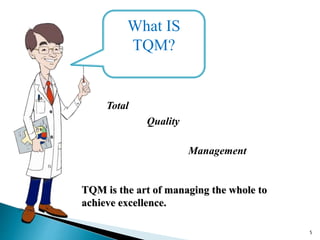
What IS
TQM?
TQM is the art of managing the whole to
achieve excellence.
Total
Quality
Management
5
6
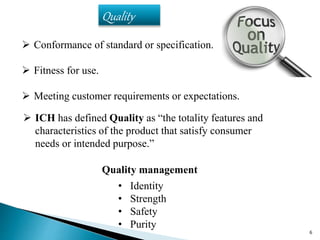
 Conformance of standard or specification.
 Fitness for use.
 Meeting customer requirements or expectations.
Quality
Quality management
 ICH has defined Quality as “the totality features and
characteristics of the product that satisfy consumer
needs or intended purpose.”
• Identity
• Strength
• Safety
• Purity
7
1. Performance.
2. Features .
3. Reliability.
4. Conformance.
5. Durability.
6. Serviceability.
7. Aesthetics.
8. Perceived quality.
The Eight Dimension Of Quality:
 Total Quality Management is a management approach
that originated in the 1950's and has steadily become
more popular since the early 1980's.
 Total Quality is a description of the
 Culture,
 attitude and
 organization of a company..
The concept of TQM (Total Quality Management)-
 TQM is a method.
 TQM implementation is the establishment of a quality
management system.
8
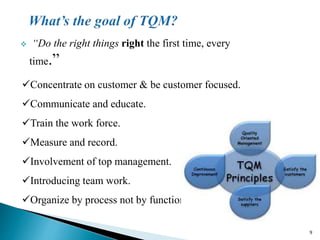
 “Do the right things right the first time, every
time.”
Concentrate on customer & be customer focused.
Communicate and educate.
Train the work force.
Measure and record.
Involvement of top management.
Introducing team work.
Organize by process not by function.
9
TQM is all managers leading and facilitating all contributors in
everyone’s two main objectives:
(1) Total client satisfaction through quality products and
services.
(2) Continuous improvements to-
Processes,
Systems,
people,
Suppliers,
Partners,
Products and services.
10
11
12
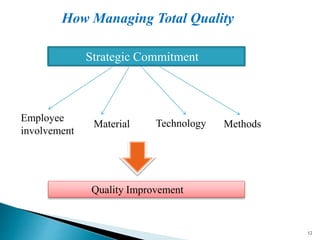
How Managing Total Quality
Strategic Commitment
Employee
involvement
Material Technology Methods
Quality Improvement
13
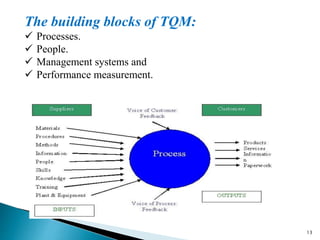
The building blocks of TQM:
 Processes.
 People.
 Management systems and
 Performance measurement.
14
 Quality Laboratory Processes (QLP).
 Quality Control (QC).
 Quality Assessment (QA) refers to the broader monitoring of
other dimensions or characteristics of quality.
 Quality Improvement (QI) is aimed at determining the causes or
sources of problems identified by QC and QA.
 Quality Planning (QP).
 Quality Goals.
TQM Working
Barriers in Successful TQM
15
1) Lack of understanding of the TQM concept.
2) Absence of visible support from senior and top
management.
3) Many layers of existing organization structure.
4) Poor internal communication.
5) Heavy workloads.
6) Nature of organization.
7) Lack of adequate education and training.
8) Limited resources.
9) Irregularity of the meetings.
10) Delay in implementation of the
recommendation of QIT’s.
16
Continue……
17
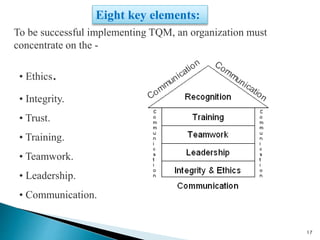
To be successful implementing TQM, an organization must
concentrate on the -
• Ethics.
• Integrity.
• Trust.
• Training.
• Teamwork.
• Leadership.
• Communication.
Eight key elements:
 Traditional view:
◦ Quality cannot be improved without significant losses in
productivity.
 TQM view:
◦ Improved quality leads to improved productivity.
18
 TQM is the management process used to make
continuous improvements to all functions.
 TQM represents an ongoing, continuous commitment
to improvement.
 The foundation of total quality is a management
philosophy that supports meeting customer
requirements through continuous improvement.
19
 Strengthened competitive position.
 Adaptability to changing or emerging market conditions
and to environmental and other government regulations.
 Higher productivity.
 Enhanced market image.
 Elimination of defects and waste.
 Reduced costs and better cost management.
 Higher profitability.
 Improved customer focus and satisfaction.
Total Quality Management Benefits
20
 Increased customer loyalty and retention.
 Increased job security.
 Enhanced shareholder and stakeholder value.
 Improved and innovative processes.
 The benefits of total quality management are
endless, helping your organization get results.
21
……to be continued.
22
oBesterfield, D., et.al. Total Quality Management, Third
Edition. Prentice Hall. 2003
oCortada, J. & Woods, J. The Quality Yearbook, 1996 Edition.
McGraw Hill. 1996
oBounds, G., et.al. Beyond Total Quality Management.
McGraw Hill. 1994
oGeorge, S. & Weimerskirch, A. Total Quality Management,
Second Edition. John Wiley & Sons Inc. 1998
oLawler, E., Morhman, S., and Ledford, G. Jr. Employeee
Involvement and Total Quality Management. Jossey-Bass
Publishers. 1992
References
THANK YOU
23

Total Quality Management

  • 1.
  • 2.
    Seminar On TOTALQUALITYMANAGEMENT Presented By Mr.RohitAshok Patil M.Pharm 1ST (Quality Assurance) SHREE SANTKRUPA COLLEGE OF PHARMACY GHOGAON SEM – II 2
  • 3.
    Quick Overview: 3  Objectives. Introduction.  Concept.  Goal.  Management.  TQM working.  Benefits.  Barrier.  References.
  • 4.
    4  To providehigh quality drug product to patients or prescribers.  Process improvement.  Defect prevention.  Helping teams to make better decision.  Continuous improvements to processes systems, people, suppliers, partners, products and services. Objectives:
  • 5.
    What IS TQM? TQM isthe art of managing the whole to achieve excellence. Total Quality Management 5
  • 6.
    6  Conformance ofstandard or specification.  Fitness for use.  Meeting customer requirements or expectations. Quality Quality management  ICH has defined Quality as “the totality features and characteristics of the product that satisfy consumer needs or intended purpose.” • Identity • Strength • Safety • Purity
  • 7.
    7 1. Performance. 2. Features. 3. Reliability. 4. Conformance. 5. Durability. 6. Serviceability. 7. Aesthetics. 8. Perceived quality. The Eight Dimension Of Quality:
  • 8.
     Total QualityManagement is a management approach that originated in the 1950's and has steadily become more popular since the early 1980's.  Total Quality is a description of the  Culture,  attitude and  organization of a company.. The concept of TQM (Total Quality Management)-  TQM is a method.  TQM implementation is the establishment of a quality management system. 8
  • 9.
     “Do theright things right the first time, every time.” Concentrate on customer & be customer focused. Communicate and educate. Train the work force. Measure and record. Involvement of top management. Introducing team work. Organize by process not by function. 9
  • 10.
    TQM is allmanagers leading and facilitating all contributors in everyone’s two main objectives: (1) Total client satisfaction through quality products and services. (2) Continuous improvements to- Processes, Systems, people, Suppliers, Partners, Products and services. 10
  • 11.
  • 12.
    12 How Managing TotalQuality Strategic Commitment Employee involvement Material Technology Methods Quality Improvement
  • 13.
    13 The building blocksof TQM:  Processes.  People.  Management systems and  Performance measurement.
  • 14.
    14  Quality LaboratoryProcesses (QLP).  Quality Control (QC).  Quality Assessment (QA) refers to the broader monitoring of other dimensions or characteristics of quality.  Quality Improvement (QI) is aimed at determining the causes or sources of problems identified by QC and QA.  Quality Planning (QP).  Quality Goals. TQM Working
  • 15.
    Barriers in SuccessfulTQM 15 1) Lack of understanding of the TQM concept. 2) Absence of visible support from senior and top management. 3) Many layers of existing organization structure. 4) Poor internal communication. 5) Heavy workloads.
  • 16.
    6) Nature oforganization. 7) Lack of adequate education and training. 8) Limited resources. 9) Irregularity of the meetings. 10) Delay in implementation of the recommendation of QIT’s. 16 Continue……
  • 17.
    17 To be successfulimplementing TQM, an organization must concentrate on the - • Ethics. • Integrity. • Trust. • Training. • Teamwork. • Leadership. • Communication. Eight key elements:
  • 18.
     Traditional view: ◦Quality cannot be improved without significant losses in productivity.  TQM view: ◦ Improved quality leads to improved productivity. 18
  • 19.
     TQM isthe management process used to make continuous improvements to all functions.  TQM represents an ongoing, continuous commitment to improvement.  The foundation of total quality is a management philosophy that supports meeting customer requirements through continuous improvement. 19
  • 20.
     Strengthened competitiveposition.  Adaptability to changing or emerging market conditions and to environmental and other government regulations.  Higher productivity.  Enhanced market image.  Elimination of defects and waste.  Reduced costs and better cost management.  Higher profitability.  Improved customer focus and satisfaction. Total Quality Management Benefits 20
  • 21.
     Increased customerloyalty and retention.  Increased job security.  Enhanced shareholder and stakeholder value.  Improved and innovative processes.  The benefits of total quality management are endless, helping your organization get results. 21 ……to be continued.
  • 22.
    22 oBesterfield, D., et.al.Total Quality Management, Third Edition. Prentice Hall. 2003 oCortada, J. & Woods, J. The Quality Yearbook, 1996 Edition. McGraw Hill. 1996 oBounds, G., et.al. Beyond Total Quality Management. McGraw Hill. 1994 oGeorge, S. & Weimerskirch, A. Total Quality Management, Second Edition. John Wiley & Sons Inc. 1998 oLawler, E., Morhman, S., and Ledford, G. Jr. Employeee Involvement and Total Quality Management. Jossey-Bass Publishers. 1992 References
  • 23.