Class XI Chemistry
UNIT 7 EQUILIBRIUM
Topics:-
• Reversible reaction
• Static and Dynamic Equilibrium
• Equilibrium In Physical Processes
Prepared by :-Vijay Kumar Sethi
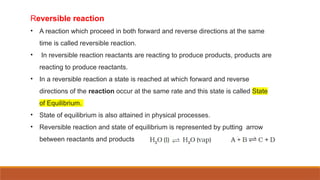
Reversible reaction
• A reaction which proceed in both forward and reverse directions at the same
time is called reversible reaction.
• In reversible reaction reactants are reacting to produce products, products are
reacting to produce reactants.
• In a reversible reaction a state is reached at which forward and reverse
directions of the reaction occur at the same rate and this state is called State
of Equilibrium.
• State of equilibrium is also attained in physical processes.
• Reversible reaction and state of equilibrium is represented by putting arrow
between reactants and products
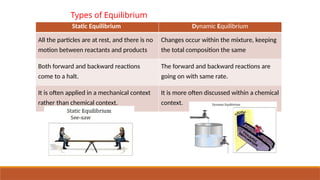
Types of Equilibrium
Static Equilibrium Dynamic Equilibrium
All the particles are at rest, and there is no
motion between reactants and products
Changes occur within the mixture, keeping
the total composition the same
Both forward and backward reactions
come to a halt.
The forward and backward reactions are
going on with same rate.
It is often applied in a mechanical context
rather than chemical context.
It is more often discussed within a chemical
context.
EQUILIBRIUM IN PHYSICAL PROCESSES
The most familiar examples are phase transformation
processes, e.g.,
solid liquid
liquid gas
solid gas
Solid-Liquid Equilibrium
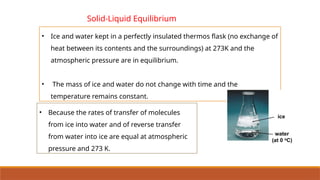
• Ice and water kept in a perfectly insulated thermos flask (no exchange of
heat between its contents and the surroundings) at 273K and the
atmospheric pressure are in equilibrium.
• The mass of ice and water do not change with time and the
temperature remains constant.
• Because the rates of transfer of molecules
from ice into water and of reverse transfer
from water into ice are equal at atmospheric
pressure and 273 K.
Continue…
Solid-Liquid Equilibrium
• Ice and water are in equilibrium only at particular temperature and
pressure.
• For any pure substance at atmospheric pressure, the temperature at
which the solid and liquid phases are at equilibrium is called the normal
melting point or normal freezing point of the substance.
• The system here is in dynamic equilibrium and we can infer the
following:
• (i) Both the opposing processes occur simultaneously.
• (ii) Both the processes occur at the same rate so that the amount of
ice and water remains constant.
Liquid-Vapour Equilibrium
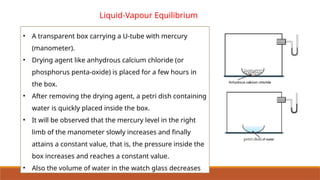
• A transparent box carrying a U-tube with mercury
(manometer).
• Drying agent like anhydrous calcium chloride (or
phosphorus penta-oxide) is placed for a few hours in
the box.
• After removing the drying agent, a petri dish containing
water is quickly placed inside the box.
• It will be observed that the mercury level in the right
limb of the manometer slowly increases and finally
attains a constant value, that is, the pressure inside the
box increases and reaches a constant value.
• Also the volume of water in the watch glass decreases
Continue…
Liquid-Vapour Equilibrium
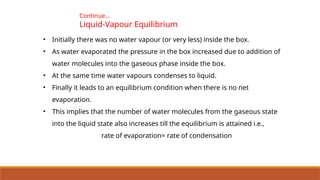
• Initially there was no water vapour (or very less) inside the box.
• As water evaporated the pressure in the box increased due to addition of
water molecules into the gaseous phase inside the box.
• At the same time water vapours condenses to liquid.
• Finally it leads to an equilibrium condition when there is no net
evaporation.
• This implies that the number of water molecules from the gaseous state
into the liquid state also increases till the equilibrium is attained i.e.,
rate of evaporation= rate of condensation
Continue…
Liquid-Vapour Equilibrium
• At equilibrium the pressure exerted by the water molecules at a given
temperature remains constant and is called the equilibrium vapour
pressure of water (or just vapour pressure of water);
• Vapour pressure of water increases with temperature
• Different liquids have different equilibrium vapour pressures at the
same temperature, and
• the liquid which has a higher vapour pressure is more volatile and has a
lower boiling point.
• methyl alcohol (64.7 °C), acetone (56 °C) and ether(34.6 °C)
Continue…
Liquid-Vapour Equilibrium
• Time taken for complete evaporation of a liquid depends on
• (i) the nature of the liquid,
• (ii) the amount of the liquid and
• (iii) the temperature.
• When the watch glass is open to the atmosphere, the rate of evaporation
remains constant but the molecules are dispersed into large volume of the
room.
• As a consequence the rate of condensation from vapour to liquid state is
much less than the rate of evaporation.
• These are open systems and it is not possible to reach equilibrium in an open
system.
Continue…
Liquid-Vapour Equilibrium
• Water and water vapour are in equilibrium position at atmospheric pressure (1.013
bar) and at 100°C in a closed vessel.
• The boiling point of water is 100°C at 1.013 bar pressure.
• For any pure liquid at one atmospheric pressure (1.013 bar), the temperature at
which the liquid and vapours are at equilibrium is called normal boiling point of the
liquid.
• Boiling point at 1 bar pressure is called Standard boiling point.
• 1 bar pressure is slightly less than 1 atm pressure.
• The normal boiling point of water is 100 °C (373 K), its standard boiling point is 99.6
°C (372.6 K).
• Boiling point of the liquid depends on the atmospheric pressure.
• It depends on the altitude of the place; at high altitude the boiling point decreases.
Solid – Vapour Equilibrium
• Systems where solids sublime to vapour phase.
• When solid iodine is placed in a closed vessel, after sometime the vessel gets
filled up with violet vapour and the intensity of colour increases with time.
• After certain time the intensity of colour becomes constant and at this stage
equilibrium is attained.
• Hence solid iodine sublimes to give iodine vapour and the iodine vapour
condenses to give solid iodine.
• The equilibrium can be represented as, I2(solid) I2 (vapour)
• Other examples Camphor (solid) Camphor (vapour) NH4Cl (solid) NH4Cl
(vapour)
Prepared by :-Vijay Kumar Sethi
Topics:-
Equilibrium Involving Dissolution of
Solid or Gases in Liquids
General Characteristics of Equilibria
Involving Physical Processes
UNIT 7 EQUILIBRIUM
Class XI Chemistry
Equilibrium Involving Dissolution of Solid or Gases in
Liquids
Solids in liquids
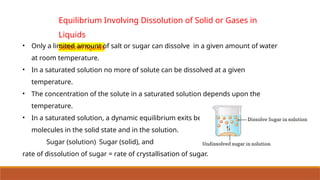
• Only a limited amount of salt or sugar can dissolve in a given amount of water
at room temperature.
• In a saturated solution no more of solute can be dissolved at a given
temperature.
• The concentration of the solute in a saturated solution depends upon the
temperature.
• In a saturated solution, a dynamic equilibrium exits between the solute
molecules in the solid state and in the solution.
Sugar (solution) Sugar (solid), and
rate of dissolution of sugar = rate of crystallisation of sugar.
Equilibrium Involving Dissolution of Solid or Gases in
Liquids
Continue….Solids in liquids
• Equality of the two rates and dynamic nature of equilibrium has been confirmed
with the help of radioactive sugar.
• If we drop some radioactive sugar into saturated solution of non-radioactive
sugar, then after some time radioactivity is observed both in the solution and in
the solid sugar
• Sugar whose molecules contain radioactive isotopes of carbon, hydrogen or
oxygen is called radioactive sugar
• Normally sugar made out of C-14 or O-16 is known as radioactive sugar.
• Normal or regular sugar molecules without any radioactive isotopes of carbon
hydrogen or oxygen are called non-radioactive sugars.
• Initially there were no radioactive sugar molecules in the solution but
due to dynamic nature of equilibrium, there is exchange between the
radioactive and non-radioactive sugar molecules between the two
phases.
• The ratio of the radioactive to non-radioactive molecules in the solution
increases till it attains a constant value.
Equilibrium Involving Dissolution of Solid or Gases in
Liquids
Continue….Solids in liquids
Equilibrium Involving Dissolution of Solid or Gases in
Liquids
Gases in liquids
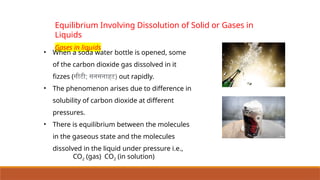
• When a soda water bottle is opened, some
of the carbon dioxide gas dissolved in it
fizzes (सीटी; सनसनाहट) out rapidly.
• The phenomenon arises due to difference in
solubility of carbon dioxide at different
pressures.
• There is equilibrium between the molecules
in the gaseous state and the molecules
dissolved in the liquid under pressure i.e.,
CO2 (gas) CO2 (in solution)
• This equilibrium is governed by Henry’s law, which states that the mass of a gas
dissolved in a given mass of a solvent at any temperature is proportional to the
pressure of the gas above the solvent.
• This amount decreases with increase of temperature.
• The soda water bottle is sealed under pressure of gas when its solubility in
water is high.
• As soon as the bottle is opened, some of the dissolved carbon dioxide gas
escapes to reach a new equilibrium condition required for the lower pressure.
• This is how the soda water in bottle when left open to the air for some time,
turns ‘flat’.
Equilibrium Involving Dissolution of Solid or Gases in
Liquids
Continue…Gases in liquids
A flat soda has no bubbles.
1) For solid liquid equilibrium, there is only one temperature (melting point) at 1
atm (1.013 bar) at which the two phases can coexist. Melting point is fixed at
constant pressure
2) For liquid vapour equilibrium, the vapour pressure is constant at a given
temperature.
3) For dissolution of solids in liquids, [Solute(s) Solute (solution)] the solubility is
constant at a given temperature.
4) For dissolution of gases in liquids, [Gas(g) Gas (aq)] the concentration of a gas
in liquid is proportional to the pressure (concentration) of the gas over the
liquid. [gas(aq)]/[gas(g)] is constant at a given temperature
Summary of Equilibrium In Physical
Processes
General Characteristics of Equilibria Involving Physical
Processes
1) Equilibrium is possible only in a closed system at a given temperature.
2) Both the opposing processes occur at the same rate and there is a dynamic
but stable condition.
3) All measurable properties of the system remain constant.
4) When equilibrium is attained for a physical process, it is characterised by
constant value of one of its parameters at a given temperature.
5) The magnitude of such quantities at any stage indicates the extent to which
the physical process has proceeded before reaching equilibrium.
Class XI Chemistry
UNIT 7 EQUILIBRIUM
Topic:-
• Equilibrium-In Chemical Processes
Prepared by :-Vijay Kumar Sethi
Equilibrium In Chemical Processes
• Reversible chemical reactions occur both in forward and backward directions.
• When the rates of the forward and reverse reactions become equal, the
concentrations of the reactants and the products remain constant.
• This is the stage of chemical equilibrium.
• This equilibrium is dynamic in nature as both opposite reactions are
continuously going on.
• General case of a reversible reaction, A + B C + D
• With passage of time, there is formation of the products C and D and depletion
of the reactants A and B .
• This leads to a decrease in the rate of forward reaction and an increase in the
rate of the reverse reaction.
Continue…
Equilibrium In Chemical Processes
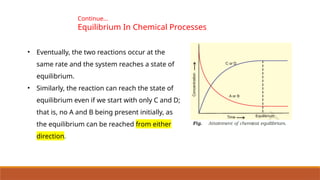
• Eventually, the two reactions occur at the
same rate and the system reaches a state of
equilibrium.
• Similarly, the reaction can reach the state of
equilibrium even if we start with only C and D;
that is, no A and B being present initially, as
the equilibrium can be reached from either
direction.
Dynamic Nature Of Chemical Equilibrium
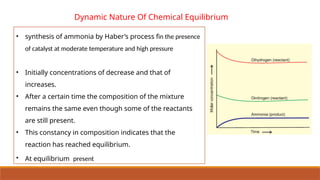
• synthesis of ammonia by Haber’s process fin the presence
of catalyst at moderate temperature and high pressure
• Initially concentrations of decrease and that of
increases.
• After a certain time the composition of the mixture
remains the same even though some of the reactants
are still present.
• This constancy in composition indicates that the
reaction has reached equilibrium.
• At equilibrium present
• Now same reaction is carried out in same conditions of T and P using D2
(deuterium) in place of H2.
• The reaction mixtures starting either with H2 or D2 reach equilibrium with the
same composition, except that D2 and ND3are present instead of H2 and NH3.
• After equilibrium is attained, these two mixtures (H2, N2, NH3 and D2, N2, ND3)
are mixed together and left for a while to achieve new equilibrium.
• Presence of (NH3, NH2D, NHD2 and ND3) and dihydrogen and its deuterated
forms (H2, HD and D2) indicates that equilibrium is dynamic in nature
Continue…
Dynamic Nature Of Chemical Equilibrium
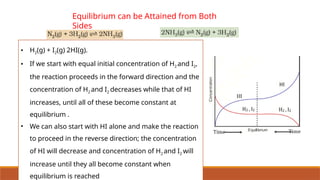
Equilibrium can be Attained from Both
Sides
• H2(g) + I2(g) 2HI(g).
• If we start with equal initial concentration of H2 and I2,
the reaction proceeds in the forward direction and the
concentration of H2 and I2 decreases while that of HI
increases, until all of these become constant at
equilibrium .
• We can also start with HI alone and make the reaction
to proceed in the reverse direction; the concentration
of HI will decrease and concentration of H2 and I2 will
increase until they all become constant when
equilibrium is reached
Class XI Chemistry
UNIT 7 EQUILIBRIUM
Topics:-
• Law Of Mass Action
• Equilibrium Equation
• Equilibrium constant
• Law of Chemical Equilibrium
Prepared by :-Vijay Kumar Sethi
Law Of Mass Action
• Proposed by Guldberg and Waage so also known as Guldberg - Waage Law
• Rate of a chemical reaction is directly proportional to the product of the
concentrations of the reactants
Rate of forward reaction,
Rate of reverse reaction,
At equilibrium,
In the early days of
chemistry,
concentration was
called “active mass”.
[A], [B], [C] and [D] are the
equilibrium concentrations
of the reactants and
products
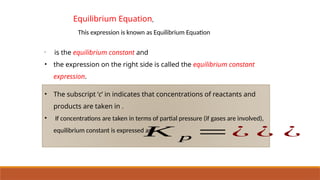
Equilibrium Equation,
This expression is known as Equilibrium Equation
•
is the equilibrium constant and
• the expression on the right side is called the equilibrium constant
expression.
• The equilibrium equation is also known as the law of mass action
• The subscript ‘c’ in indicates that concentrations of reactants and
products are taken in .
• If concentrations are taken in terms of partial pressure (if gases are involved),
equilibrium constant is expressed as
K p =¿ ¿ ¿
Equilibrium Law or Law of Chemical Equilibrium
• At a given temperature, the product of concentrations of the reaction products
raised to the respective stoichiometric coefficient in the balanced chemical
equation divided by the product of concentrations of the reactants raised to their
individual stoichiometric coefficients has a constant value. This is known as the
Equilibrium Law or Law of Chemical Equilibrium.
• Equilibrium constant for the reaction
K c =
[ C ]c
[ D ]d
[ A ]
a
[ B ]
b
• While writing expression for equilibrium
constant, symbol for phases (s, l, g, aq) are
generally ignored.
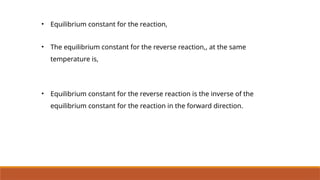
• Equilibrium constant for the reaction,
• The equilibrium constant for the reverse reaction,, at the same
temperature is,
• Equilibrium constant for the reverse reaction is the inverse of the
equilibrium constant for the reaction in the forward direction.
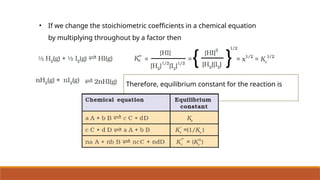
• If we change the stoichiometric coefficients in a chemical equation
by multiplying throughout by a factor then
Therefore, equilibrium constant for the reaction is
equal to
Problem 7.1
The following concentrations were obtained for the formation of NH3 from N2 and
H2 at equilibrium at 500K.
[N2] = 1.5 × 10⁻²
M [H2] = 3.0 ×10⁻²
M and [NH3] = 1.2 ×10⁻²
M. Calculate
equilibrium constant.
Solution:-
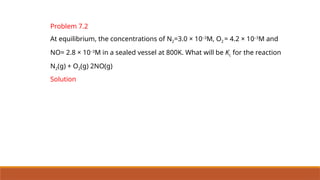
Problem 7.2
At equilibrium, the concentrations of N2=3.0 × 10⁻³
M, O2 = 4.2 × 10⁻³
M and
NO= 2.8 × 10⁻³
M in a sealed vessel at 800K. What will be Kc for the reaction
N2(g) + O2(g) 2NO(g)
Solution
Class XI Chemistry
UNIT 7 EQUILIBRIUM
Topics:-
• Homogeneous and Heterogeneous
Equilibria
Prepared by :-Vijay Kumar Sethi
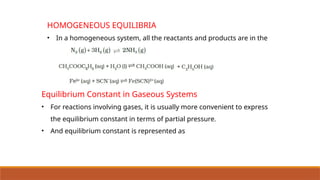
HOMOGENEOUS EQUILIBRIA
• In a homogeneous system, all the reactants and products are in the
same phase.
Equilibrium Constant in Gaseous Systems
• For reactions involving gases, it is usually more convenient to express
the equilibrium constant in terms of partial pressure.
• And equilibrium constant is represented as
HETEROGENEOUS EQUILIBRIA
• Equilibrium in a system having more than one phase is called heterogeneous
equilibrium.
• Heterogeneous equilibria often involve pure solids or liquids.
• Molar concentration of a pure solid or liquid is constant (i.e., independent of
the amount present).
• In other words if a substance ‘X’ is involved, then [X(s)] and [X(l)] are constant,
whatever the amount of ‘X’ is taken.
• While [X(g)] and [X(aq)] will vary as the amount of X in a given volume varies.
HETEROGENEOUS EQUILIBRIA
• thermal dissociation of calcium carbonate
• On the basis of the stoichiometric equation, we can write,
• Since [CaCO3(s)] and [CaO(s)] are both constant,
For the existence of heterogeneous
equilibrium pure solids or liquids must
also be present at equilibrium, but their
concentrations or partial pressures do not
appear in the expression of the
equilibrium constant.
Class XI Chemistry
UNIT 7 EQUILIBRIUM
Topics:-
• Relation between and
• Units of and
Prepared by :-Vijay Kumar Sethi
Relation between and
aA+bB⇌cC+dD
K c =
[ C ]c
[ D ]d
[ A ]
a
[ B ]
b K p =¿¿ ¿
pV = nRT
where Dn = (number of moles of gaseous products) – (number of moles of gaseous
reactants) in the balanced chemical equation.
Continue...
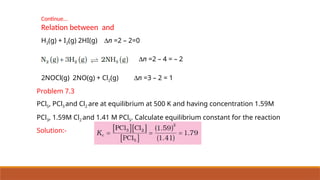
Relation between and
H2(g) + I2(g) 2HI(g) Dn =2 – 2=0
Dn =2 – 4 = – 2
2NOCl(g) 2NO(g) + Cl2(g) Dn =3 – 2 = 1
Problem 7.3
PCl5, PCl3 and Cl2 are at equilibrium at 500 K and having concentration 1.59M
PCl3, 1.59M Cl2 and 1.41 M PCl5. Calculate equilibrium constant for the reaction
Solution:-
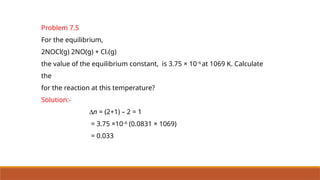
Problem 7.5
For the equilibrium,
2NOCl(g) 2NO(g) + Cl2(g)
the value of the equilibrium constant, is 3.75 × 10⁻⁶
at 1069 K. Calculate
the
for the reaction at this temperature?
Solution:-
Dn = (2+1) – 2 = 1
= 3.75 ×10⁻⁶
(0.0831 × 1069)
= 0.033
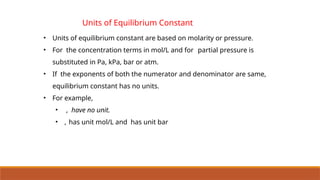
Units of Equilibrium Constant
• Units of equilibrium constant are based on molarity or pressure.
• For the concentration terms in mol/L and for partial pressure is
substituted in Pa, kPa, bar or atm.
• If the exponents of both the numerator and denominator are same,
equilibrium constant has no units.
• For example,
• , have no unit.
• , has unit mol/L and has unit bar
Continue…
Units of Equilibrium Constant
• Equilibrium constants can also be expressed as dimensionless quantities if the
standard state of reactants and products are specified.
• For a pure gas, the standard state is 1bar.
• Therefore a pressure of 4 bar in standard state can be expressed as 4 bar/1 bar
= 4, which is a dimensionless number.
• Standard state for a solute is 1 molar solution and all concentrations can be
measured with respect to it.
• Thus, in this system both are dimensionless quantities
Class XI Chemistry
UNIT 7 EQUILIBRIUM
Topics:-
• Important Features Of Equilibrium
Constant
• Applications Of Equilibrium Constants
Prepared by :-Vijay Kumar Sethi
Important Features Of Equilibrium
Constant
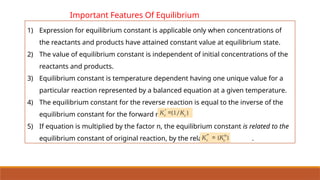
1) Expression for equilibrium constant is applicable only when concentrations of
the reactants and products have attained constant value at equilibrium state.
2) The value of equilibrium constant is independent of initial concentrations of the
reactants and products.
3) Equilibrium constant is temperature dependent having one unique value for a
particular reaction represented by a balanced equation at a given temperature.
4) The equilibrium constant for the reverse reaction is equal to the inverse of the
equilibrium constant for the forward reaction.
5) If equation is multiplied by the factor n, the equilibrium constant is related to the
equilibrium constant of original reaction, by the relation .
Applications Of Equilibrium Constants
• To:
• predict the extent of a reaction on the basis of its magnitude,
• predict the direction of the reaction, and
• calculate equilibrium concentrations.
Predicting the Extent of a Reaction
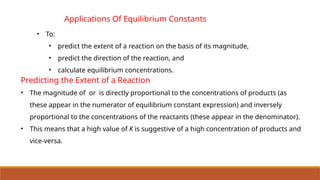
• The magnitude of or is directly proportional to the concentrations of products (as
these appear in the numerator of equilibrium constant expression) and inversely
proportional to the concentrations of the reactants (these appear in the denominator).
• This means that a high value of K is suggestive of a high concentration of products and
vice-versa.
Continue…
Predicting the Extent of a Reaction
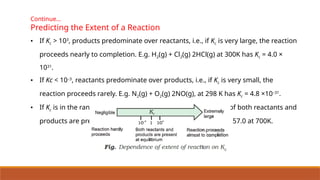
• If Kc > 103
, products predominate over reactants, i.e., if Kc is very large, the reaction
proceeds nearly to completion. E.g. H2(g) + Cl2(g) 2HCl(g) at 300K has Kc = 4.0 ×
1031
.
• If Kc < 10–3
, reactants predominate over products, i.e., if Kc is very small, the
reaction proceeds rarely. E.g. N2(g) + O2(g) 2NO(g), at 298 K has Kc = 4.8 ×10⁻³¹
.
• If Kc is in the range of 10–3
to 103
, appreciable concentrations of both reactants and
products are present. For reaction of H2 with I2 to give HI, Kc = 57.0 at 700K.
Predicting the Direction of the Reaction
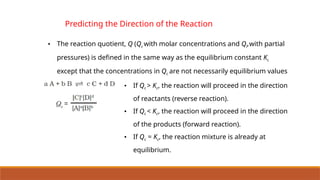
• The reaction quotient, Q (Qc with molar concentrations and QP with partial
pressures) is defined in the same way as the equilibrium constant Kc
except that the concentrations in Qc are not necessarily equilibrium values
• If Qc > Kc, the reaction will proceed in the direction
of reactants (reverse reaction).
• If Qc < Kc, the reaction will proceed in the direction
of the products (forward reaction).
• If Qc = Kc, the reaction mixture is already at
equilibrium.
Continue…
Predicting the Direction of the Reaction
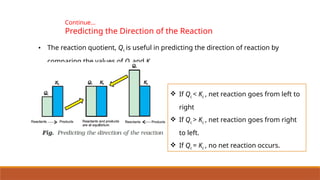
• The reaction quotient, Qc is useful in predicting the direction of reaction by
comparing the values of Qc and Kc.
 If Qc < Kc , net reaction goes from left to
right
 If Qc > Kc , net reaction goes from right
to left.
 If Qc = Kc , no net reaction occurs.
Problem 7.7
The value of Kc for the reaction 2A B + C is 2 × 10⁻³
. At a given time,
the composition of reaction mixture is [A] = [B] = [C] = 3 × 10⁻⁴
M. In
which
direction the reaction will proceed?
Solution:- For the reaction the reaction quotient Qc is given by,
as [A] = [B] = [C] = 3 × 10⁻⁴
M
as Qc > Kc so the reaction will proceed in the reverse direction.
Calculating Equilibrium Concentrations
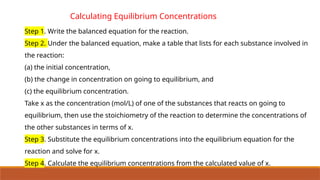
Step 1. Write the balanced equation for the reaction.
Step 2. Under the balanced equation, make a table that lists for each substance involved in
the reaction:
(a) the initial concentration,
(b) the change in concentration on going to equilibrium, and
(c) the equilibrium concentration.
Take x as the concentration (mol/L) of one of the substances that reacts on going to
equilibrium, then use the stoichiometry of the reaction to determine the concentrations of
the other substances in terms of x.
Step 3. Substitute the equilibrium concentrations into the equilibrium equation for the
reaction and solve for x.
Step 4. Calculate the equilibrium concentrations from the calculated value of x.
Problem 7.9
3.00 mol of PCl5 kept in 1L closed reaction vessel was allowed to attain
equilibrium at 380K. Calculate composition of the mixture at equilibrium. Kc=
1.80
Solution:-
Step 1: PCl5 PCl3 + Cl2
Step 2: Initial concentration : 3.0 0 0
Let x mol per litre of PCl5 be dissociated
At equilibrium: (3 – x) x x
Step 3:
x =1.59
Step 4:
x2
+ 1.8x – 5.4 = 0
x = [–1.8 ± Ö(1.8)2
– 4(–5.4)]/2
x = [–1.8 ± Ö3.24 + 21.6]/2
x = [–1.8 ± 4.98]/2
x = [–1.8 + 4.98]/2 = 1.59
Class XI Chemistry
UNIT 7 EQUILIBRIUM
Topics:-
• Relationship Between Equilibrium Constant
K, Reaction Quotient Q And Gibbs Energy G
Prepared by :-Vijay Kumar Sethi
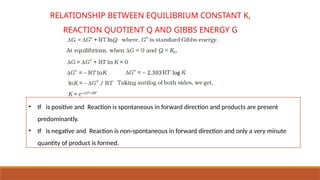
RELATIONSHIP BETWEEN EQUILIBRIUM CONSTANT K,
REACTION QUOTIENT Q AND GIBBS ENERGY G
• If is positive and Reaction is spontaneous in forward direction and products are present
predominantly.
• If is negative and Reaction is non-spontaneous in forward direction and only a very minute
quantity of product is formed.
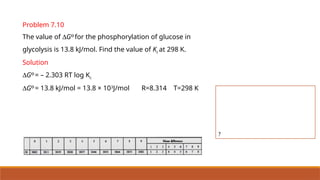
Problem 7.10
The value of DGƟ
for the phosphorylation of glucose in
glycolysis is 13.8 kJ/mol. Find the value of Kc at 298 K.
Solution
DGƟ
= – 2.303 RT log Kc
DGƟ
= 13.8 kJ/mol = 13.8 × 10³
J/mol R=8.314 T=298 K
?
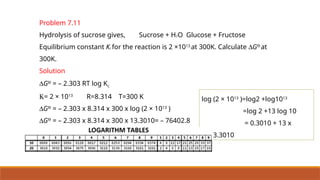
Problem 7.11
Hydrolysis of sucrose gives, Sucrose + H2O Glucose + Fructose
Equilibrium constant Kc for the reaction is 2 ×10¹³
at 300K. Calculate DGƟ
at
300K.
Solution
DGƟ
= – 2.303 RT log Kc
K= 2 × 10¹³
R=8.314 T=300 K
DGƟ
= – 2.303 x 8.314 x 300 x log (2 × 10¹³
)
DGƟ
= – 2.303 x 8.314 x 300 x 13.3010= – 76402.8
DGƟ
= – 7.64 x 10⁴
log (2 × 10¹³
)=log2 +log1013
=log 2 +13 log 10
= 0.3010 + 13 x
1=13.3010
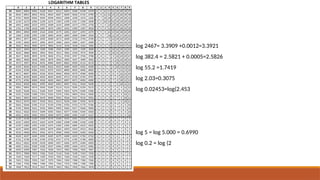
log 2467= 3.3909 +0.0012=3.3921
log 382.4 = 2.5821 + 0.0005=2.5826
log 55.2 =1.7419
log 2.03=0.3075
log 0.02453=log(2.453
log 5 = log 5.000 = 0.6990
log 0.2 = log (2
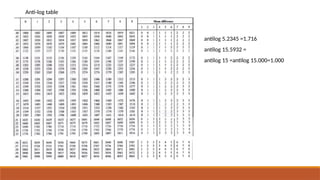
Anti-log table
antilog 5.2345 =1.716
antilog 15.5932 =
antilog 15 =antilog 15.000=1.000
Class XI Chemistry
UNIT 7 EQUILIBRIUM
Topics:-
• Factors Affecting Equilibria
• Le Chatelier’s principle
• Effect of Concentration and Pressure Change
Prepared by :-Vijay Kumar Sethi
Factors Affecting Equilibria
1. Concentration
2. Temperature
3. Pressure
4. Catalyst
Le Chatelier’s principle.
• It states that a change in any of the factors(Concentration,
temperature or pressure) that determine the equilibrium
conditions of a system will cause the system to change in such a
manner so as to reduce or to counteract the effect of the change
Effect of Concentration Change
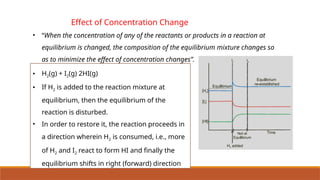
• “When the concentration of any of the reactants or products in a reaction at
equilibrium is changed, the composition of the equilibrium mixture changes so
as to minimize the effect of concentration changes”.
• H2(g) + I2(g) 2HI(g)
• If H2 is added to the reaction mixture at
equilibrium, then the equilibrium of the
reaction is disturbed.
• In order to restore it, the reaction proceeds in
a direction wherein H2 is consumed, i.e., more
of H2 and I2 react to form HI and finally the
equilibrium shifts in right (forward) direction
Continue…
Effect of Concentration Change
• The same point can be explained in terms of the reaction quotient, Qc,
• H2(g) + I2(g) 2HI(g)
• Addition of hydrogen at equilibrium results in value of Qc being less than Kc .
• Thus, in order to attain equilibrium again reaction moves in the forward
direction.
• Removal of a product also boosts the forward reaction and increases the
concentration of the products
• In case of manufacture of ammonia, N2(g) + 3H2(g) 2NH3(g)
• ammonia is liquified and removed from the reaction mixture so that reaction
keeps moving in forward direction.
Continue…
Effect of Concentration Change
• In the large scale production of CaO (used as important building material)
from CaCO3,
• CaCO3(s) Cao(s) + CO2(g)
• constant removal of CO2 from the kiln (furnace भट्ठी), drives the reaction to
completion.
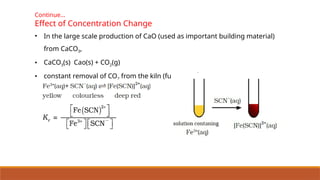
• The equilibrium can be shifted in the opposite direction
by adding reagents that remove Fe3+
or SCNions.
• For example, oxalic acid (H2C2O4), reacts with Fe3+
ions to
form the stable complex ion [Fe(C2O4)3]3–
, thus decreasing
the concentration of free Fe3+
(aq).
• So [Fe(SCN)]2+
dissociates to give Fe3+
• Because the concentration of [Fe(SCN)]2+
decreases, the
intensity of red colour decreases.
Continue…
Effect of Concentration Change
Continue…
Effect of Concentration Change
• Addition of aq. HgCl2 also decreases red colour
because Hg2+
reacts with SCNions to form stable
complex ion [Hg(SCN)4]2–
.
• Removal of free SCN(aq) shifts the equilibrium from
right to left to replenish SCNions.
• Addition of potassium thiocyanate increases the
colour intensity of the solution as it shift the
equilibrium to right.
Effect of Pressure Change
• Effect of pressure changes on solids and liquids can be ignored because the
volume (and concentration) of a solution/liquid is nearly independent of
pressure.
• Effect of pressure change is observed where gases are involved and total number of moles
of gaseous reactants and total number of moles of gaseous products are
different.
• For example CO(g) + 3H2(g CH4(g) + H2O(g)
• Here, 4 mol of gaseous reactants (CO + 3H2) become 2 mol of gaseous products (CH4 + H2O).
• When pressure is increased, number of gaseous moles increase per unit volume
so the reaction goes in the forward direction because the number of moles of gas
decreases in the forward direction.
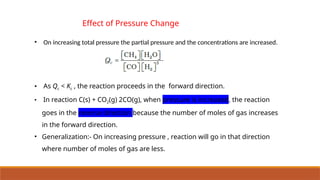
• On increasing total pressure the partial pressure and the concentrations are increased.
• As Qc < Kc , the reaction proceeds in the forward direction.
• In reaction C(s) + CO2(g) 2CO(g), when pressure is increased, the reaction
goes in the reverse direction because the number of moles of gas increases
in the forward direction.
• Generalization:- On increasing pressure , reaction will go in that direction
where number of moles of gas are less.
Effect of Pressure Change
Class XI Chemistry
UNIT 7 EQUILIBRIUM
Topics:-
• Factors Affecting Equilibria :-Effect of
• Inert Gas Addition
• Temperature Change
• A Catalyst
Prepared by :-Vijay Kumar Sethi
Effect of Inert Gas Addition
• If the volume is kept constant and an inert gas such as argon is
added which does not take part in the reaction, the equilibrium
remains undisturbed.
• It is because the addition of an inert gas at constant volume does not
change the partial pressures or the molar concentrations of the
substance involved in the reaction.
• The reaction quotient changes only if the added gas is a reactant or
product involved in the reaction.
Effect of Temperature Change
• Whenever an equilibrium is disturbed by a change in the concentration,
pressure or volume, the composition of the equilibrium mixture changes
because the reaction quotient, Qc no longer equals the equilibrium
constant, Kc.
• When a change in temperature occurs, the value of equilibrium constant, Kc
is changed.
• The equilibrium constant for an exothermic reaction (negative DH)
decreases as the temperature increases.
• The equilibrium constant for an endothermic reaction (positive DH)
increases as the temperature increases.
• Temperature changes affect the equilibrium constant and rates of
reactions.
Continue…
Effect of Temperature Change
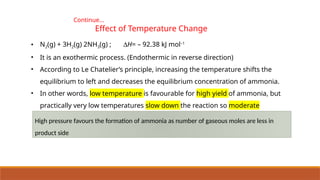
• N2(g) + 3H2(g) 2NH3(g) ; DH= – 92.38 kJ mol–1
• It is an exothermic process. (Endothermic in reverse direction)
• According to Le Chatelier’s principle, increasing the temperature shifts the
equilibrium to left and decreases the equilibrium concentration of ammonia.
• In other words, low temperature is favourable for high yield of ammonia, but
practically very low temperatures slow down the reaction so moderate
temperature and a catalyst is used.
High pressure favours the formation of ammonia as number of gaseous moles are less in
product side
Continue…
Effect of Temperature Change
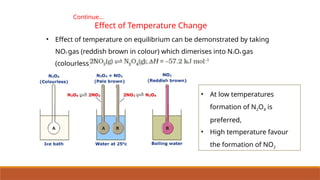
• Effect of temperature on equilibrium can be demonstrated by taking
NO2 gas (reddish brown in colour) which dimerises into N2O4 gas
(colourless).
• At low temperatures
formation of N2O4 is
preferred,
• High temperature favour
the formation of NO2
Continue…
Effect of Temperature Change
• Effect of temperature can also be seen in an endothermic
reaction,
• At room temperature, the equilibrium mixture is blue due to
[CoCl4]2–
.
• When cooled in a freezing mixture, the colour of the mixture
turns pink due to [Co(H2O)6]3+
.
Effect of a Catalyst
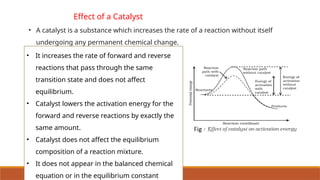
• A catalyst is a substance which increases the rate of a reaction without itself
undergoing any permanent chemical change.
• It increases the rate of forward and reverse
reactions that pass through the same
transition state and does not affect
equilibrium.
• Catalyst lowers the activation energy for the
forward and reverse reactions by exactly the
same amount.
• Catalyst does not affect the equilibrium
composition of a reaction mixture.
• It does not appear in the balanced chemical
equation or in the equilibrium constant
Continue…
Effect of a Catalyst
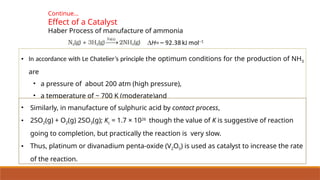
Haber Process of manufacture of ammonia
• In accordance with Le Chatelier’s principle the optimum conditions for the production of NH3
are
• a pressure of about 200 atm (high pressure),
• a temperature of ~ 700 K (moderate)and
• the use of a catalyst such as iron
• Similarly, in manufacture of sulphuric acid by contact process,
• 2SO2(g) + O2(g) 2SO3(g); Kc = 1.7 × 1026
though the value of K is suggestive of reaction
going to completion, but practically the reaction is very slow.
• Thus, platinum or divanadium penta-oxide (V2O5) is used as catalyst to increase the rate
of the reaction.
Class XI Chemistry
UNIT 7 EQUILIBRIUM
Topics:-
• Ionic Equilibrium In Solution
• Arrhenius Concept of Acids and Bases
Prepared by :-Vijay Kumar Sethi
Ionic Equilibrium In Solution
• Equilibrium involving ions in aqueous solution is called ionic equilibrium.
• Michael Faraday classified the substances into two categories based on their ability to conduct
electricity.
• (1) Electrolytes:-substances that conduct electricity in their aqueous solutions
• (2) Non-electrolytes :- substances that do not conduct electricity in their aqueous solutions
• Faraday further classified electrolytes into strong and weak electrolytes.
• Strong electrolytes on dissolution in water dissociate almost completely into ions for example
sodium chloride , while the weak electrolytes only partially ionize into ions for example acetic acid.
• In weak electrolytes, equilibrium is established between ions and the unionized
molecules.
• Acids, bases and salts come under the category of electrolytes and may act as either
strong or weak electrolytes.
• Dissociation refers to the process of separation of ions in water
already existing as such in the solid state of the solute, as in sodium
chloride.
• On the other hand, ionization corresponds to a process in which a
neutral molecule splits into charged ions in the solution.
• Here, we shall not distinguish between the two and use the two terms
interchangeably.
Acids, Bases And Salts
Acids:-
• Hydrochloric acid present in the gastric juice is secreted by the lining of
our stomach in a significant amount of 1.2-1.5 L/day and is essential for
digestive processes.
• Acetic acid is known to be the main constituent of vinegar.
• Lemon and orange juices contain citric and ascorbic acids, and tartaric
acid is found in tamarind paste.
• As most of the acids taste sour, the word “acid” has been derived from a
latin word “acidus” meaning sour.
• Acids are known to turn blue litmus paper into red and liberate
dihydrogen on reacting with some metals
Bases:-
• Bases are known to turn red litmus paper blue, taste bitter and feel
soapy.
• A common example of a base is washing soda used for washing
purposes.
Salts:-
• When acids and bases are mixed in the right proportion they react
with each other to give salts.
• Some commonly known examples of salts are sodium chloride,
barium sulphate, sodium nitrate.
• Sodium chloride (common salt, NaCl ) is an important component of
our diet and is formed by reaction between hydrochloric acid and
sodium hydroxide.
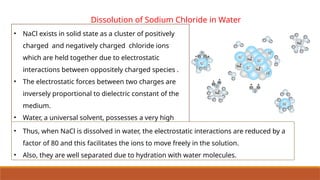
• NaCl exists in solid state as a cluster of positively
charged and negatively charged chloride ions
which are held together due to electrostatic
interactions between oppositely charged species .
• The electrostatic forces between two charges are
inversely proportional to dielectric constant of the
medium.
• Water, a universal solvent, possesses a very high
dielectric constant of 80.
Dissolution of Sodium Chloride in Water
• Thus, when NaCl is dissolved in water, the electrostatic interactions are reduced by a
factor of 80 and this facilitates the ions to move freely in the solution.
• Also, they are well separated due to hydration with water molecules.
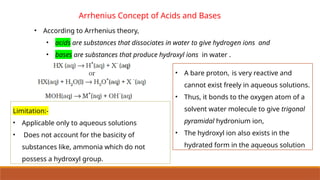
Arrhenius Concept of Acids and Bases
• According to Arrhenius theory,
• acids are substances that dissociates in water to give hydrogen ions and
• bases are substances that produce hydroxyl ions in water .
• A bare proton, is very reactive and
cannot exist freely in aqueous solutions.
• Thus, it bonds to the oxygen atom of a
solvent water molecule to give trigonal
pyramidal hydronium ion,
• The hydroxyl ion also exists in the
hydrated form in the aqueous solution
Limitation:-
• Applicable only to aqueous solutions
• Does not account for the basicity of
substances like, ammonia which do not
possess a hydroxyl group.
Class XI Chemistry
UNIT 7 EQUILIBRIUM
Topics:-
• The Brönsted-Lowry Acids and Bases
• Lewis Acids and Bases
Prepared by :-Vijay Kumar Sethi
The Brönsted-Lowry Acids and Bases
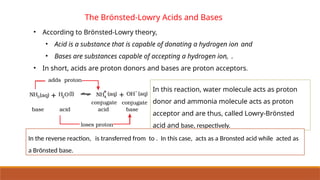
• According to Brönsted-Lowry theory,
• Acid is a substance that is capable of donating a hydrogen ion and
• Bases are substances capable of accepting a hydrogen ion, .
• In short, acids are proton donors and bases are proton acceptors.
In this reaction, water molecule acts as proton
donor and ammonia molecule acts as proton
acceptor and are thus, called Lowry-Brönsted
acid and base, respectively.
In the reverse reaction, is transferred from to . In this case, acts as a Bronsted acid while acted as
a Brönsted base.
The Brönsted-Lowry Acids and Bases
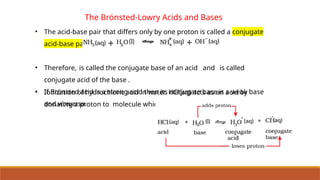
• The acid-base pair that differs only by one proton is called a conjugate
acid-base pair.
• Therefore, is called the conjugate base of an acid and is called
conjugate acid of the base .
• If Brönsted acid is a strong acid then its conjugate base is a weak base
and viceversa.
• Ionization of hydrochloric acid in water. HCl(aq) acts as an acid by
donating a proton to molecule which acts as a base.
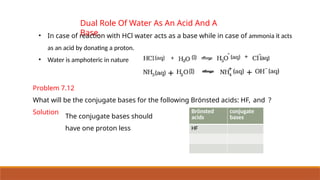
Dual Role Of Water As An Acid And A
Base.
• In case of reaction with HCl water acts as a base while in case of ammonia it acts
as an acid by donating a proton.
• Water is amphoteric in nature
Problem 7.12
What will be the conjugate bases for the following Brönsted acids: HF, and ?
Solution Brönsted
acids
conjugate
bases
HF
The conjugate bases should
have one proton less
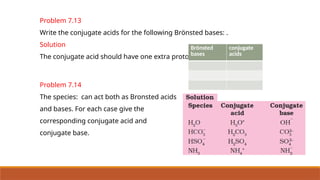
Problem 7.13
Write the conjugate acids for the following Brönsted bases: .
Solution
The conjugate acid should have one extra proton
Brönsted
bases
conjugate
acids
Problem 7.14
The species: can act both as Bronsted acids
and bases. For each case give the
corresponding conjugate acid and
conjugate base.
Lewis Acids and Bases
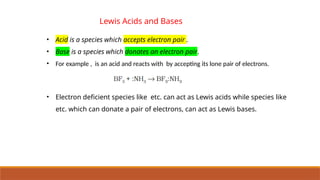
• Acid is a species which accepts electron pair .
• Base is a species which donates an electron pair.
• For example , is an acid and reacts with by accepting its lone pair of electrons.
• Electron deficient species like etc. can act as Lewis acids while species like
etc. which can donate a pair of electrons, can act as Lewis bases.
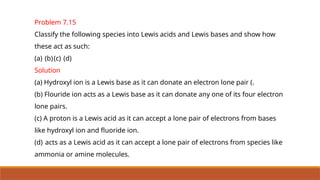
Problem 7.15
Classify the following species into Lewis acids and Lewis bases and show how
these act as such:
(a) (b)(c) (d)
Solution
(a) Hydroxyl ion is a Lewis base as it can donate an electron lone pair (.
(b) Flouride ion acts as a Lewis base as it can donate any one of its four electron
lone pairs.
(c) A proton is a Lewis acid as it can accept a lone pair of electrons from bases
like hydroxyl ion and fluoride ion.
(d) acts as a Lewis acid as it can accept a lone pair of electrons from species like
ammonia or amine molecules.
Class XI Chemistry
UNIT 7 EQUILIBRIUM
Topics:-
• Ionization Of Acids And Bases
• Ionic Product Of Water
Prepared by :-Vijay Kumar Sethi
Ionization Of Acids And Bases
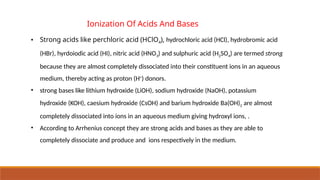
• Strong acids like perchloric acid (HClO4), hydrochloric acid (HCl), hydrobromic acid
(HBr), hyrdoiodic acid (HI), nitric acid (HNO3) and sulphuric acid (H2SO4) are termed strong
because they are almost completely dissociated into their constituent ions in an aqueous
medium, thereby acting as proton (H+
) donors.
• strong bases like lithium hydroxide (LiOH), sodium hydroxide (NaOH), potassium
hydroxide (KOH), caesium hydroxide (CsOH) and barium hydroxide Ba(OH)2 are almost
completely dissociated into ions in an aqueous medium giving hydroxyl ions, .
• According to Arrhenius concept they are strong acids and bases as they are able to
completely dissociate and produce and ions respectively in the medium.
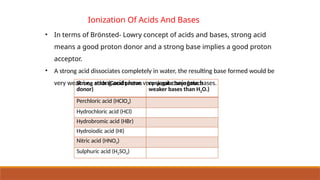
• In terms of Brönsted- Lowry concept of acids and bases, strong acid
means a good proton donor and a strong base implies a good proton
acceptor.
• A strong acid dissociates completely in water, the resulting base formed would be
very weak i.e., strong acids have very weak conjugate bases.
Strong acids (Good proton
donor)
conjugate base (much
weaker bases than H2O.)
Perchloric acid (HClO4)
Hydrochloric acid (HCl)
Hydrobromic acid (HBr)
Hydroiodic acid (HI)
Nitric acid (HNO3)
Sulphuric acid (H2SO4)
Ionization Of Acids And Bases
• A very strong base would give a very weak conjugate acid.
• On the other hand, a weak acid say HA is only partially dissociated
in aqueous medium and thus, the solution mainly contains
undissociated HA molecules.
• Typical weak acids are nitrous acid (HNO2), hydrofluoric acid (HF)
and acetic acid (CH3COOH).
• It should be noted that the weak acids have very strong conjugate
bases.
• For example, are very good proton acceptors and thus, much
stronger bases than .
Ionization Of Acids And Bases
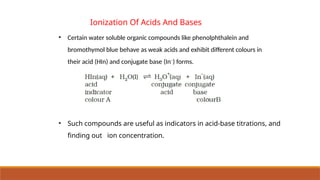
• Certain water soluble organic compounds like phenolphthalein and
bromothymol blue behave as weak acids and exhibit different colours in
their acid (HIn) and conjugate base (In–
) forms.
Ionization Of Acids And Bases
• Such compounds are useful as indicators in acid-base titrations, and
finding out ion concentration.
Ionic Product Of Water
• Water is acting both as an acid and a base.
• Self ionization of water:-In pure water, one H2O molecule donates proton and acts as an
acid and another water molecules accepts a proton and acts as a base at the same time.
• The concentration of water is
omitted from the denominator
as water is a pure liquid and its
concentration remains
constant.
• [H2O] is incorporated within the
equilibrium constant to give a
new constant, , which is called
the ionic product of water.
Continue…
Ionic Product Of Water
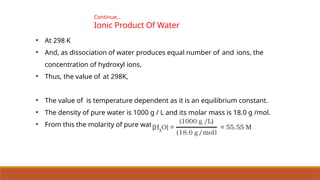
• At 298 K
• And, as dissociation of water produces equal number of and ions, the
concentration of hydroxyl ions,
• Thus, the value of at 298K,
• The value of is temperature dependent as it is an equilibrium constant.
• The density of pure water is 1000 g / L and its molar mass is 18.0 g /mol.
• From this the molarity of pure water
Continue…
Ionic Product Of Water
• The ratio of dissociated water to that of undissociated water can be given as:
•
(thus, equilibrium lies mainly towards undissociated water)
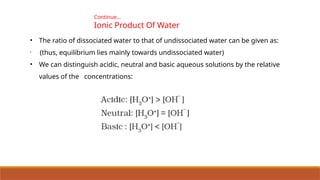
• We can distinguish acidic, neutral and basic aqueous solutions by the relative
values of the concentrations:
Class XI Chemistry
UNIT 7 EQUILIBRIUM
•The pH Scale
Topic:-
Prepared by :-Vijay Kumar Sethi
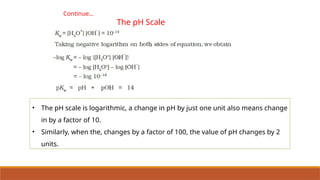
The pH Scale
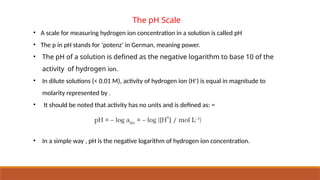
• A scale for measuring hydrogen ion concentration in a solution is called pH
• The p in pH stands for ‘potenz’ in German, meaning power.
• The pH of a solution is defined as the negative logarithm to base 10 of the
activity of hydrogen ion.
• In dilute solutions (< 0.01 M), activity of hydrogen ion (H+
) is equal in magnitude to
molarity represented by .
• It should be noted that activity has no units and is defined as: =
• In a simple way , pH is the negative logarithm of hydrogen ion concentration.
Continue…
The pH Scale
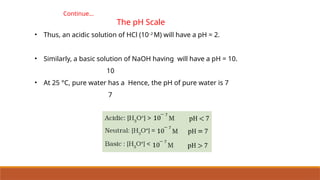
• Thus, an acidic solution of HCl (10–2
M) will have a pH = 2.
• Similarly, a basic solution of NaOH having will have a pH = 10.
10
• At 25 °C, pure water has a Hence, the pH of pure water is 7
7
Continue…
The pH Scale
• The pH scale is logarithmic, a change in pH by just one unit also means change
in by a factor of 10.
• Similarly, when the, changes by a factor of 100, the value of pH changes by 2
units.
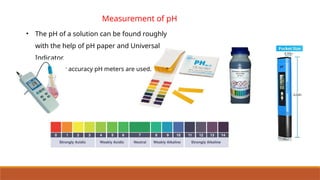
• The pH of a solution can be found roughly
with the help of pH paper and Universal
Indicator.
• For greater accuracy pH meters are used.
Measurement of pH
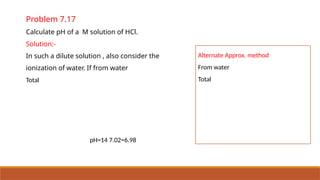
Problem 7.17
Calculate pH of a M solution of HCl.
Solution:-
In such a dilute solution , also consider the
ionization of water. If from water
Total
pH=14 7.02=6.98
Alternate Approx. method
From water
Total
Class XI Chemistry
UNIT 7 EQUILIBRIUM
Topic:-
• Ionization Constants of Weak Acids and Weak Bases
Prepared by :-Vijay Kumar Sethi
Ionization Constants of Weak Acids
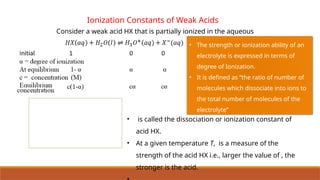
Consider a weak acid HX that is partially ionized in the aqueous
solution
• is called the dissociation or ionization constant of
acid HX.
• At a given temperature T, is a measure of the
strength of the acid HX i.e., larger the value of , the
stronger is the acid.
• The strength or ionization ability of an
electrolyte is expressed in terms of
degree of Ionization.
• It is defined as “the ratio of number of
molecules which dissociate into ions to
the total number of molecules of the
electrolyte”
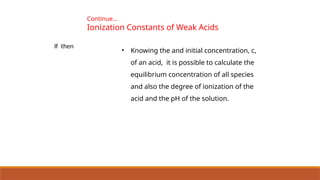
• Knowing the and initial concentration, c,
of an acid, it is possible to calculate the
equilibrium concentration of all species
and also the degree of ionization of the
acid and the pH of the solution.
If then
Continue…
Ionization Constants of Weak Acids
Ionization Constants of Weak Bases
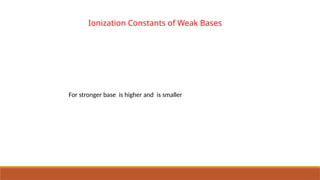
For stronger base is higher and is smaller
Class XI Chemistry
UNIT 7 EQUILIBRIUM
• Relation between and
Topics:-
Prepared by :-Vijay Kumar Sethi
Relation between and
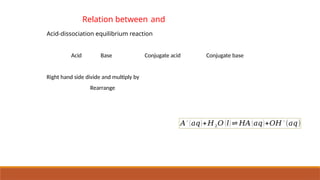
Acid-dissociation equilibrium reaction
Acid Base Conjugate acid Conjugate base
Right hand side divide and multiply by
Rearrange
𝐴−
(𝑎𝑞)+𝐻2𝑂 (𝑙) ⇌ 𝐻𝐴 (𝑎𝑞)+𝑂𝐻−
(𝑎𝑞)
Continue…
Relation between and
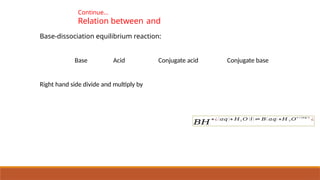
Base-dissociation equilibrium reaction:
Base Acid Conjugate acid Conjugate base
Right hand side divide and multiply by
𝐵𝐻
+¿ (𝑎𝑞 )+ 𝐻2 𝑂 (𝑙) ⇌ 𝐵( 𝑎𝑞) +𝐻 3 𝑂
+ ¿(𝑎𝑞 )¿
¿
Class XI Chemistry
UNIT 7 EQUILIBRIUM
• Numerical based on and
Topic:-
Prepared by :-Vijay Kumar Sethi
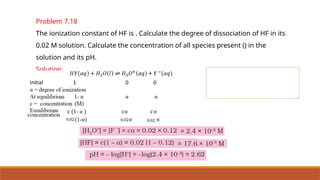
Problem 7.18
The ionization constant of HF is . Calculate the degree of dissociation of HF in its
0.02 M solution. Calculate the concentration of all species present () in the
solution and its pH.
Solution
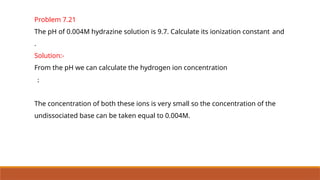
Problem 7.21
The pH of 0.004M hydrazine solution is 9.7. Calculate its ionization constant and
.
Solution:-
From the pH we can calculate the hydrogen ion concentration
;
The concentration of both these ions is very small so the concentration of the
undissociated base can be taken equal to 0.004M.
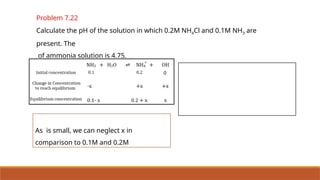
Problem 7.22
Calculate the pH of the solution in which 0.2M NH4Cl and 0.1M NH3 are
present. The
of ammonia solution is 4.75.
Solution:- ;
As is small, we can neglect x in
comparison to 0.1M and 0.2M
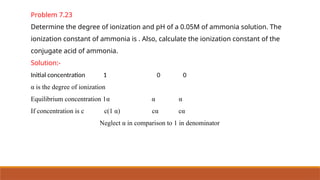
Problem 7.23
Determine the degree of ionization and pH of a 0.05M of ammonia solution. The
ionization constant of ammonia is . Also, calculate the ionization constant of the
conjugate acid of ammonia.
Solution:-
Initial concentration 1 0 0
α is the degree of ionization
Equilibrium concentration 1α α α
If concentration is c c(1 α) cα cα
Neglect α in comparison to 1 in denominator
Continue….
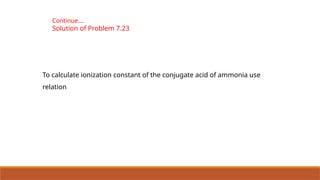
Solution of Problem 7.23
To calculate ionization constant of the conjugate acid of ammonia use
relation
Class XI Chemistry
UNIT 7
EQUILIBRIUM
Topics:-
• Di- and Polybasic Acids
• Factors Affecting Acid Strength
Prepared by :-Vijay Kumar Sethi
Di- and Polybasic Acids
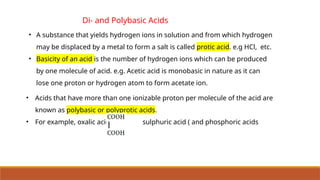
• Acids that have more than one ionizable proton per molecule of the acid are
known as polybasic or polyprotic acids.
• For example, oxalic acid, sulphuric acid ( and phosphoric acids
• A substance that yields hydrogen ions in solution and from which hydrogen
may be displaced by a metal to form a salt is called protic acid. e.g HCl, etc.
• Basicity of an acid is the number of hydrogen ions which can be produced
by one molecule of acid. e.g. Acetic acid is monobasic in nature as it can
lose one proton or hydrogen atom to form acetate ion.
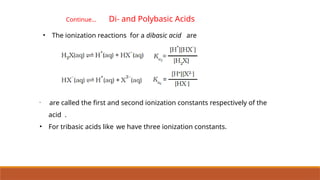
•
are called the first and second ionization constants respectively of the
acid .
• For tribasic acids like we have three ionization constants.
• The ionization reactions for a dibasic acid are
Continue… Di- and Polybasic Acids
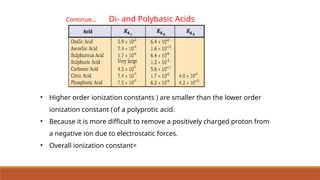
• Higher order ionization constants ) are smaller than the lower order
ionization constant (of a polyprotic acid.
• Because it is more difficult to remove a positively charged proton from
a negative ion due to electrostatic forces.
• Overall ionization constant=
Factors Affecting Acid Strength
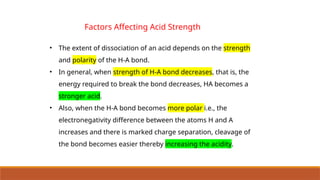
• The extent of dissociation of an acid depends on the strength
and polarity of the H-A bond.
• In general, when strength of H-A bond decreases, that is, the
energy required to break the bond decreases, HA becomes a
stronger acid.
• Also, when the H-A bond becomes more polar i.e., the
electronegativity difference between the atoms H and A
increases and there is marked charge separation, cleavage of
the bond becomes easier thereby increasing the acidity.
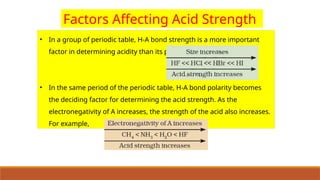
• In a group of periodic table, H-A bond strength is a more important
factor in determining acidity than its polar nature.
• In the same period of the periodic table, H-A bond polarity becomes
the deciding factor for determining the acid strength. As the
electronegativity of A increases, the strength of the acid also increases.
For example,
Factors Affecting Acid Strength
Class XI Chemistry
UNIT 7
EQUILIBRIUM
Topic:-
•Common ion effect
Prepared by :-Vijay Kumar Sethi
Common Ion Effect in the Ionization of Acids and
Bases
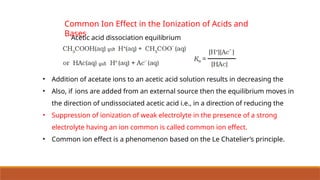
Acetic acid dissociation equilibrium
• Addition of acetate ions to an acetic acid solution results in decreasing the
• Also, if ions are added from an external source then the equilibrium moves in
the direction of undissociated acetic acid i.e., in a direction of reducing the
• Suppression of ionization of weak electrolyte in the presence of a strong
electrolyte having an ion common is called common ion effect.
• Common ion effect is a phenomenon based on the Le Chatelier’s principle.
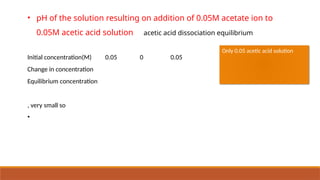
• pH of the solution resulting on addition of 0.05M acetate ion to
0.05M acetic acid solution acetic acid dissociation equilibrium
Initial concentration(M) 0.05 0 0.05
Change in concentration
Equilibrium concentration
, very small so
•
Only 0.05 acetic acid solution
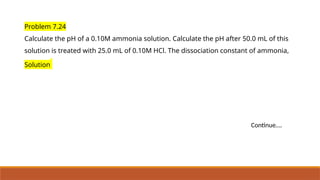
Problem 7.24
Calculate the pH of a 0.10M ammonia solution. Calculate the pH after 50.0 mL of this
solution is treated with 25.0 mL of 0.10M HCl. The dissociation constant of ammonia,
Solution
Continue….
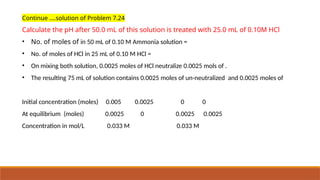
Continue ….solution of Problem 7.24
Calculate the pH after 50.0 mL of this solution is treated with 25.0 mL of 0.10M HCl
• No. of moles of in 50 mL of 0.10 M Ammonia solution =
• No. of moles of HCl in 25 mL of 0.10 M HCl =
• On mixing both solution, 0.0025 moles of HCl neutralize 0.0025 mols of .
• The resulting 75 mL of solution contains 0.0025 moles of un-neutralized and 0.0025 moles of
Initial concentration (moles) 0.005 0.0025 0 0
At equilibrium (moles) 0.0025 0 0.0025 0.0025
Concentration in mol/L 0.033 M 0.033 M
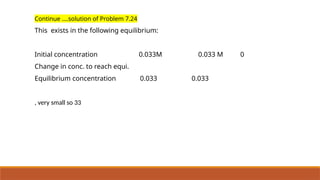
Continue ….solution of Problem 7.24
This exists in the following equilibrium:
Initial concentration 0.033M 0.033 M 0
Change in conc. to reach equi.
Equilibrium concentration 0.033 0.033
, very small so 33
Continue ….solution of Problem 7.24
When no
Class XI Chemistry
UNIT 7
EQUILIBRIUM
Topics:-
•Buffer Solution
Prepared by :-Vijay Kumar Sethi
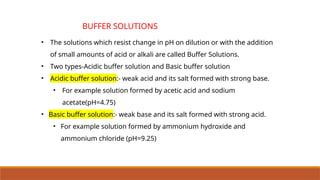
BUFFER SOLUTIONS
• The solutions which resist change in pH on dilution or with the addition
of small amounts of acid or alkali are called Buffer Solutions.
• Two types-Acidic buffer solution and Basic buffer solution
• Acidic buffer solution:- weak acid and its salt formed with strong base.
• For example solution formed by acetic acid and sodium
acetate(pH=4.75)
• Basic buffer solution:- weak base and its salt formed with strong acid.
• For example solution formed by ammonium hydroxide and
ammonium chloride (pH=9.25)
Designing Buffer Solution
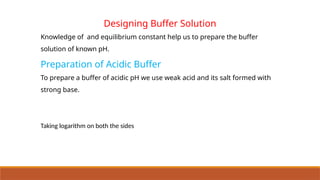
Knowledge of and equilibrium constant help us to prepare the buffer
solution of known pH.
Preparation of Acidic Buffer
To prepare a buffer of acidic pH we use weak acid and its salt formed with
strong base.
Taking logarithm on both the sides
Continue…
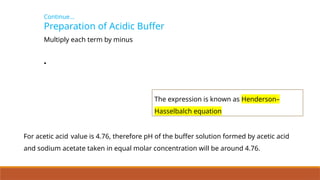
Preparation of Acidic Buffer
Multiply each term by minus
•
The expression is known as Henderson–
Hasselbalch equation
For acetic acid value is 4.76, therefore pH of the buffer solution formed by acetic acid
and sodium acetate taken in equal molar concentration will be around 4.76.
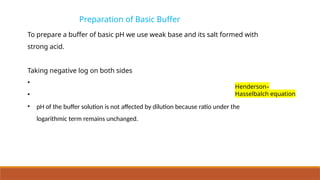
Preparation of Basic Buffer
To prepare a buffer of basic pH we use weak base and its salt formed with
strong acid.
Taking negative log on both sides
•
•
• pH of the buffer solution is not affected by dilution because ratio under the
logarithmic term remains unchanged.
Henderson–
Hasselbalch equation
Class XI Chemistry
UNIT 7
EQUILIBRIUM
Topic:-
• Hydrolysis of Salts and the pH of their
Solutions
Prepared by :-Vijay Kumar Sethi
Hydrolysis of Salts and the pH of their
Solutions
• The process of interaction between water and cations/anions or both
of salts is called hydrolysis.
• The pH of the solution gets affected by this interaction.
• The cations (e.g., of strong bases and anion (e.g. of strong acids simply
get hydrated but do not hydrolyse, and therefore the solutions of salts
formed from strong acids and bases are neutral i.e., their pH is 7.
• However, the other category of salts do undergo hydrolysis.
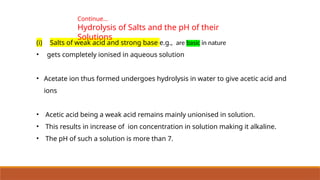
(i) Salts of weak acid and strong base e.g., are basic in nature
• gets completely ionised in aqueous solution
• Acetate ion thus formed undergoes hydrolysis in water to give acetic acid and
ions
• Acetic acid being a weak acid remains mainly unionised in solution.
• This results in increase of ion concentration in solution making it alkaline.
• The pH of such a solution is more than 7.
Continue…
Hydrolysis of Salts and the pH of their
Solutions
Continue…
Hydrolysis of Salts and the pH of their
Solutions
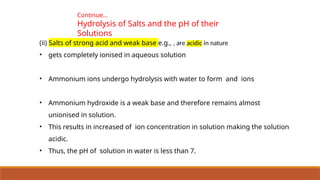
(ii) Salts of strong acid and weak base e.g., , are acidic in nature
• gets completely ionised in aqueous solution
• Ammonium ions undergo hydrolysis with water to form and ions
• Ammonium hydroxide is a weak base and therefore remains almost
unionised in solution.
• This results in increased of ion concentration in solution making the solution
acidic.
• Thus, the pH of solution in water is less than 7.
Continue… Hydrolysis of Salts and the pH of their
Solutions
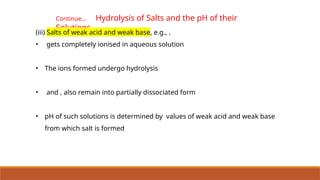
(iii) Salts of weak acid and weak base, e.g., ,
• gets completely ionised in aqueous solution
• The ions formed undergo hydrolysis
• and , also remain into partially dissociated form
• pH of such solutions is determined by values of weak acid and weak base
from which salt is formed
Problem 7.25
The of acetic acid and of ammonium hydroxide are 4.76 and 4.75
respectively. Calculate the pH of ammonium acetate solution.
Solution
Class XI Chemistry
UNIT 7 EQUILIBRIUM
Topic:-
• Solubility Product Constant
Prepared by :-Vijay Kumar Sethi
Classification Of Salts On The Basis Of Their
Solubility
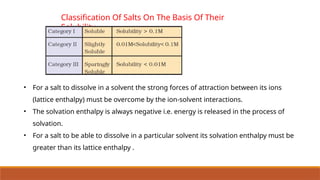
• For a salt to dissolve in a solvent the strong forces of attraction between its ions
(lattice enthalpy) must be overcome by the ion-solvent interactions.
• The solvation enthalpy is always negative i.e. energy is released in the process of
solvation.
• For a salt to be able to dissolve in a particular solvent its solvation enthalpy must be
greater than its lattice enthalpy .
Solubility Product Constant
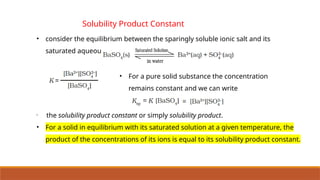
• consider the equilibrium between the sparingly soluble ionic salt and its
saturated aqueous solution.
• For a pure solid substance the concentration
remains constant and we can write
•
the solubility product constant or simply solubility product.
• For a solid in equilibrium with its saturated solution at a given temperature, the
product of the concentrations of its ions is equal to its solubility product constant.
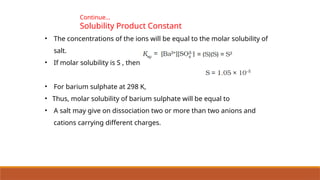
• The concentrations of the ions will be equal to the molar solubility of
salt.
• If molar solubility is S , then
• For barium sulphate at 298 K,
• Thus, molar solubility of barium sulphate will be equal to
• A salt may give on dissociation two or more than two anions and
cations carrying different charges.
Continue…
Solubility Product Constant
Continue…
Solubility Product Constant
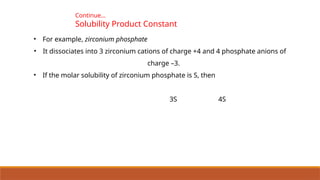
• For example, zirconium phosphate
• It dissociates into 3 zirconium cations of charge +4 and 4 phosphate anions of
charge –3.
• If the molar solubility of zirconium phosphate is S, then
3S 4S
Problem 7.26
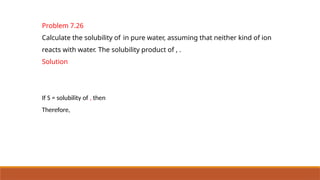
Calculate the solubility of in pure water, assuming that neither kind of ion
reacts with water. The solubility product of , .
Solution
If S = solubility of , then
Therefore,
Problem 7.27
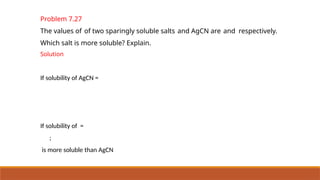
The values of of two sparingly soluble salts and AgCN are and respectively.
Which salt is more soluble? Explain.
Solution
If solubility of AgCN =
If solubility of =
;
is more soluble than AgCN

Class 11 Chapter 7 Equilibrium.pptx presentation

  • 1.
    Class XI Chemistry UNIT7 EQUILIBRIUM Topics:- • Reversible reaction • Static and Dynamic Equilibrium • Equilibrium In Physical Processes Prepared by :-Vijay Kumar Sethi
  • 2.
    Reversible reaction • Areaction which proceed in both forward and reverse directions at the same time is called reversible reaction. • In reversible reaction reactants are reacting to produce products, products are reacting to produce reactants. • In a reversible reaction a state is reached at which forward and reverse directions of the reaction occur at the same rate and this state is called State of Equilibrium. • State of equilibrium is also attained in physical processes. • Reversible reaction and state of equilibrium is represented by putting arrow between reactants and products
  • 3.
    Types of Equilibrium StaticEquilibrium Dynamic Equilibrium All the particles are at rest, and there is no motion between reactants and products Changes occur within the mixture, keeping the total composition the same Both forward and backward reactions come to a halt. The forward and backward reactions are going on with same rate. It is often applied in a mechanical context rather than chemical context. It is more often discussed within a chemical context.
  • 4.
    EQUILIBRIUM IN PHYSICALPROCESSES The most familiar examples are phase transformation processes, e.g., solid liquid liquid gas solid gas
  • 5.
    Solid-Liquid Equilibrium • Iceand water kept in a perfectly insulated thermos flask (no exchange of heat between its contents and the surroundings) at 273K and the atmospheric pressure are in equilibrium. • The mass of ice and water do not change with time and the temperature remains constant. • Because the rates of transfer of molecules from ice into water and of reverse transfer from water into ice are equal at atmospheric pressure and 273 K.
  • 6.
    Continue… Solid-Liquid Equilibrium • Iceand water are in equilibrium only at particular temperature and pressure. • For any pure substance at atmospheric pressure, the temperature at which the solid and liquid phases are at equilibrium is called the normal melting point or normal freezing point of the substance. • The system here is in dynamic equilibrium and we can infer the following: • (i) Both the opposing processes occur simultaneously. • (ii) Both the processes occur at the same rate so that the amount of ice and water remains constant.
  • 7.
    Liquid-Vapour Equilibrium • Atransparent box carrying a U-tube with mercury (manometer). • Drying agent like anhydrous calcium chloride (or phosphorus penta-oxide) is placed for a few hours in the box. • After removing the drying agent, a petri dish containing water is quickly placed inside the box. • It will be observed that the mercury level in the right limb of the manometer slowly increases and finally attains a constant value, that is, the pressure inside the box increases and reaches a constant value. • Also the volume of water in the watch glass decreases
  • 8.
    Continue… Liquid-Vapour Equilibrium • Initiallythere was no water vapour (or very less) inside the box. • As water evaporated the pressure in the box increased due to addition of water molecules into the gaseous phase inside the box. • At the same time water vapours condenses to liquid. • Finally it leads to an equilibrium condition when there is no net evaporation. • This implies that the number of water molecules from the gaseous state into the liquid state also increases till the equilibrium is attained i.e., rate of evaporation= rate of condensation
  • 9.
    Continue… Liquid-Vapour Equilibrium • Atequilibrium the pressure exerted by the water molecules at a given temperature remains constant and is called the equilibrium vapour pressure of water (or just vapour pressure of water); • Vapour pressure of water increases with temperature • Different liquids have different equilibrium vapour pressures at the same temperature, and • the liquid which has a higher vapour pressure is more volatile and has a lower boiling point. • methyl alcohol (64.7 °C), acetone (56 °C) and ether(34.6 °C)
  • 10.
    Continue… Liquid-Vapour Equilibrium • Timetaken for complete evaporation of a liquid depends on • (i) the nature of the liquid, • (ii) the amount of the liquid and • (iii) the temperature. • When the watch glass is open to the atmosphere, the rate of evaporation remains constant but the molecules are dispersed into large volume of the room. • As a consequence the rate of condensation from vapour to liquid state is much less than the rate of evaporation. • These are open systems and it is not possible to reach equilibrium in an open system.
  • 11.
    Continue… Liquid-Vapour Equilibrium • Waterand water vapour are in equilibrium position at atmospheric pressure (1.013 bar) and at 100°C in a closed vessel. • The boiling point of water is 100°C at 1.013 bar pressure. • For any pure liquid at one atmospheric pressure (1.013 bar), the temperature at which the liquid and vapours are at equilibrium is called normal boiling point of the liquid. • Boiling point at 1 bar pressure is called Standard boiling point. • 1 bar pressure is slightly less than 1 atm pressure. • The normal boiling point of water is 100 °C (373 K), its standard boiling point is 99.6 °C (372.6 K). • Boiling point of the liquid depends on the atmospheric pressure. • It depends on the altitude of the place; at high altitude the boiling point decreases.
  • 12.
    Solid – VapourEquilibrium • Systems where solids sublime to vapour phase. • When solid iodine is placed in a closed vessel, after sometime the vessel gets filled up with violet vapour and the intensity of colour increases with time. • After certain time the intensity of colour becomes constant and at this stage equilibrium is attained. • Hence solid iodine sublimes to give iodine vapour and the iodine vapour condenses to give solid iodine. • The equilibrium can be represented as, I2(solid) I2 (vapour) • Other examples Camphor (solid) Camphor (vapour) NH4Cl (solid) NH4Cl (vapour)
  • 13.
    Prepared by :-VijayKumar Sethi Topics:- Equilibrium Involving Dissolution of Solid or Gases in Liquids General Characteristics of Equilibria Involving Physical Processes UNIT 7 EQUILIBRIUM Class XI Chemistry
  • 14.
    Equilibrium Involving Dissolutionof Solid or Gases in Liquids Solids in liquids • Only a limited amount of salt or sugar can dissolve in a given amount of water at room temperature. • In a saturated solution no more of solute can be dissolved at a given temperature. • The concentration of the solute in a saturated solution depends upon the temperature. • In a saturated solution, a dynamic equilibrium exits between the solute molecules in the solid state and in the solution. Sugar (solution) Sugar (solid), and rate of dissolution of sugar = rate of crystallisation of sugar.
  • 15.
    Equilibrium Involving Dissolutionof Solid or Gases in Liquids Continue….Solids in liquids • Equality of the two rates and dynamic nature of equilibrium has been confirmed with the help of radioactive sugar. • If we drop some radioactive sugar into saturated solution of non-radioactive sugar, then after some time radioactivity is observed both in the solution and in the solid sugar • Sugar whose molecules contain radioactive isotopes of carbon, hydrogen or oxygen is called radioactive sugar • Normally sugar made out of C-14 or O-16 is known as radioactive sugar. • Normal or regular sugar molecules without any radioactive isotopes of carbon hydrogen or oxygen are called non-radioactive sugars.
  • 16.
    • Initially therewere no radioactive sugar molecules in the solution but due to dynamic nature of equilibrium, there is exchange between the radioactive and non-radioactive sugar molecules between the two phases. • The ratio of the radioactive to non-radioactive molecules in the solution increases till it attains a constant value. Equilibrium Involving Dissolution of Solid or Gases in Liquids Continue….Solids in liquids
  • 17.
    Equilibrium Involving Dissolutionof Solid or Gases in Liquids Gases in liquids • When a soda water bottle is opened, some of the carbon dioxide gas dissolved in it fizzes (सीटी; सनसनाहट) out rapidly. • The phenomenon arises due to difference in solubility of carbon dioxide at different pressures. • There is equilibrium between the molecules in the gaseous state and the molecules dissolved in the liquid under pressure i.e., CO2 (gas) CO2 (in solution)
  • 18.
    • This equilibriumis governed by Henry’s law, which states that the mass of a gas dissolved in a given mass of a solvent at any temperature is proportional to the pressure of the gas above the solvent. • This amount decreases with increase of temperature. • The soda water bottle is sealed under pressure of gas when its solubility in water is high. • As soon as the bottle is opened, some of the dissolved carbon dioxide gas escapes to reach a new equilibrium condition required for the lower pressure. • This is how the soda water in bottle when left open to the air for some time, turns ‘flat’. Equilibrium Involving Dissolution of Solid or Gases in Liquids Continue…Gases in liquids A flat soda has no bubbles.
  • 19.
    1) For solidliquid equilibrium, there is only one temperature (melting point) at 1 atm (1.013 bar) at which the two phases can coexist. Melting point is fixed at constant pressure 2) For liquid vapour equilibrium, the vapour pressure is constant at a given temperature. 3) For dissolution of solids in liquids, [Solute(s) Solute (solution)] the solubility is constant at a given temperature. 4) For dissolution of gases in liquids, [Gas(g) Gas (aq)] the concentration of a gas in liquid is proportional to the pressure (concentration) of the gas over the liquid. [gas(aq)]/[gas(g)] is constant at a given temperature Summary of Equilibrium In Physical Processes
  • 20.
    General Characteristics ofEquilibria Involving Physical Processes 1) Equilibrium is possible only in a closed system at a given temperature. 2) Both the opposing processes occur at the same rate and there is a dynamic but stable condition. 3) All measurable properties of the system remain constant. 4) When equilibrium is attained for a physical process, it is characterised by constant value of one of its parameters at a given temperature. 5) The magnitude of such quantities at any stage indicates the extent to which the physical process has proceeded before reaching equilibrium.
  • 21.
    Class XI Chemistry UNIT7 EQUILIBRIUM Topic:- • Equilibrium-In Chemical Processes Prepared by :-Vijay Kumar Sethi
  • 22.
    Equilibrium In ChemicalProcesses • Reversible chemical reactions occur both in forward and backward directions. • When the rates of the forward and reverse reactions become equal, the concentrations of the reactants and the products remain constant. • This is the stage of chemical equilibrium. • This equilibrium is dynamic in nature as both opposite reactions are continuously going on. • General case of a reversible reaction, A + B C + D • With passage of time, there is formation of the products C and D and depletion of the reactants A and B . • This leads to a decrease in the rate of forward reaction and an increase in the rate of the reverse reaction.
  • 23.
    Continue… Equilibrium In ChemicalProcesses • Eventually, the two reactions occur at the same rate and the system reaches a state of equilibrium. • Similarly, the reaction can reach the state of equilibrium even if we start with only C and D; that is, no A and B being present initially, as the equilibrium can be reached from either direction.
  • 24.
    Dynamic Nature OfChemical Equilibrium • synthesis of ammonia by Haber’s process fin the presence of catalyst at moderate temperature and high pressure • Initially concentrations of decrease and that of increases. • After a certain time the composition of the mixture remains the same even though some of the reactants are still present. • This constancy in composition indicates that the reaction has reached equilibrium. • At equilibrium present
  • 25.
    • Now samereaction is carried out in same conditions of T and P using D2 (deuterium) in place of H2. • The reaction mixtures starting either with H2 or D2 reach equilibrium with the same composition, except that D2 and ND3are present instead of H2 and NH3. • After equilibrium is attained, these two mixtures (H2, N2, NH3 and D2, N2, ND3) are mixed together and left for a while to achieve new equilibrium. • Presence of (NH3, NH2D, NHD2 and ND3) and dihydrogen and its deuterated forms (H2, HD and D2) indicates that equilibrium is dynamic in nature Continue… Dynamic Nature Of Chemical Equilibrium
  • 26.
    Equilibrium can beAttained from Both Sides • H2(g) + I2(g) 2HI(g). • If we start with equal initial concentration of H2 and I2, the reaction proceeds in the forward direction and the concentration of H2 and I2 decreases while that of HI increases, until all of these become constant at equilibrium . • We can also start with HI alone and make the reaction to proceed in the reverse direction; the concentration of HI will decrease and concentration of H2 and I2 will increase until they all become constant when equilibrium is reached
  • 27.
    Class XI Chemistry UNIT7 EQUILIBRIUM Topics:- • Law Of Mass Action • Equilibrium Equation • Equilibrium constant • Law of Chemical Equilibrium Prepared by :-Vijay Kumar Sethi
  • 28.
    Law Of MassAction • Proposed by Guldberg and Waage so also known as Guldberg - Waage Law • Rate of a chemical reaction is directly proportional to the product of the concentrations of the reactants Rate of forward reaction, Rate of reverse reaction, At equilibrium, In the early days of chemistry, concentration was called “active mass”. [A], [B], [C] and [D] are the equilibrium concentrations of the reactants and products
  • 29.
    Equilibrium Equation, This expressionis known as Equilibrium Equation • is the equilibrium constant and • the expression on the right side is called the equilibrium constant expression. • The equilibrium equation is also known as the law of mass action • The subscript ‘c’ in indicates that concentrations of reactants and products are taken in . • If concentrations are taken in terms of partial pressure (if gases are involved), equilibrium constant is expressed as K p =¿ ¿ ¿
  • 30.
    Equilibrium Law orLaw of Chemical Equilibrium • At a given temperature, the product of concentrations of the reaction products raised to the respective stoichiometric coefficient in the balanced chemical equation divided by the product of concentrations of the reactants raised to their individual stoichiometric coefficients has a constant value. This is known as the Equilibrium Law or Law of Chemical Equilibrium. • Equilibrium constant for the reaction K c = [ C ]c [ D ]d [ A ] a [ B ] b • While writing expression for equilibrium constant, symbol for phases (s, l, g, aq) are generally ignored.
  • 31.
    • Equilibrium constantfor the reaction, • The equilibrium constant for the reverse reaction,, at the same temperature is, • Equilibrium constant for the reverse reaction is the inverse of the equilibrium constant for the reaction in the forward direction.
  • 32.
    • If wechange the stoichiometric coefficients in a chemical equation by multiplying throughout by a factor then Therefore, equilibrium constant for the reaction is equal to
  • 33.
    Problem 7.1 The followingconcentrations were obtained for the formation of NH3 from N2 and H2 at equilibrium at 500K. [N2] = 1.5 × 10⁻² M [H2] = 3.0 ×10⁻² M and [NH3] = 1.2 ×10⁻² M. Calculate equilibrium constant. Solution:-
  • 34.
    Problem 7.2 At equilibrium,the concentrations of N2=3.0 × 10⁻³ M, O2 = 4.2 × 10⁻³ M and NO= 2.8 × 10⁻³ M in a sealed vessel at 800K. What will be Kc for the reaction N2(g) + O2(g) 2NO(g) Solution
  • 35.
    Class XI Chemistry UNIT7 EQUILIBRIUM Topics:- • Homogeneous and Heterogeneous Equilibria Prepared by :-Vijay Kumar Sethi
  • 36.
    HOMOGENEOUS EQUILIBRIA • Ina homogeneous system, all the reactants and products are in the same phase. Equilibrium Constant in Gaseous Systems • For reactions involving gases, it is usually more convenient to express the equilibrium constant in terms of partial pressure. • And equilibrium constant is represented as
  • 37.
    HETEROGENEOUS EQUILIBRIA • Equilibriumin a system having more than one phase is called heterogeneous equilibrium. • Heterogeneous equilibria often involve pure solids or liquids. • Molar concentration of a pure solid or liquid is constant (i.e., independent of the amount present). • In other words if a substance ‘X’ is involved, then [X(s)] and [X(l)] are constant, whatever the amount of ‘X’ is taken. • While [X(g)] and [X(aq)] will vary as the amount of X in a given volume varies.
  • 38.
    HETEROGENEOUS EQUILIBRIA • thermaldissociation of calcium carbonate • On the basis of the stoichiometric equation, we can write, • Since [CaCO3(s)] and [CaO(s)] are both constant, For the existence of heterogeneous equilibrium pure solids or liquids must also be present at equilibrium, but their concentrations or partial pressures do not appear in the expression of the equilibrium constant.
  • 39.
    Class XI Chemistry UNIT7 EQUILIBRIUM Topics:- • Relation between and • Units of and Prepared by :-Vijay Kumar Sethi
  • 40.
    Relation between and aA+bB⇌cC+dD Kc = [ C ]c [ D ]d [ A ] a [ B ] b K p =¿¿ ¿ pV = nRT where Dn = (number of moles of gaseous products) – (number of moles of gaseous reactants) in the balanced chemical equation.
  • 41.
    Continue... Relation between and H2(g)+ I2(g) 2HI(g) Dn =2 – 2=0 Dn =2 – 4 = – 2 2NOCl(g) 2NO(g) + Cl2(g) Dn =3 – 2 = 1 Problem 7.3 PCl5, PCl3 and Cl2 are at equilibrium at 500 K and having concentration 1.59M PCl3, 1.59M Cl2 and 1.41 M PCl5. Calculate equilibrium constant for the reaction Solution:-
  • 42.
    Problem 7.5 For theequilibrium, 2NOCl(g) 2NO(g) + Cl2(g) the value of the equilibrium constant, is 3.75 × 10⁻⁶ at 1069 K. Calculate the for the reaction at this temperature? Solution:- Dn = (2+1) – 2 = 1 = 3.75 ×10⁻⁶ (0.0831 × 1069) = 0.033
  • 43.
    Units of EquilibriumConstant • Units of equilibrium constant are based on molarity or pressure. • For the concentration terms in mol/L and for partial pressure is substituted in Pa, kPa, bar or atm. • If the exponents of both the numerator and denominator are same, equilibrium constant has no units. • For example, • , have no unit. • , has unit mol/L and has unit bar
  • 44.
    Continue… Units of EquilibriumConstant • Equilibrium constants can also be expressed as dimensionless quantities if the standard state of reactants and products are specified. • For a pure gas, the standard state is 1bar. • Therefore a pressure of 4 bar in standard state can be expressed as 4 bar/1 bar = 4, which is a dimensionless number. • Standard state for a solute is 1 molar solution and all concentrations can be measured with respect to it. • Thus, in this system both are dimensionless quantities
  • 45.
    Class XI Chemistry UNIT7 EQUILIBRIUM Topics:- • Important Features Of Equilibrium Constant • Applications Of Equilibrium Constants Prepared by :-Vijay Kumar Sethi
  • 46.
    Important Features OfEquilibrium Constant 1) Expression for equilibrium constant is applicable only when concentrations of the reactants and products have attained constant value at equilibrium state. 2) The value of equilibrium constant is independent of initial concentrations of the reactants and products. 3) Equilibrium constant is temperature dependent having one unique value for a particular reaction represented by a balanced equation at a given temperature. 4) The equilibrium constant for the reverse reaction is equal to the inverse of the equilibrium constant for the forward reaction. 5) If equation is multiplied by the factor n, the equilibrium constant is related to the equilibrium constant of original reaction, by the relation .
  • 47.
    Applications Of EquilibriumConstants • To: • predict the extent of a reaction on the basis of its magnitude, • predict the direction of the reaction, and • calculate equilibrium concentrations. Predicting the Extent of a Reaction • The magnitude of or is directly proportional to the concentrations of products (as these appear in the numerator of equilibrium constant expression) and inversely proportional to the concentrations of the reactants (these appear in the denominator). • This means that a high value of K is suggestive of a high concentration of products and vice-versa.
  • 48.
    Continue… Predicting the Extentof a Reaction • If Kc > 103 , products predominate over reactants, i.e., if Kc is very large, the reaction proceeds nearly to completion. E.g. H2(g) + Cl2(g) 2HCl(g) at 300K has Kc = 4.0 × 1031 . • If Kc < 10–3 , reactants predominate over products, i.e., if Kc is very small, the reaction proceeds rarely. E.g. N2(g) + O2(g) 2NO(g), at 298 K has Kc = 4.8 ×10⁻³¹ . • If Kc is in the range of 10–3 to 103 , appreciable concentrations of both reactants and products are present. For reaction of H2 with I2 to give HI, Kc = 57.0 at 700K.
  • 49.
    Predicting the Directionof the Reaction • The reaction quotient, Q (Qc with molar concentrations and QP with partial pressures) is defined in the same way as the equilibrium constant Kc except that the concentrations in Qc are not necessarily equilibrium values • If Qc > Kc, the reaction will proceed in the direction of reactants (reverse reaction). • If Qc < Kc, the reaction will proceed in the direction of the products (forward reaction). • If Qc = Kc, the reaction mixture is already at equilibrium.
  • 50.
    Continue… Predicting the Directionof the Reaction • The reaction quotient, Qc is useful in predicting the direction of reaction by comparing the values of Qc and Kc.  If Qc < Kc , net reaction goes from left to right  If Qc > Kc , net reaction goes from right to left.  If Qc = Kc , no net reaction occurs.
  • 51.
    Problem 7.7 The valueof Kc for the reaction 2A B + C is 2 × 10⁻³ . At a given time, the composition of reaction mixture is [A] = [B] = [C] = 3 × 10⁻⁴ M. In which direction the reaction will proceed? Solution:- For the reaction the reaction quotient Qc is given by, as [A] = [B] = [C] = 3 × 10⁻⁴ M as Qc > Kc so the reaction will proceed in the reverse direction.
  • 52.
    Calculating Equilibrium Concentrations Step1. Write the balanced equation for the reaction. Step 2. Under the balanced equation, make a table that lists for each substance involved in the reaction: (a) the initial concentration, (b) the change in concentration on going to equilibrium, and (c) the equilibrium concentration. Take x as the concentration (mol/L) of one of the substances that reacts on going to equilibrium, then use the stoichiometry of the reaction to determine the concentrations of the other substances in terms of x. Step 3. Substitute the equilibrium concentrations into the equilibrium equation for the reaction and solve for x. Step 4. Calculate the equilibrium concentrations from the calculated value of x.
  • 53.
    Problem 7.9 3.00 molof PCl5 kept in 1L closed reaction vessel was allowed to attain equilibrium at 380K. Calculate composition of the mixture at equilibrium. Kc= 1.80 Solution:- Step 1: PCl5 PCl3 + Cl2 Step 2: Initial concentration : 3.0 0 0 Let x mol per litre of PCl5 be dissociated At equilibrium: (3 – x) x x Step 3: x =1.59 Step 4: x2 + 1.8x – 5.4 = 0 x = [–1.8 ± Ö(1.8)2 – 4(–5.4)]/2 x = [–1.8 ± Ö3.24 + 21.6]/2 x = [–1.8 ± 4.98]/2 x = [–1.8 + 4.98]/2 = 1.59
  • 54.
    Class XI Chemistry UNIT7 EQUILIBRIUM Topics:- • Relationship Between Equilibrium Constant K, Reaction Quotient Q And Gibbs Energy G Prepared by :-Vijay Kumar Sethi
  • 55.
    RELATIONSHIP BETWEEN EQUILIBRIUMCONSTANT K, REACTION QUOTIENT Q AND GIBBS ENERGY G • If is positive and Reaction is spontaneous in forward direction and products are present predominantly. • If is negative and Reaction is non-spontaneous in forward direction and only a very minute quantity of product is formed.
  • 56.
    Problem 7.10 The valueof DGƟ for the phosphorylation of glucose in glycolysis is 13.8 kJ/mol. Find the value of Kc at 298 K. Solution DGƟ = – 2.303 RT log Kc DGƟ = 13.8 kJ/mol = 13.8 × 10³ J/mol R=8.314 T=298 K ?
  • 57.
    Problem 7.11 Hydrolysis ofsucrose gives, Sucrose + H2O Glucose + Fructose Equilibrium constant Kc for the reaction is 2 ×10¹³ at 300K. Calculate DGƟ at 300K. Solution DGƟ = – 2.303 RT log Kc K= 2 × 10¹³ R=8.314 T=300 K DGƟ = – 2.303 x 8.314 x 300 x log (2 × 10¹³ ) DGƟ = – 2.303 x 8.314 x 300 x 13.3010= – 76402.8 DGƟ = – 7.64 x 10⁴ log (2 × 10¹³ )=log2 +log1013 =log 2 +13 log 10 = 0.3010 + 13 x 1=13.3010
  • 58.
    log 2467= 3.3909+0.0012=3.3921 log 382.4 = 2.5821 + 0.0005=2.5826 log 55.2 =1.7419 log 2.03=0.3075 log 0.02453=log(2.453 log 5 = log 5.000 = 0.6990 log 0.2 = log (2
  • 59.
    Anti-log table antilog 5.2345=1.716 antilog 15.5932 = antilog 15 =antilog 15.000=1.000
  • 60.
    Class XI Chemistry UNIT7 EQUILIBRIUM Topics:- • Factors Affecting Equilibria • Le Chatelier’s principle • Effect of Concentration and Pressure Change Prepared by :-Vijay Kumar Sethi
  • 61.
    Factors Affecting Equilibria 1.Concentration 2. Temperature 3. Pressure 4. Catalyst Le Chatelier’s principle. • It states that a change in any of the factors(Concentration, temperature or pressure) that determine the equilibrium conditions of a system will cause the system to change in such a manner so as to reduce or to counteract the effect of the change
  • 62.
    Effect of ConcentrationChange • “When the concentration of any of the reactants or products in a reaction at equilibrium is changed, the composition of the equilibrium mixture changes so as to minimize the effect of concentration changes”. • H2(g) + I2(g) 2HI(g) • If H2 is added to the reaction mixture at equilibrium, then the equilibrium of the reaction is disturbed. • In order to restore it, the reaction proceeds in a direction wherein H2 is consumed, i.e., more of H2 and I2 react to form HI and finally the equilibrium shifts in right (forward) direction
  • 63.
    Continue… Effect of ConcentrationChange • The same point can be explained in terms of the reaction quotient, Qc, • H2(g) + I2(g) 2HI(g) • Addition of hydrogen at equilibrium results in value of Qc being less than Kc . • Thus, in order to attain equilibrium again reaction moves in the forward direction. • Removal of a product also boosts the forward reaction and increases the concentration of the products • In case of manufacture of ammonia, N2(g) + 3H2(g) 2NH3(g) • ammonia is liquified and removed from the reaction mixture so that reaction keeps moving in forward direction.
  • 64.
    Continue… Effect of ConcentrationChange • In the large scale production of CaO (used as important building material) from CaCO3, • CaCO3(s) Cao(s) + CO2(g) • constant removal of CO2 from the kiln (furnace भट्ठी), drives the reaction to completion.
  • 65.
    • The equilibriumcan be shifted in the opposite direction by adding reagents that remove Fe3+ or SCNions. • For example, oxalic acid (H2C2O4), reacts with Fe3+ ions to form the stable complex ion [Fe(C2O4)3]3– , thus decreasing the concentration of free Fe3+ (aq). • So [Fe(SCN)]2+ dissociates to give Fe3+ • Because the concentration of [Fe(SCN)]2+ decreases, the intensity of red colour decreases. Continue… Effect of Concentration Change
  • 66.
    Continue… Effect of ConcentrationChange • Addition of aq. HgCl2 also decreases red colour because Hg2+ reacts with SCNions to form stable complex ion [Hg(SCN)4]2– . • Removal of free SCN(aq) shifts the equilibrium from right to left to replenish SCNions. • Addition of potassium thiocyanate increases the colour intensity of the solution as it shift the equilibrium to right.
  • 67.
    Effect of PressureChange • Effect of pressure changes on solids and liquids can be ignored because the volume (and concentration) of a solution/liquid is nearly independent of pressure. • Effect of pressure change is observed where gases are involved and total number of moles of gaseous reactants and total number of moles of gaseous products are different. • For example CO(g) + 3H2(g CH4(g) + H2O(g) • Here, 4 mol of gaseous reactants (CO + 3H2) become 2 mol of gaseous products (CH4 + H2O). • When pressure is increased, number of gaseous moles increase per unit volume so the reaction goes in the forward direction because the number of moles of gas decreases in the forward direction.
  • 68.
    • On increasingtotal pressure the partial pressure and the concentrations are increased. • As Qc < Kc , the reaction proceeds in the forward direction. • In reaction C(s) + CO2(g) 2CO(g), when pressure is increased, the reaction goes in the reverse direction because the number of moles of gas increases in the forward direction. • Generalization:- On increasing pressure , reaction will go in that direction where number of moles of gas are less. Effect of Pressure Change
  • 69.
    Class XI Chemistry UNIT7 EQUILIBRIUM Topics:- • Factors Affecting Equilibria :-Effect of • Inert Gas Addition • Temperature Change • A Catalyst Prepared by :-Vijay Kumar Sethi
  • 70.
    Effect of InertGas Addition • If the volume is kept constant and an inert gas such as argon is added which does not take part in the reaction, the equilibrium remains undisturbed. • It is because the addition of an inert gas at constant volume does not change the partial pressures or the molar concentrations of the substance involved in the reaction. • The reaction quotient changes only if the added gas is a reactant or product involved in the reaction.
  • 71.
    Effect of TemperatureChange • Whenever an equilibrium is disturbed by a change in the concentration, pressure or volume, the composition of the equilibrium mixture changes because the reaction quotient, Qc no longer equals the equilibrium constant, Kc. • When a change in temperature occurs, the value of equilibrium constant, Kc is changed. • The equilibrium constant for an exothermic reaction (negative DH) decreases as the temperature increases. • The equilibrium constant for an endothermic reaction (positive DH) increases as the temperature increases. • Temperature changes affect the equilibrium constant and rates of reactions.
  • 72.
    Continue… Effect of TemperatureChange • N2(g) + 3H2(g) 2NH3(g) ; DH= – 92.38 kJ mol–1 • It is an exothermic process. (Endothermic in reverse direction) • According to Le Chatelier’s principle, increasing the temperature shifts the equilibrium to left and decreases the equilibrium concentration of ammonia. • In other words, low temperature is favourable for high yield of ammonia, but practically very low temperatures slow down the reaction so moderate temperature and a catalyst is used. High pressure favours the formation of ammonia as number of gaseous moles are less in product side
  • 73.
    Continue… Effect of TemperatureChange • Effect of temperature on equilibrium can be demonstrated by taking NO2 gas (reddish brown in colour) which dimerises into N2O4 gas (colourless). • At low temperatures formation of N2O4 is preferred, • High temperature favour the formation of NO2
  • 74.
    Continue… Effect of TemperatureChange • Effect of temperature can also be seen in an endothermic reaction, • At room temperature, the equilibrium mixture is blue due to [CoCl4]2– . • When cooled in a freezing mixture, the colour of the mixture turns pink due to [Co(H2O)6]3+ .
  • 75.
    Effect of aCatalyst • A catalyst is a substance which increases the rate of a reaction without itself undergoing any permanent chemical change. • It increases the rate of forward and reverse reactions that pass through the same transition state and does not affect equilibrium. • Catalyst lowers the activation energy for the forward and reverse reactions by exactly the same amount. • Catalyst does not affect the equilibrium composition of a reaction mixture. • It does not appear in the balanced chemical equation or in the equilibrium constant
  • 76.
    Continue… Effect of aCatalyst Haber Process of manufacture of ammonia • In accordance with Le Chatelier’s principle the optimum conditions for the production of NH3 are • a pressure of about 200 atm (high pressure), • a temperature of ~ 700 K (moderate)and • the use of a catalyst such as iron • Similarly, in manufacture of sulphuric acid by contact process, • 2SO2(g) + O2(g) 2SO3(g); Kc = 1.7 × 1026 though the value of K is suggestive of reaction going to completion, but practically the reaction is very slow. • Thus, platinum or divanadium penta-oxide (V2O5) is used as catalyst to increase the rate of the reaction.
  • 77.
    Class XI Chemistry UNIT7 EQUILIBRIUM Topics:- • Ionic Equilibrium In Solution • Arrhenius Concept of Acids and Bases Prepared by :-Vijay Kumar Sethi
  • 78.
    Ionic Equilibrium InSolution • Equilibrium involving ions in aqueous solution is called ionic equilibrium. • Michael Faraday classified the substances into two categories based on their ability to conduct electricity. • (1) Electrolytes:-substances that conduct electricity in their aqueous solutions • (2) Non-electrolytes :- substances that do not conduct electricity in their aqueous solutions • Faraday further classified electrolytes into strong and weak electrolytes. • Strong electrolytes on dissolution in water dissociate almost completely into ions for example sodium chloride , while the weak electrolytes only partially ionize into ions for example acetic acid.
  • 79.
    • In weakelectrolytes, equilibrium is established between ions and the unionized molecules. • Acids, bases and salts come under the category of electrolytes and may act as either strong or weak electrolytes. • Dissociation refers to the process of separation of ions in water already existing as such in the solid state of the solute, as in sodium chloride. • On the other hand, ionization corresponds to a process in which a neutral molecule splits into charged ions in the solution. • Here, we shall not distinguish between the two and use the two terms interchangeably.
  • 80.
    Acids, Bases AndSalts Acids:- • Hydrochloric acid present in the gastric juice is secreted by the lining of our stomach in a significant amount of 1.2-1.5 L/day and is essential for digestive processes. • Acetic acid is known to be the main constituent of vinegar. • Lemon and orange juices contain citric and ascorbic acids, and tartaric acid is found in tamarind paste. • As most of the acids taste sour, the word “acid” has been derived from a latin word “acidus” meaning sour. • Acids are known to turn blue litmus paper into red and liberate dihydrogen on reacting with some metals
  • 81.
    Bases:- • Bases areknown to turn red litmus paper blue, taste bitter and feel soapy. • A common example of a base is washing soda used for washing purposes. Salts:- • When acids and bases are mixed in the right proportion they react with each other to give salts. • Some commonly known examples of salts are sodium chloride, barium sulphate, sodium nitrate. • Sodium chloride (common salt, NaCl ) is an important component of our diet and is formed by reaction between hydrochloric acid and sodium hydroxide.
  • 82.
    • NaCl existsin solid state as a cluster of positively charged and negatively charged chloride ions which are held together due to electrostatic interactions between oppositely charged species . • The electrostatic forces between two charges are inversely proportional to dielectric constant of the medium. • Water, a universal solvent, possesses a very high dielectric constant of 80. Dissolution of Sodium Chloride in Water • Thus, when NaCl is dissolved in water, the electrostatic interactions are reduced by a factor of 80 and this facilitates the ions to move freely in the solution. • Also, they are well separated due to hydration with water molecules.
  • 83.
    Arrhenius Concept ofAcids and Bases • According to Arrhenius theory, • acids are substances that dissociates in water to give hydrogen ions and • bases are substances that produce hydroxyl ions in water . • A bare proton, is very reactive and cannot exist freely in aqueous solutions. • Thus, it bonds to the oxygen atom of a solvent water molecule to give trigonal pyramidal hydronium ion, • The hydroxyl ion also exists in the hydrated form in the aqueous solution Limitation:- • Applicable only to aqueous solutions • Does not account for the basicity of substances like, ammonia which do not possess a hydroxyl group.
  • 84.
    Class XI Chemistry UNIT7 EQUILIBRIUM Topics:- • The Brönsted-Lowry Acids and Bases • Lewis Acids and Bases Prepared by :-Vijay Kumar Sethi
  • 85.
    The Brönsted-Lowry Acidsand Bases • According to Brönsted-Lowry theory, • Acid is a substance that is capable of donating a hydrogen ion and • Bases are substances capable of accepting a hydrogen ion, . • In short, acids are proton donors and bases are proton acceptors. In this reaction, water molecule acts as proton donor and ammonia molecule acts as proton acceptor and are thus, called Lowry-Brönsted acid and base, respectively. In the reverse reaction, is transferred from to . In this case, acts as a Bronsted acid while acted as a Brönsted base.
  • 86.
    The Brönsted-Lowry Acidsand Bases • The acid-base pair that differs only by one proton is called a conjugate acid-base pair. • Therefore, is called the conjugate base of an acid and is called conjugate acid of the base . • If Brönsted acid is a strong acid then its conjugate base is a weak base and viceversa. • Ionization of hydrochloric acid in water. HCl(aq) acts as an acid by donating a proton to molecule which acts as a base.
  • 87.
    Dual Role OfWater As An Acid And A Base. • In case of reaction with HCl water acts as a base while in case of ammonia it acts as an acid by donating a proton. • Water is amphoteric in nature Problem 7.12 What will be the conjugate bases for the following Brönsted acids: HF, and ? Solution Brönsted acids conjugate bases HF The conjugate bases should have one proton less
  • 88.
    Problem 7.13 Write theconjugate acids for the following Brönsted bases: . Solution The conjugate acid should have one extra proton Brönsted bases conjugate acids Problem 7.14 The species: can act both as Bronsted acids and bases. For each case give the corresponding conjugate acid and conjugate base.
  • 89.
    Lewis Acids andBases • Acid is a species which accepts electron pair . • Base is a species which donates an electron pair. • For example , is an acid and reacts with by accepting its lone pair of electrons. • Electron deficient species like etc. can act as Lewis acids while species like etc. which can donate a pair of electrons, can act as Lewis bases.
  • 90.
    Problem 7.15 Classify thefollowing species into Lewis acids and Lewis bases and show how these act as such: (a) (b)(c) (d) Solution (a) Hydroxyl ion is a Lewis base as it can donate an electron lone pair (. (b) Flouride ion acts as a Lewis base as it can donate any one of its four electron lone pairs. (c) A proton is a Lewis acid as it can accept a lone pair of electrons from bases like hydroxyl ion and fluoride ion. (d) acts as a Lewis acid as it can accept a lone pair of electrons from species like ammonia or amine molecules.
  • 91.
    Class XI Chemistry UNIT7 EQUILIBRIUM Topics:- • Ionization Of Acids And Bases • Ionic Product Of Water Prepared by :-Vijay Kumar Sethi
  • 92.
    Ionization Of AcidsAnd Bases • Strong acids like perchloric acid (HClO4), hydrochloric acid (HCl), hydrobromic acid (HBr), hyrdoiodic acid (HI), nitric acid (HNO3) and sulphuric acid (H2SO4) are termed strong because they are almost completely dissociated into their constituent ions in an aqueous medium, thereby acting as proton (H+ ) donors. • strong bases like lithium hydroxide (LiOH), sodium hydroxide (NaOH), potassium hydroxide (KOH), caesium hydroxide (CsOH) and barium hydroxide Ba(OH)2 are almost completely dissociated into ions in an aqueous medium giving hydroxyl ions, . • According to Arrhenius concept they are strong acids and bases as they are able to completely dissociate and produce and ions respectively in the medium.
  • 93.
    • In termsof Brönsted- Lowry concept of acids and bases, strong acid means a good proton donor and a strong base implies a good proton acceptor. • A strong acid dissociates completely in water, the resulting base formed would be very weak i.e., strong acids have very weak conjugate bases. Strong acids (Good proton donor) conjugate base (much weaker bases than H2O.) Perchloric acid (HClO4) Hydrochloric acid (HCl) Hydrobromic acid (HBr) Hydroiodic acid (HI) Nitric acid (HNO3) Sulphuric acid (H2SO4) Ionization Of Acids And Bases
  • 94.
    • A verystrong base would give a very weak conjugate acid. • On the other hand, a weak acid say HA is only partially dissociated in aqueous medium and thus, the solution mainly contains undissociated HA molecules. • Typical weak acids are nitrous acid (HNO2), hydrofluoric acid (HF) and acetic acid (CH3COOH). • It should be noted that the weak acids have very strong conjugate bases. • For example, are very good proton acceptors and thus, much stronger bases than . Ionization Of Acids And Bases
  • 95.
    • Certain watersoluble organic compounds like phenolphthalein and bromothymol blue behave as weak acids and exhibit different colours in their acid (HIn) and conjugate base (In– ) forms. Ionization Of Acids And Bases • Such compounds are useful as indicators in acid-base titrations, and finding out ion concentration.
  • 96.
    Ionic Product OfWater • Water is acting both as an acid and a base. • Self ionization of water:-In pure water, one H2O molecule donates proton and acts as an acid and another water molecules accepts a proton and acts as a base at the same time. • The concentration of water is omitted from the denominator as water is a pure liquid and its concentration remains constant. • [H2O] is incorporated within the equilibrium constant to give a new constant, , which is called the ionic product of water.
  • 97.
    Continue… Ionic Product OfWater • At 298 K • And, as dissociation of water produces equal number of and ions, the concentration of hydroxyl ions, • Thus, the value of at 298K, • The value of is temperature dependent as it is an equilibrium constant. • The density of pure water is 1000 g / L and its molar mass is 18.0 g /mol. • From this the molarity of pure water
  • 98.
    Continue… Ionic Product OfWater • The ratio of dissociated water to that of undissociated water can be given as: • (thus, equilibrium lies mainly towards undissociated water) • We can distinguish acidic, neutral and basic aqueous solutions by the relative values of the concentrations:
  • 99.
    Class XI Chemistry UNIT7 EQUILIBRIUM •The pH Scale Topic:- Prepared by :-Vijay Kumar Sethi
  • 100.
    The pH Scale •A scale for measuring hydrogen ion concentration in a solution is called pH • The p in pH stands for ‘potenz’ in German, meaning power. • The pH of a solution is defined as the negative logarithm to base 10 of the activity of hydrogen ion. • In dilute solutions (< 0.01 M), activity of hydrogen ion (H+ ) is equal in magnitude to molarity represented by . • It should be noted that activity has no units and is defined as: = • In a simple way , pH is the negative logarithm of hydrogen ion concentration.
  • 101.
    Continue… The pH Scale •Thus, an acidic solution of HCl (10–2 M) will have a pH = 2. • Similarly, a basic solution of NaOH having will have a pH = 10. 10 • At 25 °C, pure water has a Hence, the pH of pure water is 7 7
  • 102.
    Continue… The pH Scale •The pH scale is logarithmic, a change in pH by just one unit also means change in by a factor of 10. • Similarly, when the, changes by a factor of 100, the value of pH changes by 2 units.
  • 103.
    • The pHof a solution can be found roughly with the help of pH paper and Universal Indicator. • For greater accuracy pH meters are used. Measurement of pH
  • 105.
    Problem 7.17 Calculate pHof a M solution of HCl. Solution:- In such a dilute solution , also consider the ionization of water. If from water Total pH=14 7.02=6.98 Alternate Approx. method From water Total
  • 106.
    Class XI Chemistry UNIT7 EQUILIBRIUM Topic:- • Ionization Constants of Weak Acids and Weak Bases Prepared by :-Vijay Kumar Sethi
  • 107.
    Ionization Constants ofWeak Acids Consider a weak acid HX that is partially ionized in the aqueous solution • is called the dissociation or ionization constant of acid HX. • At a given temperature T, is a measure of the strength of the acid HX i.e., larger the value of , the stronger is the acid. • The strength or ionization ability of an electrolyte is expressed in terms of degree of Ionization. • It is defined as “the ratio of number of molecules which dissociate into ions to the total number of molecules of the electrolyte”
  • 108.
    • Knowing theand initial concentration, c, of an acid, it is possible to calculate the equilibrium concentration of all species and also the degree of ionization of the acid and the pH of the solution. If then Continue… Ionization Constants of Weak Acids
  • 109.
    Ionization Constants ofWeak Bases For stronger base is higher and is smaller
  • 110.
    Class XI Chemistry UNIT7 EQUILIBRIUM • Relation between and Topics:- Prepared by :-Vijay Kumar Sethi
  • 111.
    Relation between and Acid-dissociationequilibrium reaction Acid Base Conjugate acid Conjugate base Right hand side divide and multiply by Rearrange 𝐴− (𝑎𝑞)+𝐻2𝑂 (𝑙) ⇌ 𝐻𝐴 (𝑎𝑞)+𝑂𝐻− (𝑎𝑞)
  • 112.
    Continue… Relation between and Base-dissociationequilibrium reaction: Base Acid Conjugate acid Conjugate base Right hand side divide and multiply by 𝐵𝐻 +¿ (𝑎𝑞 )+ 𝐻2 𝑂 (𝑙) ⇌ 𝐵( 𝑎𝑞) +𝐻 3 𝑂 + ¿(𝑎𝑞 )¿ ¿
  • 113.
    Class XI Chemistry UNIT7 EQUILIBRIUM • Numerical based on and Topic:- Prepared by :-Vijay Kumar Sethi
  • 114.
    Problem 7.18 The ionizationconstant of HF is . Calculate the degree of dissociation of HF in its 0.02 M solution. Calculate the concentration of all species present () in the solution and its pH. Solution
  • 115.
    Problem 7.21 The pHof 0.004M hydrazine solution is 9.7. Calculate its ionization constant and . Solution:- From the pH we can calculate the hydrogen ion concentration ; The concentration of both these ions is very small so the concentration of the undissociated base can be taken equal to 0.004M.
  • 116.
    Problem 7.22 Calculate thepH of the solution in which 0.2M NH4Cl and 0.1M NH3 are present. The of ammonia solution is 4.75. Solution:- ; As is small, we can neglect x in comparison to 0.1M and 0.2M
  • 117.
    Problem 7.23 Determine thedegree of ionization and pH of a 0.05M of ammonia solution. The ionization constant of ammonia is . Also, calculate the ionization constant of the conjugate acid of ammonia. Solution:- Initial concentration 1 0 0 α is the degree of ionization Equilibrium concentration 1α α α If concentration is c c(1 α) cα cα Neglect α in comparison to 1 in denominator
  • 118.
    Continue…. Solution of Problem7.23 To calculate ionization constant of the conjugate acid of ammonia use relation
  • 119.
    Class XI Chemistry UNIT7 EQUILIBRIUM Topics:- • Di- and Polybasic Acids • Factors Affecting Acid Strength Prepared by :-Vijay Kumar Sethi
  • 120.
    Di- and PolybasicAcids • Acids that have more than one ionizable proton per molecule of the acid are known as polybasic or polyprotic acids. • For example, oxalic acid, sulphuric acid ( and phosphoric acids • A substance that yields hydrogen ions in solution and from which hydrogen may be displaced by a metal to form a salt is called protic acid. e.g HCl, etc. • Basicity of an acid is the number of hydrogen ions which can be produced by one molecule of acid. e.g. Acetic acid is monobasic in nature as it can lose one proton or hydrogen atom to form acetate ion.
  • 121.
    • are called thefirst and second ionization constants respectively of the acid . • For tribasic acids like we have three ionization constants. • The ionization reactions for a dibasic acid are Continue… Di- and Polybasic Acids
  • 122.
    Continue… Di- andPolybasic Acids • Higher order ionization constants ) are smaller than the lower order ionization constant (of a polyprotic acid. • Because it is more difficult to remove a positively charged proton from a negative ion due to electrostatic forces. • Overall ionization constant=
  • 123.
    Factors Affecting AcidStrength • The extent of dissociation of an acid depends on the strength and polarity of the H-A bond. • In general, when strength of H-A bond decreases, that is, the energy required to break the bond decreases, HA becomes a stronger acid. • Also, when the H-A bond becomes more polar i.e., the electronegativity difference between the atoms H and A increases and there is marked charge separation, cleavage of the bond becomes easier thereby increasing the acidity.
  • 124.
    • In agroup of periodic table, H-A bond strength is a more important factor in determining acidity than its polar nature. • In the same period of the periodic table, H-A bond polarity becomes the deciding factor for determining the acid strength. As the electronegativity of A increases, the strength of the acid also increases. For example, Factors Affecting Acid Strength
  • 125.
    Class XI Chemistry UNIT7 EQUILIBRIUM Topic:- •Common ion effect Prepared by :-Vijay Kumar Sethi
  • 126.
    Common Ion Effectin the Ionization of Acids and Bases Acetic acid dissociation equilibrium • Addition of acetate ions to an acetic acid solution results in decreasing the • Also, if ions are added from an external source then the equilibrium moves in the direction of undissociated acetic acid i.e., in a direction of reducing the • Suppression of ionization of weak electrolyte in the presence of a strong electrolyte having an ion common is called common ion effect. • Common ion effect is a phenomenon based on the Le Chatelier’s principle.
  • 127.
    • pH ofthe solution resulting on addition of 0.05M acetate ion to 0.05M acetic acid solution acetic acid dissociation equilibrium Initial concentration(M) 0.05 0 0.05 Change in concentration Equilibrium concentration , very small so • Only 0.05 acetic acid solution
  • 128.
    Problem 7.24 Calculate thepH of a 0.10M ammonia solution. Calculate the pH after 50.0 mL of this solution is treated with 25.0 mL of 0.10M HCl. The dissociation constant of ammonia, Solution Continue….
  • 129.
    Continue ….solution ofProblem 7.24 Calculate the pH after 50.0 mL of this solution is treated with 25.0 mL of 0.10M HCl • No. of moles of in 50 mL of 0.10 M Ammonia solution = • No. of moles of HCl in 25 mL of 0.10 M HCl = • On mixing both solution, 0.0025 moles of HCl neutralize 0.0025 mols of . • The resulting 75 mL of solution contains 0.0025 moles of un-neutralized and 0.0025 moles of Initial concentration (moles) 0.005 0.0025 0 0 At equilibrium (moles) 0.0025 0 0.0025 0.0025 Concentration in mol/L 0.033 M 0.033 M
  • 130.
    Continue ….solution ofProblem 7.24 This exists in the following equilibrium: Initial concentration 0.033M 0.033 M 0 Change in conc. to reach equi. Equilibrium concentration 0.033 0.033 , very small so 33
  • 131.
    Continue ….solution ofProblem 7.24 When no
  • 132.
    Class XI Chemistry UNIT7 EQUILIBRIUM Topics:- •Buffer Solution Prepared by :-Vijay Kumar Sethi
  • 133.
    BUFFER SOLUTIONS • Thesolutions which resist change in pH on dilution or with the addition of small amounts of acid or alkali are called Buffer Solutions. • Two types-Acidic buffer solution and Basic buffer solution • Acidic buffer solution:- weak acid and its salt formed with strong base. • For example solution formed by acetic acid and sodium acetate(pH=4.75) • Basic buffer solution:- weak base and its salt formed with strong acid. • For example solution formed by ammonium hydroxide and ammonium chloride (pH=9.25)
  • 134.
    Designing Buffer Solution Knowledgeof and equilibrium constant help us to prepare the buffer solution of known pH. Preparation of Acidic Buffer To prepare a buffer of acidic pH we use weak acid and its salt formed with strong base. Taking logarithm on both the sides
  • 135.
    Continue… Preparation of AcidicBuffer Multiply each term by minus • The expression is known as Henderson– Hasselbalch equation For acetic acid value is 4.76, therefore pH of the buffer solution formed by acetic acid and sodium acetate taken in equal molar concentration will be around 4.76.
  • 136.
    Preparation of BasicBuffer To prepare a buffer of basic pH we use weak base and its salt formed with strong acid. Taking negative log on both sides • • • pH of the buffer solution is not affected by dilution because ratio under the logarithmic term remains unchanged. Henderson– Hasselbalch equation
  • 137.
    Class XI Chemistry UNIT7 EQUILIBRIUM Topic:- • Hydrolysis of Salts and the pH of their Solutions Prepared by :-Vijay Kumar Sethi
  • 138.
    Hydrolysis of Saltsand the pH of their Solutions • The process of interaction between water and cations/anions or both of salts is called hydrolysis. • The pH of the solution gets affected by this interaction. • The cations (e.g., of strong bases and anion (e.g. of strong acids simply get hydrated but do not hydrolyse, and therefore the solutions of salts formed from strong acids and bases are neutral i.e., their pH is 7. • However, the other category of salts do undergo hydrolysis.
  • 139.
    (i) Salts ofweak acid and strong base e.g., are basic in nature • gets completely ionised in aqueous solution • Acetate ion thus formed undergoes hydrolysis in water to give acetic acid and ions • Acetic acid being a weak acid remains mainly unionised in solution. • This results in increase of ion concentration in solution making it alkaline. • The pH of such a solution is more than 7. Continue… Hydrolysis of Salts and the pH of their Solutions
  • 140.
    Continue… Hydrolysis of Saltsand the pH of their Solutions (ii) Salts of strong acid and weak base e.g., , are acidic in nature • gets completely ionised in aqueous solution • Ammonium ions undergo hydrolysis with water to form and ions • Ammonium hydroxide is a weak base and therefore remains almost unionised in solution. • This results in increased of ion concentration in solution making the solution acidic. • Thus, the pH of solution in water is less than 7.
  • 141.
    Continue… Hydrolysis ofSalts and the pH of their Solutions (iii) Salts of weak acid and weak base, e.g., , • gets completely ionised in aqueous solution • The ions formed undergo hydrolysis • and , also remain into partially dissociated form • pH of such solutions is determined by values of weak acid and weak base from which salt is formed
  • 142.
    Problem 7.25 The ofacetic acid and of ammonium hydroxide are 4.76 and 4.75 respectively. Calculate the pH of ammonium acetate solution. Solution
  • 143.
    Class XI Chemistry UNIT7 EQUILIBRIUM Topic:- • Solubility Product Constant Prepared by :-Vijay Kumar Sethi
  • 144.
    Classification Of SaltsOn The Basis Of Their Solubility • For a salt to dissolve in a solvent the strong forces of attraction between its ions (lattice enthalpy) must be overcome by the ion-solvent interactions. • The solvation enthalpy is always negative i.e. energy is released in the process of solvation. • For a salt to be able to dissolve in a particular solvent its solvation enthalpy must be greater than its lattice enthalpy .
  • 145.
    Solubility Product Constant •consider the equilibrium between the sparingly soluble ionic salt and its saturated aqueous solution. • For a pure solid substance the concentration remains constant and we can write • the solubility product constant or simply solubility product. • For a solid in equilibrium with its saturated solution at a given temperature, the product of the concentrations of its ions is equal to its solubility product constant.
  • 146.
    • The concentrationsof the ions will be equal to the molar solubility of salt. • If molar solubility is S , then • For barium sulphate at 298 K, • Thus, molar solubility of barium sulphate will be equal to • A salt may give on dissociation two or more than two anions and cations carrying different charges. Continue… Solubility Product Constant
  • 147.
    Continue… Solubility Product Constant •For example, zirconium phosphate • It dissociates into 3 zirconium cations of charge +4 and 4 phosphate anions of charge –3. • If the molar solubility of zirconium phosphate is S, then 3S 4S
  • 148.
    Problem 7.26 Calculate thesolubility of in pure water, assuming that neither kind of ion reacts with water. The solubility product of , . Solution If S = solubility of , then Therefore,
  • 149.
    Problem 7.27 The valuesof of two sparingly soluble salts and AgCN are and respectively. Which salt is more soluble? Explain. Solution If solubility of AgCN = If solubility of = ; is more soluble than AgCN