Emotional Intelligence
Presented by Sandra Van Den Ordel
May 2014
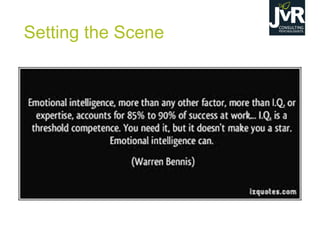
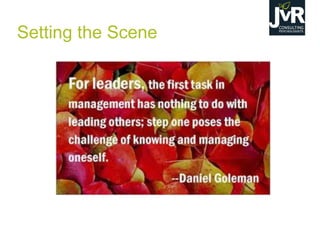
Setting the Scene
Setting the Scene
WHAT IS EQ?
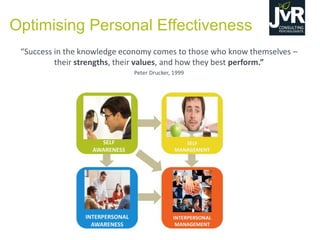
Optimising Personal Effectiveness
SELF
AWARENESS
“Success  in  the  knowledge  economy  comes  to  those  who  know  themselves  –
their strengths, their values, and how they best perform.”
Peter Drucker, 1999
Business Leaders With High EQ
Jack Welch, Chairman of GE:  “A
leader’s  intelligence  has  to  have  a  
strong emotional component. He has
to have high levels of self-awareness,
maturity and self-control. No doubt
emotional intelligence is more rare
than book smarts, but my experience
says it is actually more important in
the  making  of  a  leader.  You  just  can’t  
ignore  it.”  
http://ncra.info/docs/WinningTeams/The%20Case%20for%2
0EQ%20Jack%20Welch.pdf
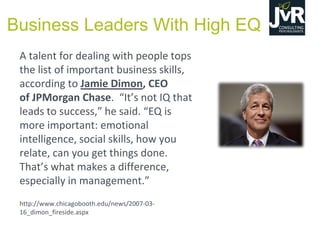
A talent for dealing with people tops
the list of important business skills,
according to Jamie Dimon, CEO
of JPMorgan Chase. “It’s  not  IQ  that  
leads  to  success,”  he  said.  “EQ  is  
more important: emotional
intelligence, social skills, how you
relate, can you get things done.
That’s  what  makes  a  difference,  
especially in management.”
http://www.chicagobooth.edu/news/2007-03-
16_dimon_fireside.aspx
Business Leaders With High EQ
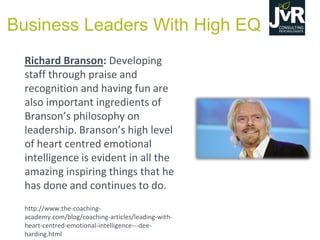
Richard Branson: Developing
staff through praise and
recognition and having fun are
also important ingredients of
Branson’s  philosophy on
leadership.  Branson’s  high  level  
of heart centred emotional
intelligence is evident in all the
amazing inspiring things that he
has done and continues to do.
http://www.the-coaching-
academy.com/blog/coaching-articles/leading-with-
heart-centred-emotional-intelligence---dee-
harding.html
Business Leaders With High EQ
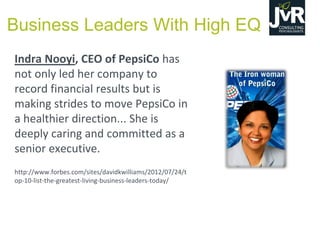
Indra Nooyi, CEO of PepsiCo has
not only led her company to
record financial results but is
making strides to move PepsiCo in
a healthier direction... She is
deeply caring and committed as a
senior executive.
http://www.forbes.com/sites/davidkwilliams/2012/07/24/t
op-10-list-the-greatest-living-business-leaders-today/
Business Leaders With High EQ
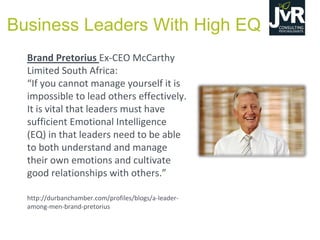
Brand Pretorius Ex-CEO McCarthy
Limited South Africa:
“If  you cannot manage yourself it is
impossible to lead others effectively.
It is vital that leaders must have
sufficient Emotional Intelligence
(EQ) in that leaders need to be able
to both understand and manage
their own emotions and cultivate
good relationships with others.”
http://durbanchamber.com/profiles/blogs/a-leader-
among-men-brand-pretorius
Business Leaders With High EQ
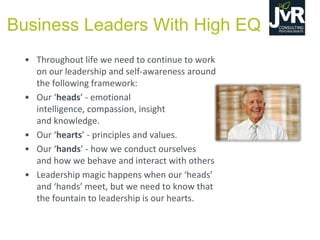
• Throughout life we need to continue to work
on our leadership and self-awareness around
the following framework:
• Our  ‘heads’  - emotional
intelligence, compassion, insight
and knowledge.
• Our  ‘hearts’  - principles and values.
• Our  ‘hands’  - how we conduct ourselves
and how we behave and interact with others
• Leadership magic  happens  when  our  ‘heads’  
and  ‘hands’  meet,  but  we  need  to  know  that  
the fountain to leadership is our hearts.
Business Leaders With High EQ
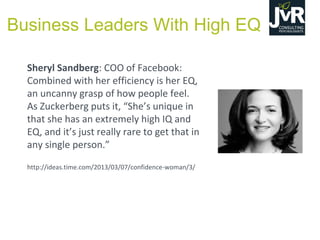
Sheryl Sandberg: COO of Facebook:
Combined with her efficiency is her EQ,
an uncanny grasp of how people feel.
As Zuckerberg  puts  it,  “She’s  unique  in  
that she has an extremely high IQ and
EQ,  and  it’s  just  really  rare  to  get  that  in  
any single person.”
http://ideas.time.com/2013/03/07/confidence-woman/3/
Business Leaders With High EQ
Emotional Intelligence is a way of recognizing,
understanding, and choosing how we think, feel, and act.
It shapes our interactions with others and our
understanding of ourselves.
It defines how and what we learn; it allows us to set
priorities; it determines the majority of our daily actions.
Research suggests it is responsible for as much as 80% of
the "success" in our lives."
Handle With Care: Emotional Intelligence Activity Book by Freedman et al
A Definition of EQ
Emotional-social intelligence is a cross-section of
interrelated emotional and social competencies
and skills that determine how effectively
we understand and express ourselves, understand
others and relate with them, and cope with daily
demands.
Dr Reuven Bar-On, 2005
A Definition of EQ
Why Measure EQ?
The measurement of emotional intelligence in the
workplace is the first step toward improving it.
By understanding the strengths and weaknesses of
[yourself, your] teams and employees, you can
systematically work toward increasing
the skills that count.
Dr Reuven Bar-On
The ROI on EQ Development
EQ Advantage (2004)
• Organisational ROI: increased innovation, productivity,
customer service and happy employees
• Team ROI: exceptional communications, positive dynamics,
team flexibility, accountability, synergy
• Individual ROI: self-aware individuals who maintain
integrity while managing emotions and impulses; an
understanding of others as well as an ability to positively
influence
WHY DOES EQ MATTER IN
THE WORKPLACE?
“75%  of  careers  are  derailed  for  reasons  related  to  
emotional competencies, including inability to
handle interpersonal problems; unsatisfactory team
leadership during times of difficulty or conflict; or
inability  to  adapt  to  change  or  elicit  trust.”
— The Center for Creative Leadership
EQ in the Workplace
EQ and Sales
And  we’re  all  in  the  business  of  selling  something  …  
• Human connections make or break a sale
• You can be prepared, with a smooth pitch, and an
impressive presentation, but if a personal connection is
missing, the window of opportunity will close
• Effectiveness in sales requires the use of various EQ
dimensions: self-awareness, self-regulation, empathy
and social skills
• Research has determined that EQ is a key predictor for
overall success in business
Richard Boyatzis
UNDERSTANDING
THE EQ MODEL
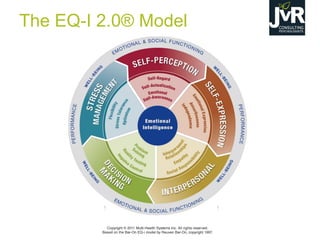
The EQ-I 2.0® Model
Important to Remember:
• Process of self development starts with raising
self awareness and determining actions to
improve your level of effectiveness
• Areas of higher skill celebrated and used to
make the most of them
• Areas of lower skill are opportunities for
enrichment
• An assessment is only one source of
information
Self-Perception
 Self-Regard
 Self-Actualization
 Emotional Self-Awareness
Interpersonal
 Interpersonal Relationships
 Empathy
 Social Responsibility
Self-Expression
 Emotional Expression
 Assertiveness
 Independence
Decision Making
 Problem Solving
 Reality Testing
 Impulse Control
Stress Management
 Flexibility
 Stress Tolerance
 Optimism
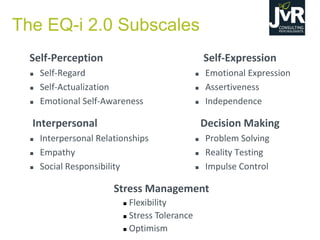
The EQ-i 2.0 Subscales
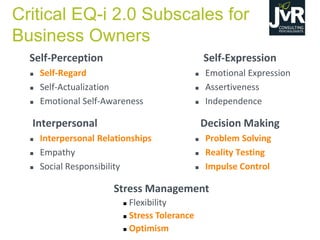
Self-Perception
 Self-Regard
 Self-Actualization
 Emotional Self-Awareness
Interpersonal
 Interpersonal Relationships
 Empathy
 Social Responsibility
Self-Expression
 Emotional Expression
 Assertiveness
 Independence
Decision Making
 Problem Solving
 Reality Testing
 Impulse Control
Stress Management
 Flexibility
 Stress Tolerance
 Optimism
Critical EQ-i 2.0 Subscales for
Business Owners
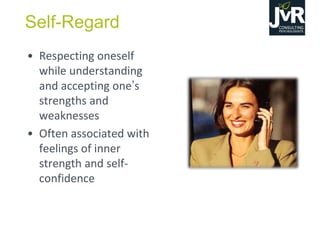
Self-Regard
• Respecting oneself
while understanding
and accepting one’s
strengths and
weaknesses
• Often associated with
feelings of inner
strength and self-
confidence
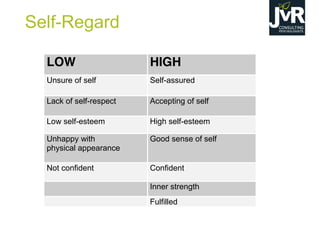
LOW HIGH
Unsure of self Self-assured
Lack of self-respect Accepting of self
Low self-esteem High self-esteem
Unhappy with
physical appearance
Good sense of self
Not confident Confident
Inner strength
Fulfilled
Self-Regard
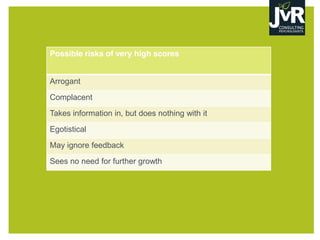
Possible risks of very high scores
Arrogant
Complacent
Takes information in, but does nothing with it
Egotistical
May ignore feedback
Sees no need for further growth
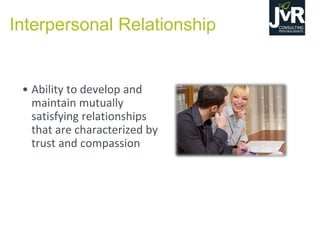
Interpersonal Relationship
• Ability to develop and
maintain mutually
satisfying relationships
that are characterized by
trust and compassion
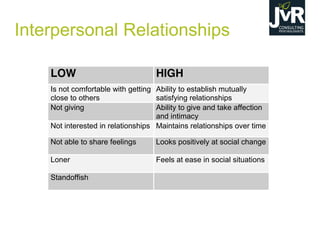
Interpersonal Relationships
LOW HIGH
Is not comfortable with getting
close to others
Ability to establish mutually
satisfying relationships
Not giving Ability to give and take affection
and intimacy
Not interested in relationships Maintains relationships over time
Not able to share feelings Looks positively at social change
Loner Feels at ease in social situations
Standoffish
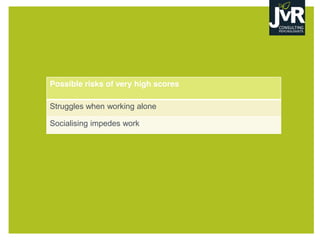
Possible risks of very high scores
Struggles when working alone
Socialising impedes work
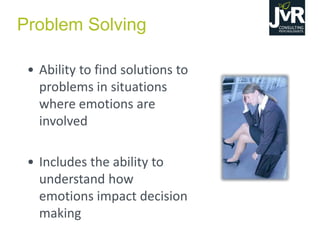
Problem Solving
• Ability to find solutions to
problems in situations
where emotions are
involved
• Includes the ability to
understand how
emotions impact decision
making
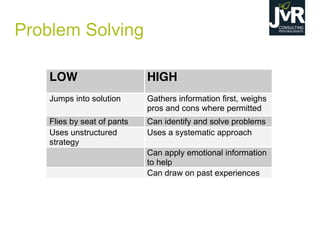
Problem Solving
LOW HIGH
Jumps into solution Gathers information first, weighs
pros and cons where permitted
Flies by seat of pants Can identify and solve problems
Uses unstructured
strategy
Uses a systematic approach
Can apply emotional information
to help
Can draw on past experiences
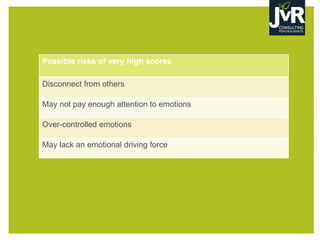
Possible risks of very high scores
Disconnect from others
May not pay enough attention to emotions
Over-controlled emotions
May lack an emotional driving force
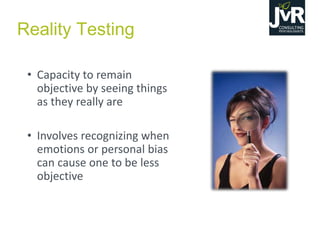
Reality Testing
• Capacity to remain
objective by seeing things
as they really are
• Involves recognizing when
emotions or personal bias
can cause one to be less
objective
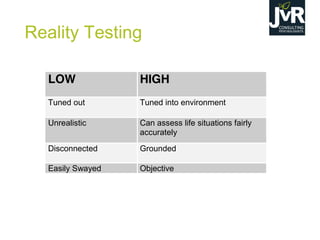
Reality Testing
LOW HIGH
Tuned out Tuned into environment
Unrealistic Can assess life situations fairly
accurately
Disconnected Grounded
Easily Swayed Objective
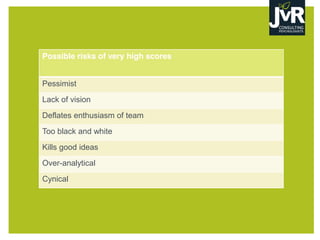
Possible risks of very high scores
Pessimist
Lack of vision
Deflates enthusiasm of team
Too black and white
Kills good ideas
Over-analytical
Cynical
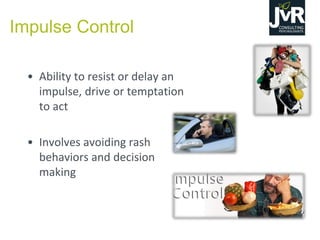
Impulse Control
• Ability to resist or delay an
impulse, drive or temptation
to act
• Involves avoiding rash
behaviors and decision
making
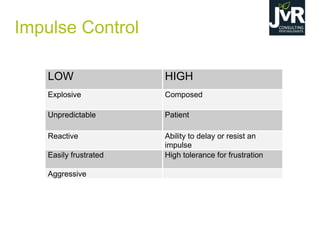
Impulse Control
LOW HIGH
Explosive Composed
Unpredictable Patient
Reactive Ability to delay or resist an
impulse
Easily frustrated High tolerance for frustration
Aggressive
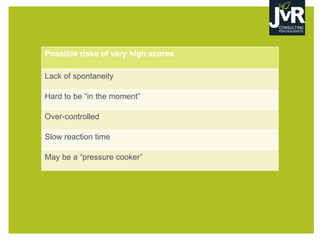
Possible risks of very high scores
Lack of spontaneity
Hard  to  be  “in the  moment”
Over-controlled
Slow reaction time
May  be  a  “pressure cooker”
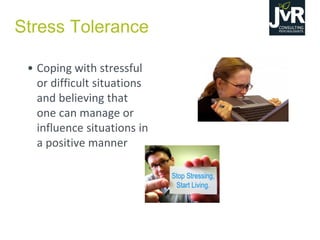
Stress Tolerance
• Coping with stressful
or difficult situations
and believing that
one can manage or
influence situations in
a positive manner
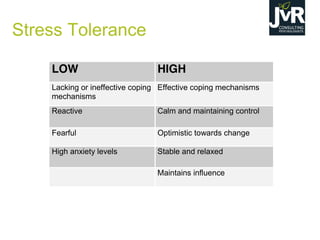
Stress Tolerance
LOW HIGH
Lacking or ineffective coping
mechanisms
Effective coping mechanisms
Reactive Calm and maintaining control
Fearful Optimistic towards change
High anxiety levels Stable and relaxed
Maintains influence
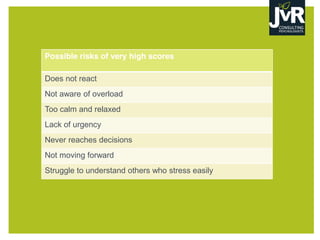
Possible risks of very high scores
Does not react
Not aware of overload
Too calm and relaxed
Lack of urgency
Never reaches decisions
Not moving forward
Struggle to understand others who stress easily
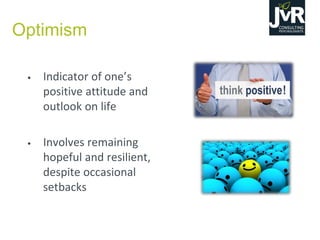
Optimism
• Indicator  of  one’s  
positive attitude and
outlook on life
• Involves remaining
hopeful and resilient,
despite occasional
setbacks
Optimism
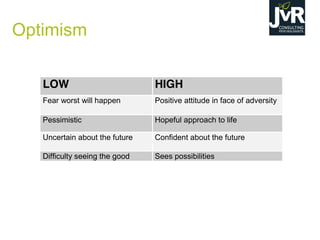
LOW HIGH
Fear worst will happen Positive attitude in face of adversity
Pessimistic Hopeful approach to life
Uncertain about the future Confident about the future
Difficulty seeing the good Sees possibilities
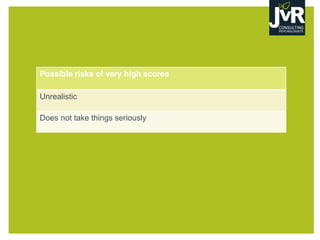
Possible risks of very high scores
Unrealistic
Does not take things seriously
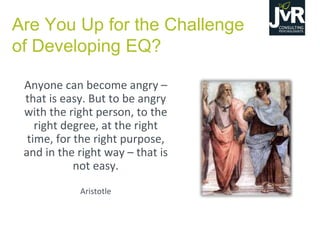
Are You Up for the Challenge
of Developing EQ?
Anyone can become angry –
that is easy. But to be angry
with the right person, to the
right degree, at the right
time, for the right purpose,
and in the right way – that is
not easy.
Aristotle
• Don’t  wait  to  find  the  ‘perfect’  opportunity  to  practice  
emotional intelligence.
• Each moment offers an opportunity to practice
– Your next phone call, team meeting, interaction with a
client
– You will think, feel, decide and act in each of these
situations
– So chose to try an emotionally intelligent approach
Becoming an Emotionally
Intelligent Individual
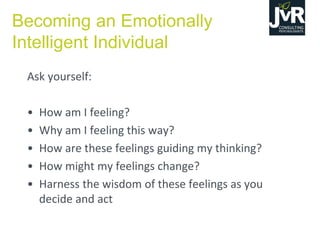
Ask yourself:
• How am I feeling?
• Why am I feeling this way?
• How are these feelings guiding my thinking?
• How might my feelings change?
• Harness the wisdom of these feelings as you
decide and act
Becoming an Emotionally
Intelligent Individual
DEVELOPING EQ BY CREATING
A DESIRED FUTURE STATE
Creating a Desired Future State
“Be  the change that you want to see in
the  world”  
Mahatma Ghandi
• Reflect on the above quote and describe the ideal
future state for yourself
• What do you need to start doing differently?
Memorable  Quotes…
If you always do what you have always done, you always get
what  you’ve  always  got.    So  if  you  want something different,
do something different.
Anonymous
He who knows others is wise. He who knows himself is
enlightened.
Lao Tzu
Begin challenging your own assumptions. Your assumptions
are your windows on the world. Scrub them off every once in
a while, or the light won't come in.
Alan Alda
Contact Info
Sandra van den Ordel
Lead  Consultant  ǀ  Industrial  Psychologist
sandrav@jvrafrica.co.za

Emotions Drive Our Performance by Sandra Van Den Ordel

  • 1.
    Emotional Intelligence Presented bySandra Van Den Ordel May 2014
  • 2.
  • 3.
  • 4.
  • 5.
    Optimising Personal Effectiveness SELF AWARENESS “Success in  the  knowledge  economy  comes  to  those  who  know  themselves  – their strengths, their values, and how they best perform.” Peter Drucker, 1999
  • 6.
    Business Leaders WithHigh EQ Jack Welch, Chairman of GE:  “A leader’s  intelligence  has  to  have  a   strong emotional component. He has to have high levels of self-awareness, maturity and self-control. No doubt emotional intelligence is more rare than book smarts, but my experience says it is actually more important in the  making  of  a  leader.  You  just  can’t   ignore  it.”   http://ncra.info/docs/WinningTeams/The%20Case%20for%2 0EQ%20Jack%20Welch.pdf
  • 7.
    A talent fordealing with people tops the list of important business skills, according to Jamie Dimon, CEO of JPMorgan Chase. “It’s  not  IQ  that   leads  to  success,”  he  said.  “EQ  is   more important: emotional intelligence, social skills, how you relate, can you get things done. That’s  what  makes  a  difference,   especially in management.” http://www.chicagobooth.edu/news/2007-03- 16_dimon_fireside.aspx Business Leaders With High EQ
  • 8.
    Richard Branson: Developing staffthrough praise and recognition and having fun are also important ingredients of Branson’s  philosophy on leadership.  Branson’s  high  level   of heart centred emotional intelligence is evident in all the amazing inspiring things that he has done and continues to do. http://www.the-coaching- academy.com/blog/coaching-articles/leading-with- heart-centred-emotional-intelligence---dee- harding.html Business Leaders With High EQ
  • 9.
    Indra Nooyi, CEOof PepsiCo has not only led her company to record financial results but is making strides to move PepsiCo in a healthier direction... She is deeply caring and committed as a senior executive. http://www.forbes.com/sites/davidkwilliams/2012/07/24/t op-10-list-the-greatest-living-business-leaders-today/ Business Leaders With High EQ
  • 10.
    Brand Pretorius Ex-CEOMcCarthy Limited South Africa: “If  you cannot manage yourself it is impossible to lead others effectively. It is vital that leaders must have sufficient Emotional Intelligence (EQ) in that leaders need to be able to both understand and manage their own emotions and cultivate good relationships with others.” http://durbanchamber.com/profiles/blogs/a-leader- among-men-brand-pretorius Business Leaders With High EQ
  • 11.
    • Throughout lifewe need to continue to work on our leadership and self-awareness around the following framework: • Our  ‘heads’  - emotional intelligence, compassion, insight and knowledge. • Our  ‘hearts’  - principles and values. • Our  ‘hands’  - how we conduct ourselves and how we behave and interact with others • Leadership magic  happens  when  our  ‘heads’   and  ‘hands’  meet,  but  we  need  to  know  that   the fountain to leadership is our hearts. Business Leaders With High EQ
  • 12.
    Sheryl Sandberg: COOof Facebook: Combined with her efficiency is her EQ, an uncanny grasp of how people feel. As Zuckerberg  puts  it,  “She’s  unique  in   that she has an extremely high IQ and EQ,  and  it’s  just  really  rare  to  get  that  in   any single person.” http://ideas.time.com/2013/03/07/confidence-woman/3/ Business Leaders With High EQ
  • 13.
    Emotional Intelligence isa way of recognizing, understanding, and choosing how we think, feel, and act. It shapes our interactions with others and our understanding of ourselves. It defines how and what we learn; it allows us to set priorities; it determines the majority of our daily actions. Research suggests it is responsible for as much as 80% of the "success" in our lives." Handle With Care: Emotional Intelligence Activity Book by Freedman et al A Definition of EQ
  • 14.
    Emotional-social intelligence isa cross-section of interrelated emotional and social competencies and skills that determine how effectively we understand and express ourselves, understand others and relate with them, and cope with daily demands. Dr Reuven Bar-On, 2005 A Definition of EQ
  • 15.
    Why Measure EQ? Themeasurement of emotional intelligence in the workplace is the first step toward improving it. By understanding the strengths and weaknesses of [yourself, your] teams and employees, you can systematically work toward increasing the skills that count. Dr Reuven Bar-On
  • 16.
    The ROI onEQ Development EQ Advantage (2004) • Organisational ROI: increased innovation, productivity, customer service and happy employees • Team ROI: exceptional communications, positive dynamics, team flexibility, accountability, synergy • Individual ROI: self-aware individuals who maintain integrity while managing emotions and impulses; an understanding of others as well as an ability to positively influence
  • 17.
    WHY DOES EQMATTER IN THE WORKPLACE?
  • 18.
    “75%  of  careers are  derailed  for  reasons  related  to   emotional competencies, including inability to handle interpersonal problems; unsatisfactory team leadership during times of difficulty or conflict; or inability  to  adapt  to  change  or  elicit  trust.” — The Center for Creative Leadership EQ in the Workplace
  • 19.
    EQ and Sales And we’re  all  in  the  business  of  selling  something  …   • Human connections make or break a sale • You can be prepared, with a smooth pitch, and an impressive presentation, but if a personal connection is missing, the window of opportunity will close • Effectiveness in sales requires the use of various EQ dimensions: self-awareness, self-regulation, empathy and social skills • Research has determined that EQ is a key predictor for overall success in business Richard Boyatzis
  • 20.
  • 21.
  • 22.
    Important to Remember: •Process of self development starts with raising self awareness and determining actions to improve your level of effectiveness • Areas of higher skill celebrated and used to make the most of them • Areas of lower skill are opportunities for enrichment • An assessment is only one source of information
  • 23.
    Self-Perception  Self-Regard  Self-Actualization Emotional Self-Awareness Interpersonal  Interpersonal Relationships  Empathy  Social Responsibility Self-Expression  Emotional Expression  Assertiveness  Independence Decision Making  Problem Solving  Reality Testing  Impulse Control Stress Management  Flexibility  Stress Tolerance  Optimism The EQ-i 2.0 Subscales
  • 24.
    Self-Perception  Self-Regard  Self-Actualization Emotional Self-Awareness Interpersonal  Interpersonal Relationships  Empathy  Social Responsibility Self-Expression  Emotional Expression  Assertiveness  Independence Decision Making  Problem Solving  Reality Testing  Impulse Control Stress Management  Flexibility  Stress Tolerance  Optimism Critical EQ-i 2.0 Subscales for Business Owners
  • 25.
    Self-Regard • Respecting oneself whileunderstanding and accepting one’s strengths and weaknesses • Often associated with feelings of inner strength and self- confidence
  • 26.
    LOW HIGH Unsure ofself Self-assured Lack of self-respect Accepting of self Low self-esteem High self-esteem Unhappy with physical appearance Good sense of self Not confident Confident Inner strength Fulfilled Self-Regard
  • 27.
    Possible risks ofvery high scores Arrogant Complacent Takes information in, but does nothing with it Egotistical May ignore feedback Sees no need for further growth
  • 28.
    Interpersonal Relationship • Abilityto develop and maintain mutually satisfying relationships that are characterized by trust and compassion
  • 29.
    Interpersonal Relationships LOW HIGH Isnot comfortable with getting close to others Ability to establish mutually satisfying relationships Not giving Ability to give and take affection and intimacy Not interested in relationships Maintains relationships over time Not able to share feelings Looks positively at social change Loner Feels at ease in social situations Standoffish
  • 30.
    Possible risks ofvery high scores Struggles when working alone Socialising impedes work
  • 31.
    Problem Solving • Abilityto find solutions to problems in situations where emotions are involved • Includes the ability to understand how emotions impact decision making
  • 32.
    Problem Solving LOW HIGH Jumpsinto solution Gathers information first, weighs pros and cons where permitted Flies by seat of pants Can identify and solve problems Uses unstructured strategy Uses a systematic approach Can apply emotional information to help Can draw on past experiences
  • 33.
    Possible risks ofvery high scores Disconnect from others May not pay enough attention to emotions Over-controlled emotions May lack an emotional driving force
  • 34.
    Reality Testing • Capacityto remain objective by seeing things as they really are • Involves recognizing when emotions or personal bias can cause one to be less objective
  • 35.
    Reality Testing LOW HIGH Tunedout Tuned into environment Unrealistic Can assess life situations fairly accurately Disconnected Grounded Easily Swayed Objective
  • 36.
    Possible risks ofvery high scores Pessimist Lack of vision Deflates enthusiasm of team Too black and white Kills good ideas Over-analytical Cynical
  • 37.
    Impulse Control • Abilityto resist or delay an impulse, drive or temptation to act • Involves avoiding rash behaviors and decision making
  • 38.
    Impulse Control LOW HIGH ExplosiveComposed Unpredictable Patient Reactive Ability to delay or resist an impulse Easily frustrated High tolerance for frustration Aggressive
  • 39.
    Possible risks ofvery high scores Lack of spontaneity Hard  to  be  “in the  moment” Over-controlled Slow reaction time May  be  a  “pressure cooker”
  • 40.
    Stress Tolerance • Copingwith stressful or difficult situations and believing that one can manage or influence situations in a positive manner
  • 41.
    Stress Tolerance LOW HIGH Lackingor ineffective coping mechanisms Effective coping mechanisms Reactive Calm and maintaining control Fearful Optimistic towards change High anxiety levels Stable and relaxed Maintains influence
  • 42.
    Possible risks ofvery high scores Does not react Not aware of overload Too calm and relaxed Lack of urgency Never reaches decisions Not moving forward Struggle to understand others who stress easily
  • 43.
    Optimism • Indicator  of one’s   positive attitude and outlook on life • Involves remaining hopeful and resilient, despite occasional setbacks
  • 44.
    Optimism LOW HIGH Fear worstwill happen Positive attitude in face of adversity Pessimistic Hopeful approach to life Uncertain about the future Confident about the future Difficulty seeing the good Sees possibilities
  • 45.
    Possible risks ofvery high scores Unrealistic Does not take things seriously
  • 46.
    Are You Upfor the Challenge of Developing EQ? Anyone can become angry – that is easy. But to be angry with the right person, to the right degree, at the right time, for the right purpose, and in the right way – that is not easy. Aristotle
  • 47.
    • Don’t  wait to  find  the  ‘perfect’  opportunity  to  practice   emotional intelligence. • Each moment offers an opportunity to practice – Your next phone call, team meeting, interaction with a client – You will think, feel, decide and act in each of these situations – So chose to try an emotionally intelligent approach Becoming an Emotionally Intelligent Individual
  • 48.
    Ask yourself: • Howam I feeling? • Why am I feeling this way? • How are these feelings guiding my thinking? • How might my feelings change? • Harness the wisdom of these feelings as you decide and act Becoming an Emotionally Intelligent Individual
  • 49.
    DEVELOPING EQ BYCREATING A DESIRED FUTURE STATE
  • 50.
    Creating a DesiredFuture State “Be  the change that you want to see in the  world”   Mahatma Ghandi • Reflect on the above quote and describe the ideal future state for yourself • What do you need to start doing differently?
  • 51.
    Memorable  Quotes… If youalways do what you have always done, you always get what  you’ve  always  got.    So  if  you  want something different, do something different. Anonymous He who knows others is wise. He who knows himself is enlightened. Lao Tzu Begin challenging your own assumptions. Your assumptions are your windows on the world. Scrub them off every once in a while, or the light won't come in. Alan Alda
  • 52.
    Contact Info Sandra vanden Ordel Lead  Consultant  ǀ  Industrial  Psychologist sandrav@jvrafrica.co.za