Tissue
• Groups of cells that are similar in structure
and perform a common or related functions
are called TISSUE
Tissues
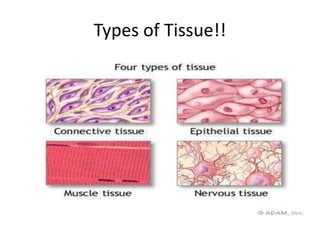
• The tissues of the human body include four
major types: general function
• Epithelial: covering
• Connective: support
• Muscle: movement
• Nervous: control
Types of Tissue!!
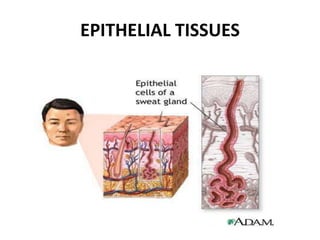
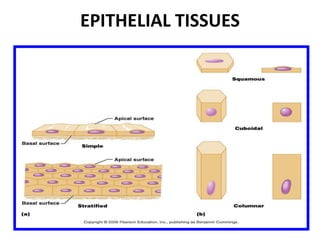
EPITHELIAL TISSUES
EPITHELIAL TISSUES
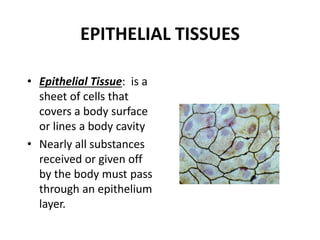
• Epithelial Tissue: is a
sheet of cells that
covers a body surface
or lines a body cavity
• Nearly all substances
received or given off
by the body must pass
through an epithelium
layer.
EPITHELIAL TISSUES
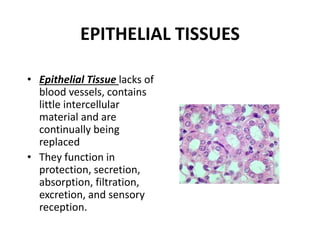
• Epithelial Tissue lacks of
blood vessels, contains
little intercellular
material and are
continually being
replaced
• They function in
protection, secretion,
absorption, filtration,
excretion, and sensory
reception.
EPITHELIAL TISSUES
• Epithelium Tissue has
many characteristics
that separate it from
other tissue types
• ET has an apical surface
(near the top) and a
basal surface (near the
bottom)
• Supported by
connective tissue.
EPITHELIAL TISSUES
• Each Epithelium Tissue is given two names.
• The first name indicates the number of cell
layers present.
– Simple- one layer
– Stratified- more than one layer
• The second describes the shape of its cells
– Squamous, cuboidal, and columnar.
EPITHELIAL TISSUES
• .
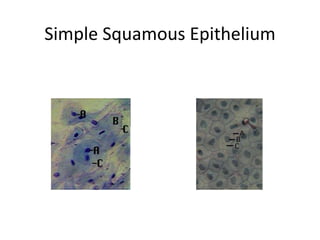
Simple Squamous Epithelium
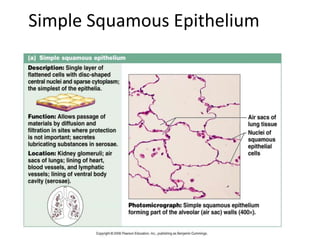
• This tissue consists of a single layer of thin, flattened
cells through which substances can pass easily. So
delicate they can easily be damaged.
• Common site of diffusion and osmosis. Its functions
in the exchange of gases in the lungs
• Lines the air sacs of the lungs (gas exchange), forms
the walls of the capillaries, lines the insides of blood
vessels and lymph vessels.
• Covers the membrane that line body cavities.
Simple Squamous Epithelium
Simple Cuboidal Epithelium
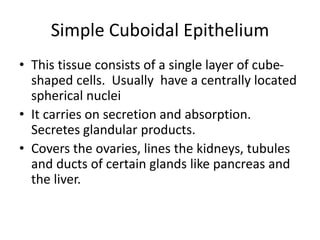
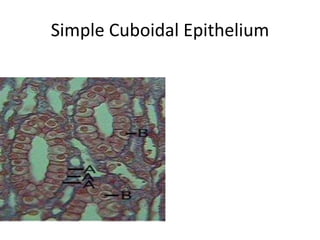
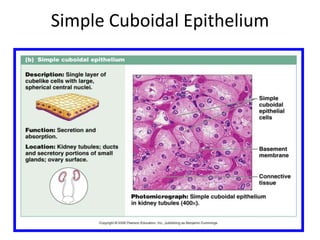
• This tissue consists of a single layer of cube-
shaped cells. Usually have a centrally located
spherical nuclei
• It carries on secretion and absorption.
Secretes glandular products.
• Covers the ovaries, lines the kidneys, tubules
and ducts of certain glands like pancreas and
the liver.
Simple Cuboidal Epithelium
Simple Columnar Epithelium
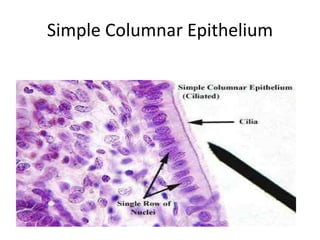
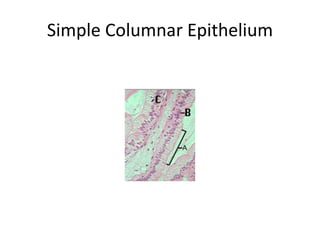
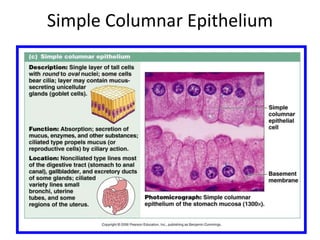
• The tissue is composed of a single layer of elongated
cells whose nuclei are usually at about the same
level, near the basement membrane.
• Some have cilia some do not
• Secretes and absorbs…this tissue is thick!!
• This tissue lines uterus and portions of the digestive
tract like small/large intestines and stomach.
Simple Columnar Epithelium
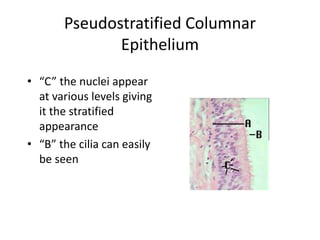
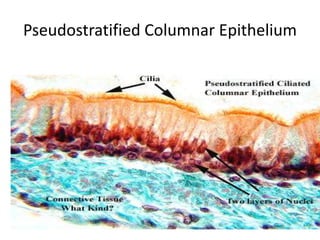
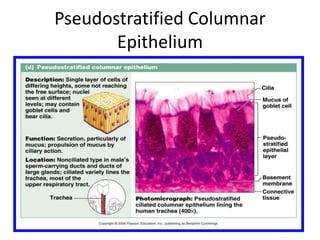
Pseudostratified Columnar Epithelium
• They appear stratified but are NOT, They appear to
have two or more nuclei but they each reach the
basement level.
• Goblet cells scattered throughout the tissue that
secret mucus, which the cilia sweep away.
• It lines tubes of the respiratory system. The mucus
and cilia created by this tissue trap the dust and
microorganisms that enter the airway.
Pseudostratified Columnar
Epithelium
• “C” the nuclei appear
at various levels giving
it the stratified
appearance
• “B” the cilia can easily
be seen
Pseudostratified Columnar Epithelium
Pseudostratified Columnar
Epithelium
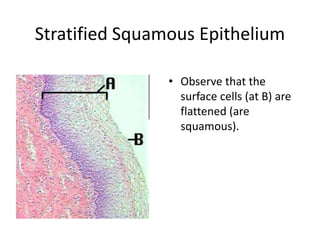
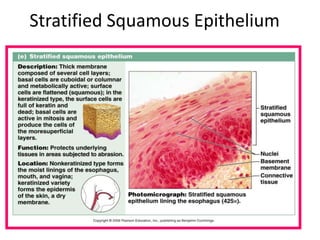
Stratified Squamous Epithelium
• Named for the shape of the cells,…consists of many
layers, relatively thick. Cells nearer the surface are
flat where as the deeper are cuboidal and columnar.
• Tissue can contain Keratin, which is a protein that
accumulates and protect the underlying tissue.
• Epidermis-outer most layer of the skin
• Also lines the skin and lines the oral cavity, throat,
vagina, and anal canal.
Stratified Squamous Epithelium
• Observe that the
surface cells (at B) are
flattened (are
squamous).
Stratified Squamous Epithelium
Stratified Cuboidal Epithelium
• This tissue is composed of two or thee layers
of cube-shaped cells.
• It lines the larger ducts of the mammary
glands sweat glands, salivary glands, and
pancreas. Forms the lining of ovarian follicles
and seminiferous tubules
• It functions in protection.
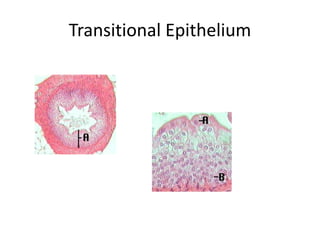
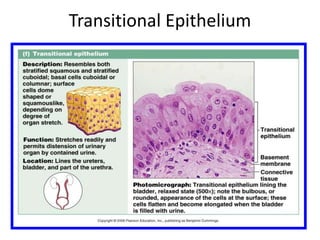
Transitional Epithelium
• This tissue is specialized to change in response
to tension..
• Transition epithelium is unstretched and
consists of many layers when the organs wall
contract the tissue stretches and appears
thinner when the organ is distended.
• Forms the lining of the urinary bladder and
lines the ureters and part of the urethra.
Transitional Epithelium

Epithelium-1.ppt

  • 2.
    Tissue • Groups ofcells that are similar in structure and perform a common or related functions are called TISSUE
  • 3.
    Tissues • The tissuesof the human body include four major types: general function • Epithelial: covering • Connective: support • Muscle: movement • Nervous: control
  • 4.
  • 5.
  • 6.
    EPITHELIAL TISSUES • EpithelialTissue: is a sheet of cells that covers a body surface or lines a body cavity • Nearly all substances received or given off by the body must pass through an epithelium layer.
  • 7.
    EPITHELIAL TISSUES • EpithelialTissue lacks of blood vessels, contains little intercellular material and are continually being replaced • They function in protection, secretion, absorption, filtration, excretion, and sensory reception.
  • 8.
    EPITHELIAL TISSUES • EpitheliumTissue has many characteristics that separate it from other tissue types • ET has an apical surface (near the top) and a basal surface (near the bottom) • Supported by connective tissue.
  • 9.
    EPITHELIAL TISSUES • EachEpithelium Tissue is given two names. • The first name indicates the number of cell layers present. – Simple- one layer – Stratified- more than one layer • The second describes the shape of its cells – Squamous, cuboidal, and columnar.
  • 10.
  • 11.
    Simple Squamous Epithelium •This tissue consists of a single layer of thin, flattened cells through which substances can pass easily. So delicate they can easily be damaged. • Common site of diffusion and osmosis. Its functions in the exchange of gases in the lungs • Lines the air sacs of the lungs (gas exchange), forms the walls of the capillaries, lines the insides of blood vessels and lymph vessels. • Covers the membrane that line body cavities.
  • 12.
  • 13.
  • 14.
    Simple Cuboidal Epithelium •This tissue consists of a single layer of cube- shaped cells. Usually have a centrally located spherical nuclei • It carries on secretion and absorption. Secretes glandular products. • Covers the ovaries, lines the kidneys, tubules and ducts of certain glands like pancreas and the liver.
  • 15.
  • 16.
  • 17.
    Simple Columnar Epithelium •The tissue is composed of a single layer of elongated cells whose nuclei are usually at about the same level, near the basement membrane. • Some have cilia some do not • Secretes and absorbs…this tissue is thick!! • This tissue lines uterus and portions of the digestive tract like small/large intestines and stomach.
  • 18.
  • 19.
  • 20.
  • 21.
    Pseudostratified Columnar Epithelium •They appear stratified but are NOT, They appear to have two or more nuclei but they each reach the basement level. • Goblet cells scattered throughout the tissue that secret mucus, which the cilia sweep away. • It lines tubes of the respiratory system. The mucus and cilia created by this tissue trap the dust and microorganisms that enter the airway.
  • 22.
    Pseudostratified Columnar Epithelium • “C”the nuclei appear at various levels giving it the stratified appearance • “B” the cilia can easily be seen
  • 23.
  • 24.
  • 25.
    Stratified Squamous Epithelium •Named for the shape of the cells,…consists of many layers, relatively thick. Cells nearer the surface are flat where as the deeper are cuboidal and columnar. • Tissue can contain Keratin, which is a protein that accumulates and protect the underlying tissue. • Epidermis-outer most layer of the skin • Also lines the skin and lines the oral cavity, throat, vagina, and anal canal.
  • 26.
    Stratified Squamous Epithelium •Observe that the surface cells (at B) are flattened (are squamous).
  • 27.
  • 28.
    Stratified Cuboidal Epithelium •This tissue is composed of two or thee layers of cube-shaped cells. • It lines the larger ducts of the mammary glands sweat glands, salivary glands, and pancreas. Forms the lining of ovarian follicles and seminiferous tubules • It functions in protection.
  • 29.
    Transitional Epithelium • Thistissue is specialized to change in response to tension.. • Transition epithelium is unstretched and consists of many layers when the organs wall contract the tissue stretches and appears thinner when the organ is distended. • Forms the lining of the urinary bladder and lines the ureters and part of the urethra.
  • 30.
  • 31.