Engineering, Procurement and
Construction (EPC) Projects
Opportunities for Improvements
through automation
Presented by Robert N. Fox
Summary
• Clarify distinctions between EPC and AEC
• State EPC Challenges
• Review EPC Principal Functions
• CAD Evolution in the past quarter century
• Case Study of an EPC “Mega-Project”
• Opportunities
• Q&A
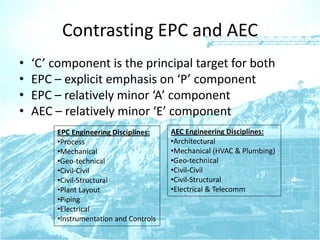
Contrasting EPC and AEC
• ‘C’ component is the principal target for both
• EPC – explicit emphasis on ‘P’ component
• EPC – relatively minor ‘A’ component
• AEC – relatively minor ‘E’ component
EPC Engineering Disciplines:
•Process
•Mechanical
•Geo-technical
•Civil-Civil
•Civil-Structural
•Plant Layout
•Piping
•Electrical
•Instrumentation and Controls
AEC Engineering Disciplines:
•Architectural
•Mechanical (HVAC & Plumbing)
•Geo-technical
•Civil-Civil
•Civil-Structural
•Electrical & Telecomm
EPC Challenges
Execute EPC “mega-projects” within budget
and on schedule
Minimize construction delays due to lagging
information, material or equipment.
Track progress and maintain contingency
plans to stay on schedule.
Document project progress in terms of
installed quantities.
The Challenge
• Intelligently apply IT/CAD to the EPC
environment.
• Overcome conservative mind-set of builders.
• Push progression of 2D to 3D, 4D and even 5D.
• Apply IT/CAD tools to the advantage of
constructors and their clients. Better
productivity leads to better gross margins.
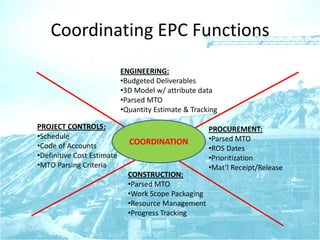
Coordinating EPC Functions
ENGINEERING:
•Budgeted Deliverables
•3D Model w/ attribute data
•Parsed MTO
•Quantity Estimate & Tracking
PROCUREMENT:
•Parsed MTO
•ROS Dates
•Prioritization
•Mat’l Receipt/Release
CONSTRUCTION:
•Parsed MTO
•Work Scope Packaging
•Resource Management
•Progress Tracking
PROJECT CONTROLS:
•Schedule
•Code of Accounts
•Definitive Cost Estimate
•MTO Parsing Criteria
COORDINATION
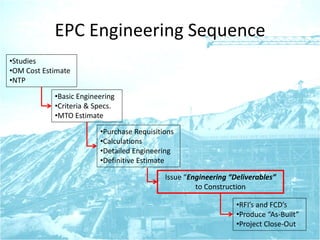
EPC Engineering Sequence
•Studies
•OM Cost Estimate
•NTP
•Basic Engineering
•Criteria & Specs.
•MTO Estimate
•Purchase Requisitions
•Calculations
•Detailed Engineering
•Definitive Estimate
Issue “Engineering “Deliverables”
to Construction
•RFI’s and FCD’s
•Produce “As-Built”
•Project Close-Out
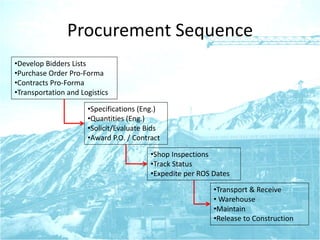
Procurement Sequence
•Develop Bidders Lists
•Purchase Order Pro-Forma
•Contracts Pro-Forma
•Transportation and Logistics
•Specifications (Eng.)
•Quantities (Eng.)
•Solicit/Evaluate Bids
•Award P.O. / Contract
•Shop Inspections
•Track Status
•Expedite per ROS Dates
•Transport & Receive
• Warehouse
•Maintain
•Release to Construction
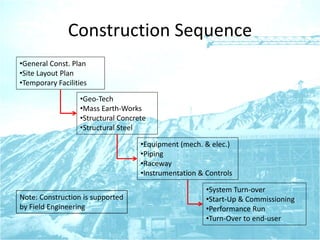
Construction Sequence
•General Const. Plan
•Site Layout Plan
•Temporary Facilities
•Geo-Tech
•Mass Earth-Works
•Structural Concrete
•Structural Steel
•Equipment (mech. & elec.)
•Piping
•Raceway
•Instrumentation & Controls
•System Turn-over
•Start-Up & Commissioning
•Performance Run
•Turn-Over to end-user
Note: Construction is supported
by Field Engineering
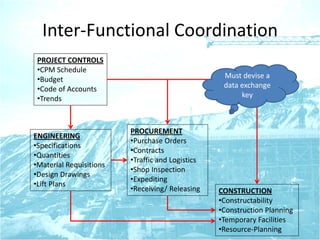
Inter-Functional Coordination
ENGINEERING
•Specifications
•Quantities
•Material Requisitions
•Design Drawings
•Lift Plans
PROCUREMENT
•Purchase Orders
•Contracts
•Traffic and Logistics
•Shop Inspection
•Expediting
•Receiving/ Releasing
PROJECT CONTROLS
•CPM Schedule
•Budget
•Code of Accounts
•Trends
CONSTRUCTION
•Constructability
•Construction Planning
•Temporary Facilities
•Resource-Planning
Must devise a
data exchange
key
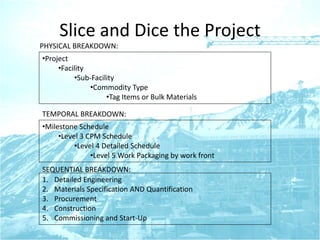
Slice and Dice the Project
•Project
•Facility
•Sub-Facility
•Commodity Type
•Tag Items or Bulk Materials
•Milestone Schedule
•Level 3 CPM Schedule
•Level 4 Detailed Schedule
•Level 5 Work Packaging by work front
PHYSICAL BREAKDOWN:
TEMPORAL BREAKDOWN:
SEQUENTIAL BREAKDOWN:
1. Detailed Engineering
2. Materials Specification AND Quantification
3. Procurement
4. Construction
5. Commissioning and Start-Up
Project Controls Sequence
• Milestone Schedule
• Code of Accounts
• Cost Estimate
• Budget Definition and Tracking
• Level 3 CPM Schedule (aka P3)
• Trend Program
• Contingency Tracking
• Schedule Optimization
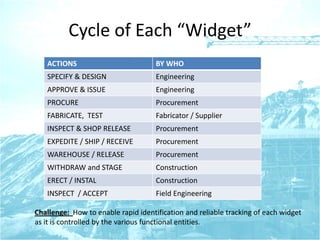
Cycle of Each “Widget”
ACTIONS BY WHO
SPECIFY & DESIGN Engineering
APPROVE & ISSUE Engineering
PROCURE Procurement
FABRICATE, TEST Fabricator / Supplier
INSPECT & SHOP RELEASE Procurement
EXPEDITE / SHIP / RECEIVE Procurement
WAREHOUSE / RELEASE Procurement
WITHDRAW and STAGE Construction
ERECT / INSTAL Construction
INSPECT / ACCEPT Field Engineering
Challenge: How to enable rapid identification and reliable tracking of each widget
as it is controlled by the various functional entities.
Levels of Modelling
• 2D Drawings and Sketches (E)
• 3D CAD Model with data attribute links (E)
• 4D Construction Simulation Model (EC)
– 4Dc –Construction Planning & Sequencing
– 4Dr – Resource Management (and Lift Plans)
– 4Ds – Construction Status
• 5D Cost Tracking Model (EPC)
– 5Dm: material costs
– 5Dr: resource costs
2D Drawings and Sketches
• Traditional format
• Inter-drawing design coordination subject to error
• Change management requires rigorous document
control process.
• 2D CAD used for nearly 30 years aids in drawing
format consistency as well as storage and
management of drawing files.
“Intelligent” 3D CAD Model
• Used for EPC over the past 20+ years (3DM, PDS,
PDMS, Smart-Plant, Plant-Space)
• Requires changes to traditional work processes
• Component attribute data is the “intelligence”
• Clash Checking
• Automatic Drawing Creation
• Material Take-Off Reports
• Data Consistency Reports
4D Construction Simulation Model
• Links 3D model components with P3 schedule
• Assigns temporal dimension to each “widget” in
the 3D model
• Facilitates Construction Operations:
• Construction Sequencing
• Resource Management Planning
• Constructability Assessment
• Lift Plan Verification
• Visualization
EPC Proceduralized Coordination
• Materials Management is the key
– Parse project in 3D Space as well as by material
commodity types.
– Derive a matrix of spacial sub-divisions crossed with
commodity types to define a series of tags. Call it the
Work Execution Package (WEP).
– Construction planners help define spacial entities.
– Each material item is assigned a tag that ties it to the
matrix.
– Each WEP tag is embedded into a scheduled activity.
5D Cost Tracking Model
• Material Cost Model
• Resource Distribution Model
• Expended Cost Tracking Model
• . . . Others yet to be defined
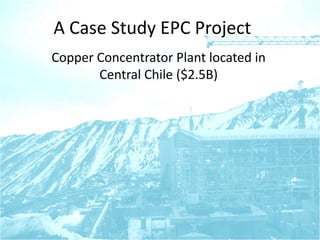
A Case Study EPC Project
Copper Concentrator Plant located in
Central Chile ($2.5B)
Case Study Parameters
• Two sites connected by a 57 km. pipeline
• 8,000,000 cubic meters of earth-works
• 400,000 cubic meters of structural concrete
• 18 tons of structural steel
• 1,200+ Equipment tag items
• 120,000 meters of piping (1,700 line nos.)
• Plant capacity: 110,000 tons per day
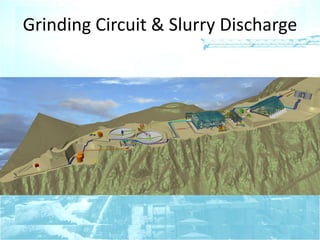
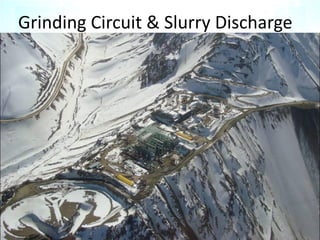
Grinding Circuit & Slurry Discharge
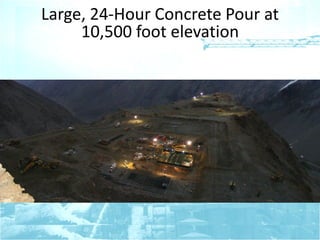
Large, 24-Hour Concrete Pour at
10,500 foot elevation
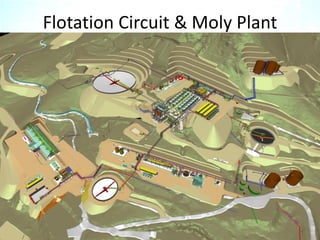
Flotation Circuit & Moly Plant
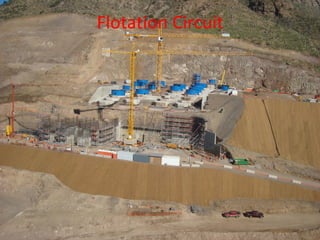
Flotation Circuit
Q & A

Epc presentation robert foxpresentation

  • 1.
    Engineering, Procurement and Construction(EPC) Projects Opportunities for Improvements through automation Presented by Robert N. Fox
  • 2.
    Summary • Clarify distinctionsbetween EPC and AEC • State EPC Challenges • Review EPC Principal Functions • CAD Evolution in the past quarter century • Case Study of an EPC “Mega-Project” • Opportunities • Q&A
  • 3.
    Contrasting EPC andAEC • ‘C’ component is the principal target for both • EPC – explicit emphasis on ‘P’ component • EPC – relatively minor ‘A’ component • AEC – relatively minor ‘E’ component EPC Engineering Disciplines: •Process •Mechanical •Geo-technical •Civil-Civil •Civil-Structural •Plant Layout •Piping •Electrical •Instrumentation and Controls AEC Engineering Disciplines: •Architectural •Mechanical (HVAC & Plumbing) •Geo-technical •Civil-Civil •Civil-Structural •Electrical & Telecomm
  • 4.
    EPC Challenges Execute EPC“mega-projects” within budget and on schedule Minimize construction delays due to lagging information, material or equipment. Track progress and maintain contingency plans to stay on schedule. Document project progress in terms of installed quantities.
  • 5.
    The Challenge • Intelligentlyapply IT/CAD to the EPC environment. • Overcome conservative mind-set of builders. • Push progression of 2D to 3D, 4D and even 5D. • Apply IT/CAD tools to the advantage of constructors and their clients. Better productivity leads to better gross margins.
  • 6.
    Coordinating EPC Functions ENGINEERING: •BudgetedDeliverables •3D Model w/ attribute data •Parsed MTO •Quantity Estimate & Tracking PROCUREMENT: •Parsed MTO •ROS Dates •Prioritization •Mat’l Receipt/Release CONSTRUCTION: •Parsed MTO •Work Scope Packaging •Resource Management •Progress Tracking PROJECT CONTROLS: •Schedule •Code of Accounts •Definitive Cost Estimate •MTO Parsing Criteria COORDINATION
  • 7.
    EPC Engineering Sequence •Studies •OMCost Estimate •NTP •Basic Engineering •Criteria & Specs. •MTO Estimate •Purchase Requisitions •Calculations •Detailed Engineering •Definitive Estimate Issue “Engineering “Deliverables” to Construction •RFI’s and FCD’s •Produce “As-Built” •Project Close-Out
  • 8.
    Procurement Sequence •Develop BiddersLists •Purchase Order Pro-Forma •Contracts Pro-Forma •Transportation and Logistics •Specifications (Eng.) •Quantities (Eng.) •Solicit/Evaluate Bids •Award P.O. / Contract •Shop Inspections •Track Status •Expedite per ROS Dates •Transport & Receive • Warehouse •Maintain •Release to Construction
  • 9.
    Construction Sequence •General Const.Plan •Site Layout Plan •Temporary Facilities •Geo-Tech •Mass Earth-Works •Structural Concrete •Structural Steel •Equipment (mech. & elec.) •Piping •Raceway •Instrumentation & Controls •System Turn-over •Start-Up & Commissioning •Performance Run •Turn-Over to end-user Note: Construction is supported by Field Engineering
  • 10.
    Inter-Functional Coordination ENGINEERING •Specifications •Quantities •Material Requisitions •DesignDrawings •Lift Plans PROCUREMENT •Purchase Orders •Contracts •Traffic and Logistics •Shop Inspection •Expediting •Receiving/ Releasing PROJECT CONTROLS •CPM Schedule •Budget •Code of Accounts •Trends CONSTRUCTION •Constructability •Construction Planning •Temporary Facilities •Resource-Planning Must devise a data exchange key
  • 11.
    Slice and Dicethe Project •Project •Facility •Sub-Facility •Commodity Type •Tag Items or Bulk Materials •Milestone Schedule •Level 3 CPM Schedule •Level 4 Detailed Schedule •Level 5 Work Packaging by work front PHYSICAL BREAKDOWN: TEMPORAL BREAKDOWN: SEQUENTIAL BREAKDOWN: 1. Detailed Engineering 2. Materials Specification AND Quantification 3. Procurement 4. Construction 5. Commissioning and Start-Up
  • 12.
    Project Controls Sequence •Milestone Schedule • Code of Accounts • Cost Estimate • Budget Definition and Tracking • Level 3 CPM Schedule (aka P3) • Trend Program • Contingency Tracking • Schedule Optimization
  • 13.
    Cycle of Each“Widget” ACTIONS BY WHO SPECIFY & DESIGN Engineering APPROVE & ISSUE Engineering PROCURE Procurement FABRICATE, TEST Fabricator / Supplier INSPECT & SHOP RELEASE Procurement EXPEDITE / SHIP / RECEIVE Procurement WAREHOUSE / RELEASE Procurement WITHDRAW and STAGE Construction ERECT / INSTAL Construction INSPECT / ACCEPT Field Engineering Challenge: How to enable rapid identification and reliable tracking of each widget as it is controlled by the various functional entities.
  • 14.
    Levels of Modelling •2D Drawings and Sketches (E) • 3D CAD Model with data attribute links (E) • 4D Construction Simulation Model (EC) – 4Dc –Construction Planning & Sequencing – 4Dr – Resource Management (and Lift Plans) – 4Ds – Construction Status • 5D Cost Tracking Model (EPC) – 5Dm: material costs – 5Dr: resource costs
  • 15.
    2D Drawings andSketches • Traditional format • Inter-drawing design coordination subject to error • Change management requires rigorous document control process. • 2D CAD used for nearly 30 years aids in drawing format consistency as well as storage and management of drawing files.
  • 16.
    “Intelligent” 3D CADModel • Used for EPC over the past 20+ years (3DM, PDS, PDMS, Smart-Plant, Plant-Space) • Requires changes to traditional work processes • Component attribute data is the “intelligence” • Clash Checking • Automatic Drawing Creation • Material Take-Off Reports • Data Consistency Reports
  • 17.
    4D Construction SimulationModel • Links 3D model components with P3 schedule • Assigns temporal dimension to each “widget” in the 3D model • Facilitates Construction Operations: • Construction Sequencing • Resource Management Planning • Constructability Assessment • Lift Plan Verification • Visualization
  • 18.
    EPC Proceduralized Coordination •Materials Management is the key – Parse project in 3D Space as well as by material commodity types. – Derive a matrix of spacial sub-divisions crossed with commodity types to define a series of tags. Call it the Work Execution Package (WEP). – Construction planners help define spacial entities. – Each material item is assigned a tag that ties it to the matrix. – Each WEP tag is embedded into a scheduled activity.
  • 19.
    5D Cost TrackingModel • Material Cost Model • Resource Distribution Model • Expended Cost Tracking Model • . . . Others yet to be defined
  • 20.
    A Case StudyEPC Project Copper Concentrator Plant located in Central Chile ($2.5B)
  • 21.
    Case Study Parameters •Two sites connected by a 57 km. pipeline • 8,000,000 cubic meters of earth-works • 400,000 cubic meters of structural concrete • 18 tons of structural steel • 1,200+ Equipment tag items • 120,000 meters of piping (1,700 line nos.) • Plant capacity: 110,000 tons per day
  • 22.
    Grinding Circuit &Slurry Discharge
  • 23.
    Grinding Circuit &Slurry Discharge
  • 24.
    Large, 24-Hour ConcretePour at 10,500 foot elevation
  • 25.
  • 26.
  • 27.