Understanding the Difference
Between EPC and EPCM Contracts
You’ve probably heard the terms EPC
(Engineering, Procurement and Construction)
and EPCM (Engineering, Procurement and
Construction Management) contracts since they
are terms commonly used in the oil, gas, mining
and power industries. However, there remains
some confusion as to the fundamental difference
between these contracts and the role of the
contractor.
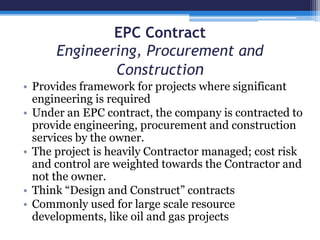
EPC Contract
Engineering, Procurement and
Construction
• Provides framework for projects where significant
engineering is required
• Under an EPC contract, the company is contracted to
provide engineering, procurement and construction
services by the owner.
• The project is heavily Contractor managed; cost risk
and control are weighted towards the Contractor and
not the owner.
• Think “Design and Construct” contracts
• Commonly used for large scale resource
developments, like oil and gas projects
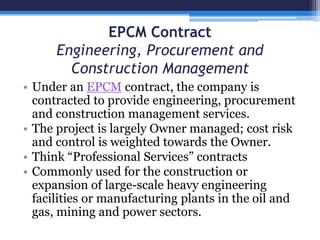
EPCM Contract
Engineering, Procurement and
Construction Management
• Under an EPCM contract, the company is
contracted to provide engineering, procurement
and construction management services.
• The project is largely Owner managed; cost risk
and control is weighted towards the Owner.
• Think “Professional Services” contracts
• Commonly used for the construction or
expansion of large-scale heavy engineering
facilities or manufacturing plants in the oil and
gas, mining and power sectors.
Responsibilities of the EPC Contractor
• The EPC contractor develops the project from
commencement to final completion
• The Contractor has direct contracts with the
contractors.
Responsibilities of the EPCM Contractor
• In EPCM contracts, Companies are contracted
by the Owner directly to provide services.
• The contractor is not directly involved in the
creation and construction of the project. Rather,
contractors are responsible for the design and
management of the project, on behalf of the
owner.
Both EPC and EPCM contracts can be highly
beneficial to a project. However, it’s crucial to
choose the correct form of contract to avoid
negative impacts on the cost and risk associated
with the project.
To learn more, visit our website

Understanding the Difference Between EPC and EPCM Contracts

  • 1.
  • 2.
    You’ve probably heardthe terms EPC (Engineering, Procurement and Construction) and EPCM (Engineering, Procurement and Construction Management) contracts since they are terms commonly used in the oil, gas, mining and power industries. However, there remains some confusion as to the fundamental difference between these contracts and the role of the contractor.
  • 3.
    EPC Contract Engineering, Procurementand Construction • Provides framework for projects where significant engineering is required • Under an EPC contract, the company is contracted to provide engineering, procurement and construction services by the owner. • The project is heavily Contractor managed; cost risk and control are weighted towards the Contractor and not the owner. • Think “Design and Construct” contracts • Commonly used for large scale resource developments, like oil and gas projects
  • 4.
    EPCM Contract Engineering, Procurementand Construction Management • Under an EPCM contract, the company is contracted to provide engineering, procurement and construction management services. • The project is largely Owner managed; cost risk and control is weighted towards the Owner. • Think “Professional Services” contracts • Commonly used for the construction or expansion of large-scale heavy engineering facilities or manufacturing plants in the oil and gas, mining and power sectors.
  • 5.
    Responsibilities of theEPC Contractor • The EPC contractor develops the project from commencement to final completion • The Contractor has direct contracts with the contractors.
  • 6.
    Responsibilities of theEPCM Contractor • In EPCM contracts, Companies are contracted by the Owner directly to provide services. • The contractor is not directly involved in the creation and construction of the project. Rather, contractors are responsible for the design and management of the project, on behalf of the owner.
  • 7.
    Both EPC andEPCM contracts can be highly beneficial to a project. However, it’s crucial to choose the correct form of contract to avoid negative impacts on the cost and risk associated with the project. To learn more, visit our website