

EOTs? Avoiding the Traps or Taking
       Advantage of Them


       Dr. Anamaria Popescu,PE,PMP,PSP
    McLachlan Lister - Hill International Australia
                     May 23, 2012
Presentation Objectives

   EOT Triggers
   Contractual Completion Date(s)
   Primary Ingredients
   Schedule Integrity
   Documentation of Causation
   Responsibility Assignment
   Concurrency of Delays
   Schedule Analysis
   Presentation is Everything!
   Recap
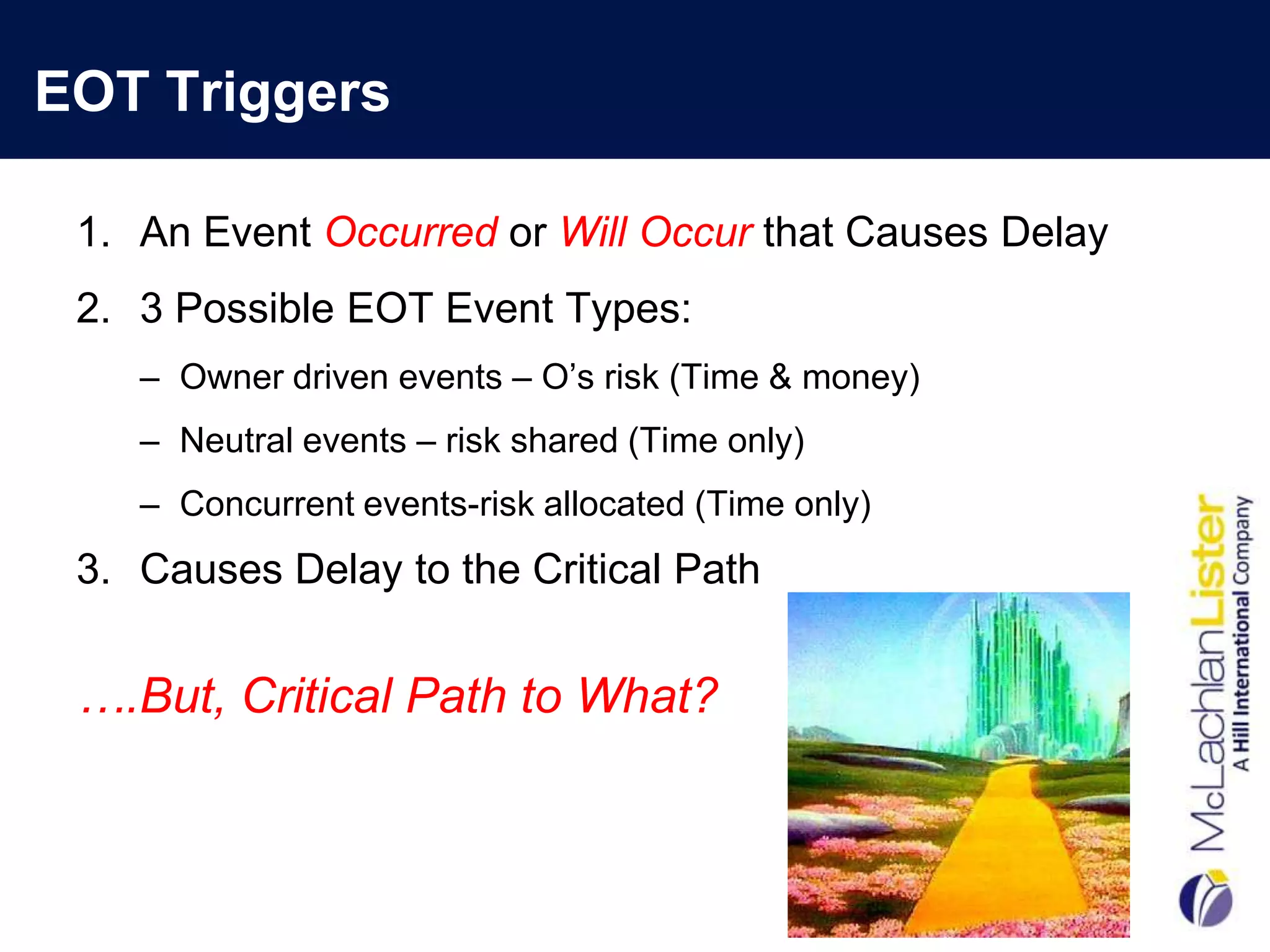
EOT Triggers

 1. An Event Occurred or Will Occur that Causes Delay
 2. 3 Possible EOT Event Types:
    – Owner driven events – O‟s risk (Time & money)
    – Neutral events – risk shared (Time only)
    – Concurrent events-risk allocated (Time only)
 3. Causes Delay to the Critical Path


 ….But, Critical Path to What?
Contractual Completion Date(s)
  Dealt with in Contract 2 ways:
    – By stating a date
    – By stating a works period
  Types of Contractual Completion Dates:
    –   „Practical Completion‟ Date
    –   „Substantial Completion‟ Date
    –   „Mechanical Completion‟ Date
    –   „Handover‟ Date
    –   „Separable Portion‟ Date
  May apply to a Section, or the Entire Project
    – Each Section is treated separately
    – Multiple EOT Claims and LD Assessments May Apply
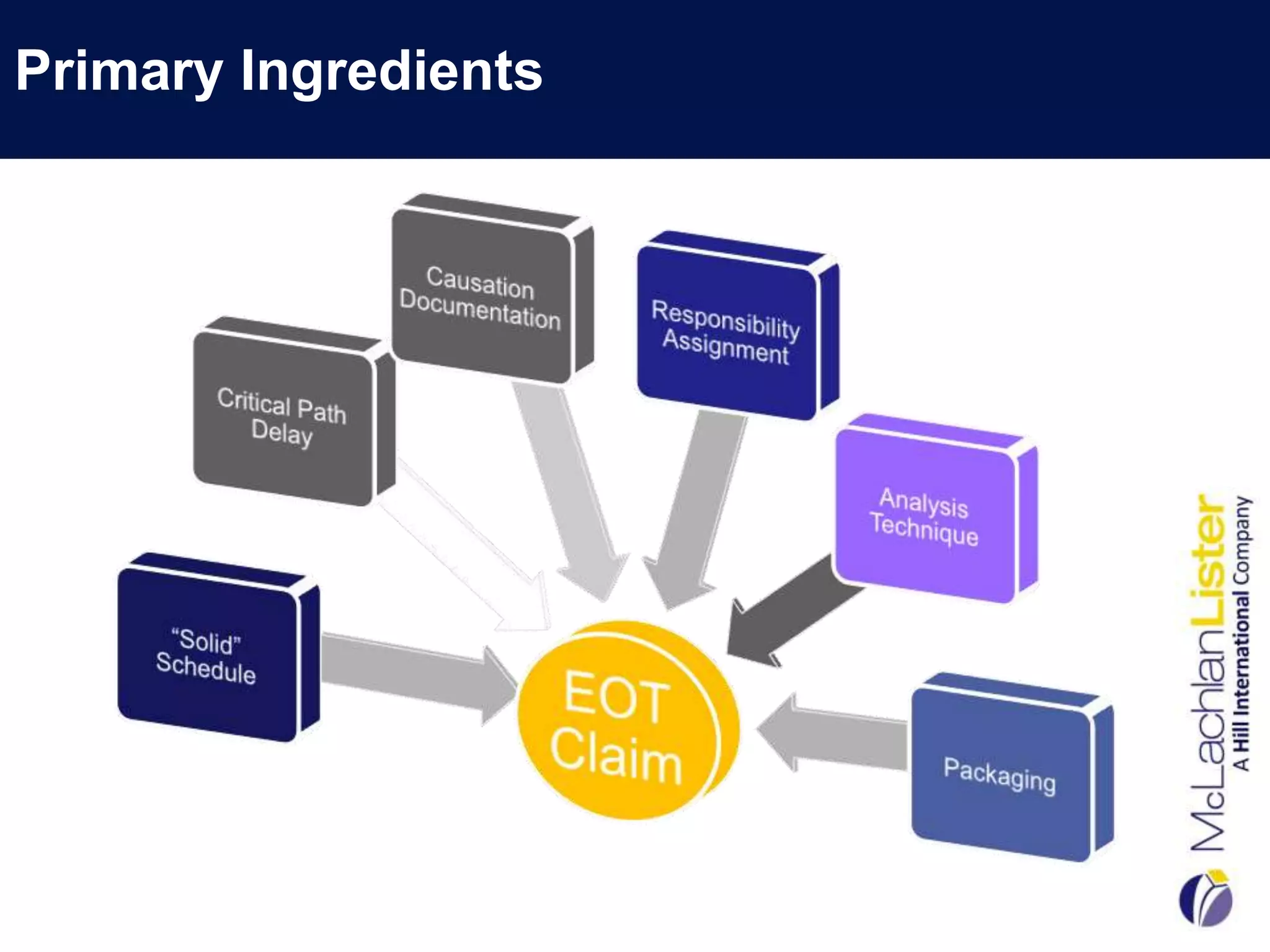
Primary Ingredients
Schedule Integrity: What is It?

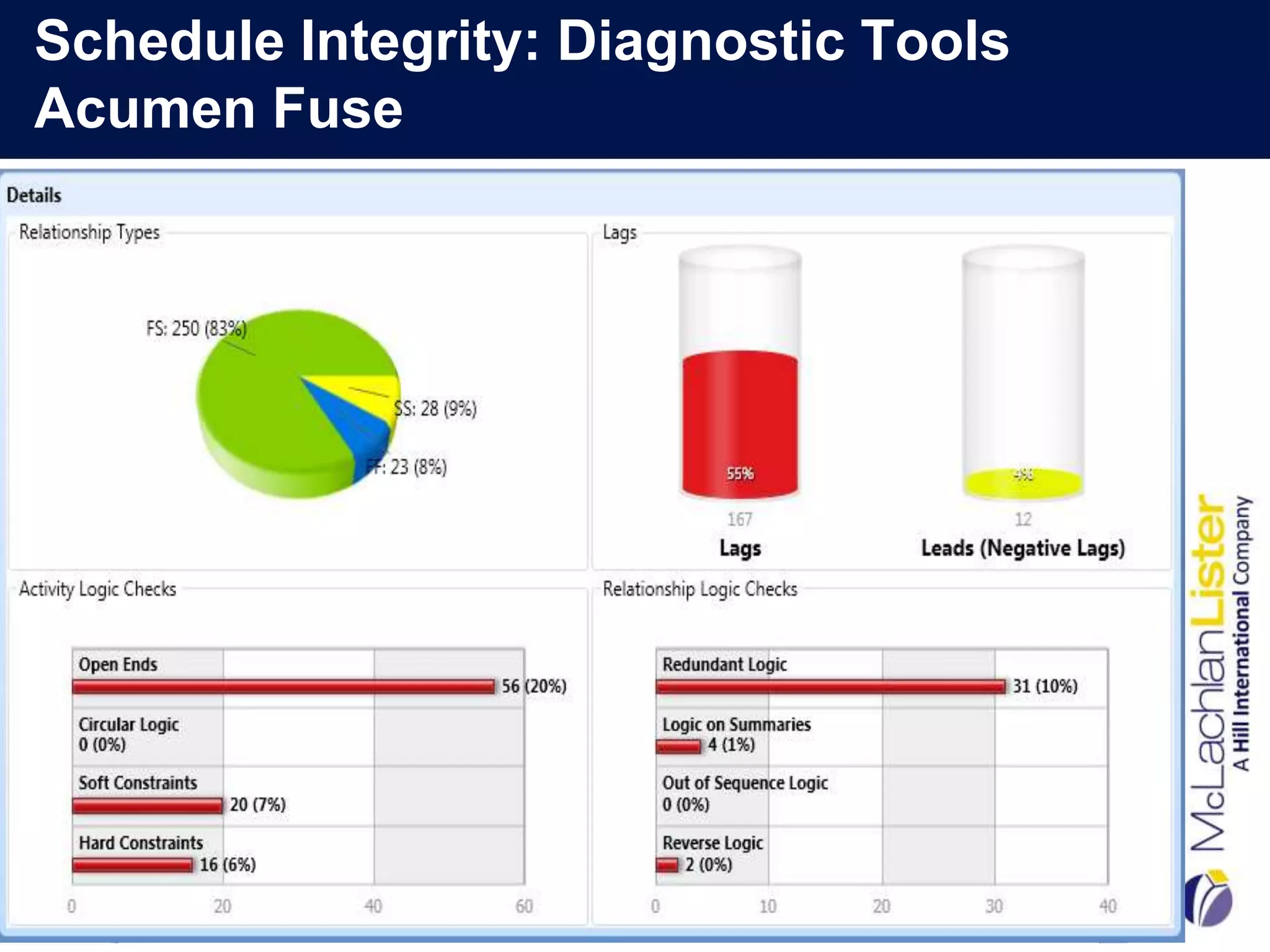
    No Open Ends
    Limited Constraints
    All Scope Captured
    Majority of Tie Types: FS
    No Large Lags: “Float Hoarding”
    No Redundant Logic Ties
    Critical Path Makes Sense
    Critical Path is Continuous
    “Longest Path” Filter Confirmation
Schedule Integrity

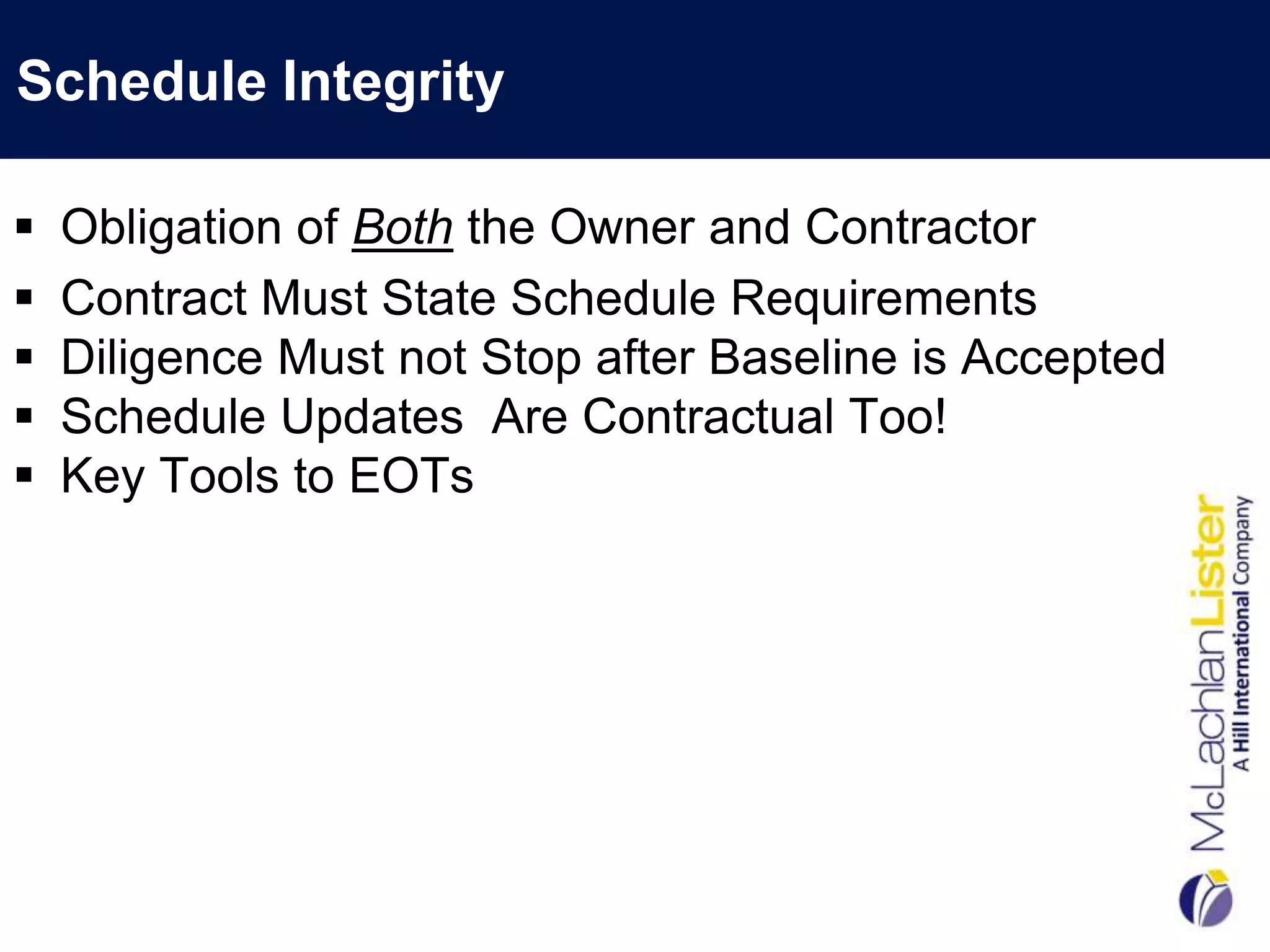
   Obligation of Both the Owner and Contractor
   Contract Must State Schedule Requirements
   Diligence Must not Stop after Baseline is Accepted
   Schedule Updates Are Contractual Too!
   Key Tools to EOTs
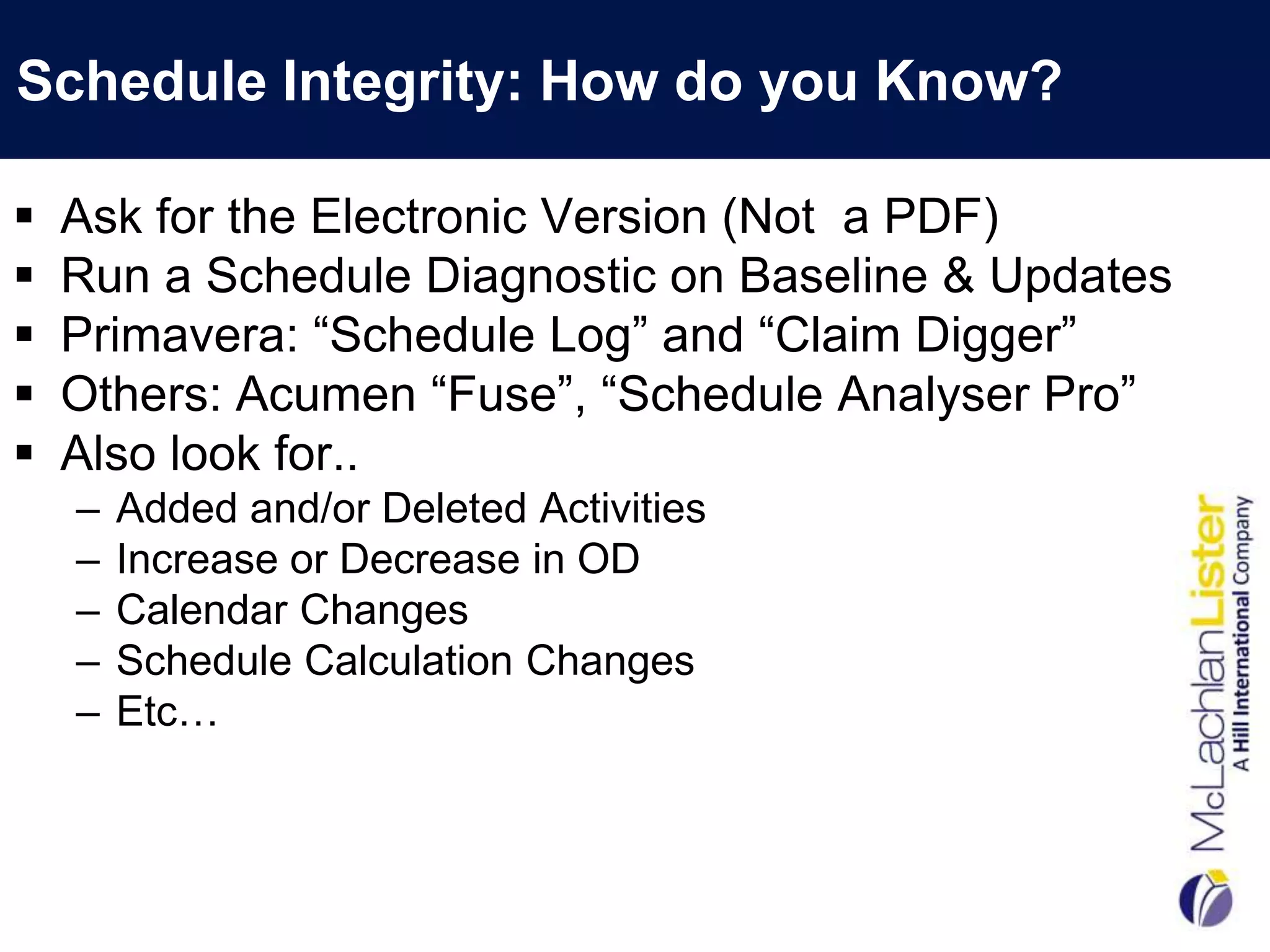
Schedule Integrity: How do you Know?

   Ask for the Electronic Version (Not a PDF)
   Run a Schedule Diagnostic on Baseline & Updates
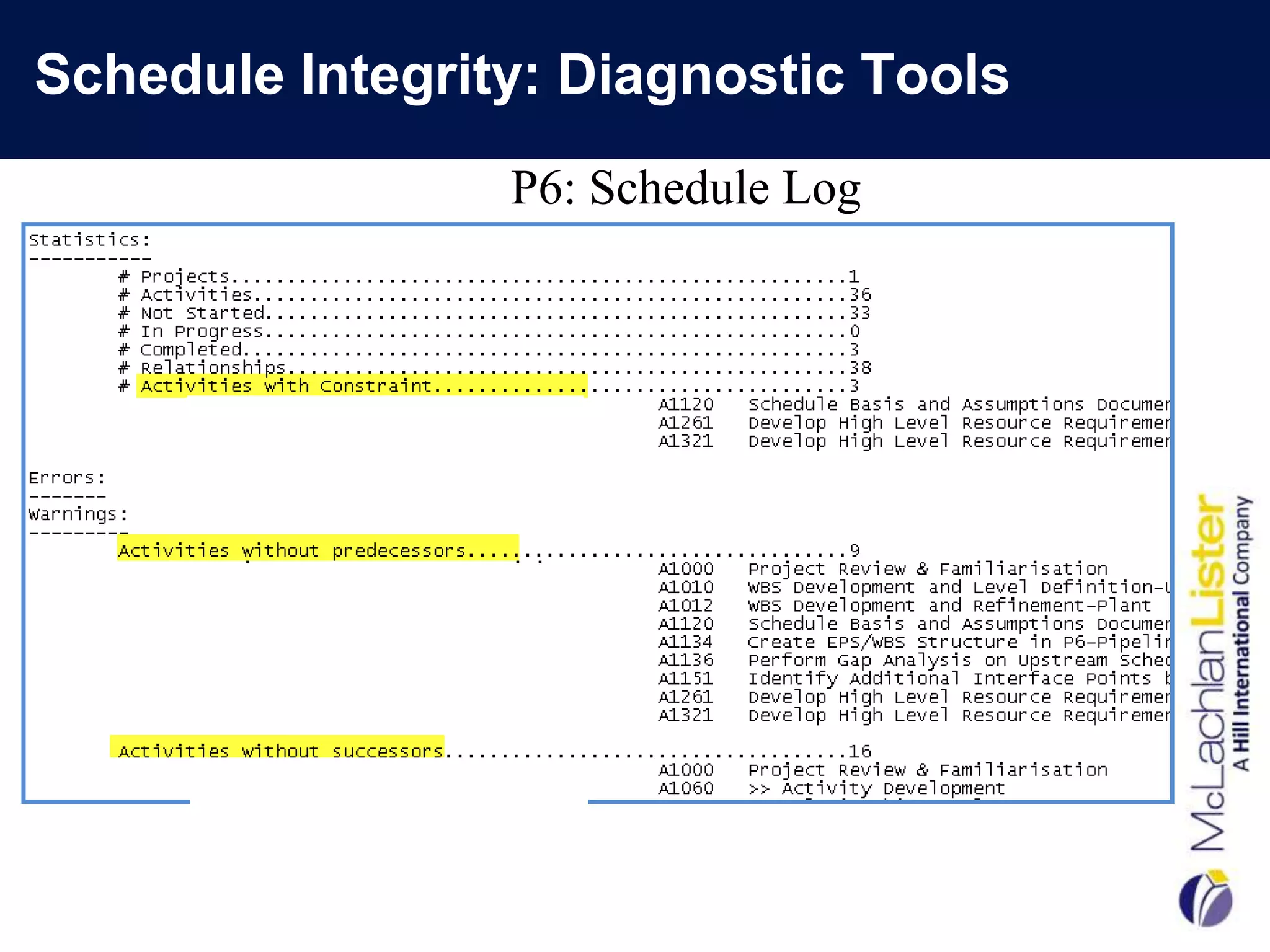
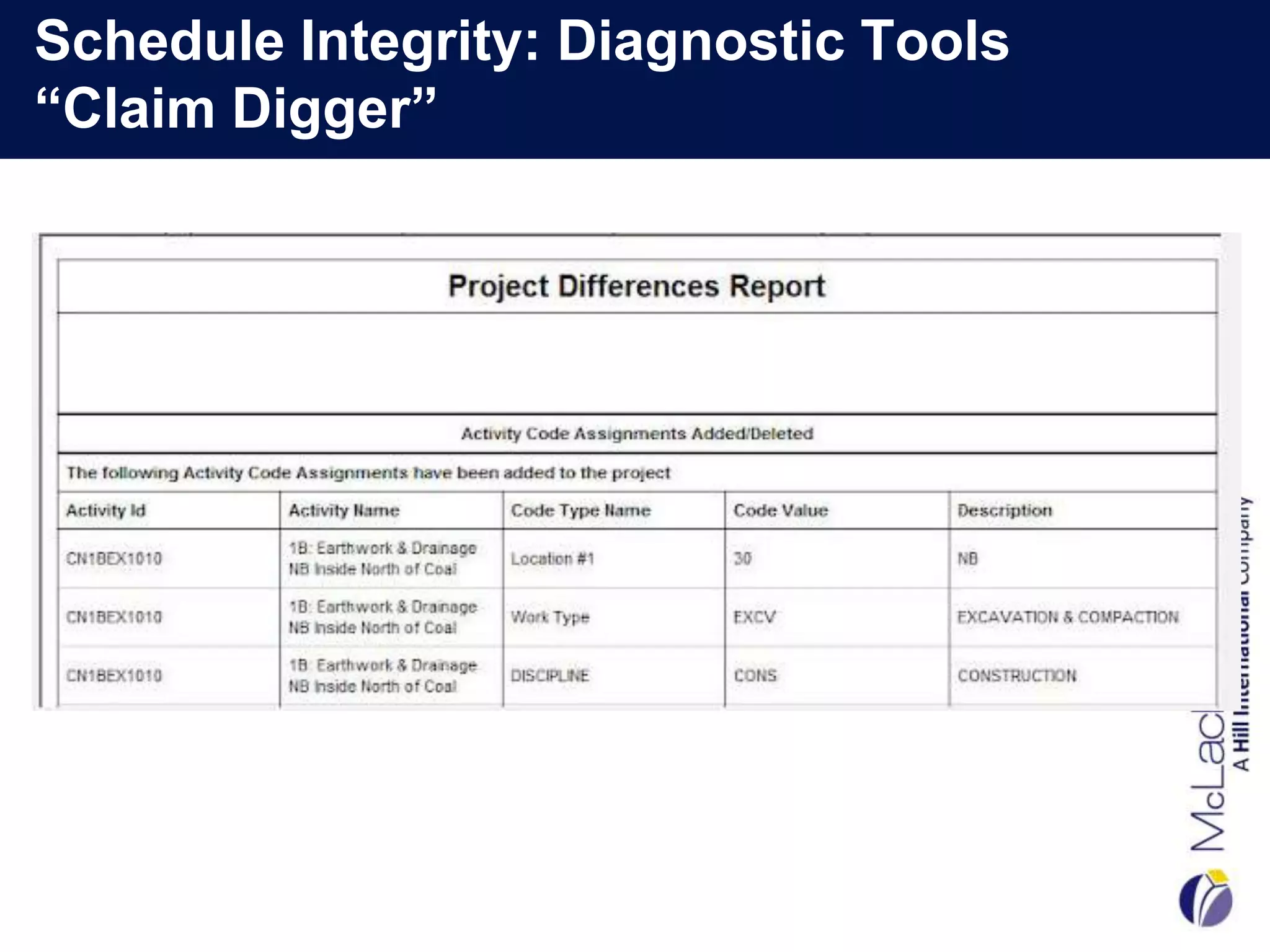
   Primavera: “Schedule Log” and “Claim Digger”
   Others: Acumen “Fuse”, “Schedule Analyser Pro”
   Also look for..
    –   Added and/or Deleted Activities
    –   Increase or Decrease in OD
    –   Calendar Changes
    –   Schedule Calculation Changes
    –   Etc…
Schedule Integrity: Diagnostic Tools
                 P6: Schedule Log
Schedule Integrity: Diagnostic Tools
“Claim Digger”
Schedule Integrity: Diagnostic Tools
Acumen Fuse
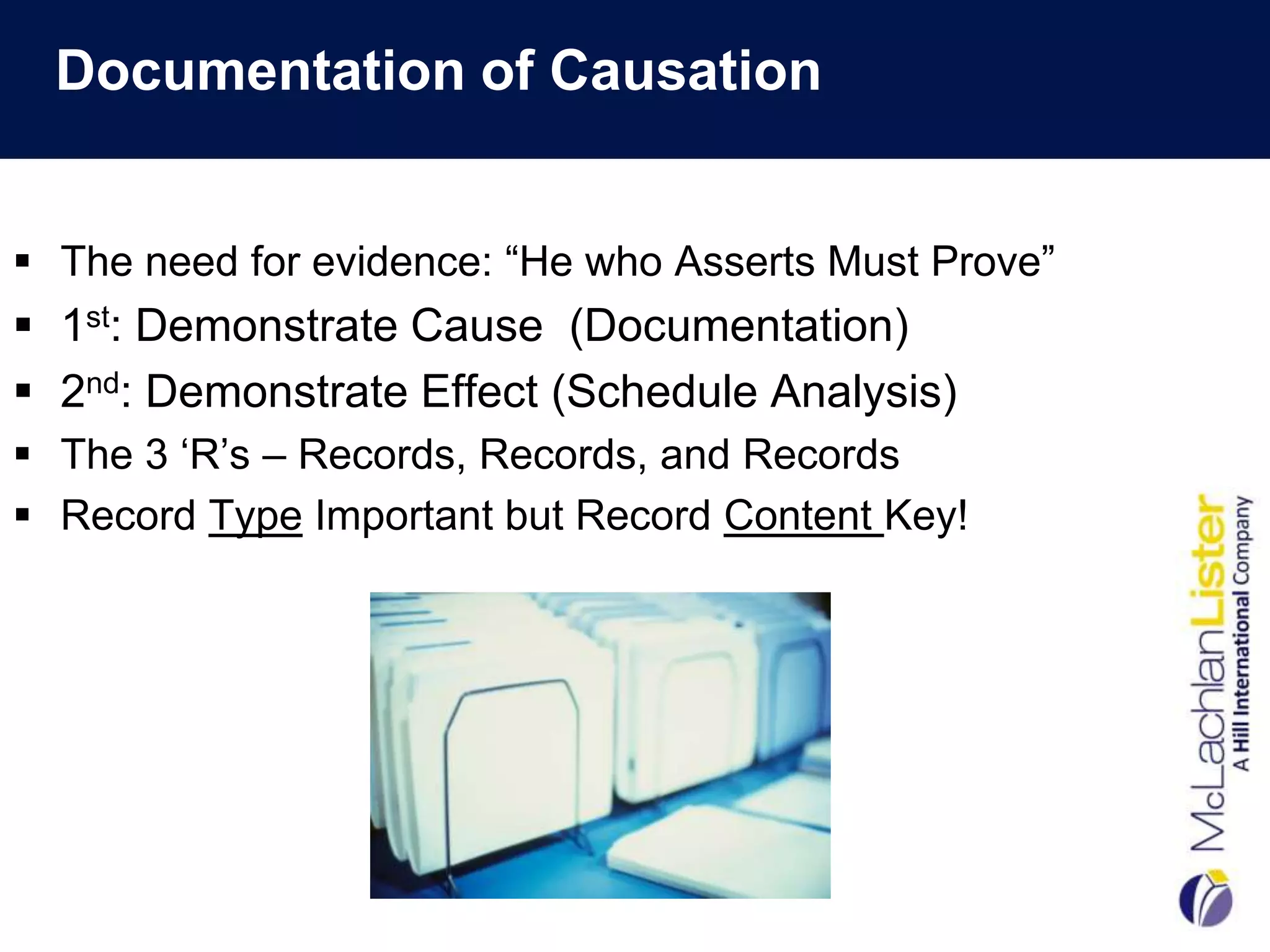
Documentation of Causation


 The need for evidence: “He who Asserts Must Prove”
 1st: Demonstrate Cause (Documentation)
 2nd: Demonstrate Effect (Schedule Analysis)
 The 3 „R‟s – Records, Records, and Records
 Record Type Important but Record Content Key!
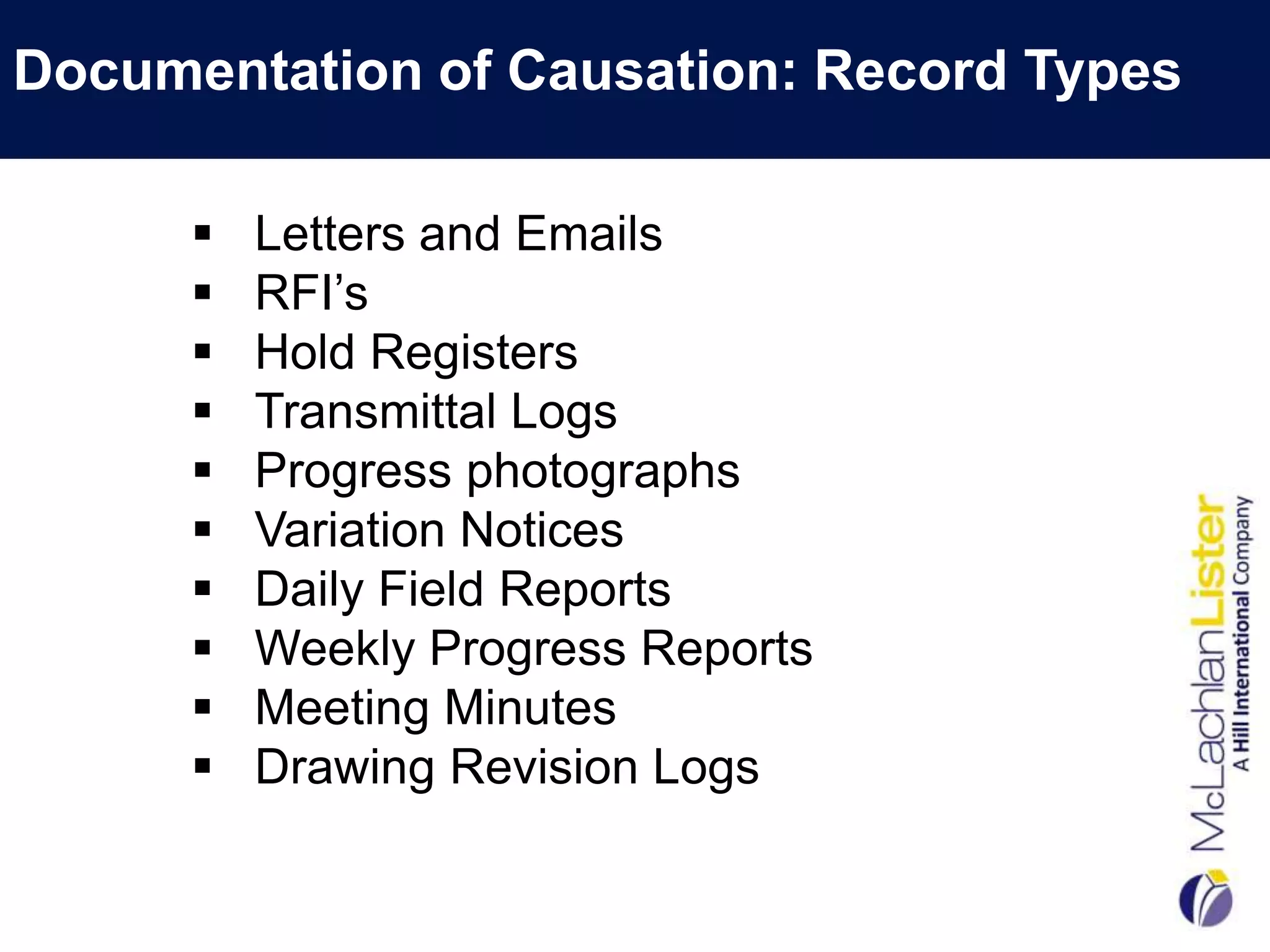
Documentation of Causation: Record Types

         Letters and Emails
         RFI‟s
         Hold Registers
         Transmittal Logs
         Progress photographs
         Variation Notices
         Daily Field Reports
         Weekly Progress Reports
         Meeting Minutes
         Drawing Revision Logs
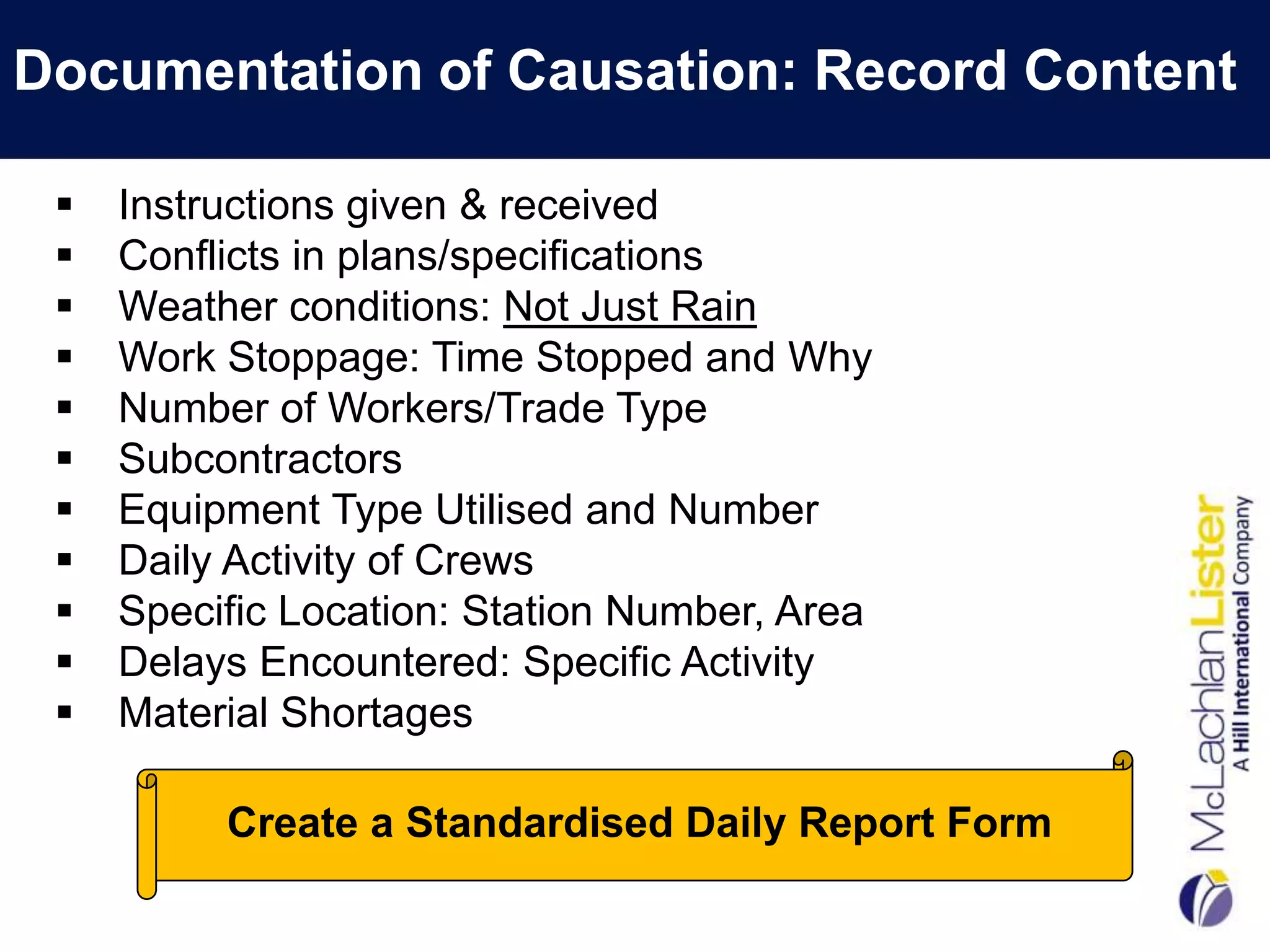
Documentation of Causation: Record Content

    Instructions given & received
    Conflicts in plans/specifications
    Weather conditions: Not Just Rain
    Work Stoppage: Time Stopped and Why
    Number of Workers/Trade Type
    Subcontractors
    Equipment Type Utilised and Number
    Daily Activity of Crews
    Specific Location: Station Number, Area
    Delays Encountered: Specific Activity
    Material Shortages

          Create a Standardised Daily Report Form
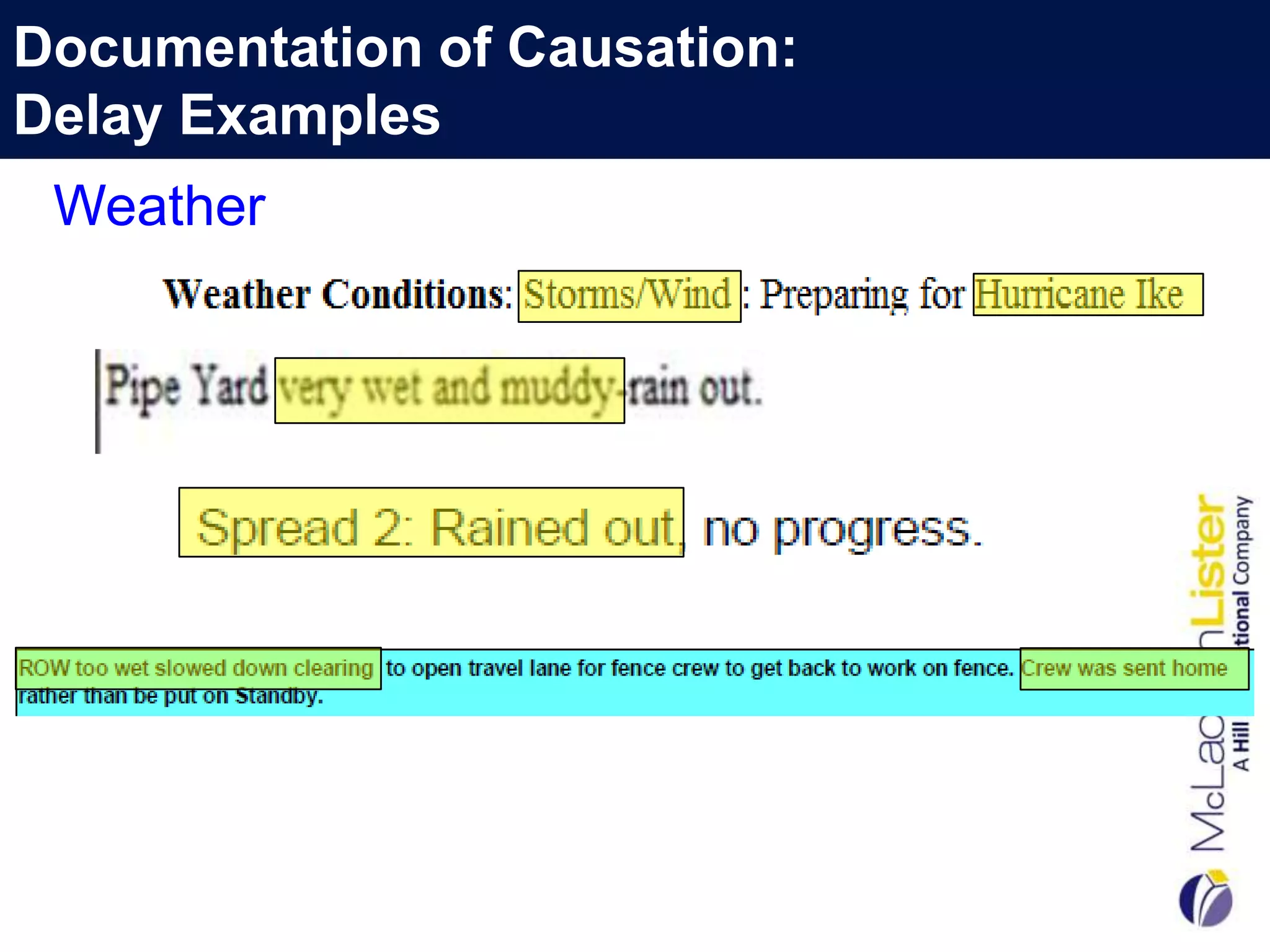
Documentation of Causation:
Delay Examples
 Weather
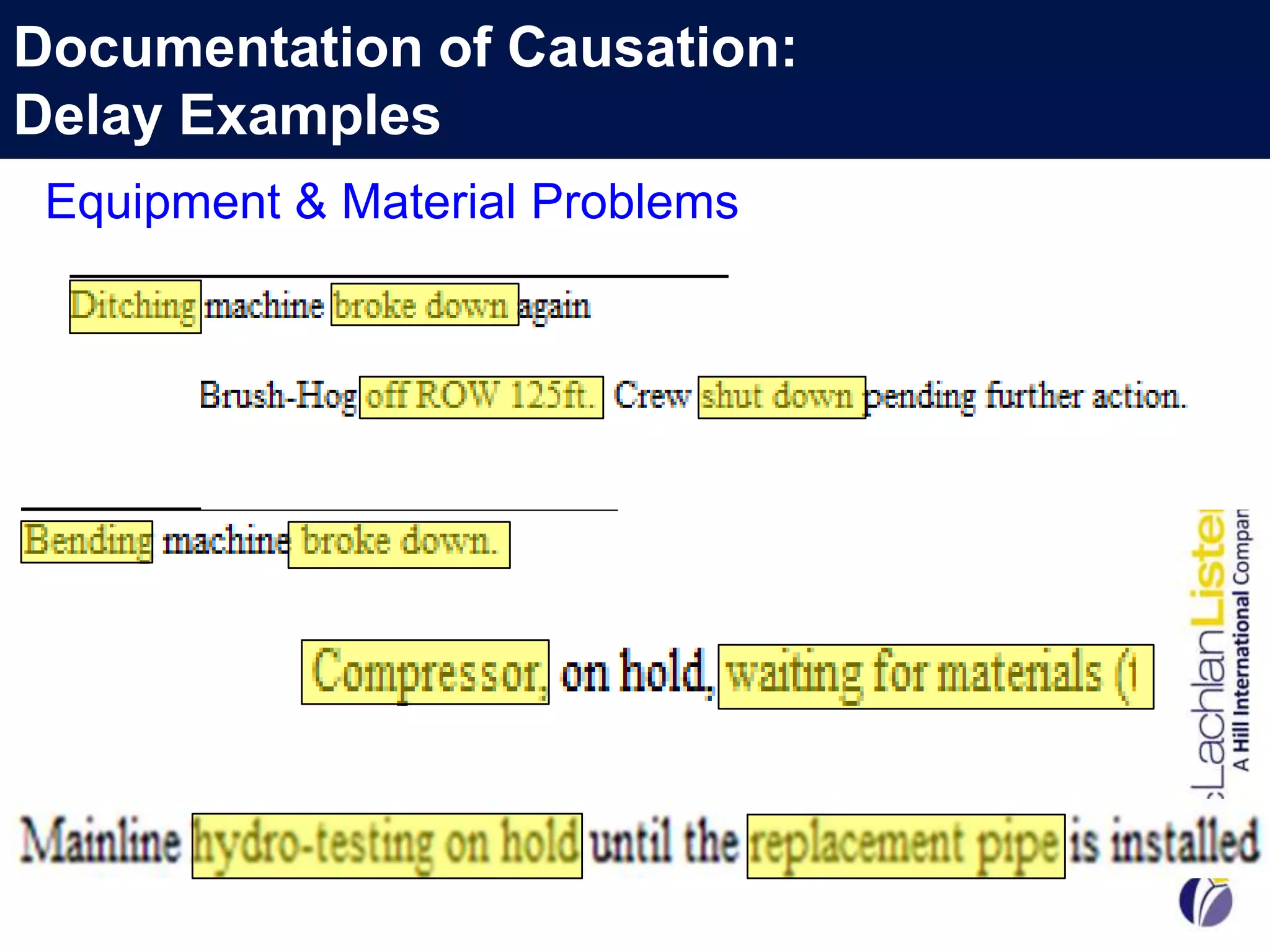
Documentation of Causation:
Delay Examples
 Equipment & Material Problems
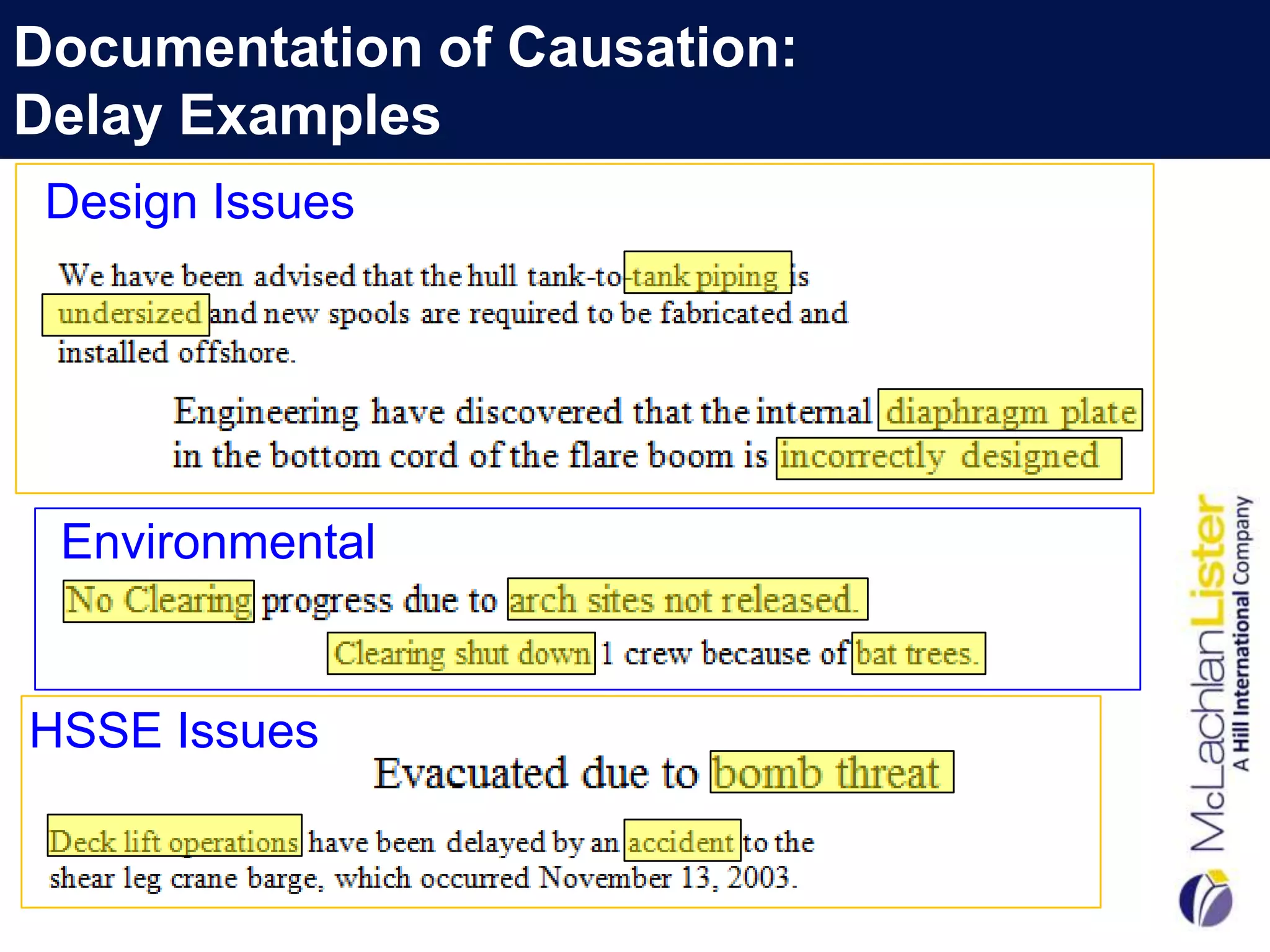
Documentation of Causation:
Delay Examples
 Design Issues


 Environmental


HSSE Issues
Responsibility Assignment

 What Does the Contract Say?
  –   Owner Caused Delays
  –   Force Majeure Delays
  –   Neutral Delays-Weather
  –   Non-Excusable Delays

 Allocate Responsibility to Individual Delay Events

                                          Allocate
          Code        Split      Code
                                           Actual
          Delay     Activities   Resp.
                                          Duration
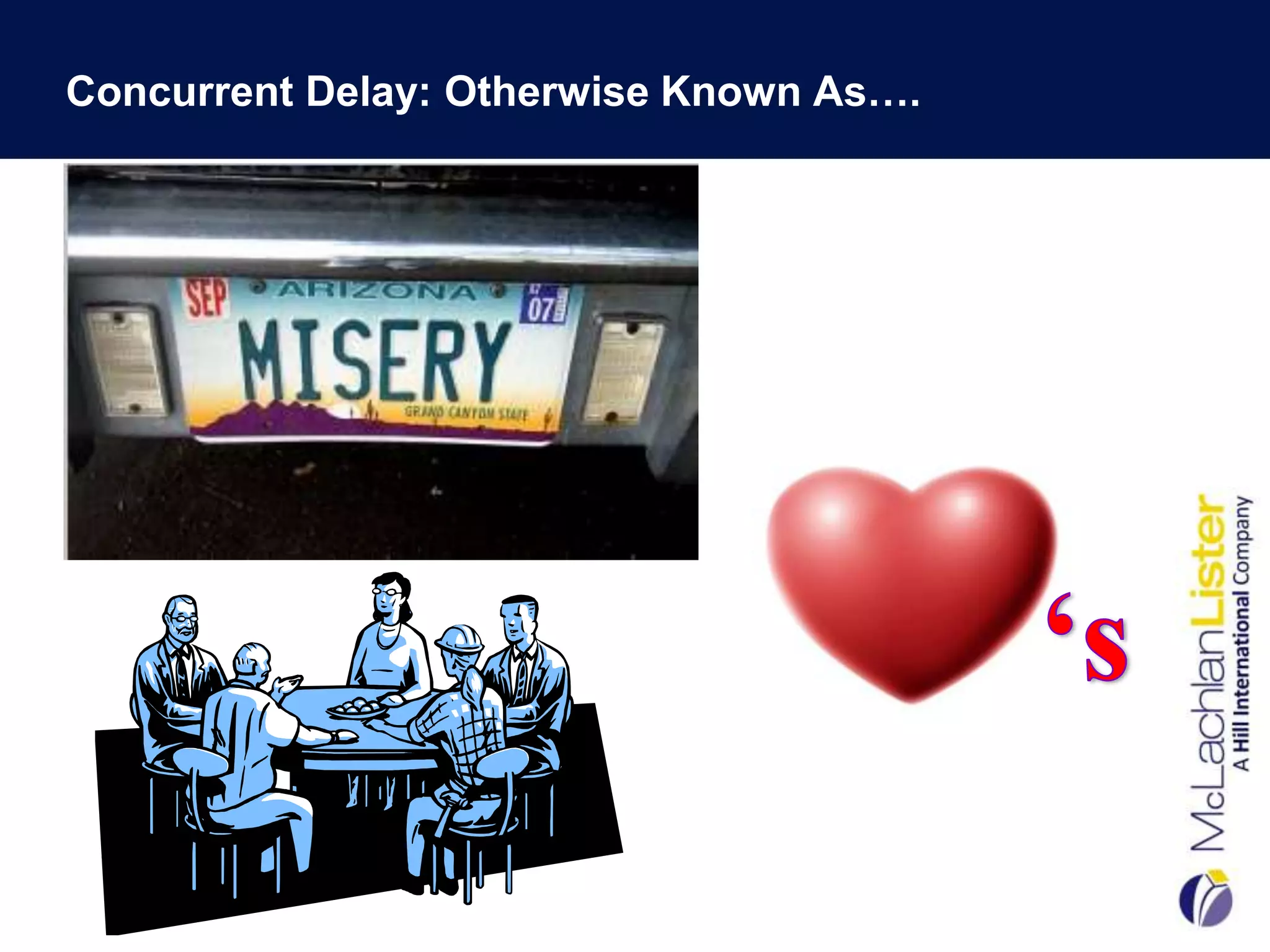
Concurrent Delay: Otherwise Known As….
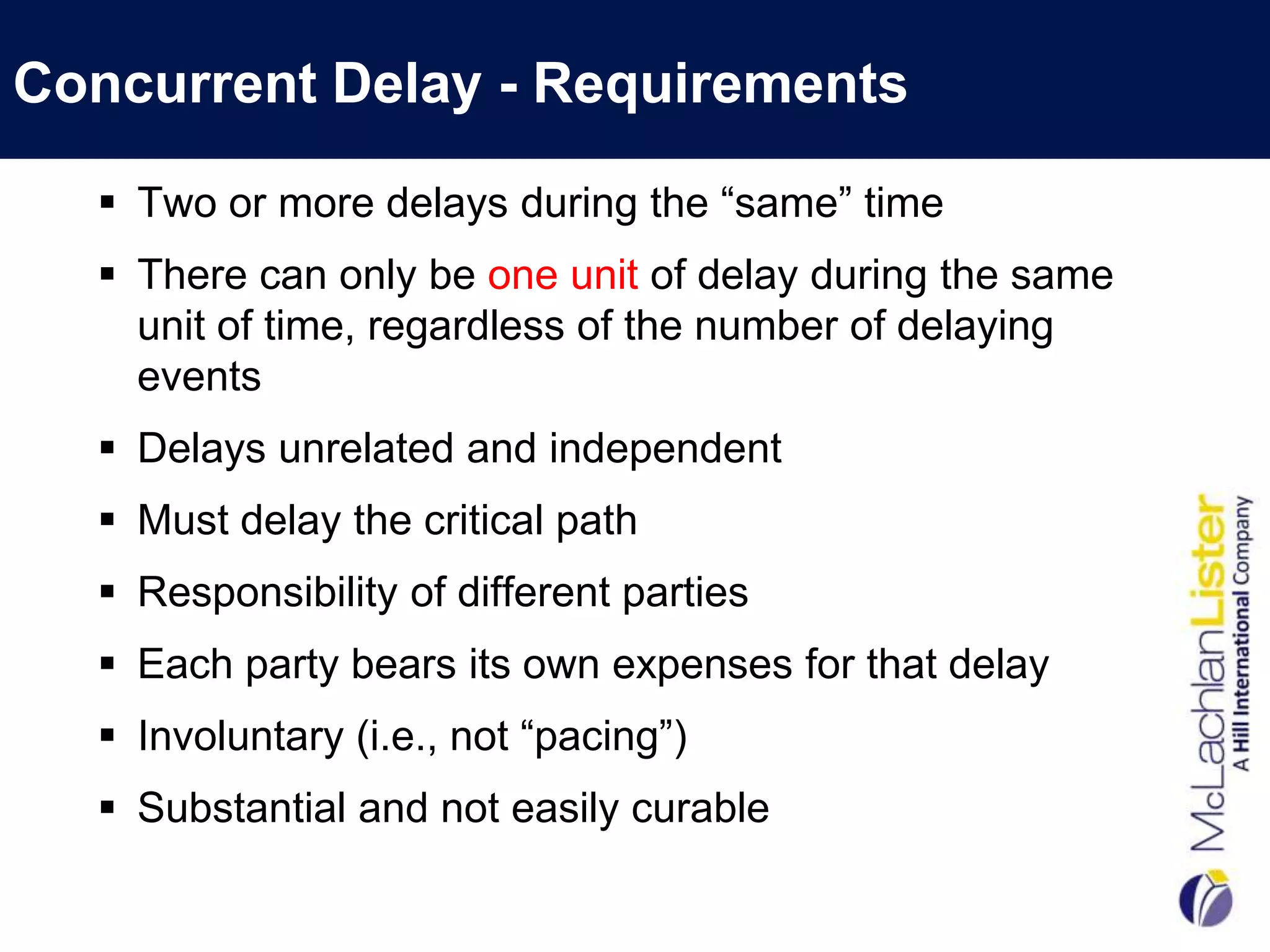
Concurrent Delay - Requirements

   Two or more delays during the “same” time
   There can only be one unit of delay during the same
    unit of time, regardless of the number of delaying
    events
   Delays unrelated and independent
   Must delay the critical path
   Responsibility of different parties
   Each party bears its own expenses for that delay
   Involuntary (i.e., not “pacing”)
   Substantial and not easily curable
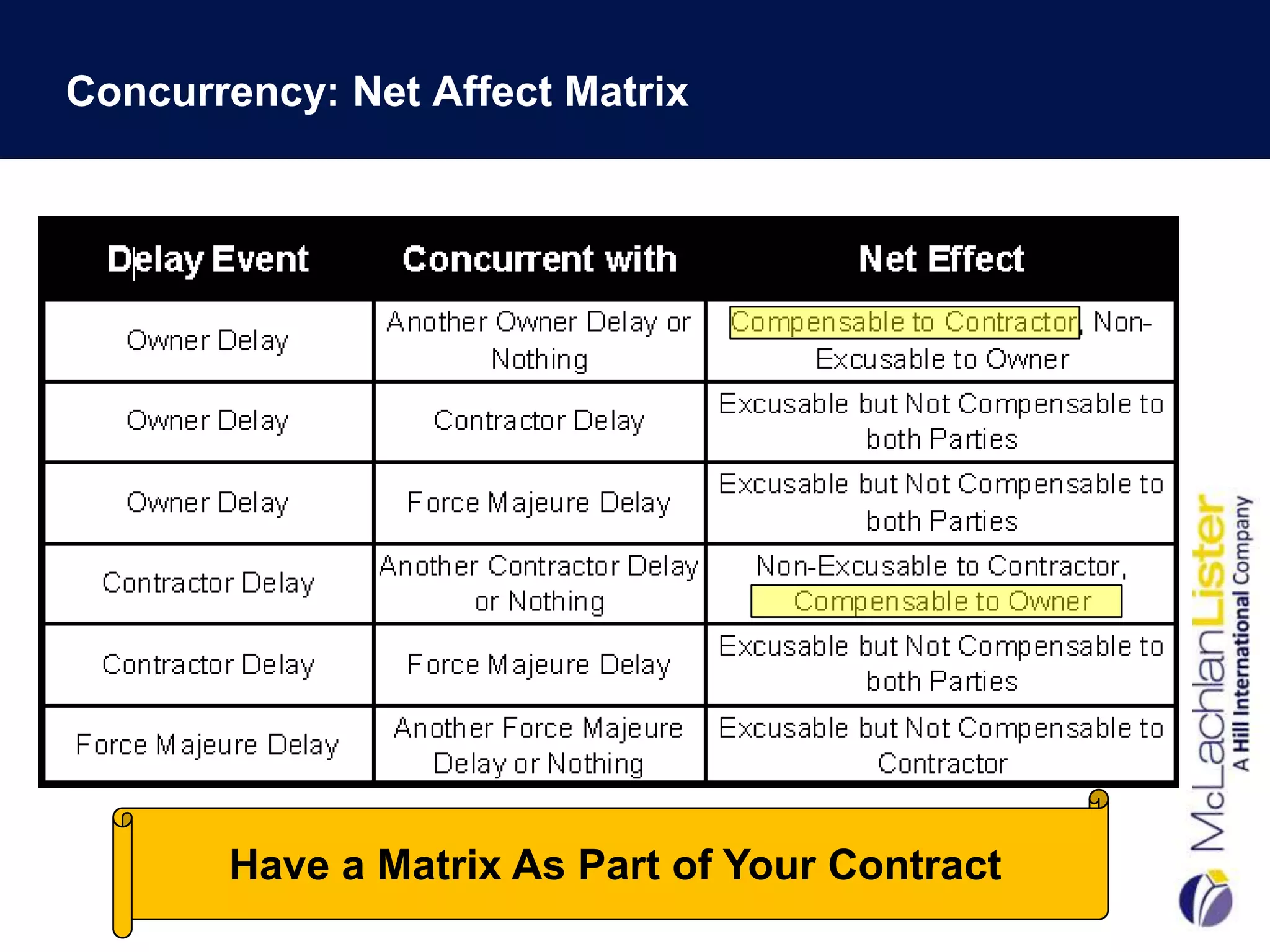
Concurrency: Net Affect Matrix


       Have a Matrix As Part of Your Contract
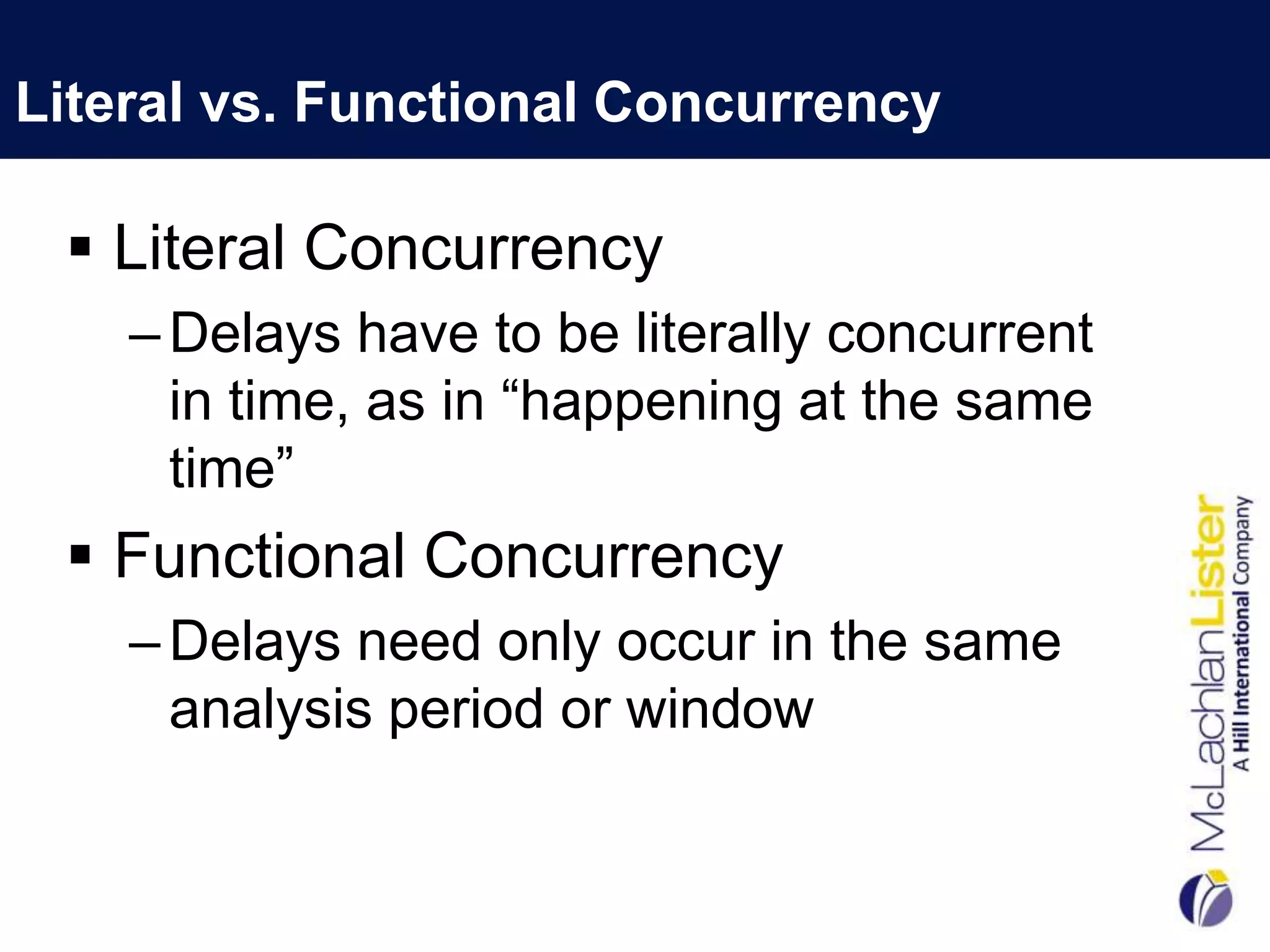
Literal vs. Functional Concurrency

  Literal Concurrency
    – Delays have to be literally concurrent
      in time, as in “happening at the same
      time”
  Functional Concurrency
    – Delays need only occur in the same
      analysis period or window
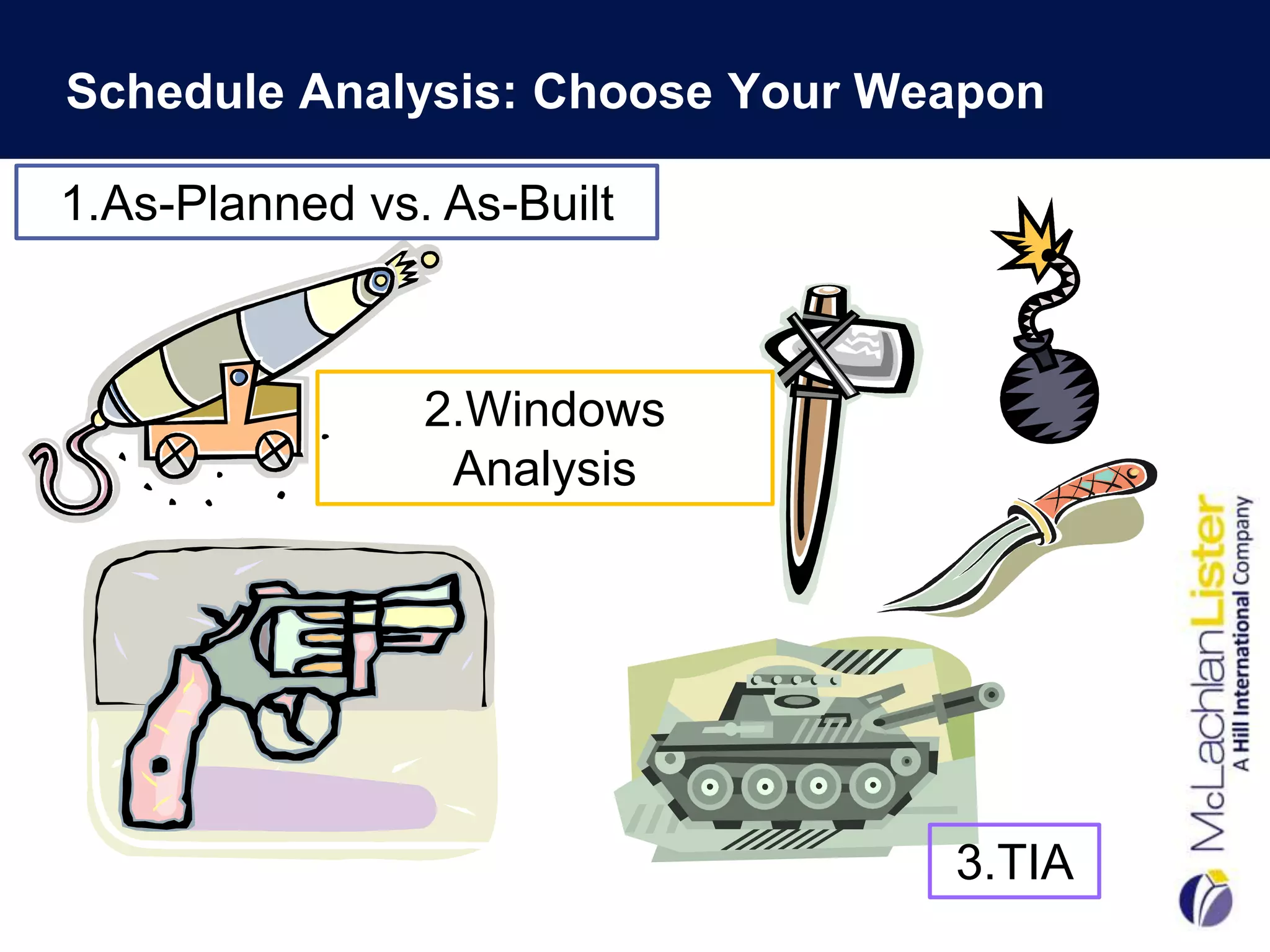
Schedule Analysis: Choose Your Weapon

1.As-Planned vs. As-Built


                2.Windows
                 Analysis


                                 3.TIA
As-Planned vs. As-Built


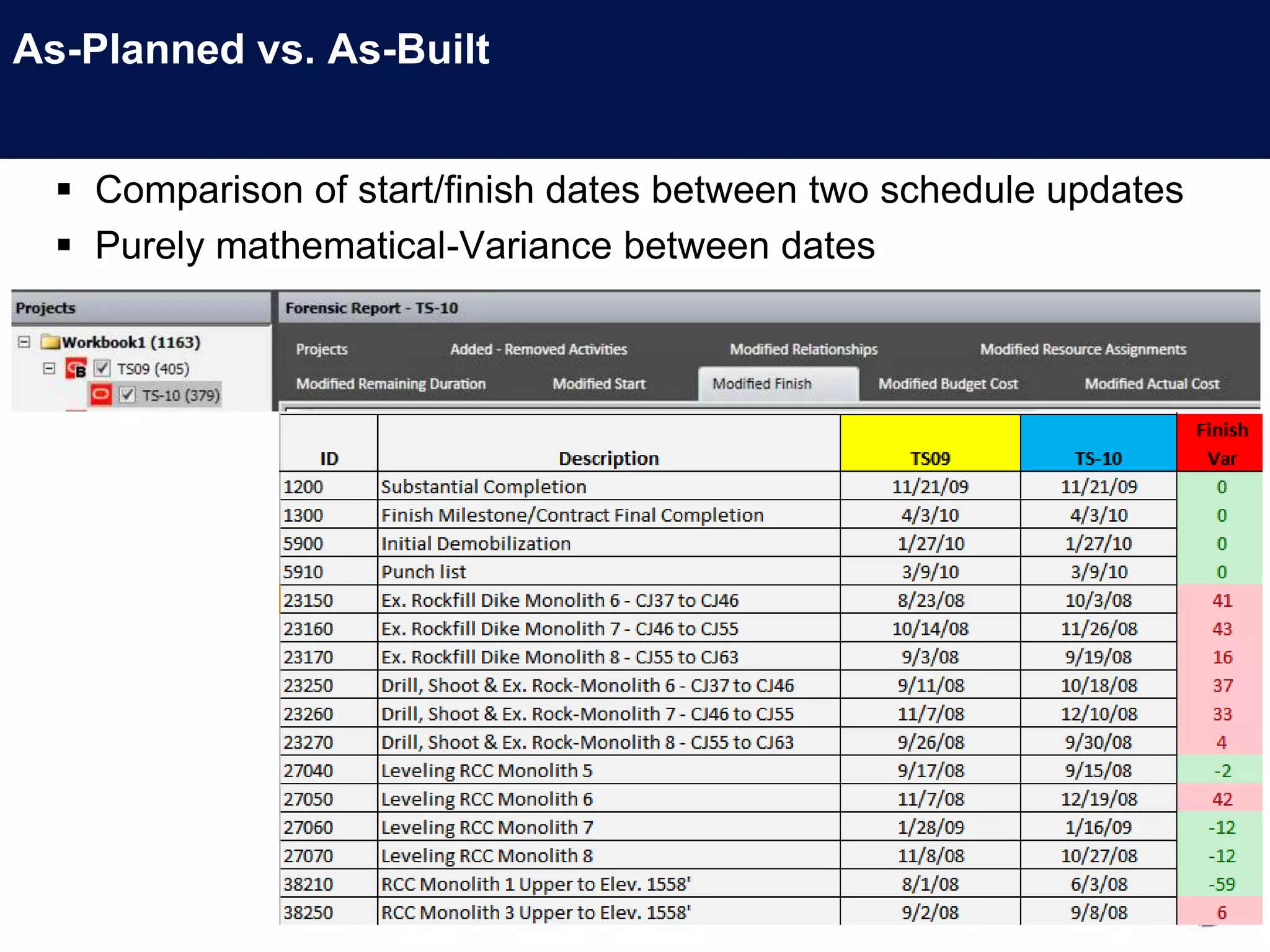
   Comparison of start/finish dates between two schedule updates
   Purely mathematical-Variance between dates
As-Planned vs. As-Built


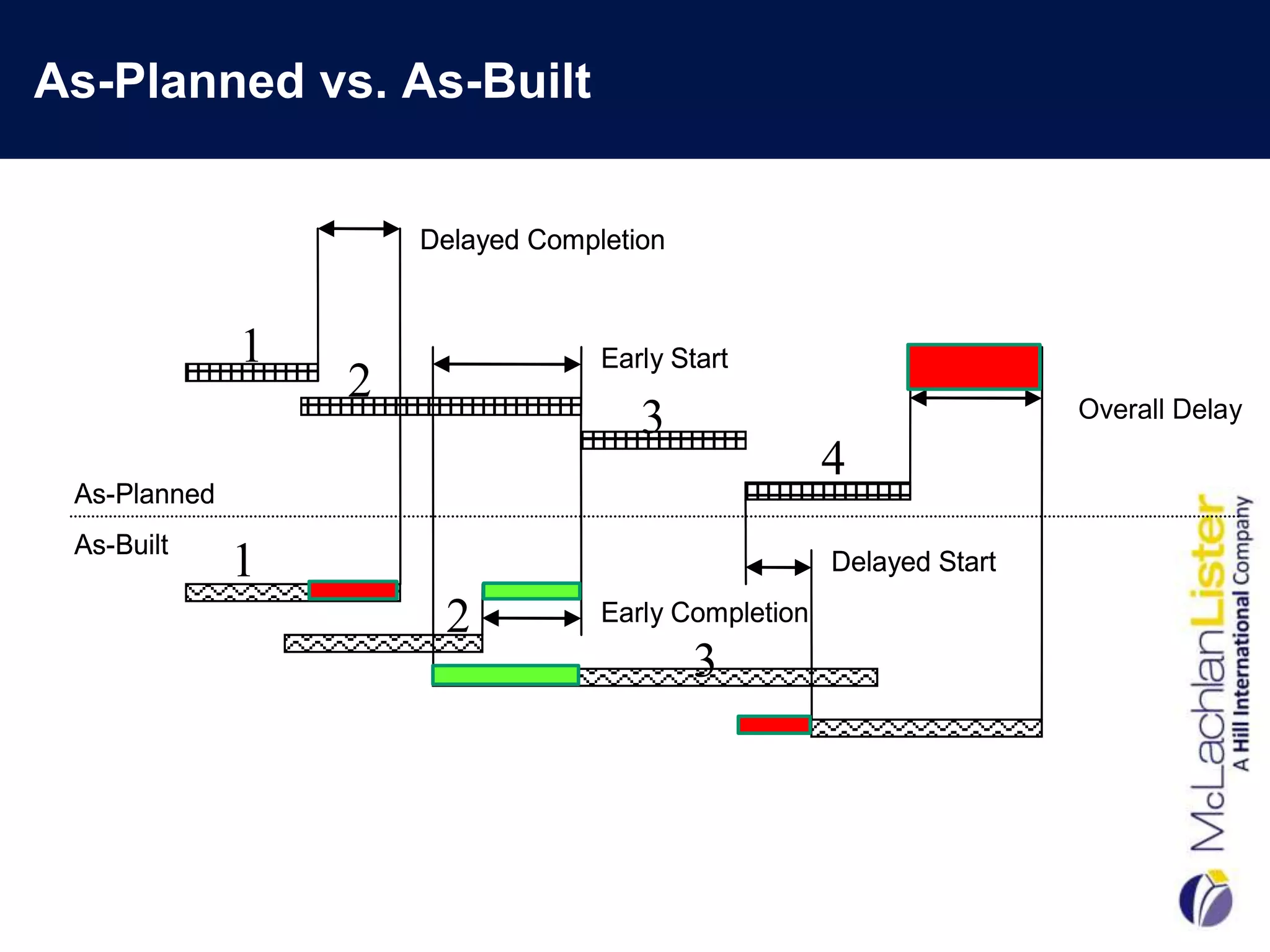
                      Delayed Completion


              1                    Early Start
                  2                                                   Overall Delay
                                      3
                                                      4
 As-Planned
 As-Built
              1                                       Delayed Start

                       2           Early Completion
                                           3
As-Planned vs. As-Built

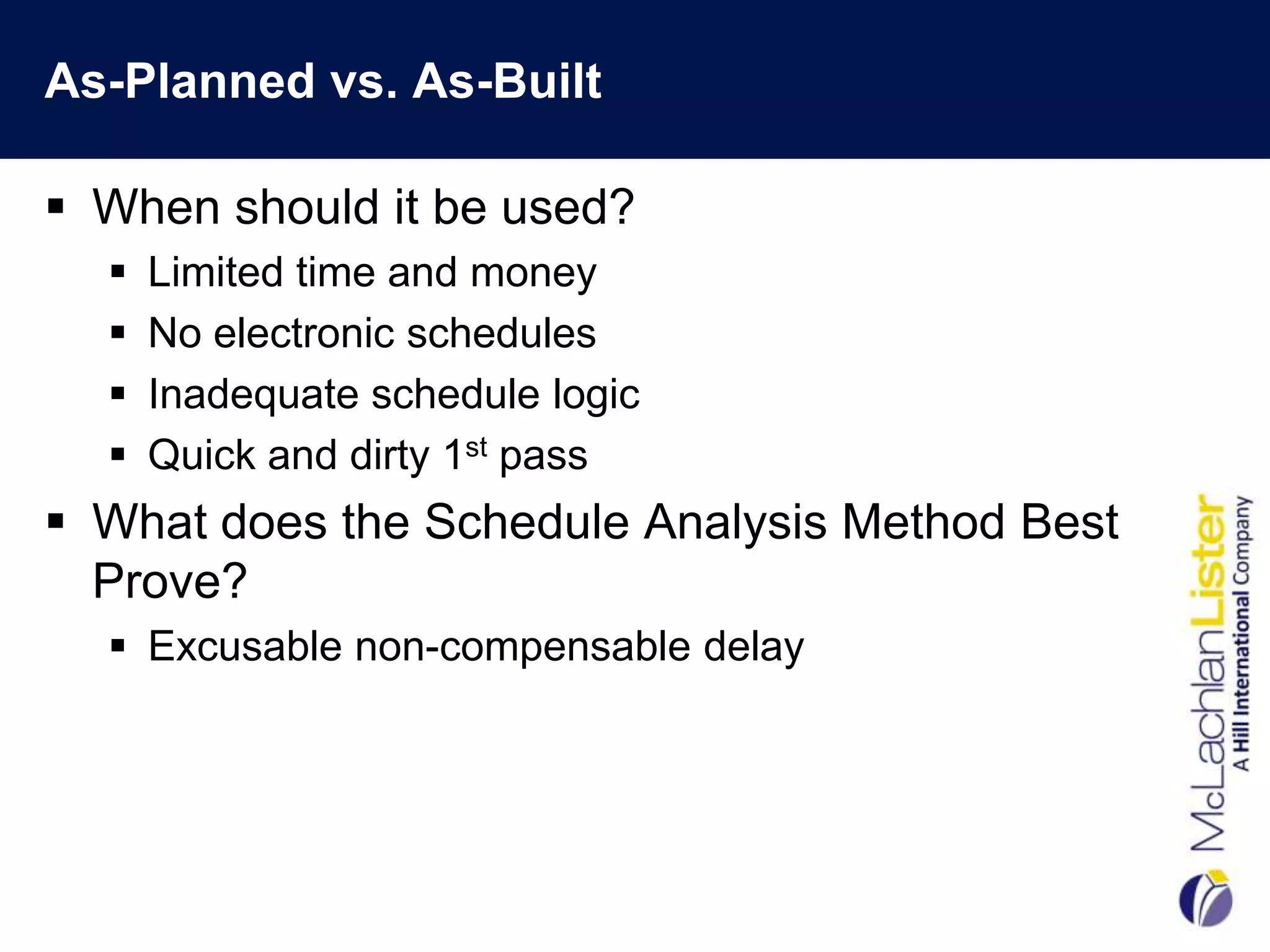
 When should it be used?
     Limited time and money
     No electronic schedules
     Inadequate schedule logic
     Quick and dirty 1st pass
 What does the Schedule Analysis Method Best
  Prove?
   Excusable non-compensable delay
As-Planned vs. As-Built

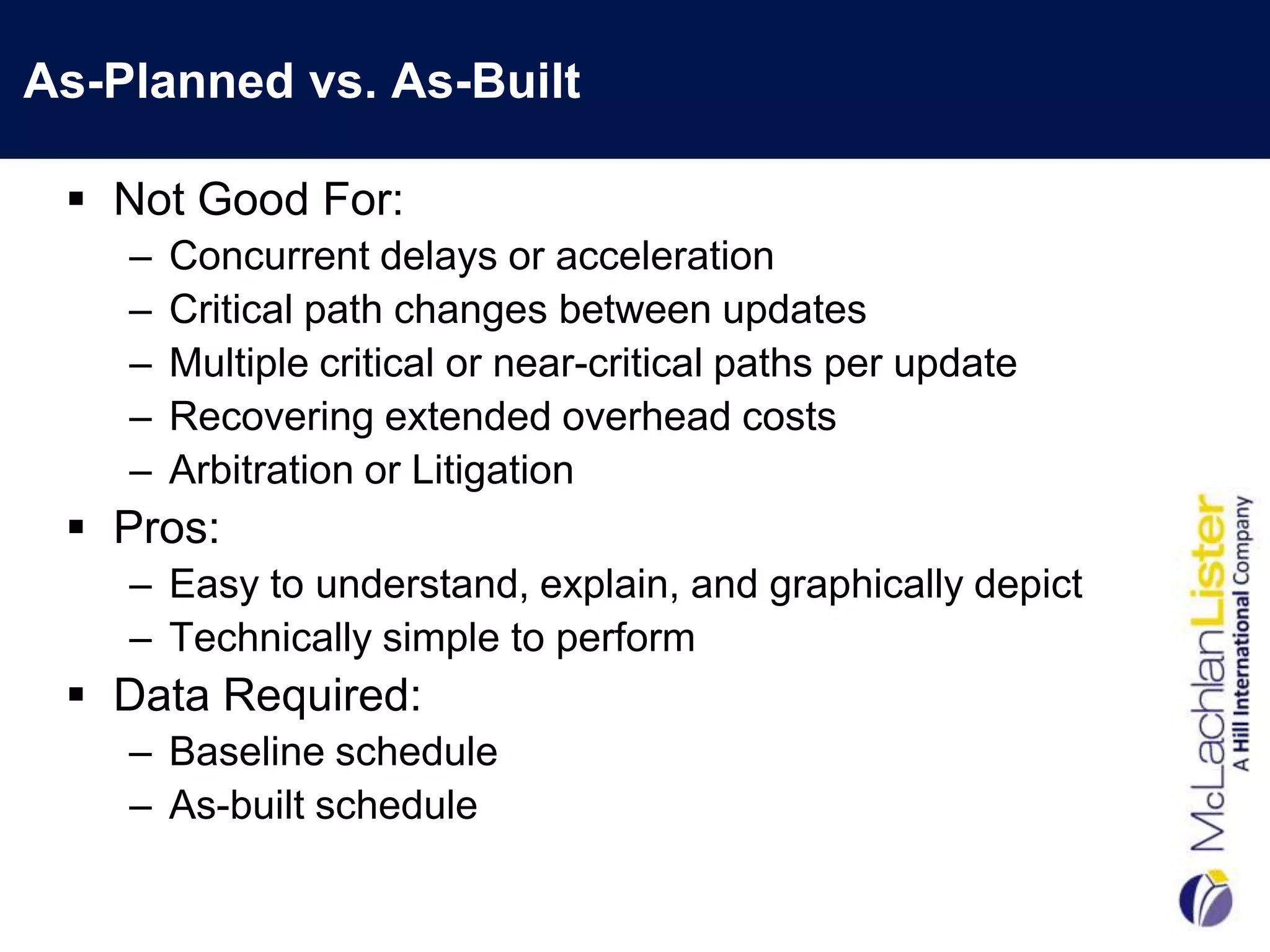
  Not Good For:
    –   Concurrent delays or acceleration
    –   Critical path changes between updates
    –   Multiple critical or near-critical paths per update
    –   Recovering extended overhead costs
    –   Arbitration or Litigation
  Pros:
    – Easy to understand, explain, and graphically depict
    – Technically simple to perform
  Data Required:
    – Baseline schedule
    – As-built schedule
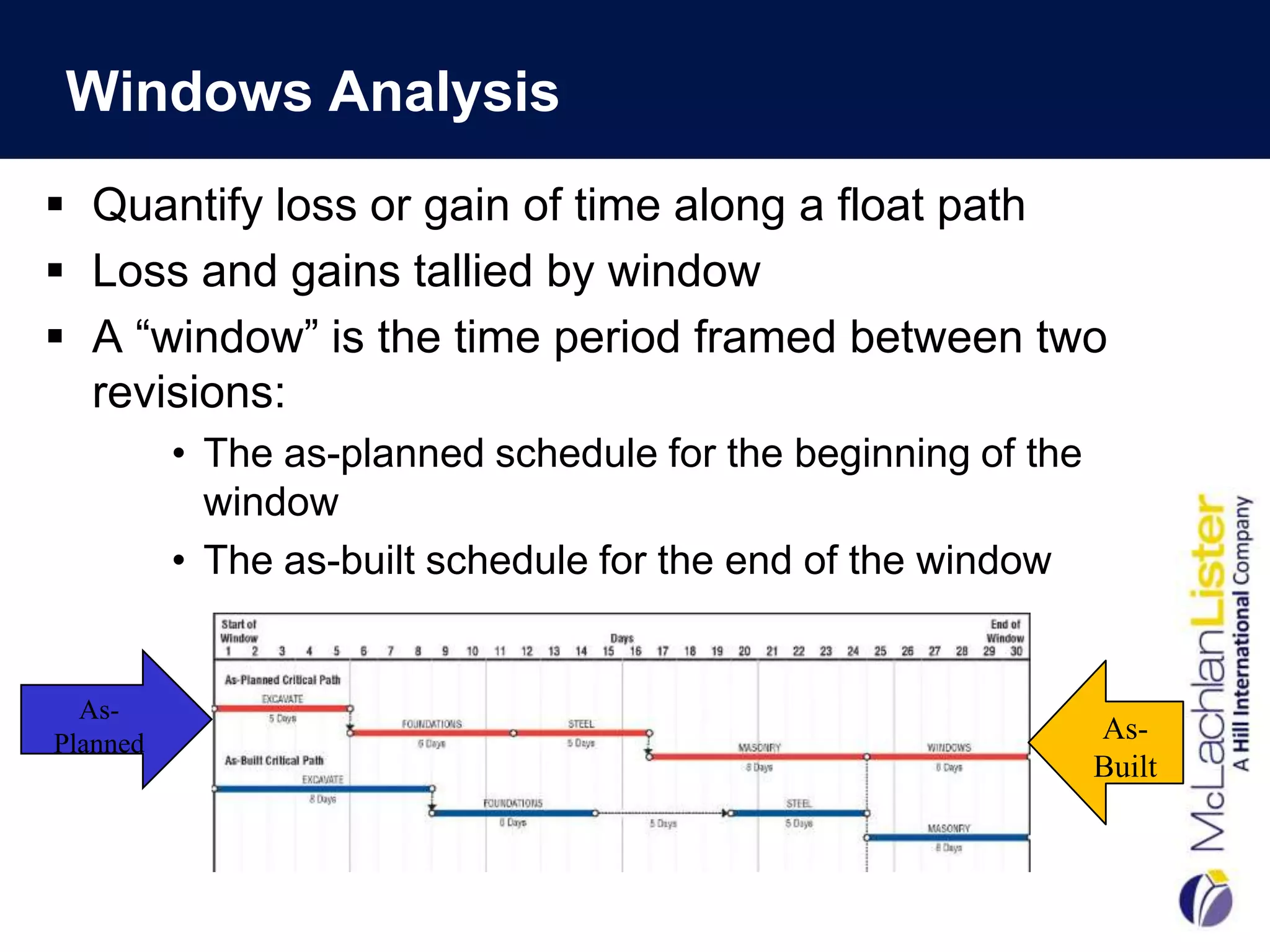
Windows Analysis
 Quantify loss or gain of time along a float path
 Loss and gains tallied by window
 A “window” is the time period framed between two
  revisions:
          • The as-planned schedule for the beginning of the
            window
          • The as-built schedule for the end of the window


  As-
Planned                                                        As-
                                                               Built
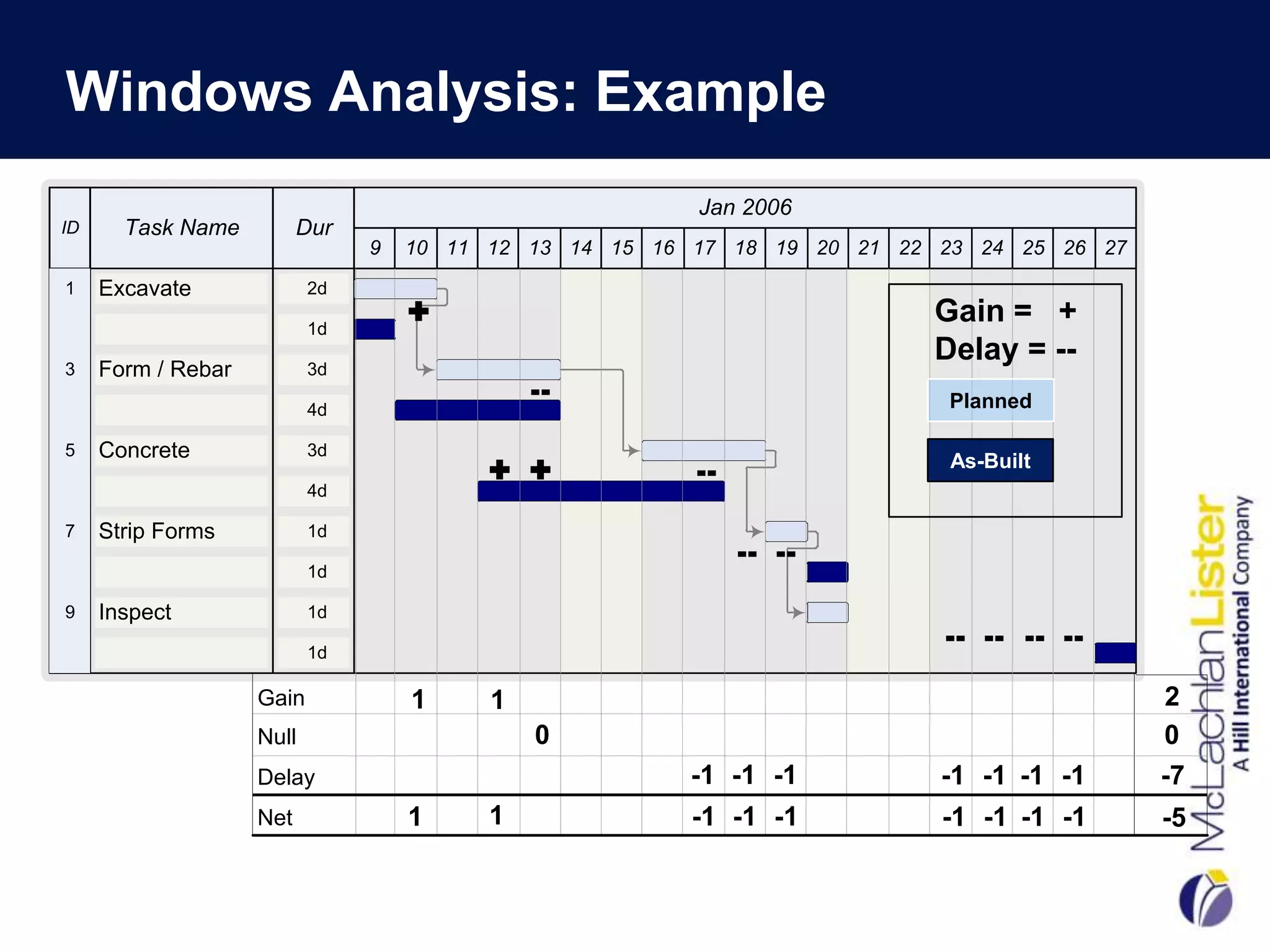
Windows Analysis: Example
                                                         Jan 2006
ID     Task Name          Dur
                                9   10 11 12 13 14 15 16 17 18 19 20 21 22 23 24 25 26 27
1    Excavate              2d
                                    Ì                                     Gain = +
2                          1d
                                                                          Delay = --
3    Form / Rebar          3d
                                              ¬¬                            Planned
4                          4d

5    Concrete              3d
                                                                            As-Built
                                          Ì Ì            ¬¬
6                          4d

7    Strip Forms           1d
                                                              ¬¬ ¬¬
8                          1d

9    Inspect               1d

10                         1d
                                                                           ¬¬ ¬¬ ¬¬ ¬¬

                    Gain            1     1                                                 2
                    Null                      0                                             0
                    Delay                                -1 -1 -1          -1 -1 -1 -1      -7
                    Net             1     1              -1 -1 -1          -1 -1 -1 -1      -5
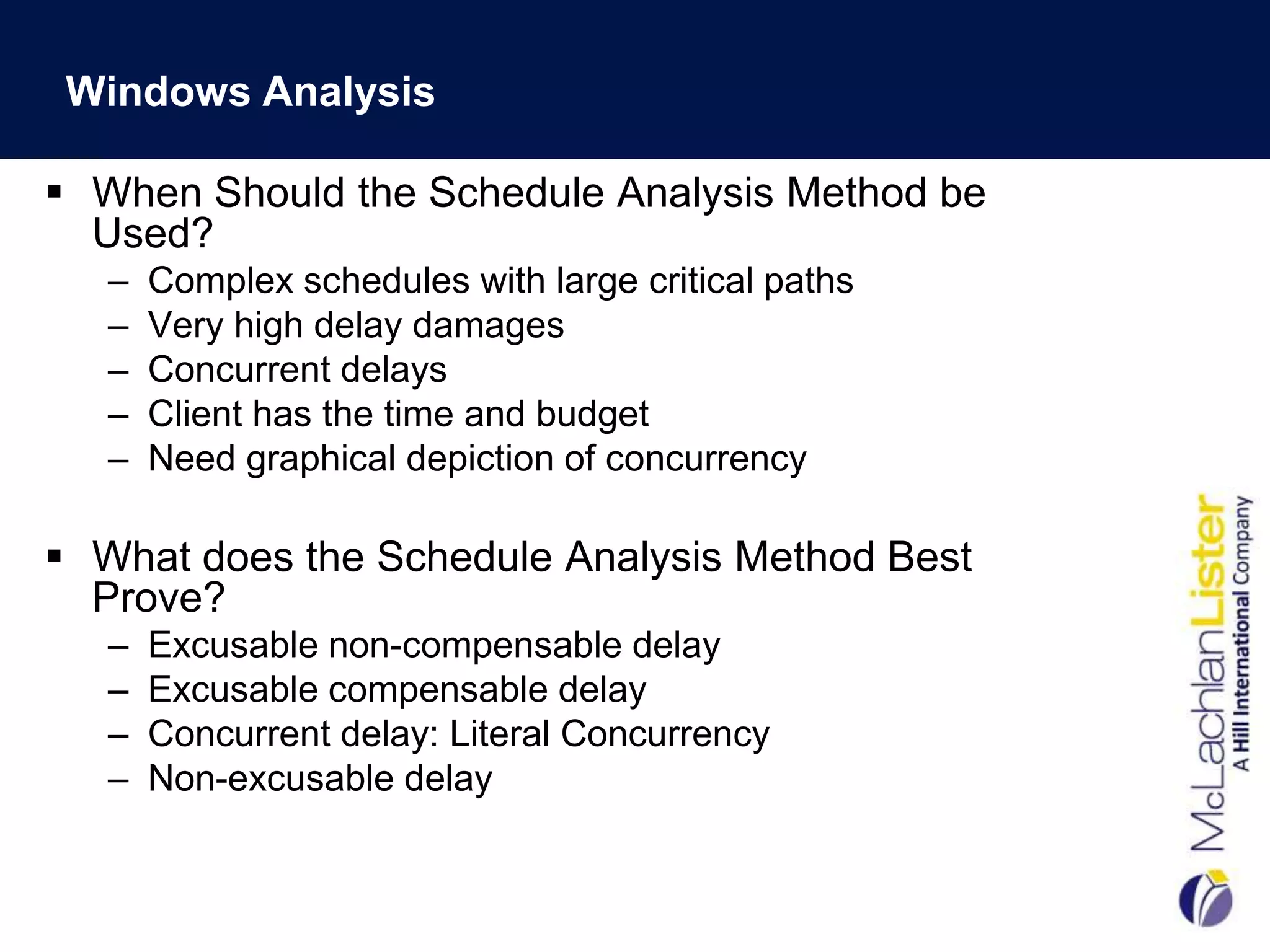
Windows Analysis

 When Should the Schedule Analysis Method be
  Used?
   –   Complex schedules with large critical paths
   –   Very high delay damages
   –   Concurrent delays
   –   Client has the time and budget
   –   Need graphical depiction of concurrency

 What does the Schedule Analysis Method Best
  Prove?
   –   Excusable non-compensable delay
   –   Excusable compensable delay
   –   Concurrent delay: Literal Concurrency
   –   Non-excusable delay
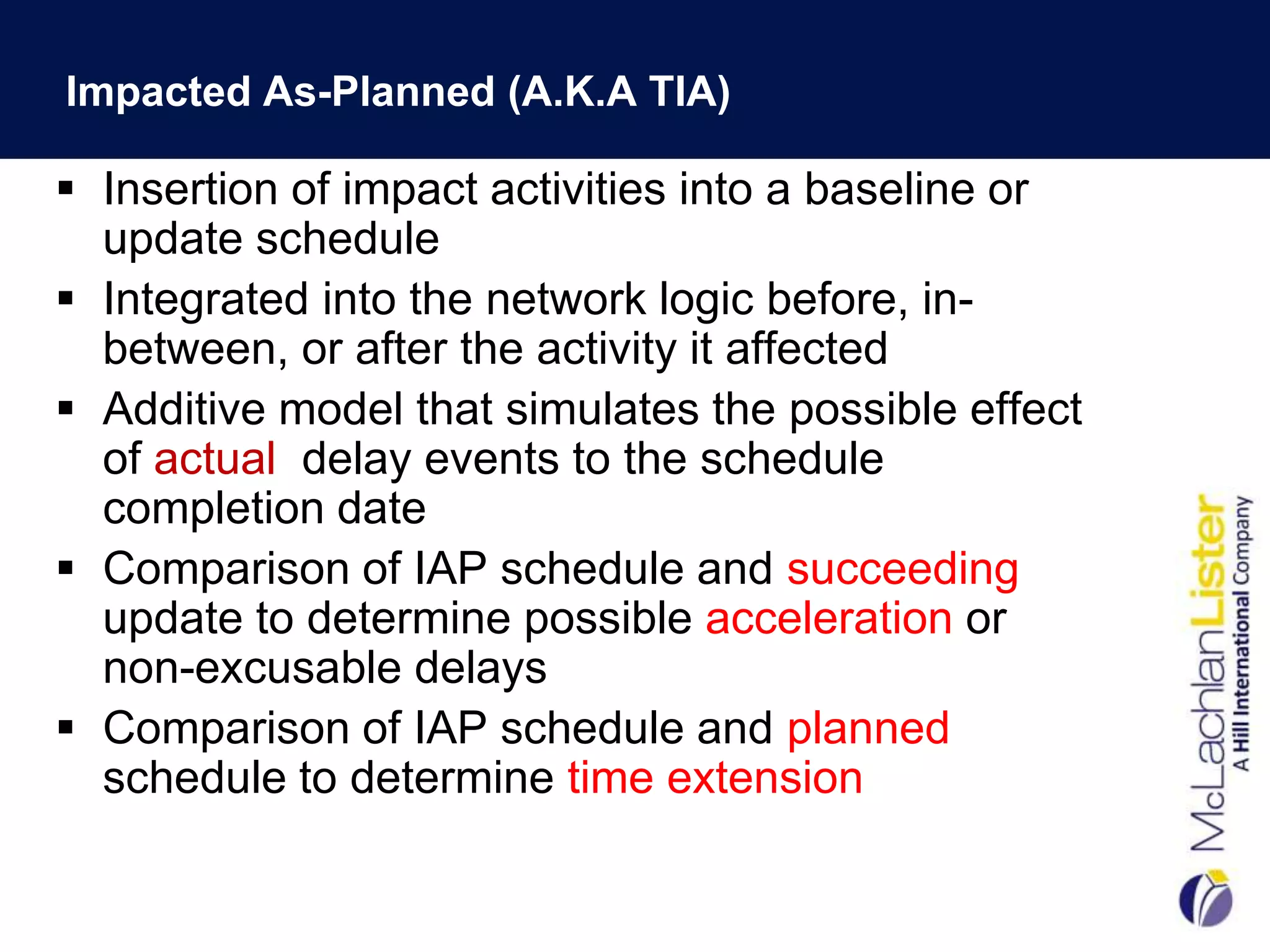
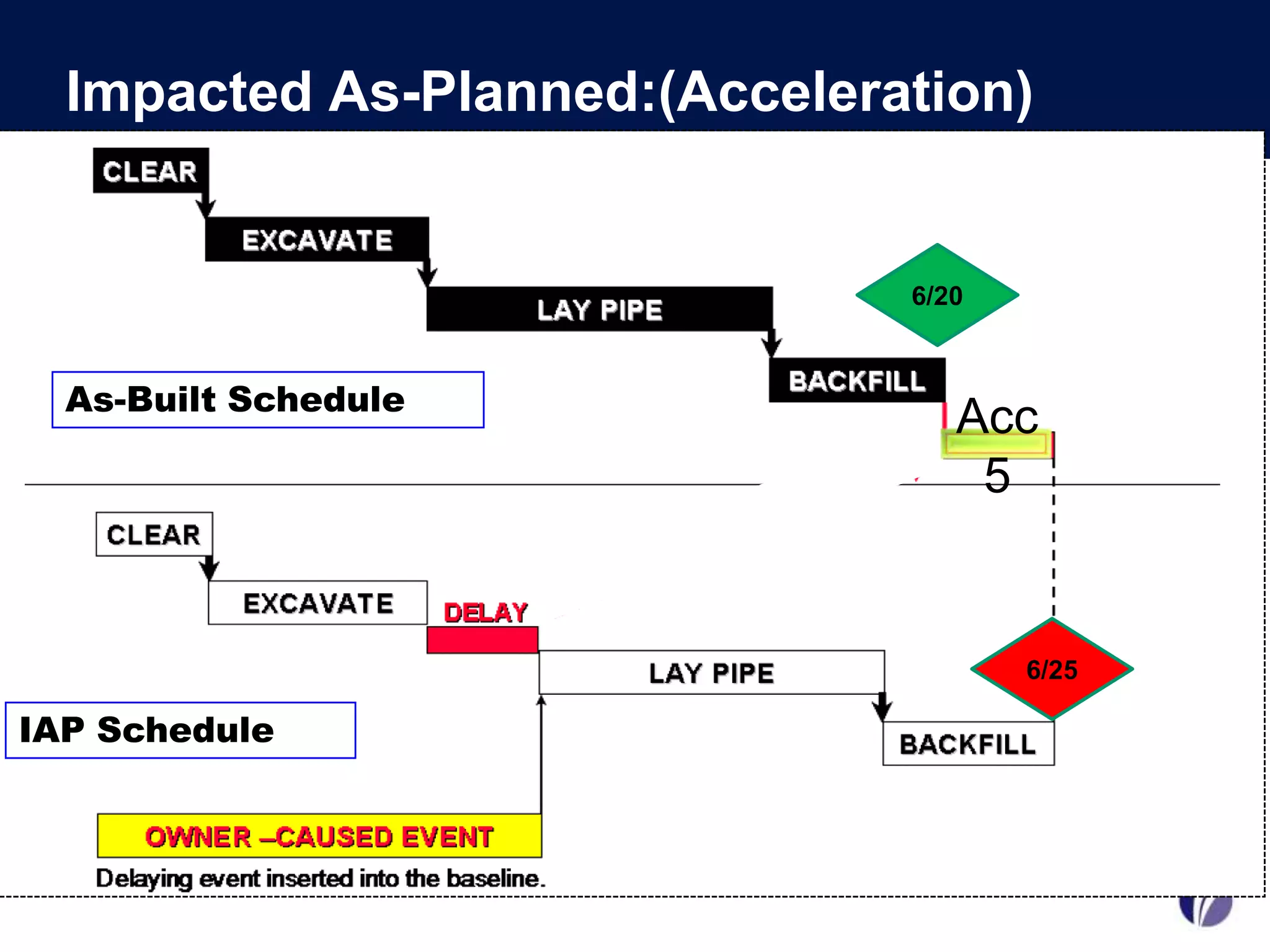
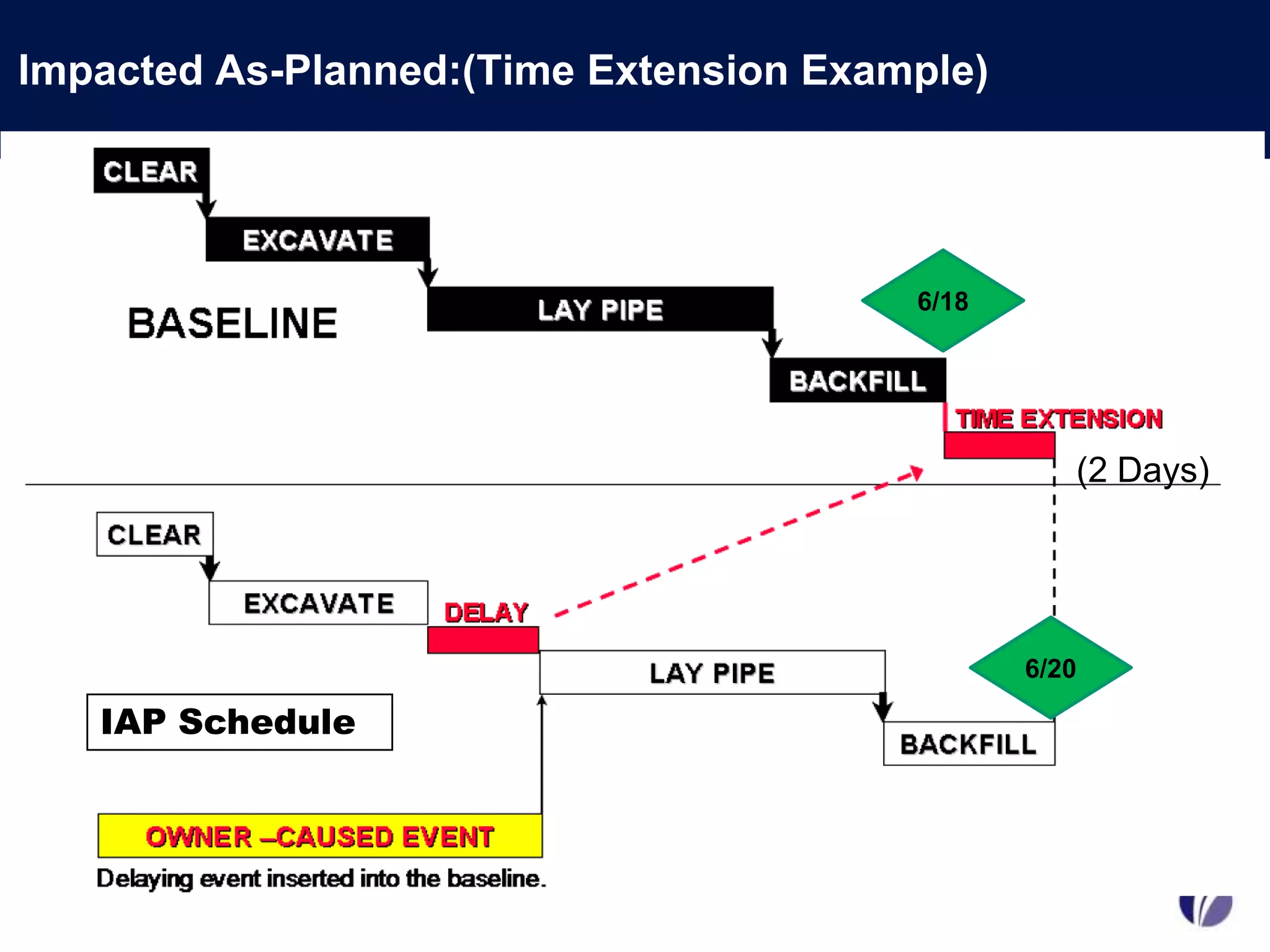
Impacted As-Planned (A.K.A TIA)

 Insertion of impact activities into a baseline or
  update schedule
 Integrated into the network logic before, in-
  between, or after the activity it affected
 Additive model that simulates the possible effect
  of actual delay events to the schedule
  completion date
 Comparison of IAP schedule and succeeding
  update to determine possible acceleration or
  non-excusable delays
 Comparison of IAP schedule and planned
  schedule to determine time extension
Impacted As-Planned:(Acceleration)


                               6/20


  As-Built Schedule
                                  Acc
                                   5


                                      6/25

IAP Schedule
Impacted As-Planned:(Time Extension Example)


                                        6/18


                                                  (2 Days)


                                               6/20

   IAP Schedule
Impacted As-Planned

 When Should the Schedule Analysis Method be
  Used?
  – Indemnification of liquidated damages
  – For preliminary negotiations between owner and
    contractor
  – While the Job is Ongoing
 What does the Schedule Analysis Method Best
  Prove?
  – Requests for Time Extension or LD Waivers
  – Acceleration Claims
Presentation
1.       Attach Source Documentation
2.       Graphical Representation
     •      Schedule Updates: Prior to Impact and After Impact
     •      Critical Path in Gantt Chart Format with Logic
     •      Concurrency
3.       Write Up
     •      Keep it Short and Sweet
     •      Explanation of Impact Event: Timing,Activities,Duration
4.     Cost Impact
      •   Stand-By Costs of Equipment and Crews Affected
      •     Don‟t Claim Costs on Crews That Were Working!
5.       Executive Summary at the Beginning
6.       Submit Once Impact Event Is Known
7.       Submit Again Once Full Impact Understood
Recap

•   Documentation is Key: Content Must be Consistent
•   Schedules Must Be Sound and Accurate
•   Don‟t Ignore Updates
•   Choose Your Technique Wisely
•   Consider Concurrency
•   Present Claim as a Concise Package
•   Don‟t Throw the Kitchen Sink into the Claim
•   Resolution Inversely Proportional to Submittal Time
Contact Information

                          Brisbane Office
                       2/19 Musgrave Street
                       West End, QLD, 4101
              Email: anamariap@mclachlanlister.com
                     Phone: 61 07 3255 0223


       Sydney Office                       Perth Office
  Level 1, 1 Hickson Road                189 Colin Place
  Phone: 61 02 9241 7328              Phone: 61 08 9480 0647

Eot claims hr__may2012

  • 1.
    EOTs? Avoiding theTraps or Taking Advantage of Them Dr. Anamaria Popescu,PE,PMP,PSP McLachlan Lister - Hill International Australia May 23, 2012
  • 2.
    Presentation Objectives  EOT Triggers  Contractual Completion Date(s)  Primary Ingredients  Schedule Integrity  Documentation of Causation  Responsibility Assignment  Concurrency of Delays  Schedule Analysis  Presentation is Everything!  Recap
  • 3.
    EOT Triggers 1.An Event Occurred or Will Occur that Causes Delay 2. 3 Possible EOT Event Types: – Owner driven events – O‟s risk (Time & money) – Neutral events – risk shared (Time only) – Concurrent events-risk allocated (Time only) 3. Causes Delay to the Critical Path ….But, Critical Path to What?
  • 4.
    Contractual Completion Date(s)  Dealt with in Contract 2 ways: – By stating a date – By stating a works period  Types of Contractual Completion Dates: – „Practical Completion‟ Date – „Substantial Completion‟ Date – „Mechanical Completion‟ Date – „Handover‟ Date – „Separable Portion‟ Date  May apply to a Section, or the Entire Project – Each Section is treated separately – Multiple EOT Claims and LD Assessments May Apply
  • 5.
  • 6.
    Schedule Integrity: Whatis It?  No Open Ends  Limited Constraints  All Scope Captured  Majority of Tie Types: FS  No Large Lags: “Float Hoarding”  No Redundant Logic Ties  Critical Path Makes Sense  Critical Path is Continuous  “Longest Path” Filter Confirmation
  • 7.
    Schedule Integrity  Obligation of Both the Owner and Contractor  Contract Must State Schedule Requirements  Diligence Must not Stop after Baseline is Accepted  Schedule Updates Are Contractual Too!  Key Tools to EOTs
  • 8.
    Schedule Integrity: Howdo you Know?  Ask for the Electronic Version (Not a PDF)  Run a Schedule Diagnostic on Baseline & Updates  Primavera: “Schedule Log” and “Claim Digger”  Others: Acumen “Fuse”, “Schedule Analyser Pro”  Also look for.. – Added and/or Deleted Activities – Increase or Decrease in OD – Calendar Changes – Schedule Calculation Changes – Etc…
  • 9.
    Schedule Integrity: DiagnosticTools P6: Schedule Log
  • 10.
    Schedule Integrity: DiagnosticTools “Claim Digger”
  • 11.
  • 12.
    Documentation of Causation The need for evidence: “He who Asserts Must Prove”  1st: Demonstrate Cause (Documentation)  2nd: Demonstrate Effect (Schedule Analysis)  The 3 „R‟s – Records, Records, and Records  Record Type Important but Record Content Key!
  • 13.
    Documentation of Causation:Record Types  Letters and Emails  RFI‟s  Hold Registers  Transmittal Logs  Progress photographs  Variation Notices  Daily Field Reports  Weekly Progress Reports  Meeting Minutes  Drawing Revision Logs
  • 14.
    Documentation of Causation:Record Content  Instructions given & received  Conflicts in plans/specifications  Weather conditions: Not Just Rain  Work Stoppage: Time Stopped and Why  Number of Workers/Trade Type  Subcontractors  Equipment Type Utilised and Number  Daily Activity of Crews  Specific Location: Station Number, Area  Delays Encountered: Specific Activity  Material Shortages Create a Standardised Daily Report Form
  • 15.
  • 16.
    Documentation of Causation: DelayExamples Equipment & Material Problems
  • 17.
    Documentation of Causation: DelayExamples Design Issues Environmental HSSE Issues
  • 18.
    Responsibility Assignment  WhatDoes the Contract Say? – Owner Caused Delays – Force Majeure Delays – Neutral Delays-Weather – Non-Excusable Delays  Allocate Responsibility to Individual Delay Events Allocate Code Split Code Actual Delay Activities Resp. Duration
  • 19.
  • 20.
    Concurrent Delay -Requirements  Two or more delays during the “same” time  There can only be one unit of delay during the same unit of time, regardless of the number of delaying events  Delays unrelated and independent  Must delay the critical path  Responsibility of different parties  Each party bears its own expenses for that delay  Involuntary (i.e., not “pacing”)  Substantial and not easily curable
  • 21.
    Concurrency: Net AffectMatrix Have a Matrix As Part of Your Contract
  • 22.
    Literal vs. FunctionalConcurrency  Literal Concurrency – Delays have to be literally concurrent in time, as in “happening at the same time”  Functional Concurrency – Delays need only occur in the same analysis period or window
  • 23.
    Schedule Analysis: ChooseYour Weapon 1.As-Planned vs. As-Built 2.Windows Analysis 3.TIA
  • 24.
    As-Planned vs. As-Built  Comparison of start/finish dates between two schedule updates  Purely mathematical-Variance between dates
  • 25.
    As-Planned vs. As-Built Delayed Completion 1 Early Start 2 Overall Delay 3 4 As-Planned As-Built 1 Delayed Start 2 Early Completion 3
  • 26.
    As-Planned vs. As-Built When should it be used?  Limited time and money  No electronic schedules  Inadequate schedule logic  Quick and dirty 1st pass  What does the Schedule Analysis Method Best Prove?  Excusable non-compensable delay
  • 27.
    As-Planned vs. As-Built  Not Good For: – Concurrent delays or acceleration – Critical path changes between updates – Multiple critical or near-critical paths per update – Recovering extended overhead costs – Arbitration or Litigation  Pros: – Easy to understand, explain, and graphically depict – Technically simple to perform  Data Required: – Baseline schedule – As-built schedule
  • 28.
    Windows Analysis  Quantifyloss or gain of time along a float path  Loss and gains tallied by window  A “window” is the time period framed between two revisions: • The as-planned schedule for the beginning of the window • The as-built schedule for the end of the window As- Planned As- Built
  • 29.
    Windows Analysis: Example Jan 2006 ID Task Name Dur 9 10 11 12 13 14 15 16 17 18 19 20 21 22 23 24 25 26 27 1 Excavate 2d Ì Gain = + 2 1d Delay = -- 3 Form / Rebar 3d ¬¬ Planned 4 4d 5 Concrete 3d As-Built Ì Ì ¬¬ 6 4d 7 Strip Forms 1d ¬¬ ¬¬ 8 1d 9 Inspect 1d 10 1d ¬¬ ¬¬ ¬¬ ¬¬ Gain 1 1 2 Null 0 0 Delay -1 -1 -1 -1 -1 -1 -1 -7 Net 1 1 -1 -1 -1 -1 -1 -1 -1 -5
  • 30.
    Windows Analysis  WhenShould the Schedule Analysis Method be Used? – Complex schedules with large critical paths – Very high delay damages – Concurrent delays – Client has the time and budget – Need graphical depiction of concurrency  What does the Schedule Analysis Method Best Prove? – Excusable non-compensable delay – Excusable compensable delay – Concurrent delay: Literal Concurrency – Non-excusable delay
  • 31.
    Impacted As-Planned (A.K.ATIA)  Insertion of impact activities into a baseline or update schedule  Integrated into the network logic before, in- between, or after the activity it affected  Additive model that simulates the possible effect of actual delay events to the schedule completion date  Comparison of IAP schedule and succeeding update to determine possible acceleration or non-excusable delays  Comparison of IAP schedule and planned schedule to determine time extension
  • 32.
    Impacted As-Planned:(Acceleration) 6/20 As-Built Schedule Acc 5 6/25 IAP Schedule
  • 33.
    Impacted As-Planned:(Time ExtensionExample) 6/18 (2 Days) 6/20 IAP Schedule
  • 34.
    Impacted As-Planned  WhenShould the Schedule Analysis Method be Used? – Indemnification of liquidated damages – For preliminary negotiations between owner and contractor – While the Job is Ongoing  What does the Schedule Analysis Method Best Prove? – Requests for Time Extension or LD Waivers – Acceleration Claims
  • 35.
    Presentation 1. Attach Source Documentation 2. Graphical Representation • Schedule Updates: Prior to Impact and After Impact • Critical Path in Gantt Chart Format with Logic • Concurrency 3. Write Up • Keep it Short and Sweet • Explanation of Impact Event: Timing,Activities,Duration 4. Cost Impact • Stand-By Costs of Equipment and Crews Affected • Don‟t Claim Costs on Crews That Were Working! 5. Executive Summary at the Beginning 6. Submit Once Impact Event Is Known 7. Submit Again Once Full Impact Understood
  • 36.
    Recap • Documentation is Key: Content Must be Consistent • Schedules Must Be Sound and Accurate • Don‟t Ignore Updates • Choose Your Technique Wisely • Consider Concurrency • Present Claim as a Concise Package • Don‟t Throw the Kitchen Sink into the Claim • Resolution Inversely Proportional to Submittal Time
  • 37.
    Contact Information Brisbane Office 2/19 Musgrave Street West End, QLD, 4101 Email: anamariap@mclachlanlister.com Phone: 61 07 3255 0223 Sydney Office Perth Office Level 1, 1 Hickson Road 189 Colin Place Phone: 61 02 9241 7328 Phone: 61 08 9480 0647

Editor's Notes

  • #21 Found on pp 112-113 of the RP