Innovation – Prof Nick Amott
Summary
 Cubic Melons
 LNG (with thanks to Prof Brian Cox)
 Who are Fluor?
 Why Innovation is Important
 Real Examples of Successful
Innovations
 Some Innovations that Didn’t
Work
 Your Role in Innovation
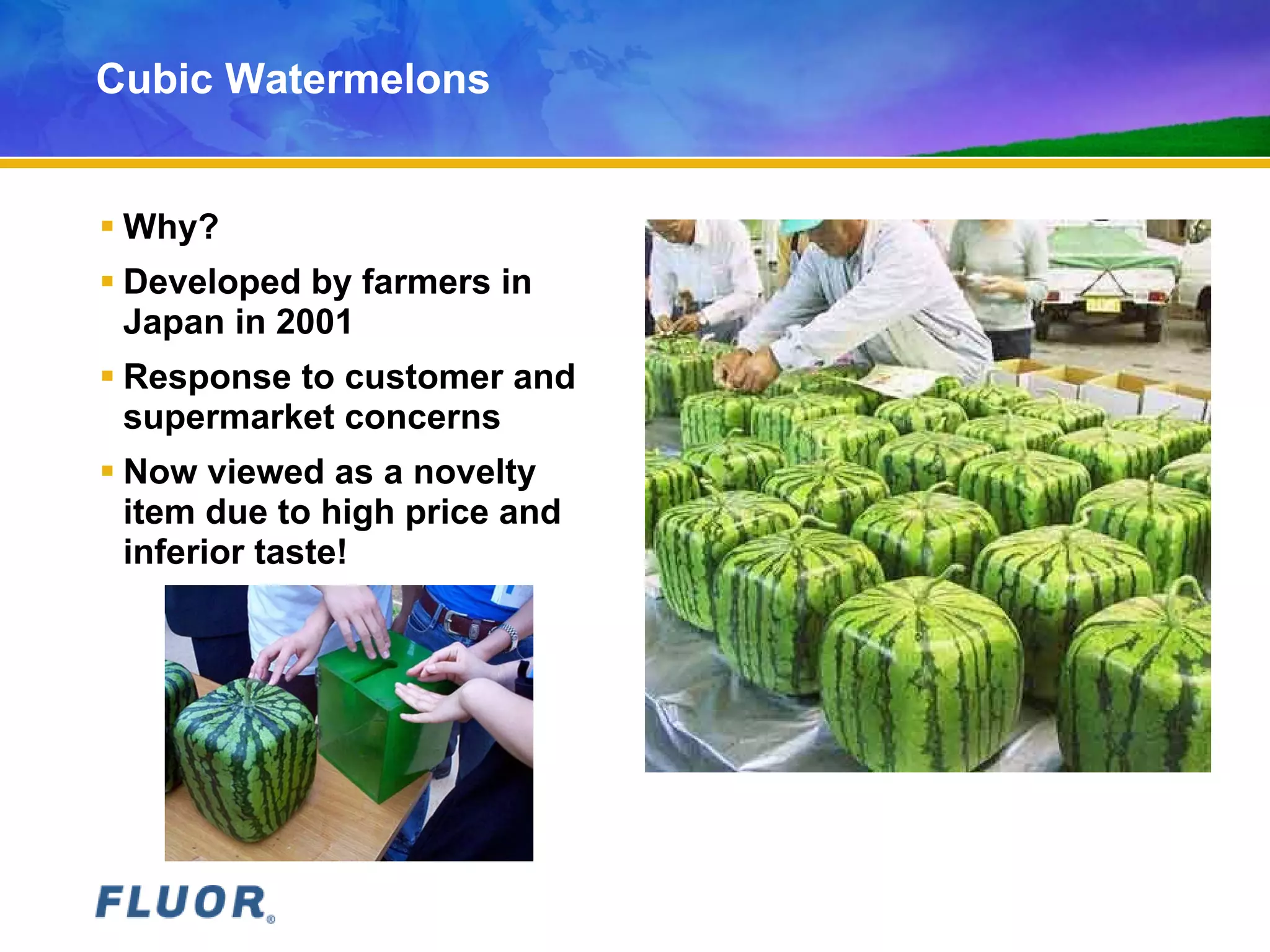
Cubic Watermelons
 Why?
 Developed by farmers in
Japan in 2001
 Response to customer and
supermarket concerns
 Now viewed as a novelty
item due to high price and
inferior taste!
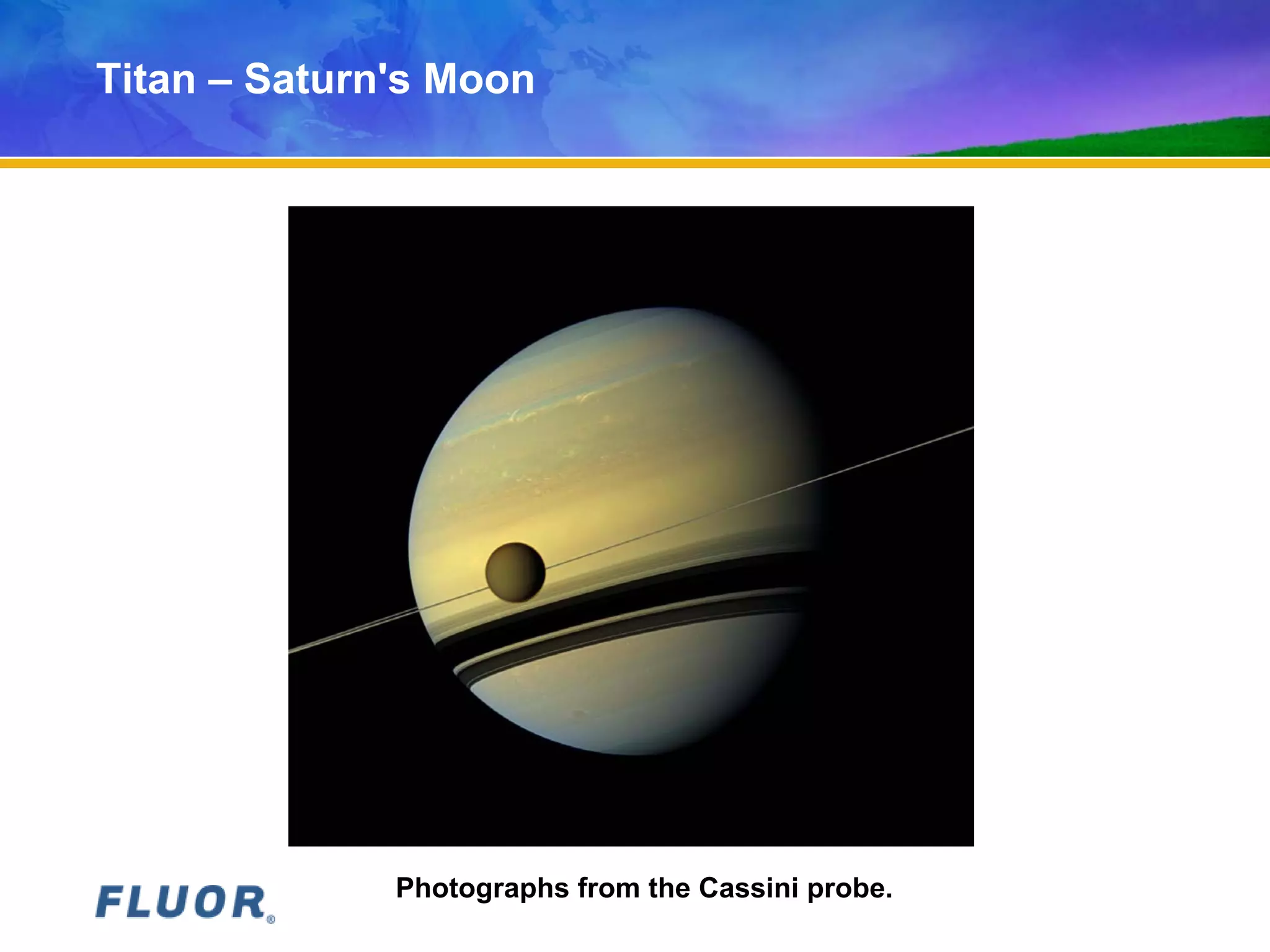
Titan – Saturn's Moon
Photographs from the Cassini probe.
Titan (Saturn Moon)
 What is the white spot?
 Titan is a long way from
the sun with an
atmosphere of
methane not air!
LNG – Liquefied Natural Gas
 LNG - Natural Gas that has
been converted to a Liquid
 Gas is cooled through
expensive liquefaction process
to -162°C @ 0.25 bar
 LNG has much greater energy
density than compressed gas
making it more efficient to
transport
 Expensive production process
and storage equipment main
barriers to widespread
commercial use.
 Prelude 488 m x 74m, more
than 4.5 soccer pitches end to
end - $12.6 billion
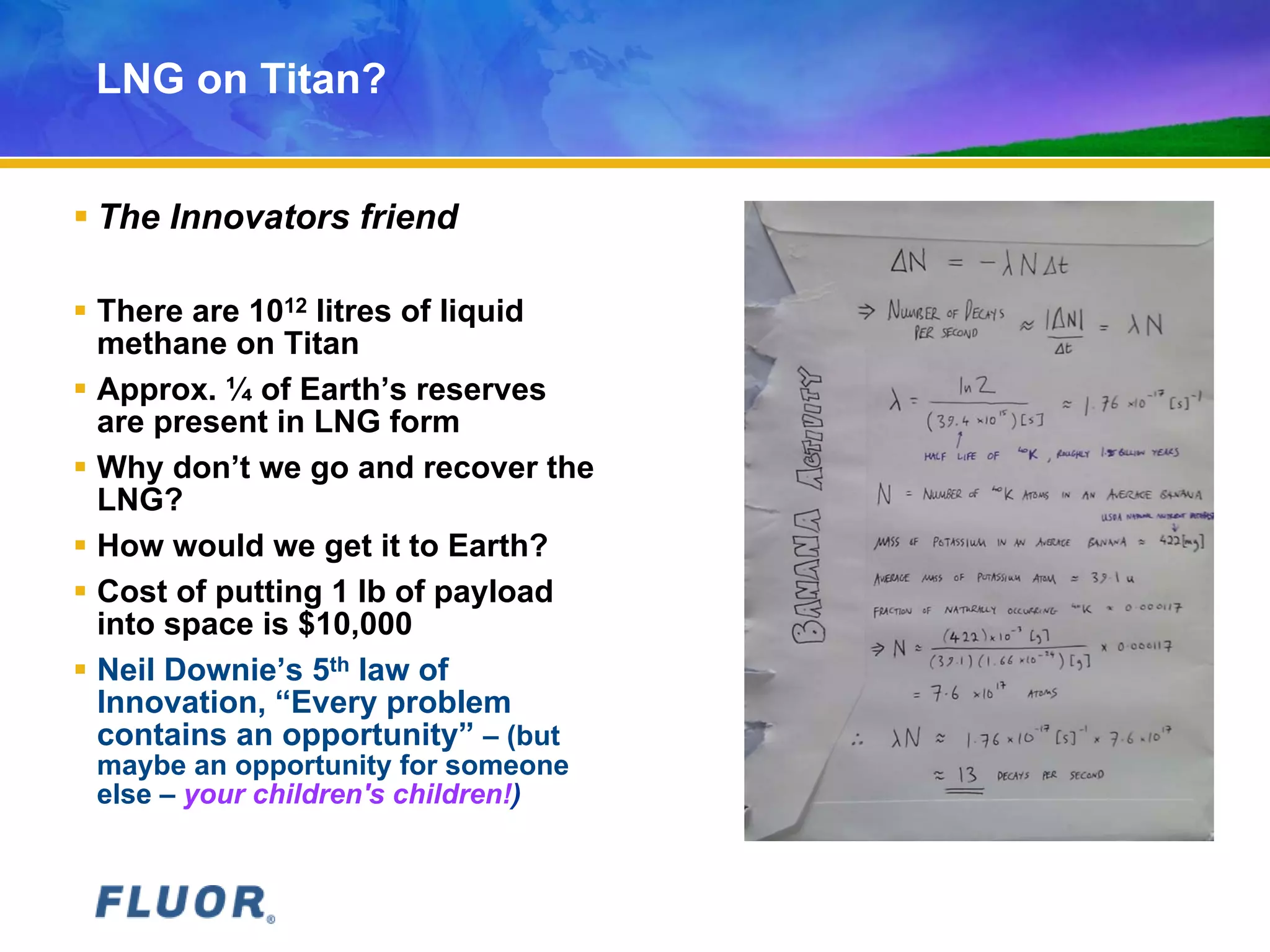
LNG on Titan?
 The Innovators friend
 There are 1012 litres of liquid
methane on Titan
 Approx. ¼ of Earth’s reserves
are present in LNG form
 Why don’t we go and recover the
LNG?
 How would we get it to Earth?
 Cost of putting 1 lb of payload
into space is $10,000
 Neil Downie’s 5th law of
Innovation, “Every problem
contains an opportunity” – (but
maybe an opportunity for someone
else – your children's children!)
What is Fluor?
 One of the world’s leading publicly
traded engineering, procurement,
construction, maintenance, and project
management companies
 #124 in the FORTUNE 500 in 2012
 Over 1,000 projects annually, serving
more than 600 clients in 66 different
countries
 Workforce of over 43,000 men and
women executing projects globally
 Offices in over 30 countries on 6
continents
 100 years of experience
Fluor Corporate Headquarters
Dallas, Texas
9
Comprehensive Services
Program/Project Management
Pre-Design Design Construction Start-Up
Operations &
Maintenance
Solutions
 Computer
Modeling
 Conceptual
Design
 Estimating
 Feasibility Studies
 Permitting
 Project Financing
 Scope Definition
 Siting
 Technology/
License
Evaluation
 Front-end
Engineering
 Detailed
Engineering
 Cost Control
 Planning &
Scheduling
 Sourcing &
Supply
 Systems
Integration
 Safety Planning
 Construction
Management
 Craft Staffing &
Training
 Equipment &
Tools Supply
 Field Mobilization
 Material Control
 Quality Control
 Safety Programs
 Contractor
Management
 Commissioning
 Engineering Support
 Precommissioning
 Systems Checkout
 Initial Production
 Plant Readiness
 Turnover
 Asset Performance
Improvement
 Facility Management
 Plant Operations &
Maintenance
 Small/Sustaining
Capital Projects
 Turnaround, Outages
& Shutdowns
Why is Innovation Important to Fluor
 One of Fluor’s guiding principles states that the company is always
looking for:
“Methods to Capture, Share and Apply our
Knowledge to deliver Customer Solutions”
 To be able to fulfil this principle Fluor must be innovative and
provide an environment for innovation to thrive
 Innovation also allows the company to:
• Gain a competitive advantage over our competitors
• Retain, attract, develop and motivate a workforce essential for success
• Ensure quality and fit-for-purpose solutions are delivered to our customers
• Build and sustain a global community for all our stakeholders
• To maximise and increase margins and profitability for the company and
shareholders
So what does this mean!
Do it better, faster, cheaper!
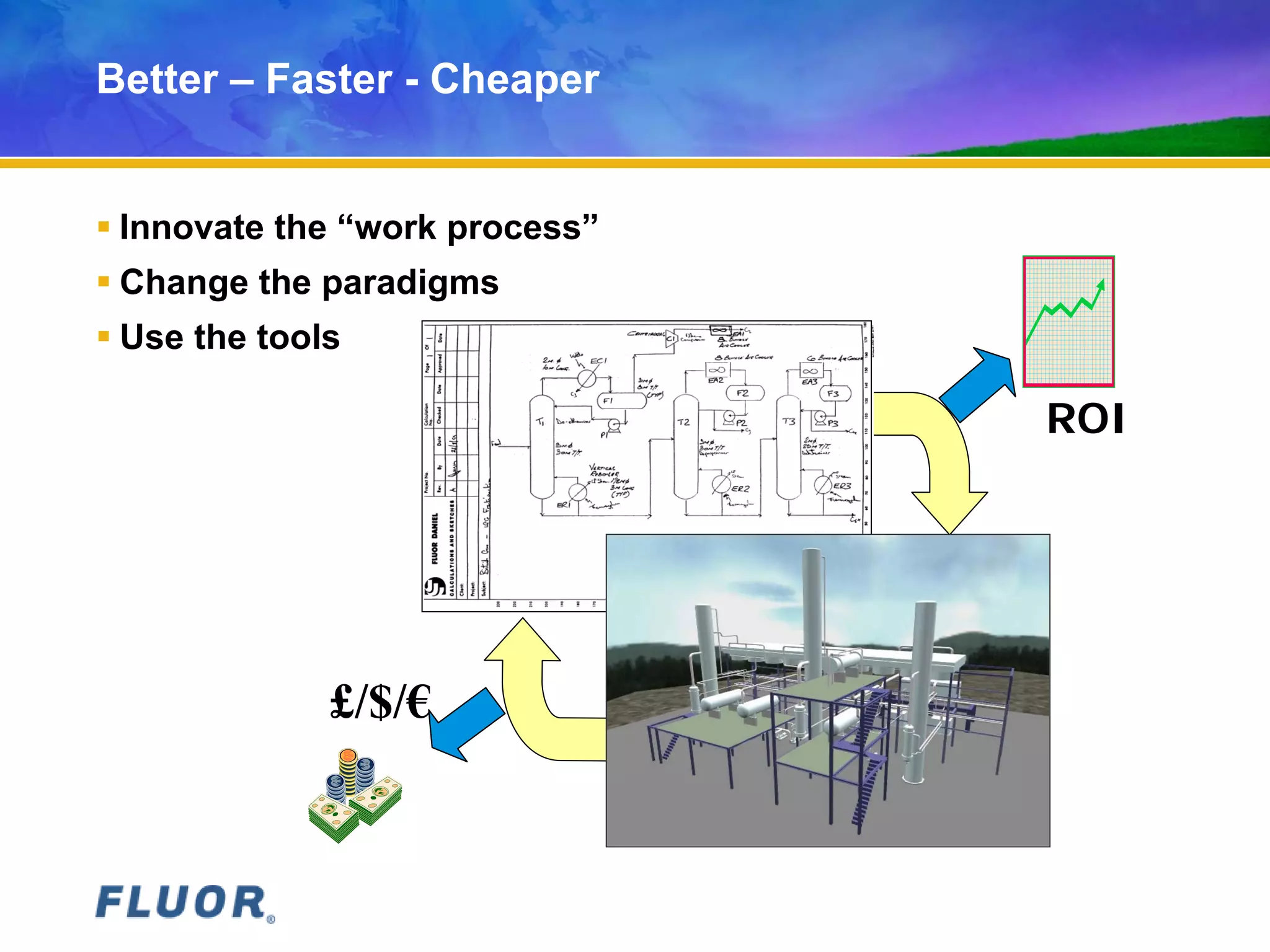
Better – Faster - Cheaper
 Innovate the “work process”
 Change the paradigms
 Use the tools
ROI
£/$/€
How do we improve the work process using the
available tools ?
• Objective – Turn a Process concept into a decision
making design and cost estimate better, faster and
cheaper
• Have a Clear Vision of the End Product
• Just Enough and No More (JEAN)
–RTFC
–Don’t Outdo Competitor Deliverables
–Neil Downie’s 4th law, don’t over-deliver
• Completed the FEED on a $120M Ethane Treatment
Project with over 20 major equipment items in less than
one month
Work Process for +/-30%Cost Estimates
Process Simulation
Heat & Mat Balance
Prelim Cost Estimate
Prelim Equipment /
Line Sizing
QuickPlantSM
•Process Flow Dgms
•Equipment Data Shts
•Equipment List
•Load List
FrontRunnerSM
IPE
Equipment Based
Cost Analysis
OptimEyesSM
Layout Studies
Critical Equipment
Sizing Checks
•I/O Count
•Concrete MTO
•Piping MTO
•Structural steel MTO
•Plot plan /elevation
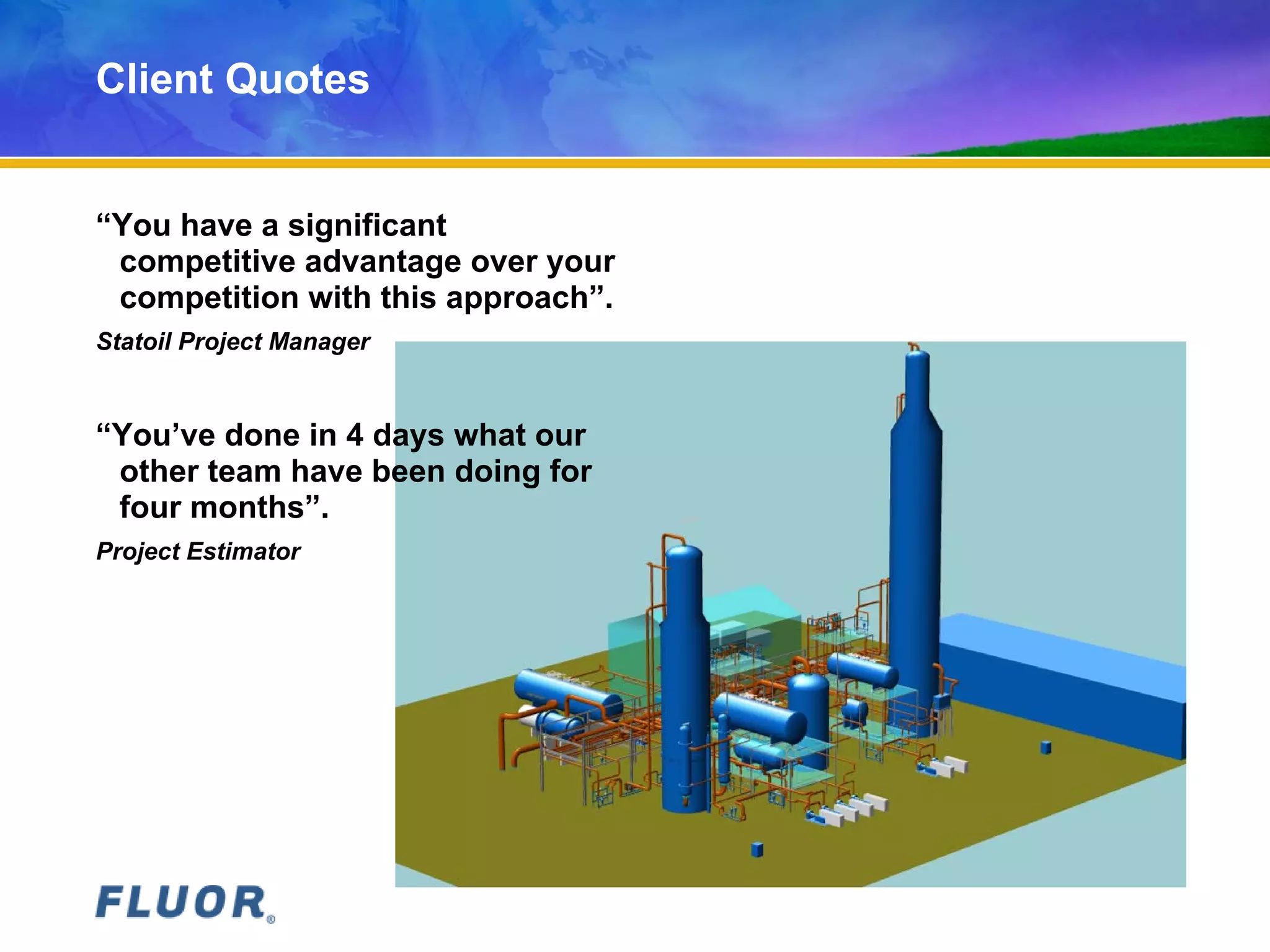
Client Quotes
“You have a significant
competitive advantage over your
competition with this approach”.
Statoil Project Manager
“You’ve done in 4 days what our
other team have been doing for
four months”.
Project Estimator
Real Example – 3rd Generation ModuleSM Design
Evolution of Modular Construction
 1st Generation Modular Execution
Evolution of Modularization in Land Locked
Locations
 2nd Generation Modular Construction Execution
• 1st Generation plus:
• Equipment or PAUs (Preassembled Units)
– Equipment on module
– Modules around equipment
Where next – 3rd Generation modulesSM
 Get more into a module
 Reduce the space occupied by the module and plant by
optimising layout
 Use the developing hardware available to the full extent
 Patent the application to protect intellectual property
Site Envelope Statistics
Traditional
320,000 m2
2nd Generation
200,000 m2
3rd Generation
84,000 m2
Real Example – 3rd Generation ModuleSM Design
 Reduced TIC
• Reduced plot area lowers quantities
• Total labor hours down
• Work done in Shop
• Dramatic decrease in construction management
 Improved Safety and Quality
 Minimized Environmental Footprint
 Operations & Maintenance Needs Maintained
 Neil Downie’s 0th and 2nd law
• Think! (laterally, contradictions, outside the box)
• Surprises = Patents
 This is a success story!
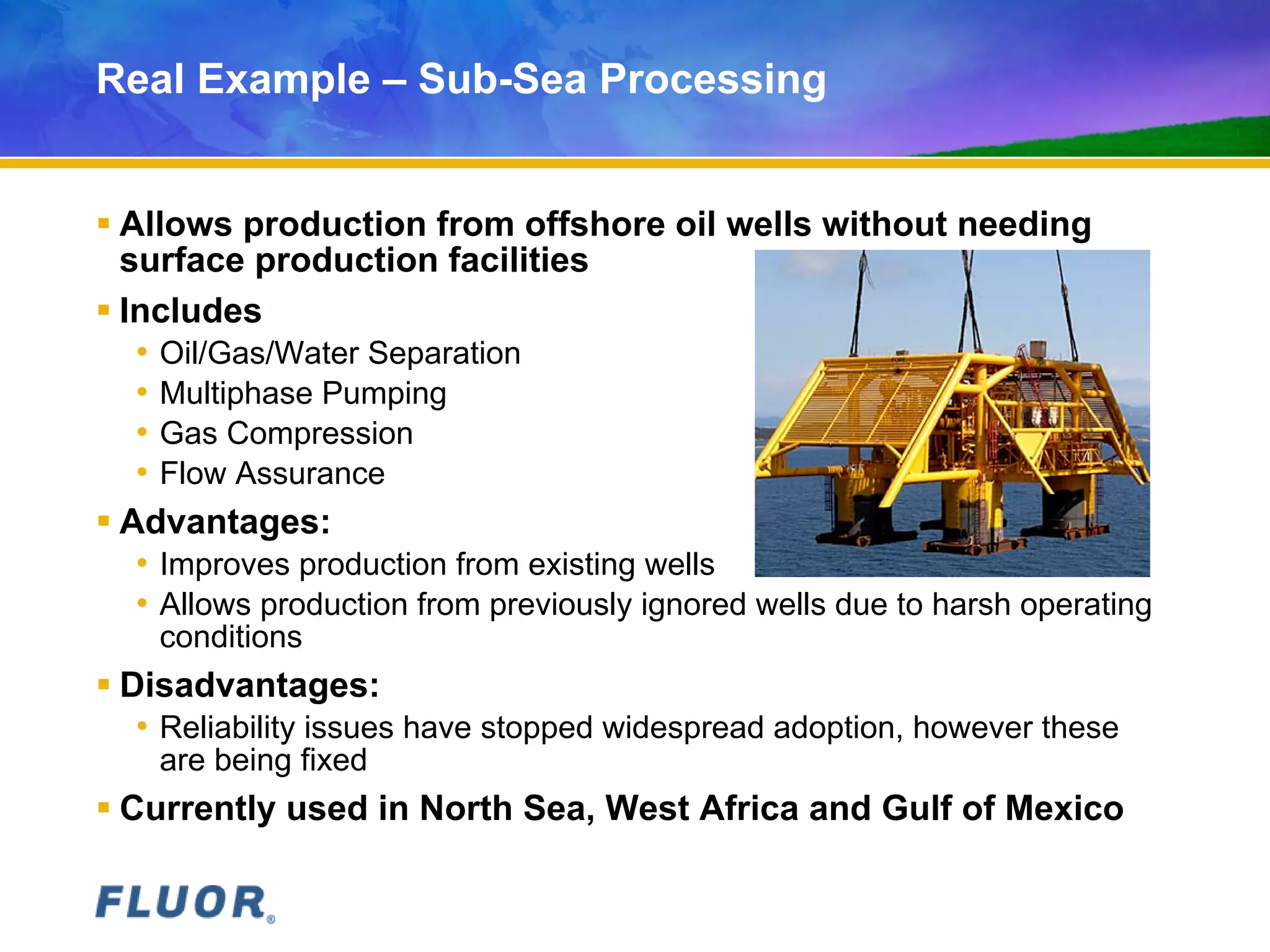
Real Example – Sub-Sea Processing
 Allows production from offshore oil wells without needing
surface production facilities
 Includes
• Oil/Gas/Water Separation
• Multiphase Pumping
• Gas Compression
• Flow Assurance
 Advantages:
• Improves production from existing wells
• Allows production from previously ignored wells due to harsh operating
conditions
 Disadvantages:
• Reliability issues have stopped widespread adoption, however these
are being fixed
 Currently used in North Sea, West Africa and Gulf of Mexico
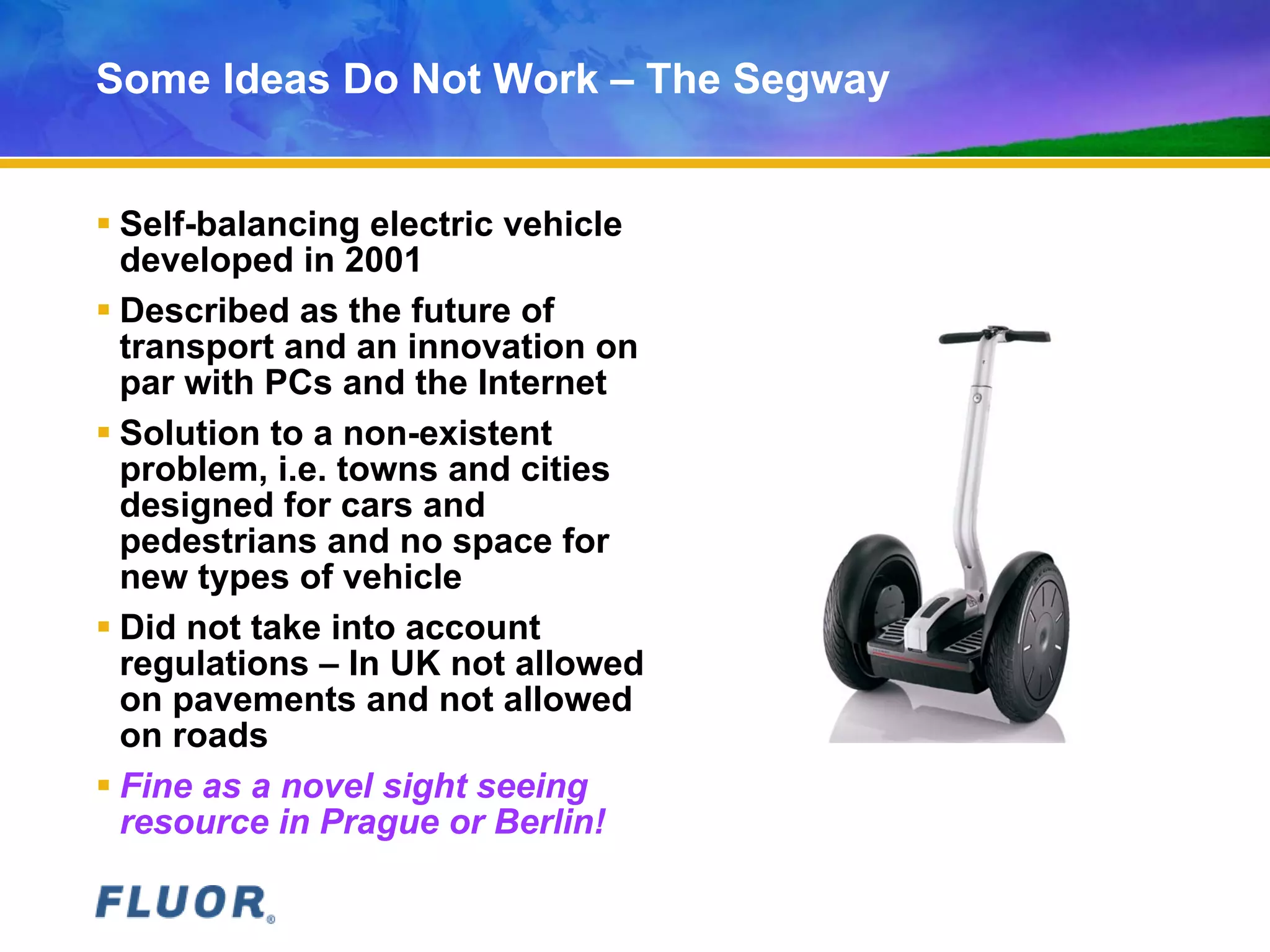
Some Ideas Do Not Work – The Segway
 Self-balancing electric vehicle
developed in 2001
 Described as the future of
transport and an innovation on
par with PCs and the Internet
 Solution to a non-existent
problem, i.e. towns and cities
designed for cars and
pedestrians and no space for
new types of vehicle
 Did not take into account
regulations – In UK not allowed
on pavements and not allowed
on roads
 Fine as a novel sight seeing
resource in Prague or Berlin!
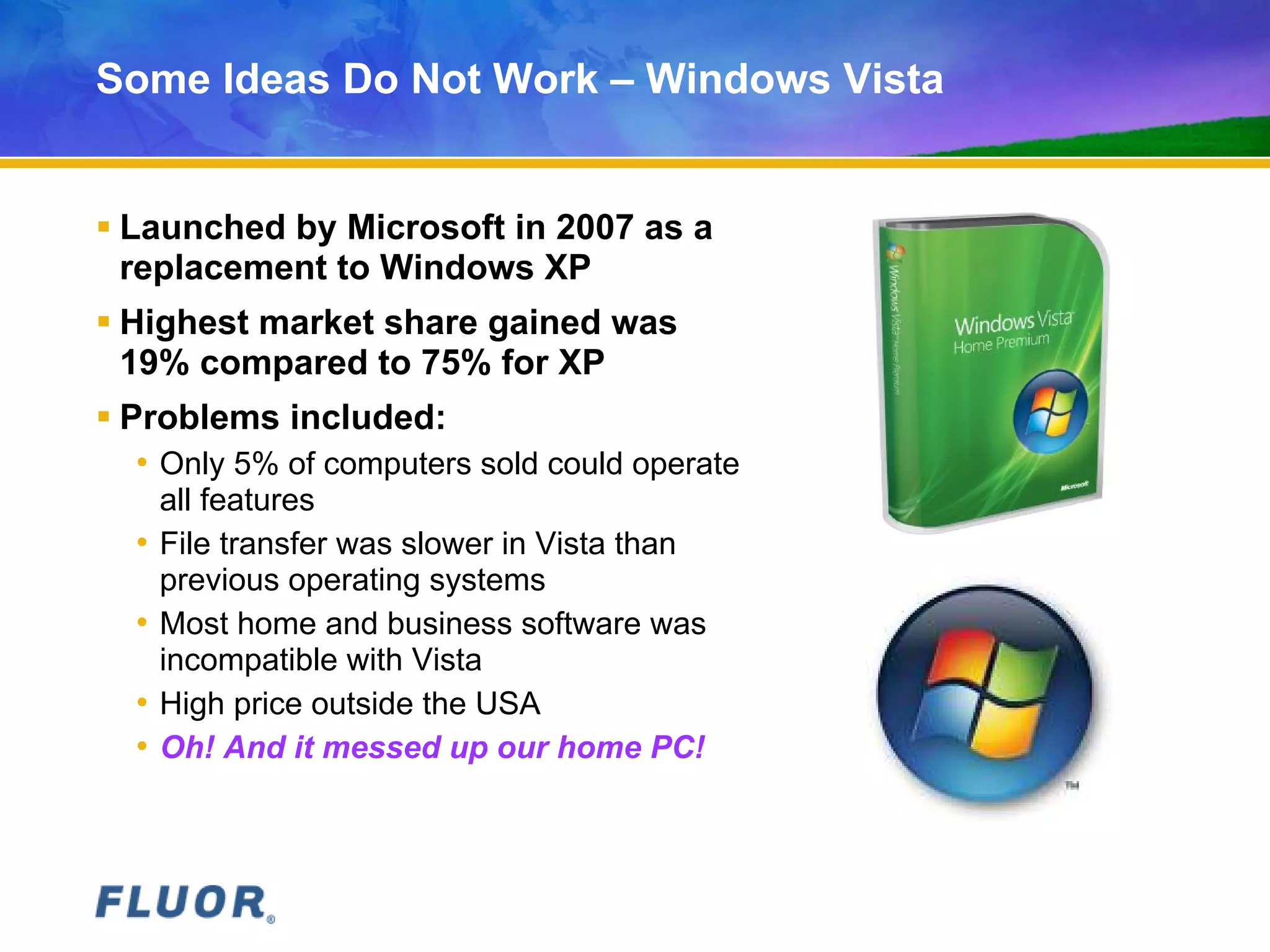
Some Ideas Do Not Work – Windows Vista
 Launched by Microsoft in 2007 as a
replacement to Windows XP
 Highest market share gained was
19% compared to 75% for XP
 Problems included:
• Only 5% of computers sold could operate
all features
• File transfer was slower in Vista than
previous operating systems
• Most home and business software was
incompatible with Vista
• High price outside the USA
• Oh! And it messed up our home PC!
Fluor’s experience with software
 Do not change if it currently works
 No matter how much you test, some old and favoured
software will not work on the new system
 Sometimes the momentum of new software will force you to
change your operating system
 Do not try and create your ideal new software from scratch
 Neil Downie’s 1st Law of Innovation – Copy (modify/enhance)
when you can, innovate when you can’t
Some Ideas Do Not Work – Sinclair C5
 Battery assisted tricycle allowing
the C5 to be operated without
using the pedals
 Sold approx. 17,000 units making
the C5 “the best selling electric
vehicle” until 2011
 A number of design flaws:
• Cold weather shortened the battery
life
• Driver exposed to adverse weather
• Could not climb hills as the motor
was not powerful enough and
overheated easily
 Declared unsafe by the Department
of Transport
Your Role in Innovation
 Fresh and New to Situations
 Your first employer will be looking to you – challenge the paradigm
 Able to challenge ideas and conventions before becoming
“Stuck in your (Company) ways”
 Always be positive, use phrases like:
• “It might work because…”
• “Let me add something to your idea”
 Suspend Critical Judgement – The part of you saying …..
“It Won’t Work”
 Consider there may be more than one good way of completing a task
 Allow ideas to develop – Innovation is rarely perfect so add to, shape
and alter ideas
 “The Important Thing is to Never Stop Asking Questions”
Albert Einstein
Aims of the Royal Institution
Be Inspired (courtesy
of Prof Brian Cox)
 Royal charter 1800
 Diffuse knowledge
 Create inventions and
improvements
 Apply Science (Engineering) to
the common purposes of life
 We are Engineers, we are
empowered to be creative and
do good things!
Graduate Recruitment Process
Farnborough workforce looking to double in size;
Requirement for suitably qualified staff at all levels;
www.fluor.com/careers
Graduate Assessment Day

Nick amott

  • 1.
  • 2.
    Summary  Cubic Melons LNG (with thanks to Prof Brian Cox)  Who are Fluor?  Why Innovation is Important  Real Examples of Successful Innovations  Some Innovations that Didn’t Work  Your Role in Innovation
  • 3.
    Cubic Watermelons  Why? Developed by farmers in Japan in 2001  Response to customer and supermarket concerns  Now viewed as a novelty item due to high price and inferior taste!
  • 4.
    Titan – Saturn'sMoon Photographs from the Cassini probe.
  • 5.
    Titan (Saturn Moon) What is the white spot?  Titan is a long way from the sun with an atmosphere of methane not air!
  • 6.
    LNG – LiquefiedNatural Gas  LNG - Natural Gas that has been converted to a Liquid  Gas is cooled through expensive liquefaction process to -162°C @ 0.25 bar  LNG has much greater energy density than compressed gas making it more efficient to transport  Expensive production process and storage equipment main barriers to widespread commercial use.  Prelude 488 m x 74m, more than 4.5 soccer pitches end to end - $12.6 billion
  • 7.
    LNG on Titan? The Innovators friend  There are 1012 litres of liquid methane on Titan  Approx. ¼ of Earth’s reserves are present in LNG form  Why don’t we go and recover the LNG?  How would we get it to Earth?  Cost of putting 1 lb of payload into space is $10,000  Neil Downie’s 5th law of Innovation, “Every problem contains an opportunity” – (but maybe an opportunity for someone else – your children's children!)
  • 8.
    What is Fluor? One of the world’s leading publicly traded engineering, procurement, construction, maintenance, and project management companies  #124 in the FORTUNE 500 in 2012  Over 1,000 projects annually, serving more than 600 clients in 66 different countries  Workforce of over 43,000 men and women executing projects globally  Offices in over 30 countries on 6 continents  100 years of experience Fluor Corporate Headquarters Dallas, Texas
  • 9.
    9 Comprehensive Services Program/Project Management Pre-DesignDesign Construction Start-Up Operations & Maintenance Solutions  Computer Modeling  Conceptual Design  Estimating  Feasibility Studies  Permitting  Project Financing  Scope Definition  Siting  Technology/ License Evaluation  Front-end Engineering  Detailed Engineering  Cost Control  Planning & Scheduling  Sourcing & Supply  Systems Integration  Safety Planning  Construction Management  Craft Staffing & Training  Equipment & Tools Supply  Field Mobilization  Material Control  Quality Control  Safety Programs  Contractor Management  Commissioning  Engineering Support  Precommissioning  Systems Checkout  Initial Production  Plant Readiness  Turnover  Asset Performance Improvement  Facility Management  Plant Operations & Maintenance  Small/Sustaining Capital Projects  Turnaround, Outages & Shutdowns
  • 10.
    Why is InnovationImportant to Fluor  One of Fluor’s guiding principles states that the company is always looking for: “Methods to Capture, Share and Apply our Knowledge to deliver Customer Solutions”  To be able to fulfil this principle Fluor must be innovative and provide an environment for innovation to thrive  Innovation also allows the company to: • Gain a competitive advantage over our competitors • Retain, attract, develop and motivate a workforce essential for success • Ensure quality and fit-for-purpose solutions are delivered to our customers • Build and sustain a global community for all our stakeholders • To maximise and increase margins and profitability for the company and shareholders So what does this mean! Do it better, faster, cheaper!
  • 11.
    Better – Faster- Cheaper  Innovate the “work process”  Change the paradigms  Use the tools ROI £/$/€
  • 12.
    How do weimprove the work process using the available tools ? • Objective – Turn a Process concept into a decision making design and cost estimate better, faster and cheaper • Have a Clear Vision of the End Product • Just Enough and No More (JEAN) –RTFC –Don’t Outdo Competitor Deliverables –Neil Downie’s 4th law, don’t over-deliver • Completed the FEED on a $120M Ethane Treatment Project with over 20 major equipment items in less than one month
  • 13.
    Work Process for+/-30%Cost Estimates Process Simulation Heat & Mat Balance Prelim Cost Estimate Prelim Equipment / Line Sizing QuickPlantSM •Process Flow Dgms •Equipment Data Shts •Equipment List •Load List FrontRunnerSM IPE Equipment Based Cost Analysis OptimEyesSM Layout Studies Critical Equipment Sizing Checks •I/O Count •Concrete MTO •Piping MTO •Structural steel MTO •Plot plan /elevation
  • 14.
    Client Quotes “You havea significant competitive advantage over your competition with this approach”. Statoil Project Manager “You’ve done in 4 days what our other team have been doing for four months”. Project Estimator
  • 15.
    Real Example –3rd Generation ModuleSM Design Evolution of Modular Construction  1st Generation Modular Execution
  • 16.
    Evolution of Modularizationin Land Locked Locations  2nd Generation Modular Construction Execution • 1st Generation plus: • Equipment or PAUs (Preassembled Units) – Equipment on module – Modules around equipment
  • 17.
    Where next –3rd Generation modulesSM  Get more into a module  Reduce the space occupied by the module and plant by optimising layout  Use the developing hardware available to the full extent  Patent the application to protect intellectual property
  • 18.
    Site Envelope Statistics Traditional 320,000m2 2nd Generation 200,000 m2 3rd Generation 84,000 m2
  • 19.
    Real Example –3rd Generation ModuleSM Design  Reduced TIC • Reduced plot area lowers quantities • Total labor hours down • Work done in Shop • Dramatic decrease in construction management  Improved Safety and Quality  Minimized Environmental Footprint  Operations & Maintenance Needs Maintained  Neil Downie’s 0th and 2nd law • Think! (laterally, contradictions, outside the box) • Surprises = Patents  This is a success story!
  • 20.
    Real Example –Sub-Sea Processing  Allows production from offshore oil wells without needing surface production facilities  Includes • Oil/Gas/Water Separation • Multiphase Pumping • Gas Compression • Flow Assurance  Advantages: • Improves production from existing wells • Allows production from previously ignored wells due to harsh operating conditions  Disadvantages: • Reliability issues have stopped widespread adoption, however these are being fixed  Currently used in North Sea, West Africa and Gulf of Mexico
  • 21.
    Some Ideas DoNot Work – The Segway  Self-balancing electric vehicle developed in 2001  Described as the future of transport and an innovation on par with PCs and the Internet  Solution to a non-existent problem, i.e. towns and cities designed for cars and pedestrians and no space for new types of vehicle  Did not take into account regulations – In UK not allowed on pavements and not allowed on roads  Fine as a novel sight seeing resource in Prague or Berlin!
  • 22.
    Some Ideas DoNot Work – Windows Vista  Launched by Microsoft in 2007 as a replacement to Windows XP  Highest market share gained was 19% compared to 75% for XP  Problems included: • Only 5% of computers sold could operate all features • File transfer was slower in Vista than previous operating systems • Most home and business software was incompatible with Vista • High price outside the USA • Oh! And it messed up our home PC!
  • 23.
    Fluor’s experience withsoftware  Do not change if it currently works  No matter how much you test, some old and favoured software will not work on the new system  Sometimes the momentum of new software will force you to change your operating system  Do not try and create your ideal new software from scratch  Neil Downie’s 1st Law of Innovation – Copy (modify/enhance) when you can, innovate when you can’t
  • 24.
    Some Ideas DoNot Work – Sinclair C5  Battery assisted tricycle allowing the C5 to be operated without using the pedals  Sold approx. 17,000 units making the C5 “the best selling electric vehicle” until 2011  A number of design flaws: • Cold weather shortened the battery life • Driver exposed to adverse weather • Could not climb hills as the motor was not powerful enough and overheated easily  Declared unsafe by the Department of Transport
  • 25.
    Your Role inInnovation  Fresh and New to Situations  Your first employer will be looking to you – challenge the paradigm  Able to challenge ideas and conventions before becoming “Stuck in your (Company) ways”  Always be positive, use phrases like: • “It might work because…” • “Let me add something to your idea”  Suspend Critical Judgement – The part of you saying ….. “It Won’t Work”  Consider there may be more than one good way of completing a task  Allow ideas to develop – Innovation is rarely perfect so add to, shape and alter ideas  “The Important Thing is to Never Stop Asking Questions” Albert Einstein
  • 26.
    Aims of theRoyal Institution Be Inspired (courtesy of Prof Brian Cox)  Royal charter 1800  Diffuse knowledge  Create inventions and improvements  Apply Science (Engineering) to the common purposes of life  We are Engineers, we are empowered to be creative and do good things!
  • 27.
    Graduate Recruitment Process Farnboroughworkforce looking to double in size; Requirement for suitably qualified staff at all levels; www.fluor.com/careers Graduate Assessment Day