BY
Assist. Prof.
Dr.Berciyal Golda. P
VICAS
INTRODUCTION
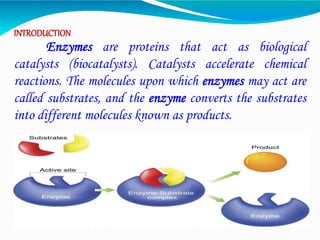
Enzymes are proteins that act as biological
catalysts (biocatalysts). Catalysts accelerate chemical
reactions. The molecules upon which enzymes may act are
called substrates, and the enzyme converts the substrates
into different molecules known as products.
•The biological processes that occur within all living
organisms are chemical reactions, and most are regulated
by enzymes.
•Without enzymes, many of these reactions would not
take place at a perceptible rate.
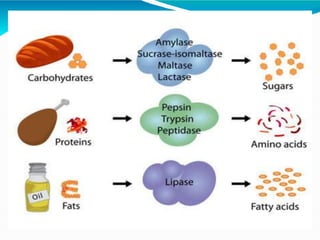
•Enzymes catalyze all aspects of cell metabolism. This
includes the digestion of food, in which large nutrient
molecules (such as proteins, carbohydrates, and fats) are
broken down into smaller molecules; the conservation and
transformation of chemical energy; and the construction
of cellular macromolecules from smaller precursors.
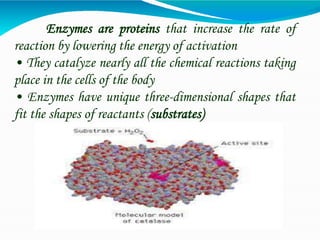
Enzymes are proteins that increase the rate of
reaction by lowering the energy of activation
• They catalyze nearly all the chemical reactions taking
place in the cells of the body
• Enzymes have unique three-dimensional shapes that
fit the shapes of reactants (substrates)
What is an enzyme?
•An enzyme is a substance that acts as a catalyst in
living organisms, regulating the rate at which chemical
reactions proceed without itself being altered in the
process.
• Enzymes are biological catalysts.
• A Catalyst is defined as "a substance that increases the
rate
of a chemical reaction without being itself changed in the
process.”
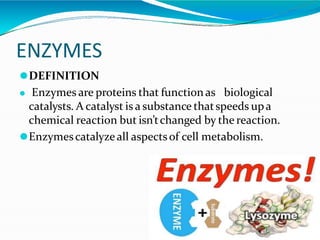
ENZYMES
⚫DEFINITION
⚫ Enzymes are proteins that functionas biological
catalysts. A catalyst is a substance thatspeeds upa
chemical reaction but isn’tchanged by the reaction.
⚫Enzymescatalyzeall aspectsof cell metabolism.
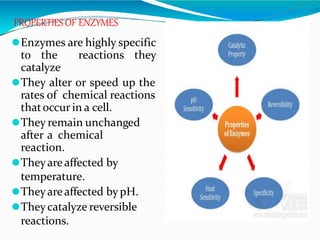
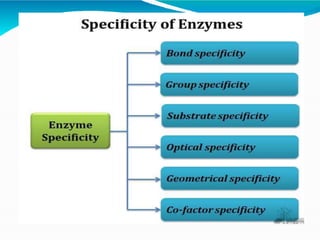
⚫Enzymes are highly specific
to the reactions they
catalyze
⚫They alter or speed up the
rates of chemical reactions
thatoccur in a cell.
⚫They remain unchanged
after a chemical
reaction.
⚫Theyareaffected by
temperature.
⚫Theyareaffected by pH.
⚫Theycatalyze reversible
reactions.
PROPERTIESOF ENZYMES
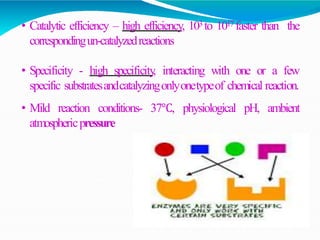
• Catalytic efficiency – high efficiency, 103 to 1017 faster than the
correspondingun-catalyzedreactions
• Specificity - high specificity
, interacting with one or a few
specific substratesandcatalyzingonlyonetypeof chemical reaction.
• Mild reaction conditions- 37℃, physiological pH, ambient
atmosphericpressure
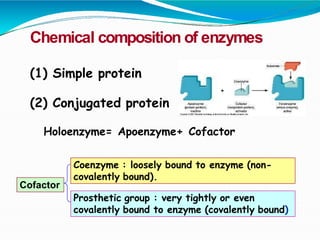
Chemical composition of enzymes
(1) Simple protein
(2) Conjugated protein
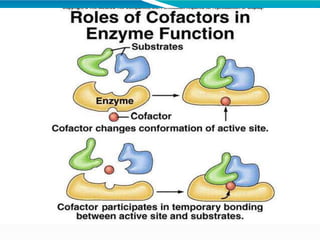
Holoenzyme= Apoenzyme+ Cofactor
Coenzyme : loosely bound to enzyme (non-
covalently bound).
Prosthetic group : very tightly or even
covalently bound to enzyme (covalently bound)
Cofactor
Classificationof enzymes
Based on their their composition
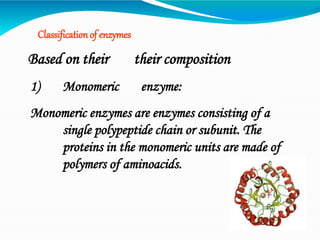
1) Monomeric enzyme:
Monomeric enzymes are enzymes consisting of a
single polypeptide chain or subunit. The
proteins in the monomeric units are made of
polymers of aminoacids.
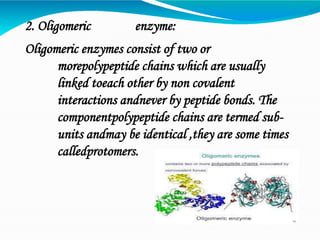
2. Oligomeric enzyme:
Oligomeric enzymes consist of two or
morepolypeptide chains which are usually
linked toeach other by non covalent
interactions andnever by peptide bonds. The
componentpolypeptide chains are termed sub-
units andmay be identical ,they are some times
calledprotomers.
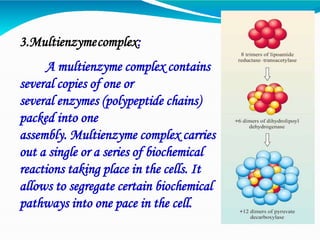
3.Multienzymecomplex:
A multienzyme complex contains
several copies of one or
several enzymes (polypeptide chains)
packed into one
assembly. Multienzyme complex carries
out a single or a series of biochemical
reactions taking place in the cells. It
allows to segregate certain biochemical
pathways into one pace in the cell.
Nomenclature
• Recommended name
•Enzymes are usuallynamed according to
the reaction they carry out.
•To generate the name of an enzyme,
the suffix ase is added to the name
of its substrate (e g , lactase is the enzyme
that cleaves lactose) or the type of reaction
(e.g., DNA polymerase forms DNA polymers).
•Systematic name (International classification)
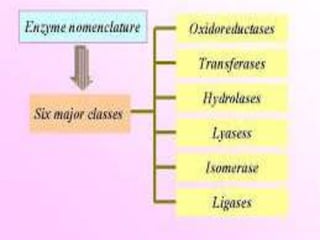
•By the reactions they catalyze (Six classes)
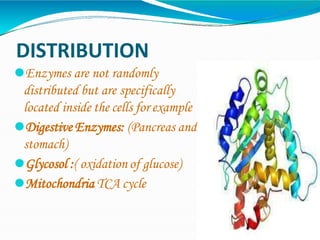
DISTRIBUTION
⚫Enzymes are not randomly
distributed but are specifically
located inside the cells for example
⚫Digestive Enzymes: (Pancreas and
stomach)
⚫Glycosol :( oxidation of glucose)
⚫Mitochondria TCA cycle
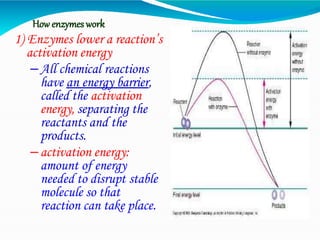
How enzymes work
1) Enzymes lower a reaction’s
activation energy
–All chemical reactions
have an energy barrier,
called the activation
energy, separating the
reactants and the
products.
–activation energy:
amount of energy
needed to disrupt stable
molecule so that
reaction can take place.
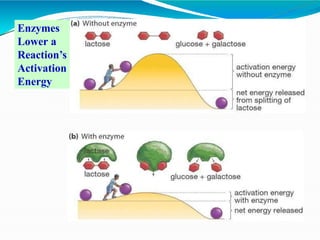
Enzymes
Lower a
Reaction’s
Activation
Energy
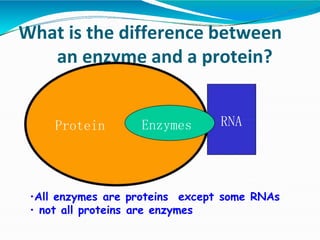
What is the difference between
an enzyme and a protein?
Protein
•All enzymes are proteins except some RNAs
• not all proteins are enzymes
RNA
Enzymes
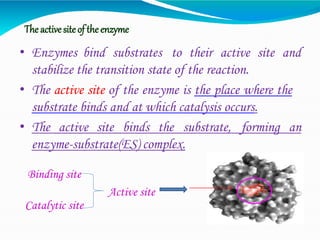
The activesiteof theenzyme
• Enzymes bind substrates to their active site and
stabilize the transition state of the reaction.
• The active site of the enzyme is the place where the
substrate binds and at which catalysis occurs.
• The active site binds the substrate, forming an
enzyme-substrate(ES) complex.
Binding site
Active site
Catalytic site
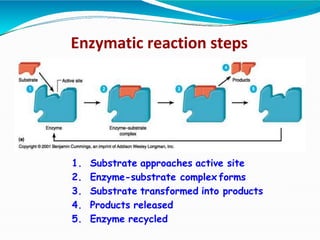
Enzymatic reaction steps
1. Substrate approaches active site
2. Enzyme-substrate complex forms
3. Substrate transformed into products
4. Products released
5. Enzyme recycled
Enzymesin clinical diagnosis
• An enzyme test is a blood test or urine test that
measures levels of certain enzymes to assess how
well the body’s systems are functioning and
whether there has been any tissue damage.
Common enzymes used for clinical diagnosis
alanine aminotransferase(ALT,also called
glutamate pyruvate transaminase,GPT)
alkaline phosphatase
amylase
aspartate aminotransferase
creatine kinase
lactate dehydrogenase
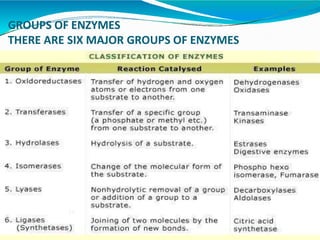
GROUPS OF ENZYMES
THERE ARE SIX MAJOR GROUPS OF ENZYMES
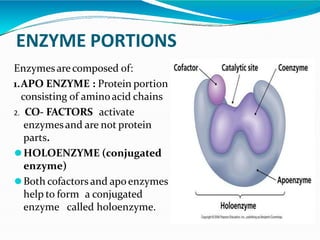
ENZYME PORTIONS
Enzymesarecomposed of:
1.APO ENZYME : Protein portion
consisting of aminoacid chains
2. CO- FACTORS activate
enzymesand are not protein
parts.
⚫HOLOENZYME (conjugated
enzyme)
⚫Both cofactors and apoenzymes
help to form a conjugated
enzyme called holoenzyme.
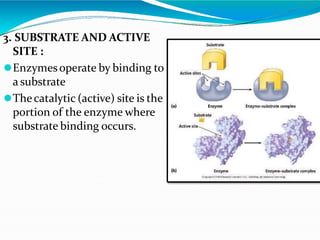
3. SUBSTRATE AND ACTIVE
SITE :
⚫Enzymesoperate by binding to
a substrate
⚫Thecatalytic (active) site is the
portion of the enzyme where
substrate binding occurs.
MECHANISMOF ENZYMEACTION
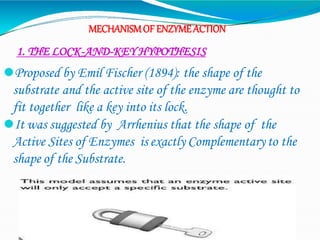
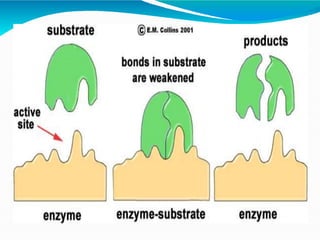
⚫Proposed by Emil Fischer (1894): the shape of the
substrate and the active site of the enzyme are thought to
fit together like a key into its lock.
⚫It was suggested by Arrhenius that the shape of the
Active Sites of Enzymes is exactly Complementary to the
shape of the Substrate.
1. THE LOCK-AND-KEY HYPOTHESIS
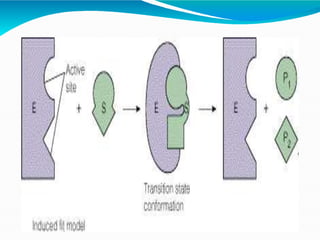
2. Induced fit hypothesis
proposed in 1958 by Daniel E. Koshland, Jr.: the
binding of substrate induces a conformational change in
the active site of the enzyme.
In addition, the enzyme may distort the substrate,
forcing it into a conformation similar to that of the
transition state
A more recent model suggested by Daniel
Koshland the Induced- Fit Model.
It states that the shape of Active Sites are not
exactly Complementary, but are changed according
to the substrate molecules
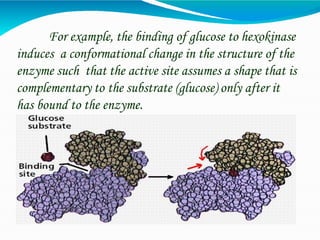
For example, the binding of glucose to hexokinase
induces a conformational change in the structure of the
enzyme such that the active site assumes a shape that is
complementary to the substrate (glucose) only after it
has bound to the enzyme.
Factors affecting enzyme activity
• Concentration of substrate
• Concentration of enzyme
• Temperature
• pH
• Activators
• Inhibitors
FACTORS AFFECTING THE RATE OF
ENZYME ACTIONS
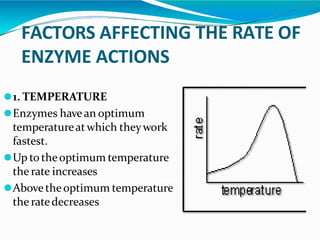
⚫1. TEMPERATURE
⚫Enzymes havean optimum
temperatureatwhich theywork
fastest.
⚫Up totheoptimum temperature
the rate increases
⚫Abovetheoptimum temperature
the ratedecreases
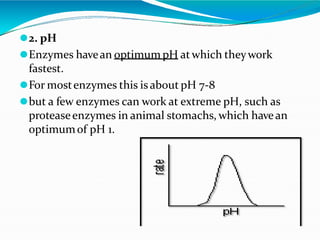
⚫2. pH
⚫Enzymes havean optimum pH atwhich theywork
fastest.
⚫For mostenzymes this is about pH 7-8
⚫but a few enzymes can work at extreme pH, such as
proteaseenzymes in animal stomachs, which havean
optimumof pH 1.
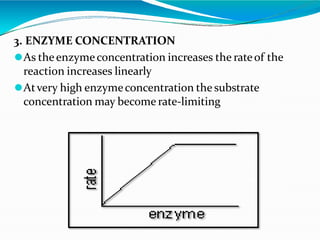
3. ENZYME CONCENTRATION
⚫As theenzymeconcentration increases the rateof the
reaction increases linearly
⚫Atvery high enzymeconcentration the substrate
concentration may become rate-limiting
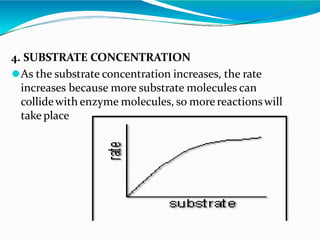
4. SUBSTRATE CONCENTRATION
⚫As the substrate concentration increases, the rate
increases because more substrate molecules can
collidewith enzyme molecules, so more reactionswill
take place
INHIBITION CAN BE EITHER COMPETITIVE OR
NONCOMPETITIVE
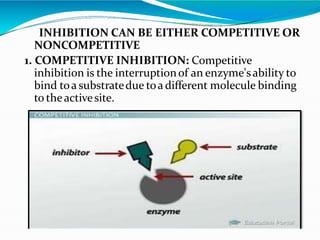
1. COMPETITIVE INHIBITION: Competitive
inhibition is the interruptionof an enzyme'sability to
bind toa substratedue toa different molecule binding
to theactivesite.
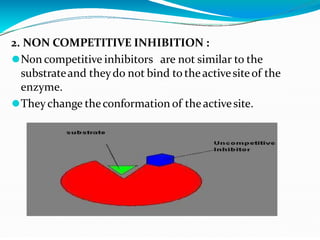
2. NON COMPETITIVE INHIBITION :
⚫Non competitive inhibitors are not similar to the
substrateand theydo not bind to theactivesiteof the
enzyme.
⚫Theychange theconformation of theactivesite.
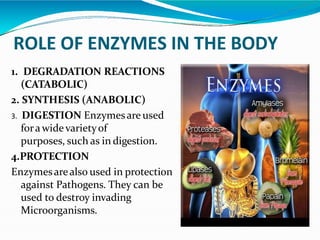
ROLE OF ENZYMES IN THE BODY
1. DEGRADATION REACTIONS
(CATABOLIC)
2. SYNTHESIS (ANABOLIC)
3. DIGESTION Enzymesare used
fora wide varietyof
purposes, such as in digestion.
4.PROTECTION
Enzymesarealso used in protection
against Pathogens. They can be
used to destroy invading
Microorganisms.
 Enzymes.pptx
 Enzymes.pptx

Enzymes.pptx

  • 1.
  • 2.
    INTRODUCTION Enzymes are proteinsthat act as biological catalysts (biocatalysts). Catalysts accelerate chemical reactions. The molecules upon which enzymes may act are called substrates, and the enzyme converts the substrates into different molecules known as products.
  • 3.
    •The biological processesthat occur within all living organisms are chemical reactions, and most are regulated by enzymes. •Without enzymes, many of these reactions would not take place at a perceptible rate. •Enzymes catalyze all aspects of cell metabolism. This includes the digestion of food, in which large nutrient molecules (such as proteins, carbohydrates, and fats) are broken down into smaller molecules; the conservation and transformation of chemical energy; and the construction of cellular macromolecules from smaller precursors.
  • 4.
    Enzymes are proteinsthat increase the rate of reaction by lowering the energy of activation • They catalyze nearly all the chemical reactions taking place in the cells of the body • Enzymes have unique three-dimensional shapes that fit the shapes of reactants (substrates)
  • 5.
    What is anenzyme? •An enzyme is a substance that acts as a catalyst in living organisms, regulating the rate at which chemical reactions proceed without itself being altered in the process. • Enzymes are biological catalysts. • A Catalyst is defined as "a substance that increases the rate of a chemical reaction without being itself changed in the process.”
  • 6.
    ENZYMES ⚫DEFINITION ⚫ Enzymes areproteins that functionas biological catalysts. A catalyst is a substance thatspeeds upa chemical reaction but isn’tchanged by the reaction. ⚫Enzymescatalyzeall aspectsof cell metabolism.
  • 7.
    ⚫Enzymes are highlyspecific to the reactions they catalyze ⚫They alter or speed up the rates of chemical reactions thatoccur in a cell. ⚫They remain unchanged after a chemical reaction. ⚫Theyareaffected by temperature. ⚫Theyareaffected by pH. ⚫Theycatalyze reversible reactions. PROPERTIESOF ENZYMES
  • 9.
    • Catalytic efficiency– high efficiency, 103 to 1017 faster than the correspondingun-catalyzedreactions • Specificity - high specificity , interacting with one or a few specific substratesandcatalyzingonlyonetypeof chemical reaction. • Mild reaction conditions- 37℃, physiological pH, ambient atmosphericpressure
  • 11.
    Chemical composition ofenzymes (1) Simple protein (2) Conjugated protein Holoenzyme= Apoenzyme+ Cofactor Coenzyme : loosely bound to enzyme (non- covalently bound). Prosthetic group : very tightly or even covalently bound to enzyme (covalently bound) Cofactor
  • 13.
    Classificationof enzymes Based ontheir their composition 1) Monomeric enzyme: Monomeric enzymes are enzymes consisting of a single polypeptide chain or subunit. The proteins in the monomeric units are made of polymers of aminoacids.
  • 14.
    2. Oligomeric enzyme: Oligomericenzymes consist of two or morepolypeptide chains which are usually linked toeach other by non covalent interactions andnever by peptide bonds. The componentpolypeptide chains are termed sub- units andmay be identical ,they are some times calledprotomers.
  • 15.
    3.Multienzymecomplex: A multienzyme complexcontains several copies of one or several enzymes (polypeptide chains) packed into one assembly. Multienzyme complex carries out a single or a series of biochemical reactions taking place in the cells. It allows to segregate certain biochemical pathways into one pace in the cell.
  • 16.
    Nomenclature • Recommended name •Enzymesare usuallynamed according to the reaction they carry out. •To generate the name of an enzyme, the suffix ase is added to the name of its substrate (e g , lactase is the enzyme that cleaves lactose) or the type of reaction (e.g., DNA polymerase forms DNA polymers). •Systematic name (International classification) •By the reactions they catalyze (Six classes)
  • 18.
    DISTRIBUTION ⚫Enzymes are notrandomly distributed but are specifically located inside the cells for example ⚫Digestive Enzymes: (Pancreas and stomach) ⚫Glycosol :( oxidation of glucose) ⚫Mitochondria TCA cycle
  • 19.
    How enzymes work 1)Enzymes lower a reaction’s activation energy –All chemical reactions have an energy barrier, called the activation energy, separating the reactants and the products. –activation energy: amount of energy needed to disrupt stable molecule so that reaction can take place.
  • 20.
  • 21.
    What is thedifference between an enzyme and a protein? Protein •All enzymes are proteins except some RNAs • not all proteins are enzymes RNA Enzymes
  • 22.
    The activesiteof theenzyme •Enzymes bind substrates to their active site and stabilize the transition state of the reaction. • The active site of the enzyme is the place where the substrate binds and at which catalysis occurs. • The active site binds the substrate, forming an enzyme-substrate(ES) complex. Binding site Active site Catalytic site
  • 23.
    Enzymatic reaction steps 1.Substrate approaches active site 2. Enzyme-substrate complex forms 3. Substrate transformed into products 4. Products released 5. Enzyme recycled
  • 24.
    Enzymesin clinical diagnosis •An enzyme test is a blood test or urine test that measures levels of certain enzymes to assess how well the body’s systems are functioning and whether there has been any tissue damage.
  • 25.
    Common enzymes usedfor clinical diagnosis alanine aminotransferase(ALT,also called glutamate pyruvate transaminase,GPT) alkaline phosphatase amylase aspartate aminotransferase creatine kinase lactate dehydrogenase
  • 26.
    GROUPS OF ENZYMES THEREARE SIX MAJOR GROUPS OF ENZYMES
  • 27.
    ENZYME PORTIONS Enzymesarecomposed of: 1.APOENZYME : Protein portion consisting of aminoacid chains 2. CO- FACTORS activate enzymesand are not protein parts. ⚫HOLOENZYME (conjugated enzyme) ⚫Both cofactors and apoenzymes help to form a conjugated enzyme called holoenzyme.
  • 28.
    3. SUBSTRATE ANDACTIVE SITE : ⚫Enzymesoperate by binding to a substrate ⚫Thecatalytic (active) site is the portion of the enzyme where substrate binding occurs.
  • 29.
    MECHANISMOF ENZYMEACTION ⚫Proposed byEmil Fischer (1894): the shape of the substrate and the active site of the enzyme are thought to fit together like a key into its lock. ⚫It was suggested by Arrhenius that the shape of the Active Sites of Enzymes is exactly Complementary to the shape of the Substrate. 1. THE LOCK-AND-KEY HYPOTHESIS
  • 31.
    2. Induced fithypothesis proposed in 1958 by Daniel E. Koshland, Jr.: the binding of substrate induces a conformational change in the active site of the enzyme. In addition, the enzyme may distort the substrate, forcing it into a conformation similar to that of the transition state A more recent model suggested by Daniel Koshland the Induced- Fit Model. It states that the shape of Active Sites are not exactly Complementary, but are changed according to the substrate molecules
  • 33.
    For example, thebinding of glucose to hexokinase induces a conformational change in the structure of the enzyme such that the active site assumes a shape that is complementary to the substrate (glucose) only after it has bound to the enzyme.
  • 34.
    Factors affecting enzymeactivity • Concentration of substrate • Concentration of enzyme • Temperature • pH • Activators • Inhibitors
  • 35.
    FACTORS AFFECTING THERATE OF ENZYME ACTIONS ⚫1. TEMPERATURE ⚫Enzymes havean optimum temperatureatwhich theywork fastest. ⚫Up totheoptimum temperature the rate increases ⚫Abovetheoptimum temperature the ratedecreases
  • 36.
    ⚫2. pH ⚫Enzymes haveanoptimum pH atwhich theywork fastest. ⚫For mostenzymes this is about pH 7-8 ⚫but a few enzymes can work at extreme pH, such as proteaseenzymes in animal stomachs, which havean optimumof pH 1.
  • 37.
    3. ENZYME CONCENTRATION ⚫Astheenzymeconcentration increases the rateof the reaction increases linearly ⚫Atvery high enzymeconcentration the substrate concentration may become rate-limiting
  • 38.
    4. SUBSTRATE CONCENTRATION ⚫Asthe substrate concentration increases, the rate increases because more substrate molecules can collidewith enzyme molecules, so more reactionswill take place
  • 39.
    INHIBITION CAN BEEITHER COMPETITIVE OR NONCOMPETITIVE 1. COMPETITIVE INHIBITION: Competitive inhibition is the interruptionof an enzyme'sability to bind toa substratedue toa different molecule binding to theactivesite.
  • 40.
    2. NON COMPETITIVEINHIBITION : ⚫Non competitive inhibitors are not similar to the substrateand theydo not bind to theactivesiteof the enzyme. ⚫Theychange theconformation of theactivesite.
  • 41.
    ROLE OF ENZYMESIN THE BODY 1. DEGRADATION REACTIONS (CATABOLIC) 2. SYNTHESIS (ANABOLIC) 3. DIGESTION Enzymesare used fora wide varietyof purposes, such as in digestion. 4.PROTECTION Enzymesarealso used in protection against Pathogens. They can be used to destroy invading Microorganisms.