Enzymes II    Department of  Bioche mistry (J.D.) 2011 Mechanism  of  enzym e  rea ction , metal l oenzym es , kineti cs , a c tivit y , enzym es in medicine
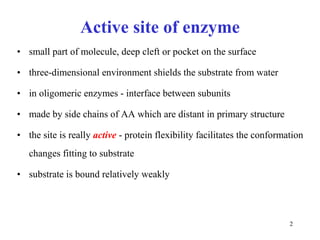
Active site of enzyme small part of molecule, deep cleft or pocket on the surface  three-dimensional environment shields the substrate from water in oligomeric enzymes - interface between subunits made by side chains of AA which are distant in primary structure the site is really  active  - protein flexibility facilitates the conformation changes fitting to substrate  substrate is bound relatively weakly
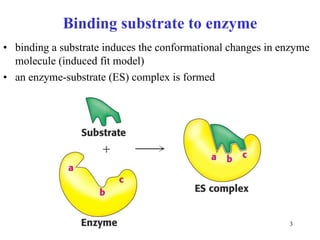
Binding substrate to  enzym e binding a substrate induces the conformational changes in enzyme molecule ( indu ced fit model) an enzyme-substrate  (ES)  complex is formed
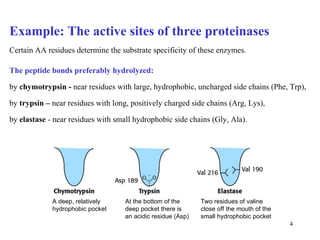
Example:  The active sites of three proteinases Certain  AA  residues determin e  the substrate specificity of these enzymes. The peptide bonds prefer ably hydrolyzed:   by  chymotrypsin  -  near  residues with large, hydrophobic, uncharged side chains (Phe, Trp), by  trypsin  –   near  residues with long, positively charged side chains (Arg, Lys),  by  elastase   - near  residues with small hydrophobic side chains (Gly, Ala). A deep, relatively hydrophobic pocket At the bottom of the deep pocket there is an acidic residue (Asp) Two residues of valine close off the mouth of the small hydrophobic pocket
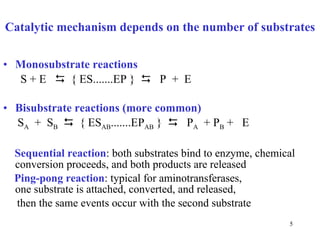
C atalytic   mechanism  depends on the number of  substr ates Monosubstr ate  rea ctions S + E     { ES.......EP }     P  +  E Bi substr ate reactions  ( more common ) S A   +  S B      { ES AB .......EP AB  }     P A   + P B  +  E Se quential reaction :  both  substr ates bind to  enzym e, chemical conversion proceeds, and both  produ cts are released Ping-pong   rea ction : typic al for  aminotransferas es ,  one  substr ate is attached, converted, and released,  then the same events occur with the second s ubstr ate
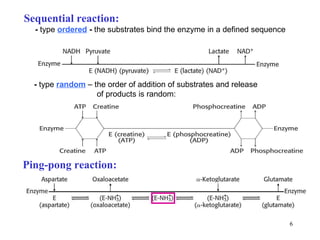
Sequential reaction : -  type  ordered  -  the substrates bind the enzyme in a defined sequence -  type  random   – the order of addition of substrates and release of products is random: Ping-pong reaction: + + +
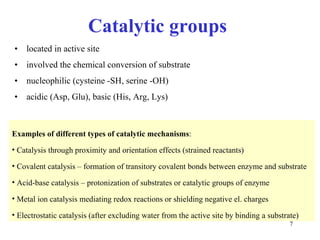
Catalytic groups  located in active site  involved the chemical conversion of substrate nucleophilic (cysteine -SH, serine -OH) acidic (Asp, Glu) ,  basic (His, Arg, Lys) Examples of   different types of catalytic mechanisms : Catalysis through proximity and orientation effects (strained reactants) Covalent catalysis – formation of transitory covalent bonds between  enzyme  and  substrate Acid-base catalysis – protonization of substrates or catalytic groups of  enzyme Metal ion catalysis mediating redox reactions or shielding negative el. charges Electrostatic catalysis (after excluding water from the active site by binding  a  substrate)
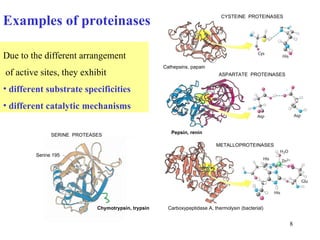
CYSTEINE   PROTEINASES Carboxypeptidase A, thermolysin (bacterial) METALLOPROTEINASES Cathepsins, papain  ASPART ATE  PROTEINASES Pepsin, renin Example s of  proteinases Due to the different arrangement  of active sites, they exhibit different substrate specificities different catalytic mechanisms   SERINE   PROTEASES Serine 195 Chymotrypsin , trypsin
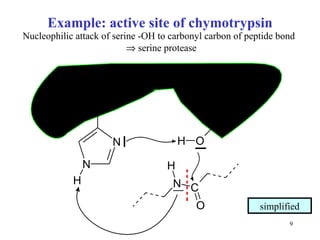
Example: active site of chymotrypsin Nucleophilic attack of serine -OH to carbonyl carbon of peptide bond      serine protease 195 57 simplified
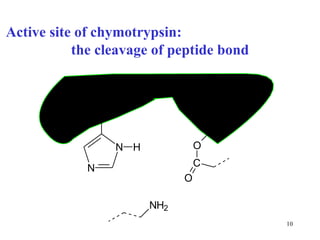
Active site of chymotrypsin:  the cleavage of peptide bond
Metalloenzymes contain  functioning metal   cations  (prosthetic groups) directly involved in catalyzed reaction, metal ions attached tightly  (Enz-M) some enzymes need metal ions just for  activation ,  they are associated relatively weekly (Enz …M),  e.g. Ca 2+  (coagulation factors),  Mg 2+  (kinases)
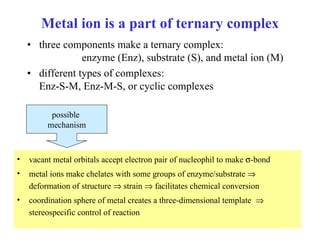
Metal ion is a part of ternary complex three components make a ternary complex:  enzyme (Enz), substrate (S), and metal ion (M) different types of complexes:  Enz-S-M, Enz-M-S, or cyclic complexes vacant metal orbitals accept electron pair of nucleophil to make   -bond metal ions make chelates with some groups of enzyme/substrate    deformation of structure    strain    facilitates chemical conversion coordination sphere of metal creates a three-dimensional template    stereospecific control of reaction possible   mechanism
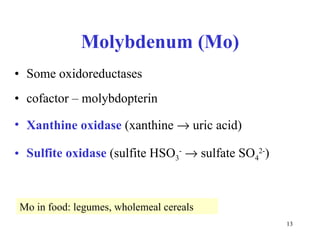
Molybdenum (Mo) Some oxidoreductases cofactor – molybdopterin Xanthine oxidase  (xanthine    uric acid) Sulfite oxidase  (sulfite HSO 3 -     sulfate SO 4 2- ) Mo in food: legumes, wholemeal cereals
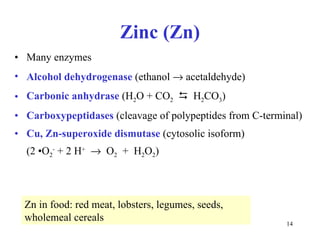
Zinc (Zn) Many enzymes Alcohol dehydrogenase  (ethanol    acetaldehyd e) Carbonic anhydrase  (H 2 O + CO 2      H 2 CO 3 ) Carboxypeptidases  (cleavage of polypeptides from C-terminal) Cu, Zn-superoxide dismutase  (cytosolic isoform)  (2 •O 2 -  + 2 H +      O 2   +  H 2 O 2 ) Zn in food: red meat, lobsters, legumes, seeds, wholemeal cereals
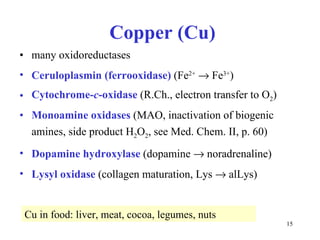
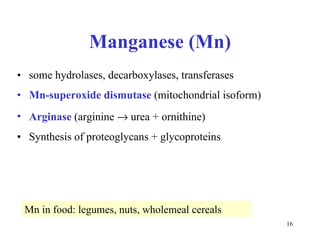
Copper (Cu) many oxidoreductases Ceruloplasmin (ferrooxidase)  (Fe 2+     Fe 3+ ) Cytochrome- c -oxidase  (R.Ch., electron transfer to O 2 ) Monoamine oxidases  (MAO, inactivation of biogenic amines, side product H 2 O 2 , see Med. Chem. II, p.  60 ) Dopamine hydroxylase  (dopamine    noradrenaline) Lysyl oxidase  (collagen maturation, Lys    alLys) Cu in food: liver, meat, cocoa, legumes, nuts
Manganese (Mn) some hydrolases, decarboxylases, transferases Mn-s uperoxide dismutase  (mitochondrial isoform) Arginase  (arginine    urea + ornithine) Synthesis of proteoglycans + glycoproteins Mn in food: legumes, nuts, wholemeal cereals
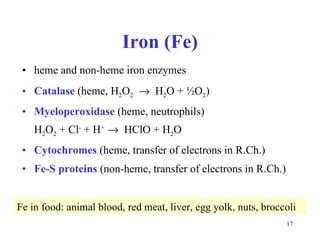
Iron (Fe) heme and non-heme iron enzymes  Catalase  (heme, H 2 O 2      H 2 O +  ½ O 2 ) Myeloperoxidase  (heme, neutrophils)  H 2 O 2  + Cl -  + H +     HClO  +  H 2 O Cytochrom es   ( hem e, transfer of electrons in R.Ch.) Fe-S proteins  (non-heme, transfer of electrons in R.Ch.) Fe in food: animal blood, red meat, liver, egg yolk, nuts, broccoli
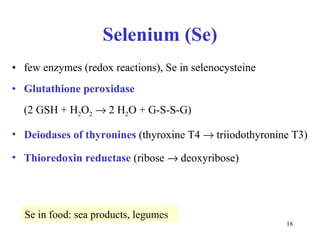
Selenium (Se) few enzymes (redox reactions) , Se  in  selenocystein e Glutathione peroxidase   (2 GSH + H 2 O 2     2 H 2 O + G-S-S-G) Deiodases of thyronines  (thyroxine T4    triiodothyronine T3) Thioredoxin reductase  (ribose    deoxyribose) Se in food: sea products, legumes
Basic  kinetic  terms rea ction :  S     P  (S = substr ate , P = produ c t) Defini tion of  rea ction velocity (rate):  this definiton is for average rate, instantaneous rate:  d[S]/d t
Factors influencing  rea ction rate  concentra tion of  substr ate   [S] temperature t he presence of c ataly st or  inhibitor In enzyme reactions  c oncentration of enzyme [E] pH
Kinetic  equation for  rea ction  S    P  v   =  k  [S]  =  k [S] 1      reaction of 1. order k =  rate   c onstant
K inetic   (progress)  curve s  for  substrate and  product during  rea ction : concentra tion of  substr ate  decreases concentration of product increases reaction rate is determined from kinetic curves The instantaneous velocity  v x  at any particular time  t x  is  g iven  by the slope of the tangent to the curve at that time. [ P ] t [ S ] t (equilibrium)
Rea ction of  0.  order  Rea ction rate does not depend on the substrate c oncentra tion   v   =  k  [S] 0   =  k  ×  1 =  k  =  constant At great excess of substrate S in enzyme rections only in  laboratory conditions
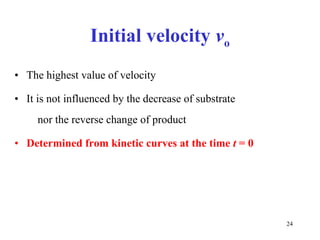
Initial velocity   v o The highest value of velocity It is not influenced by the decrease of  substr ate  no r the  reverse change of  produ ct Determined from kinetic curves at the time  t  = 0
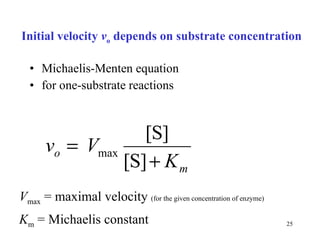
Initial velocity  v o  depends on  substr ate concentration Michaelis-Menten equation for one-substrate reactions V max  = maximal velocity  (for the given concentration of enzyme) K m  = Michaelis constant
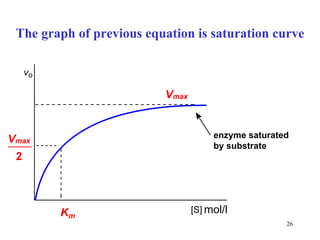
The graph of previous equation is saturation curve enzyme saturated by substrate
If  [S] <<  K m at low substrate concentration the reaction proceeds by the  1 st  order kinetics ×
If  [S] >>  K m at high substrate concentration the reaction proceeds by the  0. order kinetics ×
Two parts of saturation curve compare with   pages 21 and 23 [ S ] V 0 V max K m The zero-order kinetics The 1 st  order kinetics
If  [S] =  K m
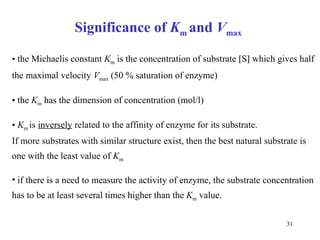
Significance of  K m  and   V max   t he Michaelis constant  K m   is the concentration   of substrate   S   which gives half the maxim al  velocity   V max  (50 % saturation of enzyme) the  K m  has the dimension of concentration (mol/l) K m  is  inversely  related to the affinity of enzyme for its substrate.  If more substrates with similar structure exist, then the best natural substrate is one with the least value of  K m i f there is a need to measure the activity of enzyme, the substrate concentration has to be at least several times higher than the  K m  value.
From the obtained progress curves, the values  v o   are   estimated   and plotted against  the corresponding [S] .  T he velocity  v o   rises linearly as substrate concentration increases, and then begins to level till it reaches a limit value at high substrate concentrations. How to get a saturation curve?  E   = const . A series of measurements of initial velocity  is  arranged   at a constant enzyme concentration   E   and different substrate   concentrations   S   (in the range of 2 - 3 orders).  [ P ] t [ S 1 ] [ S 2 ] [ S 3 ] [ S 4 ] v 0  1 v 0  2 v 0  3 v 0  4
Distinguish Kinetic curve time record  of  one   reaction [S] = f ( t )  or  [P]  = f ( t ) Saturation curve dependence obtained  from  many   reactions  ( see  p revious page ) v o  = f   ( [S]) [S] ……..  substr ate concentration [P]  ..........  product concentration f …………  function t  …………  time v o   ………..  initial velocity
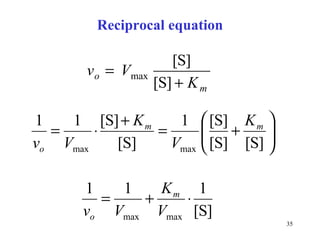
V max  and   K m  describe the kinetic properties  of enzyme are hardly obtained from saturation curve easily obtained from linear double reciprocal plot Lineweaver-Burk:  1/ v o  is plotted against  1/ [S]
Reciprocal equation
Reciprocal form is the equation of a line  ( y  =  a  x   +  b) 1/ v o   ................  dependent variable ( y ) 1/ [S]  ...............  independent variable ( x ) 1/ K m  ........... ....   1/ V max   .............  easily determined from the graph
Linear reciprocal plot: 1/ v o  is the function of 1/ [S]
Initial velocity depends on  enzym e concentration  [E]  v o [S] [E 1 ] [E 2 ]  >  [E 1 ] [E 3 ]  >  [E 2 ] K M   does not change,  V max   increases with increased  [E] saturated  enzym e :  v o   =  k [E] t   [E] t   is  tot al c oncentra tion of  enzym e
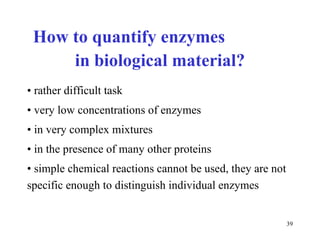
How to quantify  enzym es  in b iologic al  mater ial ? rather difficult task very low   c oncentra tions of  enzym es in very complex mixtures in the presence of many other proteins simple  chemic al reactions cannot be used, they are not specific enough to distinguish individual enzymes
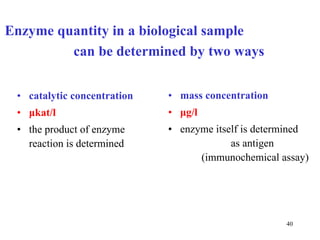
Enzyme quantity in a biological sample  can be determined by two ways  catalytic concentration   μ kat/l the product of enzyme reaction is determined mass concentration   μ g/l enzyme itself is determined   as antigen  (immunochemical assay)
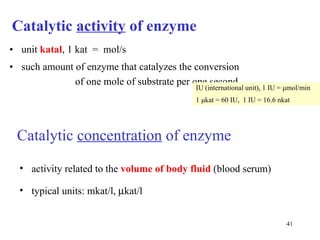
Catalytic  activity  of enzyme unit  katal , 1 kat  =  mol/s such amount of enzyme that catalyzes the conversion  of one mole of substrate per one second  IU (international unit), 1 IU =  μ mol/min 1  μ kat = 60 IU,  1 IU = 16.6 nkat Catalytic  concentration  of enzyme activity related to the  volume of body fluid  (blood serum) typical units: mkat/l,   kat/l
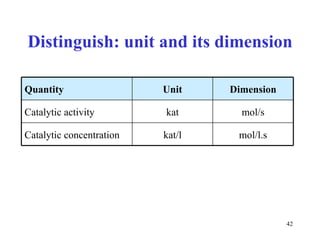
Distinguish: unit and its dimension mol/l.s kat/l Catalytic concentration mol/s kat Catalytic activity Dimension Unit Quantity
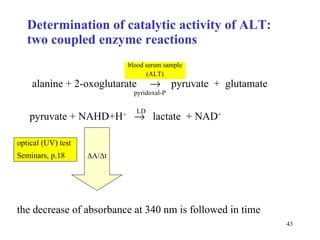
Determination of catalytic activity of ALT:  two coupled enzyme reactions alanine + 2-oxoglutarate     pyruvate  +  glutamate blood serum sample (ALT) pyridoxal-P pyruvate + NAHD+H +      lactate  + NAD + Δ A/ Δ t optical (UV) test Semin ars ,  p .18 the decrease of absorbance at 340 nm is followed in time LD
Determination of catalytic activity   in vitro optimal conditions: temperature, pH  the presence of all necessary cofactors  the absence of all (known) inhibitors excess of substrate     0. order kinetics:  [S] >>  K m      saturated enzyme, reaction rate is constant and close to  V max    [S]  or   [P] is followed during time
Two methods for catalytic concentration less exact exact  Evaluation of method average velocity initial velocity  v o What is determined no yes Kinetic curve needed after some time (e.g. 10 min) the reaction is stopped  by enzyme inactivation continually  ( e.g. in  10 s econds ) How [P]  [S]  or [P]  What is measured Constant-time method Kinetic method Feature
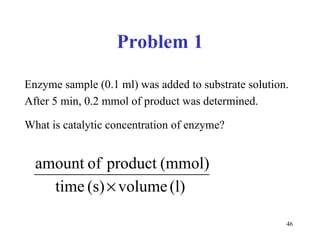
Problem 1 Enzyme sample (0.1 ml) was added to substrate solution.  After 5 min,  0 . 2 mmol  of  produ ct was determined. What is catalytic concentration  of enzyme?
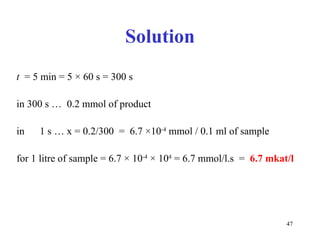
Solution t   = 5 min = 5  ×  60 s = 300 s in 300 s …  0.2 mmol of product in  1 s … x = 0.2/300  =  6.7  × 10 -4  mmol / 0.1 ml of sample for 1 litre of sample = 6.7  ×  10 -4   ×  10 4  = 6.7 mmol/l.s  =  6.7 mkat/l
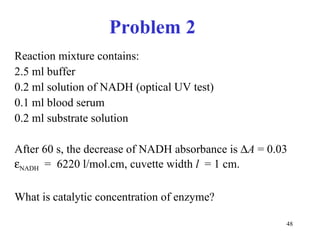
Problem 2 Reaction mixture contains:  2.5 ml buffer  0.2 ml solution of NADH (optical UV test) 0.1 ml blood serum  0.2 ml substrate solution After 60 s, the decrease of NADH absorbance is   A  = 0.03   NADH   =  6220 l/mol.cm, cuvette width  l  = 1 cm.  What is catalytic concentration of enzyme?
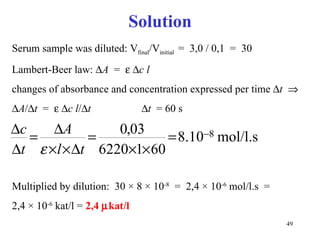
Solution Serum sample was diluted: V final /V initial  =  3,0 / 0,1  =  30 Lambert-Beer law:   A   =      c   l   changes of absorbance and concentration expressed per time   t    A /  t   =      c   l /  t   t   = 60 s Multiplied by dilution:  30  ×  8  ×  10 -8   =  2,4  ×  10 -6  mol/l.s  =  2,4  ×  10 -6  kat/l =  2,4   kat/l
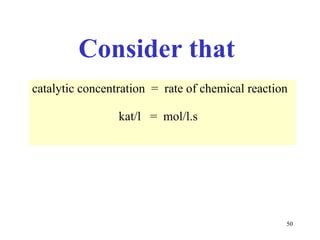
Consider that  catalytic concentration  =  rate of chemical reaction kat /l   =  mol/l.s
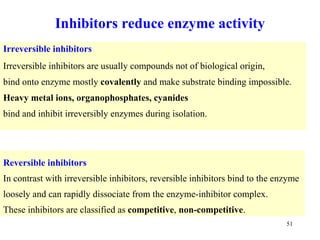
Irreversible inhibit ors Irreversible inhibitors are usually compounds not of biological origin,  bind   on to  enzyme mostly  covalently  and make substrate binding impossible. Heavy metal ions , organophosphates, cyanides   bind and inhibit irreversibly enzymes during isolation. Inhibitors reduce enzyme activity Reversible inhibit ors In contrast with irreversible inhibitors, reversible inhibitors bind to the enzyme loosely and can rapidly dissociate from the enzyme-inhibitor complex.  These inhibitors are classified as  competitive ,  non-competitive .
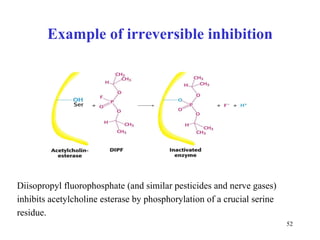
Example of i rreversible inhibition Diisopropyl   fluorophosphate (and similar pesticides and nerve gases) inhibits acetylcholine esterase by phosphorylation of a crucial serine residue.
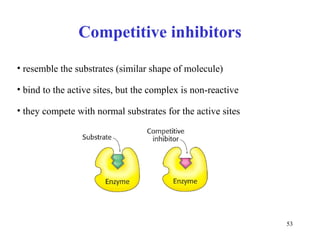
Competitive inhibitors resemble the substrates  (similar shape of molecule) bind to the active sites, but the complex is  non- reactive t hey compete with normal substrates for the active sites
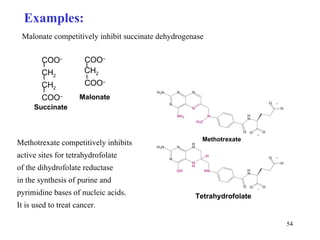
Malonate competitively inhibit succinate dehydrogenase Examples: Methotrexate competitively inhibits active sites for tetrahydrofolate of the dihydrofolate reductase in the synthesis of purine and pyrimidine bases of nucleic acids. It is used to treat cancer. Methotrexate Tetrahydrofolate Malonate Succinate COO – CH 2 CH 2 COO – COO – CH 2 COO –
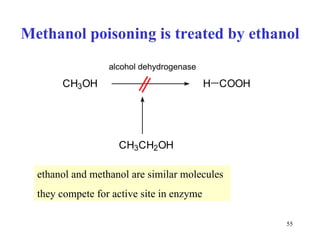
Methanol poisoning is treated by ethanol ethanol and methanol are similar molecules they compete for active site in enzyme alcohol dehydrogenase
Competitive inhibitors increase  K m   without any change in  V max   The  V max  can be reached even in the presence of inhibitor, but at much higher concentrations of  [S] that have to overcome the competing inhibitor concentration. K m [S] v 0 V max K m 1 /  v 0 1 / [S] 1 /  V max - 1 /  K m No inhibitor Competitive inhibitor
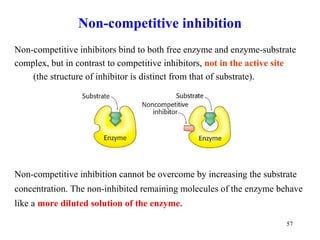
Non - competitive inhibition Non - competitive inhibitors bind to both free enzyme and enzyme-substrate complex, but in contrast to competitive inhibitors,  not in   the active site   (the structure of inhibitor is distinct from th at of  substrate ). Non - competitive inhibition cannot be overcome by increasing the substrate concentration. The non - inhibited remaining molecules of the enzyme behave like a  more diluted solution of the enzyme.
Non - competitive inhibitors decrease  V max  without any change in  K m 1/v o 1 / [S] 1 /  V max - 1 /  K m Non - competitive inhibitor No inhibitor K m [S] v 0 V max V max Non - competitive inhibitor
Many drugs are inhibitors of enzymes Acetylsalicylic acid, ibuprofen (cyclooxygenase) - see Seminars, p. 67 Statins (HMG-CoA reductase) inhibit cholesterol synthesis (e.g. lovastatin) ACE Inhibitors (angiotensin-converting enzyme) – treatment of  hypertension  Rev er sible acetylcholinesterase inhibitors (e.g. neostigmine) – myastenia gravis,  post-surgical atonia, Brain acetylcholinesterase inhibitors (rivastigmine, galantamin) – Alzheimer d. Many antibiotics inhibit bacterial enzymes: Penicillins – inhibit bacterial transpeptidases (formation of bacterial cell-wall) Tetracyclins, macrolides, chloramphenicol  –  inhibit bacterial proteosynthesis Fluoroquinolones (ciprofloxacin) – inhibit bacterial topoisomerase
Regulation of enzyme  quantity Regulation of enzyme  activity Availability and concentration of substrate and/or cofactor  ( in vivo  less important,  in vitro  critical condition) Regulation principles in enzyme reactions  (three general aspects)
Regulation of enzyme quantity Controlled enzyme proteosynthesis   constitutive and induced gene expresion,  regulation of transcription rate,  posttranscriptional RNA processing,  regulation of translation rate and posttranslational modifications Controlled enzyme degradation   specific intracellular proteinases determine  biological half-life of enzymes
Regulation of enzyme activity Activation by partial and irreversible proteolysis  Reversible covalent modification Allosteric regulation
Enzyme activation by partial proteolysis Active enzyme is formed by  irreversible  cleavage of certain sequence from  proenzyme  (zymogen) molecule  Proteinases in digestion (pepsinogen    pepsin) Factors of blood coagulation Proteinases ca s pases in apoptosis
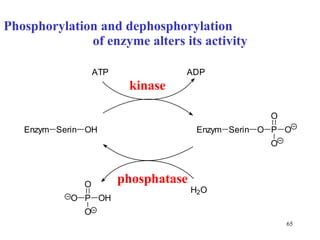
Reversible covalent enzyme modification phosphorylation , catalyzed by kinases transfer of phosphoryl -PO 3 2-  from ATP to -OH group of enzyme (Ser, Thr, Tyr) reversible process,  dephosphorylation catalyzed by  phosphatase , hydrolysis of phosphoester  Other modifications: carboxylation, acetylation, prenylation ...
Phosphorylation and dephosphorylation  of enzyme   alters its  a c tivit y kinase phosphatase
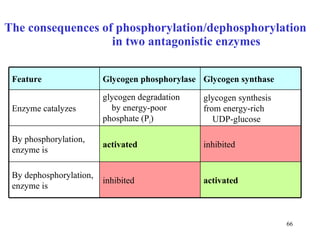
The consequences of phosphorylation/dephosphorylation  in two antagonistic enzymes activated inhibited By dephosphorylation, enzyme is inhibited activated By phosphorylation, enzyme is glycogen synthesis  from energy-rich  UDP-glucose  glycogen degradation  by energy-poor  phosphate (P i ) Enzyme catalyzes Glycogen synthase Glycogen phosphorylase Feature
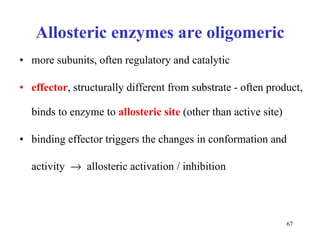
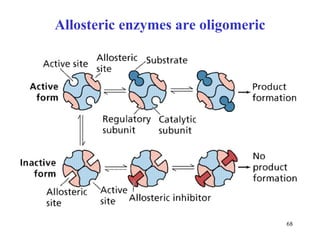
Allosteric enzymes are oligomeric more subunits, often regulatory and catalytic effector , structurally different from substrate - often product, binds to enzyme to  allosteric site  (other than active site) binding effector triggers the changes in conformation and activity     allosteric activation / inhibition
Allosteric enzymes are oligomeric
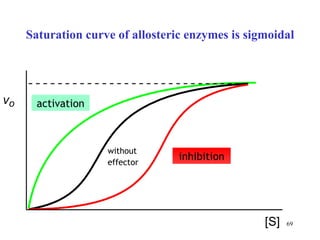
Satura tion curve of  allosteric   enzym es is  sigmoid al bez  efektoru activation without  effector inhibition
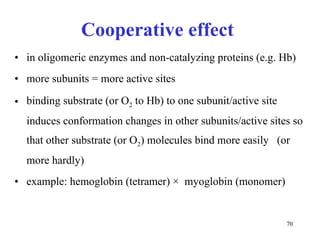
Cooperative effect  in oligomeric enzymes and non-catalyzing proteins (e.g. Hb) more subunits = more active sites binding substrate (or O 2  to Hb) to one subunit/active site induces conformation changes in other subunits/active sites so that other substrate (or O 2 ) molecules bind more easily  (or more hardly) example : hemoglobin  (tetramer)   ×   myoglobin  (monomer)
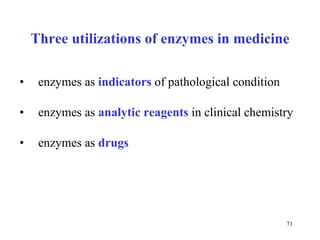
Three utilizations of enzymes in medicine enzymes as  indicators  of pathological condition enzymes as  analytic reagents  in clinical chemistry enzymes as  drugs
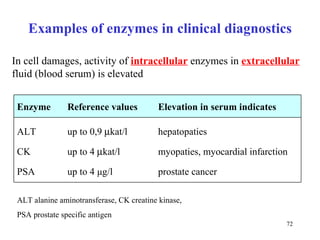
Examples of enzymes in clinical diagnostics ALT alanine aminotransferase, CK creatine kinase,   PSA prostate specific antigen In cell damages, activity of  intracellular  enzymes in  extracellular  fluid (blood serum) is elevated hepatopaties myopaties, myocardial infarction prostate cancer Elevation in serum indicates up to 0,9   kat/l up to 4   kat/l up to  4   μ g/l ALT CK PSA Reference values Enzyme
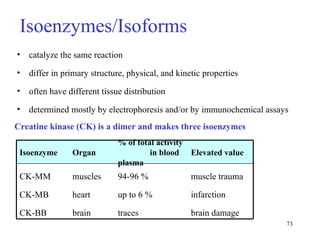
Creatine kinase (CK) is a dimer and makes three isoenzymes catalyze the same reaction  differ in primary structure, physical, and kinetic properties often have different tissue distribution determined mostly by electrophoresis and/or by immunochemical assays Isoenzymes/Isoforms muscle trauma infarction  brain damage Elevated value 94-96 % up to 6 % traces muscles heart brain CK-MM CK-MB CK-BB % of total activity  in blood plasma  Organ Isoenzyme
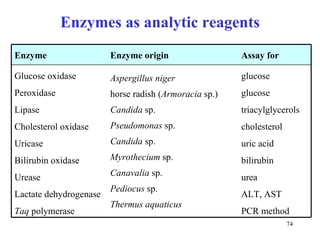
Enzymes as analytic reagents glucose glucose triacylglycerols cholesterol uric acid bilirubin urea ALT, AST PCR met hod Aspergillus niger horse   radish  ( Armoracia  sp. ) Candida  sp. Pseudomonas  sp. Candida  sp. Myrothecium  sp. Canavalia  sp. Pediocus  sp. Thermus aquaticus Glucose oxidase Peroxidase Lipase Cholesterol oxidase Uricase Bilirubin oxidase Urease Lactate dehydrogenase Taq  polymeras e Assay for Enzyme origin Enzyme
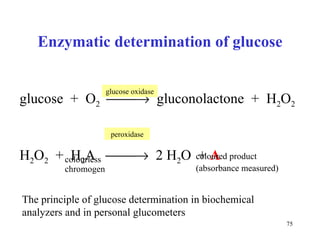
Enzymatic determination of glucose glucose  +  O 2      gluconolactone  +  H 2 O 2 H 2 O 2   +  H 2 A     2 H 2 O  +  A glucose oxidase peroxidase colourless chromogen coloured product (absorbance measured) The principle of glucose determination in biochemical analyzers and in personal glucometers
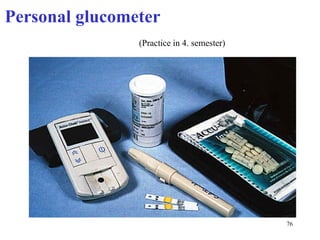
Personal glucometer  (Practice in 4. semester)
Pancreatic enzymes in therapy enzyme mixtures (lipase, amylase, proteinases)  of animal origin indication: insufficient secretion of pancreas,  cystic fibrosis 3  ×  times daily a capsule during meal acidoresistant capsules, they survive the passage through stomach, soluble till in duodenum
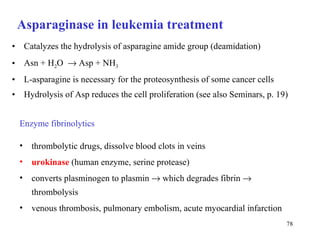
Asparaginase in leukemia treatment Catalyzes the hydrolysis of asparagine amide group (deamidation) Asn + H 2 O     Asp + NH 3 L-asparagine is necessary for the proteosynthesis of some cancer cells  Hydrolysis of Asp reduces the cell proliferation (see also  S eminars, p. 19)  Enzyme fibrinolytics thrombolytic drugs, dissolve blood clots in veins urokinase  (human enzyme, serine protease) converts plasminogen to plasmin    which degrades fibrin    thrombolysis venous thrombosis, pulmonary embolism, acute myocardial infarction
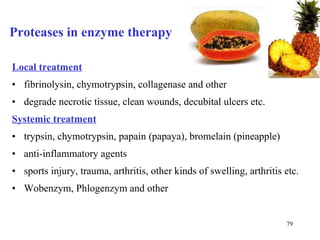
Proteases in enzyme therapy Local treatment fibrinolysin, chymotrypsin, collagenase and other degrade necrotic tissue, clean wounds, decubital ulcers etc. Systemic treatment trypsin, chymotrypsin, papain (papaya), bromelain (pineapple) anti-inflammatory agents sports injury, trauma, arthritis, other kinds of swelling, arthritis etc. Wobenzym, Phlogenzym and other

Enzymes 2

  • 1.
    Enzymes II  Department of Bioche mistry (J.D.) 2011 Mechanism of enzym e rea ction , metal l oenzym es , kineti cs , a c tivit y , enzym es in medicine
  • 2.
    Active site ofenzyme small part of molecule, deep cleft or pocket on the surface three-dimensional environment shields the substrate from water in oligomeric enzymes - interface between subunits made by side chains of AA which are distant in primary structure the site is really active - protein flexibility facilitates the conformation changes fitting to substrate substrate is bound relatively weakly
  • 3.
    Binding substrate to enzym e binding a substrate induces the conformational changes in enzyme molecule ( indu ced fit model) an enzyme-substrate (ES) complex is formed
  • 4.
    Example: Theactive sites of three proteinases Certain AA residues determin e the substrate specificity of these enzymes. The peptide bonds prefer ably hydrolyzed: by chymotrypsin - near residues with large, hydrophobic, uncharged side chains (Phe, Trp), by trypsin – near residues with long, positively charged side chains (Arg, Lys), by elastase - near residues with small hydrophobic side chains (Gly, Ala). A deep, relatively hydrophobic pocket At the bottom of the deep pocket there is an acidic residue (Asp) Two residues of valine close off the mouth of the small hydrophobic pocket
  • 5.
    C atalytic mechanism depends on the number of substr ates Monosubstr ate rea ctions S + E  { ES.......EP }  P + E Bi substr ate reactions ( more common ) S A + S B  { ES AB .......EP AB }  P A + P B + E Se quential reaction : both substr ates bind to enzym e, chemical conversion proceeds, and both produ cts are released Ping-pong rea ction : typic al for aminotransferas es , one substr ate is attached, converted, and released, then the same events occur with the second s ubstr ate
  • 6.
    Sequential reaction :- type ordered - the substrates bind the enzyme in a defined sequence - type random – the order of addition of substrates and release of products is random: Ping-pong reaction: + + +
  • 7.
    Catalytic groups located in active site involved the chemical conversion of substrate nucleophilic (cysteine -SH, serine -OH) acidic (Asp, Glu) , basic (His, Arg, Lys) Examples of different types of catalytic mechanisms : Catalysis through proximity and orientation effects (strained reactants) Covalent catalysis – formation of transitory covalent bonds between enzyme and substrate Acid-base catalysis – protonization of substrates or catalytic groups of enzyme Metal ion catalysis mediating redox reactions or shielding negative el. charges Electrostatic catalysis (after excluding water from the active site by binding a substrate)
  • 8.
    CYSTEINE PROTEINASES Carboxypeptidase A, thermolysin (bacterial) METALLOPROTEINASES Cathepsins, papain ASPART ATE PROTEINASES Pepsin, renin Example s of proteinases Due to the different arrangement of active sites, they exhibit different substrate specificities different catalytic mechanisms SERINE PROTEASES Serine 195 Chymotrypsin , trypsin
  • 9.
    Example: active siteof chymotrypsin Nucleophilic attack of serine -OH to carbonyl carbon of peptide bond  serine protease 195 57 simplified
  • 10.
    Active site ofchymotrypsin: the cleavage of peptide bond
  • 11.
    Metalloenzymes contain functioning metal cations (prosthetic groups) directly involved in catalyzed reaction, metal ions attached tightly (Enz-M) some enzymes need metal ions just for activation , they are associated relatively weekly (Enz …M), e.g. Ca 2+ (coagulation factors), Mg 2+ (kinases)
  • 12.
    Metal ion isa part of ternary complex three components make a ternary complex: enzyme (Enz), substrate (S), and metal ion (M) different types of complexes: Enz-S-M, Enz-M-S, or cyclic complexes vacant metal orbitals accept electron pair of nucleophil to make  -bond metal ions make chelates with some groups of enzyme/substrate  deformation of structure  strain  facilitates chemical conversion coordination sphere of metal creates a three-dimensional template  stereospecific control of reaction possible mechanism
  • 13.
    Molybdenum (Mo) Someoxidoreductases cofactor – molybdopterin Xanthine oxidase (xanthine  uric acid) Sulfite oxidase (sulfite HSO 3 -  sulfate SO 4 2- ) Mo in food: legumes, wholemeal cereals
  • 14.
    Zinc (Zn) Manyenzymes Alcohol dehydrogenase (ethanol  acetaldehyd e) Carbonic anhydrase (H 2 O + CO 2  H 2 CO 3 ) Carboxypeptidases (cleavage of polypeptides from C-terminal) Cu, Zn-superoxide dismutase (cytosolic isoform) (2 •O 2 - + 2 H +  O 2 + H 2 O 2 ) Zn in food: red meat, lobsters, legumes, seeds, wholemeal cereals
  • 15.
    Copper (Cu) manyoxidoreductases Ceruloplasmin (ferrooxidase) (Fe 2+  Fe 3+ ) Cytochrome- c -oxidase (R.Ch., electron transfer to O 2 ) Monoamine oxidases (MAO, inactivation of biogenic amines, side product H 2 O 2 , see Med. Chem. II, p. 60 ) Dopamine hydroxylase (dopamine  noradrenaline) Lysyl oxidase (collagen maturation, Lys  alLys) Cu in food: liver, meat, cocoa, legumes, nuts
  • 16.
    Manganese (Mn) somehydrolases, decarboxylases, transferases Mn-s uperoxide dismutase (mitochondrial isoform) Arginase (arginine  urea + ornithine) Synthesis of proteoglycans + glycoproteins Mn in food: legumes, nuts, wholemeal cereals
  • 17.
    Iron (Fe) hemeand non-heme iron enzymes Catalase (heme, H 2 O 2  H 2 O + ½ O 2 ) Myeloperoxidase (heme, neutrophils) H 2 O 2 + Cl - + H +  HClO + H 2 O Cytochrom es ( hem e, transfer of electrons in R.Ch.) Fe-S proteins (non-heme, transfer of electrons in R.Ch.) Fe in food: animal blood, red meat, liver, egg yolk, nuts, broccoli
  • 18.
    Selenium (Se) fewenzymes (redox reactions) , Se in selenocystein e Glutathione peroxidase (2 GSH + H 2 O 2  2 H 2 O + G-S-S-G) Deiodases of thyronines (thyroxine T4  triiodothyronine T3) Thioredoxin reductase (ribose  deoxyribose) Se in food: sea products, legumes
  • 19.
    Basic kinetic terms rea ction : S  P (S = substr ate , P = produ c t) Defini tion of rea ction velocity (rate): this definiton is for average rate, instantaneous rate: d[S]/d t
  • 20.
    Factors influencing rea ction rate concentra tion of substr ate [S] temperature t he presence of c ataly st or inhibitor In enzyme reactions c oncentration of enzyme [E] pH
  • 21.
    Kinetic equationfor rea ction S  P v = k [S] = k [S] 1  reaction of 1. order k = rate c onstant
  • 22.
    K inetic (progress) curve s for substrate and product during rea ction : concentra tion of substr ate decreases concentration of product increases reaction rate is determined from kinetic curves The instantaneous velocity v x at any particular time t x is g iven by the slope of the tangent to the curve at that time. [ P ] t [ S ] t (equilibrium)
  • 23.
    Rea ction of 0. order Rea ction rate does not depend on the substrate c oncentra tion v = k [S] 0 = k × 1 = k = constant At great excess of substrate S in enzyme rections only in laboratory conditions
  • 24.
    Initial velocity v o The highest value of velocity It is not influenced by the decrease of substr ate no r the reverse change of produ ct Determined from kinetic curves at the time t = 0
  • 25.
    Initial velocity v o depends on substr ate concentration Michaelis-Menten equation for one-substrate reactions V max = maximal velocity (for the given concentration of enzyme) K m = Michaelis constant
  • 26.
    The graph ofprevious equation is saturation curve enzyme saturated by substrate
  • 27.
    If [S]<< K m at low substrate concentration the reaction proceeds by the 1 st order kinetics ×
  • 28.
    If [S]>> K m at high substrate concentration the reaction proceeds by the 0. order kinetics ×
  • 29.
    Two parts ofsaturation curve compare with pages 21 and 23 [ S ] V 0 V max K m The zero-order kinetics The 1 st order kinetics
  • 30.
    If [S]= K m
  • 31.
    Significance of K m and V max t he Michaelis constant K m is the concentration of substrate  S  which gives half the maxim al velocity V max (50 % saturation of enzyme) the K m has the dimension of concentration (mol/l) K m is inversely related to the affinity of enzyme for its substrate. If more substrates with similar structure exist, then the best natural substrate is one with the least value of K m i f there is a need to measure the activity of enzyme, the substrate concentration has to be at least several times higher than the K m value.
  • 32.
    From the obtainedprogress curves, the values v o are estimated and plotted against the corresponding [S] . T he velocity v o rises linearly as substrate concentration increases, and then begins to level till it reaches a limit value at high substrate concentrations. How to get a saturation curve?  E  = const . A series of measurements of initial velocity is arranged at a constant enzyme concentration  E  and different substrate concentrations  S  (in the range of 2 - 3 orders). [ P ] t [ S 1 ] [ S 2 ] [ S 3 ] [ S 4 ] v 0 1 v 0 2 v 0 3 v 0 4
  • 33.
    Distinguish Kinetic curvetime record of one reaction [S] = f ( t ) or [P] = f ( t ) Saturation curve dependence obtained from many reactions ( see p revious page ) v o = f ( [S]) [S] …….. substr ate concentration [P] .......... product concentration f ………… function t ………… time v o ……….. initial velocity
  • 34.
    V max and K m describe the kinetic properties of enzyme are hardly obtained from saturation curve easily obtained from linear double reciprocal plot Lineweaver-Burk: 1/ v o is plotted against 1/ [S]
  • 35.
  • 36.
    Reciprocal form isthe equation of a line ( y = a x + b) 1/ v o ................ dependent variable ( y ) 1/ [S] ............... independent variable ( x ) 1/ K m ........... .... 1/ V max ............. easily determined from the graph
  • 37.
    Linear reciprocal plot:1/ v o is the function of 1/ [S]
  • 38.
    Initial velocity dependson enzym e concentration [E] v o [S] [E 1 ] [E 2 ] > [E 1 ] [E 3 ] > [E 2 ] K M does not change, V max increases with increased [E] saturated enzym e : v o = k [E] t [E] t is tot al c oncentra tion of enzym e
  • 39.
    How to quantify enzym es in b iologic al mater ial ? rather difficult task very low c oncentra tions of enzym es in very complex mixtures in the presence of many other proteins simple chemic al reactions cannot be used, they are not specific enough to distinguish individual enzymes
  • 40.
    Enzyme quantity ina biological sample can be determined by two ways catalytic concentration μ kat/l the product of enzyme reaction is determined mass concentration μ g/l enzyme itself is determined as antigen (immunochemical assay)
  • 41.
    Catalytic activity of enzyme unit katal , 1 kat = mol/s such amount of enzyme that catalyzes the conversion of one mole of substrate per one second IU (international unit), 1 IU = μ mol/min 1 μ kat = 60 IU, 1 IU = 16.6 nkat Catalytic concentration of enzyme activity related to the volume of body fluid (blood serum) typical units: mkat/l,  kat/l
  • 42.
    Distinguish: unit andits dimension mol/l.s kat/l Catalytic concentration mol/s kat Catalytic activity Dimension Unit Quantity
  • 43.
    Determination of catalyticactivity of ALT: two coupled enzyme reactions alanine + 2-oxoglutarate  pyruvate + glutamate blood serum sample (ALT) pyridoxal-P pyruvate + NAHD+H +  lactate + NAD + Δ A/ Δ t optical (UV) test Semin ars , p .18 the decrease of absorbance at 340 nm is followed in time LD
  • 44.
    Determination of catalyticactivity in vitro optimal conditions: temperature, pH the presence of all necessary cofactors the absence of all (known) inhibitors excess of substrate  0. order kinetics: [S] >> K m  saturated enzyme, reaction rate is constant and close to V max  [S] or  [P] is followed during time
  • 45.
    Two methods forcatalytic concentration less exact exact Evaluation of method average velocity initial velocity v o What is determined no yes Kinetic curve needed after some time (e.g. 10 min) the reaction is stopped by enzyme inactivation continually ( e.g. in 10 s econds ) How [P] [S] or [P] What is measured Constant-time method Kinetic method Feature
  • 46.
    Problem 1 Enzymesample (0.1 ml) was added to substrate solution. After 5 min, 0 . 2 mmol of produ ct was determined. What is catalytic concentration of enzyme?
  • 47.
    Solution t = 5 min = 5 × 60 s = 300 s in 300 s … 0.2 mmol of product in 1 s … x = 0.2/300 = 6.7 × 10 -4 mmol / 0.1 ml of sample for 1 litre of sample = 6.7 × 10 -4 × 10 4 = 6.7 mmol/l.s = 6.7 mkat/l
  • 48.
    Problem 2 Reactionmixture contains: 2.5 ml buffer 0.2 ml solution of NADH (optical UV test) 0.1 ml blood serum 0.2 ml substrate solution After 60 s, the decrease of NADH absorbance is  A = 0.03  NADH = 6220 l/mol.cm, cuvette width l = 1 cm. What is catalytic concentration of enzyme?
  • 49.
    Solution Serum samplewas diluted: V final /V initial = 3,0 / 0,1 = 30 Lambert-Beer law:  A =   c l changes of absorbance and concentration expressed per time  t   A /  t =   c l /  t  t = 60 s Multiplied by dilution: 30 × 8 × 10 -8 = 2,4 × 10 -6 mol/l.s = 2,4 × 10 -6 kat/l = 2,4  kat/l
  • 50.
    Consider that catalytic concentration = rate of chemical reaction kat /l = mol/l.s
  • 51.
    Irreversible inhibit orsIrreversible inhibitors are usually compounds not of biological origin, bind on to enzyme mostly covalently and make substrate binding impossible. Heavy metal ions , organophosphates, cyanides bind and inhibit irreversibly enzymes during isolation. Inhibitors reduce enzyme activity Reversible inhibit ors In contrast with irreversible inhibitors, reversible inhibitors bind to the enzyme loosely and can rapidly dissociate from the enzyme-inhibitor complex. These inhibitors are classified as competitive , non-competitive .
  • 52.
    Example of irreversible inhibition Diisopropyl fluorophosphate (and similar pesticides and nerve gases) inhibits acetylcholine esterase by phosphorylation of a crucial serine residue.
  • 53.
    Competitive inhibitors resemblethe substrates (similar shape of molecule) bind to the active sites, but the complex is non- reactive t hey compete with normal substrates for the active sites
  • 54.
    Malonate competitively inhibitsuccinate dehydrogenase Examples: Methotrexate competitively inhibits active sites for tetrahydrofolate of the dihydrofolate reductase in the synthesis of purine and pyrimidine bases of nucleic acids. It is used to treat cancer. Methotrexate Tetrahydrofolate Malonate Succinate COO – CH 2 CH 2 COO – COO – CH 2 COO –
  • 55.
    Methanol poisoning istreated by ethanol ethanol and methanol are similar molecules they compete for active site in enzyme alcohol dehydrogenase
  • 56.
    Competitive inhibitors increase K m without any change in V max The V max can be reached even in the presence of inhibitor, but at much higher concentrations of [S] that have to overcome the competing inhibitor concentration. K m [S] v 0 V max K m 1 / v 0 1 / [S] 1 / V max - 1 / K m No inhibitor Competitive inhibitor
  • 57.
    Non - competitiveinhibition Non - competitive inhibitors bind to both free enzyme and enzyme-substrate complex, but in contrast to competitive inhibitors, not in the active site (the structure of inhibitor is distinct from th at of substrate ). Non - competitive inhibition cannot be overcome by increasing the substrate concentration. The non - inhibited remaining molecules of the enzyme behave like a more diluted solution of the enzyme.
  • 58.
    Non - competitiveinhibitors decrease V max without any change in K m 1/v o 1 / [S] 1 / V max - 1 / K m Non - competitive inhibitor No inhibitor K m [S] v 0 V max V max Non - competitive inhibitor
  • 59.
    Many drugs areinhibitors of enzymes Acetylsalicylic acid, ibuprofen (cyclooxygenase) - see Seminars, p. 67 Statins (HMG-CoA reductase) inhibit cholesterol synthesis (e.g. lovastatin) ACE Inhibitors (angiotensin-converting enzyme) – treatment of hypertension Rev er sible acetylcholinesterase inhibitors (e.g. neostigmine) – myastenia gravis, post-surgical atonia, Brain acetylcholinesterase inhibitors (rivastigmine, galantamin) – Alzheimer d. Many antibiotics inhibit bacterial enzymes: Penicillins – inhibit bacterial transpeptidases (formation of bacterial cell-wall) Tetracyclins, macrolides, chloramphenicol – inhibit bacterial proteosynthesis Fluoroquinolones (ciprofloxacin) – inhibit bacterial topoisomerase
  • 60.
    Regulation of enzyme quantity Regulation of enzyme activity Availability and concentration of substrate and/or cofactor ( in vivo less important, in vitro critical condition) Regulation principles in enzyme reactions (three general aspects)
  • 61.
    Regulation of enzymequantity Controlled enzyme proteosynthesis constitutive and induced gene expresion, regulation of transcription rate, posttranscriptional RNA processing, regulation of translation rate and posttranslational modifications Controlled enzyme degradation specific intracellular proteinases determine biological half-life of enzymes
  • 62.
    Regulation of enzymeactivity Activation by partial and irreversible proteolysis Reversible covalent modification Allosteric regulation
  • 63.
    Enzyme activation bypartial proteolysis Active enzyme is formed by irreversible cleavage of certain sequence from proenzyme (zymogen) molecule Proteinases in digestion (pepsinogen  pepsin) Factors of blood coagulation Proteinases ca s pases in apoptosis
  • 64.
    Reversible covalent enzymemodification phosphorylation , catalyzed by kinases transfer of phosphoryl -PO 3 2- from ATP to -OH group of enzyme (Ser, Thr, Tyr) reversible process, dephosphorylation catalyzed by phosphatase , hydrolysis of phosphoester Other modifications: carboxylation, acetylation, prenylation ...
  • 65.
    Phosphorylation and dephosphorylation of enzyme alters its a c tivit y kinase phosphatase
  • 66.
    The consequences ofphosphorylation/dephosphorylation in two antagonistic enzymes activated inhibited By dephosphorylation, enzyme is inhibited activated By phosphorylation, enzyme is glycogen synthesis from energy-rich UDP-glucose glycogen degradation by energy-poor phosphate (P i ) Enzyme catalyzes Glycogen synthase Glycogen phosphorylase Feature
  • 67.
    Allosteric enzymes areoligomeric more subunits, often regulatory and catalytic effector , structurally different from substrate - often product, binds to enzyme to allosteric site (other than active site) binding effector triggers the changes in conformation and activity  allosteric activation / inhibition
  • 68.
  • 69.
    Satura tion curveof allosteric enzym es is sigmoid al bez efektoru activation without effector inhibition
  • 70.
    Cooperative effect in oligomeric enzymes and non-catalyzing proteins (e.g. Hb) more subunits = more active sites binding substrate (or O 2 to Hb) to one subunit/active site induces conformation changes in other subunits/active sites so that other substrate (or O 2 ) molecules bind more easily (or more hardly) example : hemoglobin (tetramer) × myoglobin (monomer)
  • 71.
    Three utilizations ofenzymes in medicine enzymes as indicators of pathological condition enzymes as analytic reagents in clinical chemistry enzymes as drugs
  • 72.
    Examples of enzymesin clinical diagnostics ALT alanine aminotransferase, CK creatine kinase, PSA prostate specific antigen In cell damages, activity of intracellular enzymes in extracellular fluid (blood serum) is elevated hepatopaties myopaties, myocardial infarction prostate cancer Elevation in serum indicates up to 0,9  kat/l up to 4  kat/l up to 4 μ g/l ALT CK PSA Reference values Enzyme
  • 73.
    Creatine kinase (CK)is a dimer and makes three isoenzymes catalyze the same reaction differ in primary structure, physical, and kinetic properties often have different tissue distribution determined mostly by electrophoresis and/or by immunochemical assays Isoenzymes/Isoforms muscle trauma infarction brain damage Elevated value 94-96 % up to 6 % traces muscles heart brain CK-MM CK-MB CK-BB % of total activity in blood plasma Organ Isoenzyme
  • 74.
    Enzymes as analyticreagents glucose glucose triacylglycerols cholesterol uric acid bilirubin urea ALT, AST PCR met hod Aspergillus niger horse radish ( Armoracia sp. ) Candida sp. Pseudomonas sp. Candida sp. Myrothecium sp. Canavalia sp. Pediocus sp. Thermus aquaticus Glucose oxidase Peroxidase Lipase Cholesterol oxidase Uricase Bilirubin oxidase Urease Lactate dehydrogenase Taq polymeras e Assay for Enzyme origin Enzyme
  • 75.
    Enzymatic determination ofglucose glucose + O 2  gluconolactone + H 2 O 2 H 2 O 2 + H 2 A  2 H 2 O + A glucose oxidase peroxidase colourless chromogen coloured product (absorbance measured) The principle of glucose determination in biochemical analyzers and in personal glucometers
  • 76.
    Personal glucometer (Practice in 4. semester)
  • 77.
    Pancreatic enzymes intherapy enzyme mixtures (lipase, amylase, proteinases) of animal origin indication: insufficient secretion of pancreas, cystic fibrosis 3 × times daily a capsule during meal acidoresistant capsules, they survive the passage through stomach, soluble till in duodenum
  • 78.
    Asparaginase in leukemiatreatment Catalyzes the hydrolysis of asparagine amide group (deamidation) Asn + H 2 O  Asp + NH 3 L-asparagine is necessary for the proteosynthesis of some cancer cells Hydrolysis of Asp reduces the cell proliferation (see also S eminars, p. 19) Enzyme fibrinolytics thrombolytic drugs, dissolve blood clots in veins urokinase (human enzyme, serine protease) converts plasminogen to plasmin  which degrades fibrin  thrombolysis venous thrombosis, pulmonary embolism, acute myocardial infarction
  • 79.
    Proteases in enzymetherapy Local treatment fibrinolysin, chymotrypsin, collagenase and other degrade necrotic tissue, clean wounds, decubital ulcers etc. Systemic treatment trypsin, chymotrypsin, papain (papaya), bromelain (pineapple) anti-inflammatory agents sports injury, trauma, arthritis, other kinds of swelling, arthritis etc. Wobenzym, Phlogenzym and other