© Innova Biosciences ltd. 2013. All rights reserved
Dr Nick Gee
CEO/CSO of Innova Biosciences
© Innova Biosciences ltd. 2013. All rights reserved
1. Methods of phosphate detection
2. Application to assays for phosphate generating enzymes
3. Enzyme activity & calculations
4. Malachite green assays
5. Improved malachite assays with greater stability/linear range
6. PiColorLock reagent – advantages for HTS
7. ATPase/GTPase assays
© Innova Biosciences ltd. 2013. All rights reserved
Do I need to worry about enzyme units? Or calculate units?
For drug screening work – No.
Relative activity +/- drug is main consideration.
When comparing enzyme activity in different samples – Yes.
When purchasing enzymes – not essential, but useful to know about
units and unit definitions so you get the best value if there is more
than one supplier.
© Innova Biosciences ltd. 2013. All rights reserved
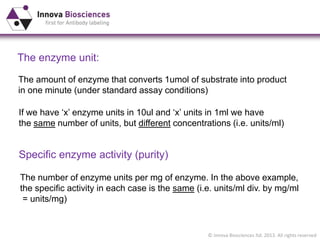
The enzyme unit:
The amount of enzyme that converts 1umol of substrate into product
in one minute (under standard assay conditions)
If we have ‘x’ enzyme units in 10ul and ‘x’ units in 1ml we have
the same number of units, but different concentrations (i.e. units/ml)
Specific enzyme activity (purity)
The number of enzyme units per mg of enzyme. In the above example,
the specific activity in each case is the same (i.e. units/ml div. by mg/ml
= units/mg)
© Innova Biosciences ltd. 2013. All rights reserved
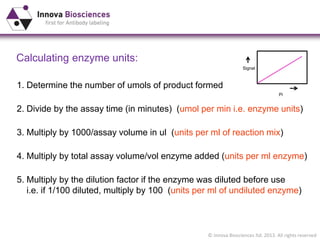
Calculating enzyme units:
1. Determine the number of umols of product formed
2. Divide by the assay time (in minutes) (umol per min i.e. enzyme units)
3. Multiply by 1000/assay volume in ul (units per ml of reaction mix)
4. Multiply by total assay volume/vol enzyme added (units per ml enzyme)
5. Multiply by the dilution factor if the enzyme was diluted before use
i.e. if 1/100 diluted, multiply by 100 (units per ml of undiluted enzyme)
Signal
Pi
© Innova Biosciences ltd. 2013. All rights reserved
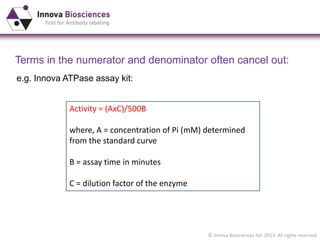
Terms in the numerator and denominator often cancel out:
Activity = (AxC)/500B
where, A = concentration of Pi (mM) determined
from the standard curve
B = assay time in minutes
C = dilution factor of the enzyme
e.g. Innova ATPase assay kit:
© Innova Biosciences ltd. 2013. All rights reserved
8
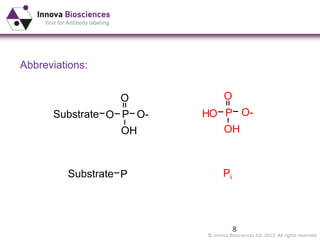
P O-
O
OH
Substrate O
Substrate P
P O-
O
OH
OH
Pi
Abbreviations:
© Innova Biosciences ltd. 2013. All rights reserved
9
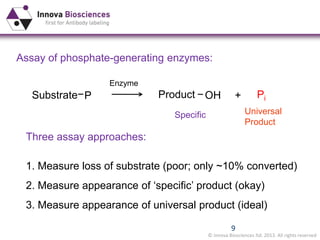
Substrate P Product OH Pi+
Specific Universal
Product
Enzyme
Three assay approaches:
1. Measure loss of substrate (poor; only ~10% converted)
2. Measure appearance of ‘specific’ product (okay)
3. Measure appearance of universal product (ideal)
Assay of phosphate-generating enzymes:
© Innova Biosciences ltd. 2013. All rights reserved
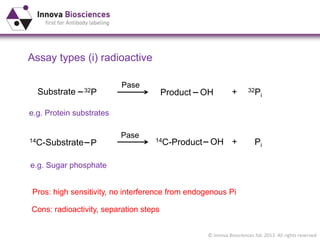
Substrate 32P Product OH 32Pi+
Assay types (i) radioactive
OH Pi+14C-Substrate P 14C-Product
e.g. Protein substrates
Pase
e.g. Sugar phosphate
Pase
Pros: high sensitivity, no interference from endogenous Pi
Cons: radioactivity, separation steps
© Innova Biosciences ltd. 2013. All rights reserved
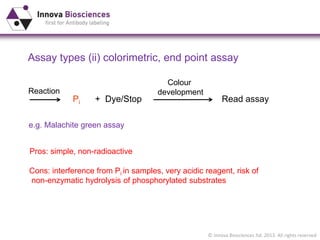
Pi + Dye/Stop Read assay
Assay types (ii) colorimetric, end point assay
e.g. Malachite green assay
Pros: simple, non-radioactive
Cons: interference from Pi in samples, very acidic reagent, risk of
non-enzymatic hydrolysis of phosphorylated substrates
Colour
developmentReaction
© Innova Biosciences ltd. 2013. All rights reserved
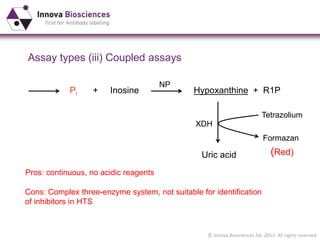
Pi + Inosine Hypoxanthine + R1P
Assay types (iii) Coupled assays
NP
Uric acid
XDH
Tetrazolium
Formazan
Pros: continuous, no acidic reagents
Cons: Complex three-enzyme system, not suitable for identification
of inhibitors in HTS
(Red)
© Innova Biosciences ltd. 2013. All rights reserved
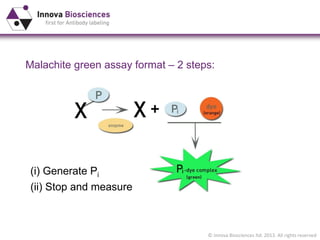
Malachite green assay format – 2 steps:
(i) Generate Pi
(ii) Stop and measure
© Innova Biosciences ltd. 2013. All rights reserved
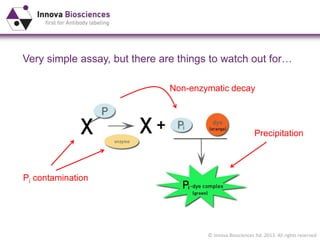
Very simple assay, but there are things to watch out for…
Pi contamination
Non-enzymatic decay
Precipitation
© Innova Biosciences ltd. 2013. All rights reserved
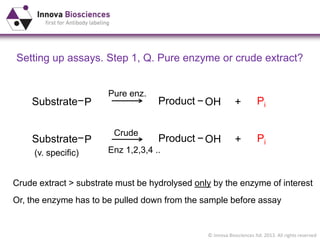
Substrate P Product OH Pi+
Pure enz.
Crude extract > substrate must be hydrolysed only by the enzyme of interest
Or, the enzyme has to be pulled down from the sample before assay
Substrate P Product OH Pi+
Crude
(v. specific) Enz 1,2,3,4 ..
Setting up assays. Step 1, Q. Pure enzyme or crude extract?
© Innova Biosciences ltd. 2013. All rights reserved
16
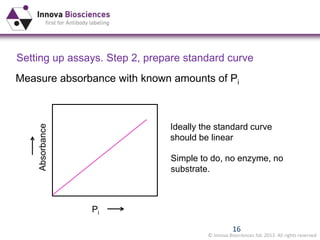
Setting up assays. Step 2, prepare standard curve
Measure absorbance with known amounts of Pi
Absorbance
Pi
Ideally the standard curve
should be linear
Simple to do, no enzyme, no
substrate.
© Innova Biosciences ltd. 2013. All rights reserved
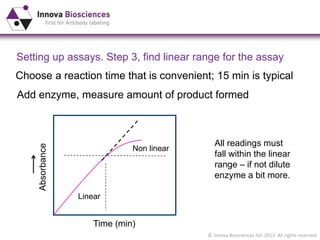
Setting up assays. Step 3, find linear range for the assay
Choose a reaction time that is convenient; 15 min is typical
Add enzyme, measure amount of product formed
All readings must
fall within the linear
range – if not dilute
enzyme a bit more.
Time (min)
Linear
Non linear
Absorbance
© Innova Biosciences ltd. 2013. All rights reserved
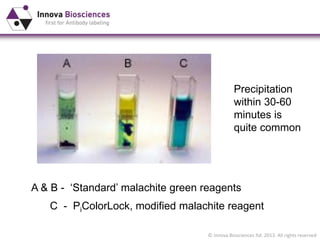
A & B - ‘Standard’ malachite green reagents
C - PiColorLock, modified malachite reagent
Precipitation
within 30-60
minutes is
quite common
© Innova Biosciences ltd. 2013. All rights reserved
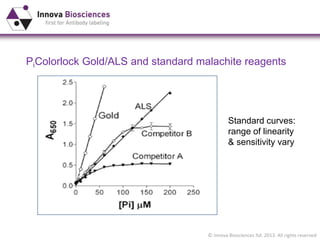
PiColorlock Gold/ALS and standard malachite reagents
Standard curves:
range of linearity
& sensitivity vary
© Innova Biosciences ltd. 2013. All rights reserved
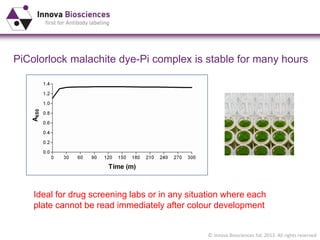
PiColorlock malachite dye-Pi complex is stable for many hours
Ideal for drug screening labs or in any situation where each
plate cannot be read immediately after colour development
© Innova Biosciences ltd. 2013. All rights reserved
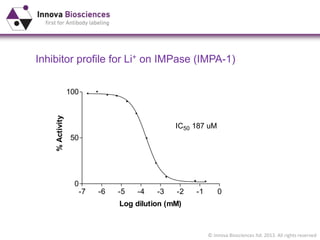
Inhibitor profile for Li+ on IMPase (IMPA-1)
-7 -6 -5 -4 -3 -2 -1 0
0
50
100
IC50 187 uM
Log dilution (mM)
%Activity
© Innova Biosciences ltd. 2013. All rights reserved
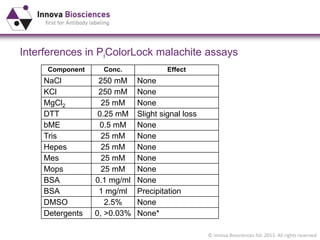
Interferences in PiColorLock malachite assays
Component Conc. Effect
NaCl 250 mM None
KCl 250 mM None
MgCl2 25 mM None
DTT 0.25 mM Slight signal loss
bME 0.5 mM None
Tris 25 mM None
Hepes 25 mM None
Mes 25 mM None
Mops 25 mM None
BSA 0.1 mg/ml None
BSA 1 mg/ml Precipitation
DMSO 2.5% None
Detergents 0, >0.03% None*
© Innova Biosciences ltd. 2013. All rights reserved
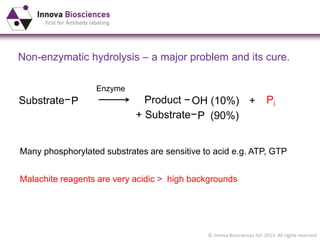
Substrate P Product OH (10%) Pi+
Enzyme
+ Substrate P (90%)
Non-enzymatic hydrolysis – a major problem and its cure.
Many phosphorylated substrates are sensitive to acid e.g. ATP, GTP
Malachite reagents are very acidic > high backgrounds
© Innova Biosciences ltd. 2013. All rights reserved
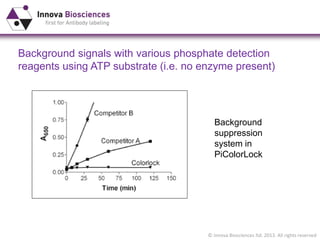
Background signals with various phosphate detection
reagents using ATP substrate (i.e. no enzyme present)
Background
suppression
system in
PiColorLock
© Innova Biosciences ltd. 2013. All rights reserved
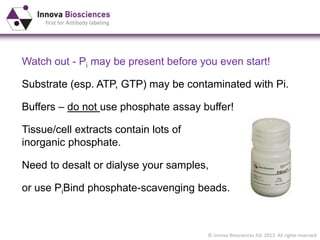
Watch out - Pi may be present before you even start!
Substrate (esp. ATP, GTP) may be contaminated with Pi.
Buffers – do not use phosphate assay buffer!
Tissue/cell extracts contain lots of
inorganic phosphate.
Need to desalt or dialyse your samples,
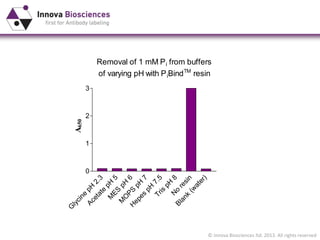
or use PiBind phosphate-scavenging beads.
© Innova Biosciences ltd. 2013. All rights reserved
Removal of 1 mM Pi from buffers
of varying pH with PiBindTM
resin
G
lycine
pH
2.3
Acetate
pH
5
M
ES
pH
6
M
O
PS
pH
7
H
epes
pH
7.5Tris
pH
8N
o
resin
Blank
(w
ater)
0
1
2
3
A650
© Innova Biosciences ltd. 2013. All rights reserved
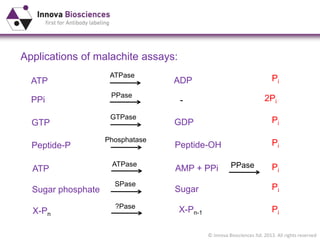
ATP
Applications of malachite assays:
ADP Pi
ATPase
ATP AMP + PPi Pi
ATPase PPase
PPi 2Pi
PPase
-
GTP GDP Pi
GTPase
Peptide-P Peptide-OH Pi
Phosphatase
X-Pn
Pi
?Pase
X-Pn-1
Sugar phosphate Sugar Pi
SPase
© Innova Biosciences ltd. 2013. All rights reserved
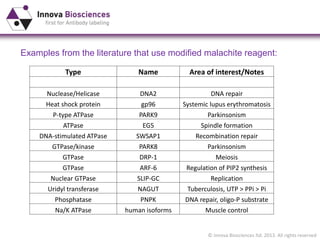
Examples from the literature that use modified malachite reagent:
Type Name Area of interest/Notes
Nuclease/Helicase DNA2 DNA repair
Heat shock protein gp96 Systemic lupus erythromatosis
P-type ATPase PARK9 Parkinsonism
ATPase EG5 Spindle formation
DNA-stimulated ATPase SWSAP1 Recombination repair
GTPase/kinase PARK8 Parkinsonism
GTPase DRP-1 Meiosis
GTPase ARF-6 Regulation of PIP2 synthesis
Nuclear GTPase SLIP-GC Replication
Uridyl transferase NAGUT Tuberculosis, UTP > PPi > Pi
Phosphatase PNPK DNA repair, oligo-P substrate
Na/K ATPase human isoforms Muscle control
© Innova Biosciences ltd. 2013. All rights reserved
Reminder of things to think about...
Is my substrate contaminated with free phosphate?
How quickly can I read my assay plates?
Is my substrate sensitive to acid?
By considering these questions it is easy to determine (i) the best
set up for your assay, (ii) whether you need ‘standard’ or ‘modified’
malachite reagent and (iii) whether sample clean up is required.
Is my enzyme pure or crude?
Does my enzyme contain any free phosphate?
Is my substrate hydrolysed by more than one enzyme?
© Innova Biosciences ltd. 2013. All rights reserved
Summary of Innova products and help…..
• Modified malachite reagent – PiColorlock Gold
with background suppression system for acid labile substrates
• PiBind resin for cleaning up enzyme samples (buffers)
• ATPase/GTPase assay kits with ultra-pure ATP/GTP for low backgrounds
• Guide to enzyme units (free)
• Litre quantities available for HTS
© Innova Biosciences ltd. 2013. All rights reserved
References
© Innova Biosciences ltd. 2013. All rights reserved
Contact
If you would like any more information, please contact us at
info@innovabiosciences.com
Please keep an eye out for our future webinars and other exciting news on our
website and social media channels:
www.innovabiosciences.com/innova/webinars.html
YouTube: www.youtube.com/InnovaBiosciences
© Innova Biosciences ltd. 2013. All rights reserved
Innova Biosciences Ltd.
Babraham Research Campus,
Cambridge, UK,
CB22 3AT
www.innovabiosciences.com
Lightning-Link® is a registered trademark of Innova Biosciences

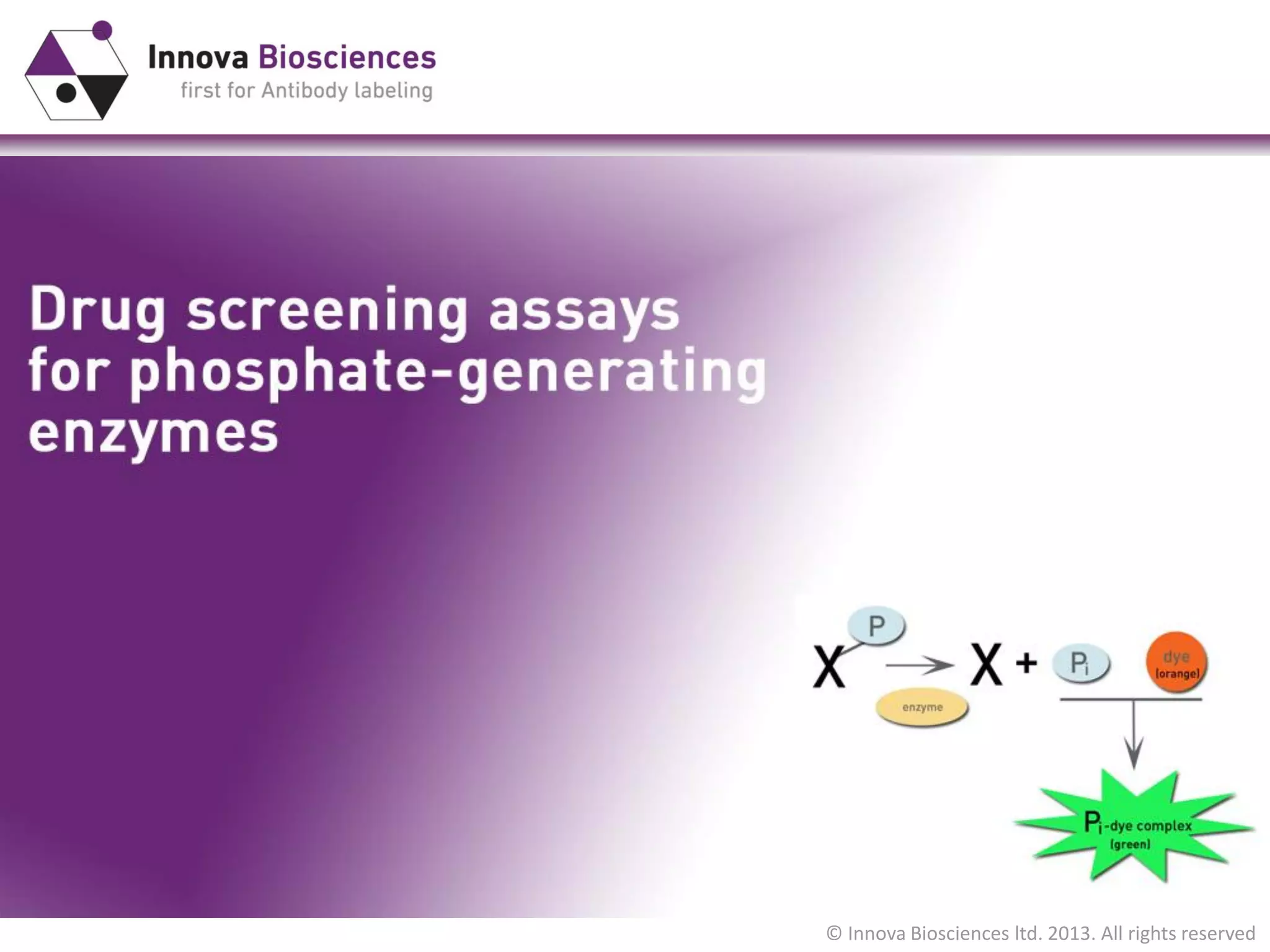
Drug screening assays for phosphate-generating enzymes

  • 1.
    © Innova Biosciencesltd. 2013. All rights reserved
  • 2.
    © Innova Biosciencesltd. 2013. All rights reserved Dr Nick Gee CEO/CSO of Innova Biosciences
  • 3.
    © Innova Biosciencesltd. 2013. All rights reserved 1. Methods of phosphate detection 2. Application to assays for phosphate generating enzymes 3. Enzyme activity & calculations 4. Malachite green assays 5. Improved malachite assays with greater stability/linear range 6. PiColorLock reagent – advantages for HTS 7. ATPase/GTPase assays
  • 4.
    © Innova Biosciencesltd. 2013. All rights reserved Do I need to worry about enzyme units? Or calculate units? For drug screening work – No. Relative activity +/- drug is main consideration. When comparing enzyme activity in different samples – Yes. When purchasing enzymes – not essential, but useful to know about units and unit definitions so you get the best value if there is more than one supplier.
  • 5.
    © Innova Biosciencesltd. 2013. All rights reserved The enzyme unit: The amount of enzyme that converts 1umol of substrate into product in one minute (under standard assay conditions) If we have ‘x’ enzyme units in 10ul and ‘x’ units in 1ml we have the same number of units, but different concentrations (i.e. units/ml) Specific enzyme activity (purity) The number of enzyme units per mg of enzyme. In the above example, the specific activity in each case is the same (i.e. units/ml div. by mg/ml = units/mg)
  • 6.
    © Innova Biosciencesltd. 2013. All rights reserved Calculating enzyme units: 1. Determine the number of umols of product formed 2. Divide by the assay time (in minutes) (umol per min i.e. enzyme units) 3. Multiply by 1000/assay volume in ul (units per ml of reaction mix) 4. Multiply by total assay volume/vol enzyme added (units per ml enzyme) 5. Multiply by the dilution factor if the enzyme was diluted before use i.e. if 1/100 diluted, multiply by 100 (units per ml of undiluted enzyme) Signal Pi
  • 7.
    © Innova Biosciencesltd. 2013. All rights reserved Terms in the numerator and denominator often cancel out: Activity = (AxC)/500B where, A = concentration of Pi (mM) determined from the standard curve B = assay time in minutes C = dilution factor of the enzyme e.g. Innova ATPase assay kit:
  • 8.
    © Innova Biosciencesltd. 2013. All rights reserved 8 P O- O OH Substrate O Substrate P P O- O OH OH Pi Abbreviations:
  • 9.
    © Innova Biosciencesltd. 2013. All rights reserved 9 Substrate P Product OH Pi+ Specific Universal Product Enzyme Three assay approaches: 1. Measure loss of substrate (poor; only ~10% converted) 2. Measure appearance of ‘specific’ product (okay) 3. Measure appearance of universal product (ideal) Assay of phosphate-generating enzymes:
  • 10.
    © Innova Biosciencesltd. 2013. All rights reserved Substrate 32P Product OH 32Pi+ Assay types (i) radioactive OH Pi+14C-Substrate P 14C-Product e.g. Protein substrates Pase e.g. Sugar phosphate Pase Pros: high sensitivity, no interference from endogenous Pi Cons: radioactivity, separation steps
  • 11.
    © Innova Biosciencesltd. 2013. All rights reserved Pi + Dye/Stop Read assay Assay types (ii) colorimetric, end point assay e.g. Malachite green assay Pros: simple, non-radioactive Cons: interference from Pi in samples, very acidic reagent, risk of non-enzymatic hydrolysis of phosphorylated substrates Colour developmentReaction
  • 12.
    © Innova Biosciencesltd. 2013. All rights reserved Pi + Inosine Hypoxanthine + R1P Assay types (iii) Coupled assays NP Uric acid XDH Tetrazolium Formazan Pros: continuous, no acidic reagents Cons: Complex three-enzyme system, not suitable for identification of inhibitors in HTS (Red)
  • 13.
    © Innova Biosciencesltd. 2013. All rights reserved Malachite green assay format – 2 steps: (i) Generate Pi (ii) Stop and measure
  • 14.
    © Innova Biosciencesltd. 2013. All rights reserved Very simple assay, but there are things to watch out for… Pi contamination Non-enzymatic decay Precipitation
  • 15.
    © Innova Biosciencesltd. 2013. All rights reserved Substrate P Product OH Pi+ Pure enz. Crude extract > substrate must be hydrolysed only by the enzyme of interest Or, the enzyme has to be pulled down from the sample before assay Substrate P Product OH Pi+ Crude (v. specific) Enz 1,2,3,4 .. Setting up assays. Step 1, Q. Pure enzyme or crude extract?
  • 16.
    © Innova Biosciencesltd. 2013. All rights reserved 16 Setting up assays. Step 2, prepare standard curve Measure absorbance with known amounts of Pi Absorbance Pi Ideally the standard curve should be linear Simple to do, no enzyme, no substrate.
  • 17.
    © Innova Biosciencesltd. 2013. All rights reserved Setting up assays. Step 3, find linear range for the assay Choose a reaction time that is convenient; 15 min is typical Add enzyme, measure amount of product formed All readings must fall within the linear range – if not dilute enzyme a bit more. Time (min) Linear Non linear Absorbance
  • 18.
    © Innova Biosciencesltd. 2013. All rights reserved A & B - ‘Standard’ malachite green reagents C - PiColorLock, modified malachite reagent Precipitation within 30-60 minutes is quite common
  • 19.
    © Innova Biosciencesltd. 2013. All rights reserved PiColorlock Gold/ALS and standard malachite reagents Standard curves: range of linearity & sensitivity vary
  • 20.
    © Innova Biosciencesltd. 2013. All rights reserved PiColorlock malachite dye-Pi complex is stable for many hours Ideal for drug screening labs or in any situation where each plate cannot be read immediately after colour development
  • 21.
    © Innova Biosciencesltd. 2013. All rights reserved Inhibitor profile for Li+ on IMPase (IMPA-1) -7 -6 -5 -4 -3 -2 -1 0 0 50 100 IC50 187 uM Log dilution (mM) %Activity
  • 22.
    © Innova Biosciencesltd. 2013. All rights reserved Interferences in PiColorLock malachite assays Component Conc. Effect NaCl 250 mM None KCl 250 mM None MgCl2 25 mM None DTT 0.25 mM Slight signal loss bME 0.5 mM None Tris 25 mM None Hepes 25 mM None Mes 25 mM None Mops 25 mM None BSA 0.1 mg/ml None BSA 1 mg/ml Precipitation DMSO 2.5% None Detergents 0, >0.03% None*
  • 23.
    © Innova Biosciencesltd. 2013. All rights reserved Substrate P Product OH (10%) Pi+ Enzyme + Substrate P (90%) Non-enzymatic hydrolysis – a major problem and its cure. Many phosphorylated substrates are sensitive to acid e.g. ATP, GTP Malachite reagents are very acidic > high backgrounds
  • 24.
    © Innova Biosciencesltd. 2013. All rights reserved Background signals with various phosphate detection reagents using ATP substrate (i.e. no enzyme present) Background suppression system in PiColorLock
  • 25.
    © Innova Biosciencesltd. 2013. All rights reserved Watch out - Pi may be present before you even start! Substrate (esp. ATP, GTP) may be contaminated with Pi. Buffers – do not use phosphate assay buffer! Tissue/cell extracts contain lots of inorganic phosphate. Need to desalt or dialyse your samples, or use PiBind phosphate-scavenging beads.
  • 26.
    © Innova Biosciencesltd. 2013. All rights reserved Removal of 1 mM Pi from buffers of varying pH with PiBindTM resin G lycine pH 2.3 Acetate pH 5 M ES pH 6 M O PS pH 7 H epes pH 7.5Tris pH 8N o resin Blank (w ater) 0 1 2 3 A650
  • 27.
    © Innova Biosciencesltd. 2013. All rights reserved ATP Applications of malachite assays: ADP Pi ATPase ATP AMP + PPi Pi ATPase PPase PPi 2Pi PPase - GTP GDP Pi GTPase Peptide-P Peptide-OH Pi Phosphatase X-Pn Pi ?Pase X-Pn-1 Sugar phosphate Sugar Pi SPase
  • 28.
    © Innova Biosciencesltd. 2013. All rights reserved Examples from the literature that use modified malachite reagent: Type Name Area of interest/Notes Nuclease/Helicase DNA2 DNA repair Heat shock protein gp96 Systemic lupus erythromatosis P-type ATPase PARK9 Parkinsonism ATPase EG5 Spindle formation DNA-stimulated ATPase SWSAP1 Recombination repair GTPase/kinase PARK8 Parkinsonism GTPase DRP-1 Meiosis GTPase ARF-6 Regulation of PIP2 synthesis Nuclear GTPase SLIP-GC Replication Uridyl transferase NAGUT Tuberculosis, UTP > PPi > Pi Phosphatase PNPK DNA repair, oligo-P substrate Na/K ATPase human isoforms Muscle control
  • 29.
    © Innova Biosciencesltd. 2013. All rights reserved Reminder of things to think about... Is my substrate contaminated with free phosphate? How quickly can I read my assay plates? Is my substrate sensitive to acid? By considering these questions it is easy to determine (i) the best set up for your assay, (ii) whether you need ‘standard’ or ‘modified’ malachite reagent and (iii) whether sample clean up is required. Is my enzyme pure or crude? Does my enzyme contain any free phosphate? Is my substrate hydrolysed by more than one enzyme?
  • 30.
    © Innova Biosciencesltd. 2013. All rights reserved Summary of Innova products and help….. • Modified malachite reagent – PiColorlock Gold with background suppression system for acid labile substrates • PiBind resin for cleaning up enzyme samples (buffers) • ATPase/GTPase assay kits with ultra-pure ATP/GTP for low backgrounds • Guide to enzyme units (free) • Litre quantities available for HTS
  • 31.
    © Innova Biosciencesltd. 2013. All rights reserved References
  • 32.
    © Innova Biosciencesltd. 2013. All rights reserved Contact If you would like any more information, please contact us at info@innovabiosciences.com Please keep an eye out for our future webinars and other exciting news on our website and social media channels: www.innovabiosciences.com/innova/webinars.html YouTube: www.youtube.com/InnovaBiosciences
  • 33.
    © Innova Biosciencesltd. 2013. All rights reserved Innova Biosciences Ltd. Babraham Research Campus, Cambridge, UK, CB22 3AT www.innovabiosciences.com Lightning-Link® is a registered trademark of Innova Biosciences