ENZYMES
� Enzymes are
⚫highly specialized proteins
⚫ act as catalysts in biological systems
⚫ by increasing the rate of reaction
⚫ without being utilised in that reaction…
� Exception
⚫ Ribozymes are RNA molecules with enzymatic
activity, which catalyze cutting of nascent mRNA or
primary transcript..
4.
ENZYMES
� Thousands ofchemical reactions take place in
the body each moment..
� Includes continuous breakdown of
biomolecules for energy, on the other hand
synthesis of new biomolecules to maintain
the structure and function of the organism..
� This chemical events termed metabolism do not
occur spontaneously but need catalysis…
� Catalysts (enzymes) are the substances that
accelerate the rate of chemical reactions
without themselves undergoing any change in
the process..
5.
�Enzymes are biocatalysts.
�Proteinscan be hydrolysed with hydrochloric acid by
boiling for a very long time; but inside the body, with
the help of enzymes, proteolysis takes place within a
short time at body temperature.
�Enzyme catalysis is very rapid; usually 1 molecule of
an enzyme can act upon about 1000 molecules of the
substrate per minute.
6.
WHAT IF ANENZYME IS ABSENT
Lack of enzymes will lead to block in
metabolic pathways causing inborn errors
of metabolism.
The substance upon which an enzyme
acts, is called the substrate. The enzyme
will convert the substrate into the product
or products.
7.
CHARACTERISTICS
� Enzymes speedup the reaction by lowering the activation
energy of the reaction.
� Their presence does not effect the nature and properties of
end product.
� They are highly specific in their action that is each
enzyme can catalyze one kind of substrate.
� Small amount of enzymes can accelerate chemical
reactions.
� Enzymes are sensitive to change in pH, temperature and
substrate concentration.
� Turnover number is defined as the number of substrate
molecules transformed per minute by one enzyme
molecule.
8.
ENZYME SPECIFICITY
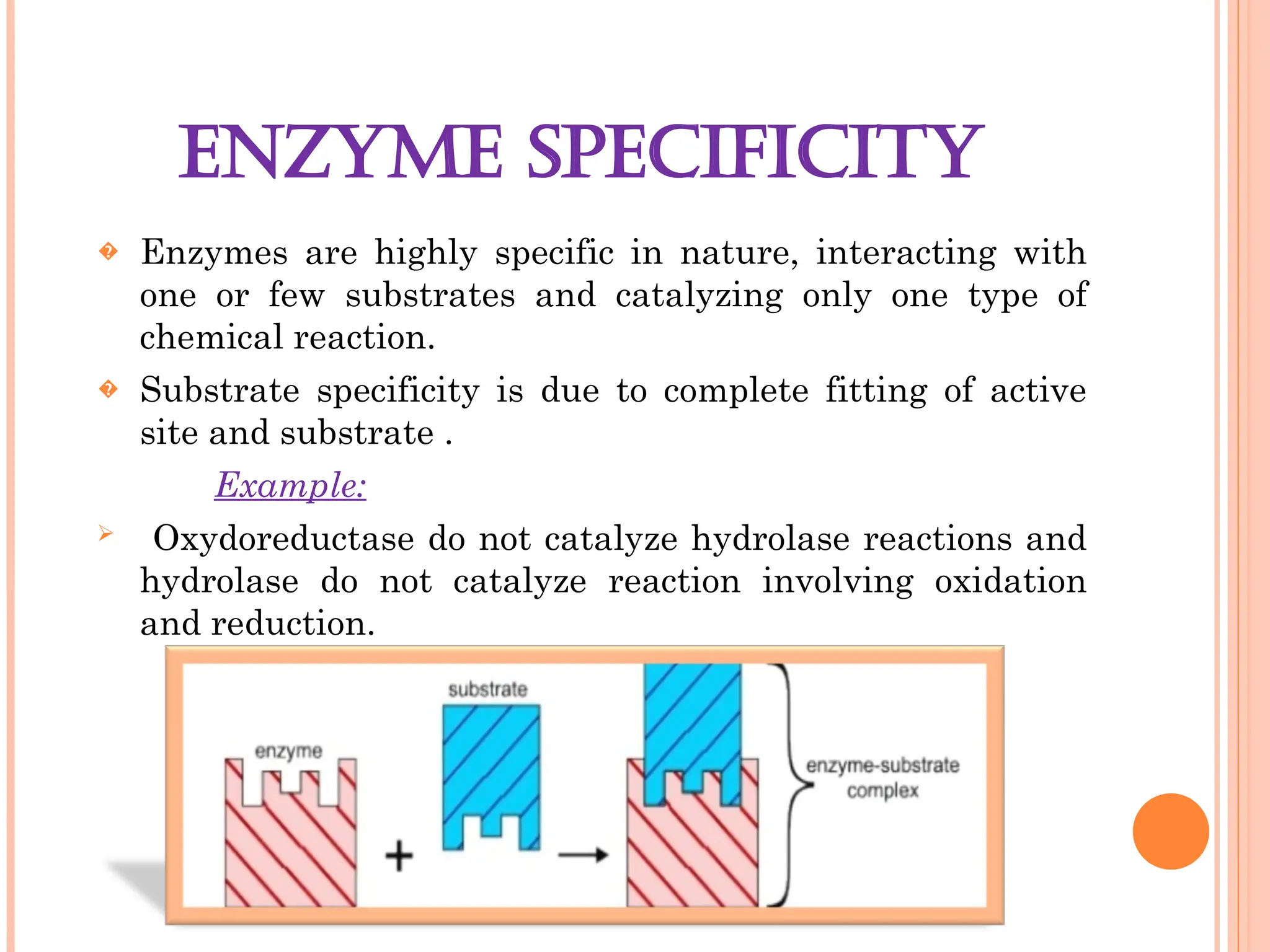
� Enzymesare highly specific in nature, interacting with
one or few substrates and catalyzing only one type of
chemical reaction.
� Substrate specificity is due to complete fitting of active
site and substrate .
Example:
Oxydoreductase do not catalyze hydrolase reactions and
hydrolase do not catalyze reaction involving oxidation
and reduction.
9.
TYPES OF ENZYME
SPECIFICITY
�Enzymes show different degrees of specificity:
Bond specificity.
Group specificity.
Absolute specificity.
Optical or stereo-specificity.
Dual specificity.
10.
BOND SPECIFICITY
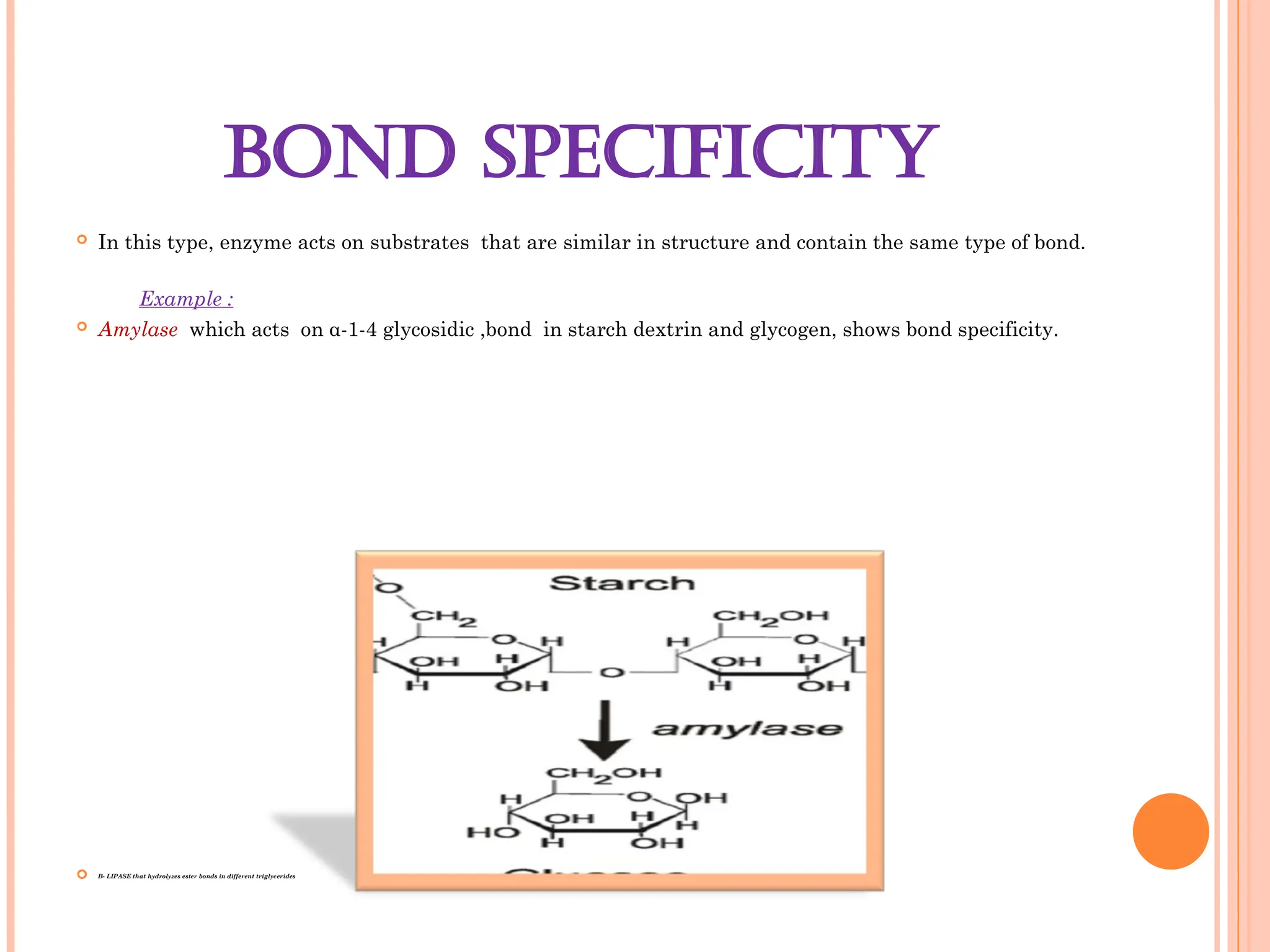
Inthis type, enzyme acts on substrates that are similar in structure and contain the same type of bond.
Example :
Amylase which acts on α-1-4 glycosidic ,bond in starch dextrin and glycogen, shows bond specificity.
B- LIPASE that hydrolyzes ester bonds in different triglycerides
11.
GROUP SPECIFICITY
� Inthis type of specificity, the enzyme is specific not only
to the type of bond but also to the structure surrounding
it.
Example:
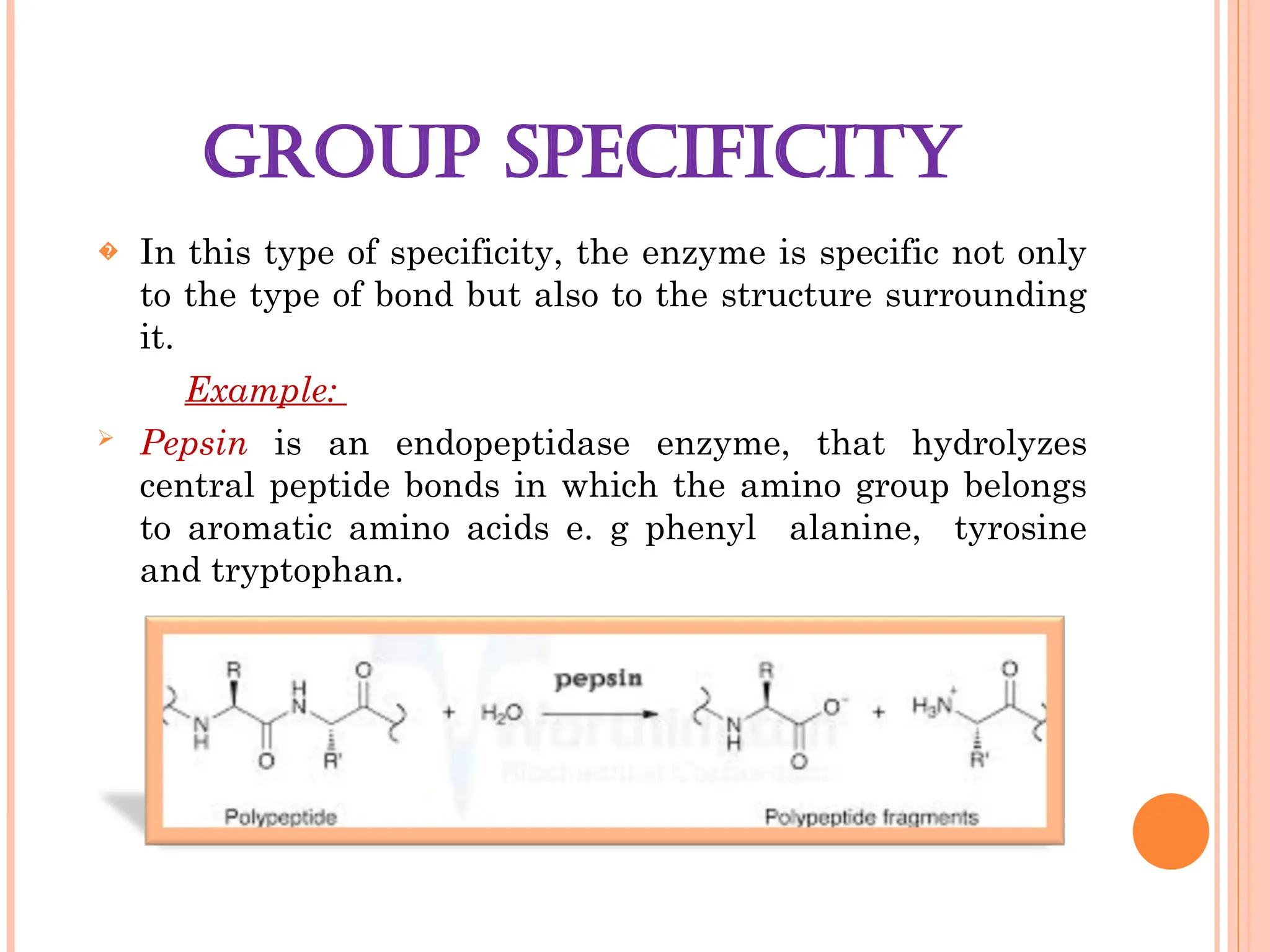
Pepsin is an endopeptidase enzyme, that hydrolyzes
central peptide bonds in which the amino group belongs
to aromatic amino acids e. g phenyl alanine, tyrosine
and tryptophan.
12.
SUBSTRATE SPECIFICITY
� Inthis type of specificity ,the enzymes acts only on one
substrate
Example :
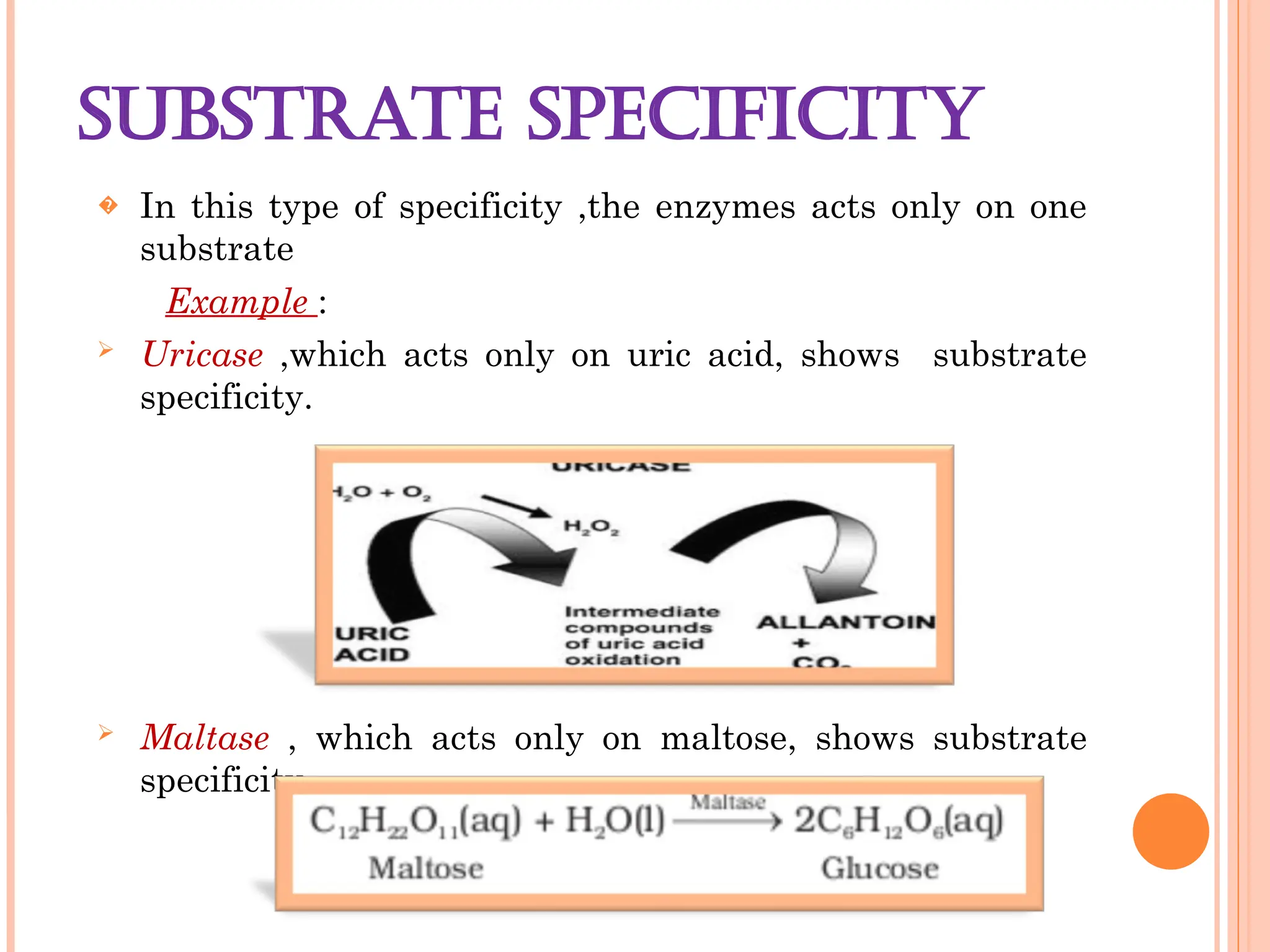
Uricase ,which acts only on uric acid, shows substrate
specificity.
Maltase , which acts only on maltose, shows substrate
specificity.
13.
OPTICAL / STEREO-SPECIFICITY
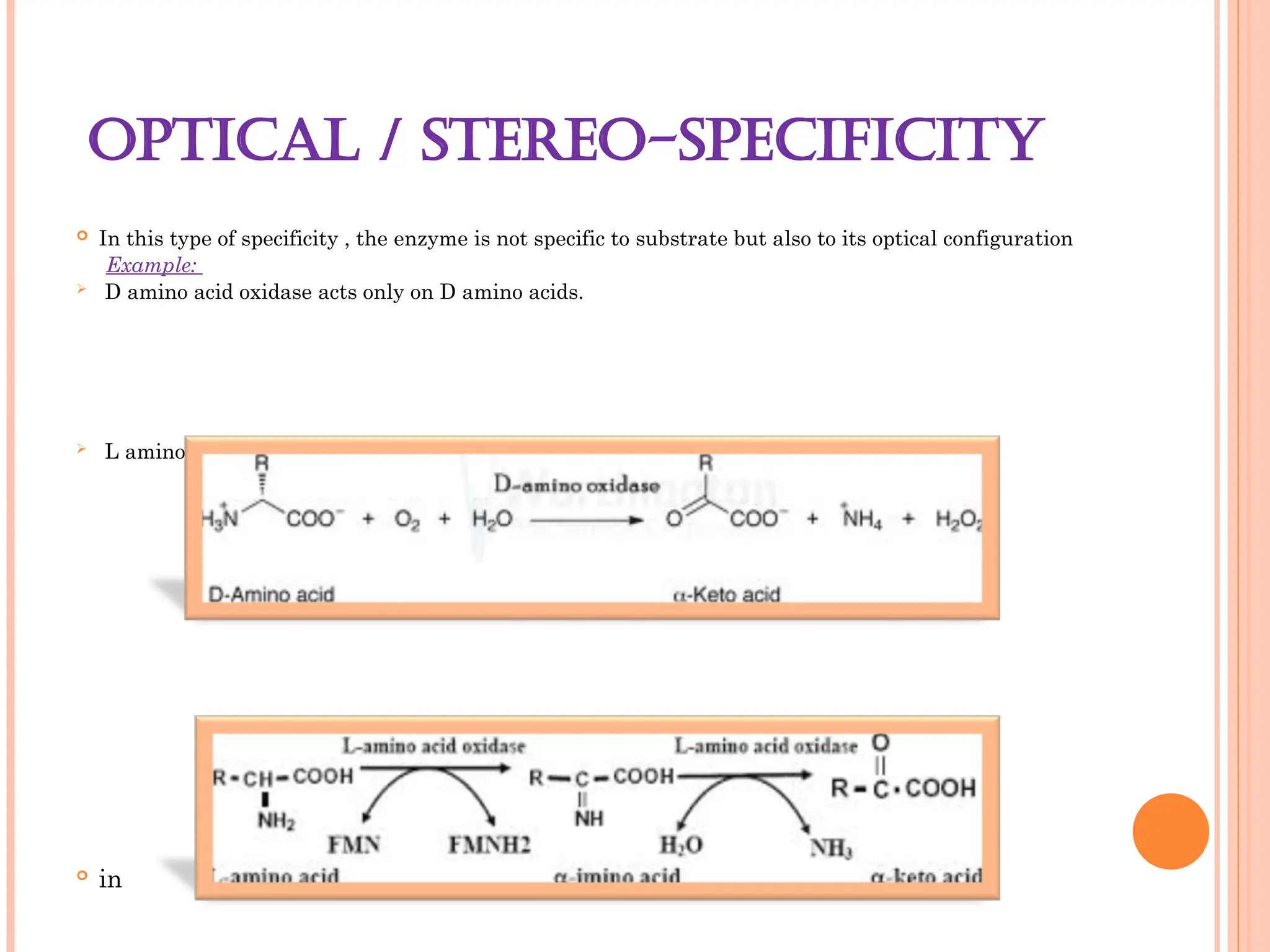
In this type of specificity , the enzyme is not specific to substrate but also to its optical configuration
Example:
D amino acid oxidase acts only on D amino acids.
L amino acid oxidase acts only on L amino acids.
in
14.
DUAL SPECIFICITY
� Thereare two types of dual specificity.
The enzyme may act on one substrate by two different
reaction types.
Example:
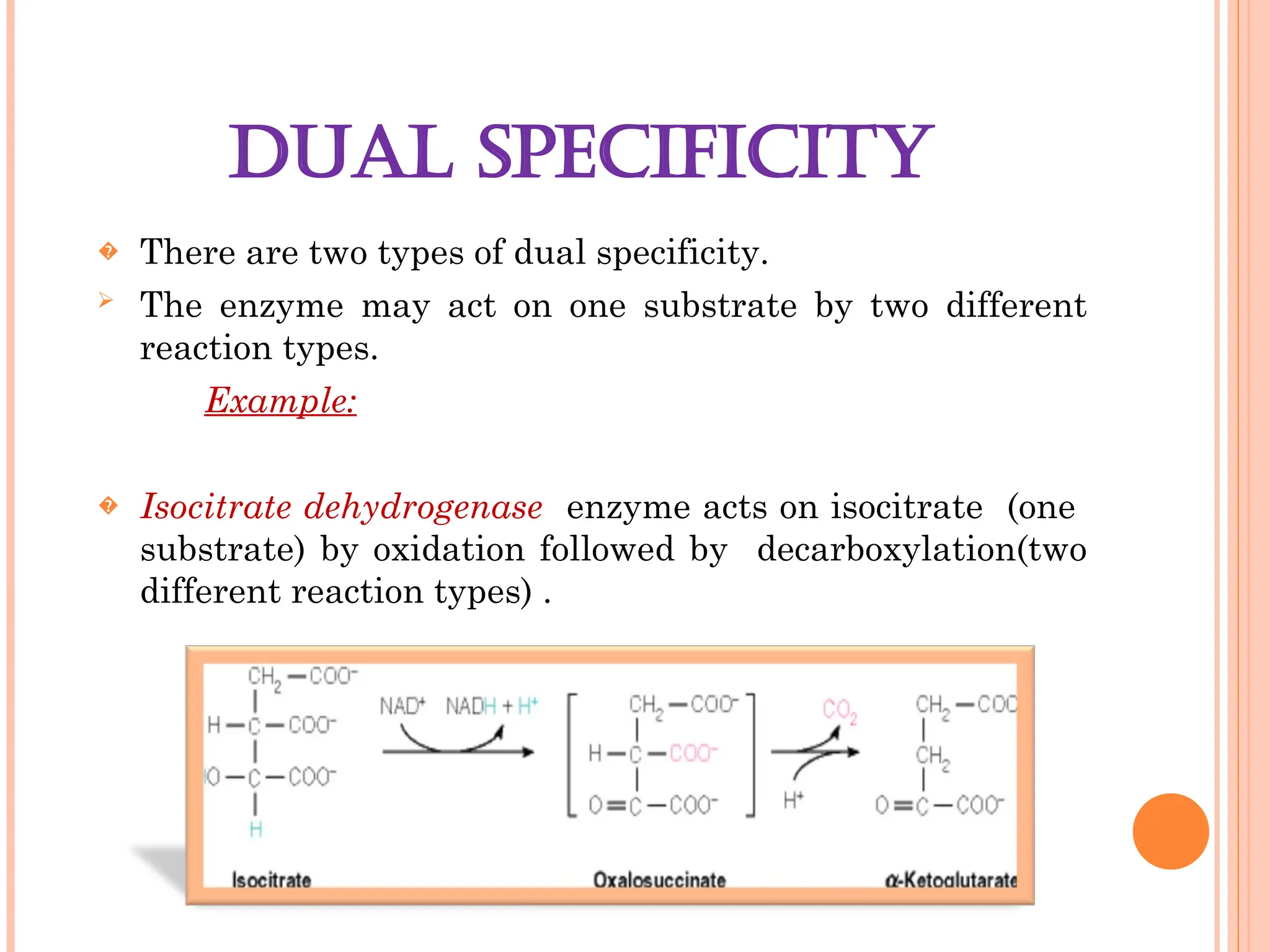
� Isocitrate dehydrogenase enzyme acts on isocitrate (one
substrate) by oxidation followed by decarboxylation(two
different reaction types) .
15.
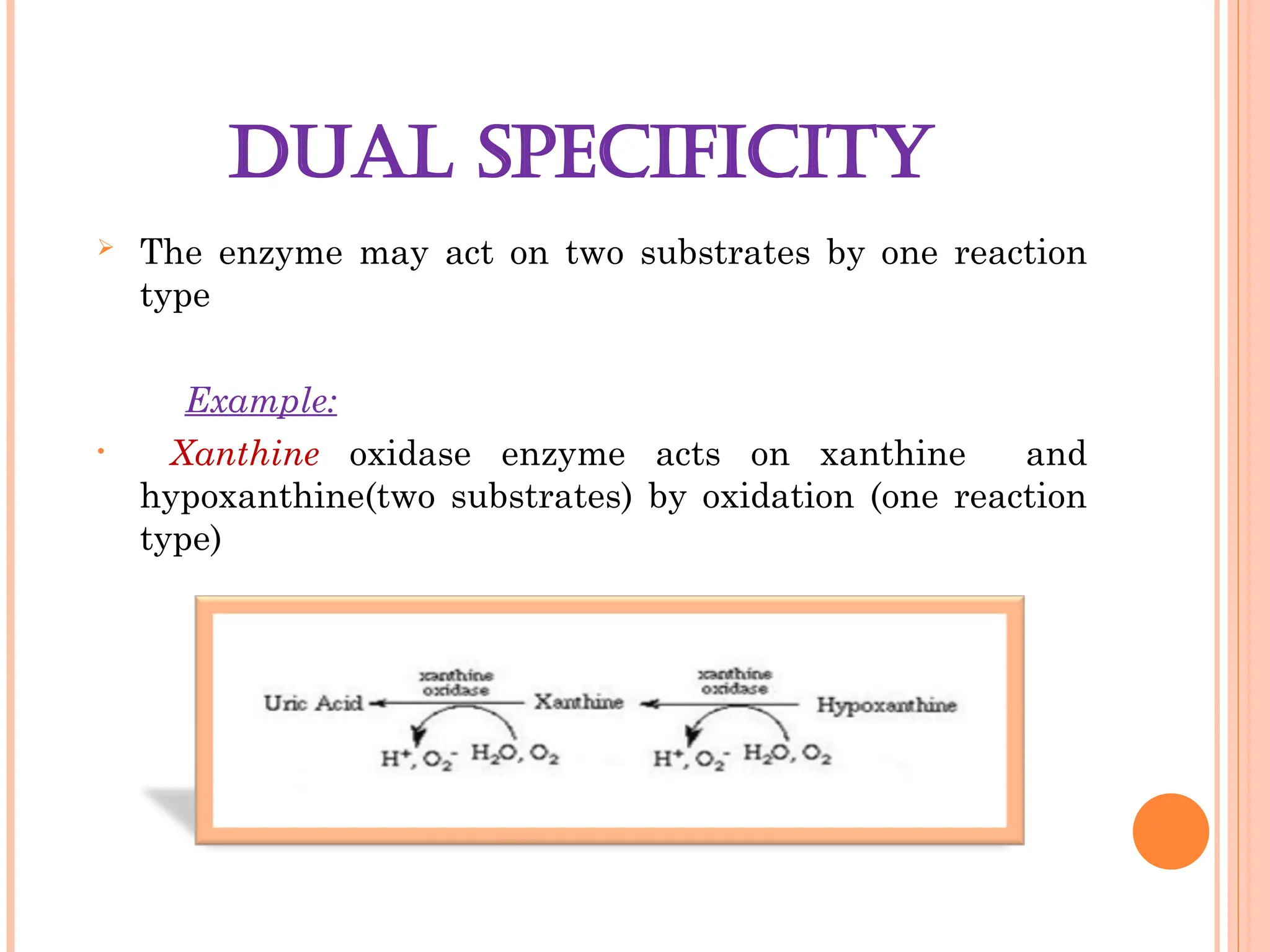
The enzymemay act on two substrates by one reaction
type
Example:
• Xanthine oxidase enzyme acts on xanthine and
hypoxanthine(two substrates) by oxidation (one reaction
type)
DUAL SPECIFICITY
16.
SITES OF ENZYME
SYNTHESIS
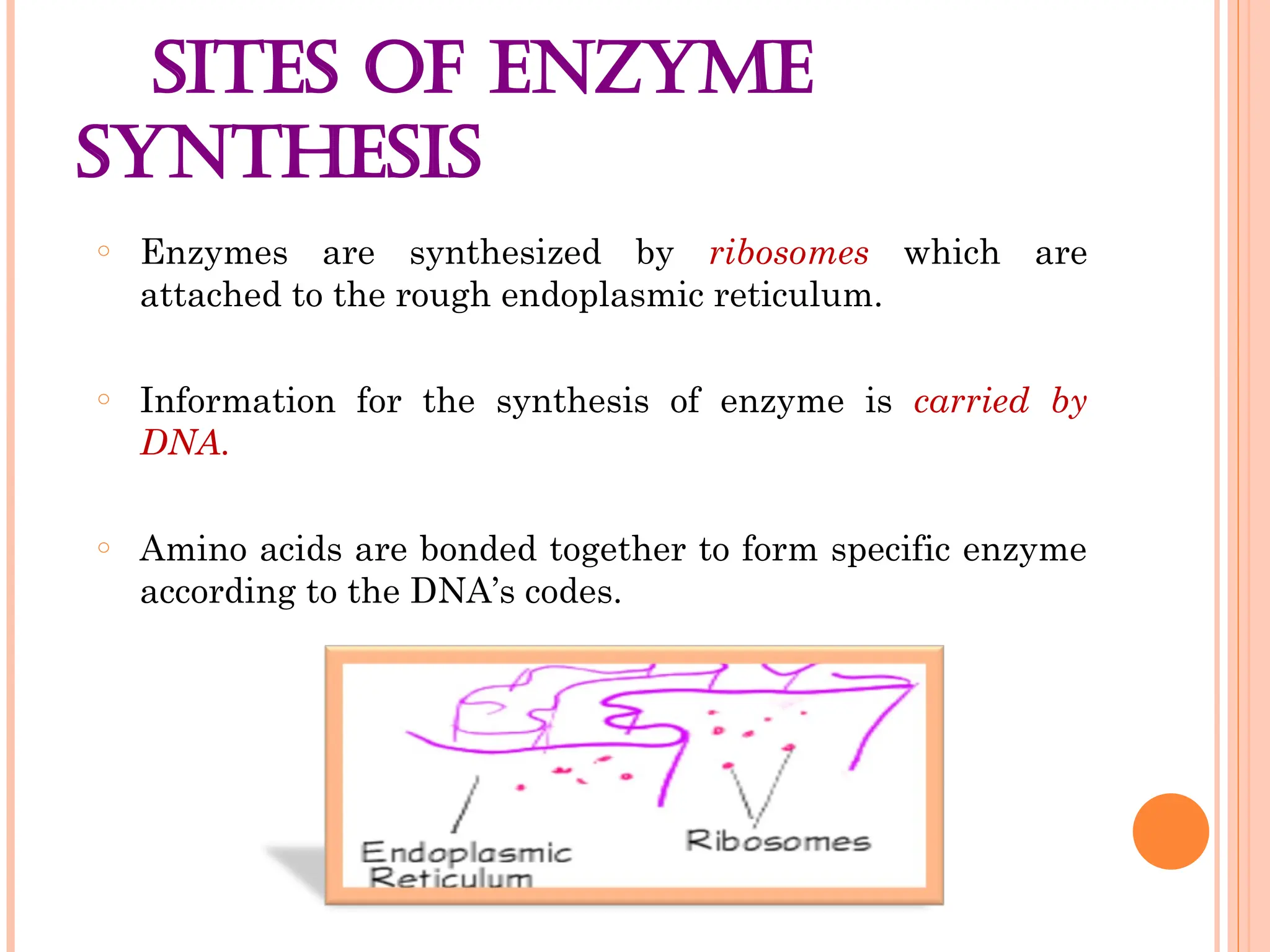
oEnzymes are synthesized by ribosomes which are
attached to the rough endoplasmic reticulum.
o Information for the synthesis of enzyme is carried by
DNA.
o Amino acids are bonded together to form specific enzyme
according to the DNA’s codes.
17.
INTRACELLULAR AND
EXTRACELLULAR
ENZYMES
o Intracellularenzymes are synthesized and retained in the
cell for the use of cell itself.
o They are found in the cytoplasm, nucleus, mitochondria
and chloroplast.
Example :
Oxydoreductase catalyses biological oxidation.
Enzymes involved in reduction in the mitochondria.
o Extracellular enzymes are synthesized in the cell but
secreted from the cell to work externally.
Example :
Digestive enzyme produced by the pancreas, are not used
by the cells in the pancreas but are transported to the
duodenum.
18.
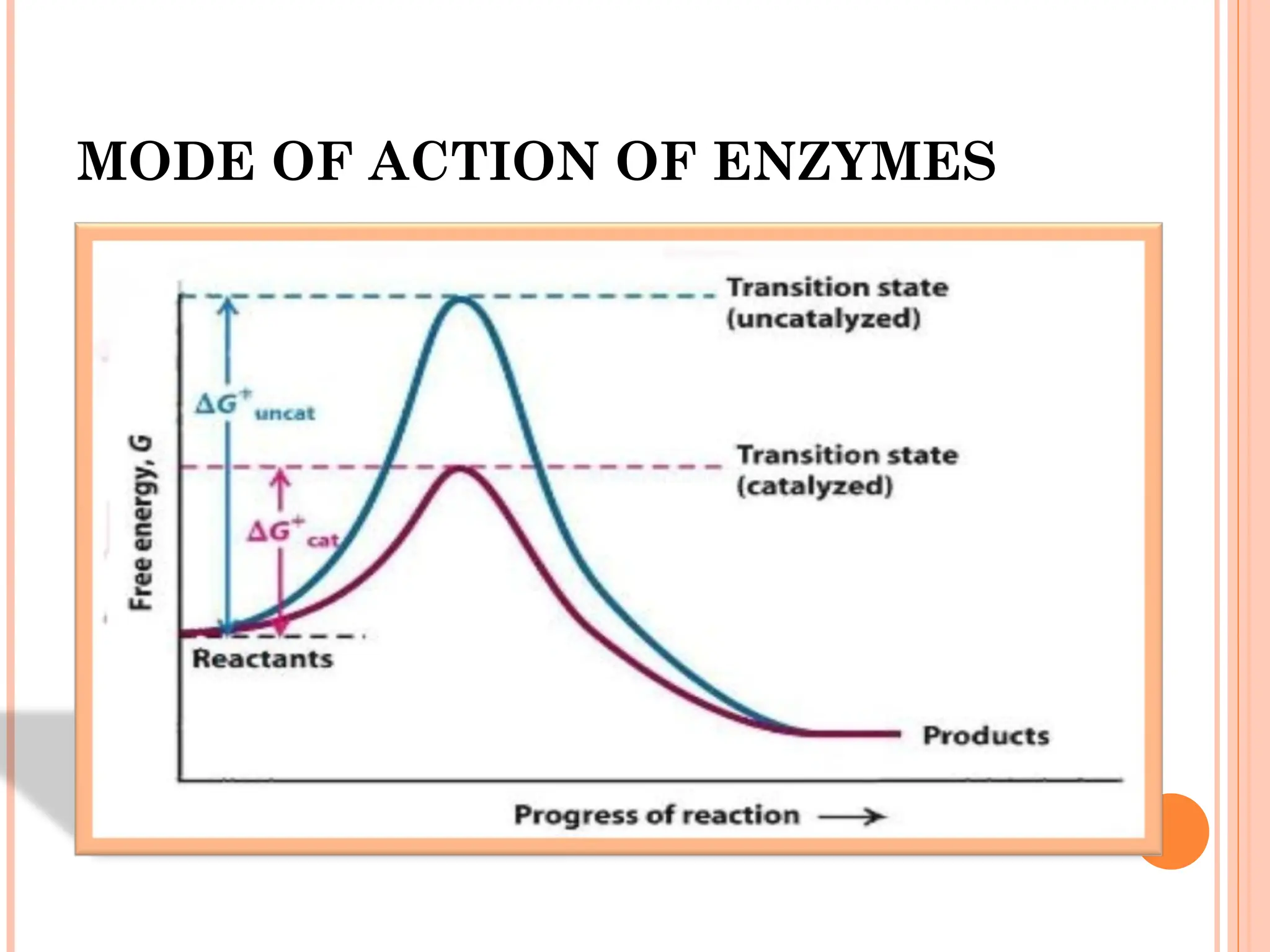
MODE OF ACTIONOF ENZYMES
� According to the transition state theory, for a
chemical reaction to occur between two reactant
molecules, their free energy level must be raised
above a threshold level to take them to a high-
energy transition state.
� The free energy needed to elevate a molecule
from its stable, low-energy ground state to a
higher energy unstable state is known as
activation energy.
� The rate of a reaction depends on the number of
reactant molecules that have enough energy to
reach the transition state of the slowest step
(rate-determining step) in the reaction.
19.
� As arule, very few molecules possess enough
energy to reach the transition state.
� Enzymes, however, reduce the value of
activation energy for a reaction, thereby
phenomenally increasing the rate of reactions.
� Some enzymes lower the activation energy after
the enzyme forms a complex with the substrate
which by bending substrate molecules in a way
facilitates bond-breaking.
� Other enzymes speed up the reaction by
bringing the two reactants closer in the right
orientation.
STRUCTURE OF ENZYMES
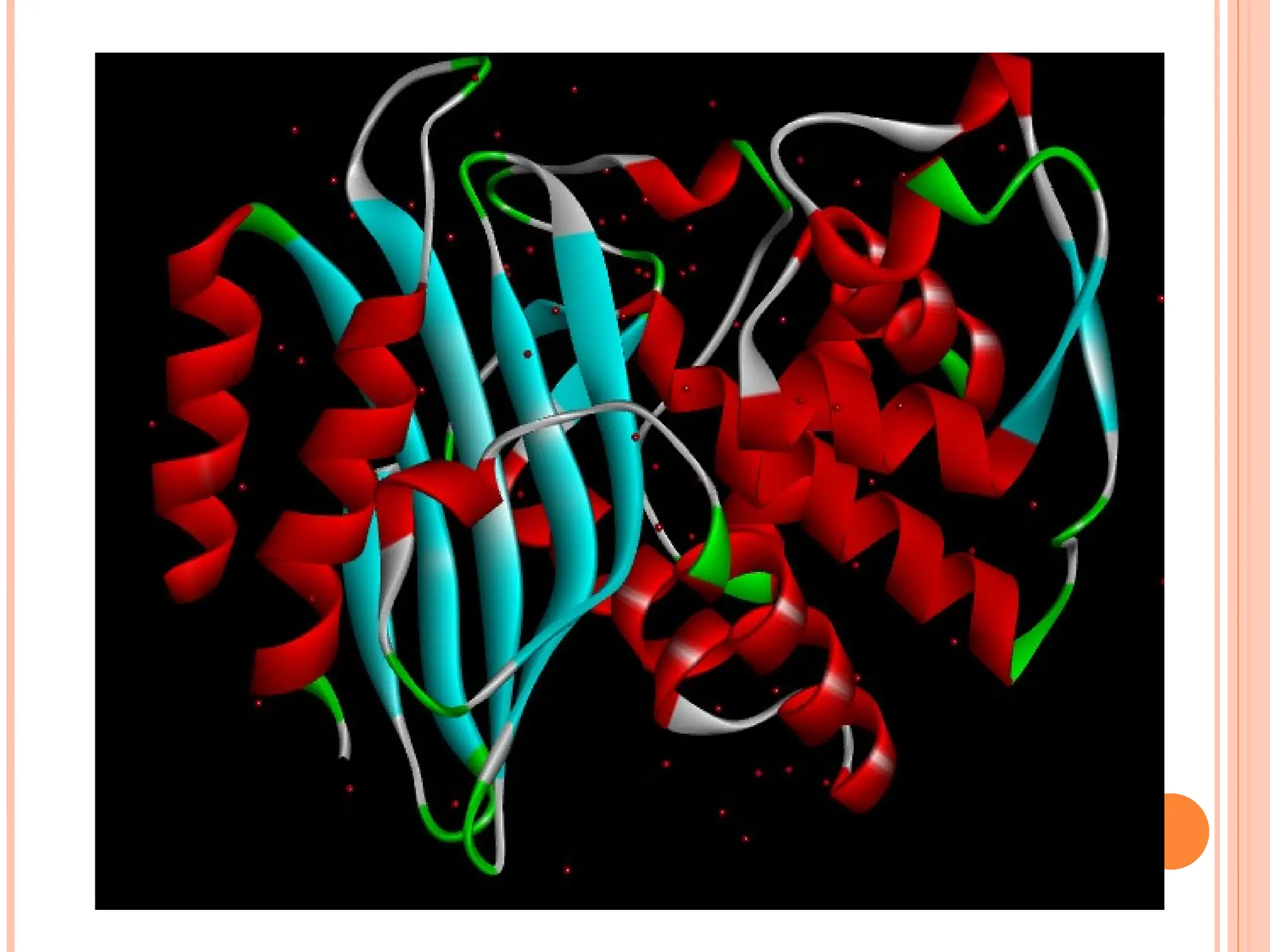
�All enzymes are proteins composed of amino
acid chains linked together by peptide bonds.
This is the primary structure of enzymes.
� All enzymes have a highly specific binding site
or active site to which their substrate binds to
produce an enzyme-substrate complex.
� The three-dimensional structures of many
proteins have been observed by x-ray
crystallography.
� These structures differ from one enzyme to
another.
22.
ACTIVE SITE
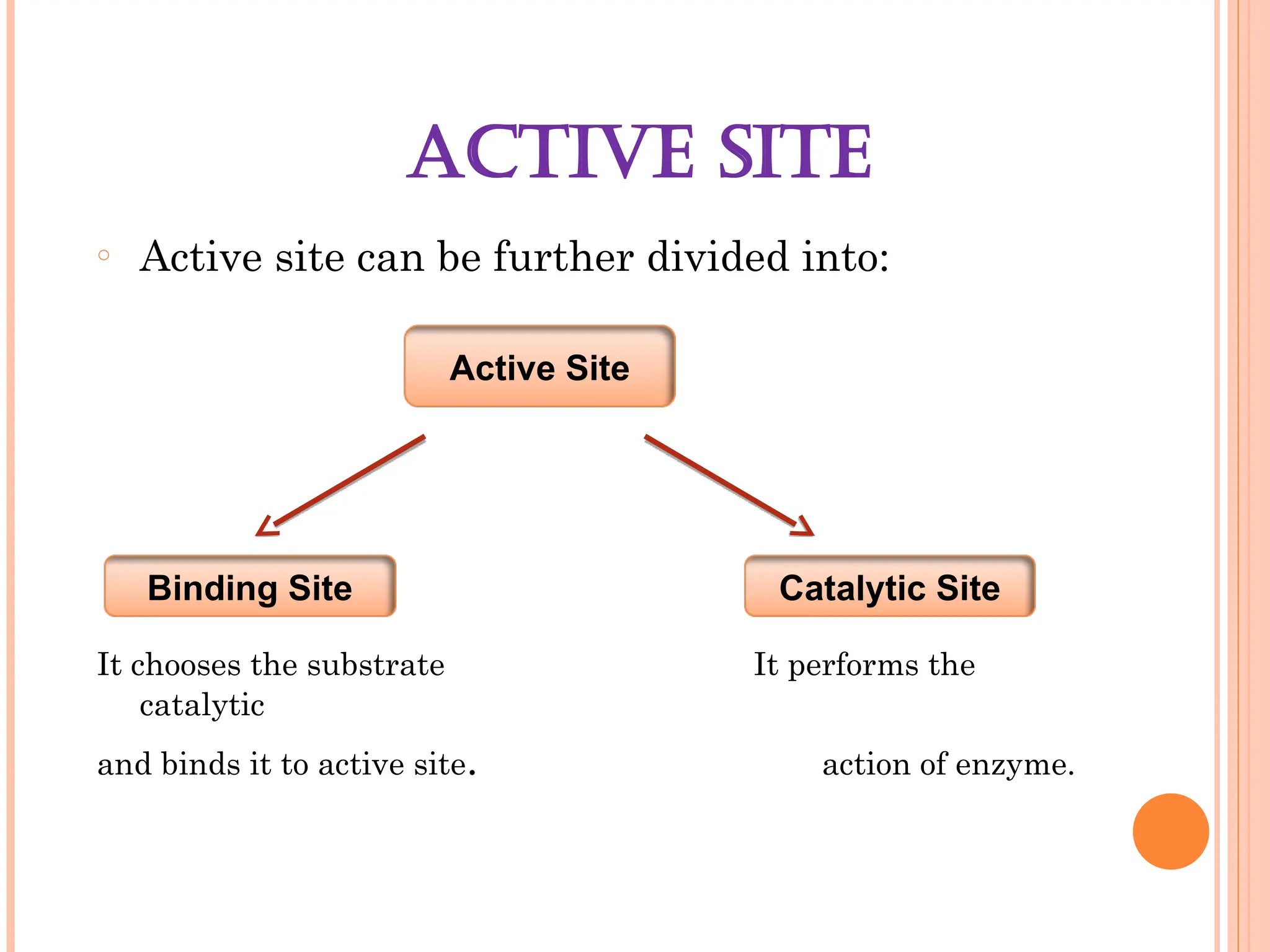
o Activesite can be further divided into:
It chooses the substrate It performs the
catalytic
and binds it to active site. action of enzyme.
Active Site
Binding Site Catalytic Site
23.
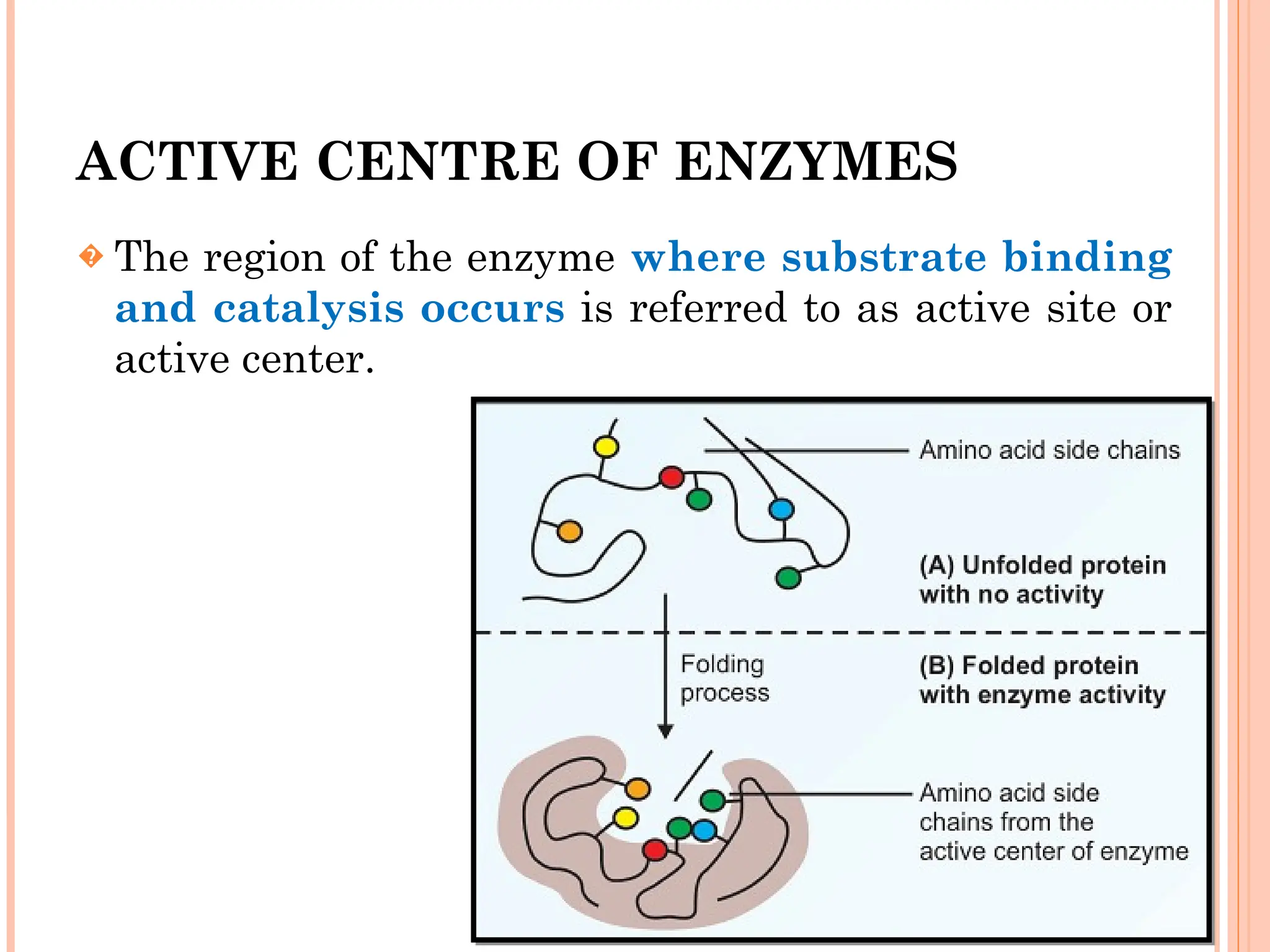
ACTIVE CENTRE OFENZYMES
� The region of the enzyme where substrate binding
and catalysis occurs is referred to as active site or
active center.
24.
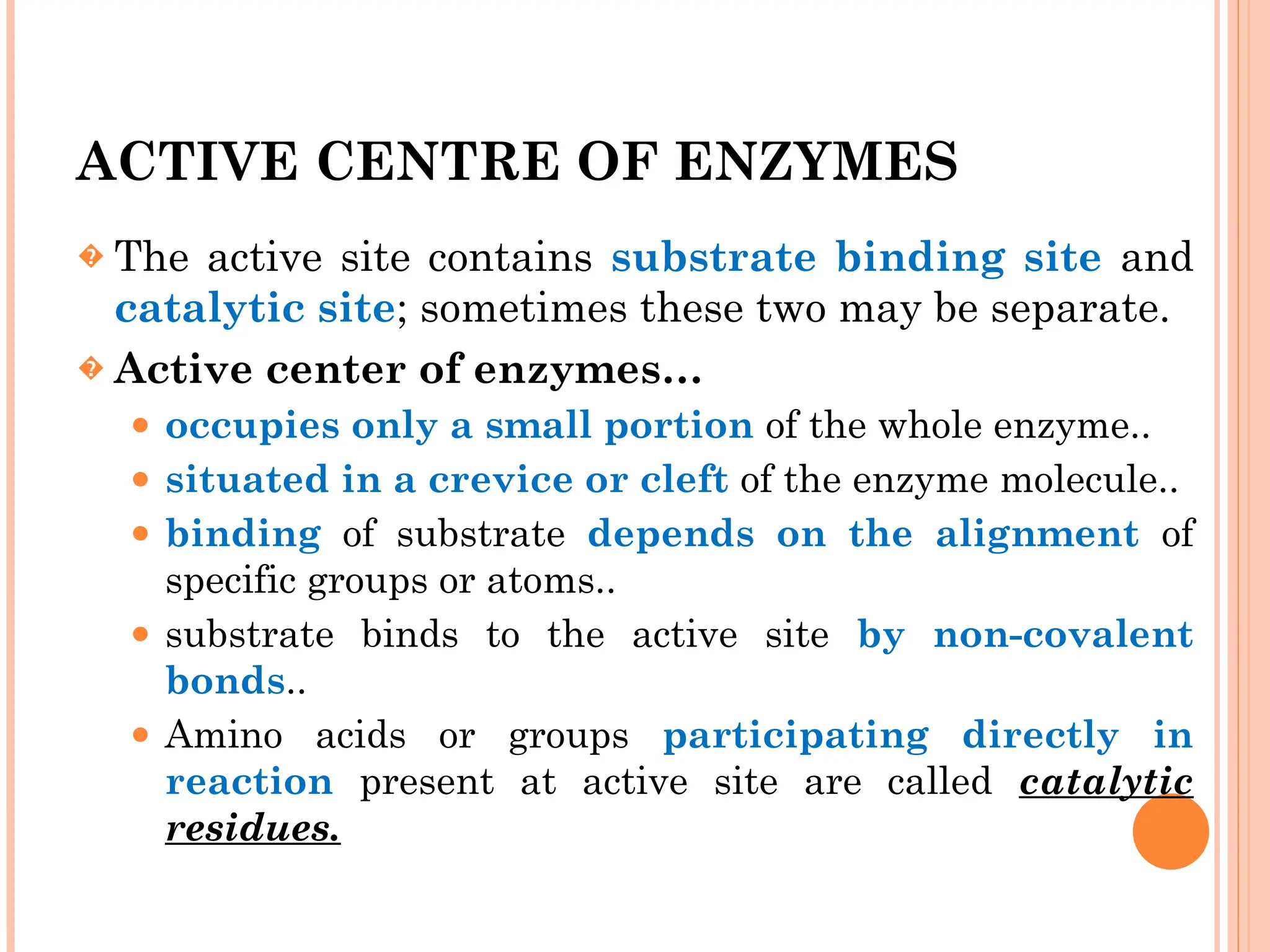
ACTIVE CENTRE OFENZYMES
� The active site contains substrate binding site and
catalytic site; sometimes these two may be separate.
� Active center of enzymes…
⚫ occupies only a small portion of the whole enzyme..
⚫ situated in a crevice or cleft of the enzyme molecule..
⚫ binding of substrate depends on the alignment of
specific groups or atoms..
⚫ substrate binds to the active site by non-covalent
bonds..
⚫ Amino acids or groups participating directly in
reaction present at active site are called catalytic
residues.
25.
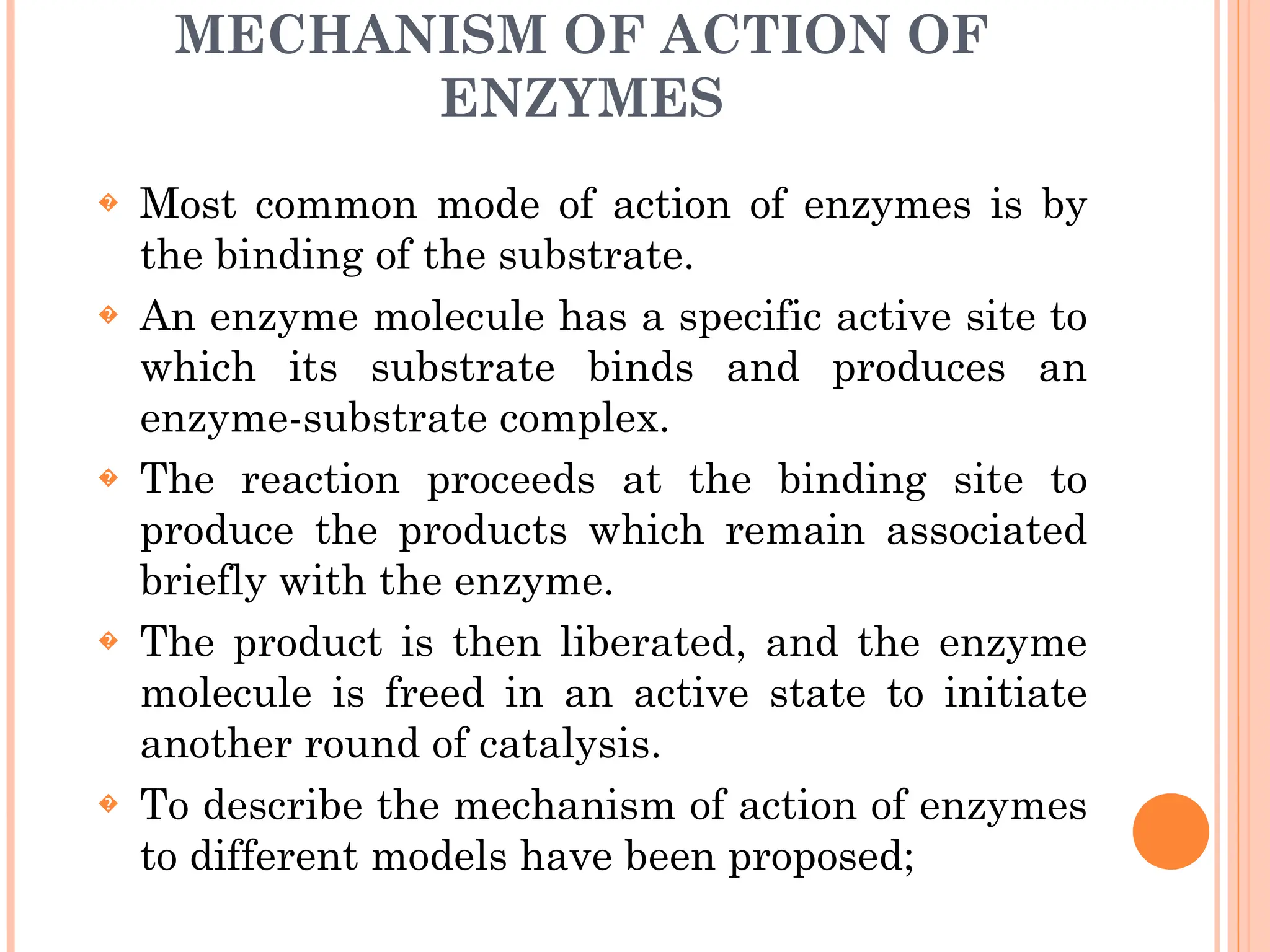
MECHANISM OF ACTIONOF
ENZYMES
� Most common mode of action of enzymes is by
the binding of the substrate.
� An enzyme molecule has a specific active site to
which its substrate binds and produces an
enzyme-substrate complex.
� The reaction proceeds at the binding site to
produce the products which remain associated
briefly with the enzyme.
� The product is then liberated, and the enzyme
molecule is freed in an active state to initiate
another round of catalysis.
� To describe the mechanism of action of enzymes
to different models have been proposed;
26.
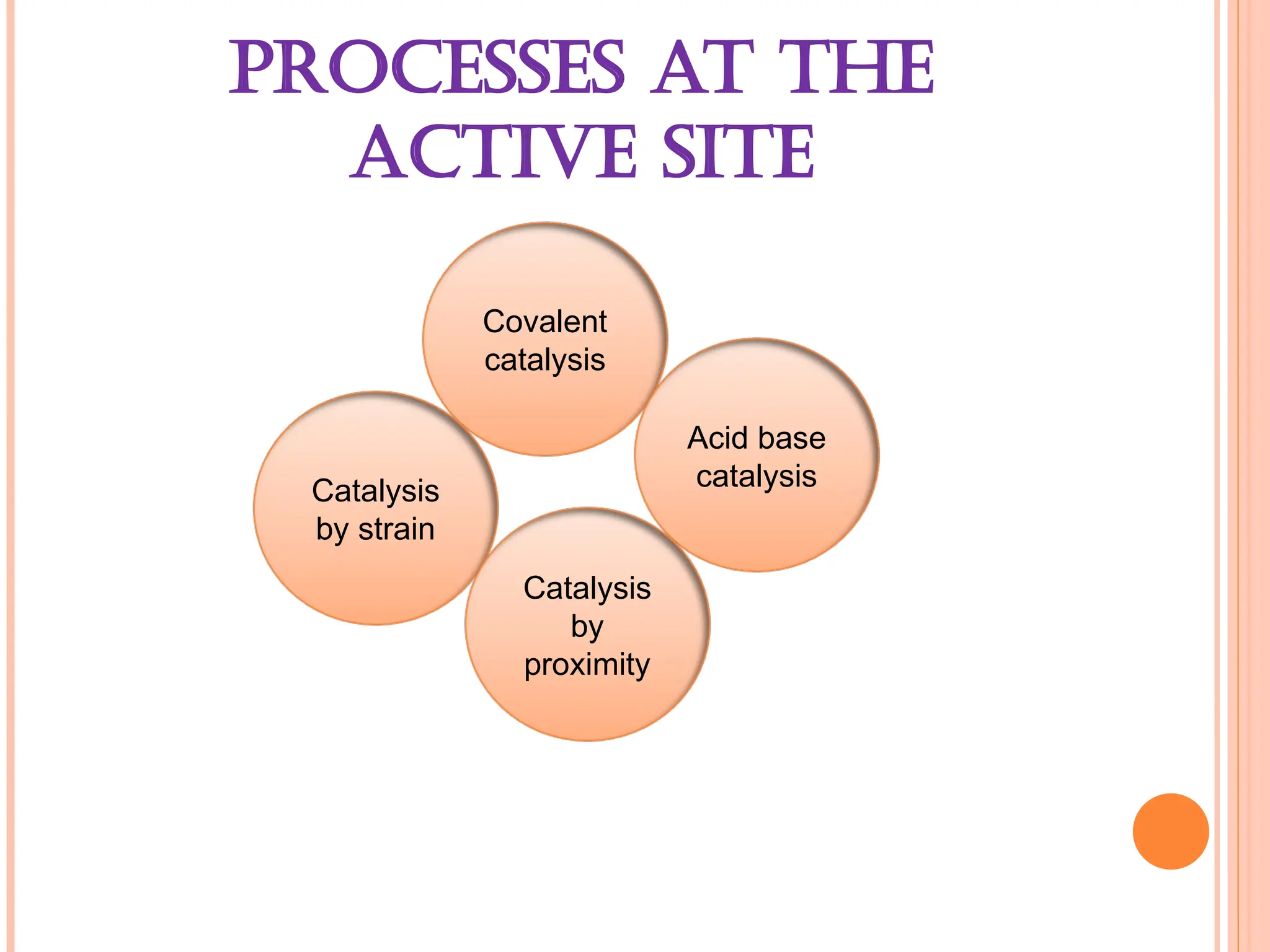
PROCESSES AT THE
ACTIVESITE
Covalent
catalysis
Acid base
catalysis
Catalysis
by strain
Catalysis
by
proximity
27.
COVALENT CATALYSIS
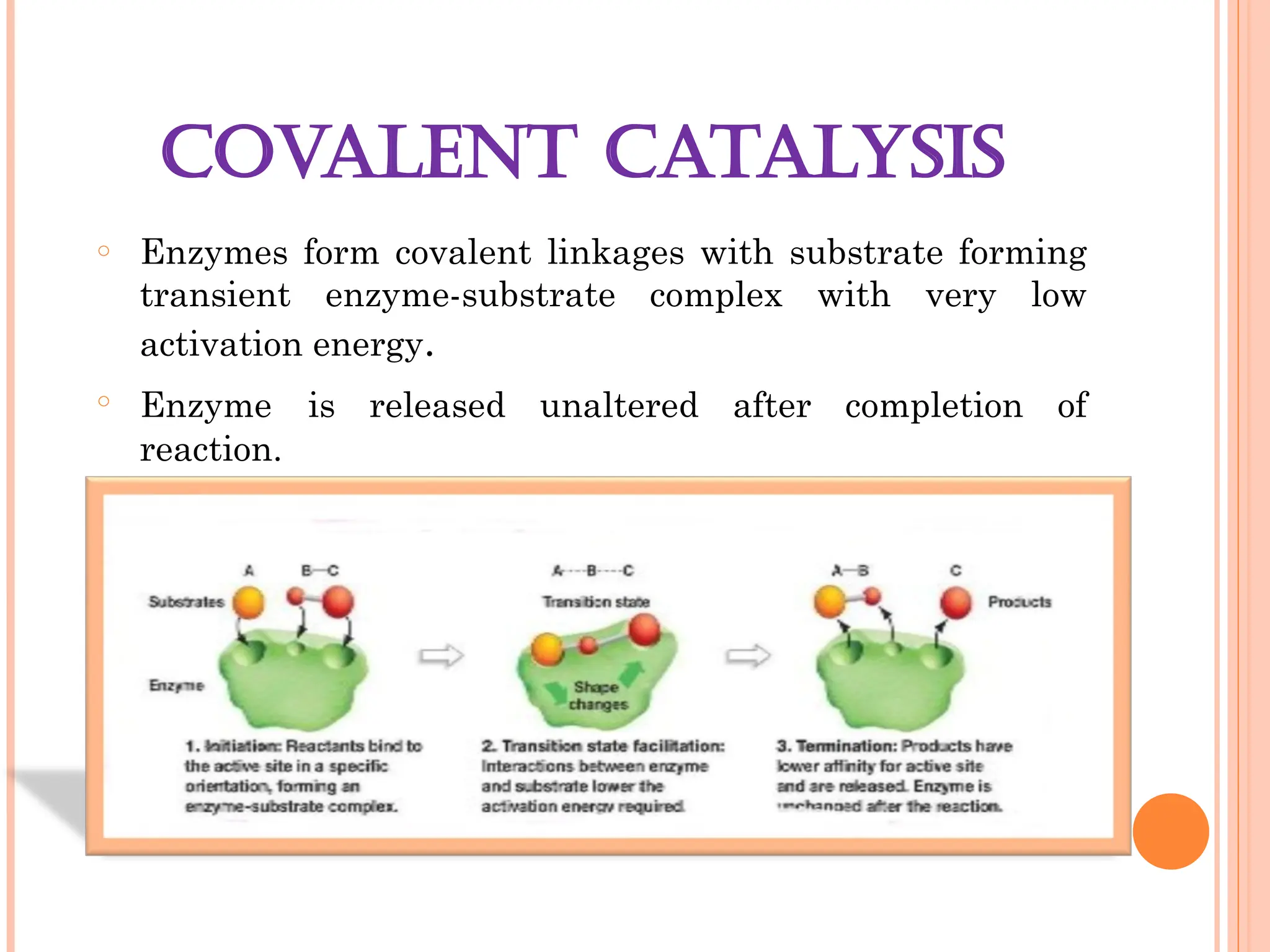
o Enzymesform covalent linkages with substrate forming
transient enzyme-substrate complex with very low
activation energy.
o Enzyme is released unaltered after completion of
reaction.
28.
ACID-BASE CATALYSIS
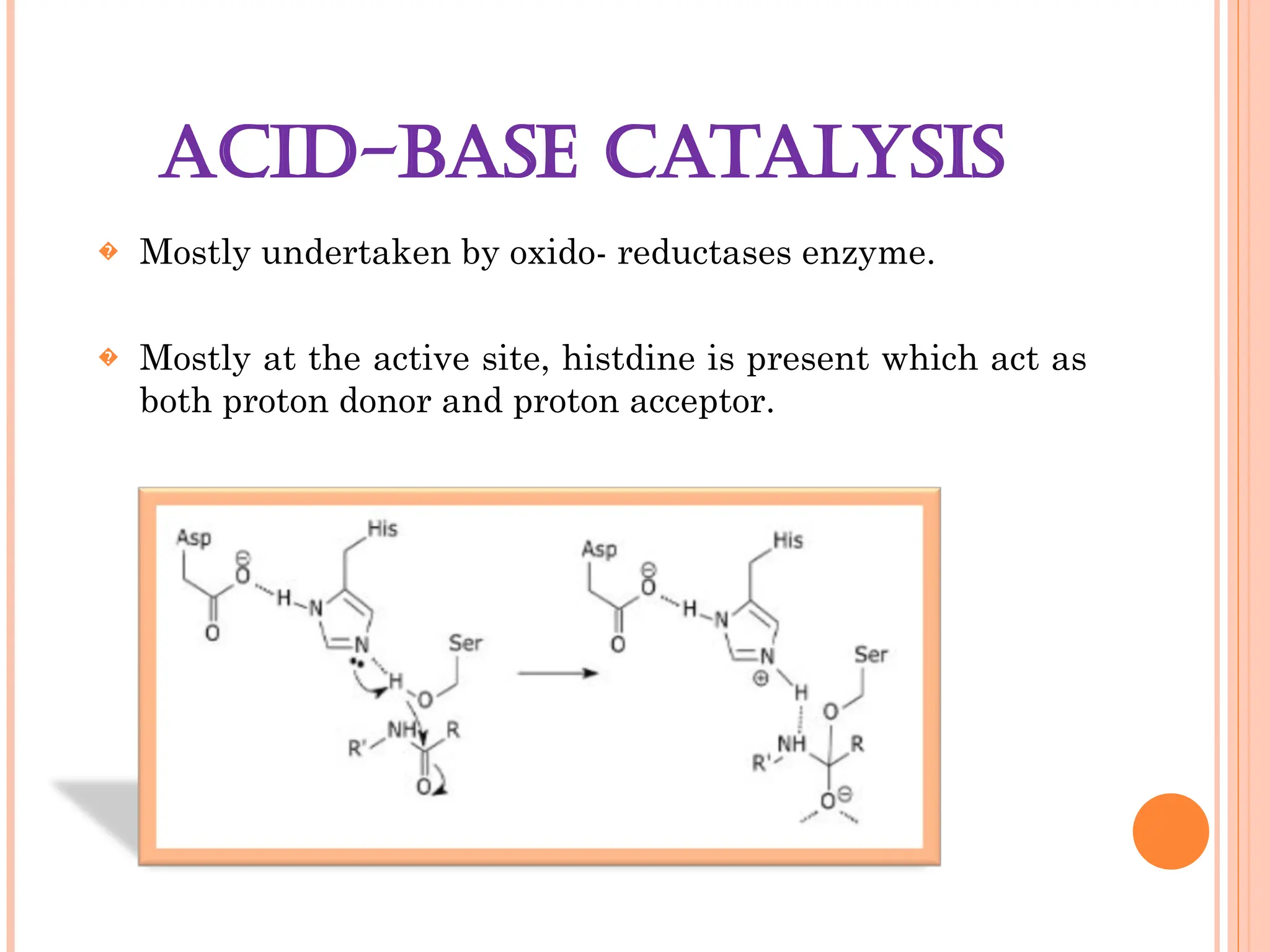
� Mostlyundertaken by oxido- reductases enzyme.
� Mostly at the active site, histdine is present which act as
both proton donor and proton acceptor.
29.
CATALYSIS BY
PROXIMITY
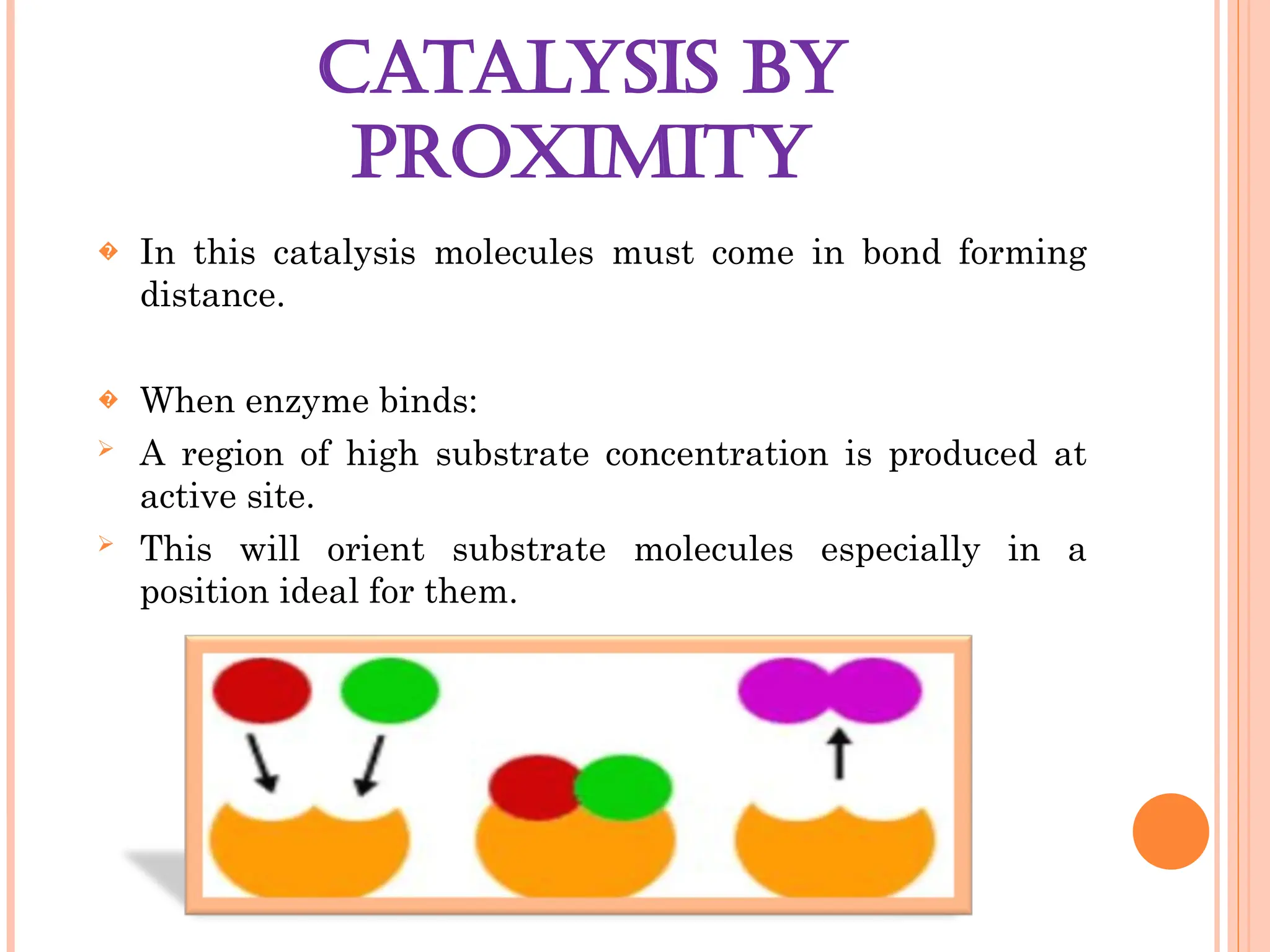
� Inthis catalysis molecules must come in bond forming
distance.
� When enzyme binds:
A region of high substrate concentration is produced at
active site.
This will orient substrate molecules especially in a
position ideal for them.
30.
CATALYSIS BY BOND
STRAIN
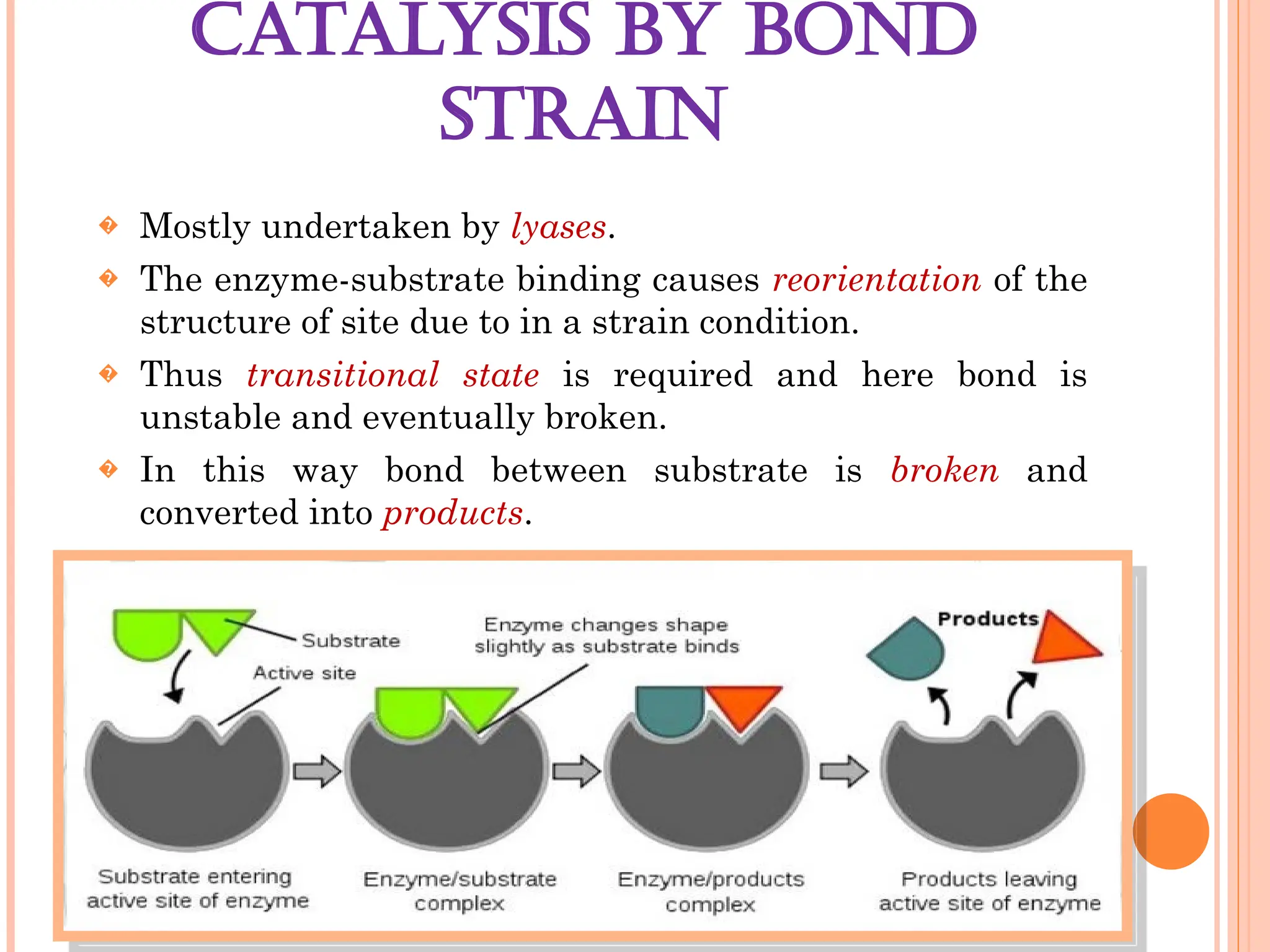
�Mostly undertaken by lyases.
� The enzyme-substrate binding causes reorientation of the
structure of site due to in a strain condition.
� Thus transitional state is required and here bond is
unstable and eventually broken.
� In this way bond between substrate is broken and
converted into products.
31.
1. LOCK ANDKEY HYPOTHESIS
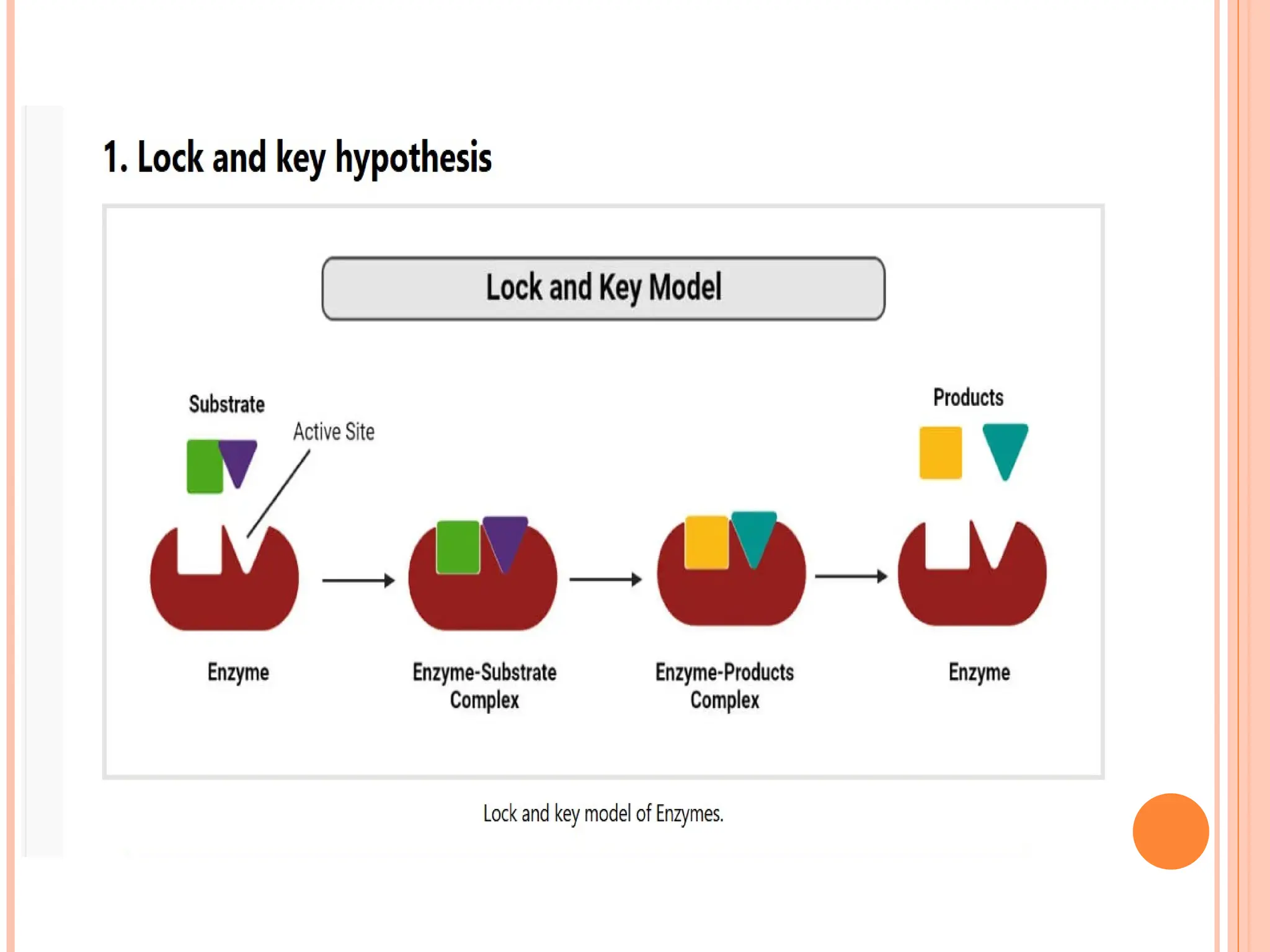
� The lock and key model was proposed by Emil Fischer in 1898
and is also known as the template model.
� According to this model, the binding of the substrate and the
enzyme takes place at the active site in a manner similar to the
one where a key fits a lock and results in the formation of an
enzyme-substrate complex.
� The enzyme-substrate complex formed is highly unstable and
almost immediately decomposes to produce the end products of
the reaction and to regenerate the free enzyme.
� This process results in the release of energy which, in turn,
raises the energy level of the substrate molecule, thus inducing
the activated or transition state.
� In this activated state, some bonds of the substrate molecule are
made susceptible to cleavage.
33.
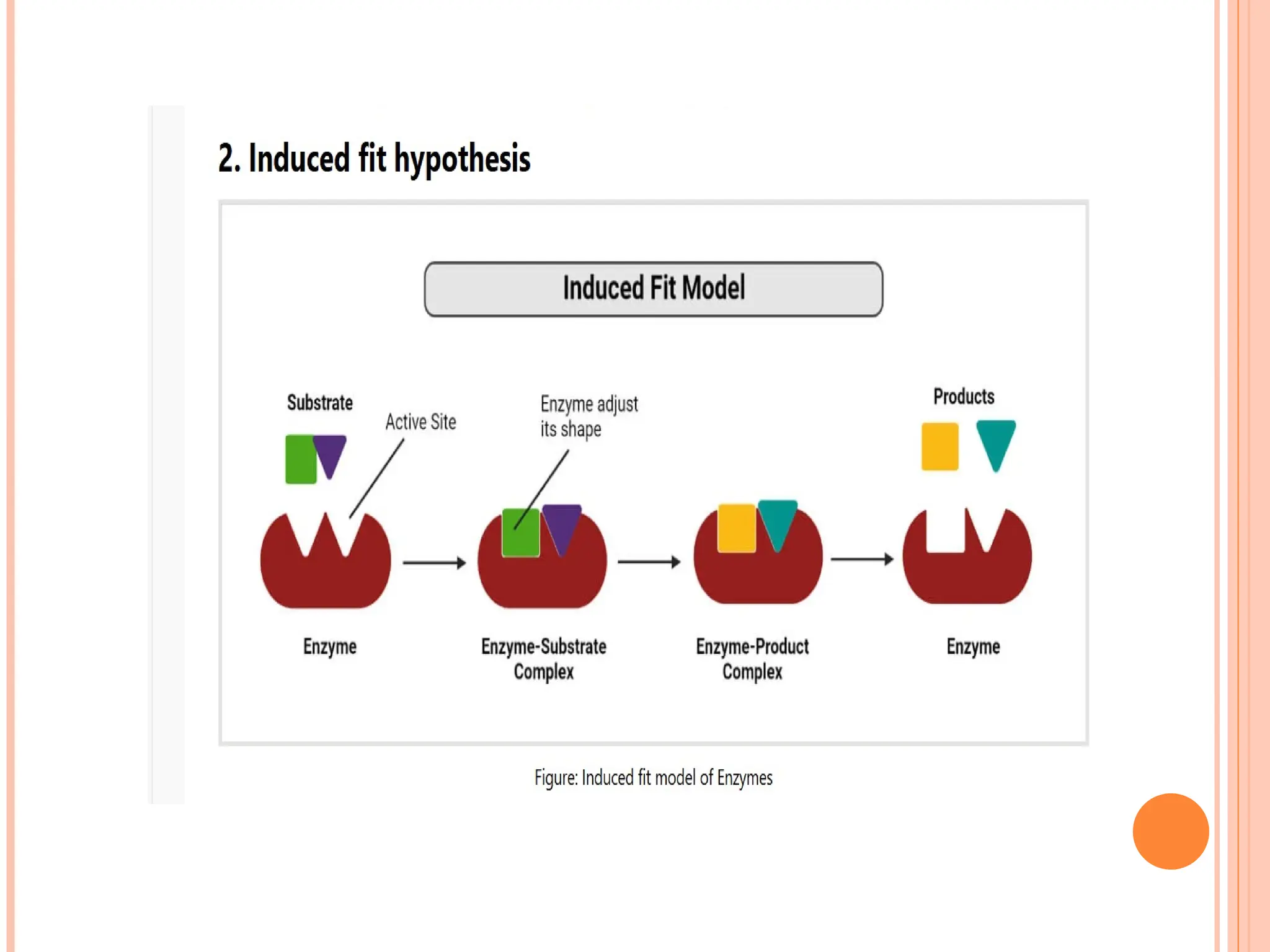
2. INDUCED FITHYPOTHESIS
� The induced fit hypothesis is a modified form of
the lock and key hypothesis proposed by
Koshland in 1958.
� According to this hypothesis, the enzyme
molecule does not retain its original shape and
structure.
� Instead, the contact of the
substrate induces some configurational or
geometrical changes in the active site of the
enzyme molecule.
� As a result, the enzyme molecule is made to fit
the configuration and active centers of the
substrate completely.
34.
� Meanwhile, otheramino acid residues remain
buried in the interior of the molecule.
� However, the sequence of events resulting in
the conformational change might be different.
� Some enzymes might first undergo a
conformational change, then bind the
substrate.
� In an alternative pathway, the substrate may
first be bound, and then a conformational
change may occur in the active site.
� Thirdly, both the processes may co-occur with
further isomerization to the final confirmation.
36.
NOMENCLATURE & CLASSIFICATION
OFENZYMES
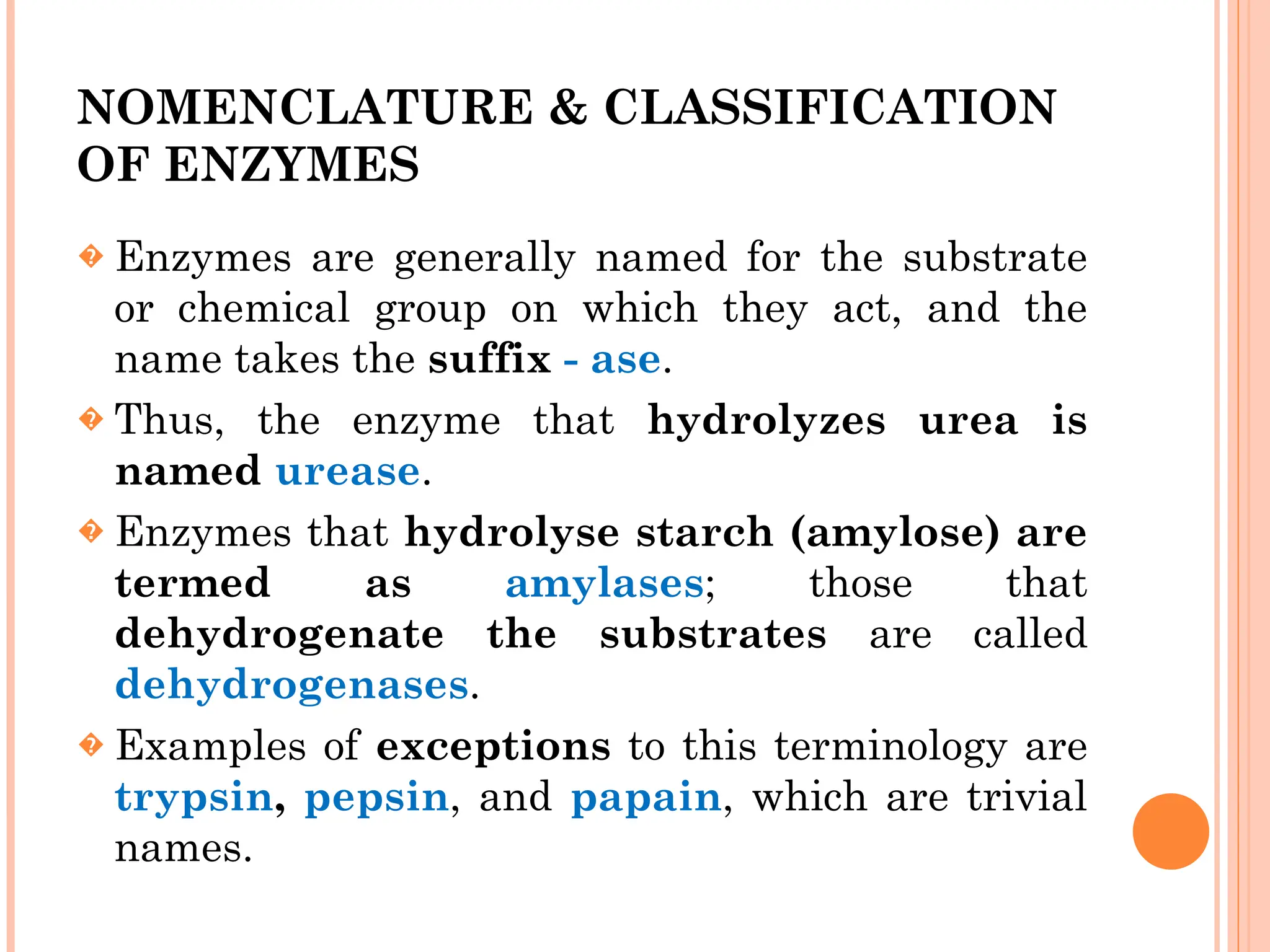
� Enzymes are generally named for the substrate
or chemical group on which they act, and the
name takes the suffix - ase.
� Thus, the enzyme that hydrolyzes urea is
named urease.
� Enzymes that hydrolyse starch (amylose) are
termed as amylases; those that
dehydrogenate the substrates are called
dehydrogenases.
� Examples of exceptions to this terminology are
trypsin, pepsin, and papain, which are trivial
names.
37.
NOMENCLATURE & CLASSIFICATION
OFENZYMES
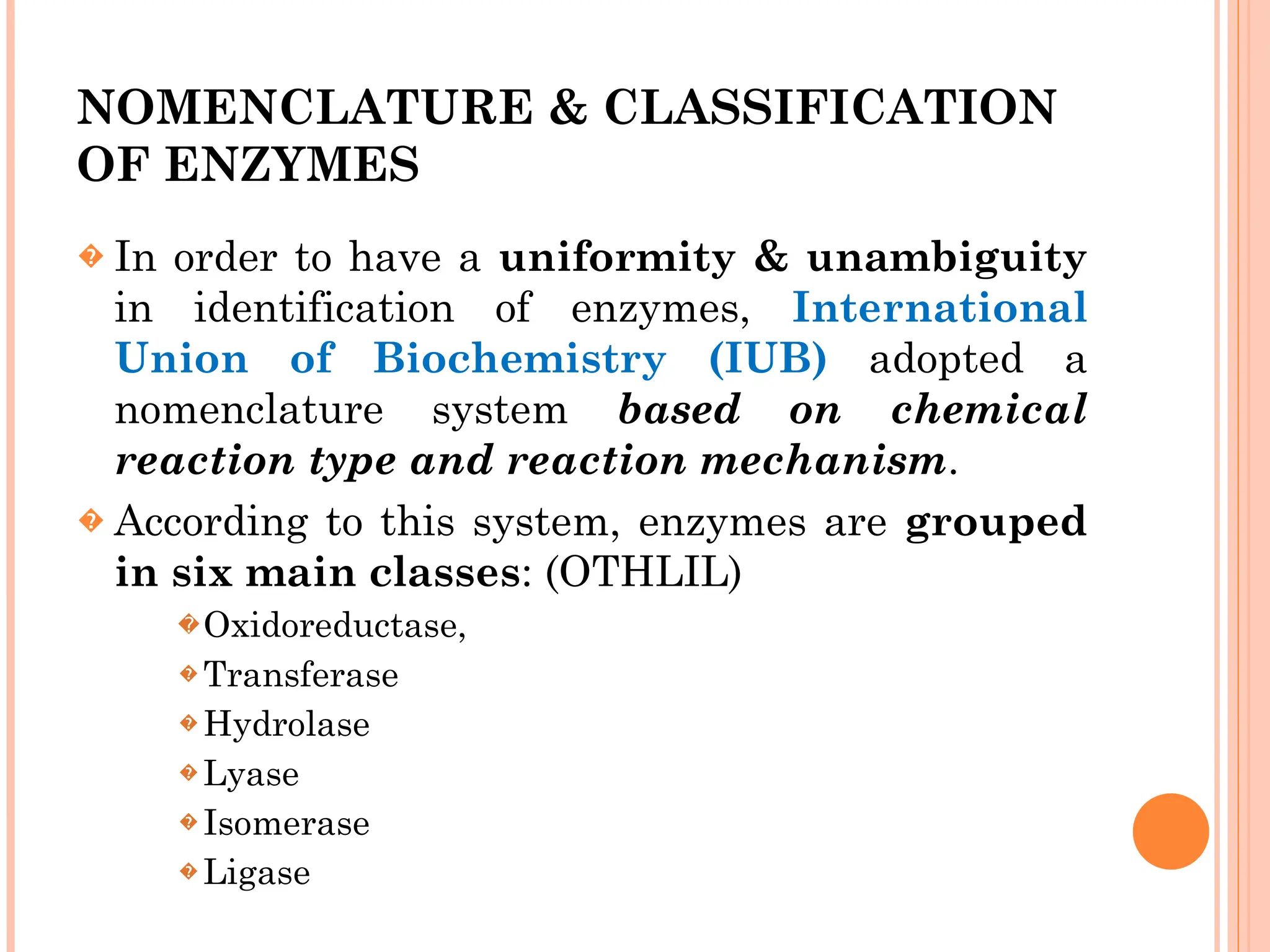
� In order to have a uniformity & unambiguity
in identification of enzymes, International
Union of Biochemistry (IUB) adopted a
nomenclature system based on chemical
reaction type and reaction mechanism.
� According to this system, enzymes are grouped
in six main classes: (OTHLIL)
� Oxidoreductase,
� Transferase
� Hydrolase
� Lyase
� Isomerase
� Ligase
38.
NOMENCLATURE & CLASSIFICATION
OFENZYMES
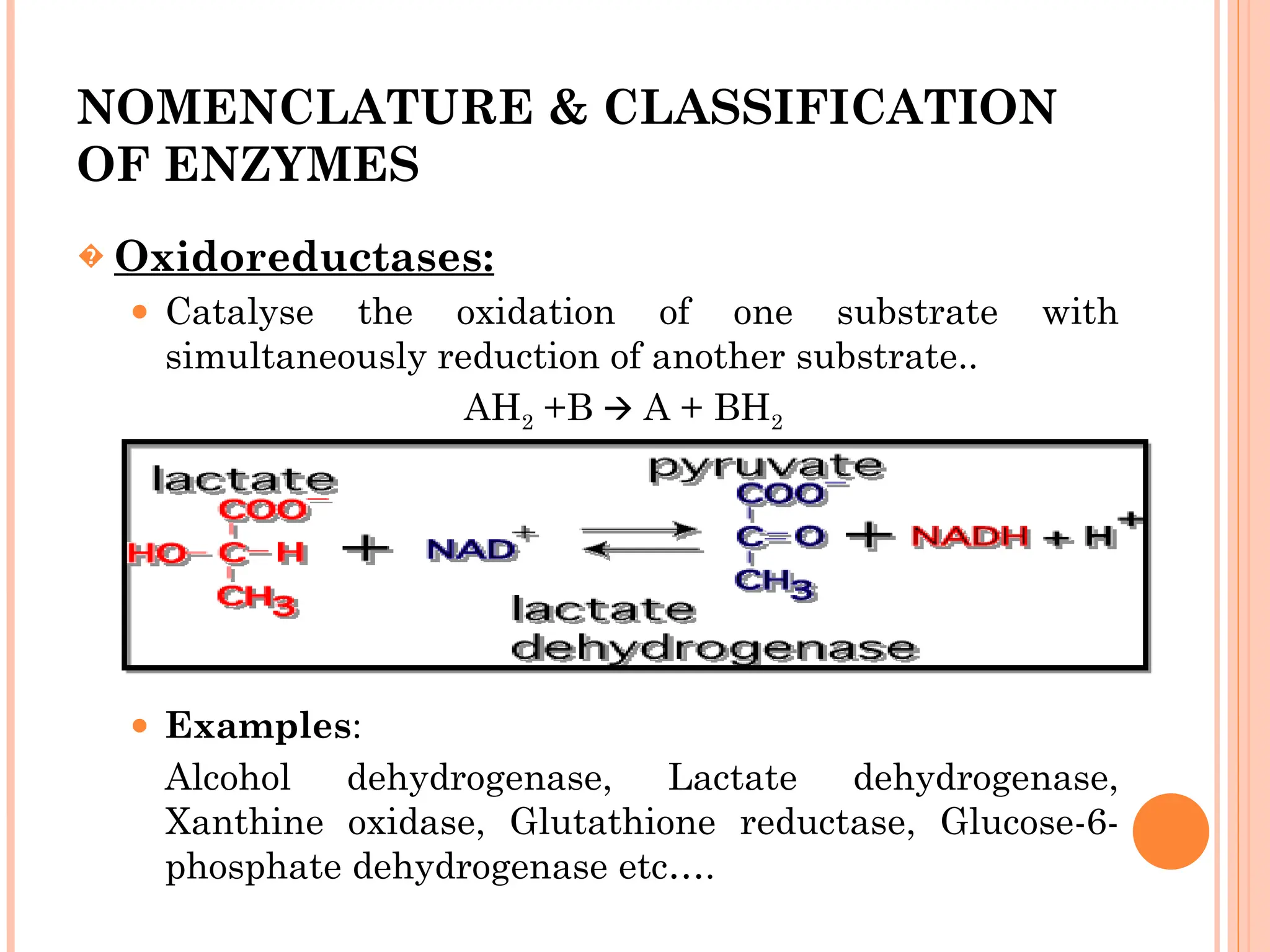
� Oxidoreductases:
⚫ Catalyse the oxidation of one substrate with
simultaneously reduction of another substrate..
AH2 +B A + BH
🡪 2
⚫ Examples:
Alcohol dehydrogenase, Lactate dehydrogenase,
Xanthine oxidase, Glutathione reductase, Glucose-6-
phosphate dehydrogenase etc….
39.
NOMENCLATURE & CLASSIFICATION
OFENZYMES
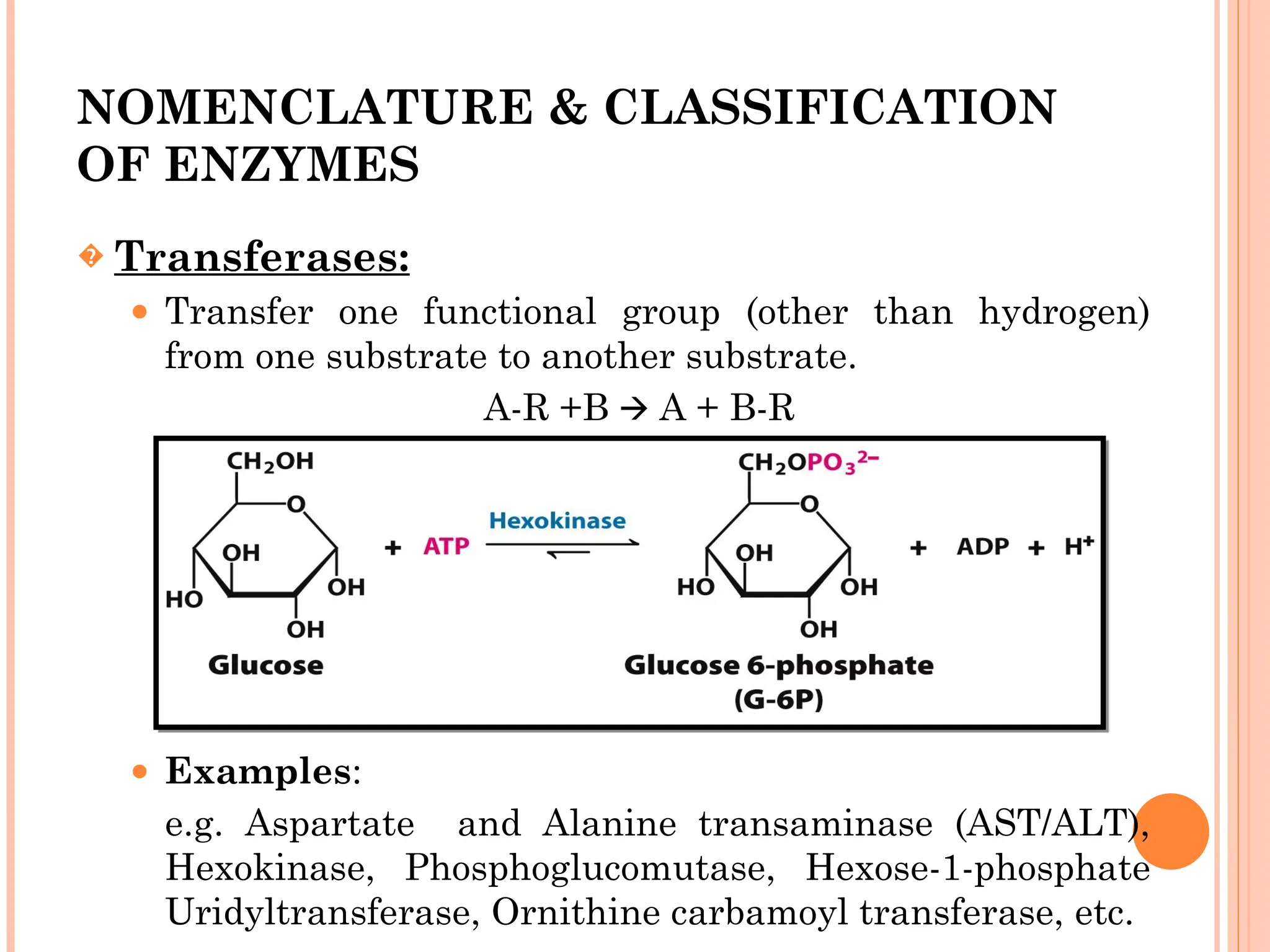
� Transferases:
⚫ Transfer one functional group (other than hydrogen)
from one substrate to another substrate.
A-R +B A + B-R
🡪
⚫ Examples:
e.g. Aspartate and Alanine transaminase (AST/ALT),
Hexokinase, Phosphoglucomutase, Hexose-1-phosphate
Uridyltransferase, Ornithine carbamoyl transferase, etc.
40.
NOMENCLATURE & CLASSIFICATION
OFENZYMES
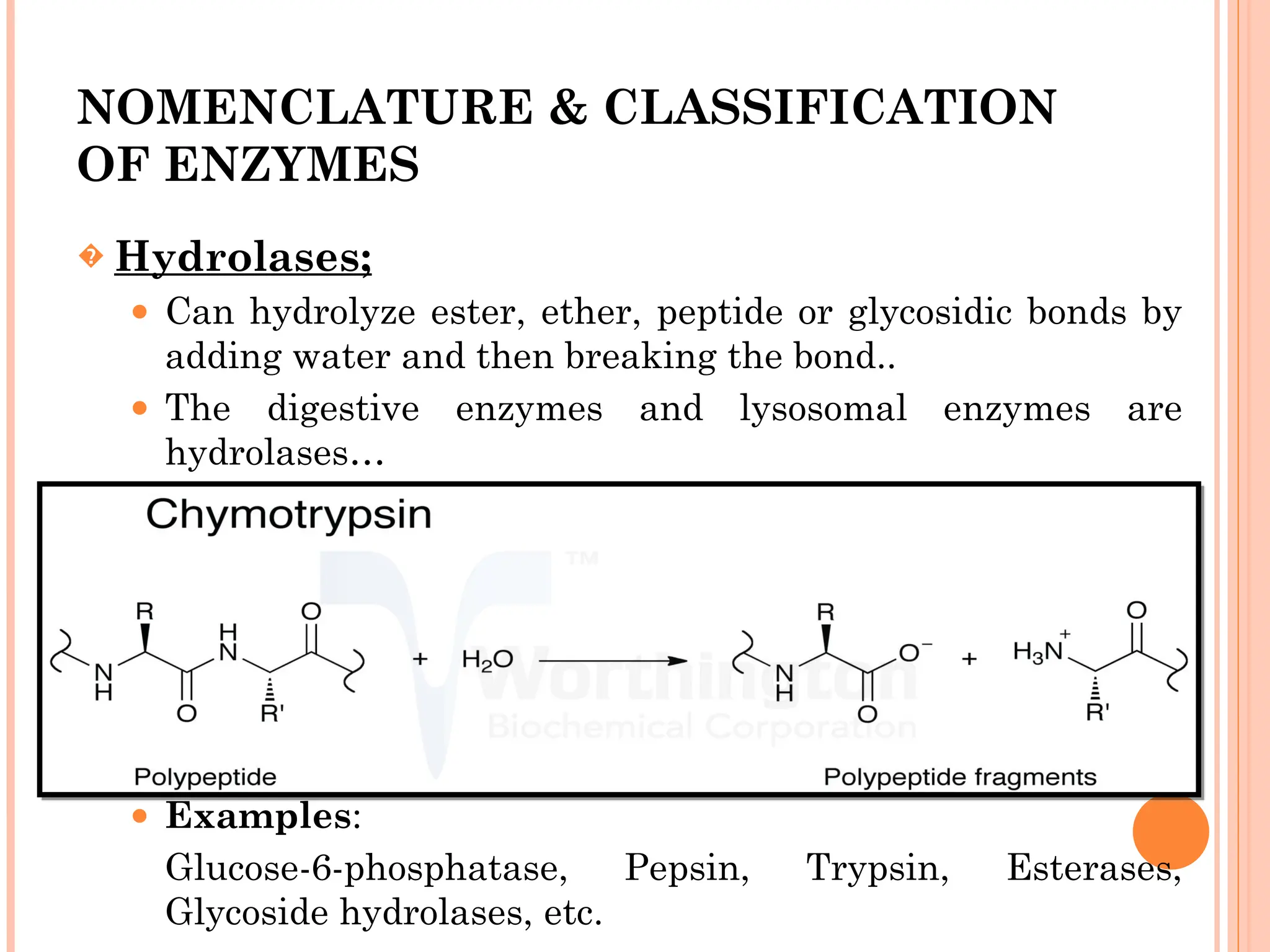
� Hydrolases;
⚫ Can hydrolyze ester, ether, peptide or glycosidic bonds by
adding water and then breaking the bond..
⚫ The digestive enzymes and lysosomal enzymes are
hydrolases…
⚫ Examples:
Glucose-6-phosphatase, Pepsin, Trypsin, Esterases,
Glycoside hydrolases, etc.
41.
NOMENCLATURE & CLASSIFICATION
OFENZYMES
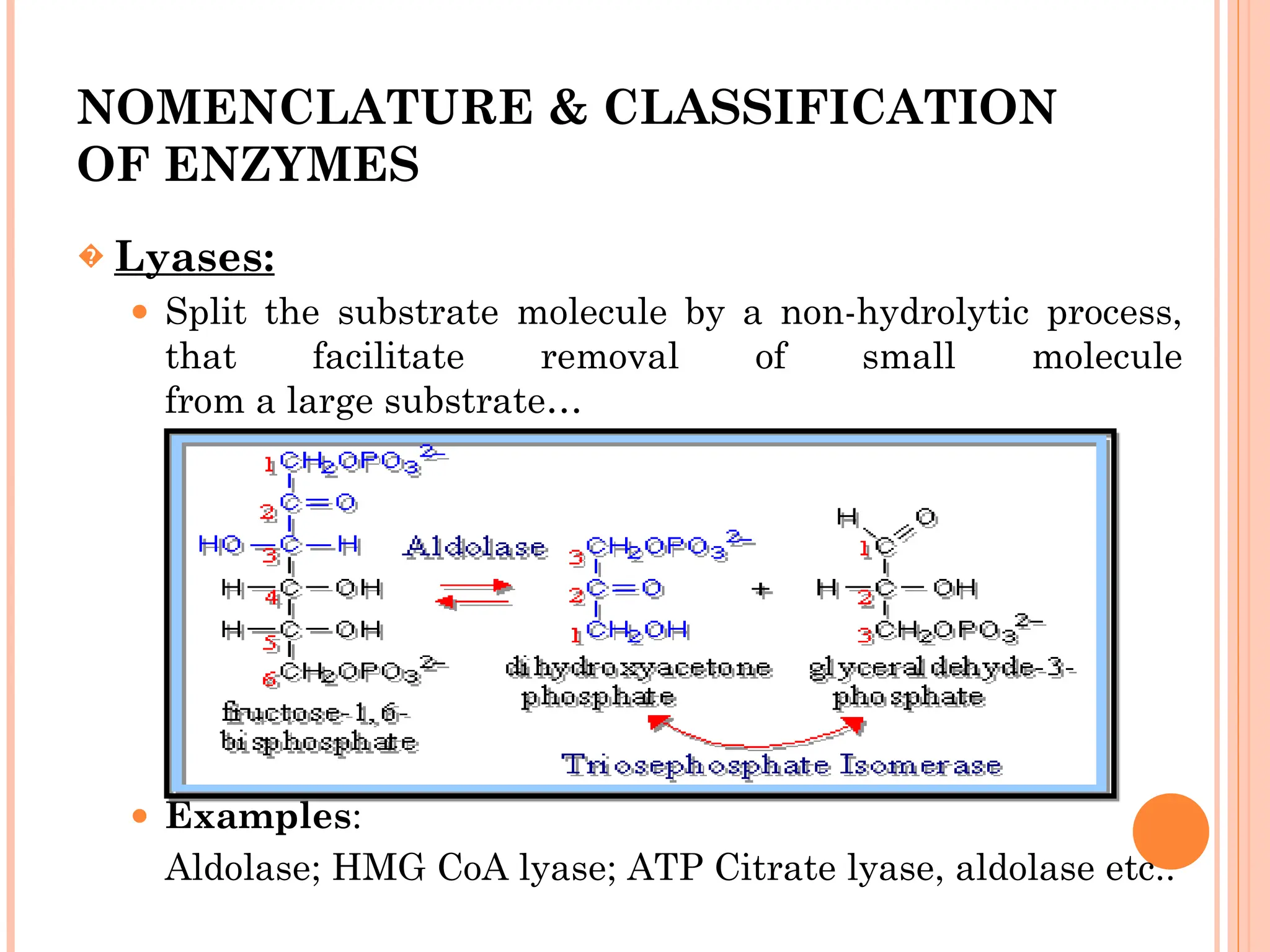
� Lyases:
⚫ Split the substrate molecule by a non-hydrolytic process,
that facilitate removal of small molecule
from a large substrate…
⚫ Examples:
Aldolase; HMG CoA lyase; ATP Citrate lyase, aldolase etc..
42.
NOMENCLATURE & CLASSIFICATION
OFENZYMES
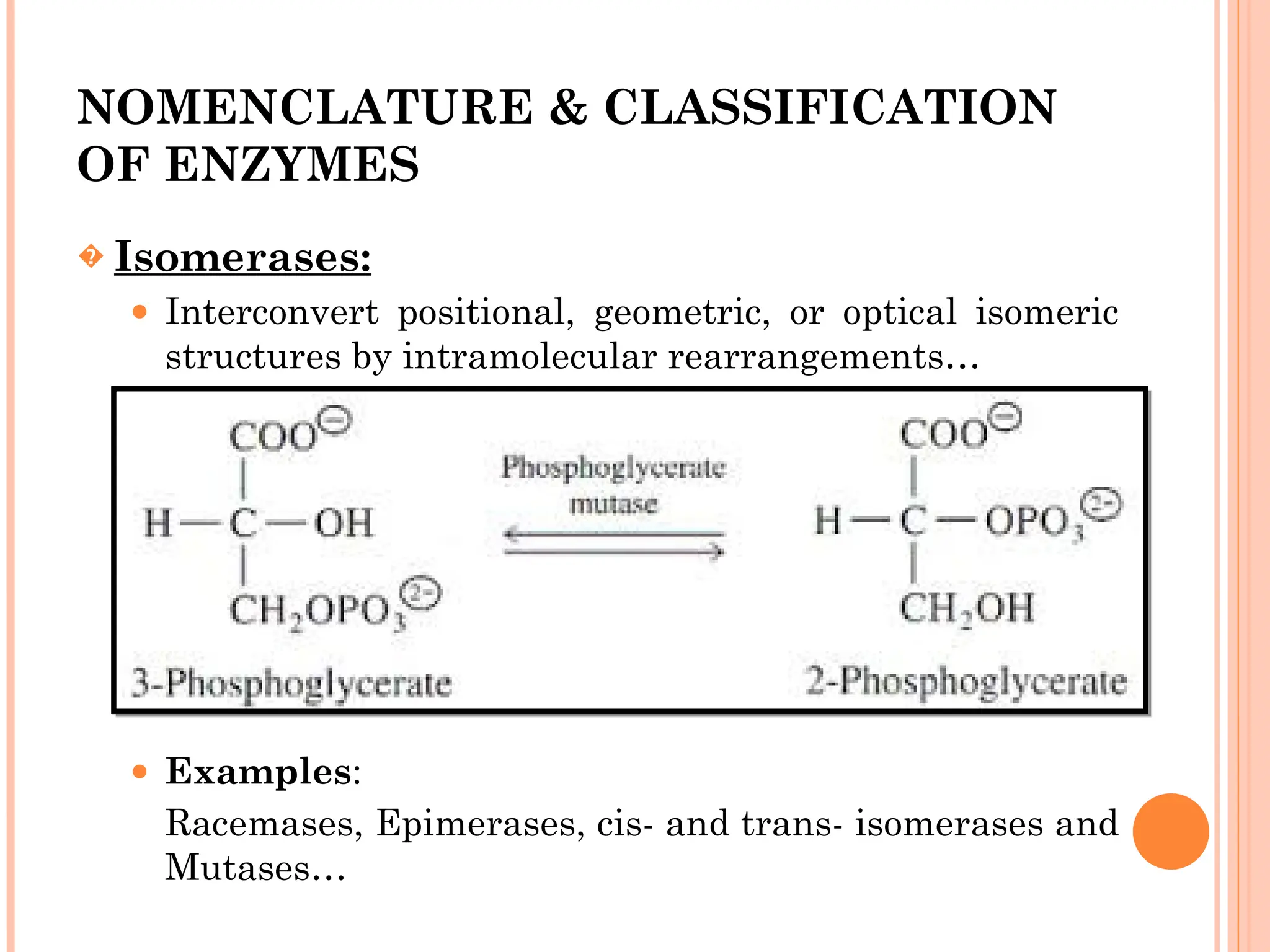
� Isomerases:
⚫ Interconvert positional, geometric, or optical isomeric
structures by intramolecular rearrangements…
⚫ Examples:
Racemases, Epimerases, cis- and trans- isomerases and
Mutases…
43.
NOMENCLATURE & CLASSIFICATION
OFENZYMES
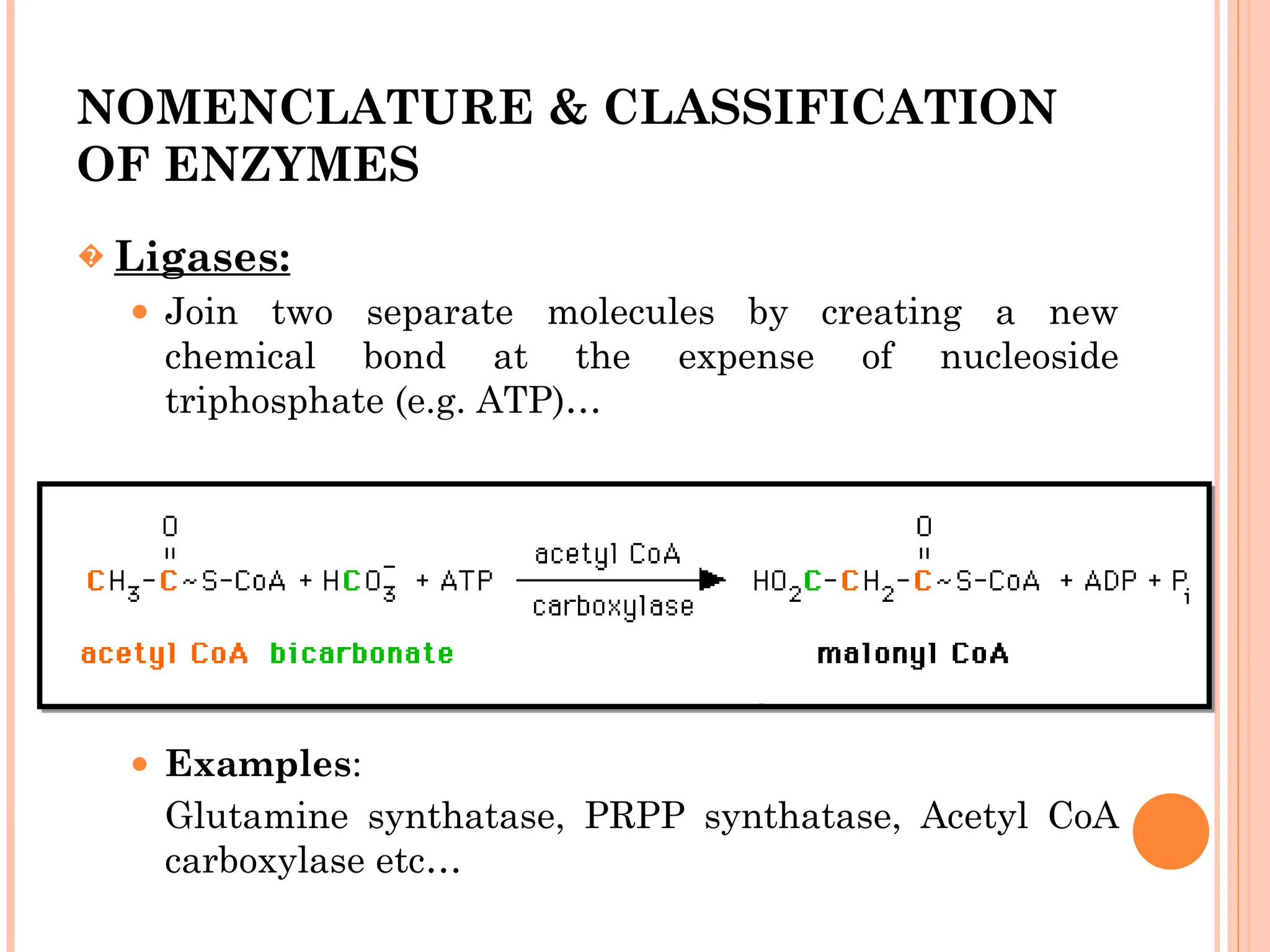
� Ligases:
⚫ Join two separate molecules by creating a new
chemical bond at the expense of nucleoside
triphosphate (e.g. ATP)…
⚫ Examples:
Glutamine synthatase, PRPP synthatase, Acetyl CoA
carboxylase etc…
44.
FACTORS AFFECTING RATE
OFENZYME CATALYZED
REACTIONS
� Temperature
� Hydrogen ion concentration(pH)
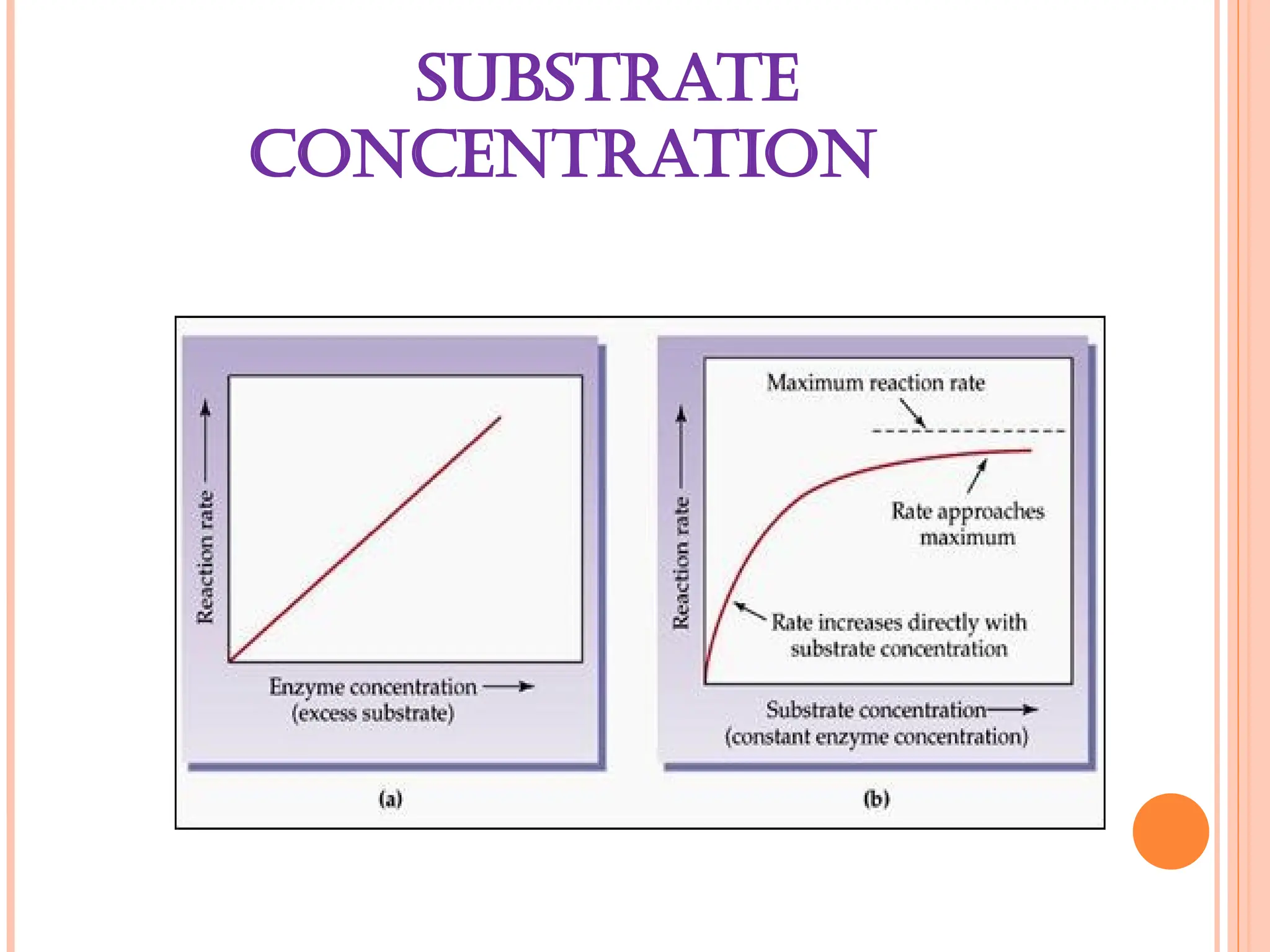
� Substrate concentration
45.
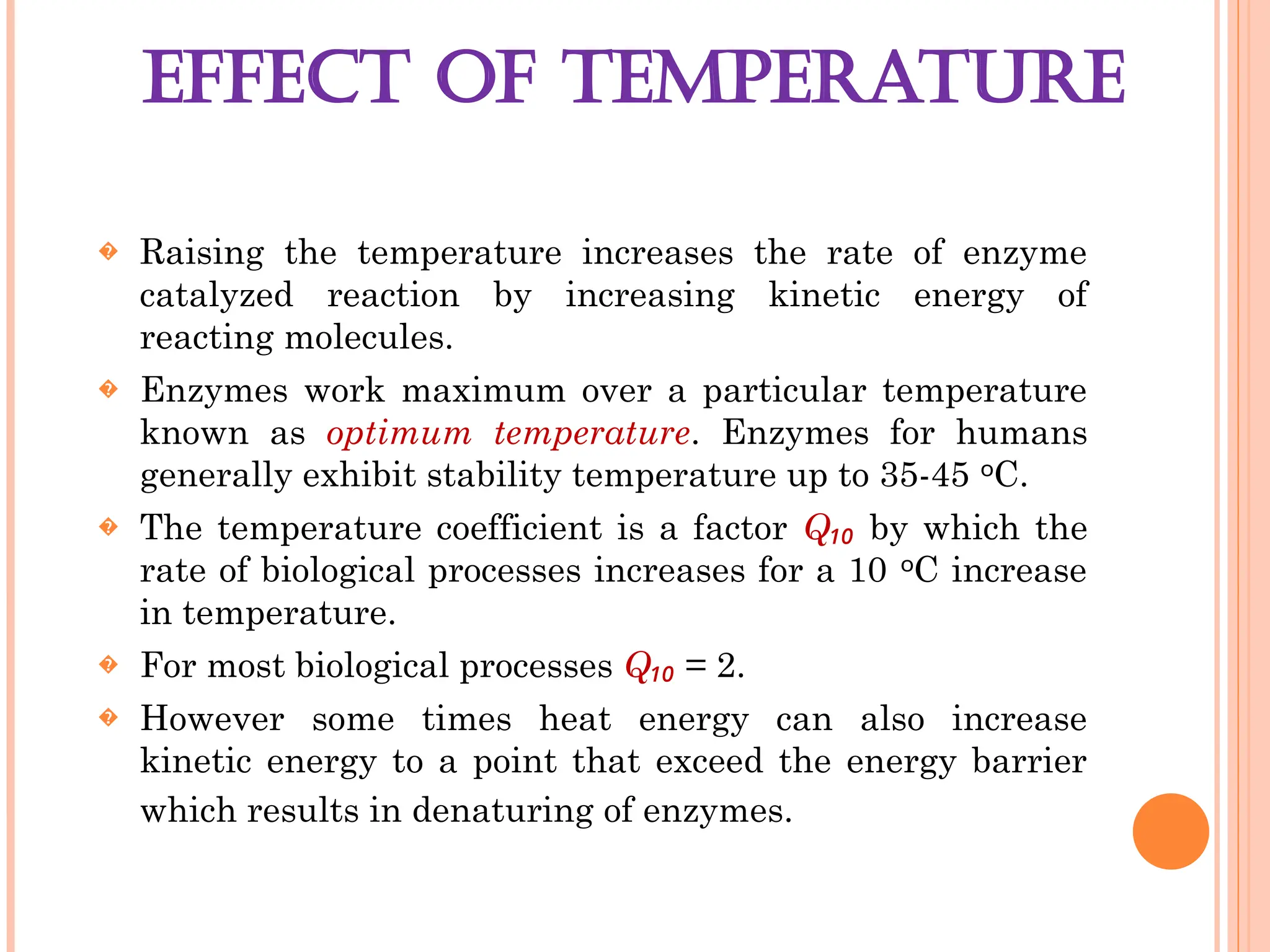
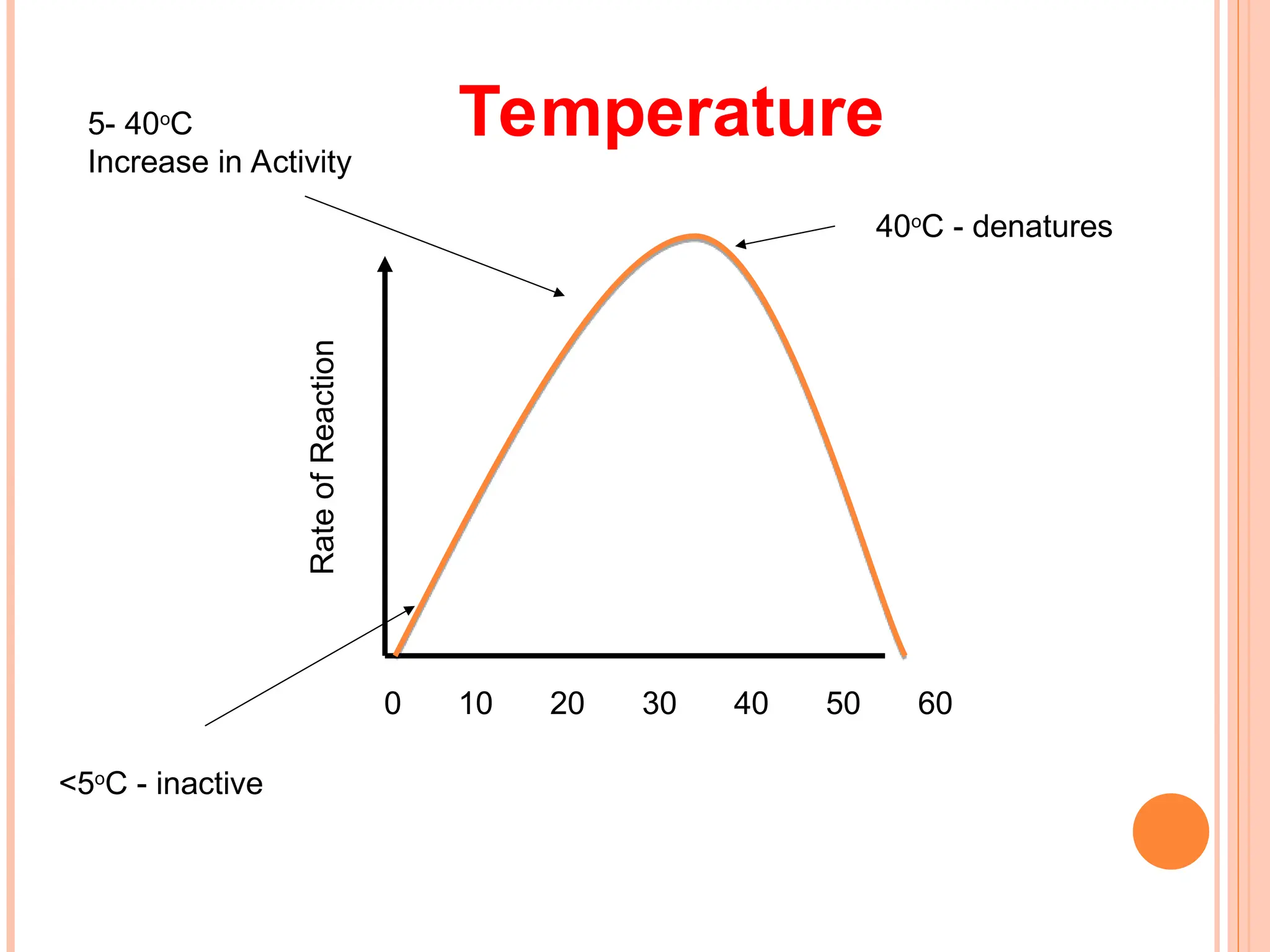
EFFECT OF TEMPERATURE
�Raising the temperature increases the rate of enzyme
catalyzed reaction by increasing kinetic energy of
reacting molecules.
� Enzymes work maximum over a particular temperature
known as optimum temperature. Enzymes for humans
generally exhibit stability temperature up to 35-45 C.
ᵒ
� The temperature coefficient is a factor Q₁₀ by which the
rate of biological processes increases for a 10 C increase
ᵒ
in temperature.
� For most biological processes Q₁₀ = 2.
� However some times heat energy can also increase
kinetic energy to a point that exceed the energy barrier
which results in denaturing of enzymes.
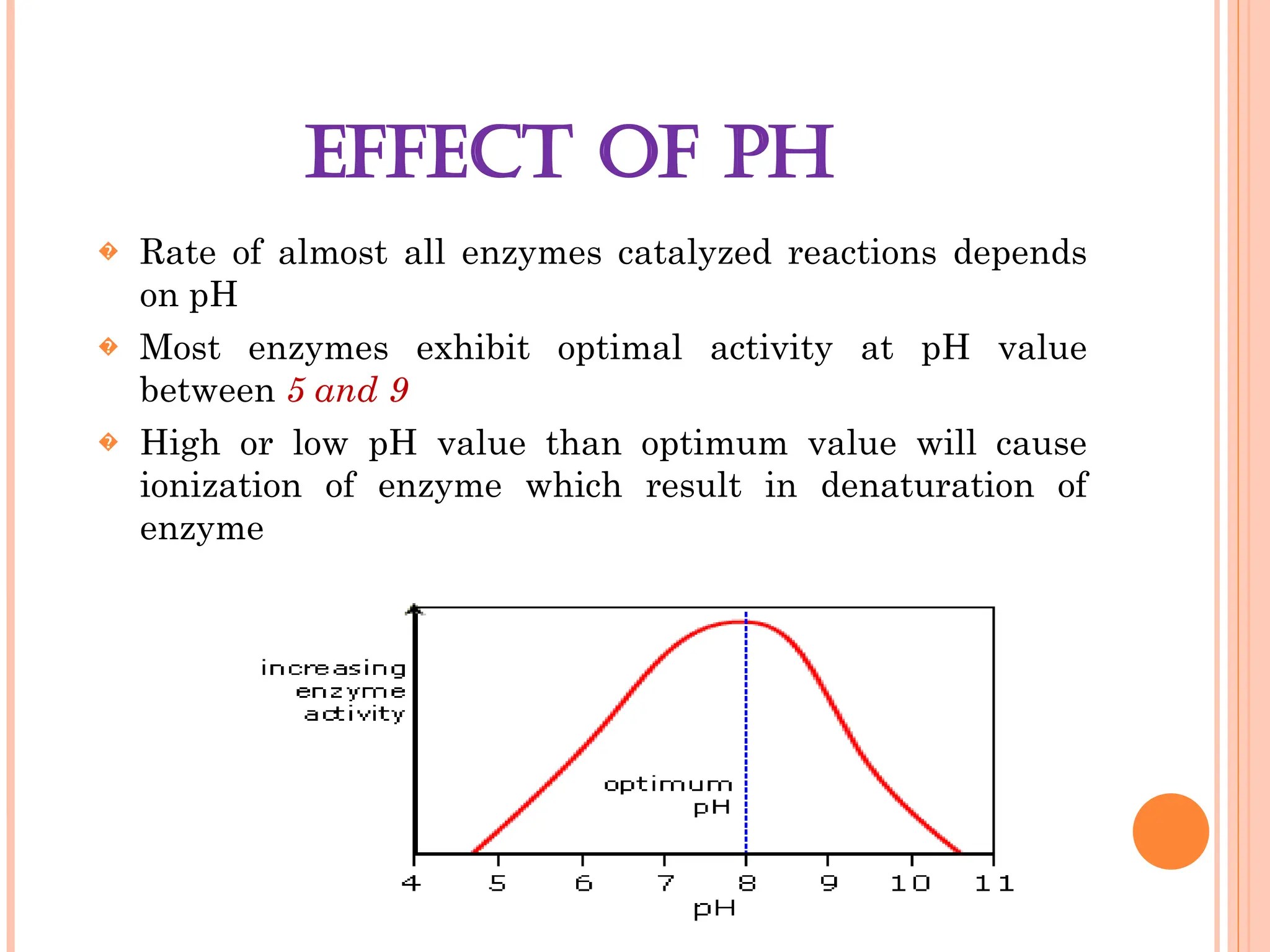
EFFECT OF PH
�Rate of almost all enzymes catalyzed reactions depends
on pH
� Most enzymes exhibit optimal activity at pH value
between 5 and 9
� High or low pH value than optimum value will cause
ionization of enzyme which result in denaturation of
enzyme
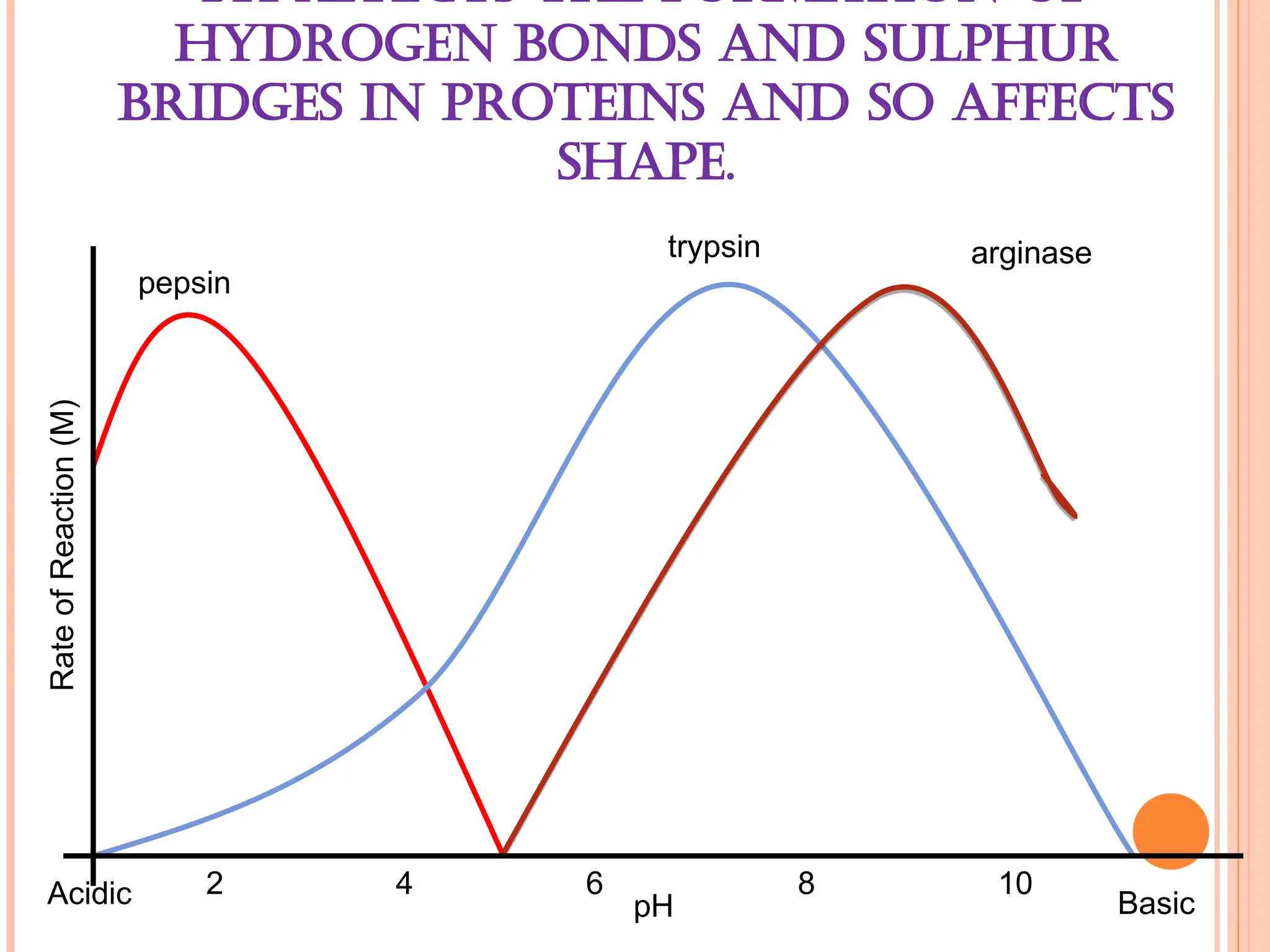
48.
PH AFFECTS THEFORMATION OF
HYDROGEN BONDS AND SULPHUR
BRIDGES IN PROTEINS AND SO AFFECTS
SHAPE.
pepsin
trypsin arginase
2 4 8 10
6
pH
Rate
of
Reaction
(M)
Acidic Basic
49.
MICHAELIS-MENTEN MODEL &
EFFECTSOF SUBSTRATE
CONCENTRATION
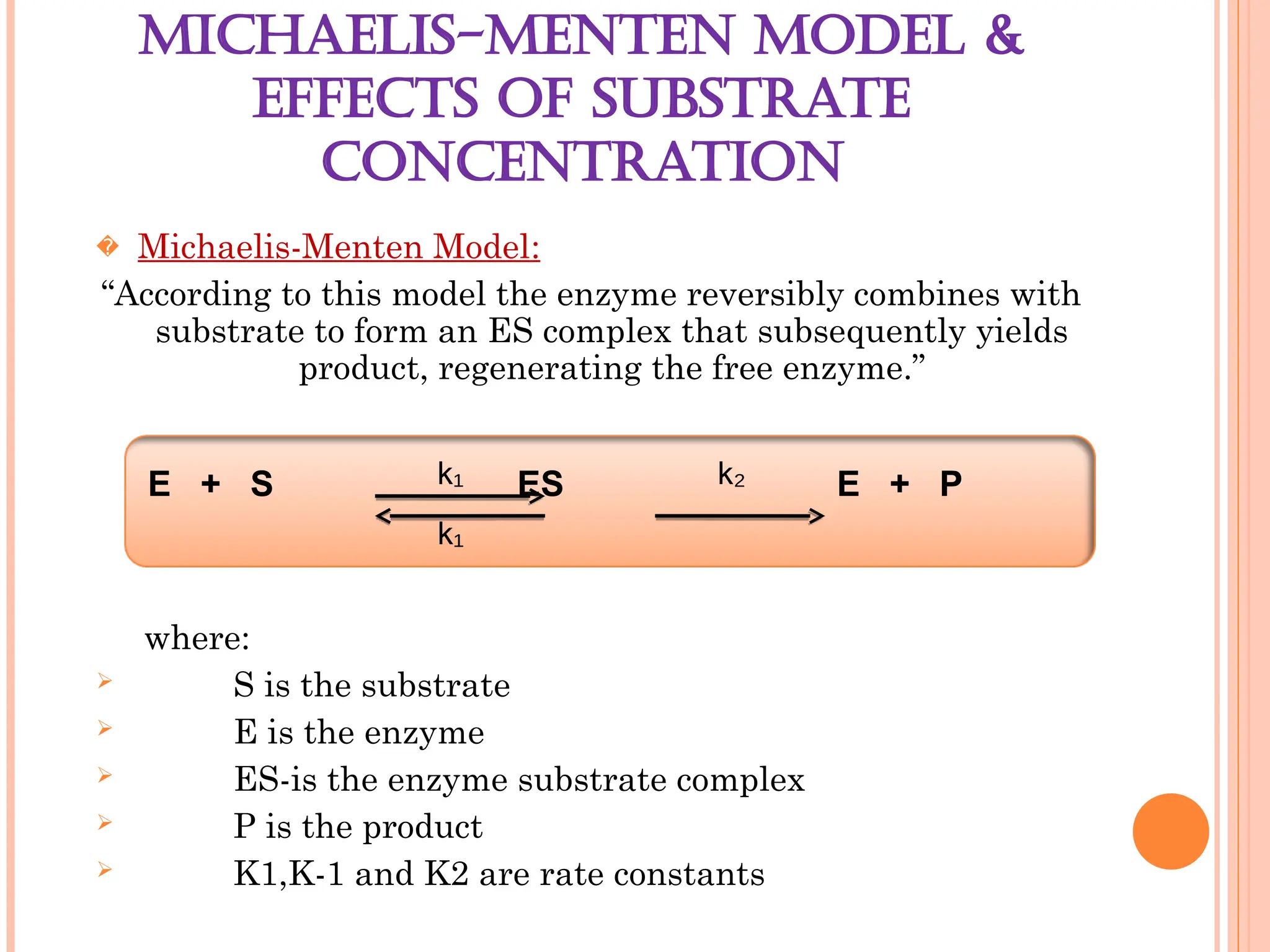
� Michaelis-Menten Model:
“According to this model the enzyme reversibly combines with
substrate to form an ES complex that subsequently yields
product, regenerating the free enzyme.”
where:
S is the substrate
E is the enzyme
ES-is the enzyme substrate complex
P is the product
K1,K-1 and K2 are rate constants
E + S ES E + P
k₁
k₁
k₂
50.
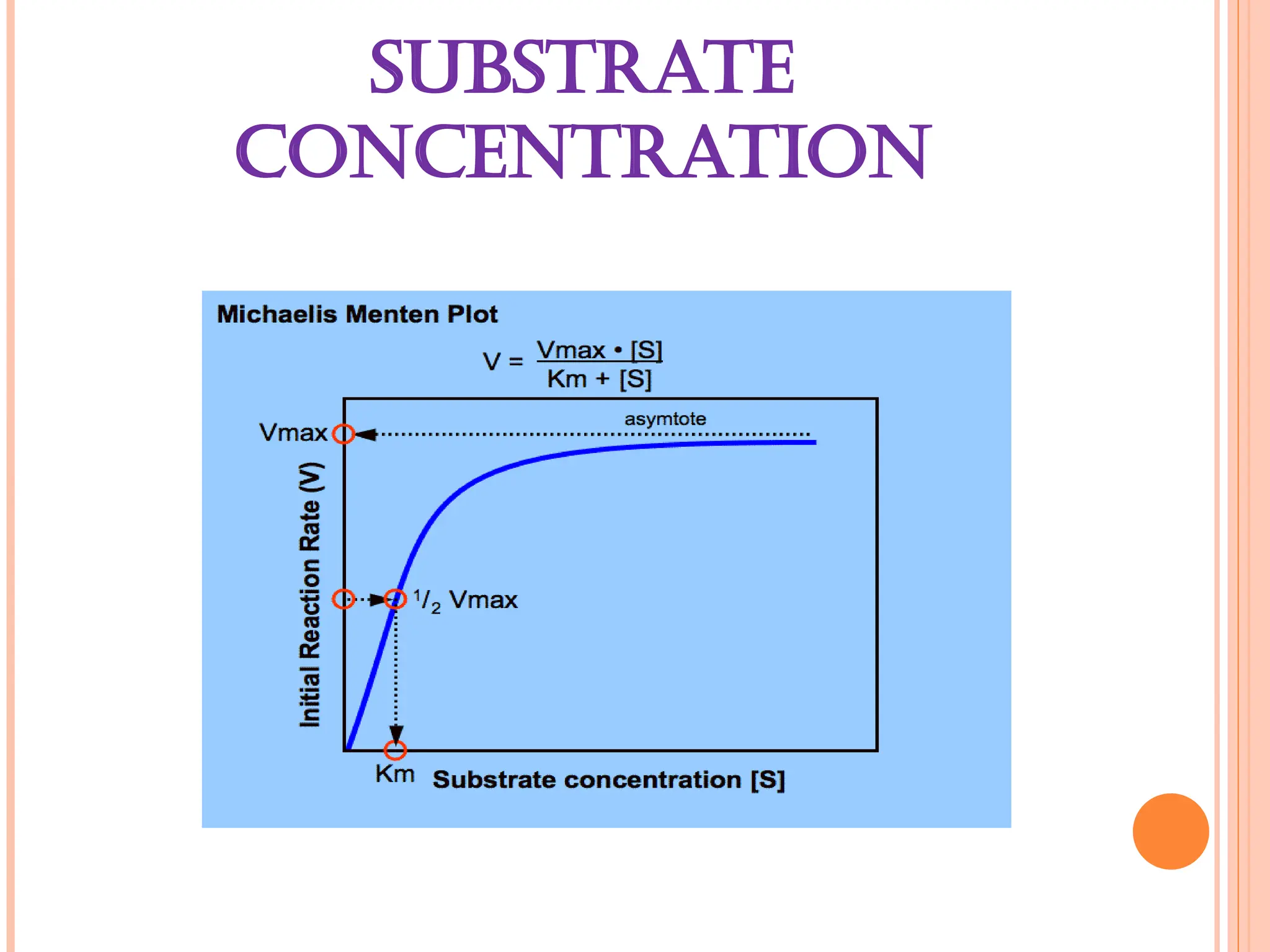
MICHAELIS-MENTEN
EQUATION
� Michaelis-Menten Equation:
“Itis an equation which describes how reaction velocity varies
with substrate concentration.”
Vmax [S]
Vo=
Km+[S]
� Where
Vo is the initial reaction velocity.
Vmax is the maximum velocity.
Km is the Michaelis constant = (k +k )/k .
₋₁ ₂ ₁
[S] is the substrate concentration.
PHARMACEUTICAL
IMPORTANCE
� Enzymes arevirtually involved in all physiological
processes which makes them the targets of choice for
drugs that cure or ameliorate human disease.
� Applied enzyme kinetics represents the principal tool by
which scientist identify and characterize therapeutic
agents that selectively inhibit the rates of specific
enzymes catalyzed processes.
� Enzymes kinetics thus play a critical role in drug
discovery as well as elaborating the mode of action of
drugs.
INHIBITION
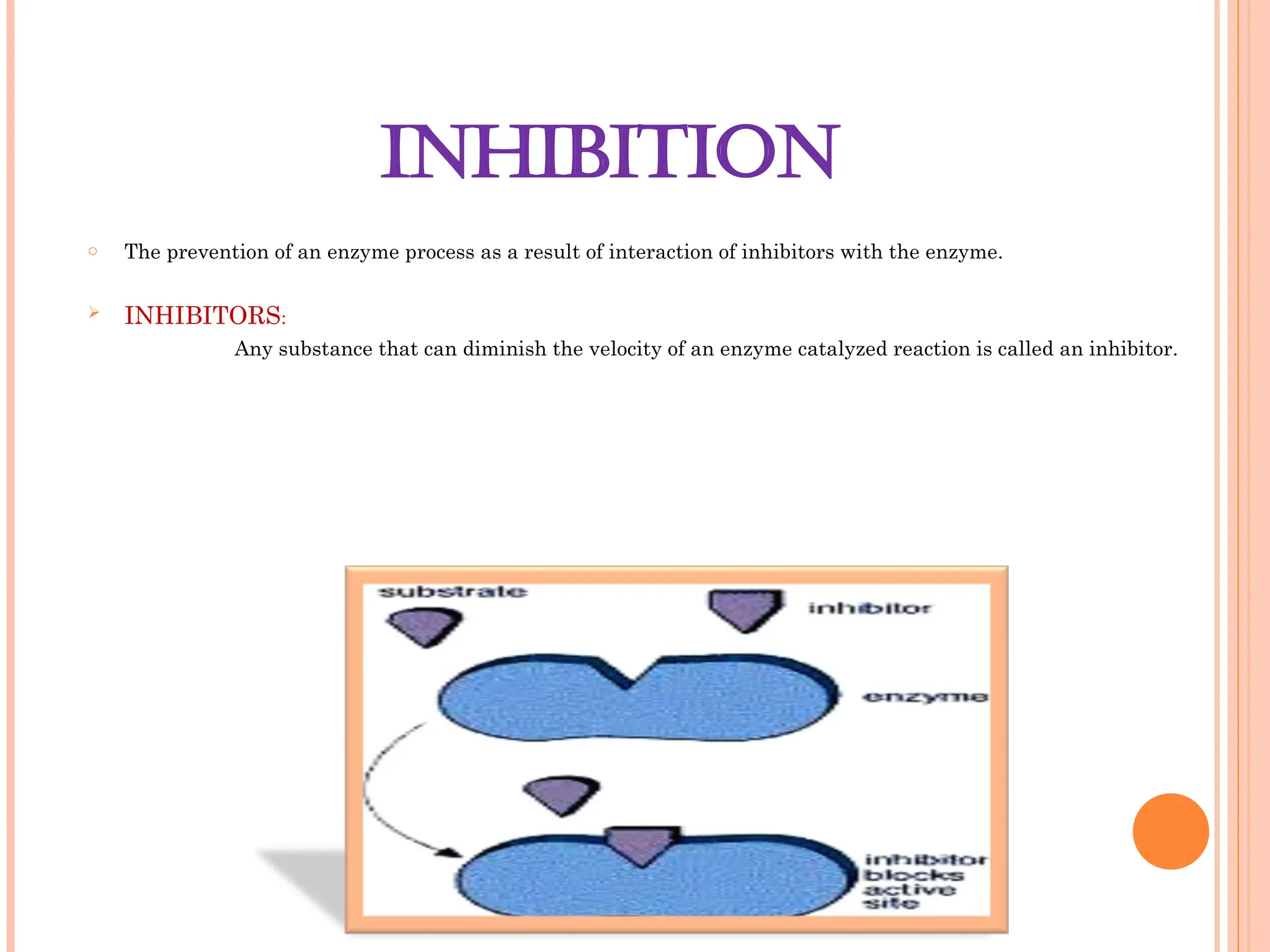
o The preventionof an enzyme process as a result of interaction of inhibitors with the enzyme.
INHIBITORS:
Any substance that can diminish the velocity of an enzyme catalyzed reaction is called an inhibitor.
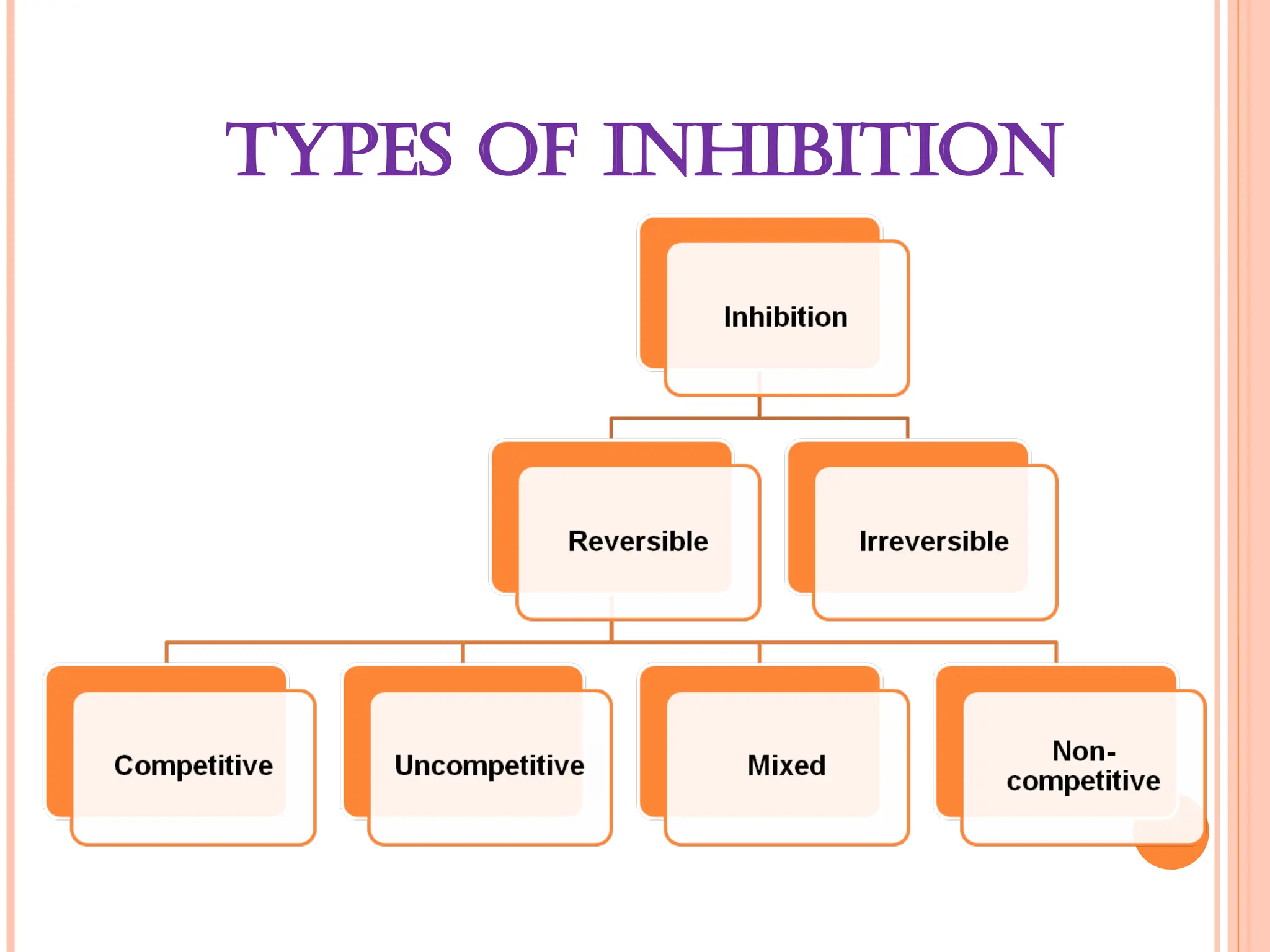
REVERSIBLE INHIBITION
o Itis an inhibition of enzyme activity in which the
inhibiting molecular entity can associate and dissociate
from the protein‘s binding site.
TYPES OF REVERSIBLE INHIBITION
o There are four types:
Competitive inhibition.
Uncompetitive inhibition.
Mixed inhibition.
Non-competitive inhibition.
58.
COMPETITIVE
INHIBITION
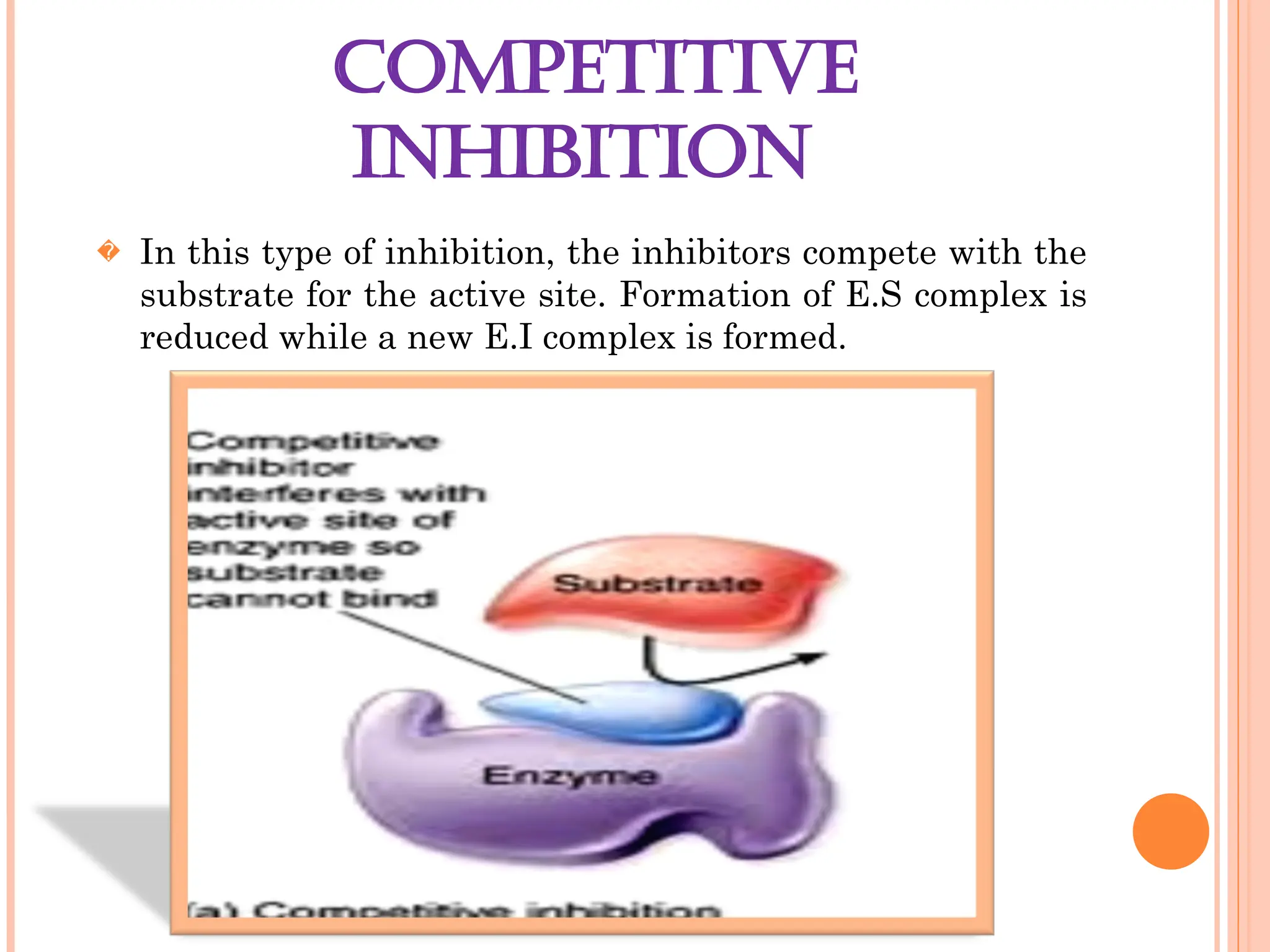
� In thistype of inhibition, the inhibitors compete with the
substrate for the active site. Formation of E.S complex is
reduced while a new E.I complex is formed.
59.
EXAMPLES OF COMPETITIVE
INHIBITION
StatinDrug As Example Of Competitive
Inhibition:
� Statin drugs such as lipitor compete with HMG-
CoA(substrate) and inhibit the active site of HMG CoA-
REDUCTASE (that bring about the catalysis of cholesterol
synthesis).
60.
UNCOMPETITIVE
INHIBITION
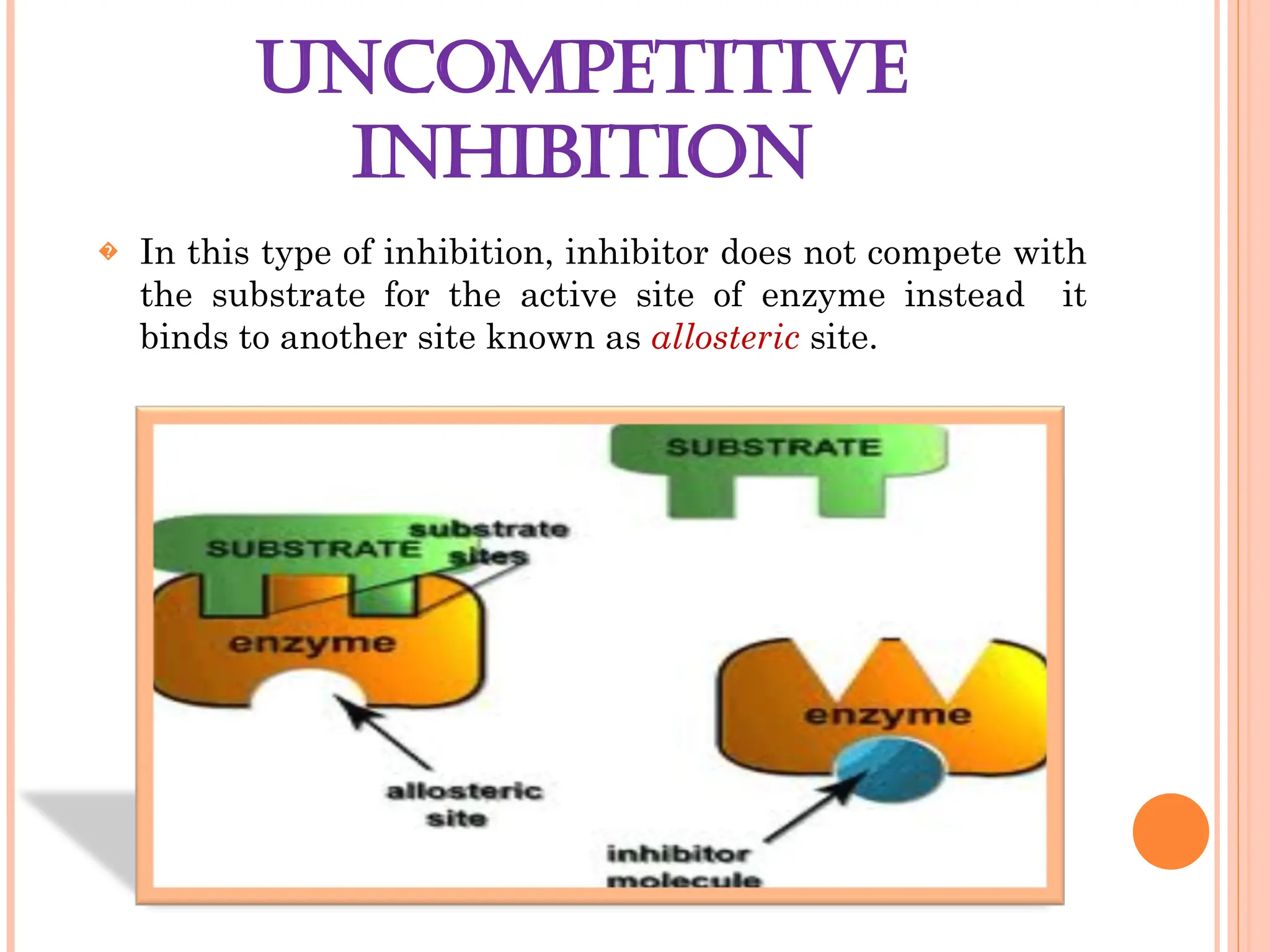
� In thistype of inhibition, inhibitor does not compete with
the substrate for the active site of enzyme instead it
binds to another site known as allosteric site.
61.
EXAMPLES OF
UNCOMPETITIVE
INHIBITION
� Drugsto treat cases of poisoning by methanol or ethylene
glycol act as uncompetitive inhibitors.
� Tetramethylene sulfoxide and 3- butylthiolene 1-oxide are
uncompetitive inhibitors of liver alcohaldehydrogenase.
62.
NON COMPETITIVE
INHIBITION
o Itis a special case of inhibition.
o In this inhibitor has the same affinity for either enzyme
E or the E.S complex.
MIXED INHIBITION
o In this type of inhibition both E.I and E.S.I complexes are
formed.
o Both complexes are catalytically inactive.
63.
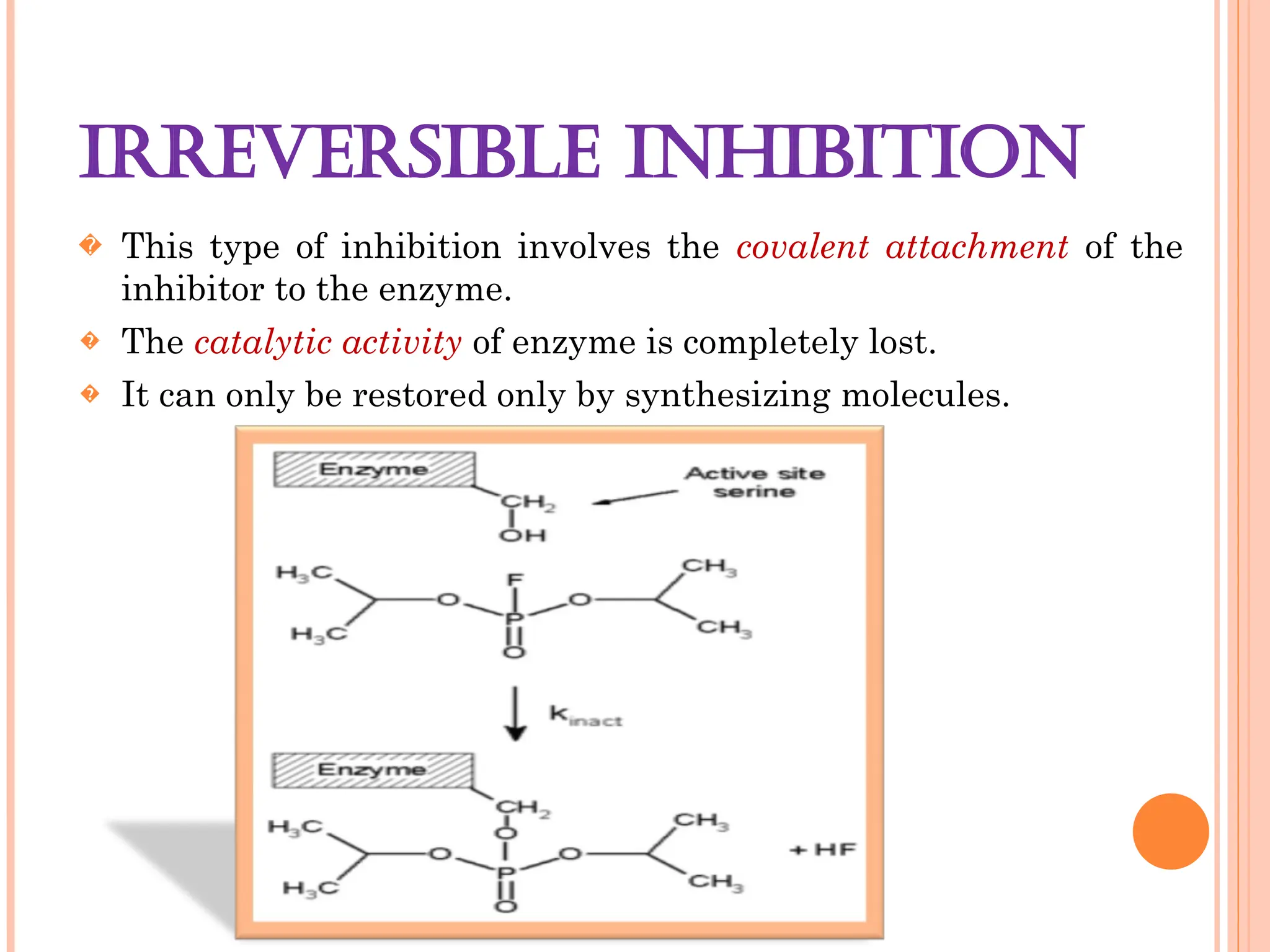
IRREVERSIBLE INHIBITION
� Thistype of inhibition involves the covalent attachment of the
inhibitor to the enzyme.
� The catalytic activity of enzyme is completely lost.
� It can only be restored only by synthesizing molecules.
64.
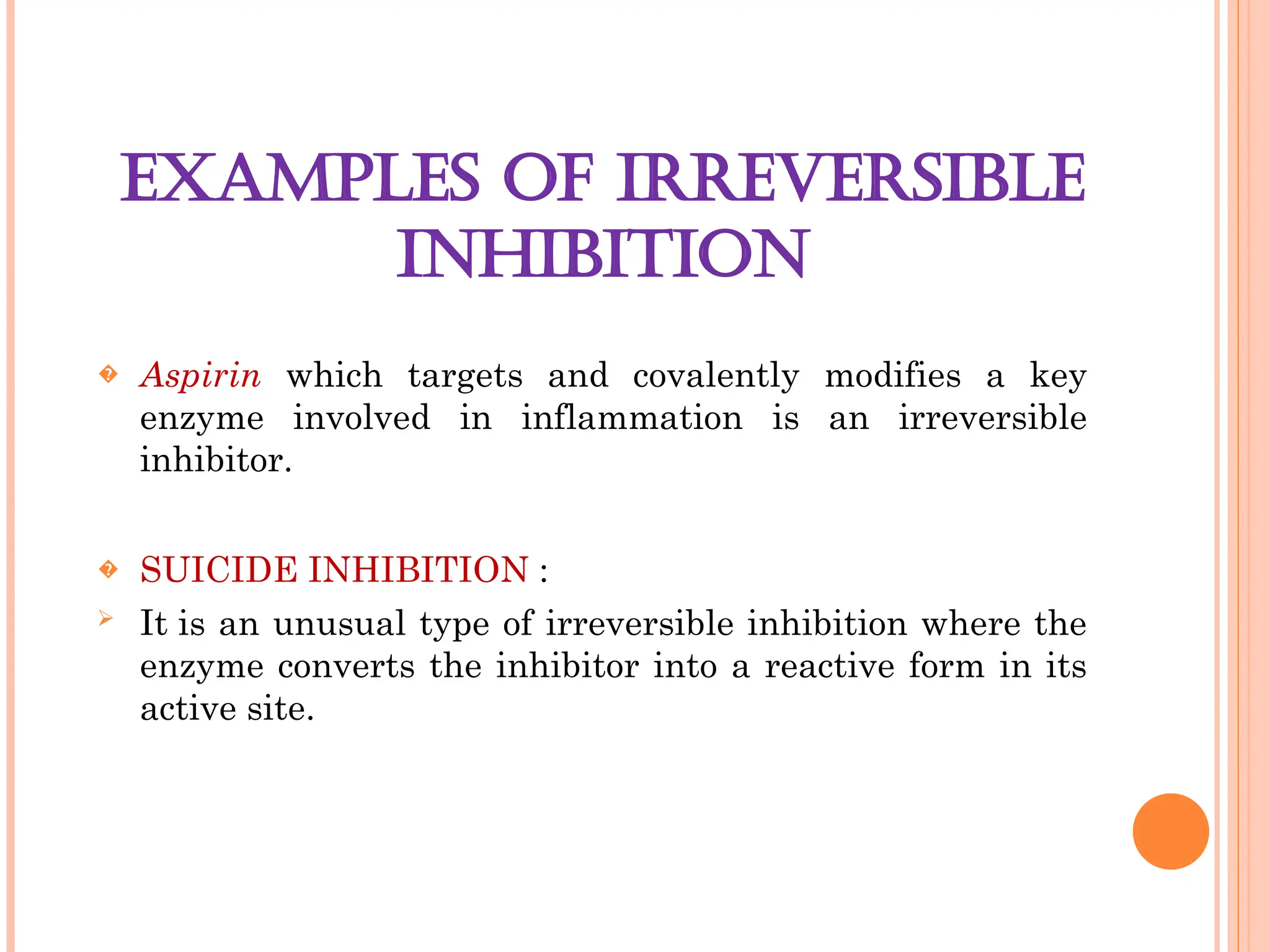
EXAMPLES OF IRREVERSIBLE
INHIBITION
�Aspirin which targets and covalently modifies a key
enzyme involved in inflammation is an irreversible
inhibitor.
� SUICIDE INHIBITION :
It is an unusual type of irreversible inhibition where the
enzyme converts the inhibitor into a reactive form in its
active site.
![MICHAELIS-MENTEN
EQUATION
� Michaelis-Menten Equation:
“It is an equation which describes how reaction velocity varies
with substrate concentration.”
Vmax [S]
Vo=
Km+[S]
� Where
Vo is the initial reaction velocity.
Vmax is the maximum velocity.
Km is the Michaelis constant = (k +k )/k .
₋₁ ₂ ₁
[S] is the substrate concentration.](https://image.slidesharecdn.com/enzymechemistry-251125092610-f46aabc7/75/power-point-slide-on-ENZYME-CHEMISTRY-ppt-50-2048.jpg)