Enzymes
Enzymes
• Enzyme definition, chemical nature of
enzyme, functions, mode of action.
• Enzyme specificity, zymogen factors affecting
enzyme activity.
Enzymes
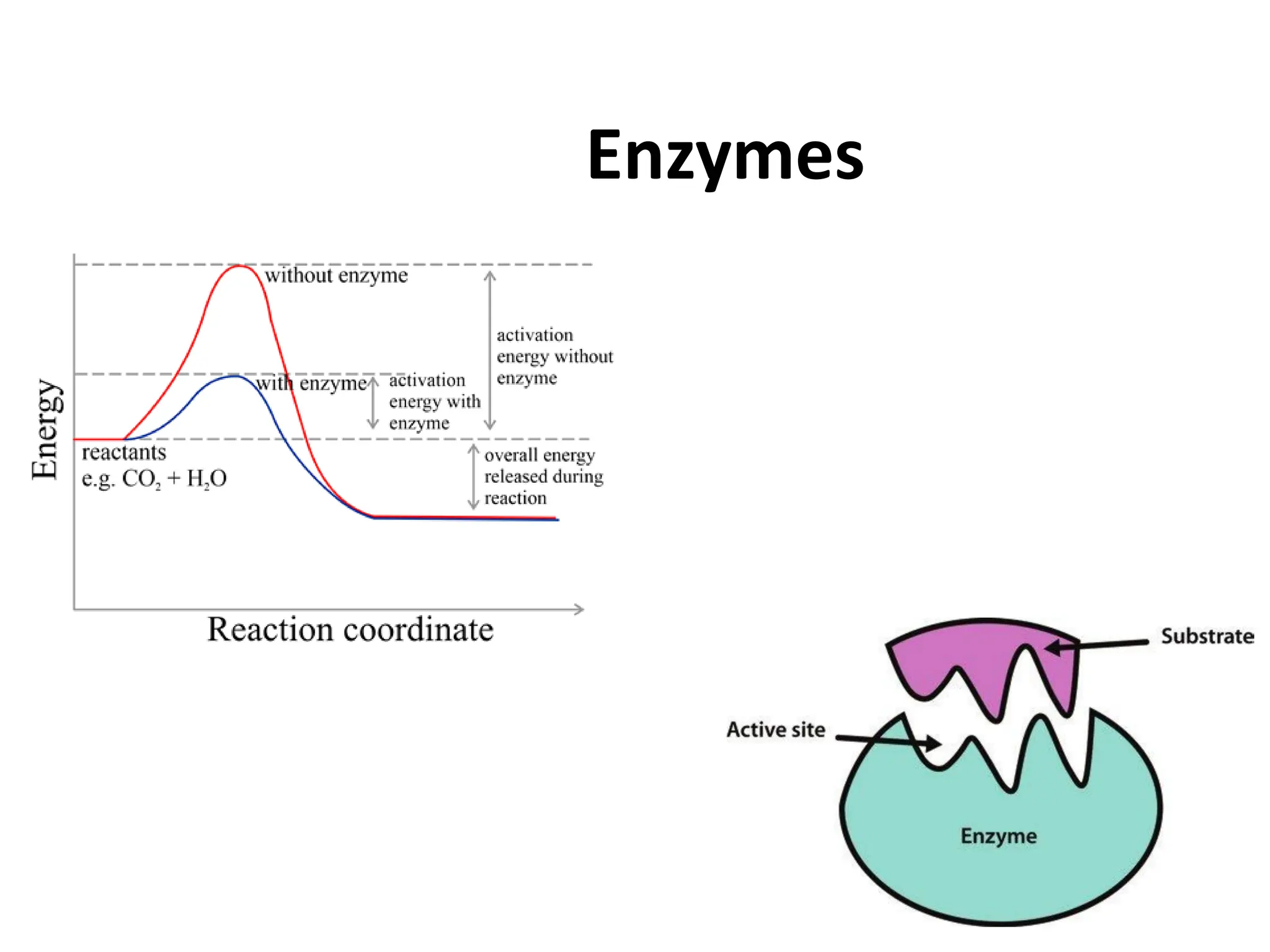
• Every day, trillions upon trillions of chemical reactions
occur in our body to make essential metabolic processes
occur.
• Enzymes are proteins that act upon substrate molecules
and decrease the activation energy necessary for a
chemical reaction to occur by stabilizing the transition
state.
• This stabilization speeds up reaction rates and makes
them happen at physiologically significant rates.
• Enzymes bind substrates at key locations in their structure
called active sites.
• They are typically highly specific and only bind certain
substrates for certain reactions.
• Without enzymes, most metabolic reactions would take
much longer and would not be fast enough to sustain life.
Enzyme definition
• An enzyme is a biological catalyst and is
almost always a protein.
• It speeds up the rate of a specific chemical
reaction in the cell.
• The enzyme is not destroyed during the
reaction and is used over and over.
• A cell contains thousands of different types of
enzyme molecules, each specific to a
particular chemical reaction.
Chemical nature of enzyme
• The macromolecular components of almost all
enzymes are composed of protein, except for a
class of RNA-modifying catalysts known as
ribozymes.
• Ribozymes are molecules of ribonucleic acid that
catalyze reactions on the phosphodiester bond of
other RNAs.
• Some enzymes, called apoenzymes, are inactive
until they are bound to a cofactor, which activates
the enzyme.
Chemical nature of enzyme
• A cofactor can be either metal ions (e.g., Zn)
or organic compounds that attach, either
covalently or noncovalently, to the enzyme.
The cofactor and apoenzyme complex is called
a holoenzyme.
Chemical nature of enzyme
Cofactors
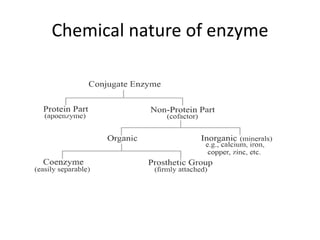
• Cofactors are non-proteinous substances that
associate with enzymes.
• A cofactor is essential for the functioning of an
enzyme.
• The protein part of enzymes in cofactors is
apoenzyme.
• An enzyme and its cofactor together
constitute the holoenzyme.
There are three kinds of cofactors
present in enzymes:
• Prosthetic groups: These are cofactors tightly
bound to an enzyme at all times. FAD (flavin
adenine dinucleotide) is a prosthetic group
present in many enzymes.
• Coenzyme: A coenzyme binds to an enzyme only
during catalysis. At all other times, it is detached
from the enzyme. NAD is a common coenzyme.
• Metal ions: For the catalysis of certain enzymes, a
metal ion is required at the active site to form
coordinate bonds. Zinc is a metal ion cofactor
used by a number of enzymes.
Chemical nature of enzyme
• Enzymes are proteins comprised of amino acids
linked together in one or more polypeptide
chains. This sequence of amino acids in a
polypeptide chain is called the primary structure.
This, in turn, determines the three-dimensional
structure of the enzyme, including the shape of
the active site.
• The secondary structure of a protein describes
the localized polypeptide chain structures, e.g., α-
helices or β-sheets.
Chemical nature of enzyme
• The complete three-dimensional fold of a
polypeptide chain into a protein subunit is known
as its tertiary structure.
• A protein can be composed of one (a monomer)
or more subunits (e.g., a dimer). The three-
dimensional arrangement of subunits is known as
its quaternary structure. Subunit structure is
determined by the sequence and characteristics
of amino acids in the polypeptide chain.
Chemical nature of enzyme
The active site
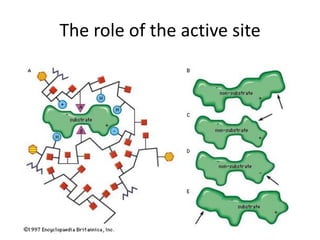
• The active site is a groove or crevice on an
enzyme in which a substrate binds to facilitate
the catalyzed chemical reaction.
• Enzymes are typically specific because the
conformation of amino acids in the active site
stabilizes the specific binding of the substrate.
The active site generally takes up a relatively
small part of the entire enzyme.
There are six main categories of
enzymes
• According to the International Union of
Biochemists (I U B), enzymes are divided into
six functional classes and are classified based
on the type of reaction in which they are used
to catalyze. The six kinds of enzymes are
hydrolases, oxidoreductases, lyases,
transferases, ligases and isomerases.
• Oxidoreductases
These catalyze oxidation and reduction reactions, e.g.
pyruvate dehydrogenase, catalysing the oxidation of
pyruvate to acetyl coenzyme A.
• Transferases
These catalyze transferring of the chemical group from
one to another compound. An example is a transaminase,
which transfers an amino group from one molecule to
another.
• Hydrolases
They catalyze the hydrolysis of a bond. For example, the
enzyme pepsin hydrolyzes peptide bonds in proteins.
• Lyases
These catalyze the breakage of bonds without catalysis, e.g. aldolase
(an enzyme in glycolysis) catalyzes the splitting of fructose-1, 6-
bisphosphate to glyceraldehyde-3-phosphate and dihydroxyacetone
phosphate.
• Isomerases
They catalyze the formation of an isomer of a compound. Example:
phosphoglucomutase catalyzes the conversion of glucose-1-phosphate
to glucose-6-phosphate (phosphate group is transferred from one to
another position in the same compound) in glycogenolysis (glycogen is
converted to glucose for energy to be released quickly).
• Ligases
Ligases catalyze the association of two molecules. For example, DNA
ligase catalyzes the joining of two fragments of DNA by forming a
phosphodiester bond.
The role of the active site
Mechanism of Enzyme Reaction
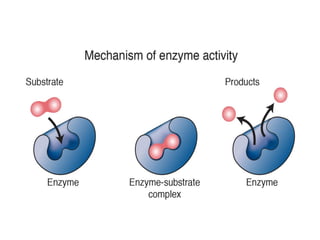
There are three different models of substrate binding to the
active site of an enzyme:
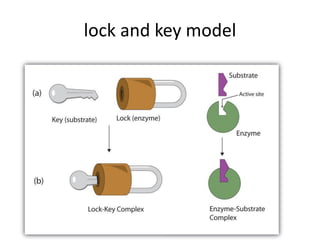
• The first model called the lock and key model, proposes
that the shape and chemistry of the substrate are
complementary to the shape and chemistry of the active
site on the enzyme. This means when the substrate enters
the active site, it fits perfectly, and the two binds together,
forming the enzyme-substrate complex.
• The lock-and-key model assumes that the enzyme (lock)
recognizes the substrate (key) through the shape
complementarity between the enzyme’s active site and the
substrate.
lock and key model
Mechanism of Enzyme Reaction
• The second model is called the induced fit model, and it
hypothesizes that the enzyme and the substrate don’t
initially have the precise complementary shape/chemistry
or alignment, but rather, this alignment becomes induced
at the active site by substrate binding.
• Substrate binding to an enzyme is generally stabilized by
local molecular interactions with the amino acid residues
on the polypeptide chain.
• The induced-fit model was first proposed by Koshland in
1958 to explain the protein conformational changes in the
binding process. This model suggests that an enzyme, when
binding with its substrate, optimizes the interface through
physical interactions to form the final complex structure.
Mechanism of Enzyme Reaction
the third model
• In the late 1990s, the conformational-selection (population
shift) model was proposed by several researchers.
• The conformational-selection model suggests that the
unbound protein receptor fluctuates among multiple
conformational states, with their occupancy probabilities being
determined by their relative free energies according to the
Boltzmann distribution.
• Only a subset of these states allows the binding of its partner.
• The encounter with its binding partner shifts the distribution
toward these states to form the final complex structure.
• The main difference between the induced-fit model and the
conformational-selection model is whether the holo structure
preexists before forming the complex.
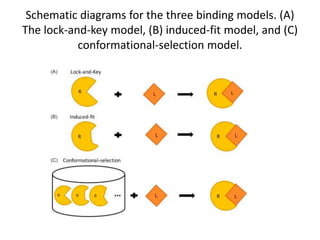
Schematic diagrams for the three binding models. (A)
The lock-and-key model, (B) induced-fit model, and (C)
conformational-selection model.
Mechanism of Enzyme Catalytic
Strategies
• There are four common mechanisms by which
most of these interactions are formed and
alter the active site to create the enzyme-
substrate complex: covalent catalysis, general
acid-base catalysis, catalysis by approximation,
and metal ion catalysis.
Mechanism of Enzyme Reaction
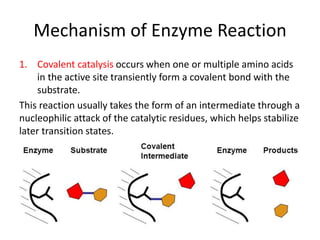
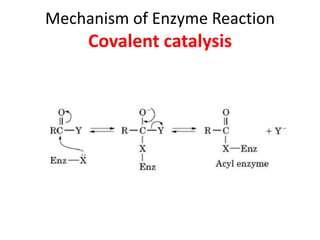
1. Covalent catalysis occurs when one or multiple amino acids
in the active site transiently form a covalent bond with the
substrate.
This reaction usually takes the form of an intermediate through a
nucleophilic attack of the catalytic residues, which helps stabilize
later transition states.
Mechanism of Enzyme Reaction
Covalent catalysis
Mechanism of Enzyme Reaction
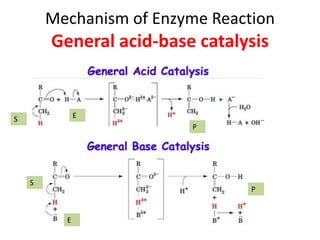
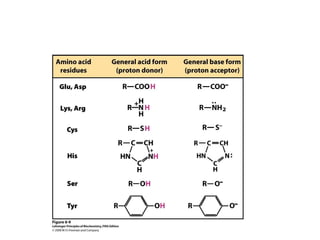
2. General acid-base catalysis takes place when a molecule
other than water acts as a proton donor or acceptor. Water
can be one of the proton donors or acceptors in the reaction,
but it cannot be the only one. This characteristic can
sometimes help make catalytic residues better nucleophiles,
so they will more easily attack substrate amino acids.
In the active site of an enzyme, a number of amino acid side
chains can act as general proton donors and acceptors.
Mechanism of Enzyme Reaction
General acid-base catalysis
S
P
S
P
E
E
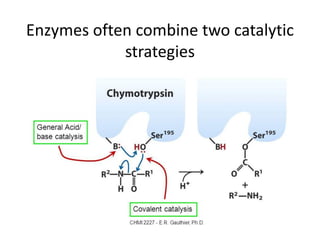
Enzymes often combine two catalytic
strategies
Mechanism of Enzyme Reaction
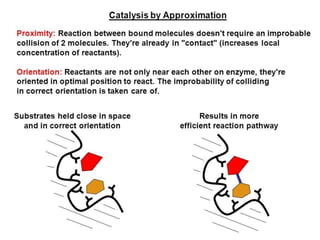
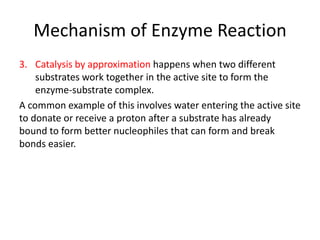
3. Catalysis by approximation happens when two different
substrates work together in the active site to form the
enzyme-substrate complex.
A common example of this involves water entering the active site
to donate or receive a proton after a substrate has already
bound to form better nucleophiles that can form and break
bonds easier.
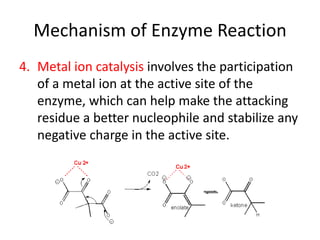
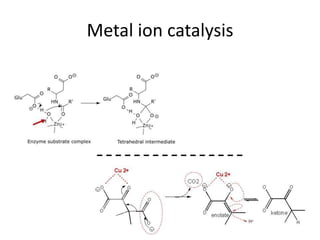
4. Metal ion catalysis involves the participation
of a metal ion at the active site of the
enzyme, which can help make the attacking
residue a better nucleophile and stabilize any
negative charge in the active site.
Mechanism of Enzyme Reaction
Metal ion catalysis
Allosteric Modulation
cooperativity
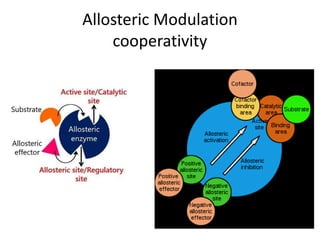
• Enzymes can be either be a single subunit or comprised
of multiple subunits. The subunits in a multisubunit
enzyme can sometimes work together in a mechanism
called “cooperativity,” in which one subunit influences
another for either positive, activity boosting effects or
negative, inhibiting effects.
• Through cooperativity between subunits, an enzyme
can either take on a T-state or an R-state. The T-state,
or “tense” state, results in less affinity for binding
substrate than regular state enzyme would.
• The R-state, or “relaxed” state, results in higher affinity
and increased substrate binding for the enzyme as a
whole.
Allosteric Modulation
cooperativity
Two-State Allosteric Model
cooperativity
• There are also two different models for the relationship between
these two states of a multisubunit enzyme.
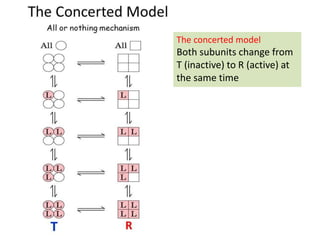
• The concerted model states that when an enzyme is in the T-state,
if one subunit changes to the R-state, then all of the other subunits
will change to the R-state at the same time, resulting in increased
binding and affinity for other effectors.
• This model is also reversible, for if all subunits are in the R-state and
an effector dissociates, then they will all go towards the T-state.
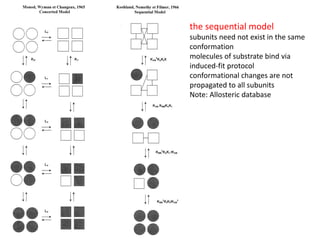
• On the other hand, the sequential model states that once one
effector binds to one of the subunits, the rest of the subunit’s
affinity for the effector increases, but they all do not necessarily
change from one state to the other. They are merely more likely to
change as well.
The concerted model
Both subunits change from
T (inactive) to R (active) at
the same time
the sequential model
subunits need not exist in the same
conformation
molecules of substrate bind via
induced-fit protocol
conformational changes are not
propagated to all subunits
Note: Allosteric database

DOC-20241221-WA0127..pdf.................

  • 1.
  • 2.
    Enzymes • Enzyme definition,chemical nature of enzyme, functions, mode of action. • Enzyme specificity, zymogen factors affecting enzyme activity.
  • 3.
    Enzymes • Every day,trillions upon trillions of chemical reactions occur in our body to make essential metabolic processes occur. • Enzymes are proteins that act upon substrate molecules and decrease the activation energy necessary for a chemical reaction to occur by stabilizing the transition state. • This stabilization speeds up reaction rates and makes them happen at physiologically significant rates. • Enzymes bind substrates at key locations in their structure called active sites. • They are typically highly specific and only bind certain substrates for certain reactions. • Without enzymes, most metabolic reactions would take much longer and would not be fast enough to sustain life.
  • 4.
    Enzyme definition • Anenzyme is a biological catalyst and is almost always a protein. • It speeds up the rate of a specific chemical reaction in the cell. • The enzyme is not destroyed during the reaction and is used over and over. • A cell contains thousands of different types of enzyme molecules, each specific to a particular chemical reaction.
  • 6.
    Chemical nature ofenzyme • The macromolecular components of almost all enzymes are composed of protein, except for a class of RNA-modifying catalysts known as ribozymes. • Ribozymes are molecules of ribonucleic acid that catalyze reactions on the phosphodiester bond of other RNAs. • Some enzymes, called apoenzymes, are inactive until they are bound to a cofactor, which activates the enzyme.
  • 7.
    Chemical nature ofenzyme • A cofactor can be either metal ions (e.g., Zn) or organic compounds that attach, either covalently or noncovalently, to the enzyme. The cofactor and apoenzyme complex is called a holoenzyme.
  • 8.
    Chemical nature ofenzyme Cofactors • Cofactors are non-proteinous substances that associate with enzymes. • A cofactor is essential for the functioning of an enzyme. • The protein part of enzymes in cofactors is apoenzyme. • An enzyme and its cofactor together constitute the holoenzyme.
  • 9.
    There are threekinds of cofactors present in enzymes: • Prosthetic groups: These are cofactors tightly bound to an enzyme at all times. FAD (flavin adenine dinucleotide) is a prosthetic group present in many enzymes. • Coenzyme: A coenzyme binds to an enzyme only during catalysis. At all other times, it is detached from the enzyme. NAD is a common coenzyme. • Metal ions: For the catalysis of certain enzymes, a metal ion is required at the active site to form coordinate bonds. Zinc is a metal ion cofactor used by a number of enzymes.
  • 10.
  • 11.
    Chemical nature ofenzyme • Enzymes are proteins comprised of amino acids linked together in one or more polypeptide chains. This sequence of amino acids in a polypeptide chain is called the primary structure. This, in turn, determines the three-dimensional structure of the enzyme, including the shape of the active site. • The secondary structure of a protein describes the localized polypeptide chain structures, e.g., α- helices or β-sheets.
  • 12.
    Chemical nature ofenzyme • The complete three-dimensional fold of a polypeptide chain into a protein subunit is known as its tertiary structure. • A protein can be composed of one (a monomer) or more subunits (e.g., a dimer). The three- dimensional arrangement of subunits is known as its quaternary structure. Subunit structure is determined by the sequence and characteristics of amino acids in the polypeptide chain.
  • 13.
    Chemical nature ofenzyme The active site • The active site is a groove or crevice on an enzyme in which a substrate binds to facilitate the catalyzed chemical reaction. • Enzymes are typically specific because the conformation of amino acids in the active site stabilizes the specific binding of the substrate. The active site generally takes up a relatively small part of the entire enzyme.
  • 14.
    There are sixmain categories of enzymes • According to the International Union of Biochemists (I U B), enzymes are divided into six functional classes and are classified based on the type of reaction in which they are used to catalyze. The six kinds of enzymes are hydrolases, oxidoreductases, lyases, transferases, ligases and isomerases.
  • 15.
    • Oxidoreductases These catalyzeoxidation and reduction reactions, e.g. pyruvate dehydrogenase, catalysing the oxidation of pyruvate to acetyl coenzyme A. • Transferases These catalyze transferring of the chemical group from one to another compound. An example is a transaminase, which transfers an amino group from one molecule to another. • Hydrolases They catalyze the hydrolysis of a bond. For example, the enzyme pepsin hydrolyzes peptide bonds in proteins.
  • 16.
    • Lyases These catalyzethe breakage of bonds without catalysis, e.g. aldolase (an enzyme in glycolysis) catalyzes the splitting of fructose-1, 6- bisphosphate to glyceraldehyde-3-phosphate and dihydroxyacetone phosphate. • Isomerases They catalyze the formation of an isomer of a compound. Example: phosphoglucomutase catalyzes the conversion of glucose-1-phosphate to glucose-6-phosphate (phosphate group is transferred from one to another position in the same compound) in glycogenolysis (glycogen is converted to glucose for energy to be released quickly). • Ligases Ligases catalyze the association of two molecules. For example, DNA ligase catalyzes the joining of two fragments of DNA by forming a phosphodiester bond.
  • 17.
    The role ofthe active site
  • 18.
    Mechanism of EnzymeReaction There are three different models of substrate binding to the active site of an enzyme: • The first model called the lock and key model, proposes that the shape and chemistry of the substrate are complementary to the shape and chemistry of the active site on the enzyme. This means when the substrate enters the active site, it fits perfectly, and the two binds together, forming the enzyme-substrate complex. • The lock-and-key model assumes that the enzyme (lock) recognizes the substrate (key) through the shape complementarity between the enzyme’s active site and the substrate.
  • 19.
  • 20.
    Mechanism of EnzymeReaction • The second model is called the induced fit model, and it hypothesizes that the enzyme and the substrate don’t initially have the precise complementary shape/chemistry or alignment, but rather, this alignment becomes induced at the active site by substrate binding. • Substrate binding to an enzyme is generally stabilized by local molecular interactions with the amino acid residues on the polypeptide chain. • The induced-fit model was first proposed by Koshland in 1958 to explain the protein conformational changes in the binding process. This model suggests that an enzyme, when binding with its substrate, optimizes the interface through physical interactions to form the final complex structure.
  • 21.
    Mechanism of EnzymeReaction the third model • In the late 1990s, the conformational-selection (population shift) model was proposed by several researchers. • The conformational-selection model suggests that the unbound protein receptor fluctuates among multiple conformational states, with their occupancy probabilities being determined by their relative free energies according to the Boltzmann distribution. • Only a subset of these states allows the binding of its partner. • The encounter with its binding partner shifts the distribution toward these states to form the final complex structure. • The main difference between the induced-fit model and the conformational-selection model is whether the holo structure preexists before forming the complex.
  • 22.
    Schematic diagrams forthe three binding models. (A) The lock-and-key model, (B) induced-fit model, and (C) conformational-selection model.
  • 23.
    Mechanism of EnzymeCatalytic Strategies • There are four common mechanisms by which most of these interactions are formed and alter the active site to create the enzyme- substrate complex: covalent catalysis, general acid-base catalysis, catalysis by approximation, and metal ion catalysis.
  • 24.
    Mechanism of EnzymeReaction 1. Covalent catalysis occurs when one or multiple amino acids in the active site transiently form a covalent bond with the substrate. This reaction usually takes the form of an intermediate through a nucleophilic attack of the catalytic residues, which helps stabilize later transition states.
  • 25.
    Mechanism of EnzymeReaction Covalent catalysis
  • 26.
    Mechanism of EnzymeReaction 2. General acid-base catalysis takes place when a molecule other than water acts as a proton donor or acceptor. Water can be one of the proton donors or acceptors in the reaction, but it cannot be the only one. This characteristic can sometimes help make catalytic residues better nucleophiles, so they will more easily attack substrate amino acids. In the active site of an enzyme, a number of amino acid side chains can act as general proton donors and acceptors.
  • 27.
    Mechanism of EnzymeReaction General acid-base catalysis S P S P E E
  • 29.
    Enzymes often combinetwo catalytic strategies
  • 30.
    Mechanism of EnzymeReaction 3. Catalysis by approximation happens when two different substrates work together in the active site to form the enzyme-substrate complex. A common example of this involves water entering the active site to donate or receive a proton after a substrate has already bound to form better nucleophiles that can form and break bonds easier.
  • 32.
    4. Metal ioncatalysis involves the participation of a metal ion at the active site of the enzyme, which can help make the attacking residue a better nucleophile and stabilize any negative charge in the active site. Mechanism of Enzyme Reaction
  • 33.
  • 34.
    Allosteric Modulation cooperativity • Enzymescan be either be a single subunit or comprised of multiple subunits. The subunits in a multisubunit enzyme can sometimes work together in a mechanism called “cooperativity,” in which one subunit influences another for either positive, activity boosting effects or negative, inhibiting effects. • Through cooperativity between subunits, an enzyme can either take on a T-state or an R-state. The T-state, or “tense” state, results in less affinity for binding substrate than regular state enzyme would. • The R-state, or “relaxed” state, results in higher affinity and increased substrate binding for the enzyme as a whole.
  • 35.
  • 36.
    Two-State Allosteric Model cooperativity •There are also two different models for the relationship between these two states of a multisubunit enzyme. • The concerted model states that when an enzyme is in the T-state, if one subunit changes to the R-state, then all of the other subunits will change to the R-state at the same time, resulting in increased binding and affinity for other effectors. • This model is also reversible, for if all subunits are in the R-state and an effector dissociates, then they will all go towards the T-state. • On the other hand, the sequential model states that once one effector binds to one of the subunits, the rest of the subunit’s affinity for the effector increases, but they all do not necessarily change from one state to the other. They are merely more likely to change as well.
  • 37.
    The concerted model Bothsubunits change from T (inactive) to R (active) at the same time
  • 38.
    the sequential model subunitsneed not exist in the same conformation molecules of substrate bind via induced-fit protocol conformational changes are not propagated to all subunits Note: Allosteric database