Presented by:
Jasmine Juliet
Biochemistry,
Agricultural College&
Research Institute, Madurai.
Enzyme - Introduction
 Enzymes are biocatalysts present in cells that speed up
biochemical reactions without getting itself destroyed in the
reaction.
 Enzymes catalyse a reaction by reducing the activation energy
needed for the reaction to occur.
 However, enzymes need to be tightly regulated to ensure that levels
of the product do not rise to undesired levels.
 This is accomplished by enzyme inhibition.
Enzyme - Inhibition
 Enzyme inhibitors are molecules that bind to enzymes and
decrease their activity.
 Inhibitor binding is either reversible or irreversible.
I. Irreversible inhibitors usually react with the enzyme and change
it chemically.
 The enzyme becomes permanently inactive.
 These inhibitors modify key amino acid residues needed for
enzymatic activity.
Enzyme - Inhibition
II. Reversible inhibitors bind non-covalently with the enzyme.
 The inhibition can be reversed on removal of the inhibitor from the
enzyme.
 Most biological inhibitions are reversible and are involved in the
regulation of metabolism.
 Not all molecules that bind to enzymes are inhibitors; enzyme
activators bind to enzymes and increase their enzymatic activity.
Enzyme - Introduction
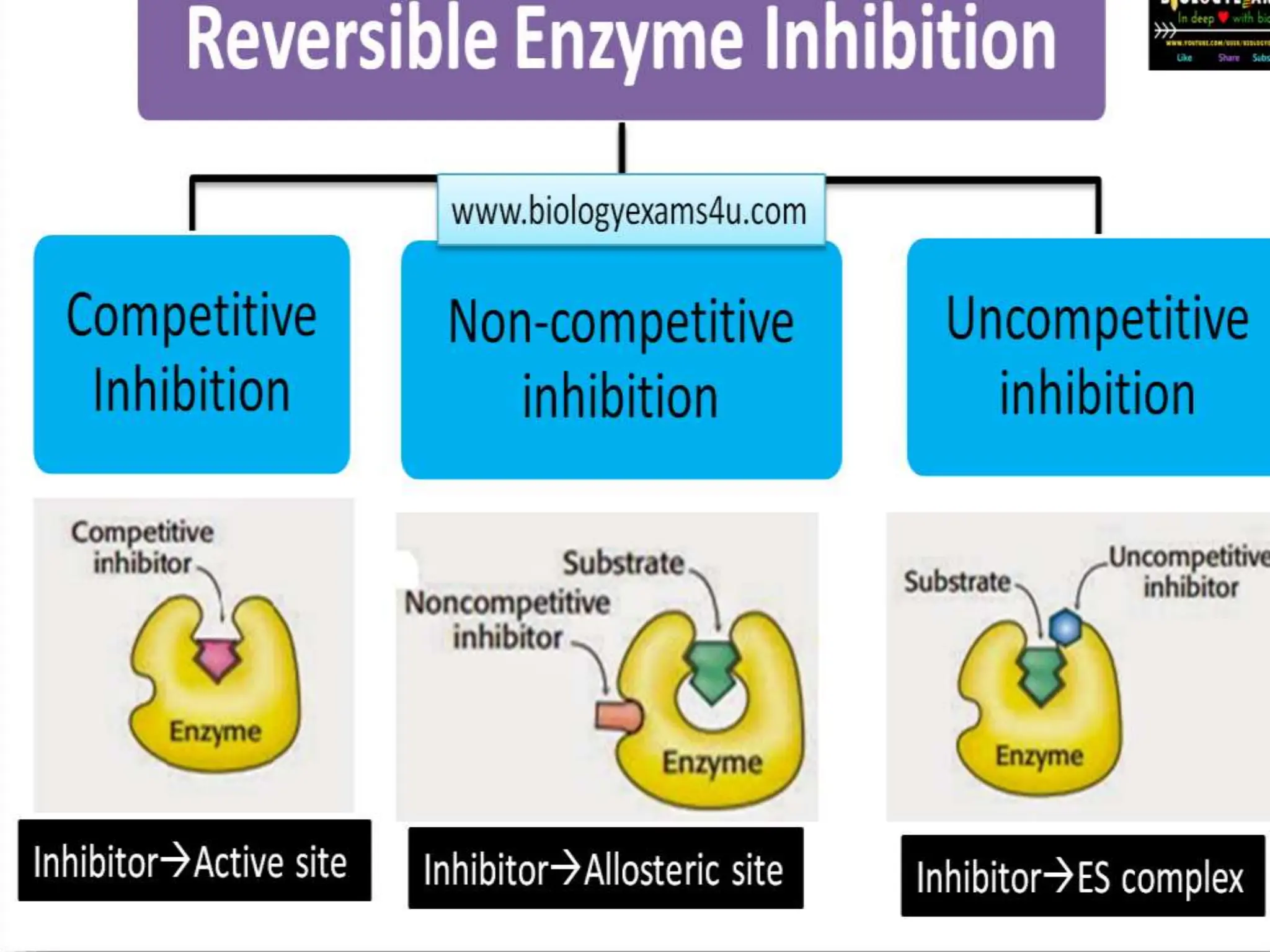
There are three different reversible inhibitions:
 Competitive inhibition
 Non competitive inhibition
 Uncompetitive inhibition
Enzyme – Competitive Inhibition
 In competitive inhibition, the inhibitor (I) competes for the
active site and binds to the active site.
 Thus, it prevents the substrate from binding to the active site.
 Binding of the inhibitor inhibits the reaction and does not produce
any product.
 E + I → EI (EI → No product formation)
 Structural analogs of the substrate act as competitive inhibitors.
Enzyme – Competitive Inhibition
 Eg: (i) Malonate is the competitive inhibitor for the enzyme
Succinate dehydrogenase and
(ii) Allopurinol is the competitive inhibitor for the enzyme
Xanthine oxidase.
 In competitive inhibition, Vmax for the enzyme is not affected
since once there is formation of ES complex the reaction proceeds
normally but, Km increases.
 Increasing substrate concentration overcomes competitive
inhibition.
Enzyme – Non-competitive Inhibition
 Inhibitor binds to the enzyme at a site other than the active site and
cause inhibition.
 The inhibitor may bind to a free enzyme forming EI complex or to
the ES complex to form ESI complex.
E + I → EI (or) ES + I → ESI
 Binding of the inhibitor to the enzyme changes the structure and
shape of the enzyme.
 This affects the rate of reaction of the enzyme.
 Vmax for the enzyme is lowered; but Km remains unaltered.
Enzyme - Uncompetitive Inhibition
 The inhibitor binds to the enzyme at a site other than the
active site.
 The inhibitor can bind only to the ES complex.
ES + I → ESI
 Uncompetitive inhibition works best when substrate
concentration is high.
 Both Vmax and Km for the enzyme are lowered.
Enzyme - Introduction
Allosteric Enzymes
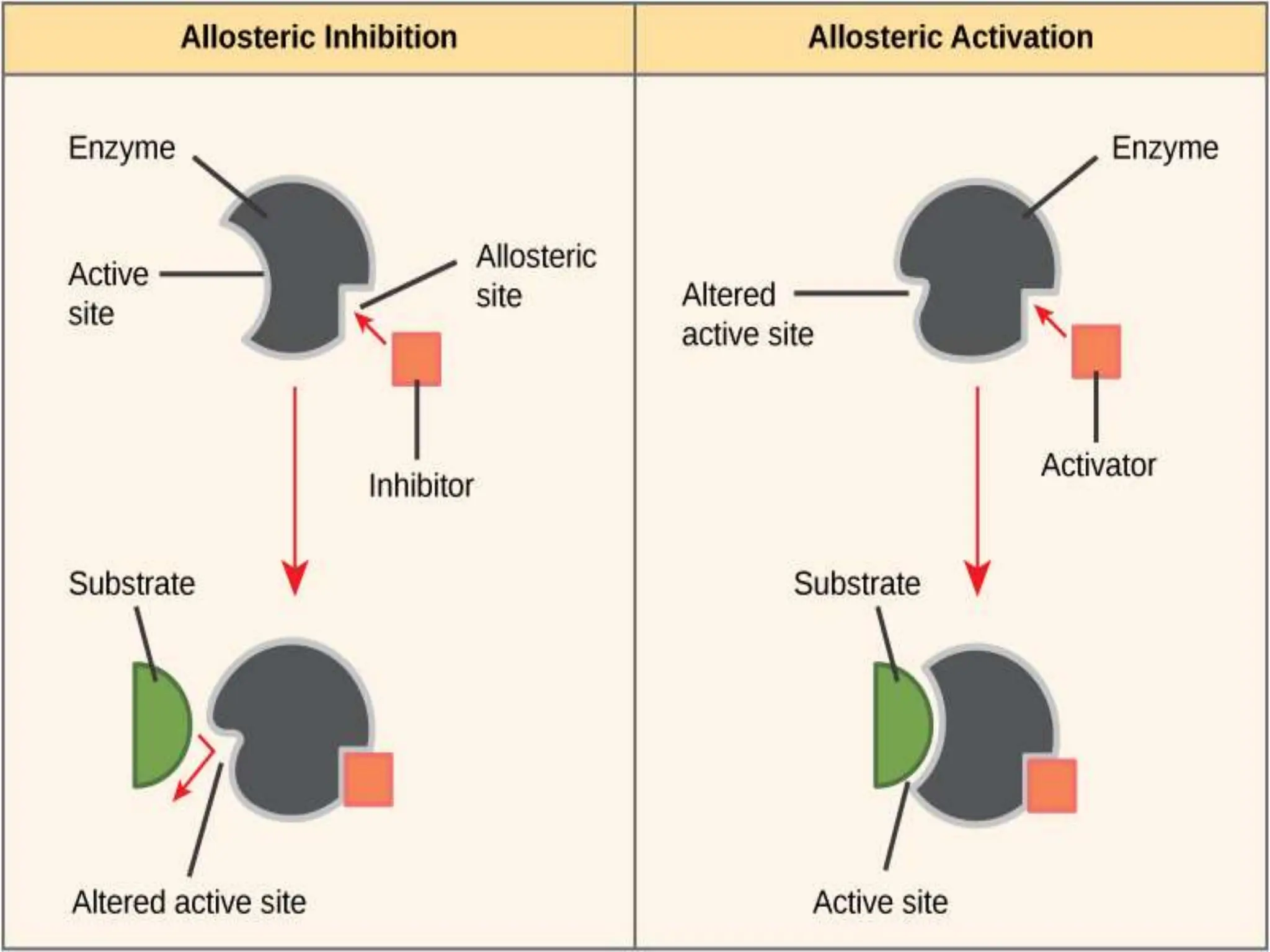
 Some enzymes are reversibly inhibited or activated by the
presence of metabolites that are not their substrate or product.
 The enzymes controlled in this way usually have additional
binding site other than the active site.
 The binding of inhibitor or activators at distant site (allosteric
site) from active site often bring about conformational
changes in the enzyme molecule which may decrease or
increase its catalytic activity.
 Thus, allosteric enzymes are usually composed of multiple binding
sites and often shows sigmoidal graph of initial rate versus [S] and
therefore do not obey MichaelisMenten kinetics.
 The kinetic properties of allosteric enzymes are often explained in terms
of a conformational change between a low-activity, low-affinity “tense”
or T state and a high-activity, high-affinity “relaxed” or R state.
 These structurally distinct enzyme forms have been shown to exist in
several known allosteric enzymes.
 Aspartate transcarbamoylase (ATCase) is a typical example of allosteric
enzyme.
 This enzyme catalyzes the first step in the biosynthesis of pyrimidines, the
condensation of aspartate and carbamoyl phosphate to form N-carbamoyl
aspartate.
 This pathway will ultimately yield pyrimidine nucleotide such as cytidine
triphosphate (CTP).
 ATCase is activated by ATP and inhibited by CTP.
 ATCase contains a regulatory subunit to which the effector molecules bind
and a catalytic subunit which contains the active site for substrate binding.
 Binding of CTP to the regulatory subunit causes the enzyme to
change its conformation and shift to the inactive T state, thereby
inhibiting the biosynthesis of pyrimidines.
 Whereas, binding of ATP favours active R state enhancing the
biosynthesis of pyrimidines.
 Since CTP, an end product of pyrimidine biosynthetic pathway is
inhibiting the pathway, this kind of regulation is also called as
feedback inhibition.
Enzyme inhibition in brief and their examples

Enzyme inhibition in brief and their examples

  • 1.
    Presented by: Jasmine Juliet Biochemistry, AgriculturalCollege& Research Institute, Madurai.
  • 2.
    Enzyme - Introduction Enzymes are biocatalysts present in cells that speed up biochemical reactions without getting itself destroyed in the reaction.  Enzymes catalyse a reaction by reducing the activation energy needed for the reaction to occur.  However, enzymes need to be tightly regulated to ensure that levels of the product do not rise to undesired levels.  This is accomplished by enzyme inhibition.
  • 4.
    Enzyme - Inhibition Enzyme inhibitors are molecules that bind to enzymes and decrease their activity.  Inhibitor binding is either reversible or irreversible. I. Irreversible inhibitors usually react with the enzyme and change it chemically.  The enzyme becomes permanently inactive.  These inhibitors modify key amino acid residues needed for enzymatic activity.
  • 5.
    Enzyme - Inhibition II.Reversible inhibitors bind non-covalently with the enzyme.  The inhibition can be reversed on removal of the inhibitor from the enzyme.  Most biological inhibitions are reversible and are involved in the regulation of metabolism.  Not all molecules that bind to enzymes are inhibitors; enzyme activators bind to enzymes and increase their enzymatic activity.
  • 6.
    Enzyme - Introduction Thereare three different reversible inhibitions:  Competitive inhibition  Non competitive inhibition  Uncompetitive inhibition
  • 9.
    Enzyme – CompetitiveInhibition  In competitive inhibition, the inhibitor (I) competes for the active site and binds to the active site.  Thus, it prevents the substrate from binding to the active site.  Binding of the inhibitor inhibits the reaction and does not produce any product.  E + I → EI (EI → No product formation)  Structural analogs of the substrate act as competitive inhibitors.
  • 10.
    Enzyme – CompetitiveInhibition  Eg: (i) Malonate is the competitive inhibitor for the enzyme Succinate dehydrogenase and (ii) Allopurinol is the competitive inhibitor for the enzyme Xanthine oxidase.  In competitive inhibition, Vmax for the enzyme is not affected since once there is formation of ES complex the reaction proceeds normally but, Km increases.  Increasing substrate concentration overcomes competitive inhibition.
  • 12.
    Enzyme – Non-competitiveInhibition  Inhibitor binds to the enzyme at a site other than the active site and cause inhibition.  The inhibitor may bind to a free enzyme forming EI complex or to the ES complex to form ESI complex. E + I → EI (or) ES + I → ESI  Binding of the inhibitor to the enzyme changes the structure and shape of the enzyme.  This affects the rate of reaction of the enzyme.  Vmax for the enzyme is lowered; but Km remains unaltered.
  • 14.
    Enzyme - UncompetitiveInhibition  The inhibitor binds to the enzyme at a site other than the active site.  The inhibitor can bind only to the ES complex. ES + I → ESI  Uncompetitive inhibition works best when substrate concentration is high.  Both Vmax and Km for the enzyme are lowered.
  • 17.
  • 20.
    Allosteric Enzymes  Someenzymes are reversibly inhibited or activated by the presence of metabolites that are not their substrate or product.  The enzymes controlled in this way usually have additional binding site other than the active site.  The binding of inhibitor or activators at distant site (allosteric site) from active site often bring about conformational changes in the enzyme molecule which may decrease or increase its catalytic activity.
  • 21.
     Thus, allostericenzymes are usually composed of multiple binding sites and often shows sigmoidal graph of initial rate versus [S] and therefore do not obey MichaelisMenten kinetics.  The kinetic properties of allosteric enzymes are often explained in terms of a conformational change between a low-activity, low-affinity “tense” or T state and a high-activity, high-affinity “relaxed” or R state.  These structurally distinct enzyme forms have been shown to exist in several known allosteric enzymes.
  • 22.
     Aspartate transcarbamoylase(ATCase) is a typical example of allosteric enzyme.  This enzyme catalyzes the first step in the biosynthesis of pyrimidines, the condensation of aspartate and carbamoyl phosphate to form N-carbamoyl aspartate.  This pathway will ultimately yield pyrimidine nucleotide such as cytidine triphosphate (CTP).  ATCase is activated by ATP and inhibited by CTP.  ATCase contains a regulatory subunit to which the effector molecules bind and a catalytic subunit which contains the active site for substrate binding.
  • 23.
     Binding ofCTP to the regulatory subunit causes the enzyme to change its conformation and shift to the inactive T state, thereby inhibiting the biosynthesis of pyrimidines.  Whereas, binding of ATP favours active R state enhancing the biosynthesis of pyrimidines.  Since CTP, an end product of pyrimidine biosynthetic pathway is inhibiting the pathway, this kind of regulation is also called as feedback inhibition.