
Biological Drug Targets
Receptors and it's Types
Presented By: Varsha Jindaniya
Receptors can be subdivided into
four main classes:
1. Introduction of Biological Drug Targets
2. Receptors
3. Types of Receptor
Introduction of Biological Drug Targets
Biological targets are most commonly proteins such as enzymes, ion channels,
and receptors.
1. A biological target is a living organism to which some other entity like an
endogenous ligand or a drug is directly binds, resulting in a change in its
behaviour or function.
Receptors:-
• Receptors are macromolecules composed of lipoprotein.
• They are located on the cell membrane or inside the cell.
• Receptors are binds with drugs and forms the Drug- Receptors complex
• The magnitude of the response is proportional to the number of the drug
receptors complexes.
• Drug(D) + Receptor (R) forms a complex and shows the therapeutic action.
Types of Receptors:-
1. G- Protein coupled Receptors eg:- Beta adrenergic receptors , epinephrine,
prostaglandin E2 receptors etc.
2. Ligand gated Ion channel Receptors eg:- Nicotinic cholinergic, GABA-A ,5-
HT3 (Hydroxytryptamine) receptor.
3. Enzymes linked Receptors eg:- Tyrosine, insuline ,etc
4. Nuclear Receptors eg:- Estrogen, glucocorticoid, thyroid hormone etc
1. G- Protein coupled Receptors
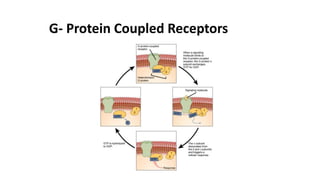
1. G-protein-coupled receptors bind a ligand and activate a membrane protein
called a G-protein.
2. The activated G-protein then interacts with either an ion channel or an
enzyme in the membrane.
3. Before the ligand binds, the inactive G-protein can bind to a site on a specific
recepto
4. G-protein binds to the receptor, changes shape, and becomes active and
divided into three sub uits alpha , beta and gama sub units.
G- Protein Coupled Receptors
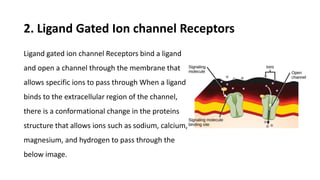
2. Ligand Gated Ion channel Receptors
Ligand gated ion channel Receptors bind a ligand
and open a channel through the membrane that
allows specific ions to pass through When a ligand
binds to the extracellular region of the channel,
there is a conformational change in the proteins
structure that allows ions such as sodium, calcium,
magnesium, and hydrogen to pass through the
below image.
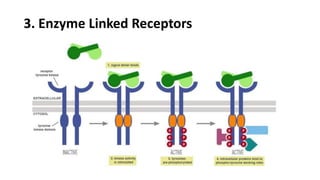
3. Enzyme Linked Receptors
Enzyme-linked receptors are cell-surface receptors with intracellular domains
that are associated with an enzyme. When a ligand binds to the extracellular
domain, a signal is transferred through the membrane, activating the enzyme.
Activation of the enzyme sets off a chain of events within the cell that
eventually leads to a response.
3. Enzyme Linked Receptors
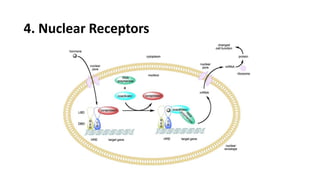
4. Nuclear Receptors
Nuclear receptors are a class of proteins found within cells that are responsible
for sensing steroid and thyroid hormones and certain other molecules.
1. Nuclear receptors have the ability to directly bind to DNA and regulate the
expression of genes.
2. Nuclear receptors are activated by lipid-soluble signals (e.g., steroid
hormones) that cross the plasma membrane.
3. Once activated, most function as transcription factors to control gene
expression for numerous biological processes.
4. Nuclear Receptors regulate gene therapy.
4. Nuclear Receptors
Thank You

Biological Drug Targets.pptx

  • 1.
    Biological Drug Targets Receptorsand it's Types Presented By: Varsha Jindaniya
  • 2.
    Receptors can besubdivided into four main classes: 1. Introduction of Biological Drug Targets 2. Receptors 3. Types of Receptor
  • 3.
    Introduction of BiologicalDrug Targets Biological targets are most commonly proteins such as enzymes, ion channels, and receptors. 1. A biological target is a living organism to which some other entity like an endogenous ligand or a drug is directly binds, resulting in a change in its behaviour or function.
  • 4.
    Receptors:- • Receptors aremacromolecules composed of lipoprotein. • They are located on the cell membrane or inside the cell. • Receptors are binds with drugs and forms the Drug- Receptors complex • The magnitude of the response is proportional to the number of the drug receptors complexes. • Drug(D) + Receptor (R) forms a complex and shows the therapeutic action.
  • 5.
    Types of Receptors:- 1.G- Protein coupled Receptors eg:- Beta adrenergic receptors , epinephrine, prostaglandin E2 receptors etc. 2. Ligand gated Ion channel Receptors eg:- Nicotinic cholinergic, GABA-A ,5- HT3 (Hydroxytryptamine) receptor. 3. Enzymes linked Receptors eg:- Tyrosine, insuline ,etc 4. Nuclear Receptors eg:- Estrogen, glucocorticoid, thyroid hormone etc
  • 6.
    1. G- Proteincoupled Receptors 1. G-protein-coupled receptors bind a ligand and activate a membrane protein called a G-protein. 2. The activated G-protein then interacts with either an ion channel or an enzyme in the membrane. 3. Before the ligand binds, the inactive G-protein can bind to a site on a specific recepto 4. G-protein binds to the receptor, changes shape, and becomes active and divided into three sub uits alpha , beta and gama sub units.
  • 7.
  • 8.
    2. Ligand GatedIon channel Receptors Ligand gated ion channel Receptors bind a ligand and open a channel through the membrane that allows specific ions to pass through When a ligand binds to the extracellular region of the channel, there is a conformational change in the proteins structure that allows ions such as sodium, calcium, magnesium, and hydrogen to pass through the below image.
  • 9.
    3. Enzyme LinkedReceptors Enzyme-linked receptors are cell-surface receptors with intracellular domains that are associated with an enzyme. When a ligand binds to the extracellular domain, a signal is transferred through the membrane, activating the enzyme. Activation of the enzyme sets off a chain of events within the cell that eventually leads to a response.
  • 10.
  • 11.
    4. Nuclear Receptors Nuclearreceptors are a class of proteins found within cells that are responsible for sensing steroid and thyroid hormones and certain other molecules. 1. Nuclear receptors have the ability to directly bind to DNA and regulate the expression of genes. 2. Nuclear receptors are activated by lipid-soluble signals (e.g., steroid hormones) that cross the plasma membrane. 3. Once activated, most function as transcription factors to control gene expression for numerous biological processes. 4. Nuclear Receptors regulate gene therapy.
  • 12.
  • 13.