Enzyme Inhibition
Prof. (Dr.) V.P. Acharya
All things are difficult before they
are easy.
Thomas Fuller
Many different kinds of molecules inhibit
enzymes and act in a variety of ways
Enzyme inhibition
Competitive
Non-competitive
Reversible Irreversible
Uncompetitive
Suicide
Allosteric
Feedback
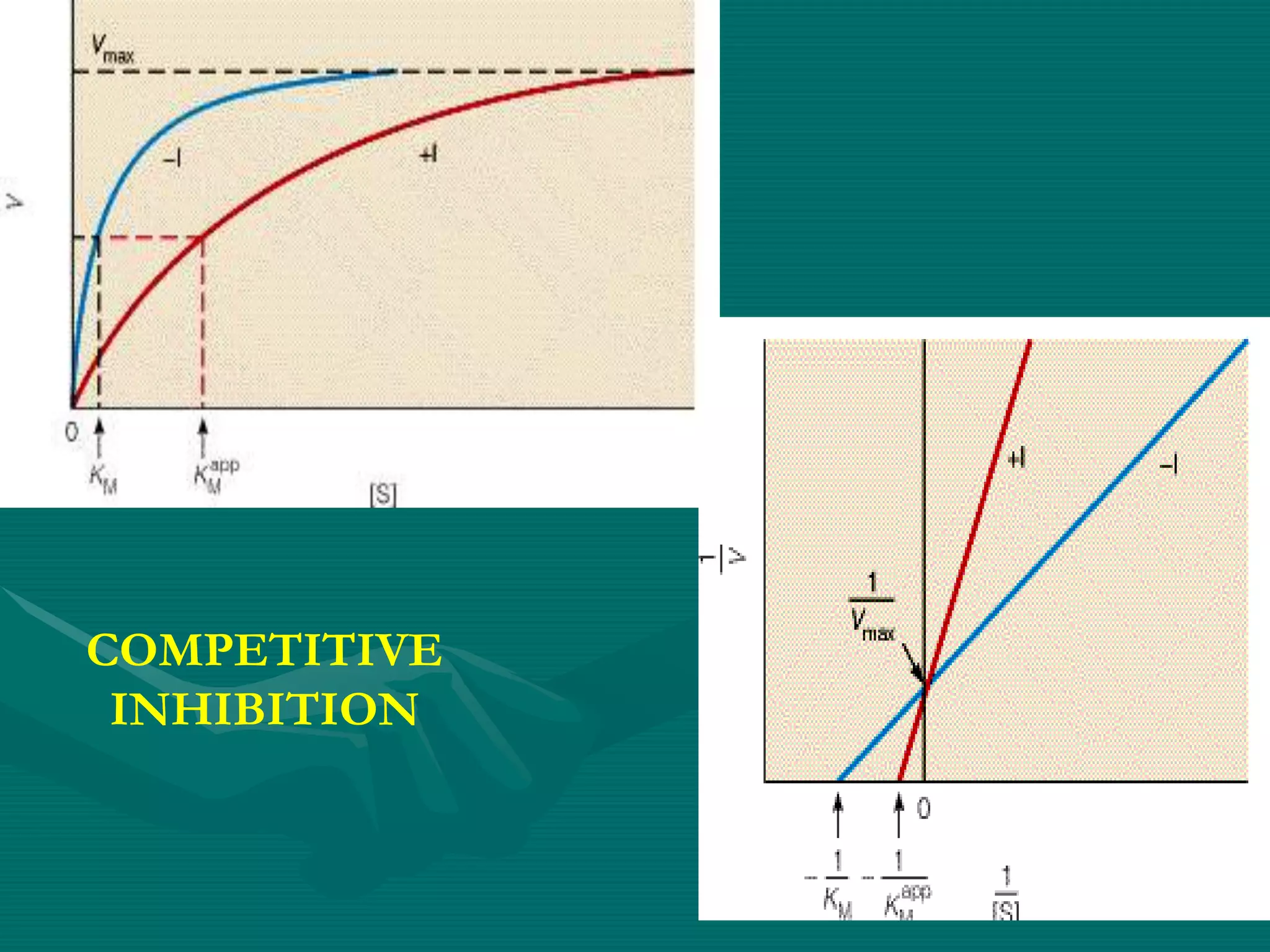
Competitive inhibition
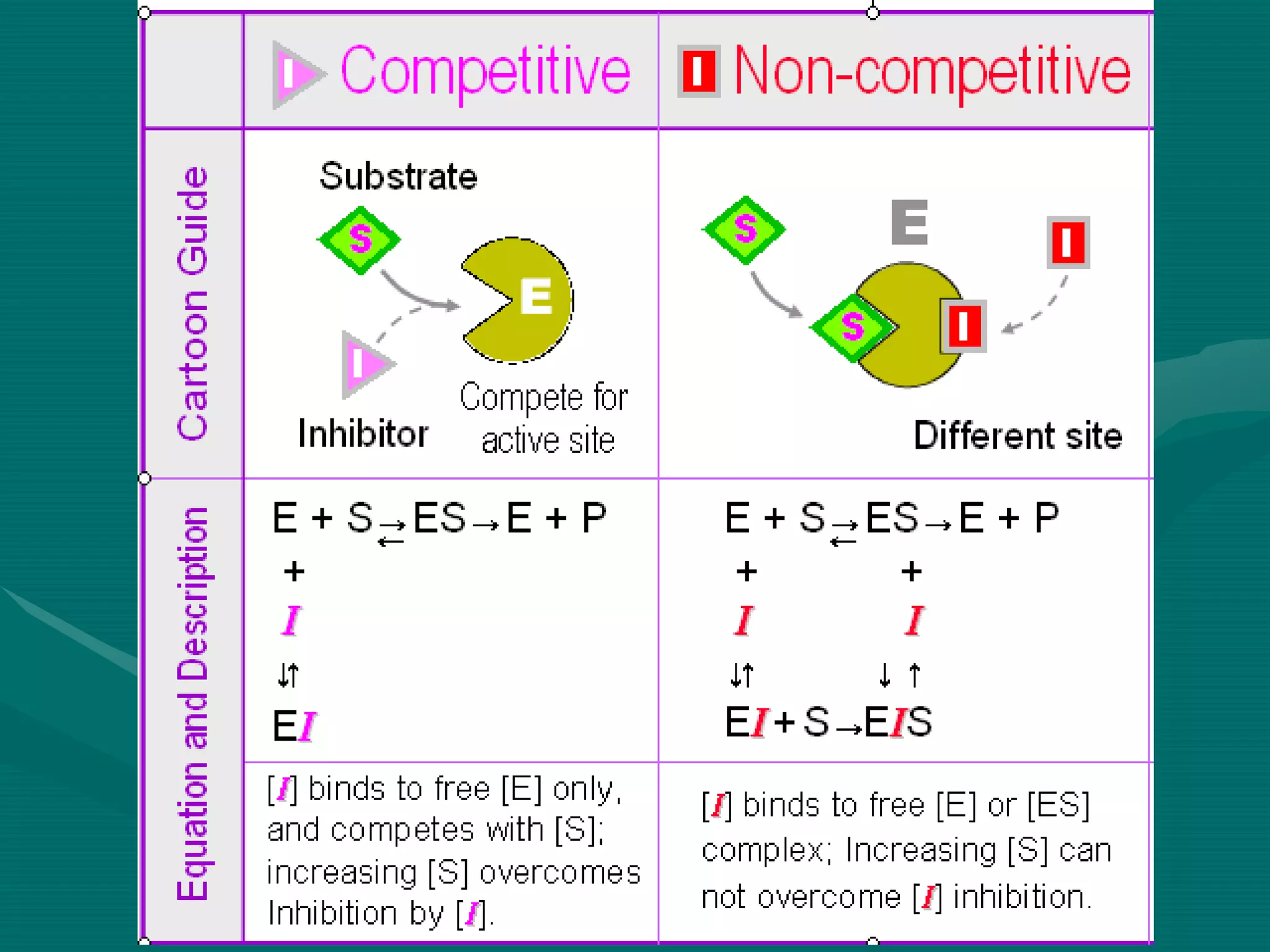
• Inhibitor competes with the substrate for the active site
• Inhibitor is substrate analogue
• Usually reversible
• ↑ [S] abolishes inhibition
• ↓ velocity of reaction
• ↑ Km
• Vmax unchanged
COMPETITIVE
INHIBITION
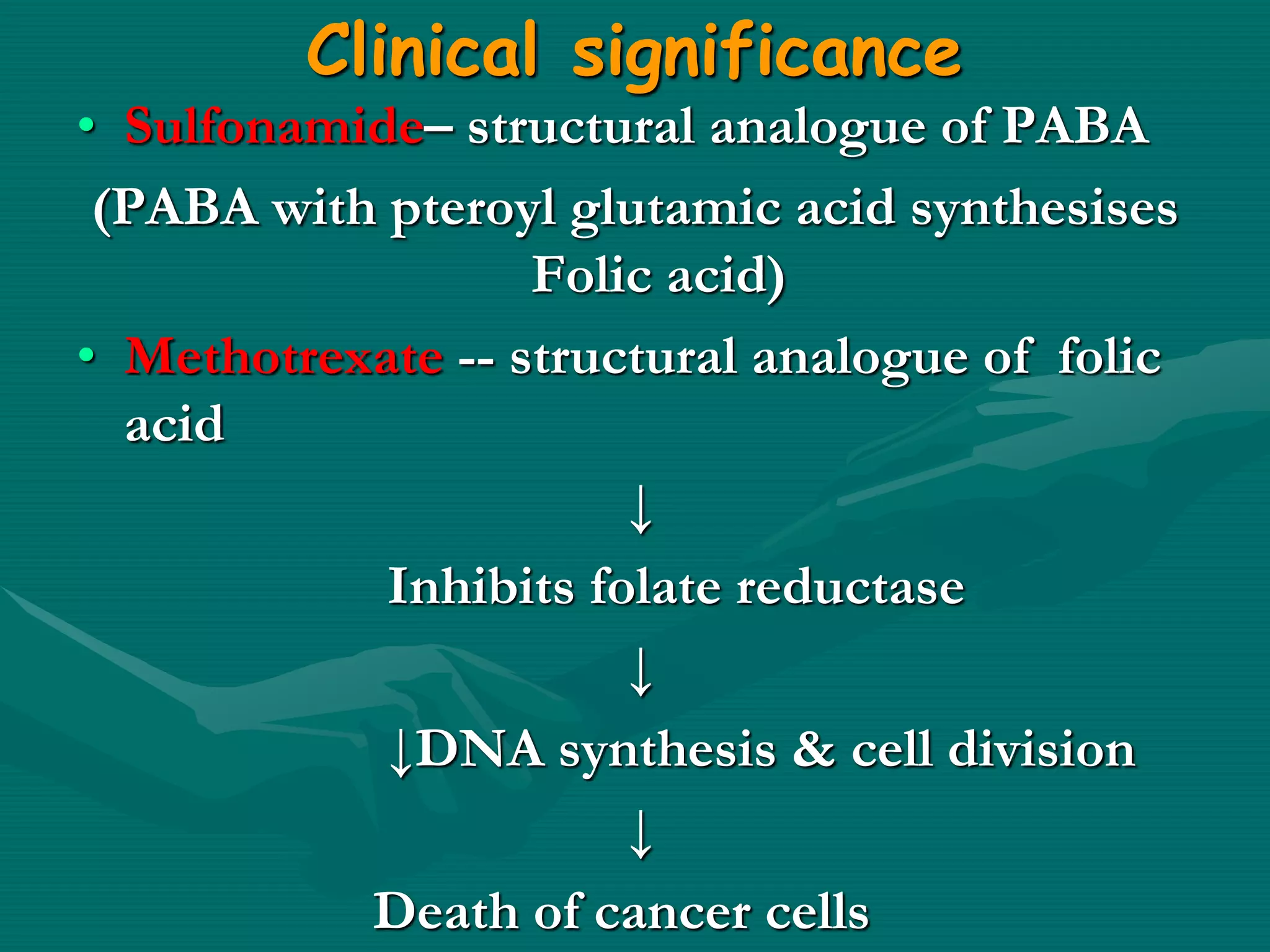
Clinical significance
• Sulfonamide– structural analogue of PABA
(PABA with pteroyl glutamic acid synthesises
Folic acid)
• Methotrexate -- structural analogue of folic
acid
↓
Inhibits folate reductase
↓
↓DNA synthesis & cell division
↓
Death of cancer cells
• INH– Similar structure to pyridoxal
↓
Pyridoxal deficiency
↓
Peripheral neuropathy
• Methanol↔ Ethanol
• Allopurinol↔ Xanthine oxidase
• Dicoumarol ↔ Vit. K epoxide reductase
↓
Act as anticoagulant
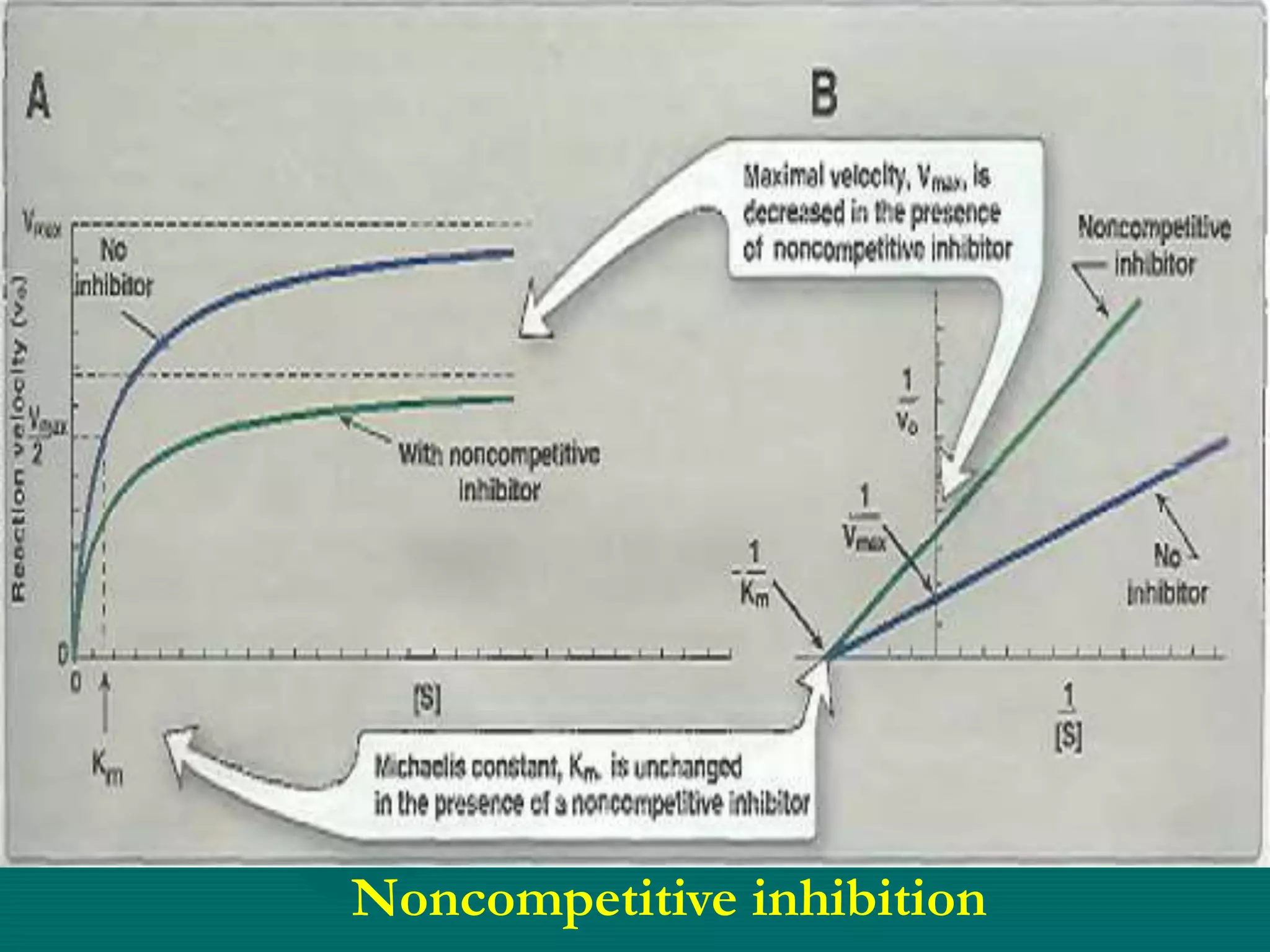
Non-competitive inhibition
• No competition between substrate and
inhibitor
• Different binding sites
• No structural similarities
• ↑ [S] doesn’t resolve the inhibition
• Usually irreversible
• May be reversible when inhibitor is
removed
• Km value unchanged
• Vmax reduces
Noncompetitive inhibition
Clinical significance
• Cyanide inhibits cytochrome oxidase
• F inhibits enolase- removes Mn & Mg
• Heavy metals react with –SH gr. Of BAL-
hence BAL is used in heavy metal poisoning
Toxicological importance
• Most of the poisons- Irreversible NC
inhibitors- iodoacetate, heavy metal poisons
Reversible non-competitive inhibition
Inhibition is reversible if inhibitor is removed
Ex:
Ascaris and soybean are trypsin inhibitors
Ab prepared against any enzyme
precipitates it
Competitive Vs Non-competitive
inhibition
Competitive
inhibition
Non-competitive
inhibition
Act on Active site May/may not be
Str of inhibitor Substrate analogue Not an analogue
Reversibility Reversible Mostly irreversible
↑ Substrate Inhibition relieved No effect
Km ↑ No change
Vmax Unchanged ↓
Significance Drug action Toxicological
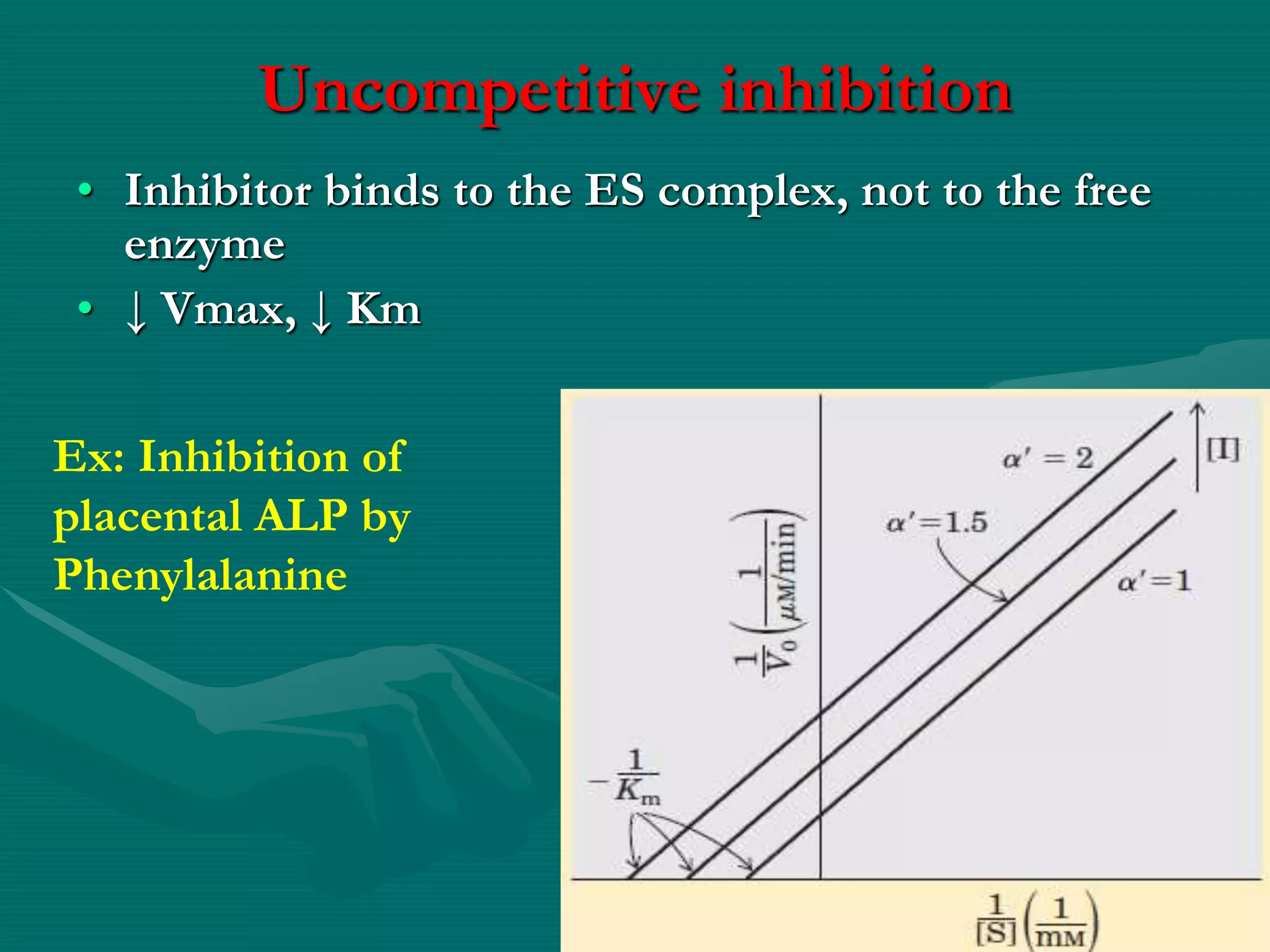
Uncompetitive inhibition
• Inhibitor binds to the ES complex, not to the free
enzyme
• ↓ Vmax, ↓ Km
Ex: Inhibition of
placental ALP by
Phenylalanine
Suicide inhibition
• A substrate analogue binds to the enzyme
↓
First few steps of the pathway are catalyzed
↓
New product irreversibly binds to the enzyme
↓
Enzyme inhibited
• Irreversible reaction
Ex:
Allopurinol Xanthine oxidase Alloxanthine
• Difluoromethyl ornithine (DFMO) inhibits ornithine
decarboxylase in Trypanosoma
• Purine and Pyrimidine analogues in cancer
chemotherapy
• Aspirin inhibits COX enzyme
(-)
not failed. I've just found 10,000 ways that won't w
Thomas A. Edison
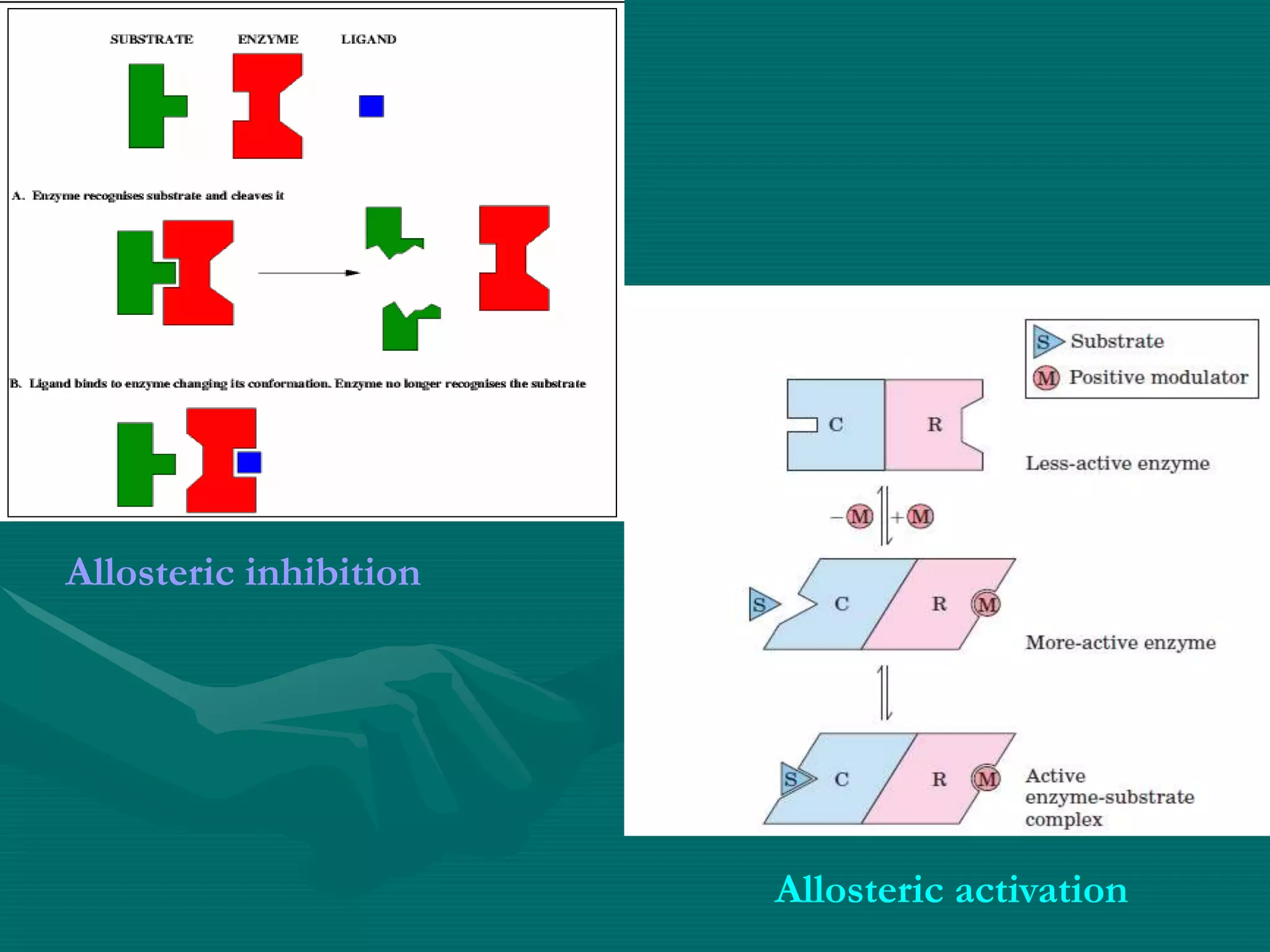
Allosteric inhibition
• Allos= Different; Steric = site
• Different sites for substrate and modifier binding
• Effectors or modifiers bind covalently
• Most of the hormone action
• Mostly multimeric enzymes; hence co-operative
binding
• Binding of modifier– changes configuration of
active site– release the substrate
• Catalytic and allosteric sites may not lie closely
• Inhibitor is not a substrate analogue
• Partially reversible; excess substrate
may reverse the reaction
• ↑ Km
• ↓Vmax
• Effect of modifier is maximum when
[s]≈ Km
Allosteric inhibition
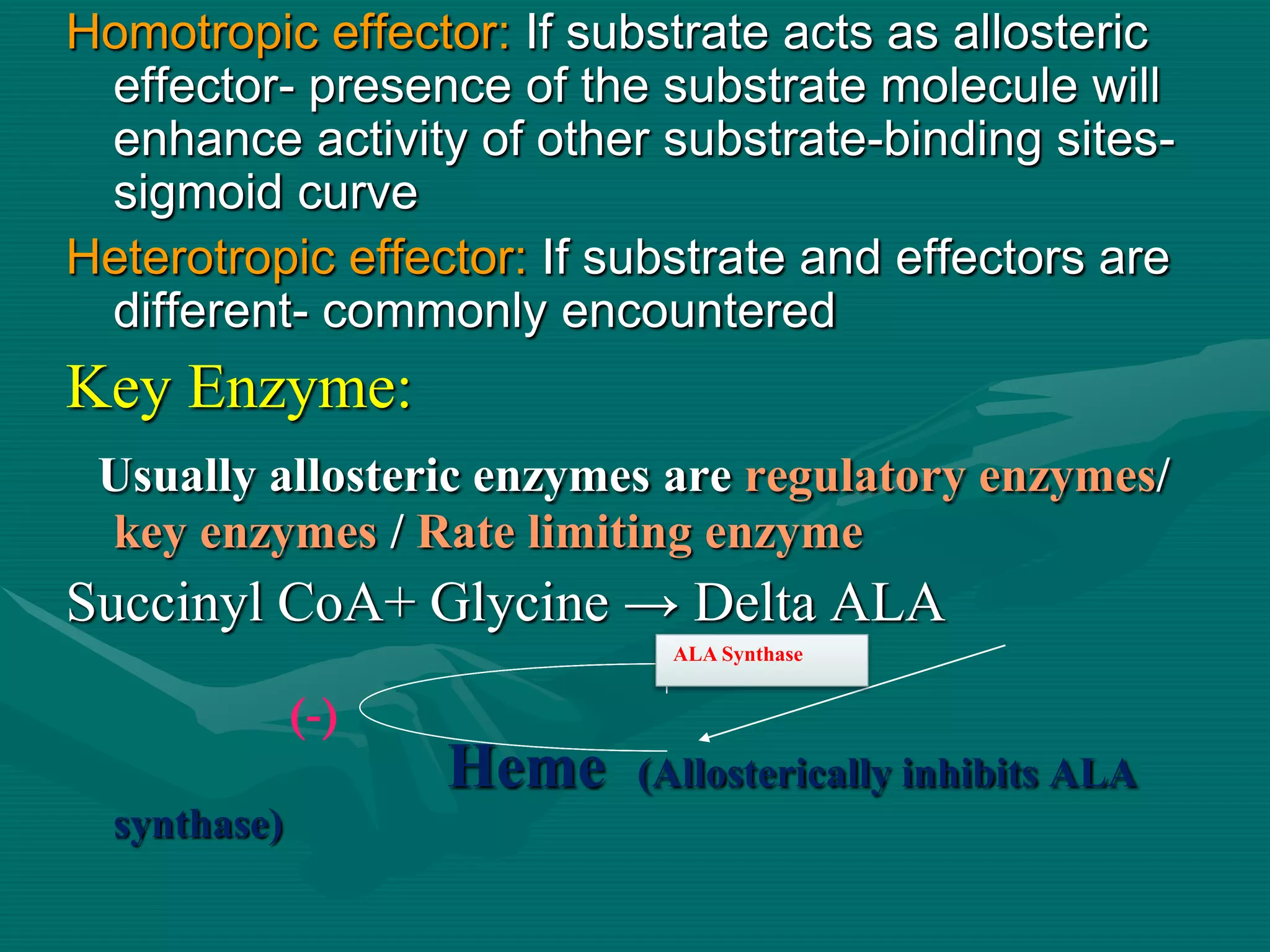
Allosteric activation
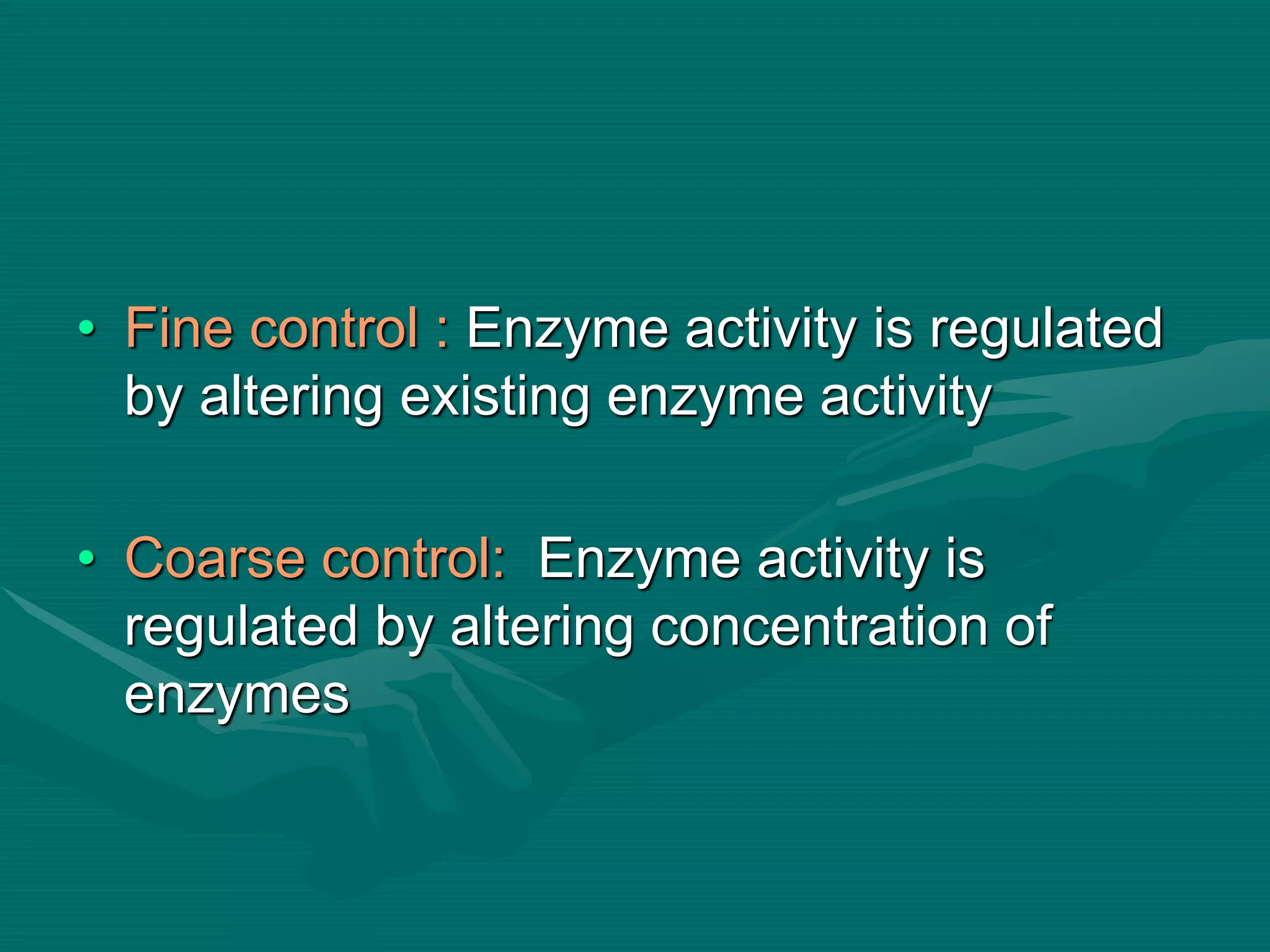
Homotropic effector: If substrate acts as allosteric
effector- presence of the substrate molecule will
enhance activity of other substrate-binding sites-
sigmoid curve
Heterotropic effector: If substrate and effectors are
different- commonly encountered
Key Enzyme:
Usually allosteric enzymes are regulatory enzymes/
key enzymes / Rate limiting enzyme
Succinyl CoA+ Glycine → Delta ALA
Heme (Allosterically inhibits ALA
synthase)
(-)
ALA Synthase
• Fine control : Enzyme activity is regulated
by altering existing enzyme activity
• Coarse control: Enzyme activity is
regulated by altering concentration of
enzymes
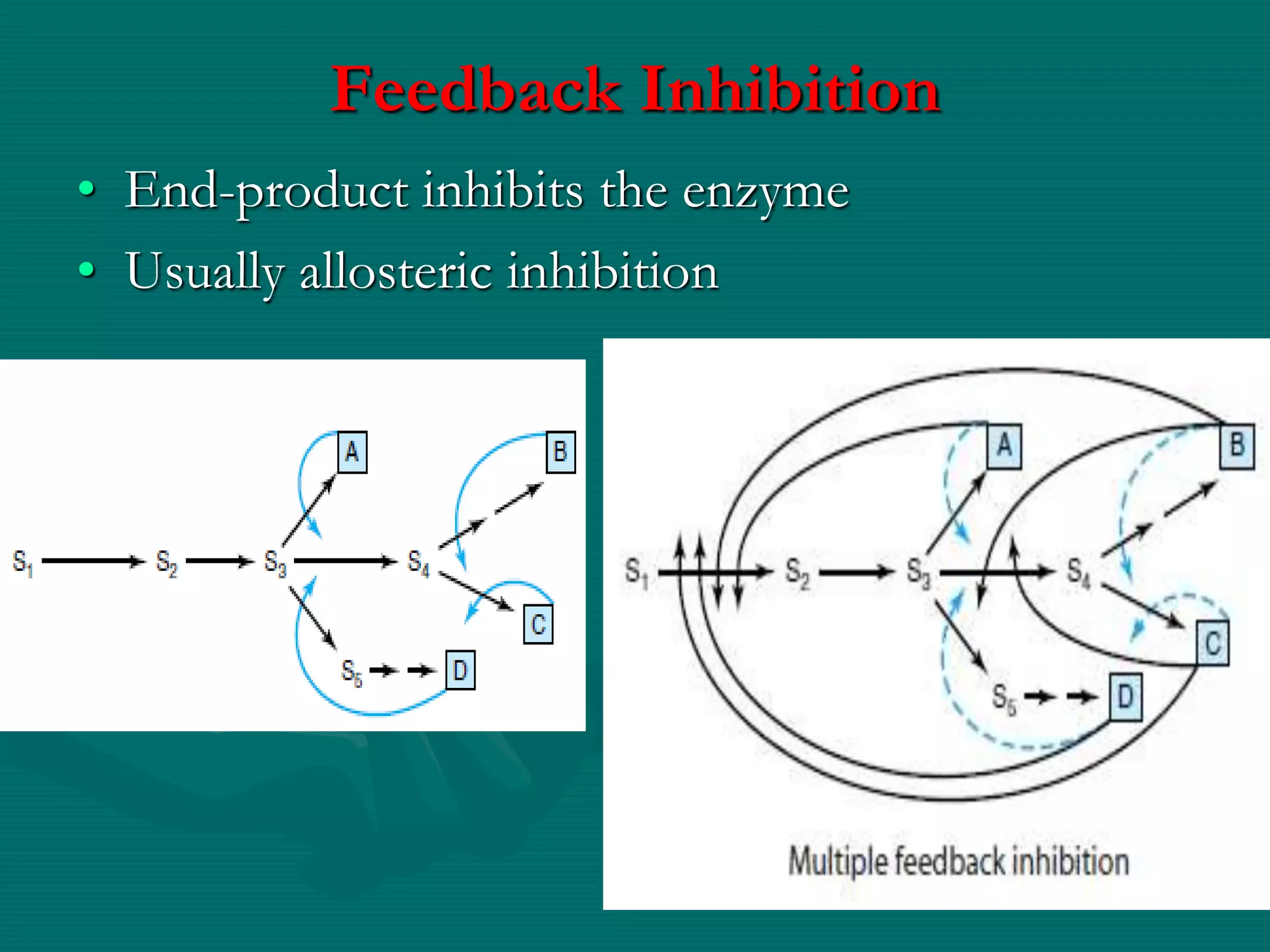
Feedback Inhibition
• End-product inhibits the enzyme
• Usually allosteric inhibition
Covalent modification
By addition or removal of a group to the enzyme
protein by covalent bond
Ex: Zymogen activation
Phosphorylation & dephosphorylation
Methylation
Uridylation
Adenylation & deadenylation
Induction
Inducer
↓
Relieve repression at the operator site
↓
Biosynthesis of enzyme starts
Constitutive enzyme– Independent of
inducer
Ex: Lac operon
Glucokinase induced by glucose
Repression
• Acts at molecular level, on genes
• Effect is noticed after a lag period of hours
and days
• ↓ no. of enzyme molecules
Ex: ALA synthase is regulated by heme by
repression
Genetic Engineering & Modified Enzyme
• Hybrid enzymes/ Chimeric enzymes/Fusion
proteins: Fusion of 2 or more enzymes having
desired properties
• Abenzymes / Catmab: Enzymes+ monoclonal
antibodies
Treatment for autoimmune diseases, HIV
Non-protein enzymes
• Ribonuclease P (1983)
 Found to have true enzyme activity
 Obeyed M-M equation
Name the other ribozymes??
Walking with a friend in the dark is better than
walking alone in the light.
Helen Keller
5 enzyme inhibition

5 enzyme inhibition

  • 1.
  • 2.
    All things aredifficult before they are easy. Thomas Fuller
  • 4.
    Many different kindsof molecules inhibit enzymes and act in a variety of ways Enzyme inhibition Competitive Non-competitive Reversible Irreversible Uncompetitive Suicide Allosteric Feedback
  • 5.
    Competitive inhibition • Inhibitorcompetes with the substrate for the active site • Inhibitor is substrate analogue • Usually reversible • ↑ [S] abolishes inhibition • ↓ velocity of reaction • ↑ Km • Vmax unchanged
  • 6.
  • 7.
    Clinical significance • Sulfonamide–structural analogue of PABA (PABA with pteroyl glutamic acid synthesises Folic acid) • Methotrexate -- structural analogue of folic acid ↓ Inhibits folate reductase ↓ ↓DNA synthesis & cell division ↓ Death of cancer cells
  • 8.
    • INH– Similarstructure to pyridoxal ↓ Pyridoxal deficiency ↓ Peripheral neuropathy • Methanol↔ Ethanol • Allopurinol↔ Xanthine oxidase • Dicoumarol ↔ Vit. K epoxide reductase ↓ Act as anticoagulant
  • 10.
    Non-competitive inhibition • Nocompetition between substrate and inhibitor • Different binding sites • No structural similarities • ↑ [S] doesn’t resolve the inhibition • Usually irreversible • May be reversible when inhibitor is removed • Km value unchanged • Vmax reduces
  • 12.
  • 13.
    Clinical significance • Cyanideinhibits cytochrome oxidase • F inhibits enolase- removes Mn & Mg • Heavy metals react with –SH gr. Of BAL- hence BAL is used in heavy metal poisoning Toxicological importance • Most of the poisons- Irreversible NC inhibitors- iodoacetate, heavy metal poisons
  • 14.
    Reversible non-competitive inhibition Inhibitionis reversible if inhibitor is removed Ex: Ascaris and soybean are trypsin inhibitors Ab prepared against any enzyme precipitates it
  • 15.
    Competitive Vs Non-competitive inhibition Competitive inhibition Non-competitive inhibition Acton Active site May/may not be Str of inhibitor Substrate analogue Not an analogue Reversibility Reversible Mostly irreversible ↑ Substrate Inhibition relieved No effect Km ↑ No change Vmax Unchanged ↓ Significance Drug action Toxicological
  • 16.
    Uncompetitive inhibition • Inhibitorbinds to the ES complex, not to the free enzyme • ↓ Vmax, ↓ Km Ex: Inhibition of placental ALP by Phenylalanine
  • 17.
    Suicide inhibition • Asubstrate analogue binds to the enzyme ↓ First few steps of the pathway are catalyzed ↓ New product irreversibly binds to the enzyme ↓ Enzyme inhibited • Irreversible reaction
  • 18.
    Ex: Allopurinol Xanthine oxidaseAlloxanthine • Difluoromethyl ornithine (DFMO) inhibits ornithine decarboxylase in Trypanosoma • Purine and Pyrimidine analogues in cancer chemotherapy • Aspirin inhibits COX enzyme (-)
  • 19.
    not failed. I'vejust found 10,000 ways that won't w Thomas A. Edison
  • 20.
    Allosteric inhibition • Allos=Different; Steric = site • Different sites for substrate and modifier binding • Effectors or modifiers bind covalently • Most of the hormone action • Mostly multimeric enzymes; hence co-operative binding • Binding of modifier– changes configuration of active site– release the substrate • Catalytic and allosteric sites may not lie closely • Inhibitor is not a substrate analogue
  • 21.
    • Partially reversible;excess substrate may reverse the reaction • ↑ Km • ↓Vmax • Effect of modifier is maximum when [s]≈ Km
  • 22.
  • 24.
    Homotropic effector: Ifsubstrate acts as allosteric effector- presence of the substrate molecule will enhance activity of other substrate-binding sites- sigmoid curve Heterotropic effector: If substrate and effectors are different- commonly encountered Key Enzyme: Usually allosteric enzymes are regulatory enzymes/ key enzymes / Rate limiting enzyme Succinyl CoA+ Glycine → Delta ALA Heme (Allosterically inhibits ALA synthase) (-) ALA Synthase
  • 25.
    • Fine control: Enzyme activity is regulated by altering existing enzyme activity • Coarse control: Enzyme activity is regulated by altering concentration of enzymes
  • 26.
    Feedback Inhibition • End-productinhibits the enzyme • Usually allosteric inhibition
  • 27.
    Covalent modification By additionor removal of a group to the enzyme protein by covalent bond Ex: Zymogen activation Phosphorylation & dephosphorylation Methylation Uridylation Adenylation & deadenylation
  • 28.
    Induction Inducer ↓ Relieve repression atthe operator site ↓ Biosynthesis of enzyme starts Constitutive enzyme– Independent of inducer Ex: Lac operon Glucokinase induced by glucose
  • 29.
    Repression • Acts atmolecular level, on genes • Effect is noticed after a lag period of hours and days • ↓ no. of enzyme molecules Ex: ALA synthase is regulated by heme by repression
  • 30.
    Genetic Engineering &Modified Enzyme • Hybrid enzymes/ Chimeric enzymes/Fusion proteins: Fusion of 2 or more enzymes having desired properties • Abenzymes / Catmab: Enzymes+ monoclonal antibodies Treatment for autoimmune diseases, HIV
  • 31.
    Non-protein enzymes • RibonucleaseP (1983)  Found to have true enzyme activity  Obeyed M-M equation Name the other ribozymes??
  • 32.
    Walking with afriend in the dark is better than walking alone in the light. Helen Keller

Editor's Notes

  • #14 Heavy metals act on –sH gr of enzymes. BAL has many –SH gr and hence heavy metals bind to them and poisoning effects reduced
  • #19 ODC catalyses the conversion of ornithine to putrescine in polyamine synthesis. Aspirin acetylates Ser residue in the active centre of COX, thus PG synthesis inhibited.