


• Initial Environmental Examination (IEE)
Study for the “Construction of 2nd largest
shopping plaza after the Centurus mall in I-8
Islamabad”.
• Project will be almost 100 m high, having area
of 2 Hectare and 35 stories. Estimated cost of
this project is about $350 million USD
• Initial environmental examination (IEE) is
intended as a low-cost environmental
evaluation that makes use of information
already available
4
• Describes the proposed project or activity and
examines alternatives
• Identifies and addresses community concerns to
extent possible
• Identifies and assesses potential environmental
effects
• Directs future action
5
• Identify all potential environmental concerns
relating to a proposed project or activity
• Identify all significant environmental issues
(SEIs)
• Resolve simple SEIs
• Develop the focus for follow-up studies based
on unresolved SEIs
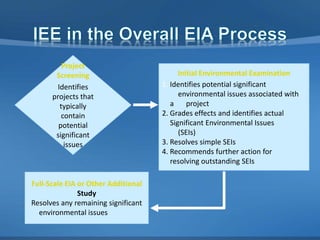
Project
Screening
Identifies
projects that
typically
contain
potential
significant
issues
Initial Environmental Examination
1. Identifies potential significant
environmental issues associated with
a project
2. Grades effects and identifies actual
Significant Environmental Issues
(SEIs)
3. Resolves simple SEIs
4. Recommends further action for
resolving outstanding SEIs
Full-Scale EIA or Other Additional
Study
Resolves any remaining significant
environmental issues
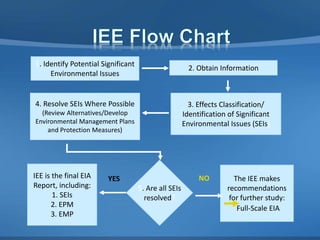
1. Identify Potential Significant
Environmental Issues
2. Obtain Information
3. Effects Classification/
Identification of Significant
Environmental Issues (SEIs)
4. Resolve SEIs Where Possible
(Review Alternatives/Develop
Environmental Management Plans
and Protection Measures)
The IEE makes
recommendations
for further study:
Full-Scale EIA
IEE is the final EIA
Report, including:
1. SEIs
2. EPM
3. EMP
5. Are all SEIs
resolved?
YES NO
• Environmental Protection Act (1997); the
Forest Act (1927); the Punjab Wildlife Act
(1974). In addition the Land Acquisition
Act (1894)
• Pakistan Environmental Protection Agency
Review of Environmental Assessment Study
and EIA Regulations, 2000
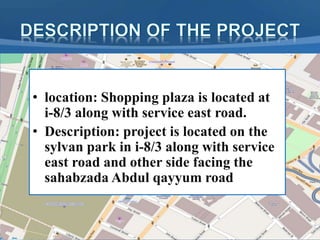
• location: Shopping plaza is located at
i-8/3 along with service east road.
• Description: project is located on the
sylvan park in i-8/3 along with service
east road and other side facing the
sahabzada Abdul qayyum road
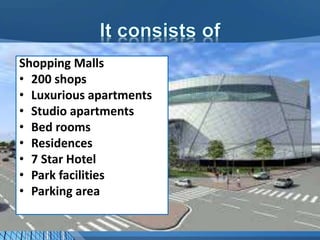
Shopping Malls
• 200 shops
• Luxurious apartments
• Studio apartments
• Bed rooms
• Residences
• 7 Star Hotel
• Park facilities
• Parking area
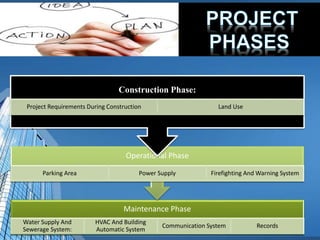
Maintenance Phase
Water Supply And
Sewerage System:
HVAC And Building
Automatic System
Communication System Records
Operational Phase
Parking Area Power Supply Firefighting And Warning System
Construction Phase:
Project Requirements During Construction Land Use
• No Project Option (NPO)
• It provides recreation, economic benefits, shopping place, quality
improvement in commodities, increase in economic growth,
competition among goods and export of products. So despite of
environmental impacts, it is considered necessary to build. Mitigation
measures are followed to minimize impacts.
• Siting Alternative
Another option for area selection is at 9th Avenue facing
towards I-9. Mitigatory measures need to followed to
minimize impact on water bodies and residence area
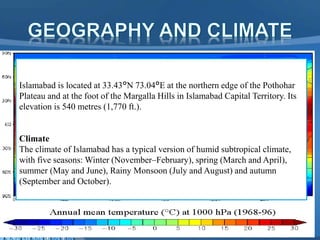
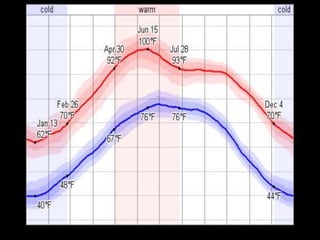
Islamabad is located at 33.43°N 73.04°E at the northern edge of the Pothohar
Plateau and at the foot of the Margalla Hills in Islamabad Capital Territory. Its
elevation is 540 metres (1,770 ft.).
Climate
The climate of Islamabad has a typical version of humid subtropical climate,
with five seasons: Winter (November–February), spring (March and April),
summer (May and June), Rainy Monsoon (July and August) and autumn
(September and October).
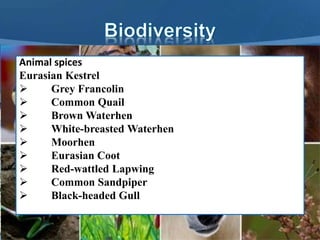
Animal spices
Eurasian Kestrel
 Grey Francolin
 Common Quail
 Brown Waterhen
 White-breasted Waterhen
 Moorhen
 Eurasian Coot
 Red-wattled Lapwing
 Common Sandpiper
 Black-headed Gull
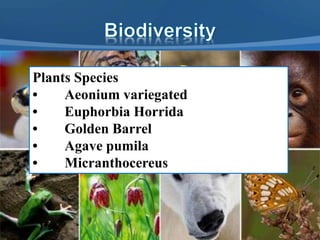
Plants Species
• Aeonium variegated
• Euphorbia Horrida
• Golden Barrel
• Agave pumila
• Micranthocereus
• Seismic Activities
The federal capital falls on the most active
fault line with the seismic hazard varying
from sector to sector.
• Soil Characteristics
The soil is mixture of clay, sand, limestone,
and gravel (in small amount). Surface soil is
sandy while at the depth of 4 meters it starts
silt
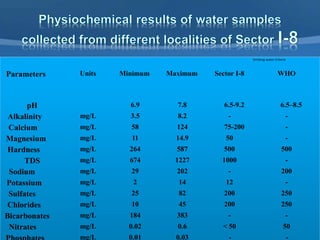
Drinking water Criteria
Parameters Units Minimum Maximum Sector I-8 WHO
pH 6.9 7.8 6.5-9.2 6.5–8.5
Alkalinity mg/L 3.5 8.2 - -
Calcium mg/L 58 124 75-200 -
Magnesium mg/L 11 14.9 50 -
Hardness mg/L 264 587 500 500
TDS mg/L 674 1227 1000 -
Sodium mg/L 29 202 - 200
Potassium mg/L 2 14 12 -
Sulfates mg/L 25 82 200 250
Chlorides mg/L 10 45 200 250
Bicarbonates mg/L 184 383 - -
Nitrates mg/L 0.02 0.6 < 50 50
mg/L 0.01 0.03 - -
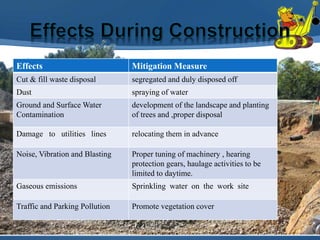
Effects Mitigation Measure
Cut & fill waste disposal segregated and duly disposed off
Dust spraying of water
Ground and Surface Water
Contamination
development of the landscape and planting
of trees and ,proper disposal
Damage to utilities lines relocating them in advance
Noise, Vibration and Blasting Proper tuning of machinery , hearing
protection gears, haulage activities to be
limited to daytime.
Gaseous emissions Sprinkling water on the work site
Traffic and Parking Pollution Promote vegetation cover
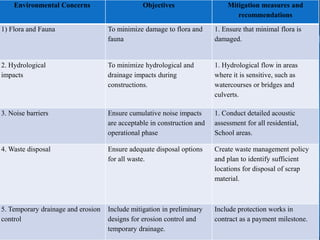
Environmental Concerns Objectives Mitigation measures and
recommendations
1) Flora and Fauna To minimize damage to flora and
fauna
1. Ensure that minimal flora is
damaged.
2. Hydrological
impacts
To minimize hydrological and
drainage impacts during
constructions.
1. Hydrological flow in areas
where it is sensitive, such as
watercourses or bridges and
culverts.
3. Noise barriers Ensure cumulative noise impacts
are acceptable in construction and
operational phase
1. Conduct detailed acoustic
assessment for all residential,
School areas.
4. Waste disposal Ensure adequate disposal options
for all waste.
Create waste management policy
and plan to identify sufficient
locations for disposal of scrap
material.
5. Temporary drainage and erosion
control
Include mitigation in preliminary
designs for erosion control and
temporary drainage.
Include protection works in
contract as a payment milestone.
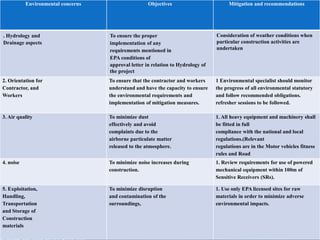
Environmental concerns Objectives Mitigation and recommendations
. Hydrology and
Drainage aspects
To ensure the proper
implementation of any
requirements mentioned in
EPA conditions of
approval letter in relation to Hydrology of
the project
Consideration of weather conditions when
particular construction activities are
undertaken
2. Orientation for
Contractor, and
Workers
To ensure that the contractor and workers
understand and have the capacity to ensure
the environmental requirements and
implementation of mitigation measures.
1 Environmental specialist should monitor
the progress of all environmental statutory
and follow recommended obligations.
refresher sessions to be followed.
3. Air quality To minimize dust
effectively and avoid
complaints due to the
airborne particulate matter
released to the atmosphere.
1. All heavy equipment and machinery shall
be fitted in full
compliance with the national and local
regulations.(Relevant
regulations are in the Motor vehicles fitness
rules and Road
4. noise To minimize noise increases during
construction.
1. Review requirements for use of powered
mechanical equipment within 100m of
Sensitive Receivers (SRs).
5. Exploitation,
Handling,
Transportation
and Storage of
Construction
materials
To minimize disruption
and contamination of the
surroundings,
1. Use only EPA licensed sites for raw
materials in order to minimize adverse
environmental impacts.
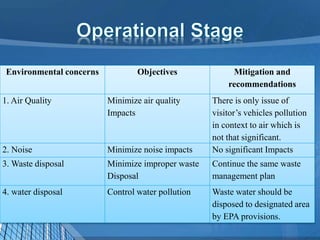
Environmental concerns Objectives Mitigation and
recommendations
1. Air Quality Minimize air quality
Impacts
There is only issue of
visitor’s vehicles pollution
in context to air which is
not that significant.
2. Noise Minimize noise impacts No significant Impacts
3. Waste disposal Minimize improper waste
Disposal
Continue the same waste
management plan
4. water disposal Control water pollution Waste water should be
disposed to designated area
by EPA provisions.
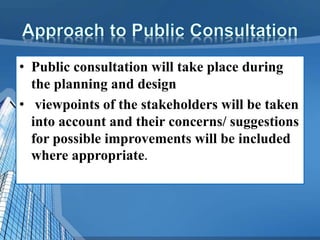
• Public consultation will take place during
the planning and design
• viewpoints of the stakeholders will be taken
into account and their concerns/ suggestions
for possible improvements will be included
where appropriate.
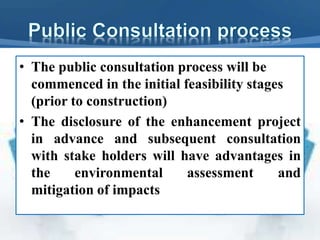
• The public consultation process will be
commenced in the initial feasibility stages
(prior to construction)
• The disclosure of the enhancement project
in advance and subsequent consultation
with stake holders will have advantages in
the environmental assessment and
mitigation of impacts
• Islamabad 2nd largest shopping mall in
construction and operational stages is only
likely to affect the areas within the
premises.
• There are unlikely to be any significant
impacts outside except for perhaps
temporary minor inconveniences to traffic
for any kind of transportation to site.
• In order to receive and facilitate the resolution
of affected peoples’ concerns, complaints, and
grievances about the project’s environmental
performance an Environmental Grievance
• Redress Mechanism (GRM) will be established
for the project. The mechanism will be used for
addressing any complaints that arise during
the implementation of projects
• Baseline monitoring activities should be
carried out to establish the baseline of
parameters for checking during the
construction stage. The results should be
integrated with the contract documentation to
establish performance action thresholds,
pollution limits and contingency plans for the
contractor’s performance.
Iee
Iee

Iee

  • 2.
    • Initial EnvironmentalExamination (IEE) Study for the “Construction of 2nd largest shopping plaza after the Centurus mall in I-8 Islamabad”. • Project will be almost 100 m high, having area of 2 Hectare and 35 stories. Estimated cost of this project is about $350 million USD
  • 3.
    • Initial environmentalexamination (IEE) is intended as a low-cost environmental evaluation that makes use of information already available
  • 4.
    4 • Describes theproposed project or activity and examines alternatives • Identifies and addresses community concerns to extent possible • Identifies and assesses potential environmental effects • Directs future action
  • 5.
    5 • Identify allpotential environmental concerns relating to a proposed project or activity • Identify all significant environmental issues (SEIs) • Resolve simple SEIs • Develop the focus for follow-up studies based on unresolved SEIs
  • 6.
    Project Screening Identifies projects that typically contain potential significant issues Initial EnvironmentalExamination 1. Identifies potential significant environmental issues associated with a project 2. Grades effects and identifies actual Significant Environmental Issues (SEIs) 3. Resolves simple SEIs 4. Recommends further action for resolving outstanding SEIs Full-Scale EIA or Other Additional Study Resolves any remaining significant environmental issues
  • 7.
    1. Identify PotentialSignificant Environmental Issues 2. Obtain Information 3. Effects Classification/ Identification of Significant Environmental Issues (SEIs) 4. Resolve SEIs Where Possible (Review Alternatives/Develop Environmental Management Plans and Protection Measures) The IEE makes recommendations for further study: Full-Scale EIA IEE is the final EIA Report, including: 1. SEIs 2. EPM 3. EMP 5. Are all SEIs resolved? YES NO
  • 8.
    • Environmental ProtectionAct (1997); the Forest Act (1927); the Punjab Wildlife Act (1974). In addition the Land Acquisition Act (1894) • Pakistan Environmental Protection Agency Review of Environmental Assessment Study and EIA Regulations, 2000
  • 9.
    • location: Shoppingplaza is located at i-8/3 along with service east road. • Description: project is located on the sylvan park in i-8/3 along with service east road and other side facing the sahabzada Abdul qayyum road
  • 10.
    Shopping Malls • 200shops • Luxurious apartments • Studio apartments • Bed rooms • Residences • 7 Star Hotel • Park facilities • Parking area
  • 11.
    Maintenance Phase Water SupplyAnd Sewerage System: HVAC And Building Automatic System Communication System Records Operational Phase Parking Area Power Supply Firefighting And Warning System Construction Phase: Project Requirements During Construction Land Use
  • 12.
    • No ProjectOption (NPO) • It provides recreation, economic benefits, shopping place, quality improvement in commodities, increase in economic growth, competition among goods and export of products. So despite of environmental impacts, it is considered necessary to build. Mitigation measures are followed to minimize impacts. • Siting Alternative Another option for area selection is at 9th Avenue facing towards I-9. Mitigatory measures need to followed to minimize impact on water bodies and residence area
  • 13.
    Islamabad is locatedat 33.43°N 73.04°E at the northern edge of the Pothohar Plateau and at the foot of the Margalla Hills in Islamabad Capital Territory. Its elevation is 540 metres (1,770 ft.). Climate The climate of Islamabad has a typical version of humid subtropical climate, with five seasons: Winter (November–February), spring (March and April), summer (May and June), Rainy Monsoon (July and August) and autumn (September and October).
  • 15.
    Animal spices Eurasian Kestrel Grey Francolin  Common Quail  Brown Waterhen  White-breasted Waterhen  Moorhen  Eurasian Coot  Red-wattled Lapwing  Common Sandpiper  Black-headed Gull
  • 16.
    Plants Species • Aeoniumvariegated • Euphorbia Horrida • Golden Barrel • Agave pumila • Micranthocereus
  • 17.
    • Seismic Activities Thefederal capital falls on the most active fault line with the seismic hazard varying from sector to sector. • Soil Characteristics The soil is mixture of clay, sand, limestone, and gravel (in small amount). Surface soil is sandy while at the depth of 4 meters it starts silt
  • 18.
    Drinking water Criteria ParametersUnits Minimum Maximum Sector I-8 WHO pH 6.9 7.8 6.5-9.2 6.5–8.5 Alkalinity mg/L 3.5 8.2 - - Calcium mg/L 58 124 75-200 - Magnesium mg/L 11 14.9 50 - Hardness mg/L 264 587 500 500 TDS mg/L 674 1227 1000 - Sodium mg/L 29 202 - 200 Potassium mg/L 2 14 12 - Sulfates mg/L 25 82 200 250 Chlorides mg/L 10 45 200 250 Bicarbonates mg/L 184 383 - - Nitrates mg/L 0.02 0.6 < 50 50 mg/L 0.01 0.03 - -
  • 20.
    Effects Mitigation Measure Cut& fill waste disposal segregated and duly disposed off Dust spraying of water Ground and Surface Water Contamination development of the landscape and planting of trees and ,proper disposal Damage to utilities lines relocating them in advance Noise, Vibration and Blasting Proper tuning of machinery , hearing protection gears, haulage activities to be limited to daytime. Gaseous emissions Sprinkling water on the work site Traffic and Parking Pollution Promote vegetation cover
  • 23.
    Environmental Concerns ObjectivesMitigation measures and recommendations 1) Flora and Fauna To minimize damage to flora and fauna 1. Ensure that minimal flora is damaged. 2. Hydrological impacts To minimize hydrological and drainage impacts during constructions. 1. Hydrological flow in areas where it is sensitive, such as watercourses or bridges and culverts. 3. Noise barriers Ensure cumulative noise impacts are acceptable in construction and operational phase 1. Conduct detailed acoustic assessment for all residential, School areas. 4. Waste disposal Ensure adequate disposal options for all waste. Create waste management policy and plan to identify sufficient locations for disposal of scrap material. 5. Temporary drainage and erosion control Include mitigation in preliminary designs for erosion control and temporary drainage. Include protection works in contract as a payment milestone.
  • 25.
    Environmental concerns ObjectivesMitigation and recommendations . Hydrology and Drainage aspects To ensure the proper implementation of any requirements mentioned in EPA conditions of approval letter in relation to Hydrology of the project Consideration of weather conditions when particular construction activities are undertaken 2. Orientation for Contractor, and Workers To ensure that the contractor and workers understand and have the capacity to ensure the environmental requirements and implementation of mitigation measures. 1 Environmental specialist should monitor the progress of all environmental statutory and follow recommended obligations. refresher sessions to be followed. 3. Air quality To minimize dust effectively and avoid complaints due to the airborne particulate matter released to the atmosphere. 1. All heavy equipment and machinery shall be fitted in full compliance with the national and local regulations.(Relevant regulations are in the Motor vehicles fitness rules and Road 4. noise To minimize noise increases during construction. 1. Review requirements for use of powered mechanical equipment within 100m of Sensitive Receivers (SRs). 5. Exploitation, Handling, Transportation and Storage of Construction materials To minimize disruption and contamination of the surroundings, 1. Use only EPA licensed sites for raw materials in order to minimize adverse environmental impacts.
  • 26.
    Environmental concerns ObjectivesMitigation and recommendations 1. Air Quality Minimize air quality Impacts There is only issue of visitor’s vehicles pollution in context to air which is not that significant. 2. Noise Minimize noise impacts No significant Impacts 3. Waste disposal Minimize improper waste Disposal Continue the same waste management plan 4. water disposal Control water pollution Waste water should be disposed to designated area by EPA provisions.
  • 28.
    • Public consultationwill take place during the planning and design • viewpoints of the stakeholders will be taken into account and their concerns/ suggestions for possible improvements will be included where appropriate.
  • 29.
    • The publicconsultation process will be commenced in the initial feasibility stages (prior to construction) • The disclosure of the enhancement project in advance and subsequent consultation with stake holders will have advantages in the environmental assessment and mitigation of impacts
  • 30.
    • Islamabad 2ndlargest shopping mall in construction and operational stages is only likely to affect the areas within the premises. • There are unlikely to be any significant impacts outside except for perhaps temporary minor inconveniences to traffic for any kind of transportation to site.
  • 31.
    • In orderto receive and facilitate the resolution of affected peoples’ concerns, complaints, and grievances about the project’s environmental performance an Environmental Grievance • Redress Mechanism (GRM) will be established for the project. The mechanism will be used for addressing any complaints that arise during the implementation of projects
  • 32.
    • Baseline monitoringactivities should be carried out to establish the baseline of parameters for checking during the construction stage. The results should be integrated with the contract documentation to establish performance action thresholds, pollution limits and contingency plans for the contractor’s performance.