Environmental Risk Assessment
Abir Goldar
Development Studies Discipline
Khulna University 1
Outline
 Defining Key Terms
 Risk Characterization
 Risk Recognition
 Risk Identification
 Grading of Risk
 Steps to Risk Assessment
 Risk Management
 Steps to Risk Management
 Conclusion
2
3
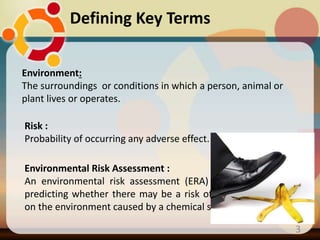
Environment:
The surroundings or conditions in which a person, animal or
plant lives or operates.
Risk :
Probability of occurring any adverse effect.
Environmental Risk Assessment :
An environmental risk assessment (ERA) is a process of
predicting whether there may be a risk of adverse effects
on the environment caused by a chemical substance.
Defining Key Terms
Risk characterization
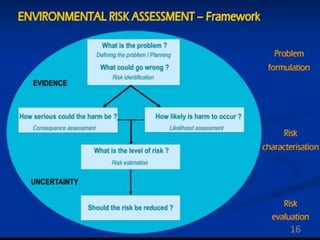
 Risk characterization is the process of estimating the
incidence of a health effect under the various conditions of
human exposure described in the exposure assessment
 The results of risk characterization are used to identify
potential options that are then evaluated in terms of
expected public health, economic, social, and political
consequences
4
Quantitative risk characterization
Characterizations of Risk
5
Quantitative characterization involves the calculation of a
simple risk ratio (PEC/PNEC). That is, the predicted
environmental concentration is compared to the predicted
concentration at which no effects on organisms in the
compartment will occur.
Qualitative risk characterization
Characterizations of Risk
6
It is not always possible to undertake a quantitative
characterization of risk. In these instances, such as when
assessing the risks to remote marine areas or where PECs or
PNECs cannot be calculated, the risk characterization will
need to be performed qualitatively.
Risk Recognition
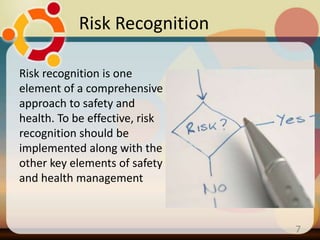
Risk recognition is one
element of a comprehensive
approach to safety and
health. To be effective, risk
recognition should be
implemented along with the
other key elements of safety
and health management
7
Risk Identification
8
Risk identification is the
process of determining risks
that could potentially
prevent the program,
enterprise, or investment
from achieving its objectives
.It includes documenting and
communicating the concern.
Risk Identification Process
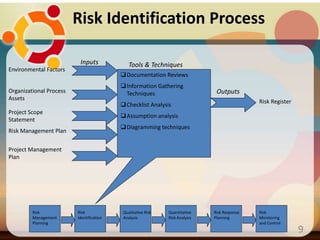
Project Scope
Statement
Environmental Factors
Organizational Process
Assets
Risk Management Plan
Risk Register
Documentation Reviews
Information Gathering
Techniques
Checklist Analysis
Assumption analysis
Diagramming techniques
Inputs
Outputs
Tools & Techniques
Risk
Management
Planning
Risk
Identification
Qualitative Risk
Analysis
Quantitative
Risk Analysis
Risk Response
Planning
Risk
Monitoring
and Control
Project Management
Plan
9
Grading of Risk
10
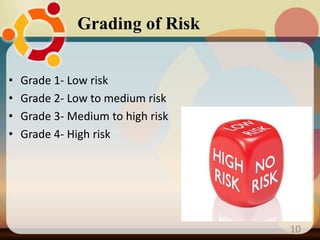
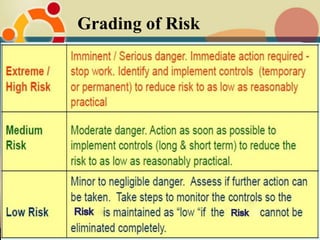
• Grade 1- Low risk
• Grade 2- Low to medium risk
• Grade 3- Medium to high risk
• Grade 4- High risk
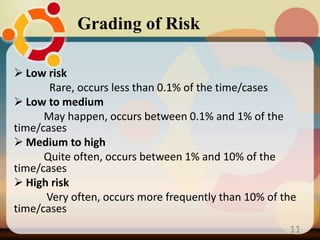
 Low risk
Rare, occurs less than 0.1% of the time/cases
 Low to medium
May happen, occurs between 0.1% and 1% of the
time/cases
 Medium to high
Quite often, occurs between 1% and 10% of the
time/cases
 High risk
Very often, occurs more frequently than 10% of the
time/cases
11
Grading of Risk
12
Grading of Risk
13
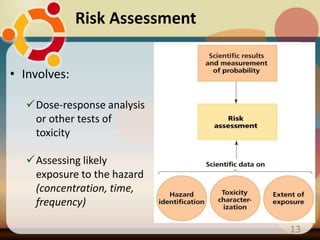
Risk Assessment
• Involves:
Dose-response analysis
or other tests of
toxicity
Assessing likely
exposure to the hazard
(concentration, time,
frequency)
1. Hazard identification : The process of determining whether
exposure to an agent can increase the incidence of a health
condition
2. Dose-response assessment: The process of characterizing the
relation between the dose of an agent administered or
received and the incidence of an adverse health effect in
exposed populations; it expresses incidence as a function of
exposure to the agent.
Steps to Risk Assessment
14
3. Exposure assessment : The process of measuring or
estimating the intensity, frequency, and duration of human
exposures to an existing agent or of estimating
hypothetical exposures that might arise from the release of
new chemicals into the environment .
4. Risk characterization: The process of estimating the
incidence of a health effect under the various conditions of
human exposure described in the exposure assessment
15
Steps to Risk Assessment
16
17
Environmental Risk Management
• Environmental risk management is a method
of assessing, mitigating, and monitoring the
effects of a recognized risk that may have the
potential adverse effects on the public and
environmental health.
18
Environmental Risk Management
Risk management is a decision making process that
involves:
- Risk Assessment
- Technological Feasibility
- Economic Impacts
- Public Concerns
- Legal Requirements
19
The process of evaluating alternative regulatory options
and selecting among them.
Seeks to prevent adverse effects on :
• Human health and
• Ecological systems
20
Environmental Risk Management
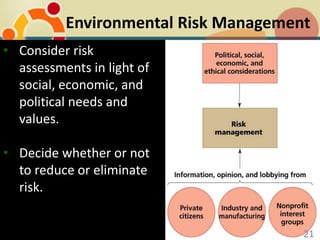
• Consider risk
assessments in light of
social, economic, and
political needs and
values.
• Decide whether or not
to reduce or eliminate
risk.
21
Environmental Risk Management
Steps to Risk Management
1. Decision: The process of choosing between the
options .
2. Implementation : The process of creating the
option that we had choose .
3. Monitoring and Evaluation : The process of
controlling the option to be sure that we achieved
our aim .
4. Review : The process of choosing other option in
case we didn’t have the best results. 22
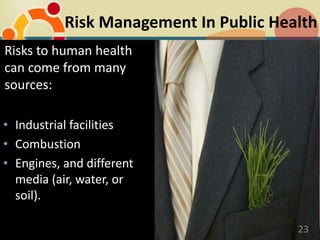
Risk Management In Public Health
Risks to human health
can come from many
sources:
• Industrial facilities
• Combustion
• Engines, and different
media (air, water, or
soil).
23
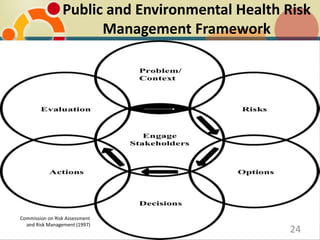
Public and Environmental Health Risk
Management Framework
24
Commission on Risk Assessment
and Risk Management (1997)
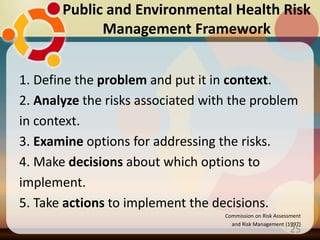
Public and Environmental Health Risk
Management Framework
25
1. Define the problem and put it in context.
2. Analyze the risks associated with the problem
in context.
3. Examine options for addressing the risks.
4. Make decisions about which options to
implement.
5. Take actions to implement the decisions.
Commission on Risk Assessment
and Risk Management (1997)
26
Conclusion
 For recognition and grading of risk ,
characterization of risk is necessary.
 Risk assessment is an important part of risk
management. So environmental risk assessment
is needed to manage the risk effectively.
THANK
YOU

Environmental Risk Assessment

  • 1.
    Environmental Risk Assessment AbirGoldar Development Studies Discipline Khulna University 1
  • 2.
    Outline  Defining KeyTerms  Risk Characterization  Risk Recognition  Risk Identification  Grading of Risk  Steps to Risk Assessment  Risk Management  Steps to Risk Management  Conclusion 2
  • 3.
    3 Environment: The surroundings orconditions in which a person, animal or plant lives or operates. Risk : Probability of occurring any adverse effect. Environmental Risk Assessment : An environmental risk assessment (ERA) is a process of predicting whether there may be a risk of adverse effects on the environment caused by a chemical substance. Defining Key Terms
  • 4.
    Risk characterization  Riskcharacterization is the process of estimating the incidence of a health effect under the various conditions of human exposure described in the exposure assessment  The results of risk characterization are used to identify potential options that are then evaluated in terms of expected public health, economic, social, and political consequences 4
  • 5.
    Quantitative risk characterization Characterizationsof Risk 5 Quantitative characterization involves the calculation of a simple risk ratio (PEC/PNEC). That is, the predicted environmental concentration is compared to the predicted concentration at which no effects on organisms in the compartment will occur.
  • 6.
    Qualitative risk characterization Characterizationsof Risk 6 It is not always possible to undertake a quantitative characterization of risk. In these instances, such as when assessing the risks to remote marine areas or where PECs or PNECs cannot be calculated, the risk characterization will need to be performed qualitatively.
  • 7.
    Risk Recognition Risk recognitionis one element of a comprehensive approach to safety and health. To be effective, risk recognition should be implemented along with the other key elements of safety and health management 7
  • 8.
    Risk Identification 8 Risk identificationis the process of determining risks that could potentially prevent the program, enterprise, or investment from achieving its objectives .It includes documenting and communicating the concern.
  • 9.
    Risk Identification Process ProjectScope Statement Environmental Factors Organizational Process Assets Risk Management Plan Risk Register Documentation Reviews Information Gathering Techniques Checklist Analysis Assumption analysis Diagramming techniques Inputs Outputs Tools & Techniques Risk Management Planning Risk Identification Qualitative Risk Analysis Quantitative Risk Analysis Risk Response Planning Risk Monitoring and Control Project Management Plan 9
  • 10.
    Grading of Risk 10 •Grade 1- Low risk • Grade 2- Low to medium risk • Grade 3- Medium to high risk • Grade 4- High risk
  • 11.
     Low risk Rare,occurs less than 0.1% of the time/cases  Low to medium May happen, occurs between 0.1% and 1% of the time/cases  Medium to high Quite often, occurs between 1% and 10% of the time/cases  High risk Very often, occurs more frequently than 10% of the time/cases 11 Grading of Risk
  • 12.
  • 13.
    13 Risk Assessment • Involves: Dose-responseanalysis or other tests of toxicity Assessing likely exposure to the hazard (concentration, time, frequency)
  • 14.
    1. Hazard identification: The process of determining whether exposure to an agent can increase the incidence of a health condition 2. Dose-response assessment: The process of characterizing the relation between the dose of an agent administered or received and the incidence of an adverse health effect in exposed populations; it expresses incidence as a function of exposure to the agent. Steps to Risk Assessment 14
  • 15.
    3. Exposure assessment: The process of measuring or estimating the intensity, frequency, and duration of human exposures to an existing agent or of estimating hypothetical exposures that might arise from the release of new chemicals into the environment . 4. Risk characterization: The process of estimating the incidence of a health effect under the various conditions of human exposure described in the exposure assessment 15 Steps to Risk Assessment
  • 16.
  • 17.
  • 18.
    Environmental Risk Management •Environmental risk management is a method of assessing, mitigating, and monitoring the effects of a recognized risk that may have the potential adverse effects on the public and environmental health. 18
  • 19.
    Environmental Risk Management Riskmanagement is a decision making process that involves: - Risk Assessment - Technological Feasibility - Economic Impacts - Public Concerns - Legal Requirements 19
  • 20.
    The process ofevaluating alternative regulatory options and selecting among them. Seeks to prevent adverse effects on : • Human health and • Ecological systems 20 Environmental Risk Management
  • 21.
    • Consider risk assessmentsin light of social, economic, and political needs and values. • Decide whether or not to reduce or eliminate risk. 21 Environmental Risk Management
  • 22.
    Steps to RiskManagement 1. Decision: The process of choosing between the options . 2. Implementation : The process of creating the option that we had choose . 3. Monitoring and Evaluation : The process of controlling the option to be sure that we achieved our aim . 4. Review : The process of choosing other option in case we didn’t have the best results. 22
  • 23.
    Risk Management InPublic Health Risks to human health can come from many sources: • Industrial facilities • Combustion • Engines, and different media (air, water, or soil). 23
  • 24.
    Public and EnvironmentalHealth Risk Management Framework 24 Commission on Risk Assessment and Risk Management (1997)
  • 25.
    Public and EnvironmentalHealth Risk Management Framework 25 1. Define the problem and put it in context. 2. Analyze the risks associated with the problem in context. 3. Examine options for addressing the risks. 4. Make decisions about which options to implement. 5. Take actions to implement the decisions. Commission on Risk Assessment and Risk Management (1997)
  • 26.
    26 Conclusion  For recognitionand grading of risk , characterization of risk is necessary.  Risk assessment is an important part of risk management. So environmental risk assessment is needed to manage the risk effectively.
  • 27.