F.A.-3 (TASK-1)
SUB-ENGLISH
A PowerPoint Presentation On:
Prepared by-group B
Class – IX(A)
1) Akankshya Das Goswami
Roll No.-01
2) Ananya Panigrahi
Roll No.-04
3) Ananya Parija
Roll No.-05
4) Ananyashree Sahoo
Roll No.-06
5) Kiran Mohanty
Roll No.-23
6) Madhurya Sarangi
Roll No.-26
 Ecosystem or biocenosis is a
segment of nature/ biosphere
consisting of a community of
living beings and the
abiotic/physical environment
both interacting and
exchanging materials
between them.
 Ecosystem can be temporary
(e.g. rain water pond) or
permanent, natural or man-
made (e.g. aquarium,
agriculture), small or large.
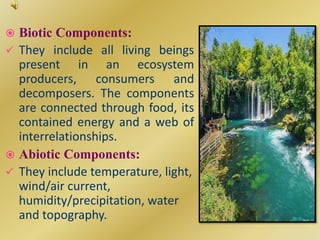
 Biotic Components:
 They include all living beings
present in an ecosystem
producers, consumers and
decomposers. The components
are connected through food, its
contained energy and a web of
interrelationships.
 Abiotic Components:
 They include temperature, light,
wind/air current,
humidity/precipitation, water
and topography.
 Modification of the climate
 Maintenance of the hydrological cycle
 Erosion control and soil formation
 Maintenance of O- and N-Cycles
 Waste and toxic chemical treatment
 Pest Management
 Carbon storage; maintain the C-Cycle
 Increased population growth:
› Increasing our biotic potential.
› Decreased our environmental resistance.
 Contributions to ecosystem degradation:
› Introduce species
› Eliminate natural predators
› Alter abiotic factors
› Reduce biodiversity
› Misunderstand the role of fire
 Have we exceeded our carrying capacity?
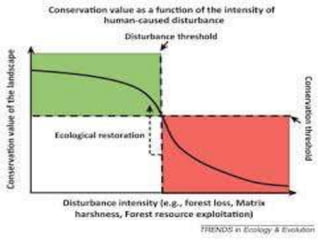
 We need to protect and manage the natural
environment to maintain the goods and services vital to
human economy and survival.
 Establishing a balance between our own species and the
rest of the biosphere should be a practical goal for all of
us, if not also a moral goal.
 Adaptive Ecosystem Management: an approach that
accepts uncertainty of our knowledge base and flexible
to change as new information is gathered; the goal is to
balance our exploitation with an ecosystem’s capacity to
renew goods and services.
As the world’s population grows and natural resources
dwindle, the creation of parks and protected natural
areas is not enough to solve the problem of forest
destruction.
The farms, forests and tourism businesses with which we
work not only manage their own lands sustainably but
they also function as an integral part of the larger
landscape -- keeping trees standing, preventing erosion,
protecting waterways and soils, providing wildlife habitat
and reducing the risk of fires and other destructive
activities. Together, sustainably managed businesses and
neighboring protected areas can form a thriving mosaic
that nurtures ecosystems, wildlife and people.
Conservation of eco system

Conservation of eco system

  • 2.
  • 3.
    Prepared by-group B Class– IX(A) 1) Akankshya Das Goswami Roll No.-01 2) Ananya Panigrahi Roll No.-04 3) Ananya Parija Roll No.-05 4) Ananyashree Sahoo Roll No.-06 5) Kiran Mohanty Roll No.-23 6) Madhurya Sarangi Roll No.-26
  • 4.
     Ecosystem orbiocenosis is a segment of nature/ biosphere consisting of a community of living beings and the abiotic/physical environment both interacting and exchanging materials between them.  Ecosystem can be temporary (e.g. rain water pond) or permanent, natural or man- made (e.g. aquarium, agriculture), small or large.
  • 5.
     Biotic Components: They include all living beings present in an ecosystem producers, consumers and decomposers. The components are connected through food, its contained energy and a web of interrelationships.  Abiotic Components:  They include temperature, light, wind/air current, humidity/precipitation, water and topography.
  • 6.
     Modification ofthe climate  Maintenance of the hydrological cycle  Erosion control and soil formation  Maintenance of O- and N-Cycles  Waste and toxic chemical treatment  Pest Management  Carbon storage; maintain the C-Cycle
  • 7.
     Increased populationgrowth: › Increasing our biotic potential. › Decreased our environmental resistance.  Contributions to ecosystem degradation: › Introduce species › Eliminate natural predators › Alter abiotic factors › Reduce biodiversity › Misunderstand the role of fire  Have we exceeded our carrying capacity?
  • 8.
     We needto protect and manage the natural environment to maintain the goods and services vital to human economy and survival.  Establishing a balance between our own species and the rest of the biosphere should be a practical goal for all of us, if not also a moral goal.  Adaptive Ecosystem Management: an approach that accepts uncertainty of our knowledge base and flexible to change as new information is gathered; the goal is to balance our exploitation with an ecosystem’s capacity to renew goods and services.
  • 10.
    As the world’spopulation grows and natural resources dwindle, the creation of parks and protected natural areas is not enough to solve the problem of forest destruction. The farms, forests and tourism businesses with which we work not only manage their own lands sustainably but they also function as an integral part of the larger landscape -- keeping trees standing, preventing erosion, protecting waterways and soils, providing wildlife habitat and reducing the risk of fires and other destructive activities. Together, sustainably managed businesses and neighboring protected areas can form a thriving mosaic that nurtures ecosystems, wildlife and people.