Montreal Protocol on
Substances that
Deplete the Ozone
Layer
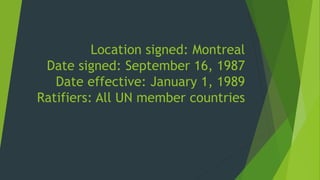
Location signed: Montreal
Date signed: September 16, 1987
Date effective: January 1, 1989
Ratifiers: All UN member countries
 The Montreal Protocol on Substances that
Deplete the Ozone Layer was designed to
reduce the production and consumption of
ozone depleting substances in order to
reduce their abundance in the atmosphere,
and thereby protect the earth’s fragile
ozone Layer.
 After being entered into force on January
1, 1989, it was followed by a first meeting
in Helsinki in May 1989. Since then, it has
undergone eight revisions, in 1990
(London), 1991 (Nairobi), 1992
(Copenhagen), 1993 (Bangkok), 1995
(Vienna), 1997 (Montreal), 1999 (Beijing)
and 2007 (Montreal).
 The treaty is structured around several
groups of halogenated hydrocarbons that
have been shown to play a role in ozone
depletion. All of these ozone depleting
substances contain either chlorine or
bromine (substances containing only
fluorine do not harm the ozone layer). For
each group, the treaty provides a timetable
on which the production of those
substances must be phased out and
eventually eliminated.
Chlorofluorocarbons (CFCs) Phase-out
Management Plan
 The stated purpose of the treaty is that the signatory states shall
accept a series of stepped limits on CFC use and production,
including:
 from 1991 to 1992 its levels of consumption and production of the
controlled substances in Group I of Annex A do not exceed 150
percent of its calculated levels of production and consumption of
those substances in 1986.
 from 1994 its calculated level of consumption and production of
the controlled substances in Group I of Annex A does not exceed,
annually, twenty-five percent of its calculated level of
consumption and production in 1986.
 from 1996 its calculated level of consumption and production of
the controlled substances in Group I of Annex A does not exceed
zero.
Hydrochlorofluorocarbons (HCFCs) Phase-
out Management Plan (HPMP)
 Under the Montreal Protocol on Substances that Deplete the
Ozone Layer, especially Executive Committee (ExCom) 53/37 and
ExCom 54/39, Parties to this Protocol agreed to set year 2013 as
the time to freeze the consumption and production of HCFCs.
They also agreed to start reducing its consumption and
production in 2015. The time of freezing and reducing HCFCs is
then known as 2013/2015.
 The HCFCs are transitional CFCs replacements, used as
refrigerants, solvents, blowing agents for plastic foam
manufacture, and fire extinguishers. In terms of Ozone Depleting
Potential (ODP), in comparison to CFCs that have ODP 0.6 – 1.0,
these HCFCs have lower ODPs (0.01 – 0.5). In terms of Global
Warming Potential (GWP), in comparison to CFCs that have GWP
4,680 – 10,720, HCFCs have lower GWPs (76 – 2,270).
Hydrofluorocarbons (HFCs)
 Produced mostly in developed countries, HFCs replaced
CFCs and HCFCs. HFCs pose no harm to the ozone layer
because, unlike CFCs and HCFCs, they do not contain
chlorine. But it has been established that HFCs are not
innocuous either.[16] They are greenhouse gases, with a
high global warming potential (GWP), comparable to that
of CFCs and HCFCs.
 The Montreal Protocol does not address HFCs, but these
substances figure in the basket of six greenhouse gases
under the Kyoto Protocol. Developed countries following
the Kyoto Protocol report their HFC emission data to
UNFCCC; parties to the Montreal Protocol have no such
obligation.
Effectiveness of the protocol
 As a result of the international agreement, the
ozone hole in Antarctica is slowly recovering.
Climate projections indicate that the ozone layer
will return to 1980 levels between 2050 and 2070.
 Due to its widespread adoption and
implementation it has been hailed as an example
of exceptional international co-operation, with
Kofi Annan (former UN secretary general) quoted
as saying that "perhaps the single most successful
international agreement to date has been the
Montreal Protocol".

About the Montreal Protocol

  • 1.
    Montreal Protocol on Substancesthat Deplete the Ozone Layer
  • 2.
    Location signed: Montreal Datesigned: September 16, 1987 Date effective: January 1, 1989 Ratifiers: All UN member countries
  • 3.
     The MontrealProtocol on Substances that Deplete the Ozone Layer was designed to reduce the production and consumption of ozone depleting substances in order to reduce their abundance in the atmosphere, and thereby protect the earth’s fragile ozone Layer.
  • 4.
     After beingentered into force on January 1, 1989, it was followed by a first meeting in Helsinki in May 1989. Since then, it has undergone eight revisions, in 1990 (London), 1991 (Nairobi), 1992 (Copenhagen), 1993 (Bangkok), 1995 (Vienna), 1997 (Montreal), 1999 (Beijing) and 2007 (Montreal).
  • 5.
     The treatyis structured around several groups of halogenated hydrocarbons that have been shown to play a role in ozone depletion. All of these ozone depleting substances contain either chlorine or bromine (substances containing only fluorine do not harm the ozone layer). For each group, the treaty provides a timetable on which the production of those substances must be phased out and eventually eliminated.
  • 6.
    Chlorofluorocarbons (CFCs) Phase-out ManagementPlan  The stated purpose of the treaty is that the signatory states shall accept a series of stepped limits on CFC use and production, including:  from 1991 to 1992 its levels of consumption and production of the controlled substances in Group I of Annex A do not exceed 150 percent of its calculated levels of production and consumption of those substances in 1986.  from 1994 its calculated level of consumption and production of the controlled substances in Group I of Annex A does not exceed, annually, twenty-five percent of its calculated level of consumption and production in 1986.  from 1996 its calculated level of consumption and production of the controlled substances in Group I of Annex A does not exceed zero.
  • 7.
    Hydrochlorofluorocarbons (HCFCs) Phase- outManagement Plan (HPMP)  Under the Montreal Protocol on Substances that Deplete the Ozone Layer, especially Executive Committee (ExCom) 53/37 and ExCom 54/39, Parties to this Protocol agreed to set year 2013 as the time to freeze the consumption and production of HCFCs. They also agreed to start reducing its consumption and production in 2015. The time of freezing and reducing HCFCs is then known as 2013/2015.  The HCFCs are transitional CFCs replacements, used as refrigerants, solvents, blowing agents for plastic foam manufacture, and fire extinguishers. In terms of Ozone Depleting Potential (ODP), in comparison to CFCs that have ODP 0.6 – 1.0, these HCFCs have lower ODPs (0.01 – 0.5). In terms of Global Warming Potential (GWP), in comparison to CFCs that have GWP 4,680 – 10,720, HCFCs have lower GWPs (76 – 2,270).
  • 8.
    Hydrofluorocarbons (HFCs)  Producedmostly in developed countries, HFCs replaced CFCs and HCFCs. HFCs pose no harm to the ozone layer because, unlike CFCs and HCFCs, they do not contain chlorine. But it has been established that HFCs are not innocuous either.[16] They are greenhouse gases, with a high global warming potential (GWP), comparable to that of CFCs and HCFCs.  The Montreal Protocol does not address HFCs, but these substances figure in the basket of six greenhouse gases under the Kyoto Protocol. Developed countries following the Kyoto Protocol report their HFC emission data to UNFCCC; parties to the Montreal Protocol have no such obligation.
  • 9.
    Effectiveness of theprotocol  As a result of the international agreement, the ozone hole in Antarctica is slowly recovering. Climate projections indicate that the ozone layer will return to 1980 levels between 2050 and 2070.  Due to its widespread adoption and implementation it has been hailed as an example of exceptional international co-operation, with Kofi Annan (former UN secretary general) quoted as saying that "perhaps the single most successful international agreement to date has been the Montreal Protocol".