What is Sustainable
Development
Introduction
1. WCED
2. Earth Summit
3. WSSD
4. MGD’s
All these are important conferences
in which stress on Sustainable
Development and introduced these
latter and discuss on it.
WCED
 The report of the World Commission on
Environment and Development entitled Our
Common Future (WCED, 1987) used term
“sustainable development” and defined as
“Development that meets the needs of the
present without compromising the ability of the
future generations to meet their own need.”
 Their recommendations focused on integrating
development strategies and environmental
policies and global partnerships to meet the
interdependent environmental concerns and
development opportunities.
Earth Summit
The Earth Summit in Rio De Janerio, Brazil in
1992 was the largest ever international
conference in which 116 heads of states
gathered and first time and considered
environment.
The central aim was to identify the principles
of an agenda for action towards sustainable
development in the future.
Agenda 21 document detailing the issues, the
actors and the means for achieving sustainable
development by putting into practice by the
start of the 21 century.
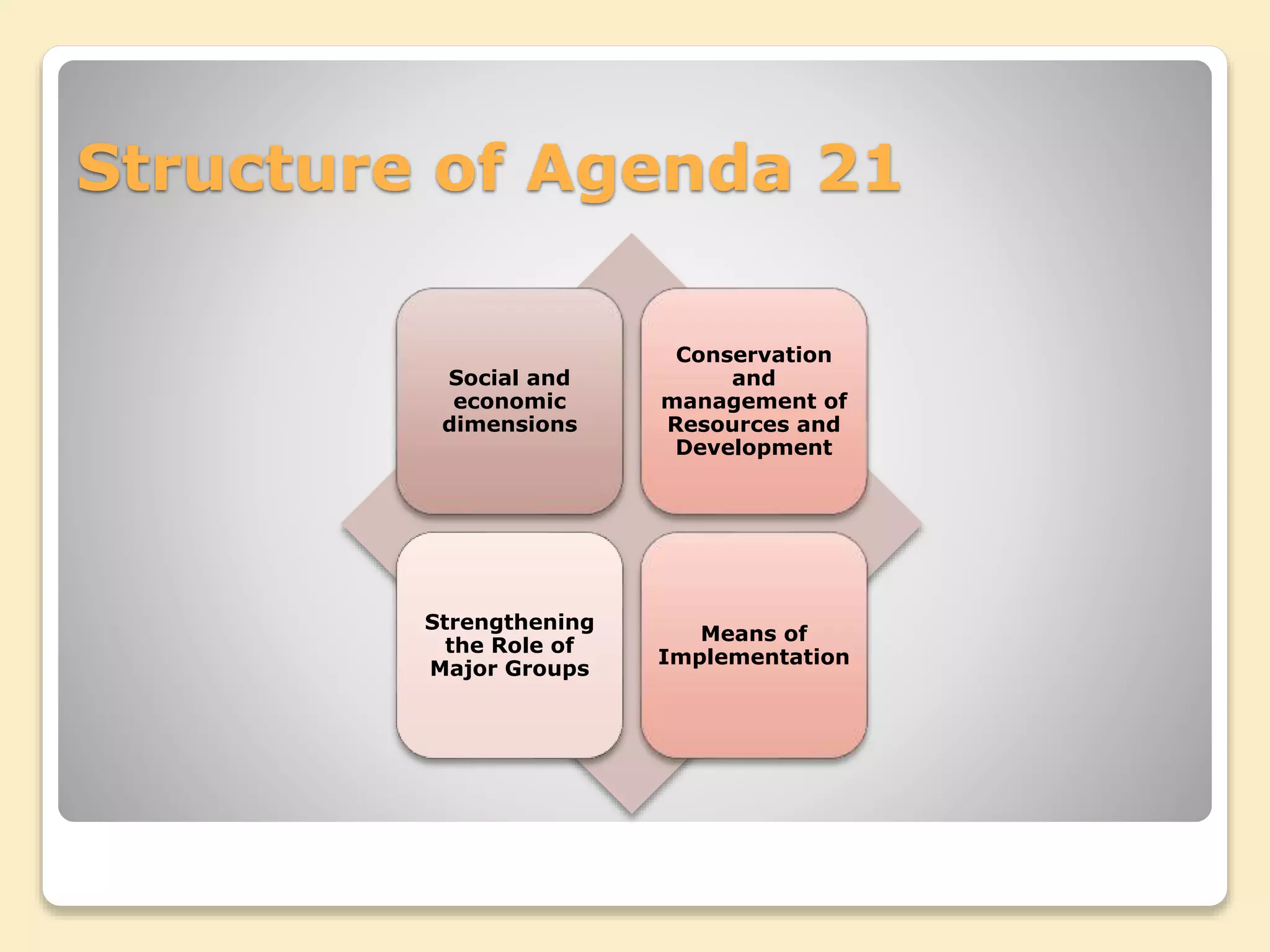
Structure of Agenda 21
Social and
economic
dimensions
Conservation
and
management of
Resources and
Development
Strengthening
the Role of
Major Groups
Means of
Implementation
A number of important conventions were
also agreed at Rio, including the
Convention on Biodiversity and the
Framework Convention on Climate Change
in recognition of the growing problems of
sustainable use of ecosystem and of
human-induced climate change.
There was an optimism concerning a
common interest on behalf of countries
globally and between current and future
generation that drive sustainable
development into practice.
WSSD
104 heads of state gathered again for the UN
World Summit on Sustainable Development
(WSSD) in Johannesburg, South Africa.
The aim was to reinvigorate at the highest
political level, the global commitment to a
North-South partnership to achieve
sustainable development.
Key concerns at the start of the 21 century
were for the continued degradation of
environmental systems since Rio, but also for
the persistence of poverty and evidence of
widening global disparities.
WSSD a central concern was the impacts
of globalization on the poor.
People and places were closely linked
together within global markets and
through flows of finance.
Poverty, inequality and exclusion were
identified as threats not just to the
environment and economic prosperity but
also to future security and democracy.
Millennium Development Goals
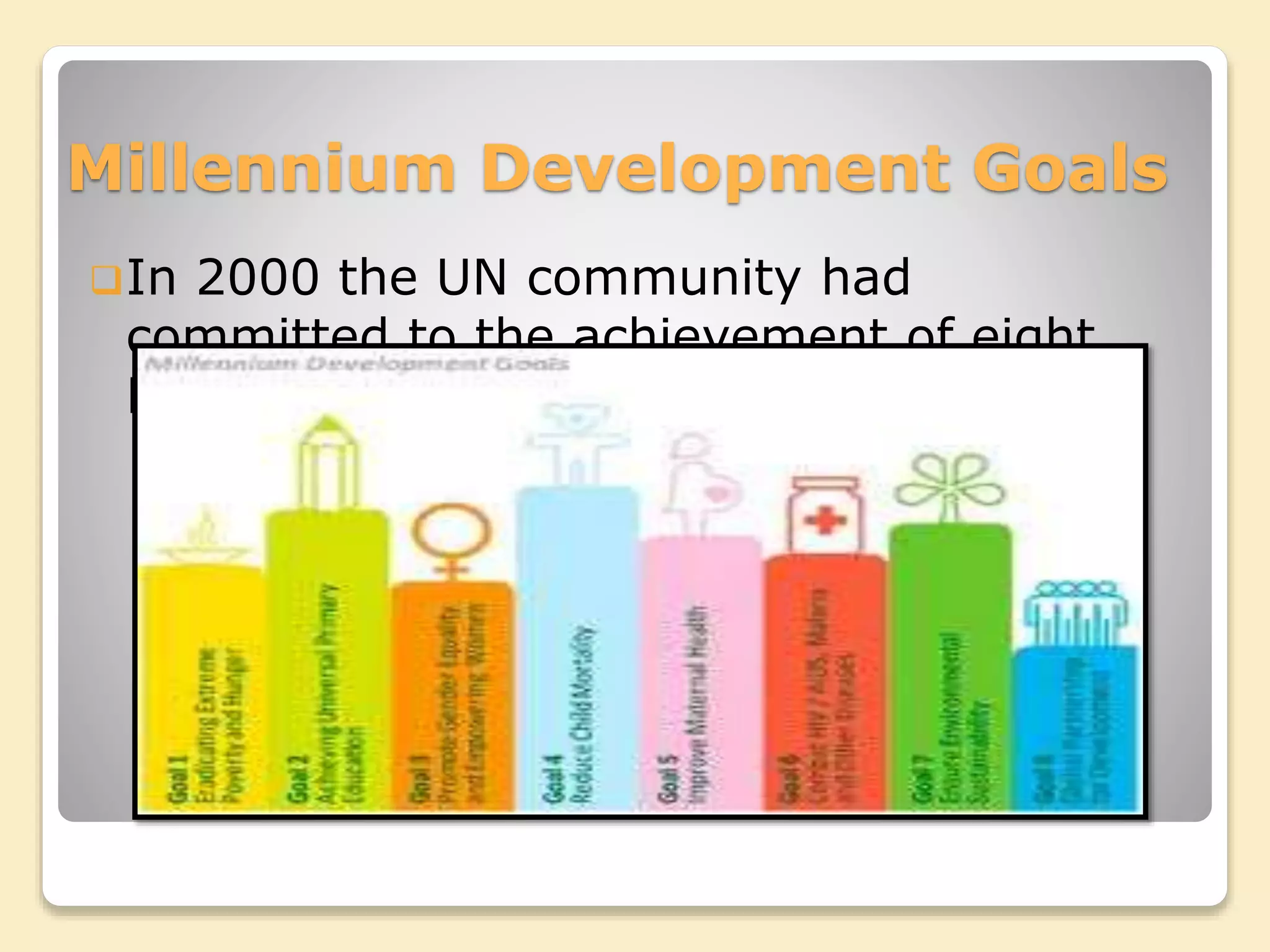
In 2000 the UN community had
committed to the achievement of eight
Millennium (MDG’s).
Rio+20
 On 24th December 2009 the UN General Assembly adopted a
Resolution agreeing to hold the United Nations Conference on
Sustainable Development (UNCSD) in 2012 - also referred to as
'Rio+20' or 'Rio 20'. The Conference seeks three objectives:
 The Member States have agreed on the following two themes for
the Conference: green economy within the context of
sustainable development and poverty eradication, and
institutional framework for sustainable development
 Since UNCED, sustainable development has become part of the
international lexicon. The concept has been incorporated in many
UN declarations and its implementation, while complex has been
at the forefront of world’s institutions and organizations working
in the economic, social and environmental sectors. However, they
all recognize how difficult it has proven to grant the
environmental pillar the same recognition enjoyed by the other
two pillars despite the many calls by scientists and civil society
signalling the vulnerability and precariousness of the Earth since
the 1960s.
Securing renewed political
commitment to sustainable
development.
Addressing new and emerging
challenges.
Assessing the progress and
implementation gaps in
meeting already agreed
commitments.
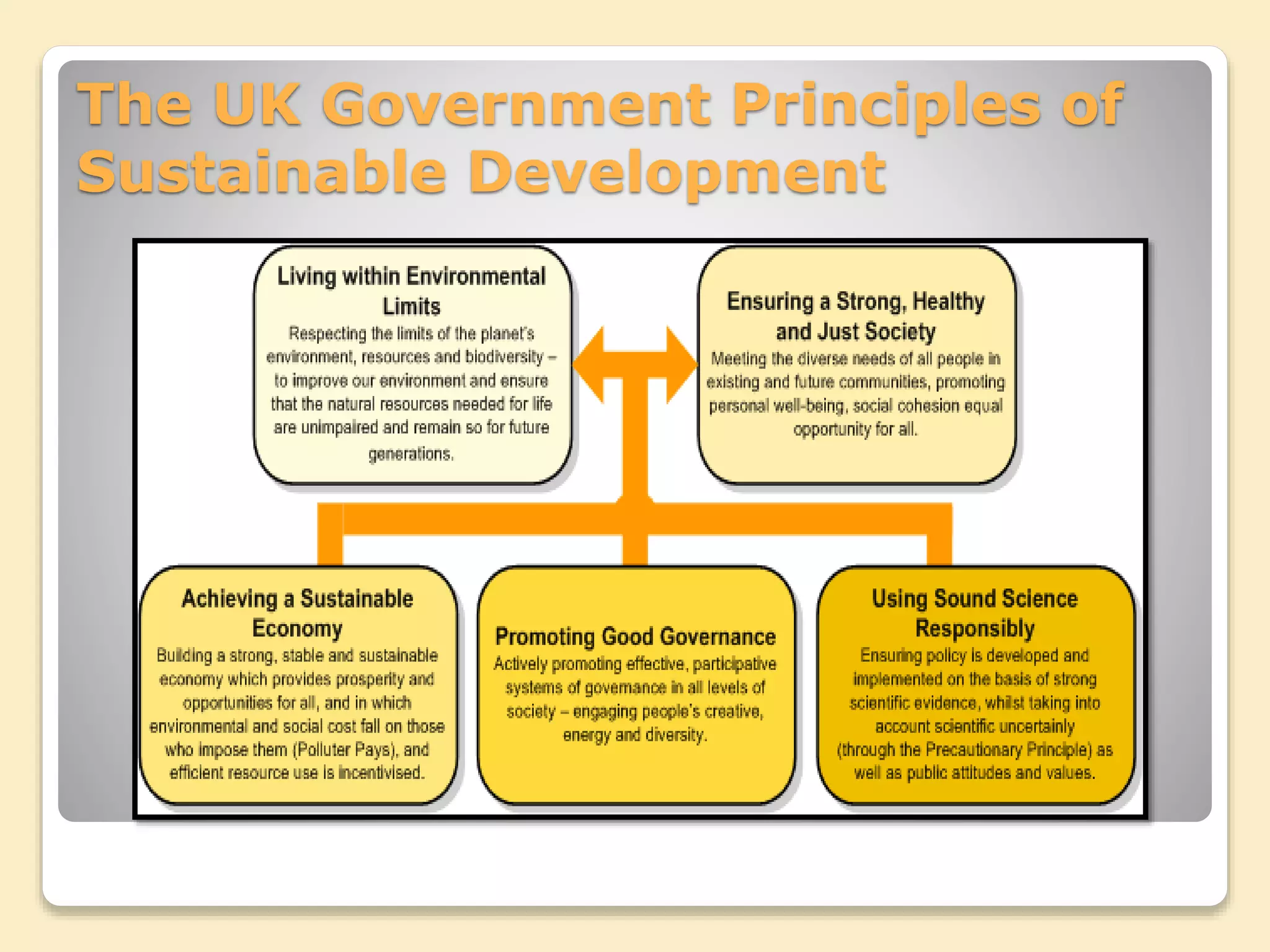
The UK Government Principles of
Sustainable Development
The Concept of Sustainable
Development
Sustainable Development refers to
maintaining development overtime.
As Jacob 1991 identified sustainable
development is a contestable concept that
like democracy or equality has a basic
meaning that almost everyone is in favor
but some conflicts also exists
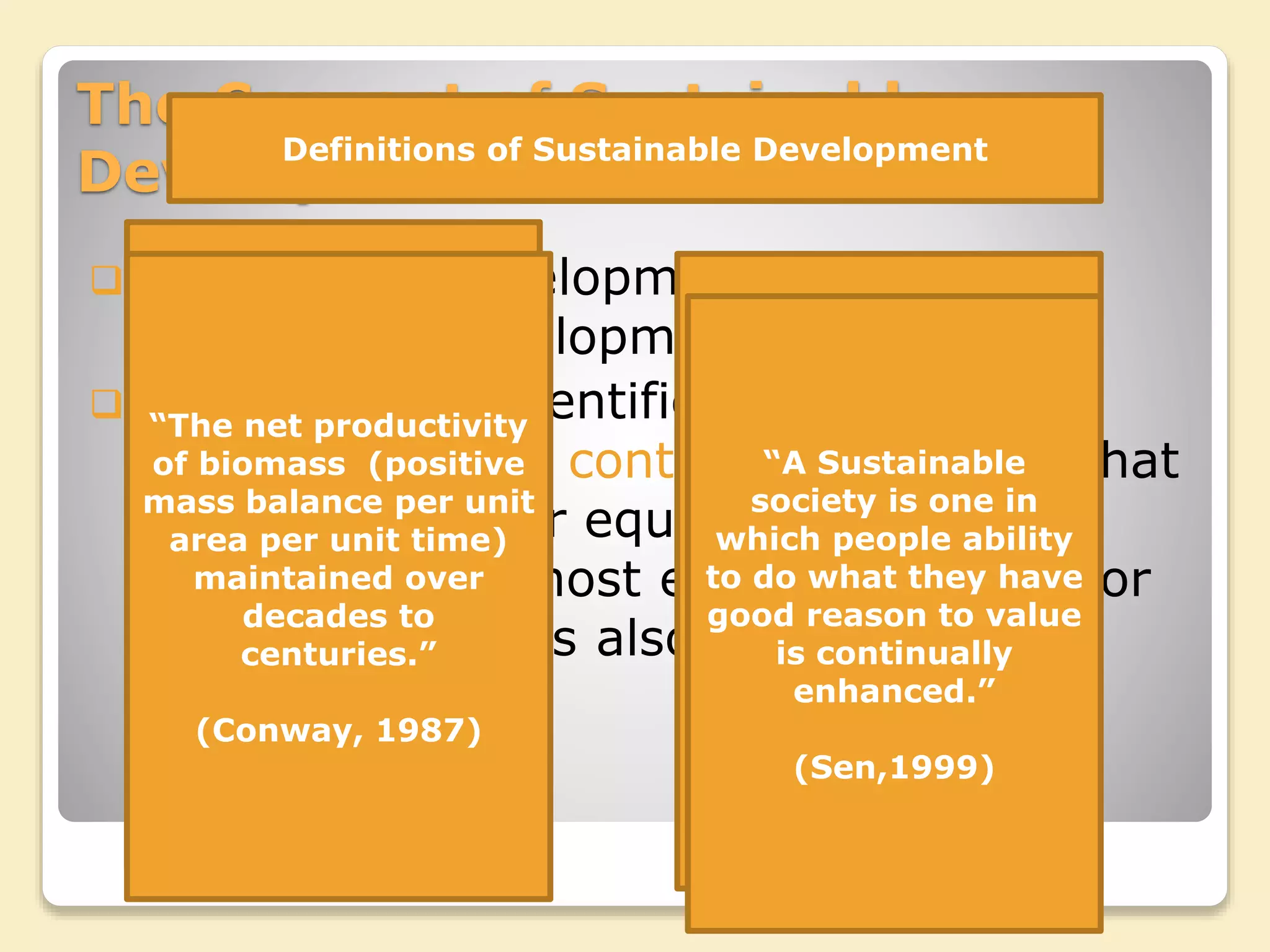
Definitions of Sustainable Development
“In principle such an
optimal(sustainable
growth) policy would
seek to maintain an
Acceptable rate of
growth in per-capita
real incomes without
depleting the
national capital asset
stock or the natural
environmental asset
stock.”
(Turner, 1998)
“The net productivity
of biomass (positive
mass balance per unit
area per unit time)
maintained over
decades to
centuries.”
(Conway, 1987)
“Development that
meets the needs of
the present without
compromising the
ability of future
generations to meet
their own needs.”
(WCED, 1987)
“A Sustainable
society is one in
which people ability
to do what they have
good reason to value
is continually
enhanced.”
(Sen,1999)
Interpretations of Sustainable Development
“Like Motherhood,
and God, it is
difficult not to
approve of it. At
the same time, the
idea of sustainable
development is
fraught with
contradiction.”
(Redclifft, 1997)
“It is
distinguishable
from the total
development of
society.”
(Barbier, 1987)
“Its very ambiguity
enables it to
transcends the
tensions inherent in
its meaning.”
(O’ Riordan, 1995)
“Sustainable
Development
appears to be an
over-used,
misunderstood
phrase.”
(Mawhinney, 2002)
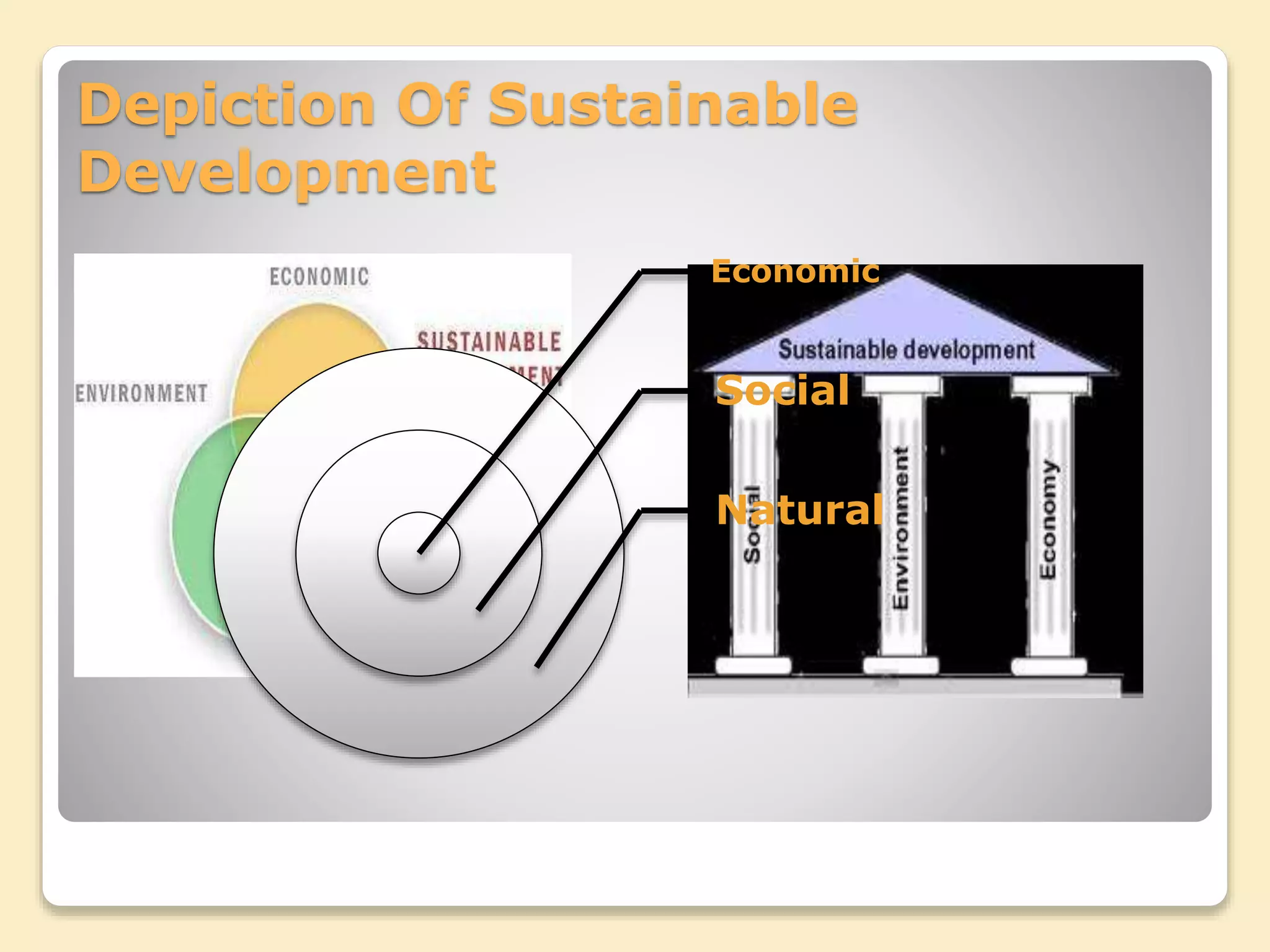
Depiction Of Sustainable
Development
Economic
Social
Natural
Disciplinary development of the
concept
The disciplines of very economics have also
been very important in shaping the concept
and practices of sustainable development.
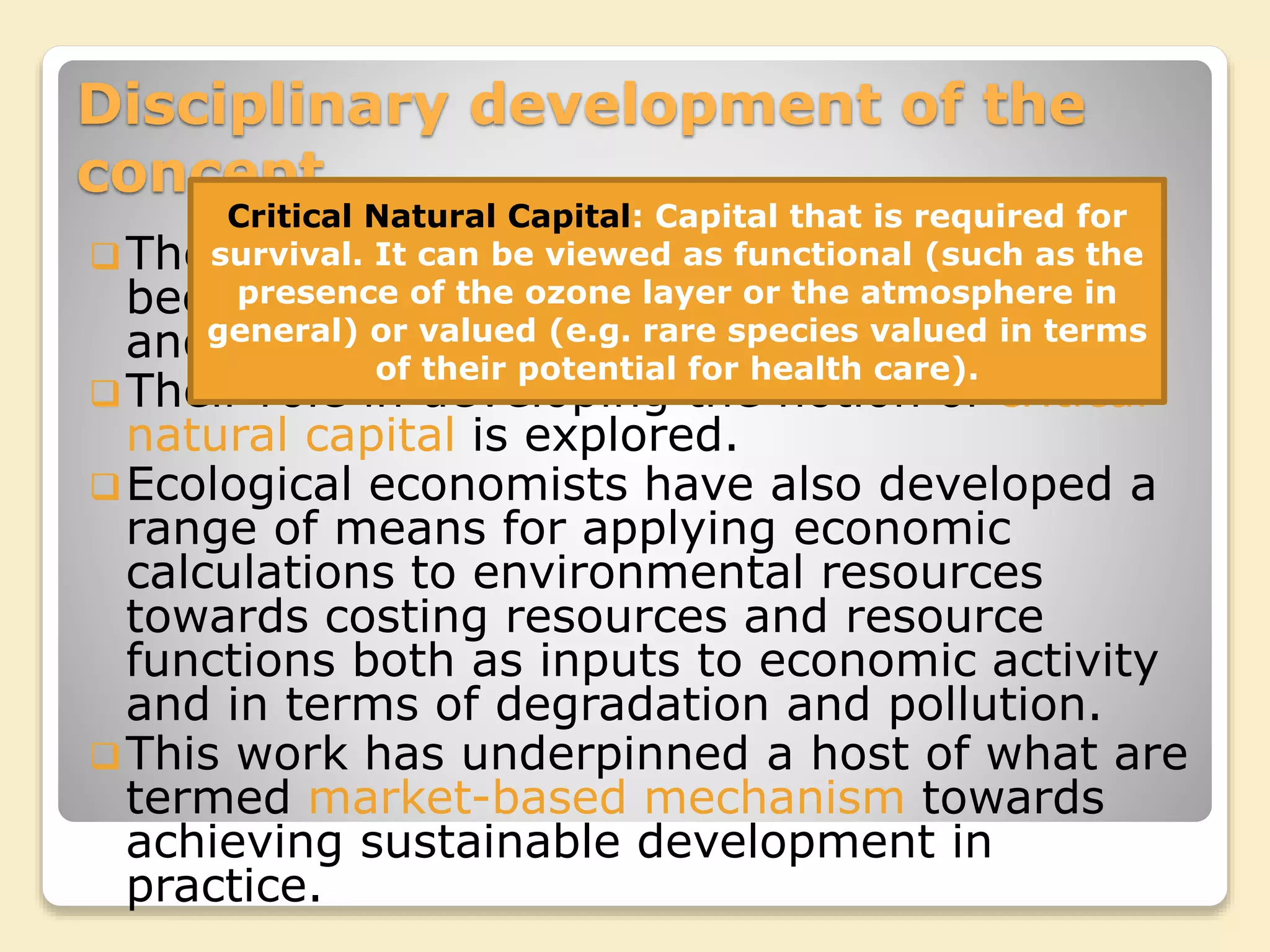
Their role in developing the notion of critical
natural capital is explored.
Ecological economists have also developed a
range of means for applying economic
calculations to environmental resources
towards costing resources and resource
functions both as inputs to economic activity
and in terms of degradation and pollution.
This work has underpinned a host of what are
termed market-based mechanism towards
achieving sustainable development in
practice.
Critical Natural Capital: Capital that is required for
survival. It can be viewed as functional (such as the
presence of the ozone layer or the atmosphere in
general) or valued (e.g. rare species valued in terms
of their potential for health care).
Essentially market-based mechanism
encompass measures to alter the economic
costs of particular behaviors and production
practices towards more sustainable
outcomes. Example: environmental taxes on
petrol use and solid waste disposal that make
these practices more costly to individuals and
businesses.
Sustainable development as a moral concept
that seeks to define a fair and just
development.
The concept of sustainable development is
itself challenge.
Gibson suggest that out of great diversity of
theoretical formulations & applications, an
essential commonality of shared concerns &
principles identified.
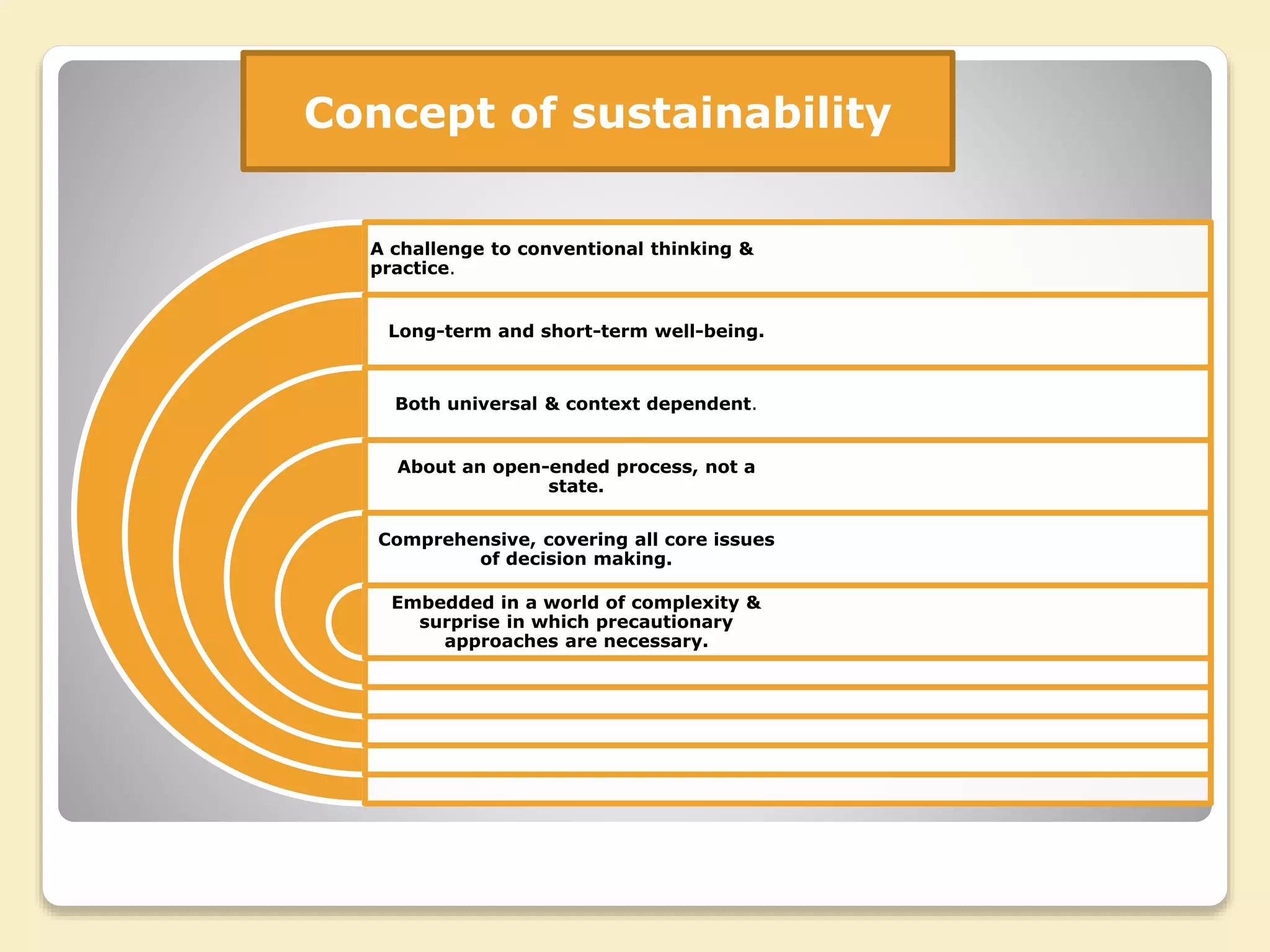
Concept of sustainability
A challenge to conventional thinking &
practice.
Long-term and short-term well-being.
Both universal & context dependent.
About an open-ended process, not a
state.
Comprehensive, covering all core issues
of decision making.
Embedded in a world of complexity &
surprise in which precautionary
approaches are necessary.
Challenging perception of
Development
 Poverty, hunger, disease and debt have been familiar words
within the lexicon of development.
 Development is discussed in relation to ‘developing
countries’, but is a concept which relates to all parts of the
world at every level, from the individual to global
transformations .
 Development is something to which we all aspire and
certainly in the more developed world, ‘self-development’
has become something that is actively encouraged and an
Endeavour on which large amounts of money are spent.
 The origin of modern era of international development as a
planned activity & of development studies as a subject is
suggested to link back to a speech made by President
Truman of US in 1949 when he employed the term ‘under
developed areas’ & identified poverty as the threat to
prosperity & peace for the world as a whole.
It was the time of post war recovery in
Europe for which US Administration had
provided financial assistance through
Marshall Plan.
44 countries largely from industrialized world
had also come together Bretton Woods
conference in 1944 to form the World Bank,
the International Monetary Fund & General
Agreement on Tariffs & Trade.
These new International organizations were
formulate to prevent the economic crisis &
conflict that had characterized the previous
period & ensure future economic stability,
prosperity and a more peaceful world.
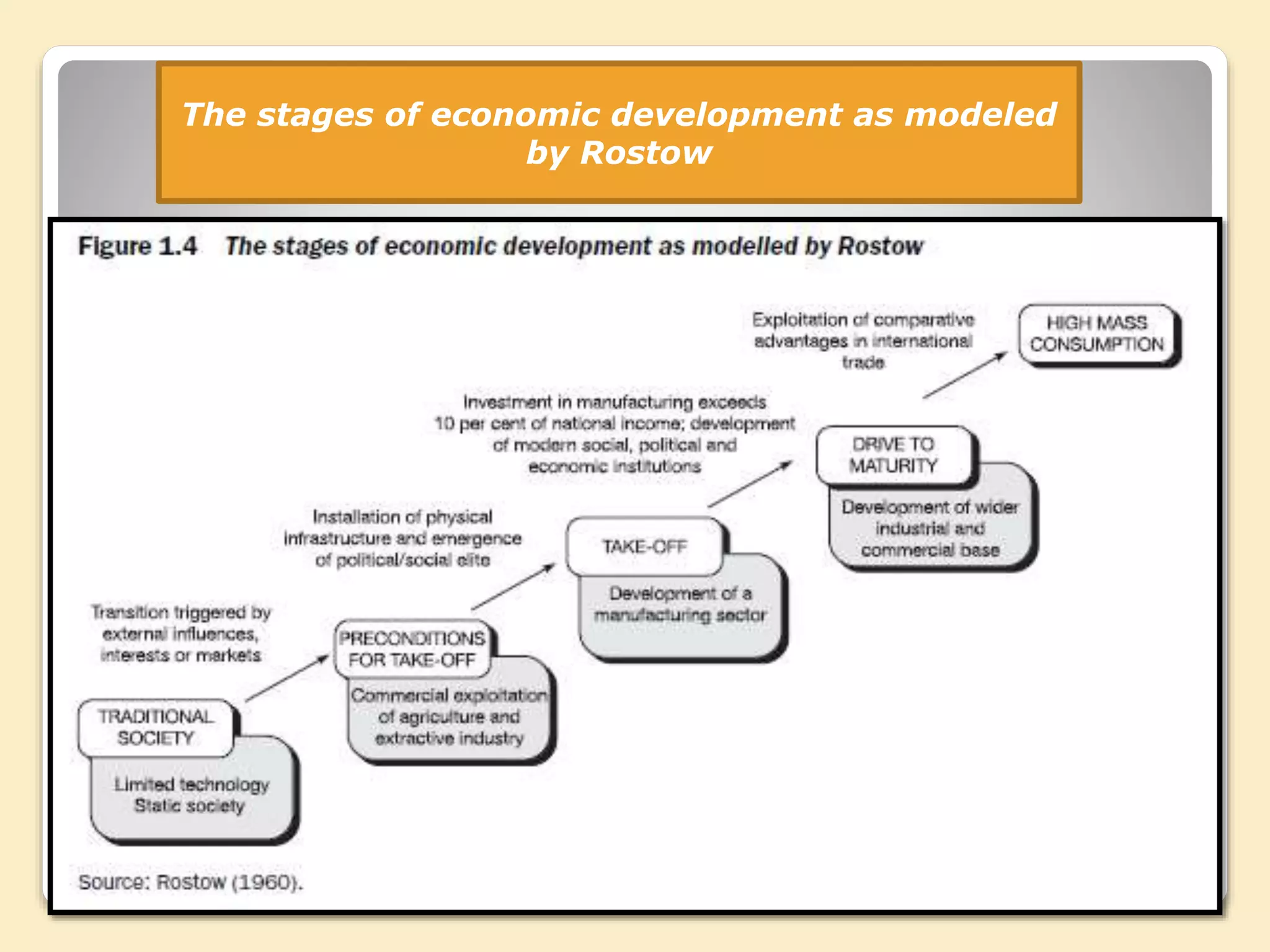
The stages of economic development as modeled
by Rostow
Furthermore, the rise of globalization
whereby countries & regions of world
were seen to be becoming more widely &
deeply interconnected and ever more
global in character, were also changing
the position of the nation state & national
governments across economic, social and
political spheres.
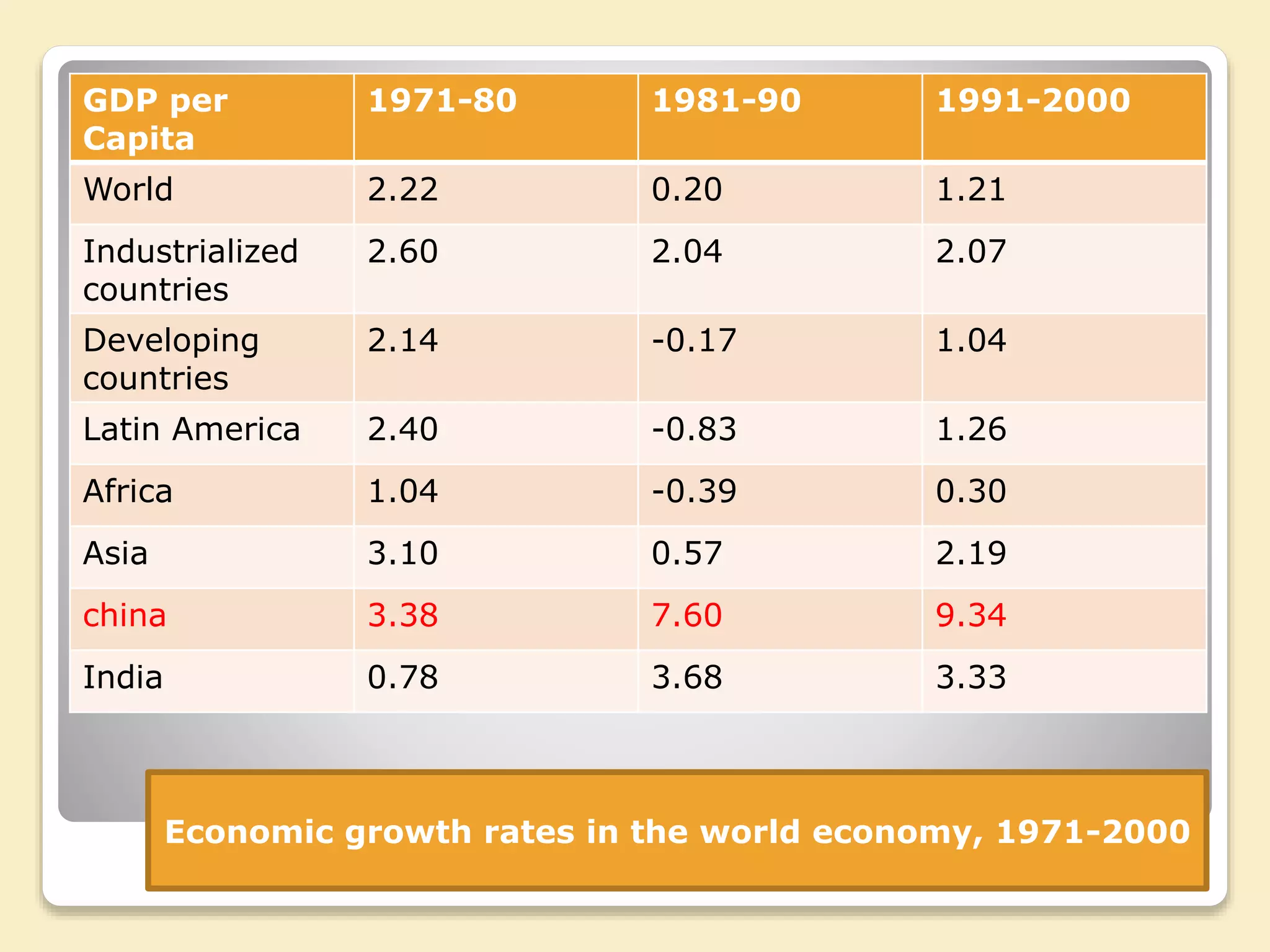
GDP per
Capita
1971-80 1981-90 1991-2000
World 2.22 0.20 1.21
Industrialized
countries
2.60 2.04 2.07
Developing
countries
2.14 -0.17 1.04
Latin America 2.40 -0.83 1.26
Africa 1.04 -0.39 0.30
Asia 3.10 0.57 2.19
china 3.38 7.60 9.34
India 0.78 3.68 3.33
Economic growth rates in the world economy, 1971-2000
Environmental Justice
Environmental Justice movement focused
on urban based injustices to people,
pollution, hazardous waste &
environmental dangers that were seen to
be spatially concentrated in poors &
minorities neighborhoods.
The movement challenged the major
environmental organizations to expand
their agendas into issues of community
health & urban community development.
The principles of Environmental
Justice
1. Opposes the destructive operations of multinational
corporations.
2. Opposes military occupation, repression &
exploitation of lands, people & cultures and other
life forms
3. Protects the rights of victims of Environmental
injustice to receive full compensation & reparation
for damages as well as quality health care.
4. Affirms the sacredness of Mother Earth, ecological
unity & the interdependence of all species, & the
right to be free from ecological destruction.
5. Mandates the right to ethical, balanced &
responsible uses of land & renewable resources in
the interest of a sustainable planet for humans &
other living things.
Conclusion
 Critically, sustainable development was
recognized as a global challenge: ultimately,
the achievement of environment and
development ends in any single location or
for any group of people is connected in some
way to what is happening elsewhere, for
others.
 By the end of the 1990s, the widespread
suggestion was that the world itself was
characterized by unprecedented rates and
degrees of economic, political and social
change and the understanding of sustainable
What is sustainable development

What is sustainable development

  • 1.
  • 2.
    Introduction 1. WCED 2. EarthSummit 3. WSSD 4. MGD’s All these are important conferences in which stress on Sustainable Development and introduced these latter and discuss on it.
  • 3.
    WCED  The reportof the World Commission on Environment and Development entitled Our Common Future (WCED, 1987) used term “sustainable development” and defined as “Development that meets the needs of the present without compromising the ability of the future generations to meet their own need.”  Their recommendations focused on integrating development strategies and environmental policies and global partnerships to meet the interdependent environmental concerns and development opportunities.
  • 4.
    Earth Summit The EarthSummit in Rio De Janerio, Brazil in 1992 was the largest ever international conference in which 116 heads of states gathered and first time and considered environment. The central aim was to identify the principles of an agenda for action towards sustainable development in the future. Agenda 21 document detailing the issues, the actors and the means for achieving sustainable development by putting into practice by the start of the 21 century.
  • 5.
    Structure of Agenda21 Social and economic dimensions Conservation and management of Resources and Development Strengthening the Role of Major Groups Means of Implementation
  • 6.
    A number ofimportant conventions were also agreed at Rio, including the Convention on Biodiversity and the Framework Convention on Climate Change in recognition of the growing problems of sustainable use of ecosystem and of human-induced climate change. There was an optimism concerning a common interest on behalf of countries globally and between current and future generation that drive sustainable development into practice.
  • 7.
    WSSD 104 heads ofstate gathered again for the UN World Summit on Sustainable Development (WSSD) in Johannesburg, South Africa. The aim was to reinvigorate at the highest political level, the global commitment to a North-South partnership to achieve sustainable development. Key concerns at the start of the 21 century were for the continued degradation of environmental systems since Rio, but also for the persistence of poverty and evidence of widening global disparities.
  • 8.
    WSSD a centralconcern was the impacts of globalization on the poor. People and places were closely linked together within global markets and through flows of finance. Poverty, inequality and exclusion were identified as threats not just to the environment and economic prosperity but also to future security and democracy.
  • 9.
    Millennium Development Goals In2000 the UN community had committed to the achievement of eight Millennium (MDG’s).
  • 10.
    Rio+20  On 24thDecember 2009 the UN General Assembly adopted a Resolution agreeing to hold the United Nations Conference on Sustainable Development (UNCSD) in 2012 - also referred to as 'Rio+20' or 'Rio 20'. The Conference seeks three objectives:  The Member States have agreed on the following two themes for the Conference: green economy within the context of sustainable development and poverty eradication, and institutional framework for sustainable development  Since UNCED, sustainable development has become part of the international lexicon. The concept has been incorporated in many UN declarations and its implementation, while complex has been at the forefront of world’s institutions and organizations working in the economic, social and environmental sectors. However, they all recognize how difficult it has proven to grant the environmental pillar the same recognition enjoyed by the other two pillars despite the many calls by scientists and civil society signalling the vulnerability and precariousness of the Earth since the 1960s. Securing renewed political commitment to sustainable development. Addressing new and emerging challenges. Assessing the progress and implementation gaps in meeting already agreed commitments.
  • 11.
    The UK GovernmentPrinciples of Sustainable Development
  • 12.
    The Concept ofSustainable Development Sustainable Development refers to maintaining development overtime. As Jacob 1991 identified sustainable development is a contestable concept that like democracy or equality has a basic meaning that almost everyone is in favor but some conflicts also exists Definitions of Sustainable Development “In principle such an optimal(sustainable growth) policy would seek to maintain an Acceptable rate of growth in per-capita real incomes without depleting the national capital asset stock or the natural environmental asset stock.” (Turner, 1998) “The net productivity of biomass (positive mass balance per unit area per unit time) maintained over decades to centuries.” (Conway, 1987) “Development that meets the needs of the present without compromising the ability of future generations to meet their own needs.” (WCED, 1987) “A Sustainable society is one in which people ability to do what they have good reason to value is continually enhanced.” (Sen,1999)
  • 13.
    Interpretations of SustainableDevelopment “Like Motherhood, and God, it is difficult not to approve of it. At the same time, the idea of sustainable development is fraught with contradiction.” (Redclifft, 1997) “It is distinguishable from the total development of society.” (Barbier, 1987) “Its very ambiguity enables it to transcends the tensions inherent in its meaning.” (O’ Riordan, 1995) “Sustainable Development appears to be an over-used, misunderstood phrase.” (Mawhinney, 2002)
  • 14.
  • 15.
    Disciplinary development ofthe concept The disciplines of very economics have also been very important in shaping the concept and practices of sustainable development. Their role in developing the notion of critical natural capital is explored. Ecological economists have also developed a range of means for applying economic calculations to environmental resources towards costing resources and resource functions both as inputs to economic activity and in terms of degradation and pollution. This work has underpinned a host of what are termed market-based mechanism towards achieving sustainable development in practice. Critical Natural Capital: Capital that is required for survival. It can be viewed as functional (such as the presence of the ozone layer or the atmosphere in general) or valued (e.g. rare species valued in terms of their potential for health care).
  • 16.
    Essentially market-based mechanism encompassmeasures to alter the economic costs of particular behaviors and production practices towards more sustainable outcomes. Example: environmental taxes on petrol use and solid waste disposal that make these practices more costly to individuals and businesses. Sustainable development as a moral concept that seeks to define a fair and just development. The concept of sustainable development is itself challenge. Gibson suggest that out of great diversity of theoretical formulations & applications, an essential commonality of shared concerns & principles identified.
  • 17.
    Concept of sustainability Achallenge to conventional thinking & practice. Long-term and short-term well-being. Both universal & context dependent. About an open-ended process, not a state. Comprehensive, covering all core issues of decision making. Embedded in a world of complexity & surprise in which precautionary approaches are necessary.
  • 18.
    Challenging perception of Development Poverty, hunger, disease and debt have been familiar words within the lexicon of development.  Development is discussed in relation to ‘developing countries’, but is a concept which relates to all parts of the world at every level, from the individual to global transformations .  Development is something to which we all aspire and certainly in the more developed world, ‘self-development’ has become something that is actively encouraged and an Endeavour on which large amounts of money are spent.  The origin of modern era of international development as a planned activity & of development studies as a subject is suggested to link back to a speech made by President Truman of US in 1949 when he employed the term ‘under developed areas’ & identified poverty as the threat to prosperity & peace for the world as a whole.
  • 19.
    It was thetime of post war recovery in Europe for which US Administration had provided financial assistance through Marshall Plan. 44 countries largely from industrialized world had also come together Bretton Woods conference in 1944 to form the World Bank, the International Monetary Fund & General Agreement on Tariffs & Trade. These new International organizations were formulate to prevent the economic crisis & conflict that had characterized the previous period & ensure future economic stability, prosperity and a more peaceful world.
  • 20.
    The stages ofeconomic development as modeled by Rostow
  • 21.
    Furthermore, the riseof globalization whereby countries & regions of world were seen to be becoming more widely & deeply interconnected and ever more global in character, were also changing the position of the nation state & national governments across economic, social and political spheres.
  • 22.
    GDP per Capita 1971-80 1981-901991-2000 World 2.22 0.20 1.21 Industrialized countries 2.60 2.04 2.07 Developing countries 2.14 -0.17 1.04 Latin America 2.40 -0.83 1.26 Africa 1.04 -0.39 0.30 Asia 3.10 0.57 2.19 china 3.38 7.60 9.34 India 0.78 3.68 3.33 Economic growth rates in the world economy, 1971-2000
  • 23.
    Environmental Justice Environmental Justicemovement focused on urban based injustices to people, pollution, hazardous waste & environmental dangers that were seen to be spatially concentrated in poors & minorities neighborhoods. The movement challenged the major environmental organizations to expand their agendas into issues of community health & urban community development.
  • 24.
    The principles ofEnvironmental Justice 1. Opposes the destructive operations of multinational corporations. 2. Opposes military occupation, repression & exploitation of lands, people & cultures and other life forms 3. Protects the rights of victims of Environmental injustice to receive full compensation & reparation for damages as well as quality health care. 4. Affirms the sacredness of Mother Earth, ecological unity & the interdependence of all species, & the right to be free from ecological destruction. 5. Mandates the right to ethical, balanced & responsible uses of land & renewable resources in the interest of a sustainable planet for humans & other living things.
  • 25.
    Conclusion  Critically, sustainabledevelopment was recognized as a global challenge: ultimately, the achievement of environment and development ends in any single location or for any group of people is connected in some way to what is happening elsewhere, for others.  By the end of the 1990s, the widespread suggestion was that the world itself was characterized by unprecedented rates and degrees of economic, political and social change and the understanding of sustainable