The document discusses sustainable development, defined as meeting present needs without compromising future generations' ability to meet theirs. It highlights the importance of balancing economic, environmental, and social needs, and outlines the history and goals of sustainable development, including Agenda 21. Key challenges such as inequitable growth, loss of biodiversity, and climate change are identified, along with actions individuals can take to promote sustainability.
OUT LINE
• Introduction
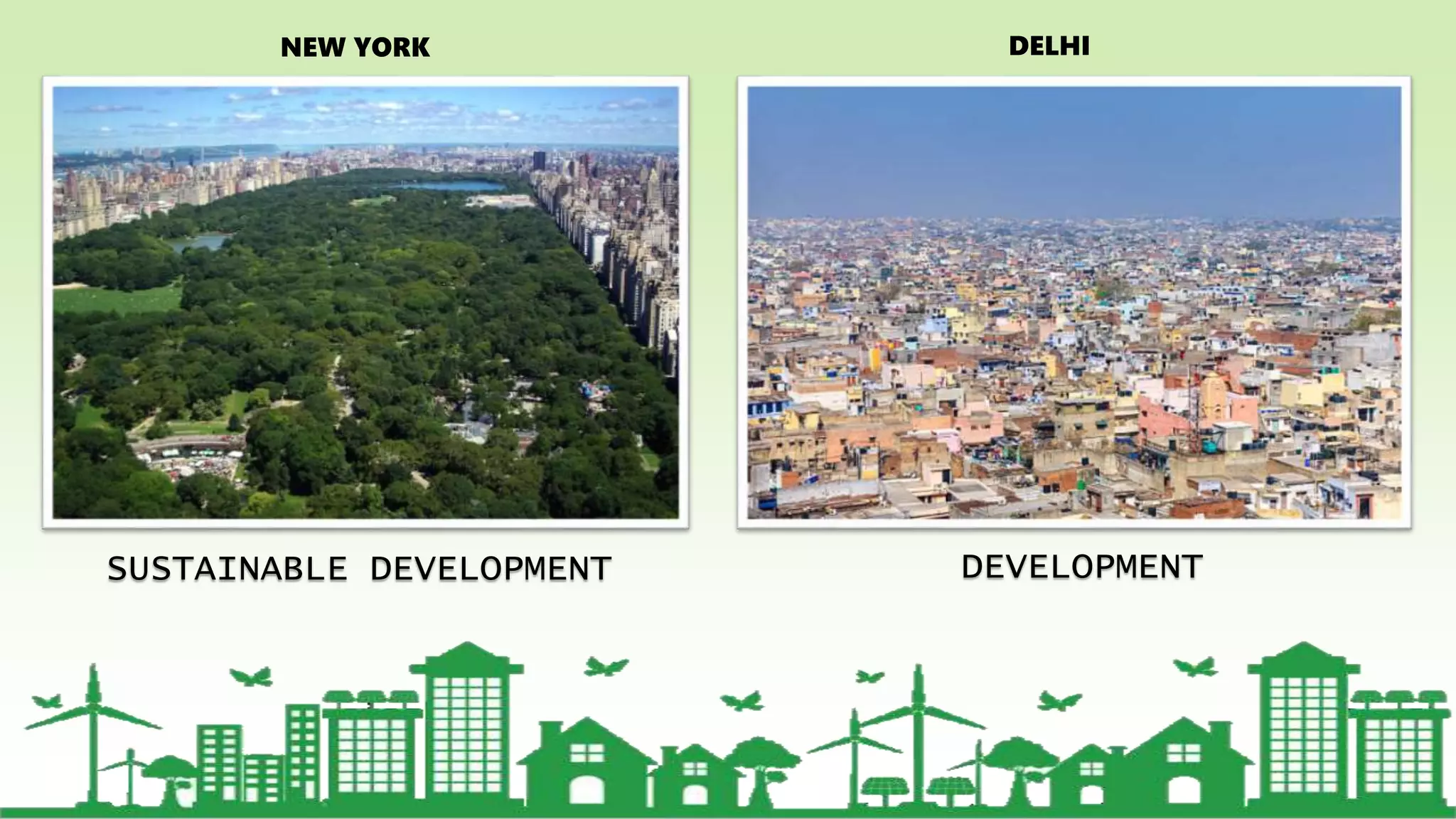
•Difference between
• Development and sustainable development
• Objectives
• Why Sustainable development importance for us
• What is Agenda 21
• Problems
• Goal of sustainable development
• What can we do?
• Conclusion
• Reference
3.
WHAT IS SUSTAINABLEDEVELOPMENT
Sustainable development is development that meets the needs of the present, without
compromising the ability of future generations to meet their own needs.
The concept of sustainable development can be interpreted in many different ways, but at its core is
an approach to development that looks to balance different, and often competing, needs against an
awareness of the environmental, social and economic limitations we face as a society.
4.
DIFFERENCE BETWEEN DEVELOPMENTAND
SUSTAINABLE DEVELOPMENT
THE MAIN DIFFERENCE BETWEEN THE DEVELOPMENT AND SUSTAINABLE DEVELOPMENT IS THAT
DEVELOPMENT AIMS AT RAISING THE QUALITY OF ONLY PRESENT LIFE, WHEREAS, THE SUSTAINABLE
DEVELOPMENT AIMS AT RAISING THE QUALITY OF PRESENT LIFE, WITHOUT COMPROMISING THE FUTURE
LIFE NEEDS.
Development means the rate of production is greater than the rate of increase in population and the rate of growth
of GDP is high enough to fulfil the basic needs of the population.
Sustainable Development is development that meets the needs of the present without compromising the ability of
future generations to meet their own needs.
1992 -UN Conference on Environment and Development (UNCED), also known as the Earth Summit.
1993 – the creation of the Commission for Sustainable Development to monitor and promote the implementation of
Agenda 21;
1997 – Earth Summit +5, which reviewed and renewed commitment to implementation of Agenda 21;
2000 – Millennium Summit in New York, which resulted in the UN Millennium Declaration, a set of targets to be achieved
by 2015 that included environmental sustainability, the eradication of extreme poverty and equality for women, now
known as the Millennium Development Goals;
2012 – Rio+20, which resulted in an outcome document, The Future We Want, in which States reaffirmed commitments to
all previous SD agreements, plans and targets. They also committed to develop a suite of Sustainable Development Goals
(SDGs) building on the priorities identified in Agenda 21 and the JPOI
7.
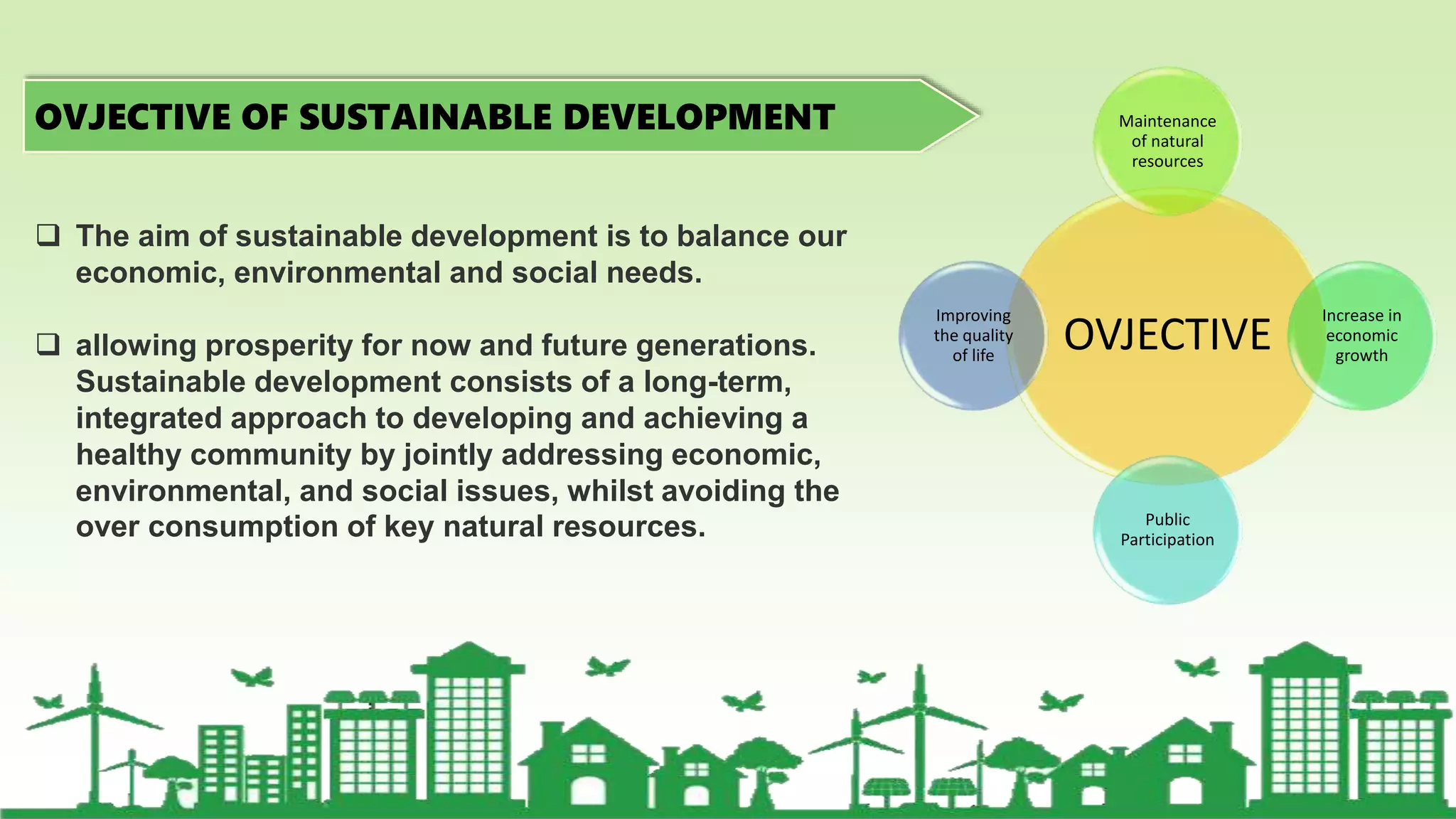
OVJECTIVE OF SUSTAINABLEDEVELOPMENT
OVJECTIVE
Maintenance
of natural
resources
Increase in
economic
growth
Public
Participation
Improving
the quality
of life
The aim of sustainable development is to balance our
economic, environmental and social needs.
allowing prosperity for now and future generations.
Sustainable development consists of a long-term,
integrated approach to developing and achieving a
healthy community by jointly addressing economic,
environmental, and social issues, whilst avoiding the
over consumption of key natural resources.
8.
WHY SUSTAINABLE DEVELOPMENTIMPORTANCE FOR US
Sustainable development helps us in conserving natural or non-renewable resources for future use.
Economic growth is necessary for developing countries. Sustainable development helps in attaining
economic growth. It helps in enhancing our resource base
It promotes fair use of natural resources. This helps in conserving our resource base.
It maintains the ecological balance in the ecosystem.
It balances the economical, social, and environmental needs.
Sustainability brings harmony between nature and human beings.
9.
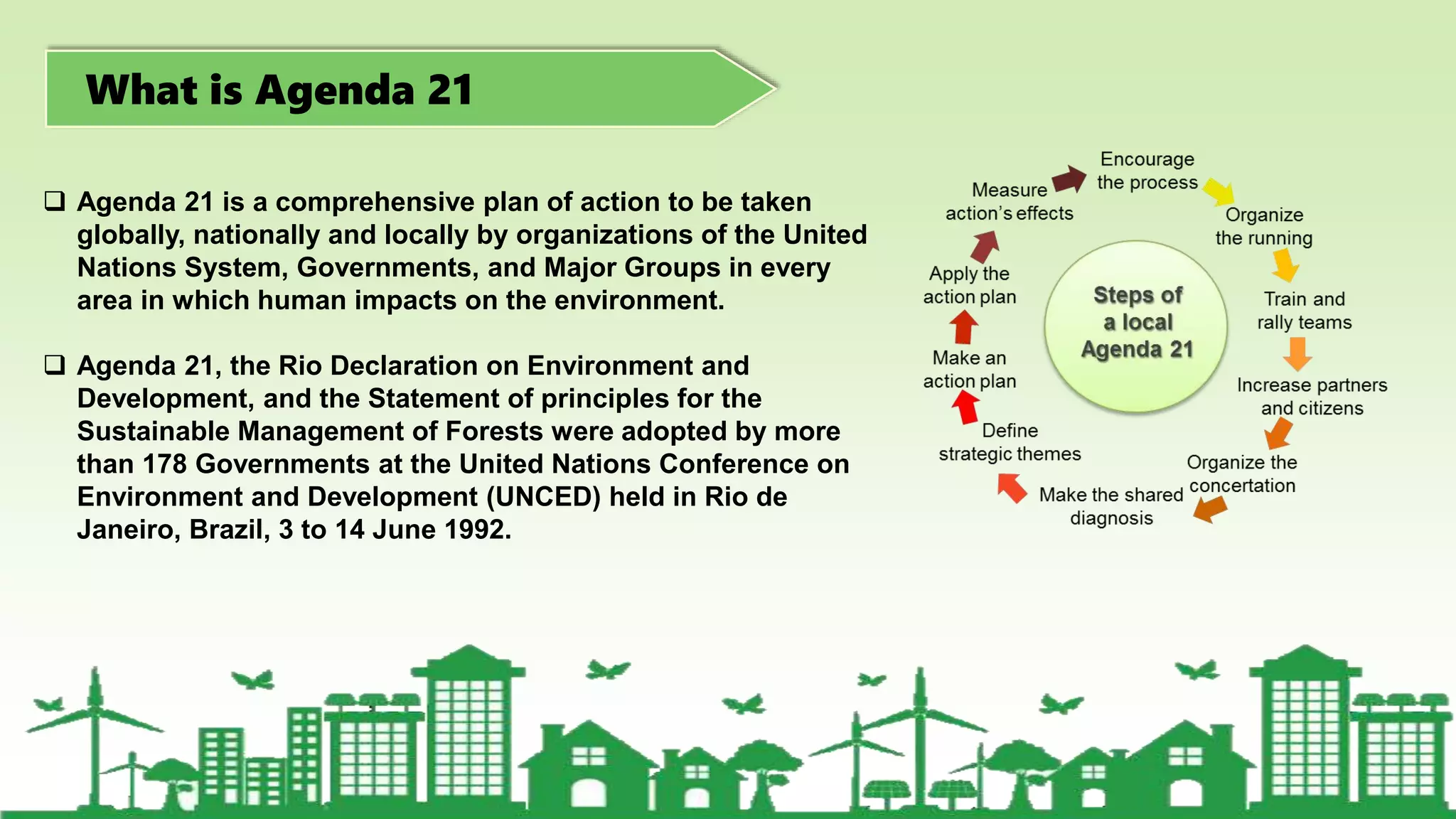
What is Agenda21
Agenda 21 is a comprehensive plan of action to be taken
globally, nationally and locally by organizations of the United
Nations System, Governments, and Major Groups in every
area in which human impacts on the environment.
Agenda 21, the Rio Declaration on Environment and
Development, and the Statement of principles for the
Sustainable Management of Forests were adopted by more
than 178 Governments at the United Nations Conference on
Environment and Development (UNCED) held in Rio de
Janeiro, Brazil, 3 to 14 June 1992.
10.
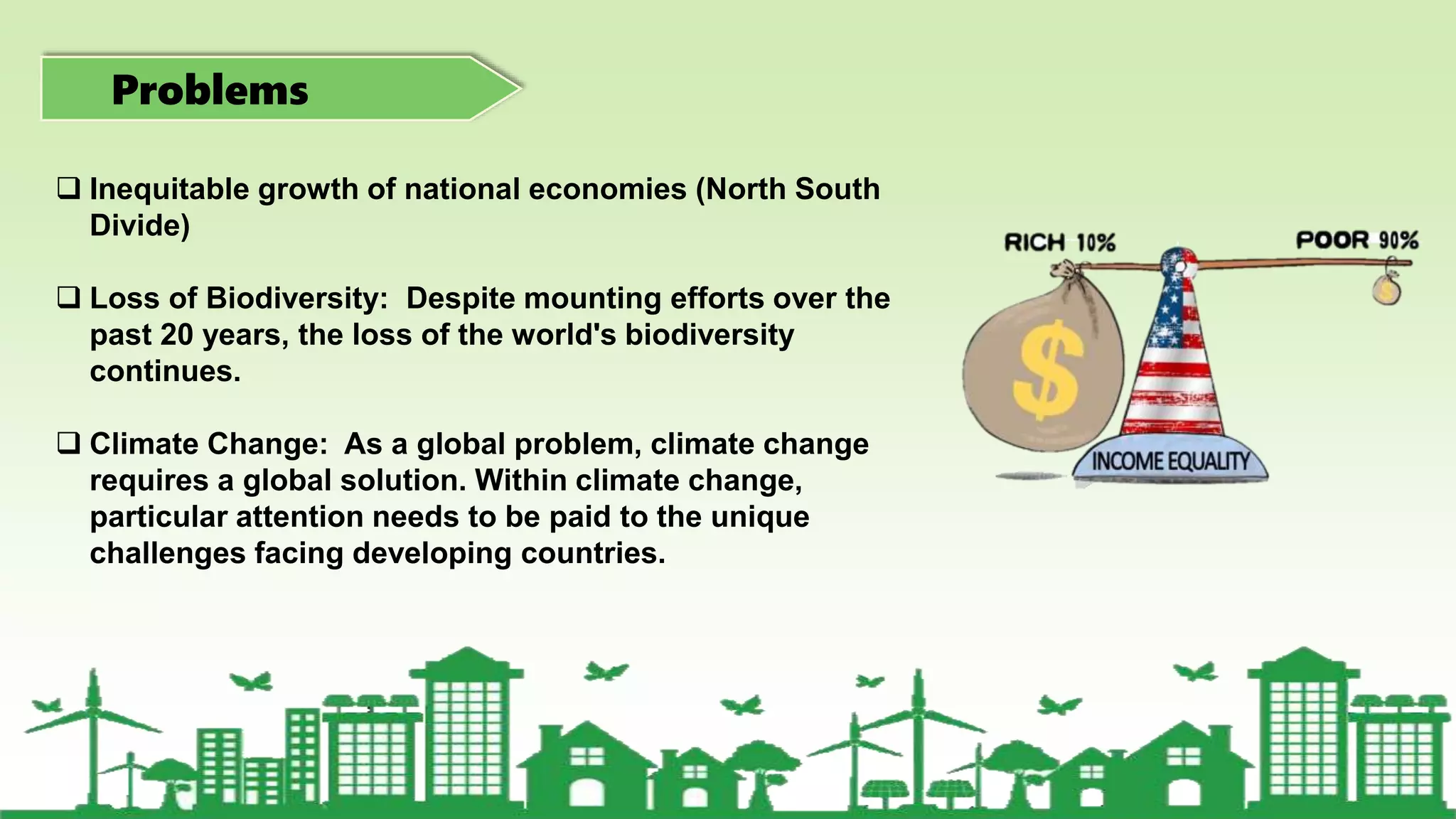
Problems
Inequitable growthof national economies (North South
Divide)
Loss of Biodiversity: Despite mounting efforts over the
past 20 years, the loss of the world's biodiversity
continues.
Climate Change: As a global problem, climate change
requires a global solution. Within climate change,
particular attention needs to be paid to the unique
challenges facing developing countries.
11.
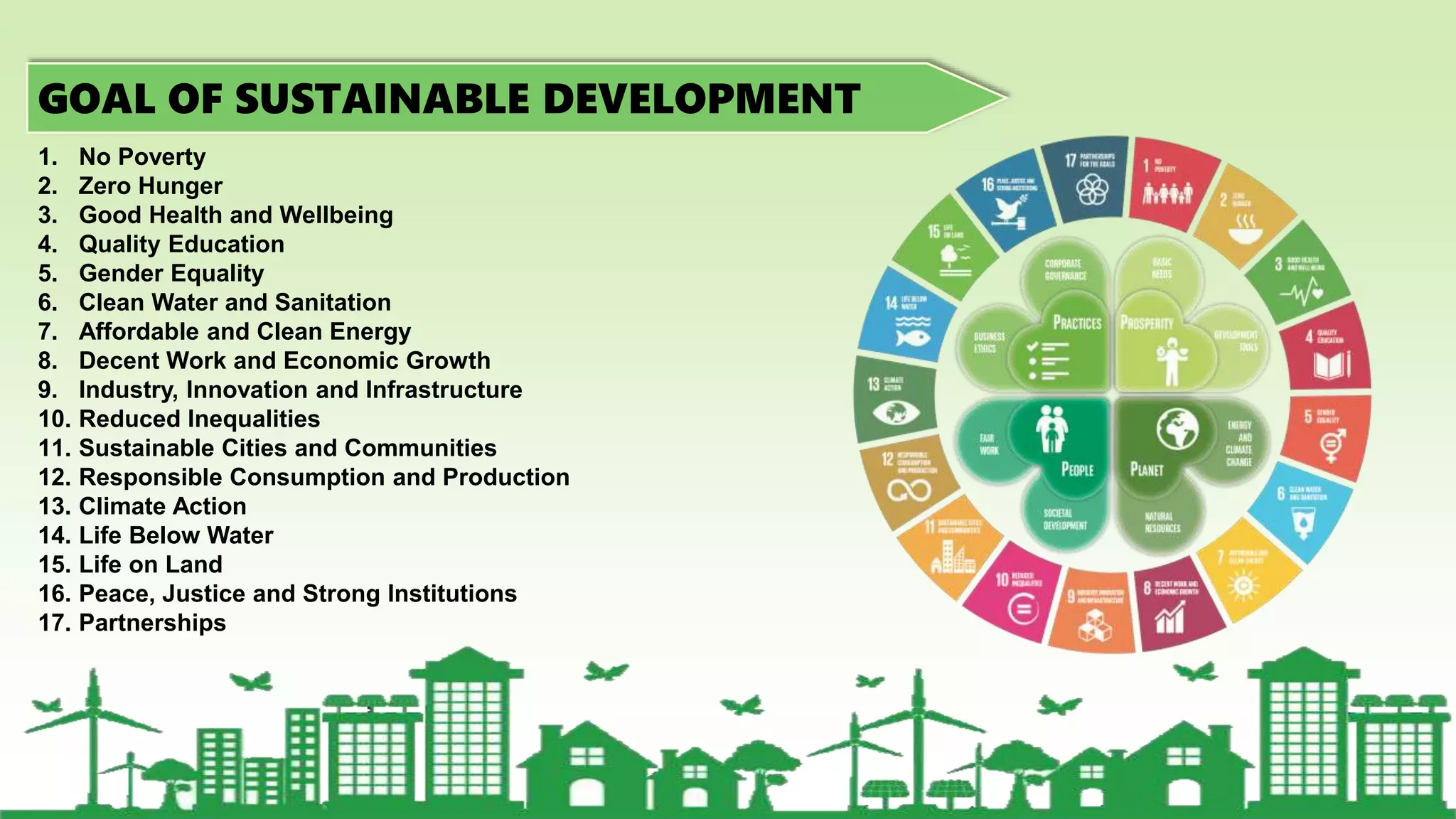
GOAL OF SUSTAINABLEDEVELOPMENT
1. No Poverty
2. Zero Hunger
3. Good Health and Wellbeing
4. Quality Education
5. Gender Equality
6. Clean Water and Sanitation
7. Affordable and Clean Energy
8. Decent Work and Economic Growth
9. Industry, Innovation and Infrastructure
10. Reduced Inequalities
11. Sustainable Cities and Communities
12. Responsible Consumption and Production
13. Climate Action
14. Life Below Water
15. Life on Land
16. Peace, Justice and Strong Institutions
17. Partnerships
12.
WHAT CAN WEDO?
1) Save electricity by turning off appliances when not in
use – and use energy friendly light bulbs.
2) Turn off the light and take advantage of the natural light
instead.
3) Think before you print! – And recycle the paper you do
use for printing.
4) Actually just recycle: Paper, plastic, glass, aluminum…
5) Take short showers and save water.
13.
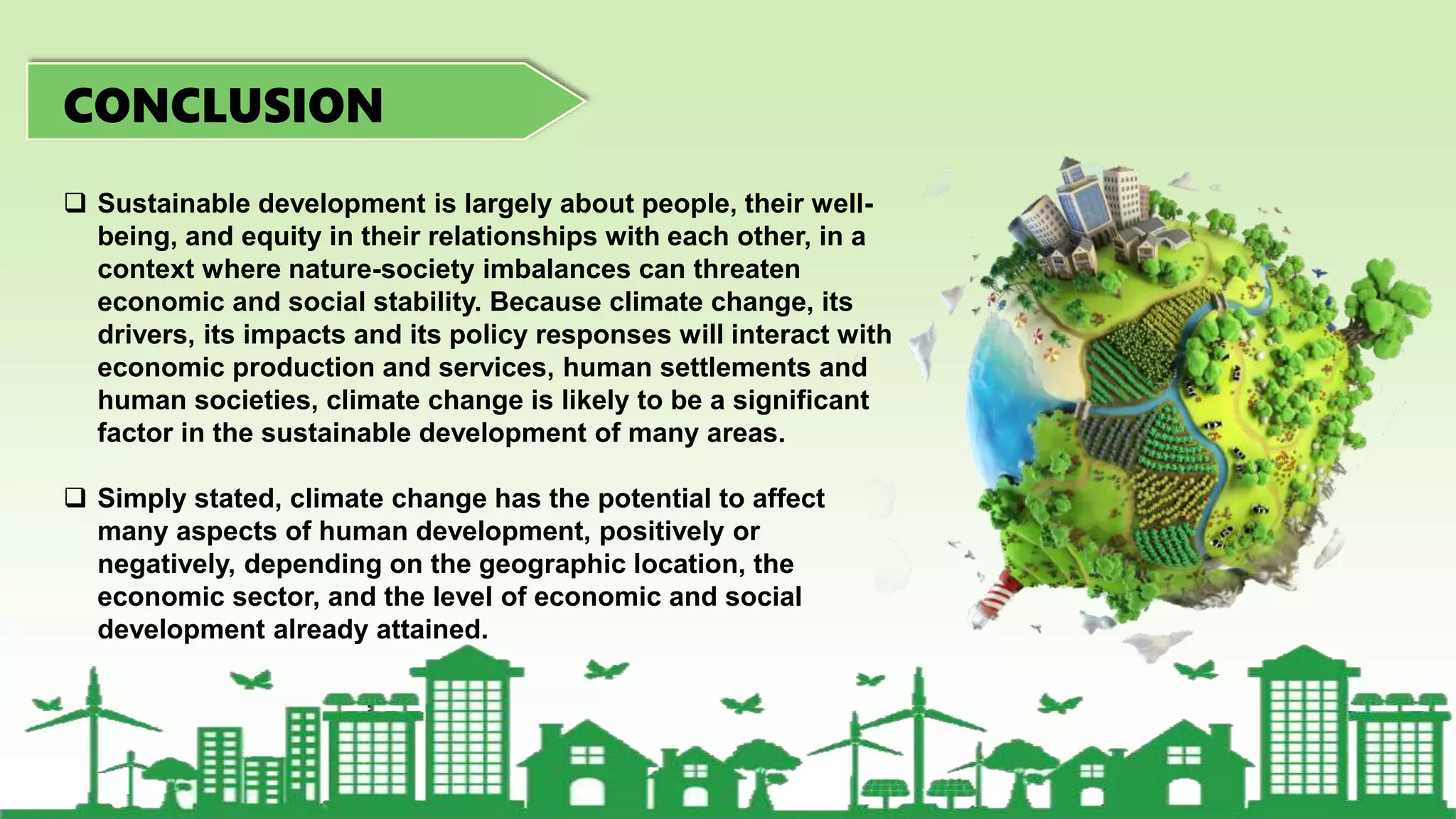
Sustainable developmentis largely about people, their well-
being, and equity in their relationships with each other, in a
context where nature-society imbalances can threaten
economic and social stability. Because climate change, its
drivers, its impacts and its policy responses will interact with
economic production and services, human settlements and
human societies, climate change is likely to be a significant
factor in the sustainable development of many areas.
Simply stated, climate change has the potential to affect
many aspects of human development, positively or
negatively, depending on the geographic location, the
economic sector, and the level of economic and social
development already attained.
CONCLUSION



![sustainable-development in tech-ppt[1].pptx](https://cdn.slidesharecdn.com/ss_thumbnails/sustainable-development-ppt1-250812002018-7e03cf38-thumbnail.jpg?width=640&height=640&fit=bounds)


