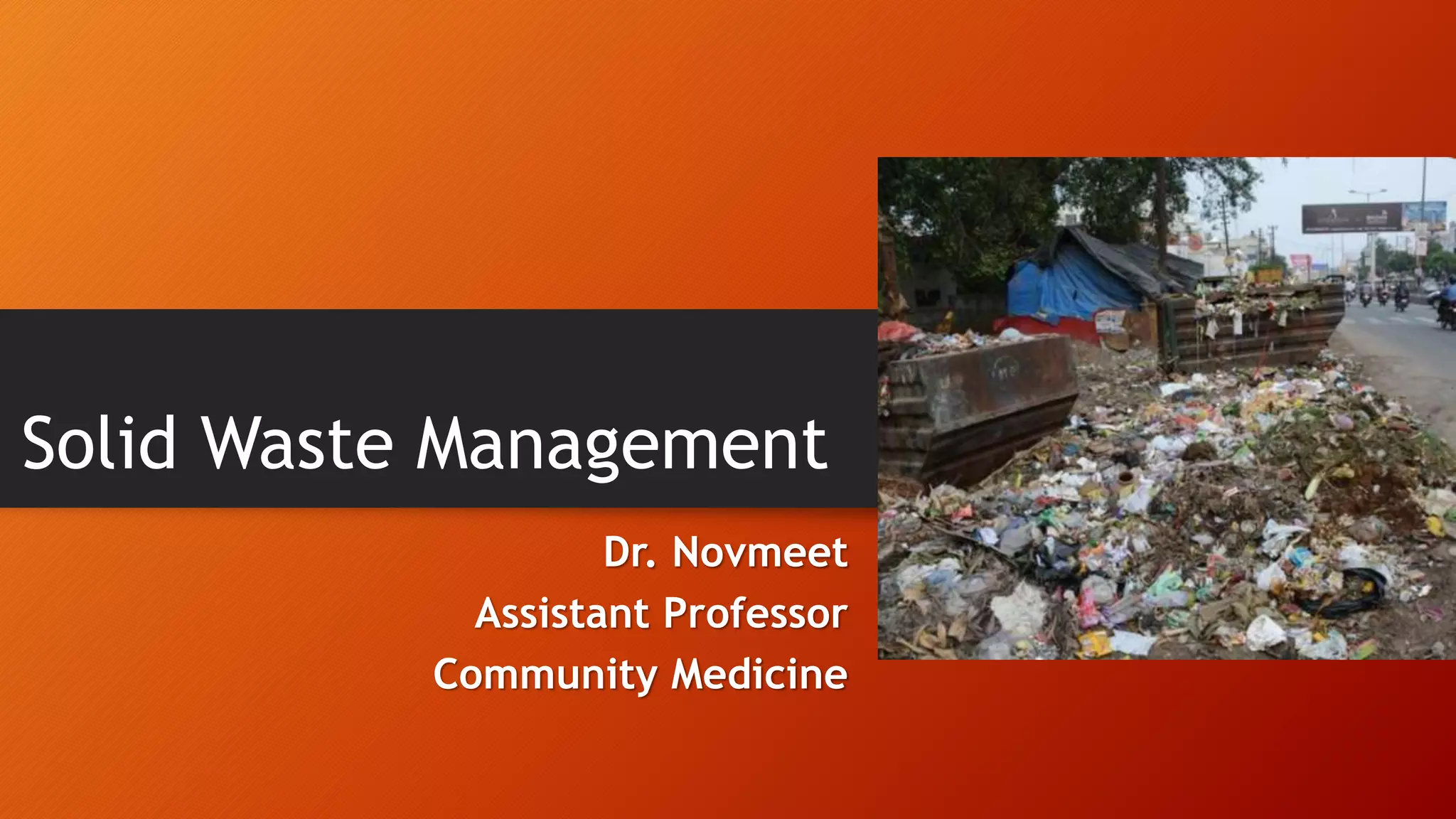
Solid Waste Management
Dr. Novmeet
Assistant Professor
Community Medicine
Solid Waste
• is defined as
“non liquid, non-soluble materials ranging from
municipal garbage to industrial wastes that
contain complex & sometimes hazardous
substances”
Garbage
Rubbish
Demolition products
Sewage treatment residue
Dead animals
Manure and other discarded material
-- Per capita solid waste out put 0.25-2.5 Kg/day
Solid waste also includes
Solid waste, if allowed to accumulate, is a
health hazard because:
• It decomposes and favors fly breeding
• Attracts rodents and vermin
• Pathogens which may be present in waste maybe
conveyed back to man
• Possibility of water and soil pollution
• Unsightly appearance and nuisance from bad
odours
Sources of Refuse
• Street Refuse : collected by the street cleansing
services or scavenging
• Market refuse : collected from market
• Stable litter : collected from stables. Mainly animal
droppings and left over animal feed
• Industrial refuse : wide variety ranging from completely
inert materials like calcium carbonate to highly toxic and
explosive compounds
• Domestic refuse : ash, rubbish and garbage.
Types of waste
• Broadly there are 3 types of waste
which as follows :
1. Household waste as municipal waste
2. Industrial waste as hazardous waste
3. Biomedical waste or hospital waste
as infectious waste
Municipal Solid Waste
• Municipal solid waste consist of
Household waste
Construction and demolition debris
Sanitation residue
Waste from streets
• With rising urbanization and change in life style
and food habits ,the amount of municipal solid
waste has been increasing rapidly and its
composition changing.
Hazardous Waste
• Industrial and hospital waste is considered hazardous as
they may contain toxic substances
• Hazardous waste could be highly toxic to humans,
animals and plants. They are
Corrosive
highly inflammable or explosive
• In the industrial sector the major generators of
hazardous waste are the metal’ chemical’ paper,
pesticide, dye and rubber goods industries.
• Direct exposure to chemicals in hazardous waste such as
mercury and cyanide can be fatal
Solid Waste Management
• Waste management is the
Storage
Collection
Transport and handling
Recycling
Disposal and monitoring of waste materials.
Storage
• Storage:
- Galvanized steel dust
bin
- Paper sack
- Public bins
Collection
- House-to-house collection
- Collection from the public bins
Methods of Disposal
1.Dumping
2.Controlled Tipping or Sanitary Landfill
3.Incineration
4.Composting
5.Manure pits
6.Burial
Dumping
 Low lying areas.
 Mainly for dry refuses
 Kolkata disposes by this method and reclaimed land
given for cultivation.
 Unsanitary method
Exposed to flies and rodents
Nuisance
Dispersed by wind
pollution of surface water
Controlled Tipping or Sanitary Landfill
• Satisfactory method
Material placed in a trench
Compacted with earth at the end of the working day.
• Modified sanitary land fill -where compaction and covering
are accomplished once or twice a week.
• 3 Methods
1. Trench method
2. Ramp method
3. Area method
• Refuse is compacted on its exposed surface with excavated
earth (30 cm).
Trench Method
• Long trench of 6-10 feet deep and 12-36 feet wide.
• Refuse is compacted and covered with excavated earth.
• Refuse is filled up to 6 feet.
• It is estimated one acre of land per year for 10,000
population.
• RAMP METHOD: suited where the terrain is moderately
slopping
Area Method
• Used for filling land depressions, disused quarries
and clay pits.
• Refuse is deposited, packed and consolidated in
uniform layers for 6-8 feet.
• Each layer is sealed with a mud cover at least 12
inches.
• Sealing prevents infestation by flies and rodents.
• Prevents nuisance of smell and dust.
Chemical
Bacteriological
Physical
• The temperature rises to over 60 degree C within 7
days and kills all pathogens and hastens the
decomposition process.
• It takes 4 to 6 months for complete decomposition.
Changes that take place during Dumping :
Incineration
• It is a disposal method in which solid organic wastes are
subjected to combustion so as to convert them into
residue and gaseous products.
• This process reduces the volumes of solid waste to 20-
30% of the original volume.
• Also described as thermal treatment
• Where land is not available
• Hospital waste
Composting
• Method of combined disposal of refuse and night
soil/ sludge
• Principal by-products are: CO2 , Water and heat
• End product- compost
• Methods
a) Bangalore method
b) Mechanical composting
Bangalore Method (Hot Fermentation
Process/Anaerobic Method)
• Research carried out under Indian Council of Agricultural
Research at Indian Institute of Science, Bangalore.
• Trenches are dug 3ft deep, 5-8ft broad, 15-30ft long.
• Composting procedure
1. Layer of Refuse- 15 cm
2. Layer of Night soil – 5 cm
Physical, chemical and biological changes takes place
Mechanical Composting
• Compost manufactured by processing raw materials.
1. Screening
2. Pulverization (<2inches)
3. Mixing
4. Incubation
Process completed in 4-6 week
Manure Pits
• Mostly used in rural areas
• Digging “manure pits” is to prevent the refuses thrown
around the houses.
• The garbage, cattle dung, straw, and leaves should be
dumped into the manure pits and covered with earth.
• Two pits will be needed
• In 5-6 month’s time the refuse is converted into manure
which can be returned to the field.
Burial
• Suitable for small camp
• A trench 1.5m wide & 2m deep is excavated
• The refuse is covered with 20 -30cm of earth
• When the level in the trench is 40cm from ground
level, the trench is filled with earth & compacted
• After 4-6 months, material is taken out and used
on the fields
Waste management policies
• Environment protection act, 1986
• Hazardous waste rule 1989
• Bio-medical waste rule 1998
• Municipal solid waste rule 2000
• Waste management act 1996
• Solid waste policy in India 2006

Solid waste management

  • 1.
    Solid Waste Management Dr.Novmeet Assistant Professor Community Medicine
  • 2.
    Solid Waste • isdefined as “non liquid, non-soluble materials ranging from municipal garbage to industrial wastes that contain complex & sometimes hazardous substances”
  • 3.
    Garbage Rubbish Demolition products Sewage treatmentresidue Dead animals Manure and other discarded material -- Per capita solid waste out put 0.25-2.5 Kg/day Solid waste also includes
  • 4.
    Solid waste, ifallowed to accumulate, is a health hazard because: • It decomposes and favors fly breeding • Attracts rodents and vermin • Pathogens which may be present in waste maybe conveyed back to man • Possibility of water and soil pollution • Unsightly appearance and nuisance from bad odours
  • 5.
    Sources of Refuse •Street Refuse : collected by the street cleansing services or scavenging • Market refuse : collected from market • Stable litter : collected from stables. Mainly animal droppings and left over animal feed • Industrial refuse : wide variety ranging from completely inert materials like calcium carbonate to highly toxic and explosive compounds • Domestic refuse : ash, rubbish and garbage.
  • 6.
    Types of waste •Broadly there are 3 types of waste which as follows : 1. Household waste as municipal waste 2. Industrial waste as hazardous waste 3. Biomedical waste or hospital waste as infectious waste
  • 7.
    Municipal Solid Waste •Municipal solid waste consist of Household waste Construction and demolition debris Sanitation residue Waste from streets • With rising urbanization and change in life style and food habits ,the amount of municipal solid waste has been increasing rapidly and its composition changing.
  • 8.
    Hazardous Waste • Industrialand hospital waste is considered hazardous as they may contain toxic substances • Hazardous waste could be highly toxic to humans, animals and plants. They are Corrosive highly inflammable or explosive • In the industrial sector the major generators of hazardous waste are the metal’ chemical’ paper, pesticide, dye and rubber goods industries. • Direct exposure to chemicals in hazardous waste such as mercury and cyanide can be fatal
  • 9.
    Solid Waste Management •Waste management is the Storage Collection Transport and handling Recycling Disposal and monitoring of waste materials.
  • 10.
    Storage • Storage: - Galvanizedsteel dust bin - Paper sack - Public bins
  • 11.
    Collection - House-to-house collection -Collection from the public bins
  • 12.
    Methods of Disposal 1.Dumping 2.ControlledTipping or Sanitary Landfill 3.Incineration 4.Composting 5.Manure pits 6.Burial
  • 13.
    Dumping  Low lyingareas.  Mainly for dry refuses  Kolkata disposes by this method and reclaimed land given for cultivation.  Unsanitary method Exposed to flies and rodents Nuisance Dispersed by wind pollution of surface water
  • 14.
    Controlled Tipping orSanitary Landfill • Satisfactory method Material placed in a trench Compacted with earth at the end of the working day. • Modified sanitary land fill -where compaction and covering are accomplished once or twice a week. • 3 Methods 1. Trench method 2. Ramp method 3. Area method • Refuse is compacted on its exposed surface with excavated earth (30 cm).
  • 15.
    Trench Method • Longtrench of 6-10 feet deep and 12-36 feet wide. • Refuse is compacted and covered with excavated earth. • Refuse is filled up to 6 feet. • It is estimated one acre of land per year for 10,000 population. • RAMP METHOD: suited where the terrain is moderately slopping
  • 16.
    Area Method • Usedfor filling land depressions, disused quarries and clay pits. • Refuse is deposited, packed and consolidated in uniform layers for 6-8 feet. • Each layer is sealed with a mud cover at least 12 inches. • Sealing prevents infestation by flies and rodents. • Prevents nuisance of smell and dust.
  • 17.
    Chemical Bacteriological Physical • The temperaturerises to over 60 degree C within 7 days and kills all pathogens and hastens the decomposition process. • It takes 4 to 6 months for complete decomposition. Changes that take place during Dumping :
  • 18.
    Incineration • It isa disposal method in which solid organic wastes are subjected to combustion so as to convert them into residue and gaseous products. • This process reduces the volumes of solid waste to 20- 30% of the original volume. • Also described as thermal treatment • Where land is not available • Hospital waste
  • 19.
    Composting • Method ofcombined disposal of refuse and night soil/ sludge • Principal by-products are: CO2 , Water and heat • End product- compost • Methods a) Bangalore method b) Mechanical composting
  • 20.
    Bangalore Method (HotFermentation Process/Anaerobic Method) • Research carried out under Indian Council of Agricultural Research at Indian Institute of Science, Bangalore. • Trenches are dug 3ft deep, 5-8ft broad, 15-30ft long. • Composting procedure 1. Layer of Refuse- 15 cm 2. Layer of Night soil – 5 cm Physical, chemical and biological changes takes place
  • 21.
    Mechanical Composting • Compostmanufactured by processing raw materials. 1. Screening 2. Pulverization (<2inches) 3. Mixing 4. Incubation Process completed in 4-6 week
  • 22.
    Manure Pits • Mostlyused in rural areas • Digging “manure pits” is to prevent the refuses thrown around the houses. • The garbage, cattle dung, straw, and leaves should be dumped into the manure pits and covered with earth. • Two pits will be needed • In 5-6 month’s time the refuse is converted into manure which can be returned to the field.
  • 23.
    Burial • Suitable forsmall camp • A trench 1.5m wide & 2m deep is excavated • The refuse is covered with 20 -30cm of earth • When the level in the trench is 40cm from ground level, the trench is filled with earth & compacted • After 4-6 months, material is taken out and used on the fields
  • 24.
    Waste management policies •Environment protection act, 1986 • Hazardous waste rule 1989 • Bio-medical waste rule 1998 • Municipal solid waste rule 2000 • Waste management act 1996 • Solid waste policy in India 2006

Editor's Notes

  • #6 Ash is the residue from fire used for cooking and heating Rubbish comprises paper, clothing, bits of wood, metal, glass, dust and dirt Garbage is waste matter arising from preparation, cooking and consumption of food. Consists of waste food, vegetable peelings and other organic matter
  • #22 At large scale The refuse is first cleared of rags, bones, metals, glass and items which interfere with grinding operations Then the material is pulverized to the size of less than 2 inch articles Then it is mixed with sewage, sludge and night soil in a rotating machine Then it is incubated In developed countries In India, cities like Delhi, Nagpur, Mumbai, Chennai, Pune, Allahabad, Hyderabad, Kanpur are to join the government for pilot plants