DISPOSAL OF
BIOMEDICAL WASTE
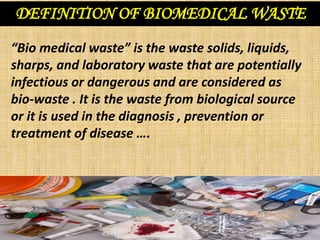
DEFINITION OF BIOMEDICAL WASTE
“Bio medical waste” is the waste solids, liquids,
sharps, and laboratory waste that are potentially
infectious or dangerous and are considered as
bio-waste . It is the waste from biological source
or it is used in the diagnosis , prevention or
treatment of disease ….
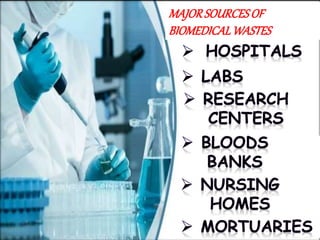
MAJORSOURCESOF
BIOMEDICALWASTES
MINOR SOURES OF
BIOMEDICAL WASTES
Clinics
Health care
Cosmetic
clinics
Paramedics
Funerals
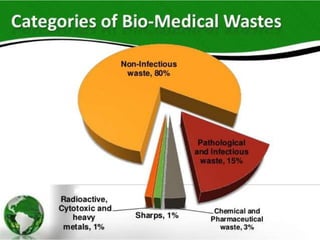
Classification of Bio‐Medical Waste
Biomedical waste
Non-Hazardous
[75-90%]
Hazardous
[10-25%]
Infectious [15-18%] Other Hazardous [5-7%]
 Non-sharps
 Sharps
 Plastic disposables
 Liquid wastes
 Radioactive waste
 Discarded glass
 Pressurized containers
 Chemical waste
 Cytotoxic waste
 Incinerator ash
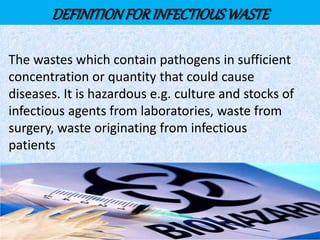
DEFINITIONFORINFECTIOUSWASTE
The wastes which contain pathogens in sufficient
concentration or quantity that could cause
diseases. It is hazardous e.g. culture and stocks of
infectious agents from laboratories, waste from
surgery, waste originating from infectious
patients
Classification Of Biomedical Waste According To
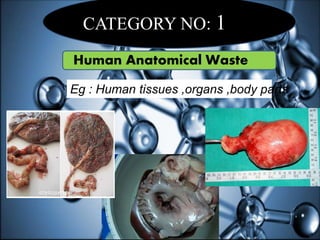
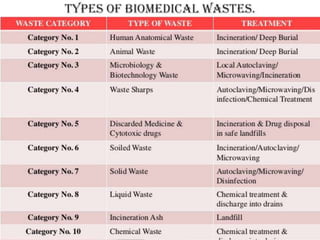
CATEGORY NO: 1
Human Anatomical Waste
Eg : Human tissues ,organs ,body parts
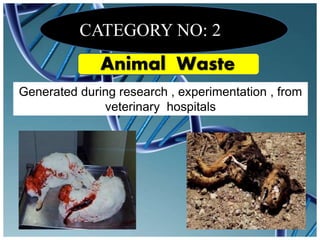
CATEGORY NO: 2
Animal Waste
Generated during research , experimentation , from
veterinary hospitals
CATEGORY NO: 3
Microbiology & Biotechnology Waste
Laboratory cultures, micro organisms, human and
animal cell cultures , toxins.
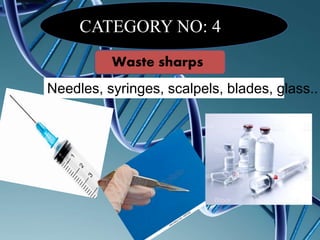
CATEGORY NO: 4
Waste sharps
Needles, syringes, scalpels, blades, glass..
CATEGORY NO: 5
Discarded Medicines and Cytotoxic drugs
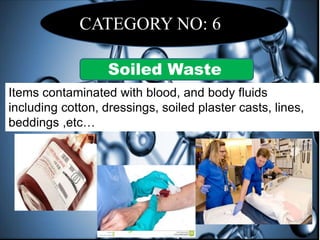
CATEGORY NO: 6
Soiled Waste
Items contaminated with blood, and body fluids
including cotton, dressings, soiled plaster casts, lines,
beddings ,etc…
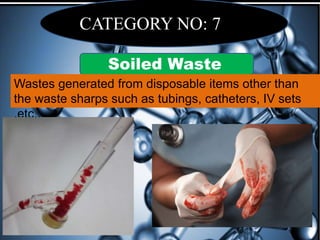
CATEGORY NO: 7
Soiled Waste
Wastes generated from disposable items other than
the waste sharps such as tubings, catheters, IV sets
,etc..
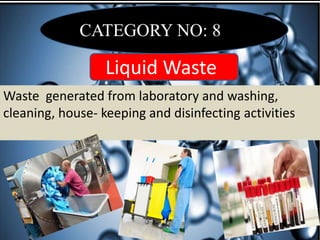
CATEGORY NO: 8
Liquid Waste
Waste generated from laboratory and washing,
cleaning, house‐ keeping and disinfecting activities
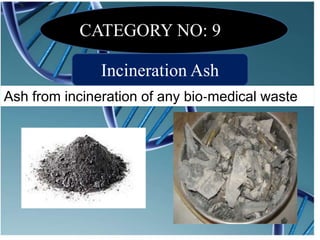
CATEGORY NO: 9
Incineration Ash
Ash from incineration of any bio‐medical waste
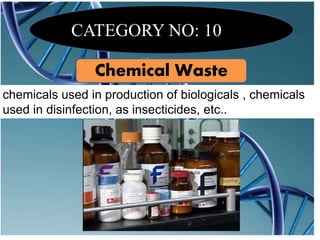
CATEGORY NO: 10
Chemical Waste
chemicals used in production of biologicals , chemicals
used in disinfection, as insecticides, etc..
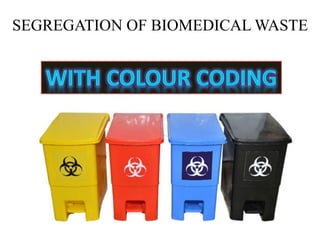
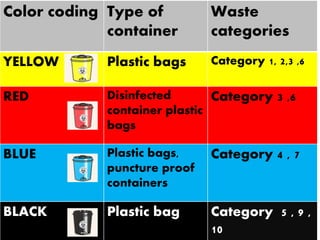
SEGREGATION OF BIOMEDICAL WASTE
Color coding Type of
container
Waste
categories
YELLOW Plastic bags Category 1, 2,3 ,6
RED Disinfected
container plastic
bags
Category 3 ,6
BLUE Plastic bags,
puncture proof
containers
Category 4 , 7
BLACK Plastic bag Category 5 , 9 ,
10
TRANSPORTATION AND STORAGE
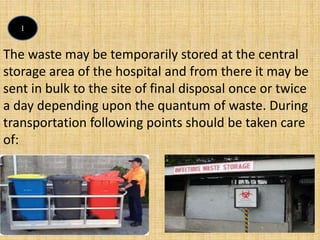
The waste may be temporarily stored at the central
storage area of the hospital and from there it may be
sent in bulk to the site of final disposal once or twice
a day depending upon the quantum of waste. During
transportation following points should be taken care
of:
1
2
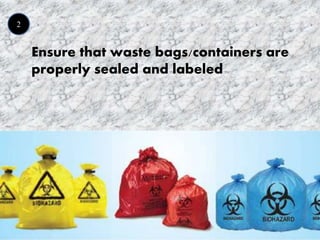
Ensure that waste bags/containers are
properly sealed and labeled
3
Bags should not be filled completely,
so that bags can be picked up by the
neck again for further handling. Hand
should not be put under the bag. At a
time only one bag should be lifted.
4
Manual handling of waste bags should be
minimized to reduce the risk of needle prick
injury and infection
BMW should be kept only in a
specified storage area
5
6
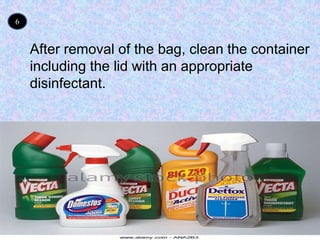
After removal of the bag, clean the container
including the lid with an appropriate
disinfectant.
7
Waste bags and containers should be removed daily from
wards / OPDs or even more frequently if needed (as in
Operation Theatres, ICUs, labour rooms). Waste bags
should be transported in a covered wheeled containers or
large bins in covered trolleys.
8
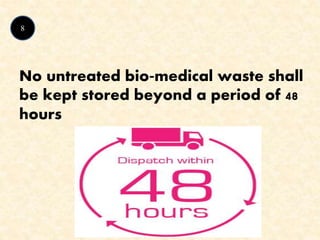
No untreated bio‐medical waste shall
be kept stored beyond a period of 48
hours
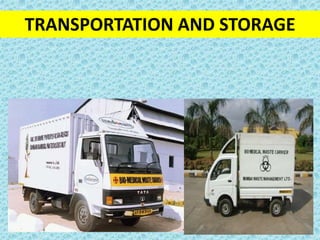
TRANSPORT TO FINAL DISPOSAL SITE
Transportation from health care establishment to the
site of final disposal in a closed motor vehicle (truck,
tractor‐trolley etc.) is desirable as it prevents spillage of
waste on the way.
Vehicles used for transport of BMW must have the
“Bio‐Hazard” symbol and these vehicles should not be
used for any other purpose.
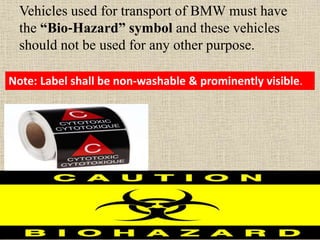
Vehicles used for transport of BMW must have
the “Bio‐Hazard” symbol and these vehicles
should not be used for any other purpose.
Note: Label shall be non‐washable & prominently visible.
DISPOSAL OF BIOMEDICAL WASTE
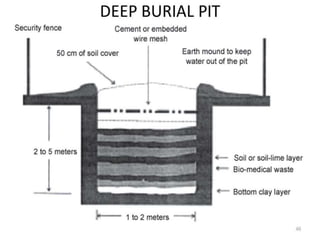
Category 1 and 2
only .
 In cities having
less than 5 lakh
population &
rural area.
Deep burial
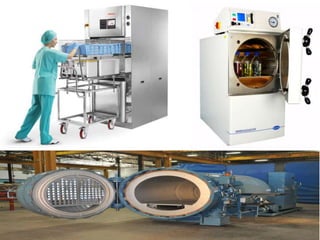
Autoclave and microwave
treatment
Standards for the autoclaving and
microwaving are also mentioned in the
Biomedical waste (Management and
Handling) Rules 1998.
– All equipment installed/shared should
meet these specifications.
– Category 3, 4, 6 and 7 can be treated
by these techniques.
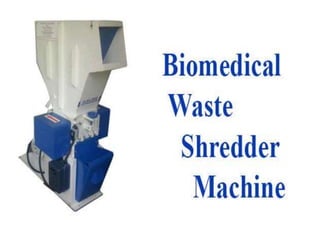
Shredding
 The plastic (I.V. bottles, I.V. sets,
syringes, catheters etc.), sharps
(needles, blades, glass etc) should
be shredded but only after chemical
Treatment/microwaving/autoclaving
.
 Needle destroyers can be used
for disposal of needles directly
without chemical treatment.
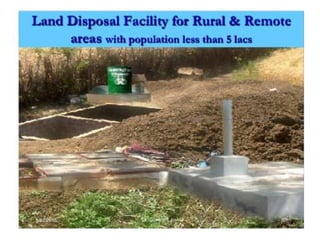
Land disposal
 Open dumps
 Secured/Sanitary landfill: advantages.
 The incinerator ash, discarded
medicines, cytotoxic substances
and solid chemical waste should be
treated by this option.
Incineration
 A high temperature dry oxidation process, which
reduces organic and combustible waste to inorganic
incombustible matter.
 Usually used for the waste that can not be reused,
recycled or disposed of in landfill site.
 The incinerator should be
installed and made
operational as per
specification under the BMW
rules 1998
 Certificate may be taken from
CPCB/State Pollution Control
Board
 Category 1, 2, 3, 5, and 6 can
be incinerated.
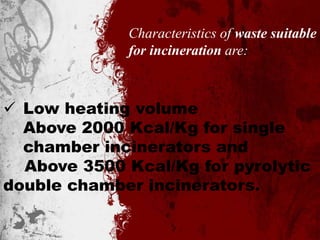
Characteristics of waste suitable
for incineration are:
 Low heating volume
Above 2000 Kcal/Kg for single
chamber incinerators and
Above 3500 Kcal/Kg for pyrolytic
double chamber incinerators.
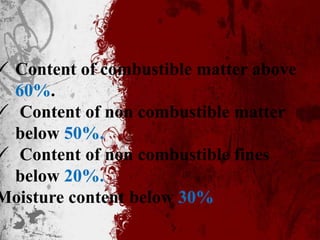
 Content of combustible matter above
60%.
 Content of non combustible matter
below 50%.
 Content of non combustible fines
below 20%.
Moisture content below 30%
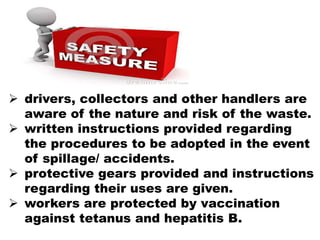
 drivers, collectors and other handlers are
aware of the nature and risk of the waste.
 written instructions provided regarding
the procedures to be adopted in the event
of spillage/ accidents.
 protective gears provided and instructions
regarding their uses are given.
 workers are protected by vaccination
against tetanus and hepatitis B.
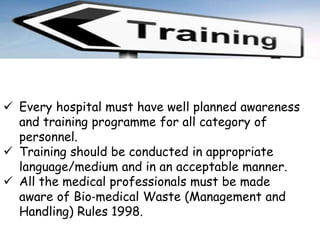
 Every hospital must have well planned awareness
and training programme for all category of
personnel.
 Training should be conducted in appropriate
language/medium and in an acceptable manner.
 All the medical professionals must be made
aware of Bio‐medical Waste (Management and
Handling) Rules 1998.
Coordination between hospital and
outside agencies
Municipal authority :
As quite a large percentage of waste (in India
up to 85%), generated in Indian hospitals,
belong to general category (non‐toxic and
non‐hazardous), hospital should have constant
interaction with municipal authorities so that
this category of waste is regularly taken out of
the hospital premises for land fill or other
treatment.
Co‐ordination with Pollution Control Boards:
Co‐ordination with Pollution Control
Boards:
o To search for better methods technology, provision of
facilities for testing, approval of certain models for
hospital use in conformity with standards 'aid down.
o To search for cost effective and environmental friendly
technology for treatment of bio‐medical and hazardous
waste.
o To search for suitable materials to be used as
containers for bio‐medical waste requiring
incineration/autoclaving/ microwaving.
Presentat
ion By,

biomedical waste

  • 1.
  • 2.
    DEFINITION OF BIOMEDICALWASTE “Bio medical waste” is the waste solids, liquids, sharps, and laboratory waste that are potentially infectious or dangerous and are considered as bio-waste . It is the waste from biological source or it is used in the diagnosis , prevention or treatment of disease ….
  • 3.
  • 4.
    MINOR SOURES OF BIOMEDICALWASTES Clinics Health care Cosmetic clinics Paramedics Funerals
  • 5.
    Classification of Bio‐MedicalWaste Biomedical waste Non-Hazardous [75-90%] Hazardous [10-25%] Infectious [15-18%] Other Hazardous [5-7%]  Non-sharps  Sharps  Plastic disposables  Liquid wastes  Radioactive waste  Discarded glass  Pressurized containers  Chemical waste  Cytotoxic waste  Incinerator ash
  • 8.
    DEFINITIONFORINFECTIOUSWASTE The wastes whichcontain pathogens in sufficient concentration or quantity that could cause diseases. It is hazardous e.g. culture and stocks of infectious agents from laboratories, waste from surgery, waste originating from infectious patients
  • 10.
    Classification Of BiomedicalWaste According To
  • 11.
    CATEGORY NO: 1 HumanAnatomical Waste Eg : Human tissues ,organs ,body parts
  • 12.
    CATEGORY NO: 2 AnimalWaste Generated during research , experimentation , from veterinary hospitals
  • 13.
    CATEGORY NO: 3 Microbiology& Biotechnology Waste Laboratory cultures, micro organisms, human and animal cell cultures , toxins.
  • 14.
    CATEGORY NO: 4 Wastesharps Needles, syringes, scalpels, blades, glass..
  • 15.
    CATEGORY NO: 5 DiscardedMedicines and Cytotoxic drugs
  • 16.
    CATEGORY NO: 6 SoiledWaste Items contaminated with blood, and body fluids including cotton, dressings, soiled plaster casts, lines, beddings ,etc…
  • 17.
    CATEGORY NO: 7 SoiledWaste Wastes generated from disposable items other than the waste sharps such as tubings, catheters, IV sets ,etc..
  • 18.
    CATEGORY NO: 8 LiquidWaste Waste generated from laboratory and washing, cleaning, house‐ keeping and disinfecting activities
  • 19.
    CATEGORY NO: 9 IncinerationAsh Ash from incineration of any bio‐medical waste
  • 20.
    CATEGORY NO: 10 ChemicalWaste chemicals used in production of biologicals , chemicals used in disinfection, as insecticides, etc..
  • 21.
  • 22.
    Color coding Typeof container Waste categories YELLOW Plastic bags Category 1, 2,3 ,6 RED Disinfected container plastic bags Category 3 ,6 BLUE Plastic bags, puncture proof containers Category 4 , 7 BLACK Plastic bag Category 5 , 9 , 10
  • 23.
  • 24.
    The waste maybe temporarily stored at the central storage area of the hospital and from there it may be sent in bulk to the site of final disposal once or twice a day depending upon the quantum of waste. During transportation following points should be taken care of: 1
  • 25.
    2 Ensure that wastebags/containers are properly sealed and labeled
  • 26.
    3 Bags should notbe filled completely, so that bags can be picked up by the neck again for further handling. Hand should not be put under the bag. At a time only one bag should be lifted.
  • 27.
    4 Manual handling ofwaste bags should be minimized to reduce the risk of needle prick injury and infection BMW should be kept only in a specified storage area 5
  • 28.
    6 After removal ofthe bag, clean the container including the lid with an appropriate disinfectant.
  • 29.
    7 Waste bags andcontainers should be removed daily from wards / OPDs or even more frequently if needed (as in Operation Theatres, ICUs, labour rooms). Waste bags should be transported in a covered wheeled containers or large bins in covered trolleys.
  • 30.
    8 No untreated bio‐medicalwaste shall be kept stored beyond a period of 48 hours
  • 31.
    TRANSPORT TO FINALDISPOSAL SITE Transportation from health care establishment to the site of final disposal in a closed motor vehicle (truck, tractor‐trolley etc.) is desirable as it prevents spillage of waste on the way. Vehicles used for transport of BMW must have the “Bio‐Hazard” symbol and these vehicles should not be used for any other purpose.
  • 32.
    Vehicles used fortransport of BMW must have the “Bio‐Hazard” symbol and these vehicles should not be used for any other purpose. Note: Label shall be non‐washable & prominently visible.
  • 33.
  • 34.
    Category 1 and2 only .  In cities having less than 5 lakh population & rural area. Deep burial
  • 36.
    Autoclave and microwave treatment Standardsfor the autoclaving and microwaving are also mentioned in the Biomedical waste (Management and Handling) Rules 1998. – All equipment installed/shared should meet these specifications. – Category 3, 4, 6 and 7 can be treated by these techniques.
  • 38.
    Shredding  The plastic(I.V. bottles, I.V. sets, syringes, catheters etc.), sharps (needles, blades, glass etc) should be shredded but only after chemical Treatment/microwaving/autoclaving .  Needle destroyers can be used for disposal of needles directly without chemical treatment.
  • 40.
    Land disposal  Opendumps  Secured/Sanitary landfill: advantages.  The incinerator ash, discarded medicines, cytotoxic substances and solid chemical waste should be treated by this option.
  • 42.
  • 43.
     A hightemperature dry oxidation process, which reduces organic and combustible waste to inorganic incombustible matter.  Usually used for the waste that can not be reused, recycled or disposed of in landfill site.
  • 44.
     The incineratorshould be installed and made operational as per specification under the BMW rules 1998  Certificate may be taken from CPCB/State Pollution Control Board  Category 1, 2, 3, 5, and 6 can be incinerated.
  • 45.
    Characteristics of wastesuitable for incineration are:  Low heating volume Above 2000 Kcal/Kg for single chamber incinerators and Above 3500 Kcal/Kg for pyrolytic double chamber incinerators.
  • 46.
     Content ofcombustible matter above 60%.  Content of non combustible matter below 50%.  Content of non combustible fines below 20%. Moisture content below 30%
  • 48.
     drivers, collectorsand other handlers are aware of the nature and risk of the waste.  written instructions provided regarding the procedures to be adopted in the event of spillage/ accidents.  protective gears provided and instructions regarding their uses are given.  workers are protected by vaccination against tetanus and hepatitis B.
  • 49.
     Every hospitalmust have well planned awareness and training programme for all category of personnel.  Training should be conducted in appropriate language/medium and in an acceptable manner.  All the medical professionals must be made aware of Bio‐medical Waste (Management and Handling) Rules 1998.
  • 51.
    Coordination between hospitaland outside agencies Municipal authority : As quite a large percentage of waste (in India up to 85%), generated in Indian hospitals, belong to general category (non‐toxic and non‐hazardous), hospital should have constant interaction with municipal authorities so that this category of waste is regularly taken out of the hospital premises for land fill or other treatment. Co‐ordination with Pollution Control Boards:
  • 52.
    Co‐ordination with PollutionControl Boards: o To search for better methods technology, provision of facilities for testing, approval of certain models for hospital use in conformity with standards 'aid down. o To search for cost effective and environmental friendly technology for treatment of bio‐medical and hazardous waste. o To search for suitable materials to be used as containers for bio‐medical waste requiring incineration/autoclaving/ microwaving.
  • 54.