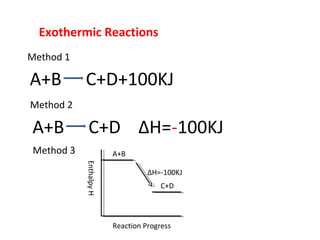
Exothermic Reactions
Method 1
A+B C+D+100KJ
Method 2
A+B C+D ∆H=-100KJ
Method 3
C+D
∆H=-100KJ
A+B
Reaction Progress
EnthalpyH
Endothermic Reactions
A+B+100KJ C+D
Method 1
Method 2
A+B C+D ∆H=+100KJ
Method 3
A+B
Reaction Progress
EnthalpyH
∆H=+100KJ
C+D
Molar Enthalpy
Enthalpy per 1 mole of a substance
2A+BC+3D+400KJ
Molar enthalpy of A=-400/2=-200KJ/mol
Molar enthalpy of D=-400/3=-133KJ/mol
Q1. Consider the following reaction.
N2(g) + O2(g) → 2NO(g) ΔH°rxn = +180.6 kJ
(a) Rewrite the thermochemical equation, including the standard
enthalpy of reaction as either a reactant or a product.
(b) Draw an enthalpy diagram for the reaction.
(c) What is the enthalpy change for the formation of one mole of
nitrogen monoxide?
Answer:
(a)N2(g) + O2(g) +180.6 kJ → 2NO(g)
Reaction Progress
EnthalpyH
∆H=+180.6KJ
2NO
N2+O2
(b)
(c) 2 mol of NO= +180.6 KJ
1 mol of NO=?
+180.6KJ________
2
=+90.3 KJ
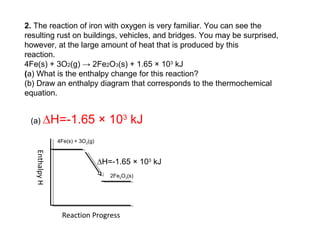
2. The reaction of iron with oxygen is very familiar. You can see the
resulting rust on buildings, vehicles, and bridges. You may be surprised,
however, at the large amount of heat that is produced by this
reaction.
4Fe(s) + 3O2(g) → 2Fe2O3(s) + 1.65 × 10³
kJ
(a) What is the enthalpy change for this reaction?
(b) Draw an enthalpy diagram that corresponds to the thermochemical
equation.
(a) ∆H=-1.65 × 10³
kJ
2Fe2O3(s)
∆H=-1.65 × 10³
kJ
4Fe(s) + 3O2(g)
Reaction Progress
EnthalpyH
3. Tetraphosphorus decoxide, P4O10, is an acidic oxide. It reacts with
water to produce phosphoric acid, H3PO4, in an exothermic reaction.
P4O10(s) + 6H2O() → 4H3PO4(aq) ΔH°rxn = −257.2 kJ
(a) Rewrite the thermochemical equation, including the enthalpy
change as a heat term in the equation.
(b) How much energy is released when 5.00 mol of P4O10 reacts with
excess water?
(a)P4O10(s) + 6H2O() → 4H3PO4(aq)+257.2 kJ
(b)1 mol of P4O10= -257.2 kJ
5 mol of P4O10= ?
5x -257.2 kJ=-1286 KJ
4.
(a) -483.6/2= -241.8KJ/mol
(b) -1134.4/4= -283.6KJ/mol
(c) +163.2/2= +81.6KJ/mol
(d) -1118.4/3= -372.8KJ/mol

Enthalpy diagrams

  • 1.
    Exothermic Reactions Method 1 A+BC+D+100KJ Method 2 A+B C+D ∆H=-100KJ Method 3 C+D ∆H=-100KJ A+B Reaction Progress EnthalpyH
  • 2.
    Endothermic Reactions A+B+100KJ C+D Method1 Method 2 A+B C+D ∆H=+100KJ Method 3 A+B Reaction Progress EnthalpyH ∆H=+100KJ C+D
  • 3.
    Molar Enthalpy Enthalpy per1 mole of a substance 2A+BC+3D+400KJ Molar enthalpy of A=-400/2=-200KJ/mol Molar enthalpy of D=-400/3=-133KJ/mol
  • 4.
    Q1. Consider thefollowing reaction. N2(g) + O2(g) → 2NO(g) ΔH°rxn = +180.6 kJ (a) Rewrite the thermochemical equation, including the standard enthalpy of reaction as either a reactant or a product. (b) Draw an enthalpy diagram for the reaction. (c) What is the enthalpy change for the formation of one mole of nitrogen monoxide? Answer: (a)N2(g) + O2(g) +180.6 kJ → 2NO(g) Reaction Progress EnthalpyH ∆H=+180.6KJ 2NO N2+O2 (b) (c) 2 mol of NO= +180.6 KJ 1 mol of NO=? +180.6KJ________ 2 =+90.3 KJ
  • 5.
    2. The reactionof iron with oxygen is very familiar. You can see the resulting rust on buildings, vehicles, and bridges. You may be surprised, however, at the large amount of heat that is produced by this reaction. 4Fe(s) + 3O2(g) → 2Fe2O3(s) + 1.65 × 10³ kJ (a) What is the enthalpy change for this reaction? (b) Draw an enthalpy diagram that corresponds to the thermochemical equation. (a) ∆H=-1.65 × 10³ kJ 2Fe2O3(s) ∆H=-1.65 × 10³ kJ 4Fe(s) + 3O2(g) Reaction Progress EnthalpyH
  • 6.
    3. Tetraphosphorus decoxide,P4O10, is an acidic oxide. It reacts with water to produce phosphoric acid, H3PO4, in an exothermic reaction. P4O10(s) + 6H2O() → 4H3PO4(aq) ΔH°rxn = −257.2 kJ (a) Rewrite the thermochemical equation, including the enthalpy change as a heat term in the equation. (b) How much energy is released when 5.00 mol of P4O10 reacts with excess water? (a)P4O10(s) + 6H2O() → 4H3PO4(aq)+257.2 kJ (b)1 mol of P4O10= -257.2 kJ 5 mol of P4O10= ? 5x -257.2 kJ=-1286 KJ
  • 7.
    4. (a) -483.6/2= -241.8KJ/mol (b)-1134.4/4= -283.6KJ/mol (c) +163.2/2= +81.6KJ/mol (d) -1118.4/3= -372.8KJ/mol