
Enterprise Systems
Marlon Dumas
Professor of Information Systems @ University of Tartu
Co-founder @ Apromore
Introduction
Companies use many different types of software
to run their day-to-day operations
A software that records transactions and digital
content in order to enable workers and managers
to run a company smoothly is called an enterprise
software system (or enterprise system)
2
3
Obtain
PO
confirm.
Prepare
shipment
Schedule
delivery
Issue
invoice
Check
Invoice
Load
truck
Check &
confirm
PO
Notify
shipment
Unload
truck
Package
products
Issue
delivery
receipt
Request
PO change
Match
incoming
payment
Schedule
payment
4
Issue
Credit
Note
Submit
complaint
to supplier
Renegotiate
supplier
contract
Source: Metcash
Enterprise
Suppliers &
Partners
Customers
Inventory &
Materials
Collaboration & Org Memory
Financial
Resources
Infrastructure
& Assets
Human Resources
An enterprise in a nutshell
Enterprise
Suppliers &
Partners
Customers
Inventory &
Materials
Collaboration & Org Memory
Financial
Resources
Infrastructure
& Assets
Human Resources
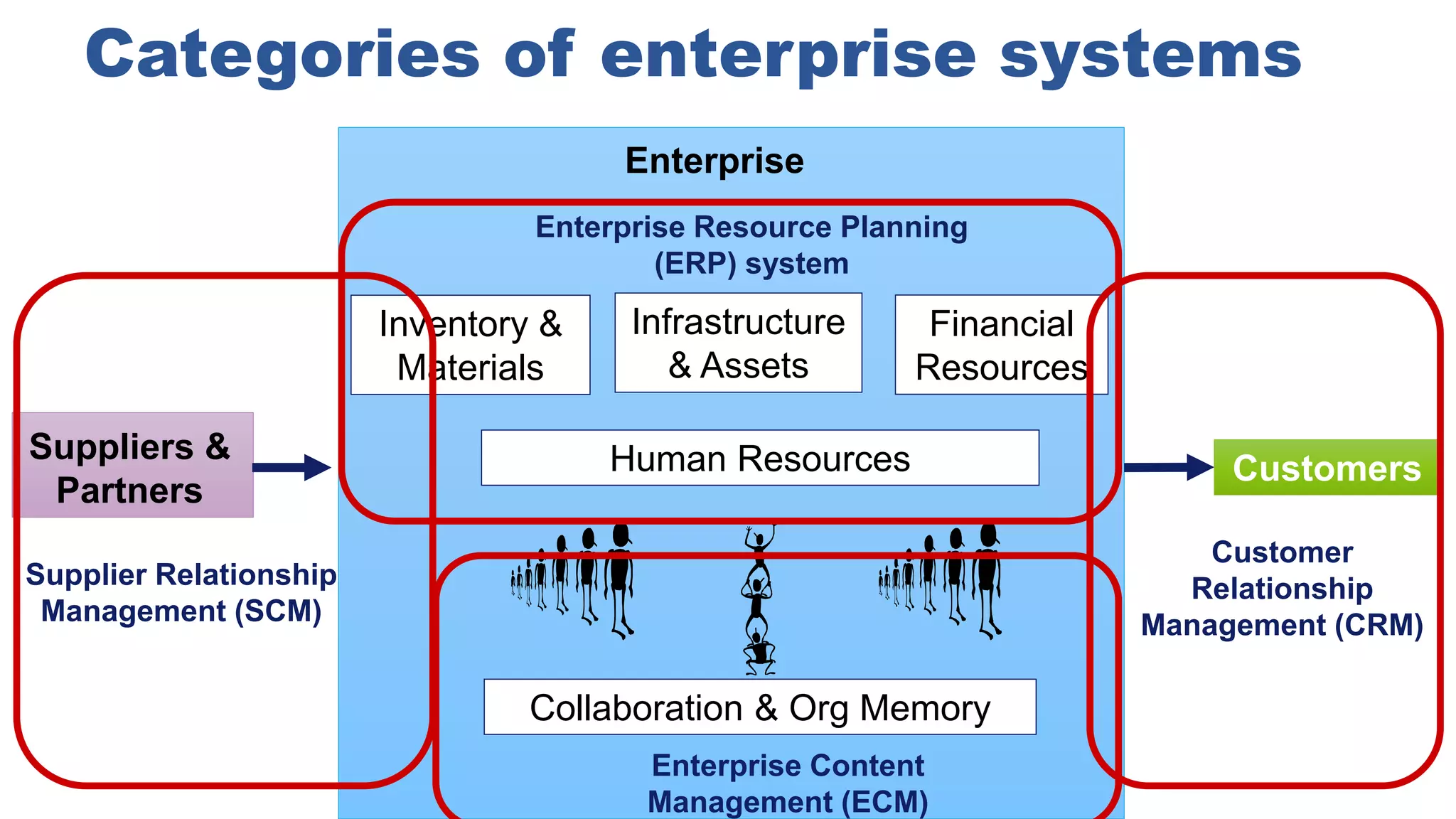
Categories of enterprise systems
Supplier Relationship
Management (SCM)
Customer
Relationship
Management (CRM)
Enterprise Resource Planning
(ERP) system
Enterprise Content
Management (ECM)
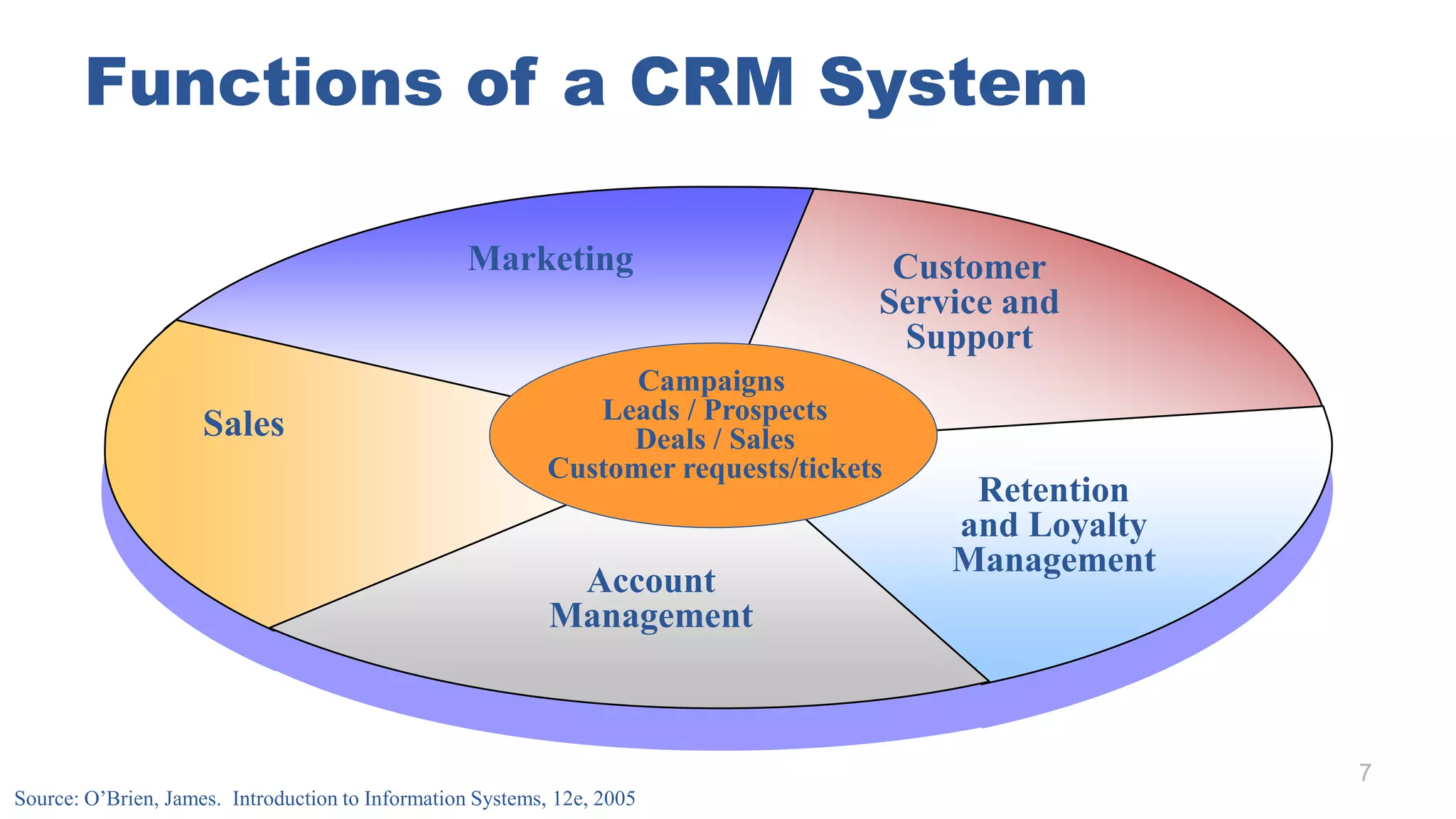
Functions of a CRM System
7
Source: O’Brien, James. Introduction to Information Systems, 12e, 2005
Marketing Customer
Service and
Support
Retention
and Loyalty
Management
Account
Management
Sales
Campaigns
Leads / Prospects
Deals / Sales
Customer requests/tickets
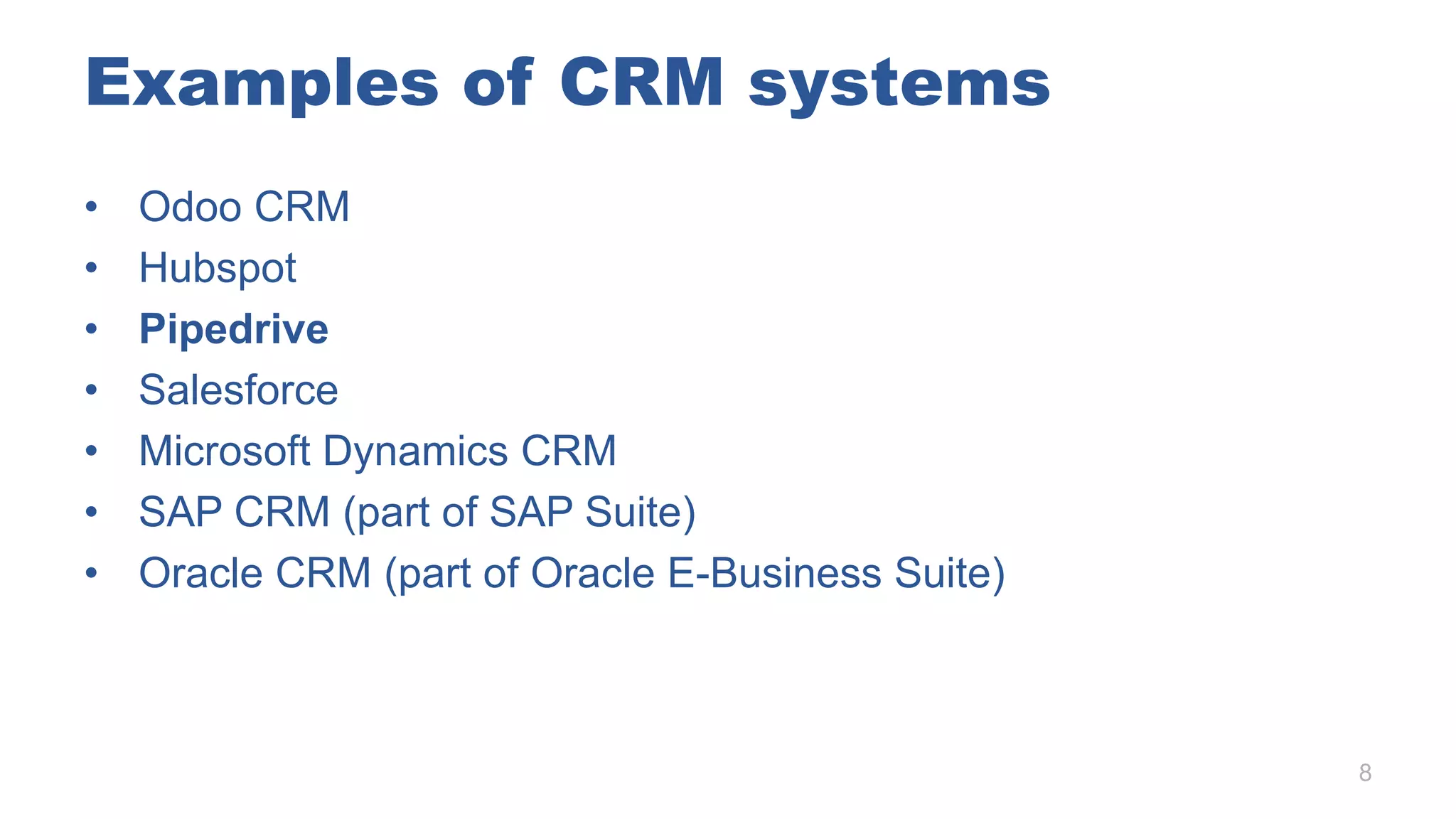
Examples of CRM systems
• Odoo CRM
• Hubspot
• Pipedrive
• Salesforce
• Microsoft Dynamics CRM
• SAP CRM (part of SAP Suite)
• Oracle CRM (part of Oracle E-Business Suite)
8
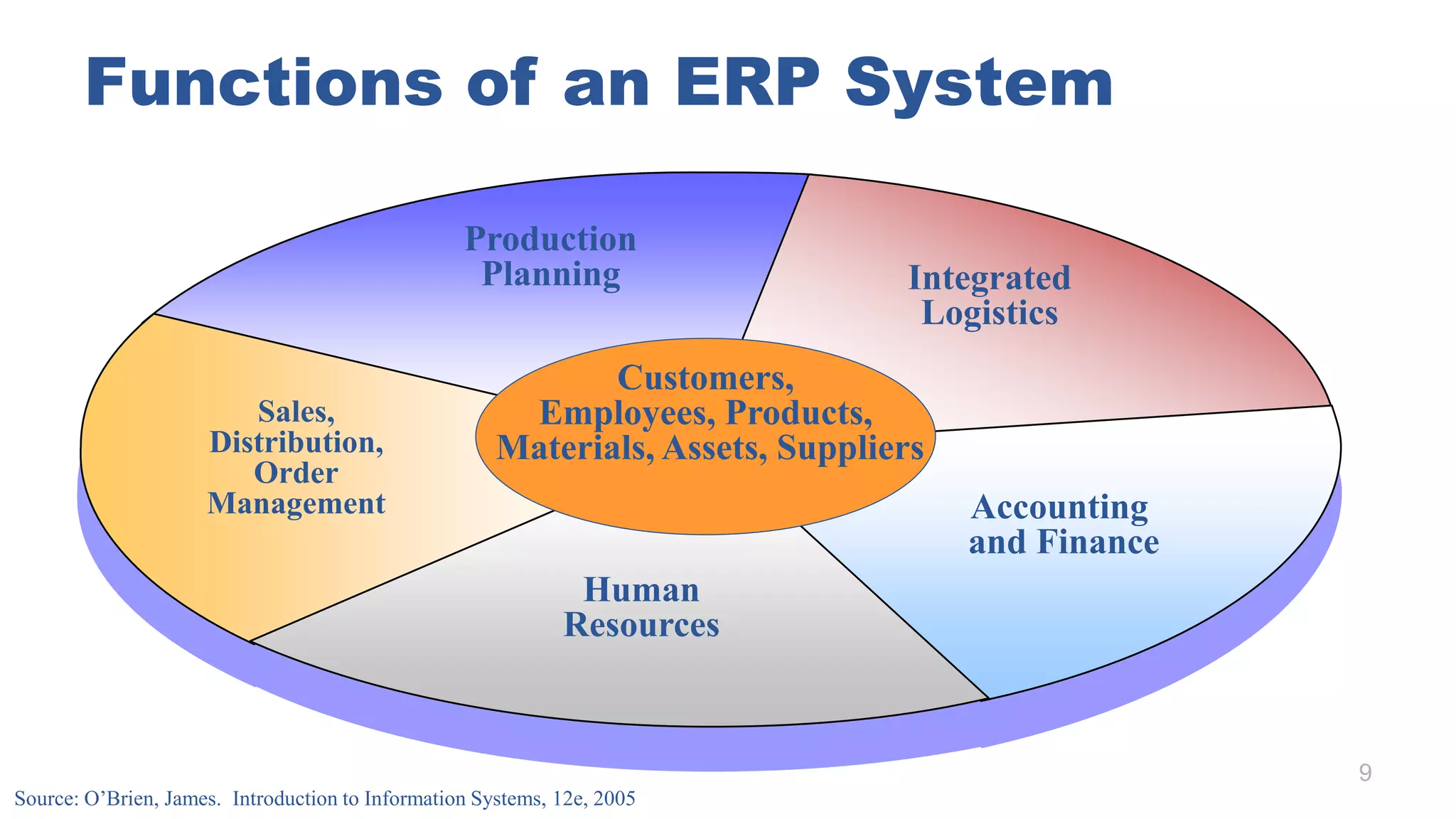
Functions of an ERP System
9
Production
Planning Integrated
Logistics
Accounting
and Finance
Human
Resources
Sales,
Distribution,
Order
Management
Customers,
Employees, Products,
Materials, Assets, Suppliers
Source: O’Brien, James. Introduction to Information Systems, 12e, 2005
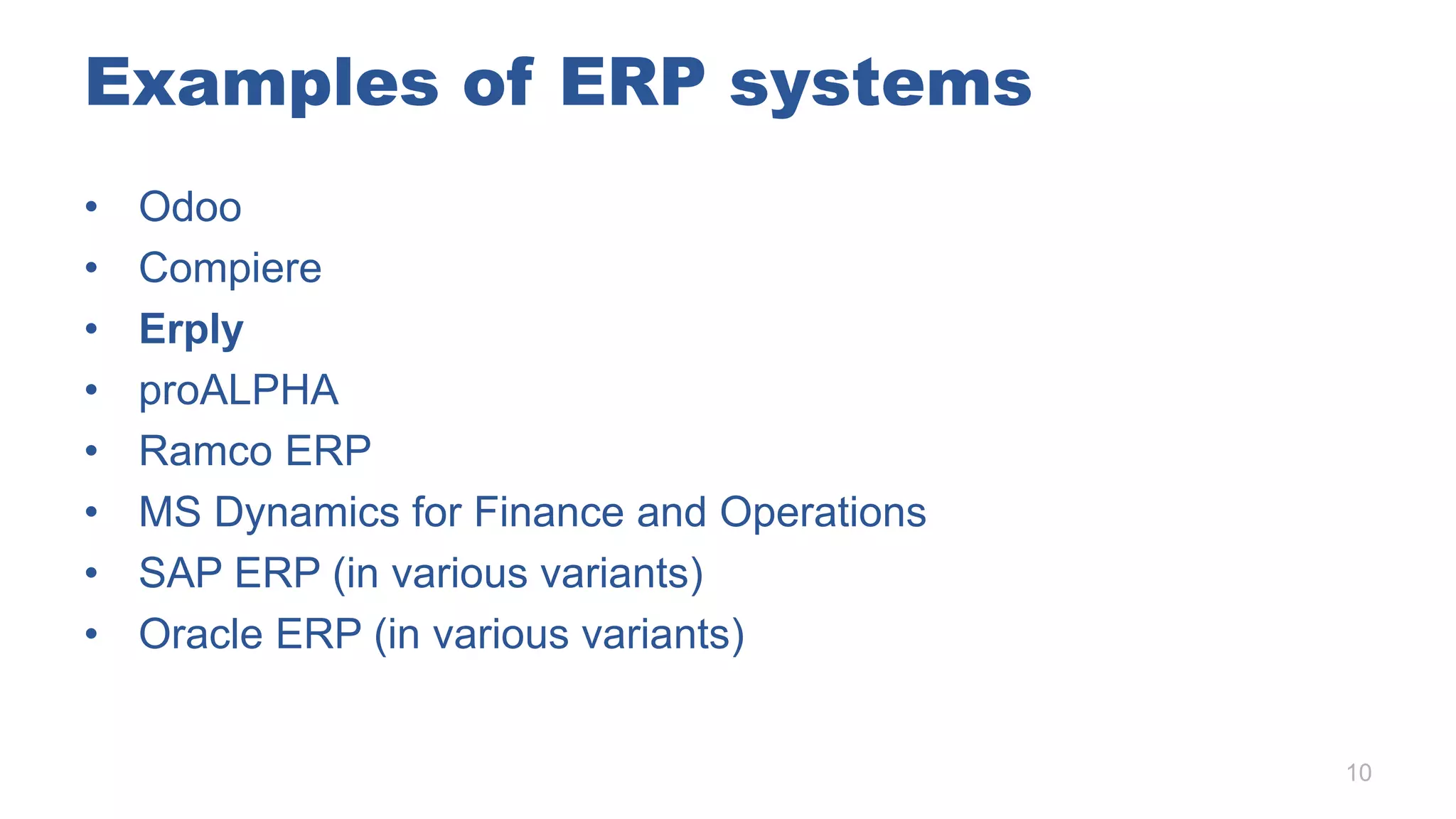
Examples of ERP systems
• Odoo
• Compiere
• Erply
• proALPHA
• Ramco ERP
• MS Dynamics for Finance and Operations
• SAP ERP (in various variants)
• Oracle ERP (in various variants)
10
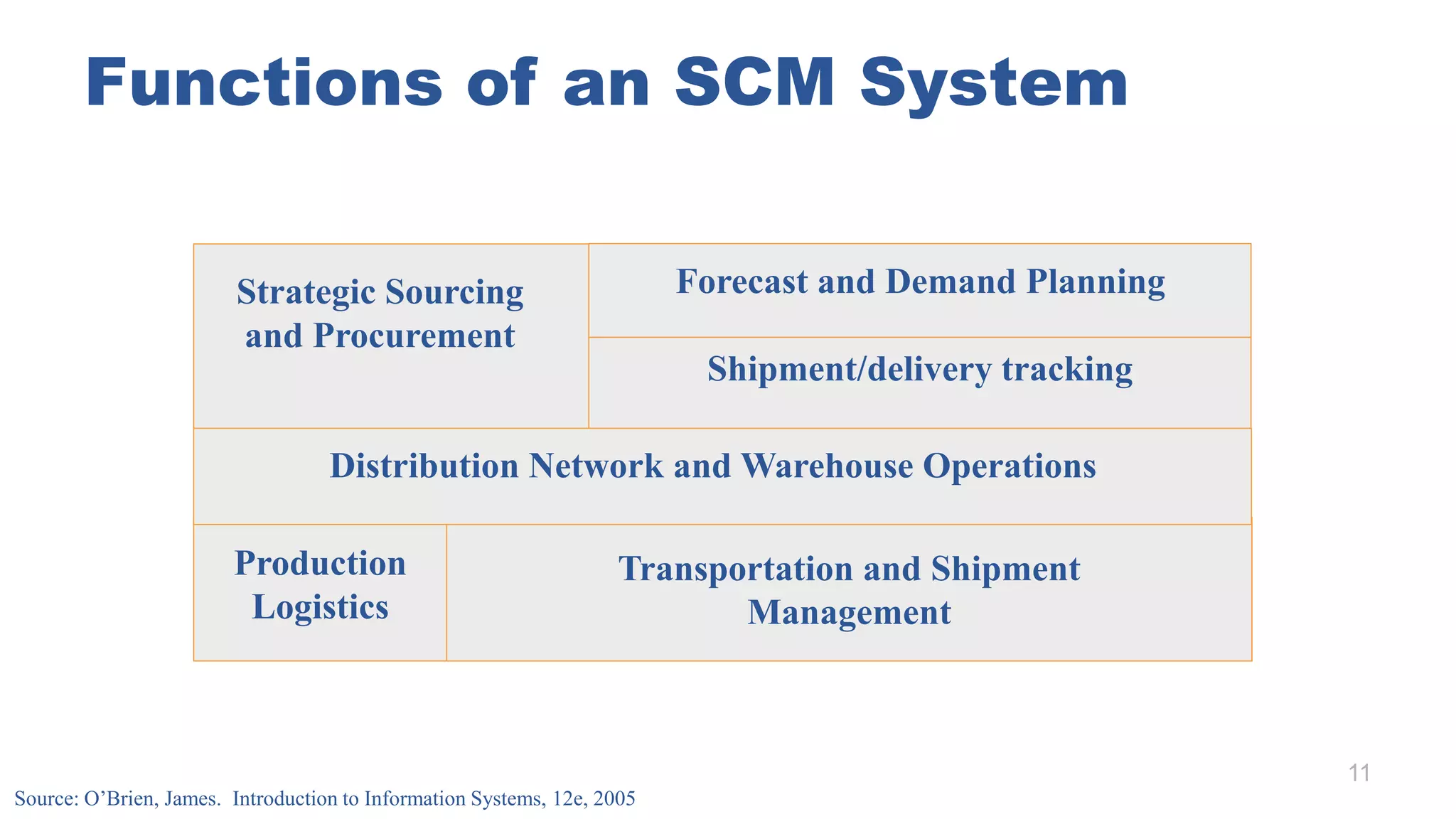
Functions of an SCM System
11
Source: O’Brien, James. Introduction to Information Systems, 12e, 2005
Strategic Sourcing
and Procurement
Forecast and Demand Planning
Shipment/delivery tracking
Distribution Network and Warehouse Operations
Transportation and Shipment
Management
Production
Logistics
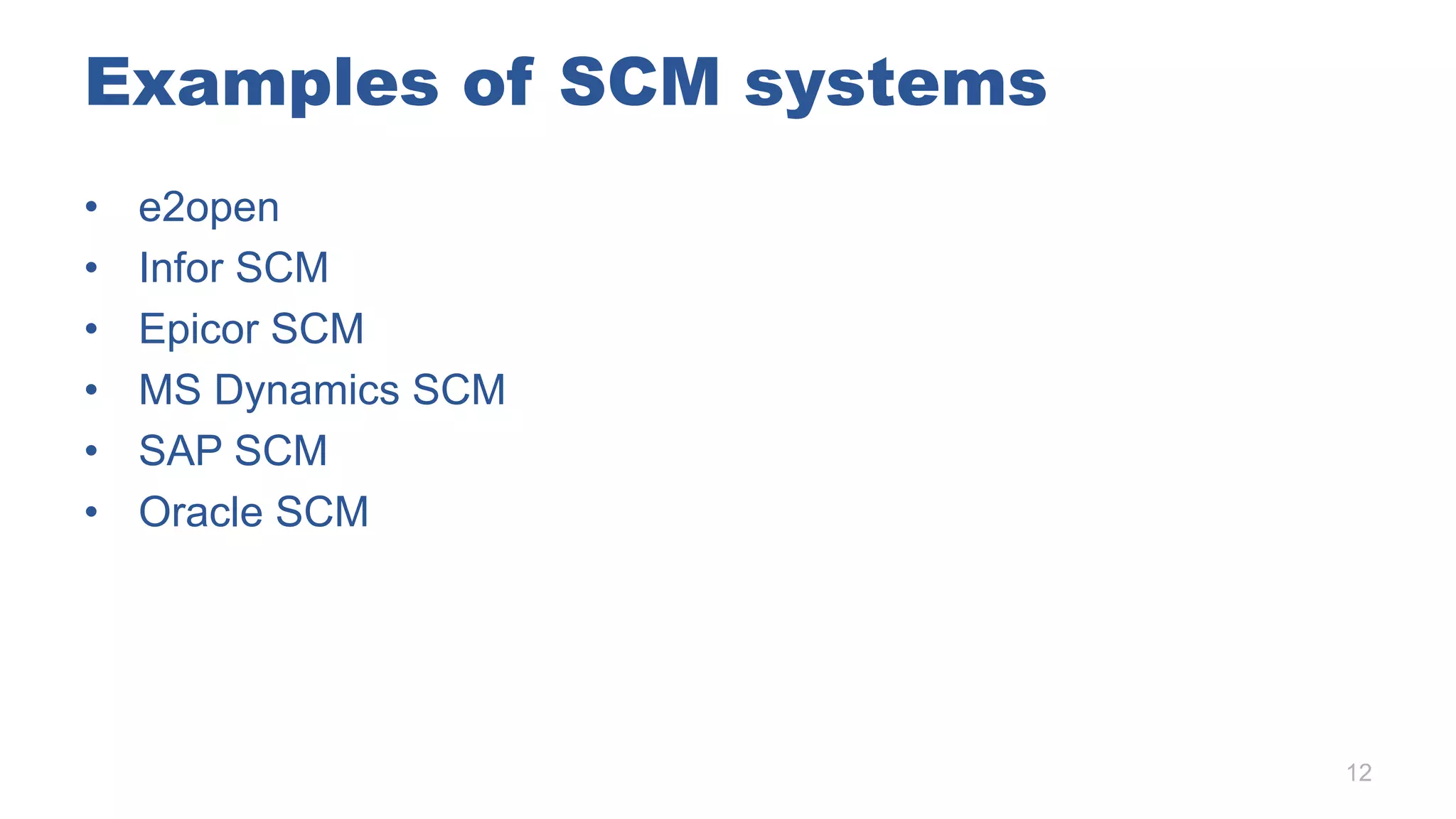
Examples of SCM systems
• e2open
• Infor SCM
• Epicor SCM
• MS Dynamics SCM
• SAP SCM
• Oracle SCM
12
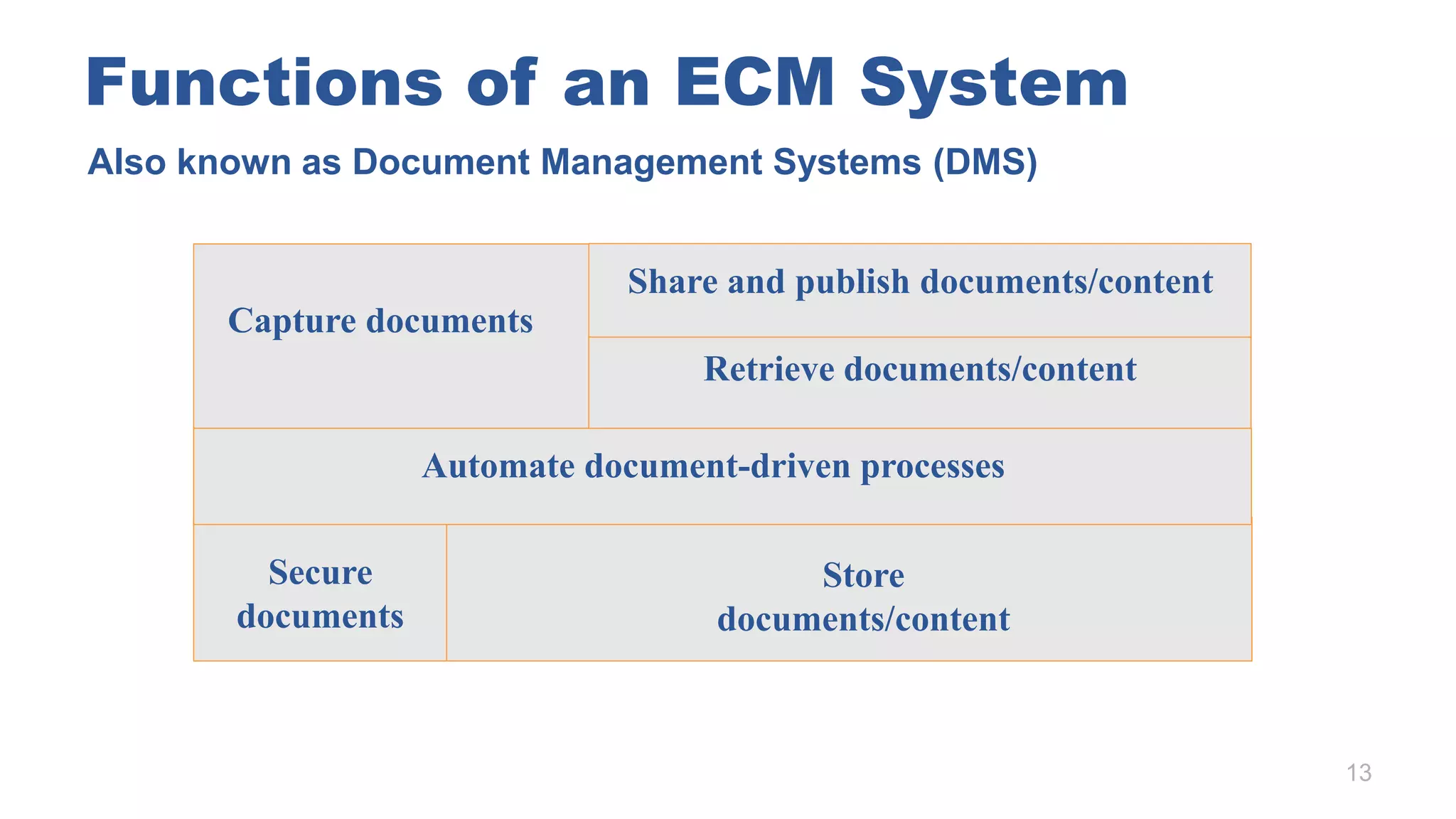
Functions of an ECM System
13
Capture documents
Share and publish documents/content
Retrieve documents/content
Automate document-driven processes
Store
documents/content
Secure
documents
Also known as Document Management Systems (DMS)
Examples of ECM systems
• Alfresco
• Drupal
• OpenText Documentum
• Zoho docs
• Laserfiche
• MS Sharepoint
• IBM Filenet
• Oracle ECM
Note: Not included here are Web Content Management Systems
(e.g. Wordpress, Joomla) meant specifically for Web publishing. 14
Functionally specialized systems
• Accounting software (focused on financials)
• Xero, Quickbooks, Simplbooks, Merit …
• Project management software
• Scoro, Trello, Jira, Asana, MS Project, Oracle Primavera, etc.
• Team collaboration software
• Slack, MS Teams, …
• Helpdesk software
• ServiceNow, JIRA Helpdesk, …
• Talent management software (specialized in HR)
• Asset management software
• Facility management software
• … 15
Vertically specialized systems
• Insurance policy management
• Guidewire
• Electronic Medical Records (EMR) software
• Raintree, Epic …
• Learning Management System (LMS)
• Moodle, Blackboard, Canvas, …
• Freight management
• Sixfold, …
• Hotel Management System
• …
16
Summary
Software has eaten the enterprise
17

Enterprise Systems

  • 1.
    Enterprise Systems Marlon Dumas Professorof Information Systems @ University of Tartu Co-founder @ Apromore
  • 2.
    Introduction Companies use manydifferent types of software to run their day-to-day operations A software that records transactions and digital content in order to enable workers and managers to run a company smoothly is called an enterprise software system (or enterprise system) 2
  • 3.
  • 4.
  • 5.
    Enterprise Suppliers & Partners Customers Inventory & Materials Collaboration& Org Memory Financial Resources Infrastructure & Assets Human Resources An enterprise in a nutshell
  • 6.
    Enterprise Suppliers & Partners Customers Inventory & Materials Collaboration& Org Memory Financial Resources Infrastructure & Assets Human Resources Categories of enterprise systems Supplier Relationship Management (SCM) Customer Relationship Management (CRM) Enterprise Resource Planning (ERP) system Enterprise Content Management (ECM)
  • 7.
    Functions of aCRM System 7 Source: O’Brien, James. Introduction to Information Systems, 12e, 2005 Marketing Customer Service and Support Retention and Loyalty Management Account Management Sales Campaigns Leads / Prospects Deals / Sales Customer requests/tickets
  • 8.
    Examples of CRMsystems • Odoo CRM • Hubspot • Pipedrive • Salesforce • Microsoft Dynamics CRM • SAP CRM (part of SAP Suite) • Oracle CRM (part of Oracle E-Business Suite) 8
  • 9.
    Functions of anERP System 9 Production Planning Integrated Logistics Accounting and Finance Human Resources Sales, Distribution, Order Management Customers, Employees, Products, Materials, Assets, Suppliers Source: O’Brien, James. Introduction to Information Systems, 12e, 2005
  • 10.
    Examples of ERPsystems • Odoo • Compiere • Erply • proALPHA • Ramco ERP • MS Dynamics for Finance and Operations • SAP ERP (in various variants) • Oracle ERP (in various variants) 10
  • 11.
    Functions of anSCM System 11 Source: O’Brien, James. Introduction to Information Systems, 12e, 2005 Strategic Sourcing and Procurement Forecast and Demand Planning Shipment/delivery tracking Distribution Network and Warehouse Operations Transportation and Shipment Management Production Logistics
  • 12.
    Examples of SCMsystems • e2open • Infor SCM • Epicor SCM • MS Dynamics SCM • SAP SCM • Oracle SCM 12
  • 13.
    Functions of anECM System 13 Capture documents Share and publish documents/content Retrieve documents/content Automate document-driven processes Store documents/content Secure documents Also known as Document Management Systems (DMS)
  • 14.
    Examples of ECMsystems • Alfresco • Drupal • OpenText Documentum • Zoho docs • Laserfiche • MS Sharepoint • IBM Filenet • Oracle ECM Note: Not included here are Web Content Management Systems (e.g. Wordpress, Joomla) meant specifically for Web publishing. 14
  • 15.
    Functionally specialized systems •Accounting software (focused on financials) • Xero, Quickbooks, Simplbooks, Merit … • Project management software • Scoro, Trello, Jira, Asana, MS Project, Oracle Primavera, etc. • Team collaboration software • Slack, MS Teams, … • Helpdesk software • ServiceNow, JIRA Helpdesk, … • Talent management software (specialized in HR) • Asset management software • Facility management software • … 15
  • 16.
    Vertically specialized systems •Insurance policy management • Guidewire • Electronic Medical Records (EMR) software • Raintree, Epic … • Learning Management System (LMS) • Moodle, Blackboard, Canvas, … • Freight management • Sixfold, … • Hotel Management System • … 16
  • 17.
    Summary Software has eatenthe enterprise 17

Editor's Notes

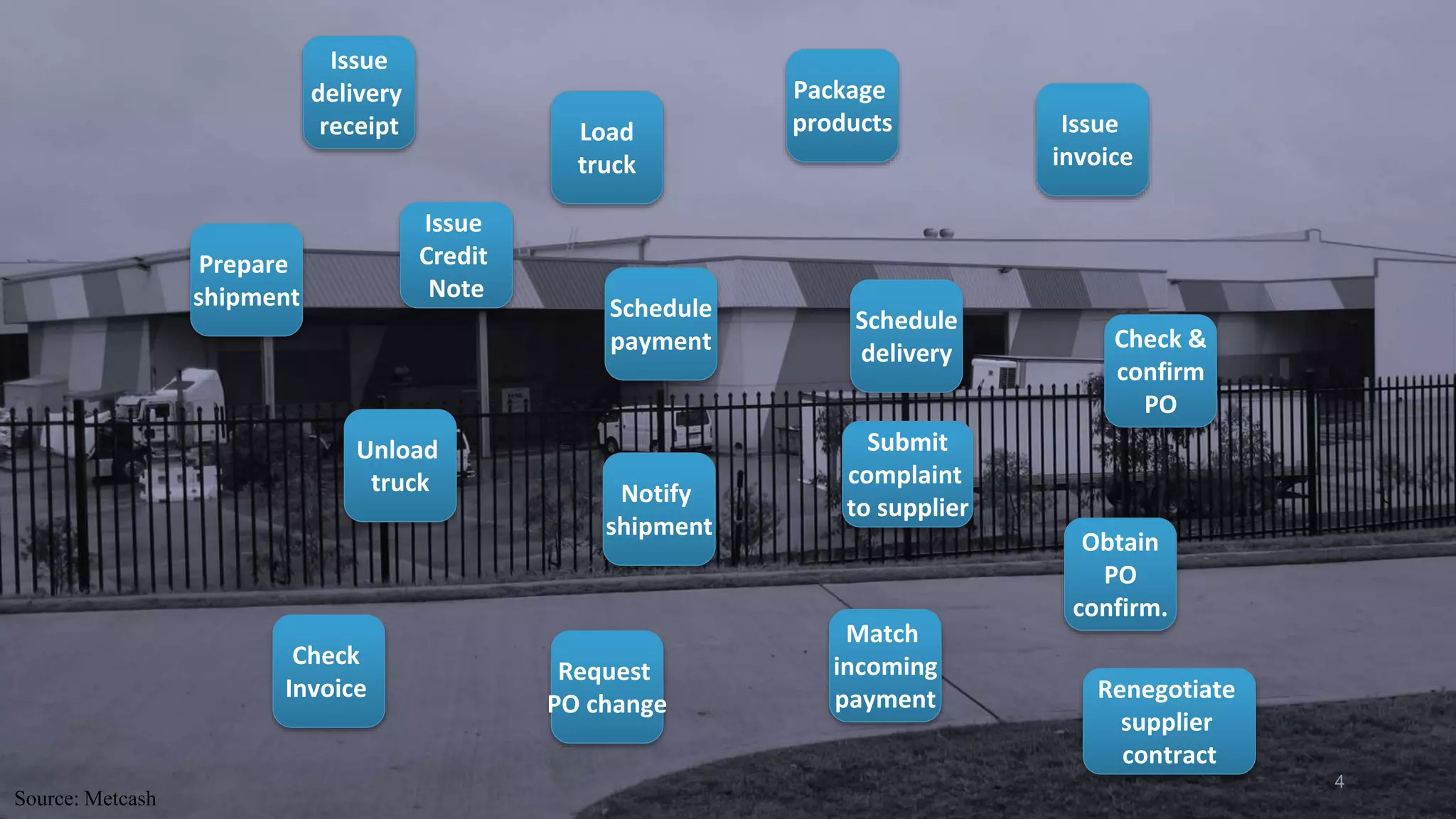
  • #5 Image from: http://commons.wikimedia.org/wiki/File:Metcash_Distribution_Centre_in_Eastern_Creek.jpg By Bidgee (Own work) [CC BY-SA 3.0 (http://creativecommons.org/licenses/by-sa/3.0)], via Wikimedia Commons All work in a company is part of something larger Modern orgs are to say the least complex structures: through X-ray we see different people interacting with machines, IT systems etc. The defyning trait of a modern organization is the last amount of activities that an organization performs. Let’s consider a distribution center of a whole sellers: buys supplies from producers, stores in warehouses and distribution centers and sells and delivers to grocery stores
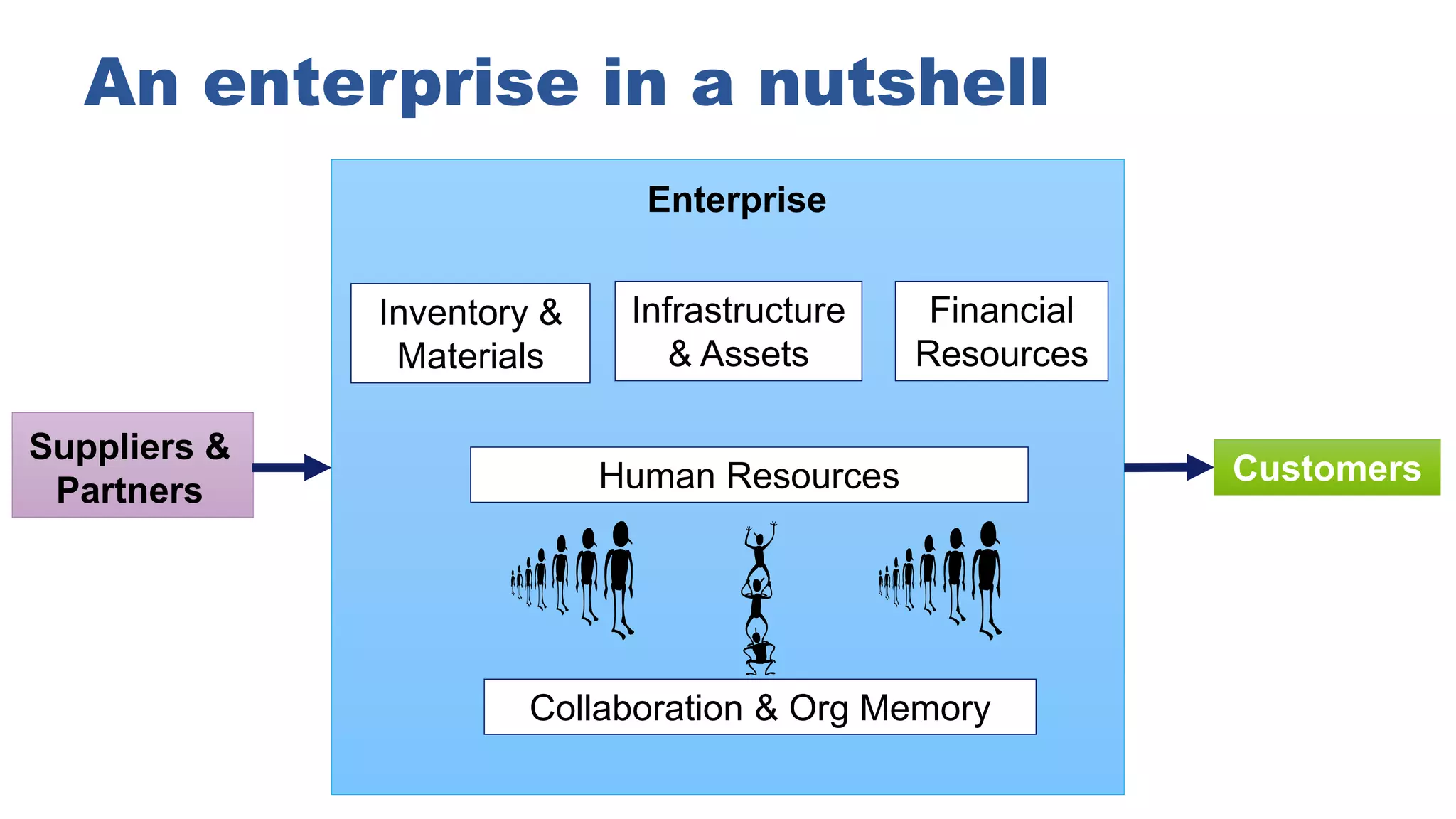
  • #6 Looking at the activities individually is not going to help us conceptualize and manage the complexity of an organization. BPs add structure to this. To understand what a BP is, it helps see an organization as a system supported by IT and be organized in functions: e.g. accounts payable (paying money to suppliers, e.g. checking, accepting and rejecting invoices, making payments etc.), accounts receivable (everything to collect money: getting money, matching them with invoices) in a whole seller org we will have warehouse… etc., However an organization is more complex than that. It includes assets and partners…. Ultimately an organization is about satisfying a customer or set of customers, e.g. retailers for whole sellers. Talk about value and spanning different org. functions It may appear from the previous examples that orgs perform random sets of activities. However this is not the case. Any organization can be seen as a system where work is performed along a number of business processes. A process is triggered by a need from someone (the process customer) and ending with an outcome that is of value to the customer. It involves activities (functions) performed by several stakeholders…
  • #7 Looking at the activities individually is not going to help us conceptualize and manage the complexity of an organization. BPs add structure to this. To understand what a BP is, it helps see an organization as a system supported by IT and be organized in functions: e.g. accounts payable (paying money to suppliers, e.g. checking, accepting and rejecting invoices, making payments etc.), accounts receivable (everything to collect money: getting money, matching them with invoices) in a whole seller org we will have warehouse… etc., However an organization is more complex than that. It includes assets and partners…. Ultimately an organization is about satisfying a customer or set of customers, e.g. retailers for whole sellers. Talk about value and spanning different org. functions It may appear from the previous examples that orgs perform random sets of activities. However this is not the case. Any organization can be seen as a system where work is performed along a number of business processes. A process is triggered by a need from someone (the process customer) and ending with an outcome that is of value to the customer. It involves activities (functions) performed by several stakeholders…