

When to intervene?
Prescriptive Process Monitoring Under
Uncertainty and Resource Constraints
Mahmoud Shoush, Marlon Dumas.
{mahmoud.shoush, marlon.dumas}@ut.ee
1
Refresh your mind: Intervention slide
Source: shorturl.at/oPSTX
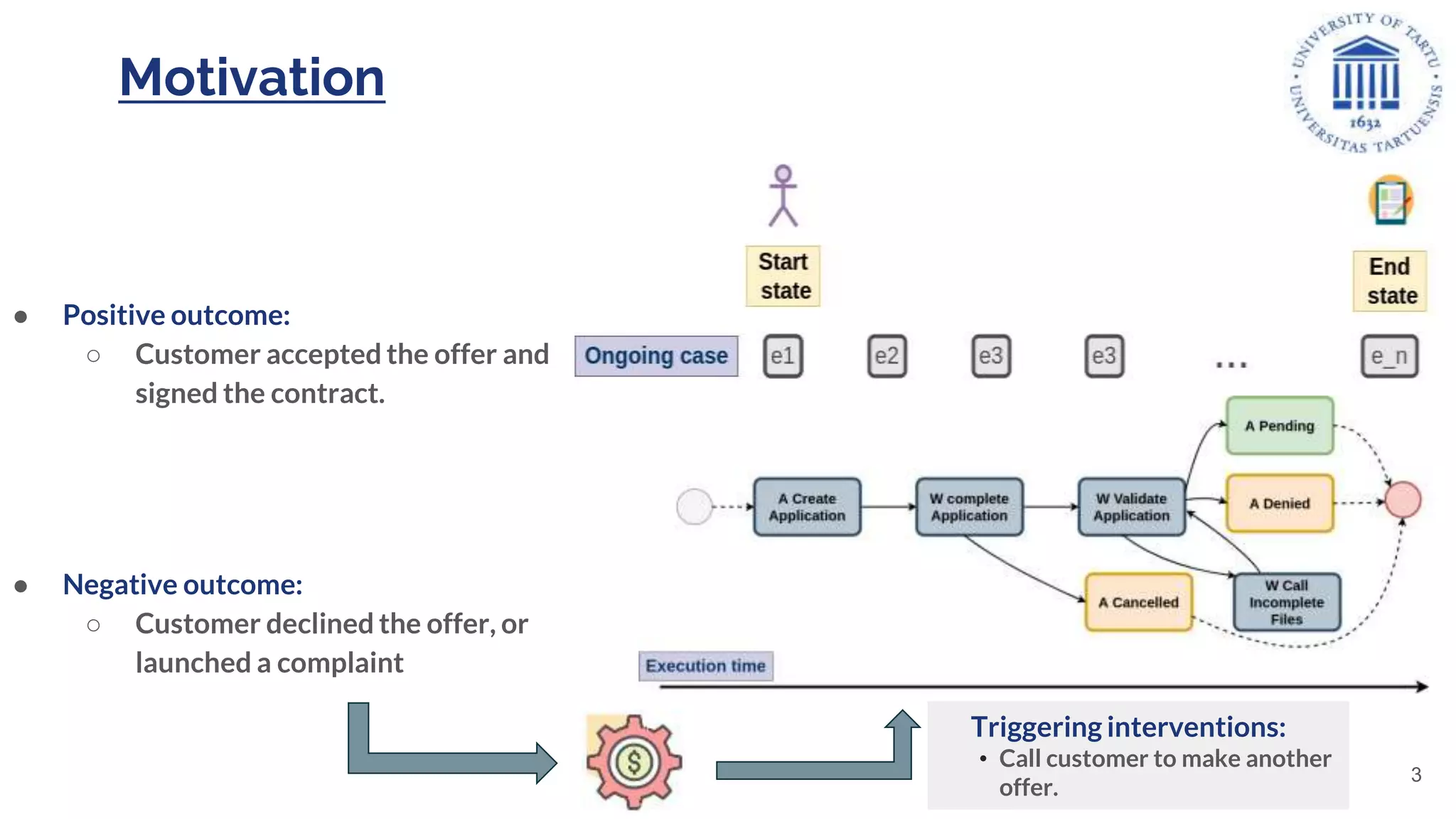
Motivation
3
● Positive outcome:
○ Customer accepted the offer and
signed the contract.
● Negative outcome:
○ Customer declined the offer, or
launched a complaint
Triggering interventions:
• Call customer to make another
offer.
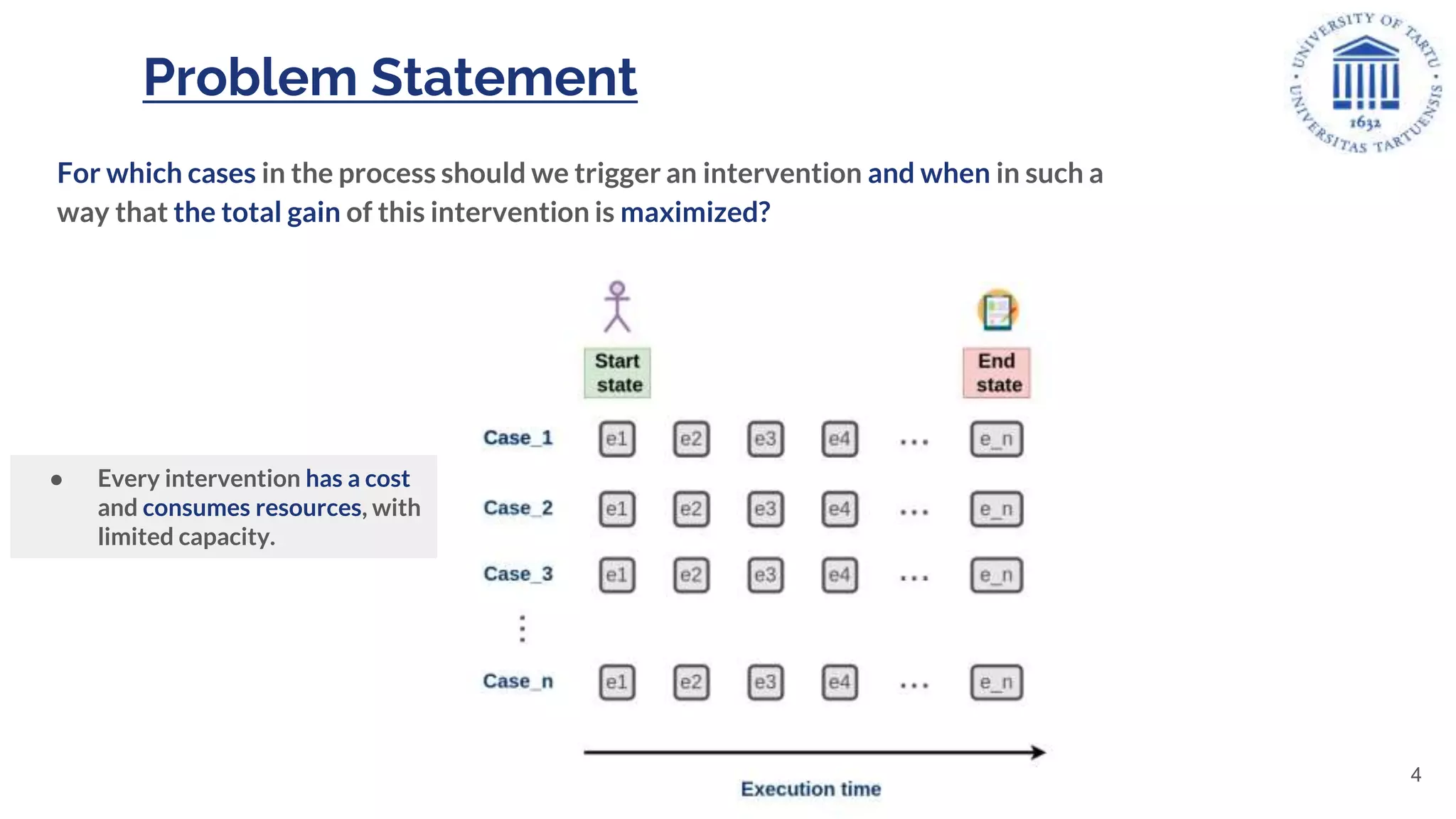
Problem Statement
For which cases in the process should we trigger an intervention and when in such a
way that the total gain of this intervention is maximized?
● Every intervention has a cost
and consumes resources, with
limited capacity.
4
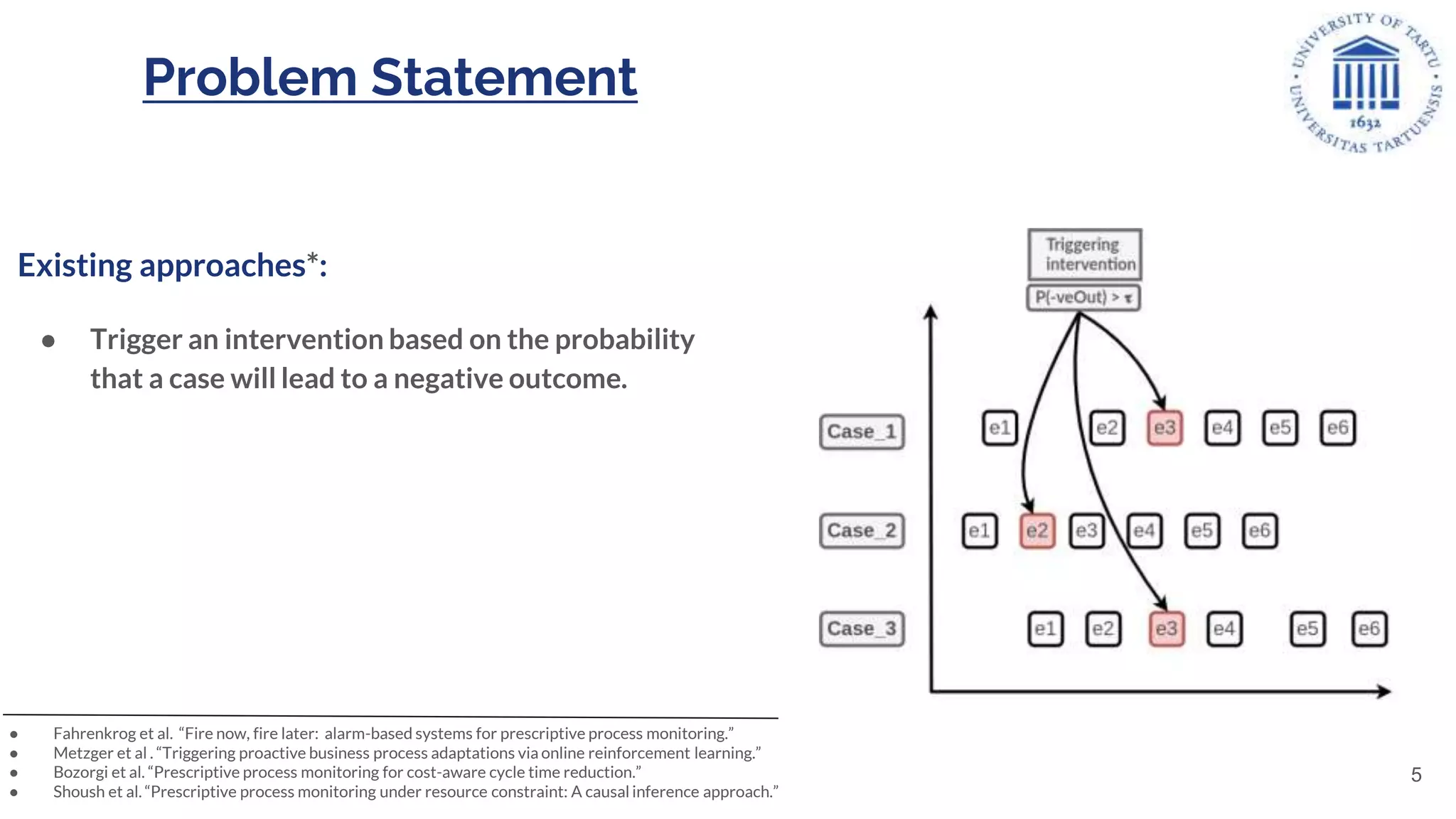
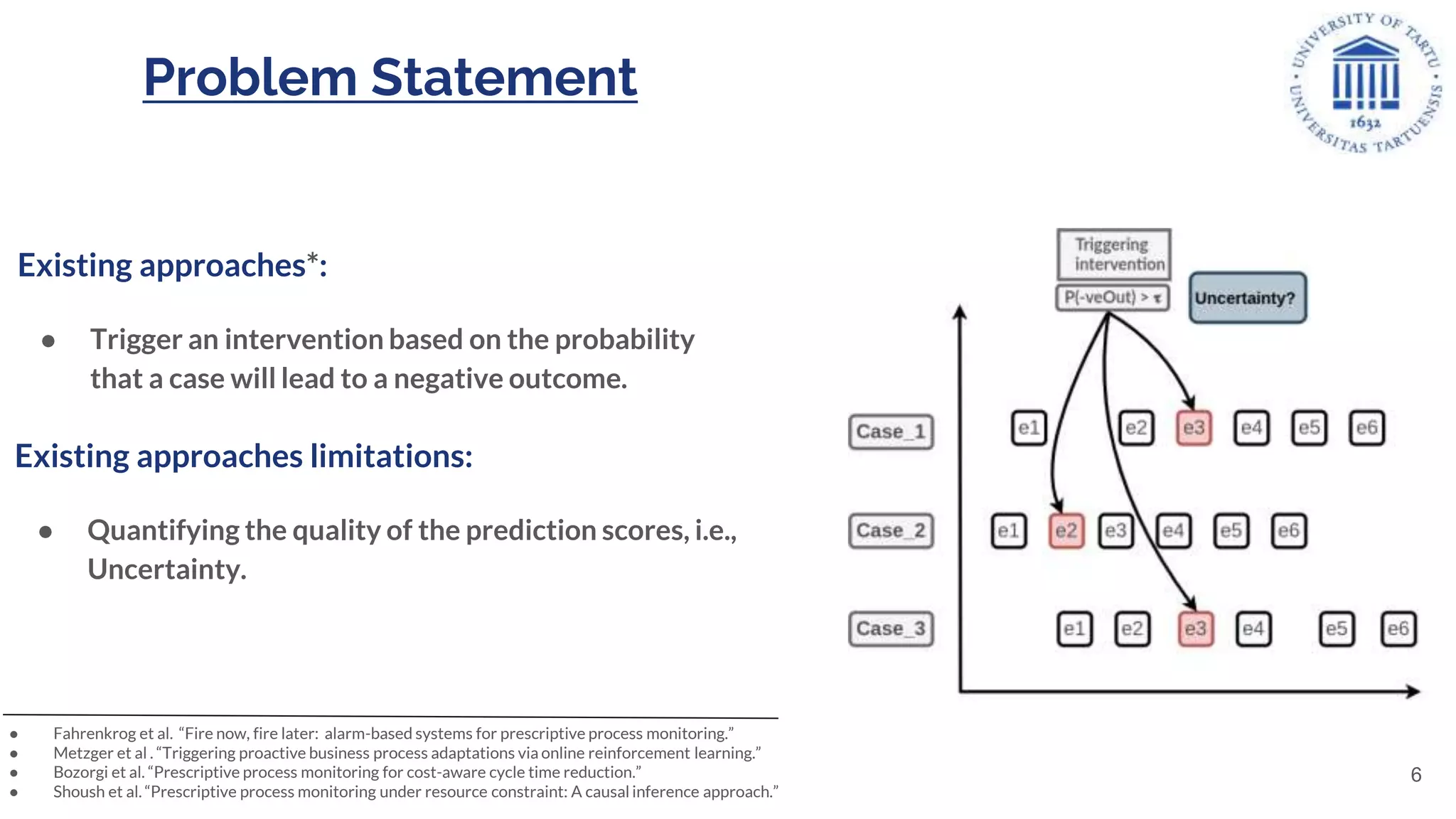
Existing approaches*:
● Trigger an intervention based on the probability
that a case will lead to a negative outcome.
● Fahrenkrog et al. “Fire now, fire later: alarm-based systems for prescriptive process monitoring.”
● Metzger et al . “Triggering proactive business process adaptations via online reinforcement learning.”
● Bozorgi et al. “Prescriptive process monitoring for cost-aware cycle time reduction.”
● Shoush et al. “Prescriptive process monitoring under resource constraint: A causal inference approach.”
Problem Statement
5
Existing approaches*:
● Trigger an intervention based on the probability
that a case will lead to a negative outcome.
Existing approaches limitations:
● Quantifying the quality of the prediction scores, i.e.,
Uncertainty.
● Fahrenkrog et al. “Fire now, fire later: alarm-based systems for prescriptive process monitoring.”
● Metzger et al . “Triggering proactive business process adaptations via online reinforcement learning.”
● Bozorgi et al. “Prescriptive process monitoring for cost-aware cycle time reduction.”
● Shoush et al. “Prescriptive process monitoring under resource constraint: A causal inference approach.”
Problem Statement
6
Existing approaches*:
● Trigger an intervention based on the probability
that a case will lead to a negative outcome.
Existing approaches limitations:
● Quantifying the quality of the prediction scores, i.e.,
Uncertainty.
● Fahrenkrog et al. “Fire now, fire later: alarm-based systems for prescriptive process monitoring.”
● Metzger et al . “Triggering proactive business process adaptations via online reinforcement learning.”
● Bozorgi et al. “Prescriptive process monitoring for cost-aware cycle time reduction.”
● Shoush et al. “Prescriptive process monitoring under resource constraint: A causal inference approach.”
Problem Statement
7
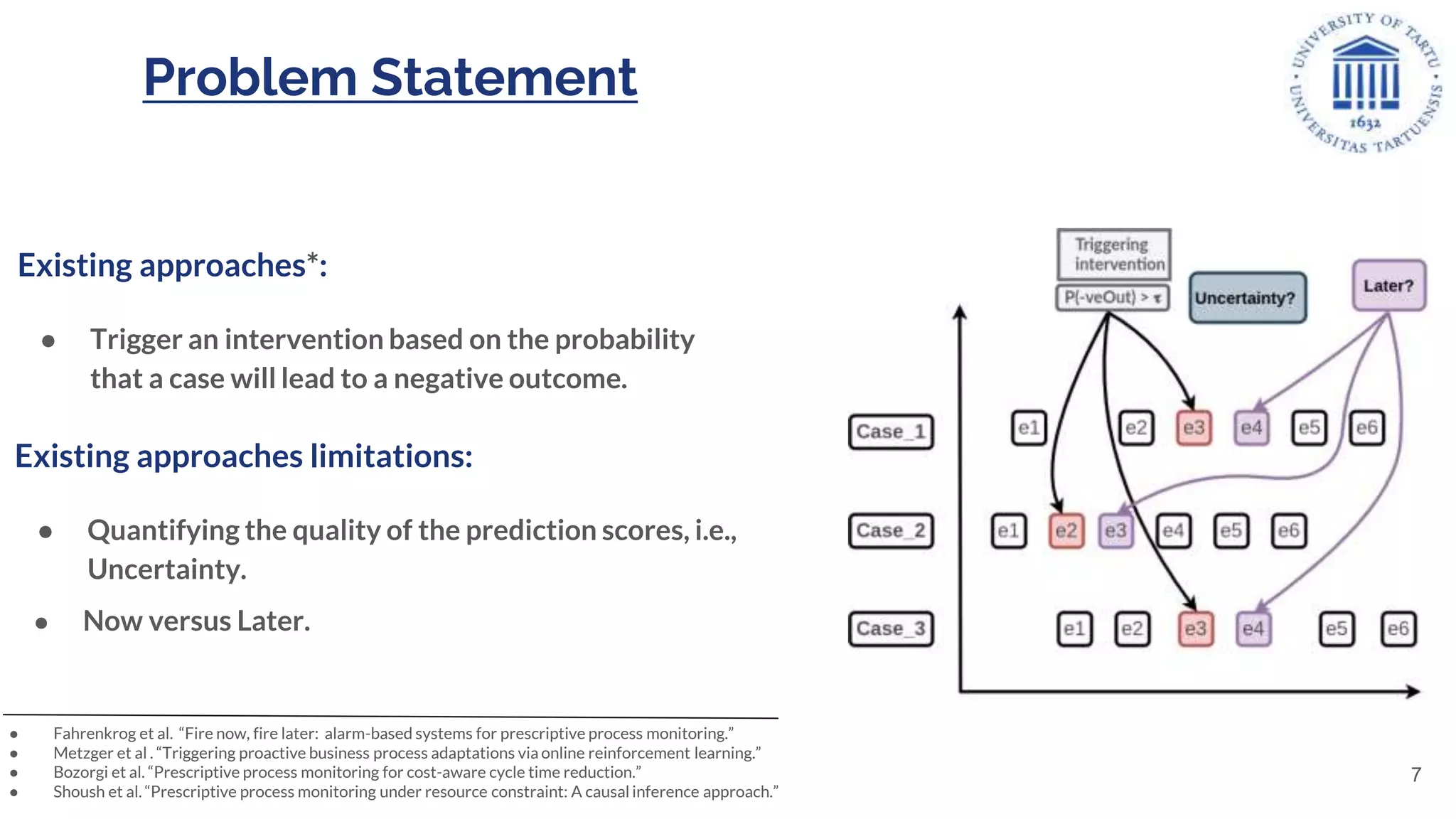
● Now versus Later.
Existing approaches*:
● Trigger an intervention based on the probability
that a case will lead to a negative outcome.
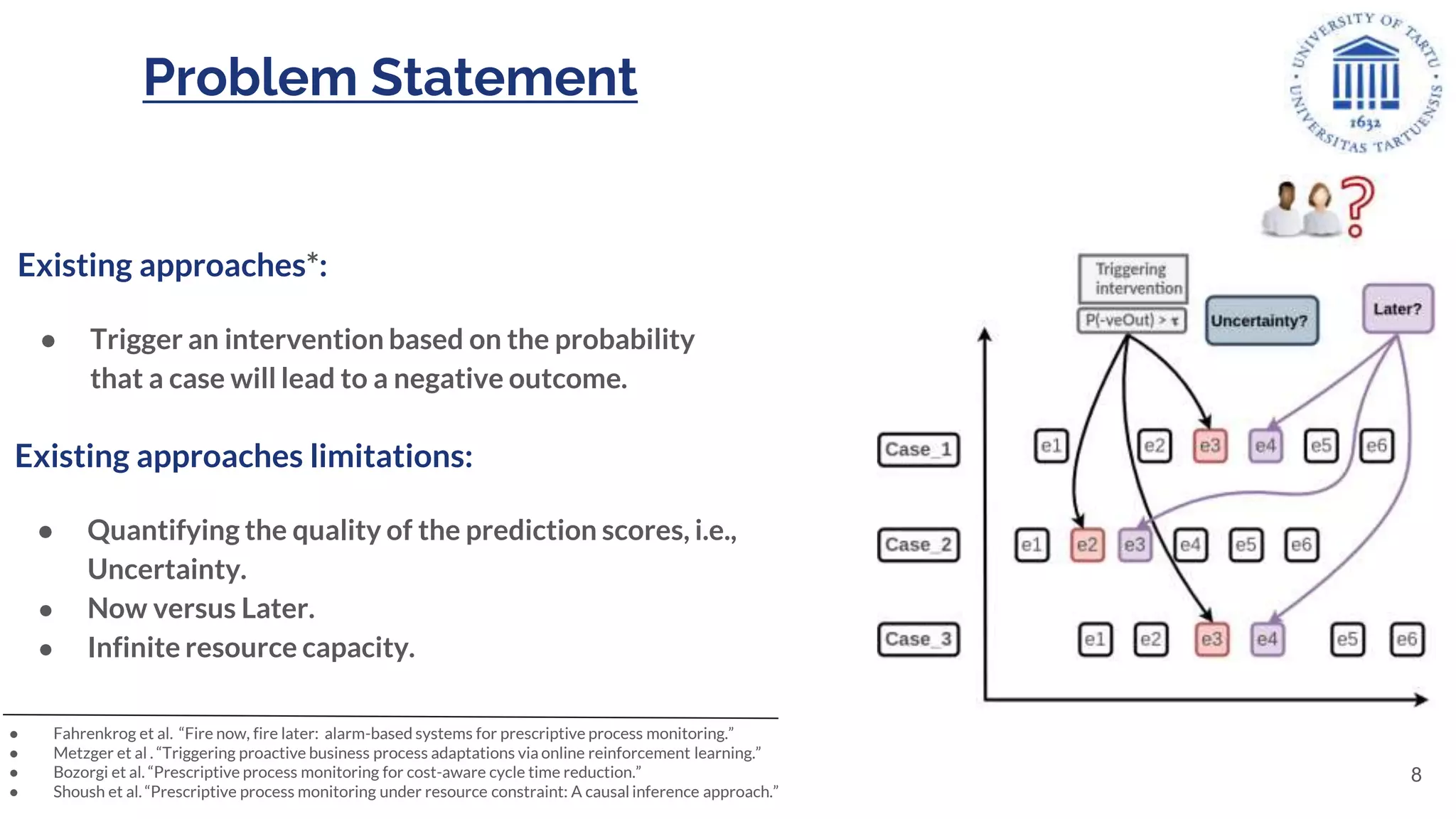
Existing approaches limitations:
● Quantifying the quality of the prediction scores, i.e.,
Uncertainty.
● Now versus Later.
● Infinite resource capacity.
● Fahrenkrog et al. “Fire now, fire later: alarm-based systems for prescriptive process monitoring.”
● Metzger et al . “Triggering proactive business process adaptations via online reinforcement learning.”
● Bozorgi et al. “Prescriptive process monitoring for cost-aware cycle time reduction.”
● Shoush et al. “Prescriptive process monitoring under resource constraint: A causal inference approach.”
Problem Statement
8
Approach
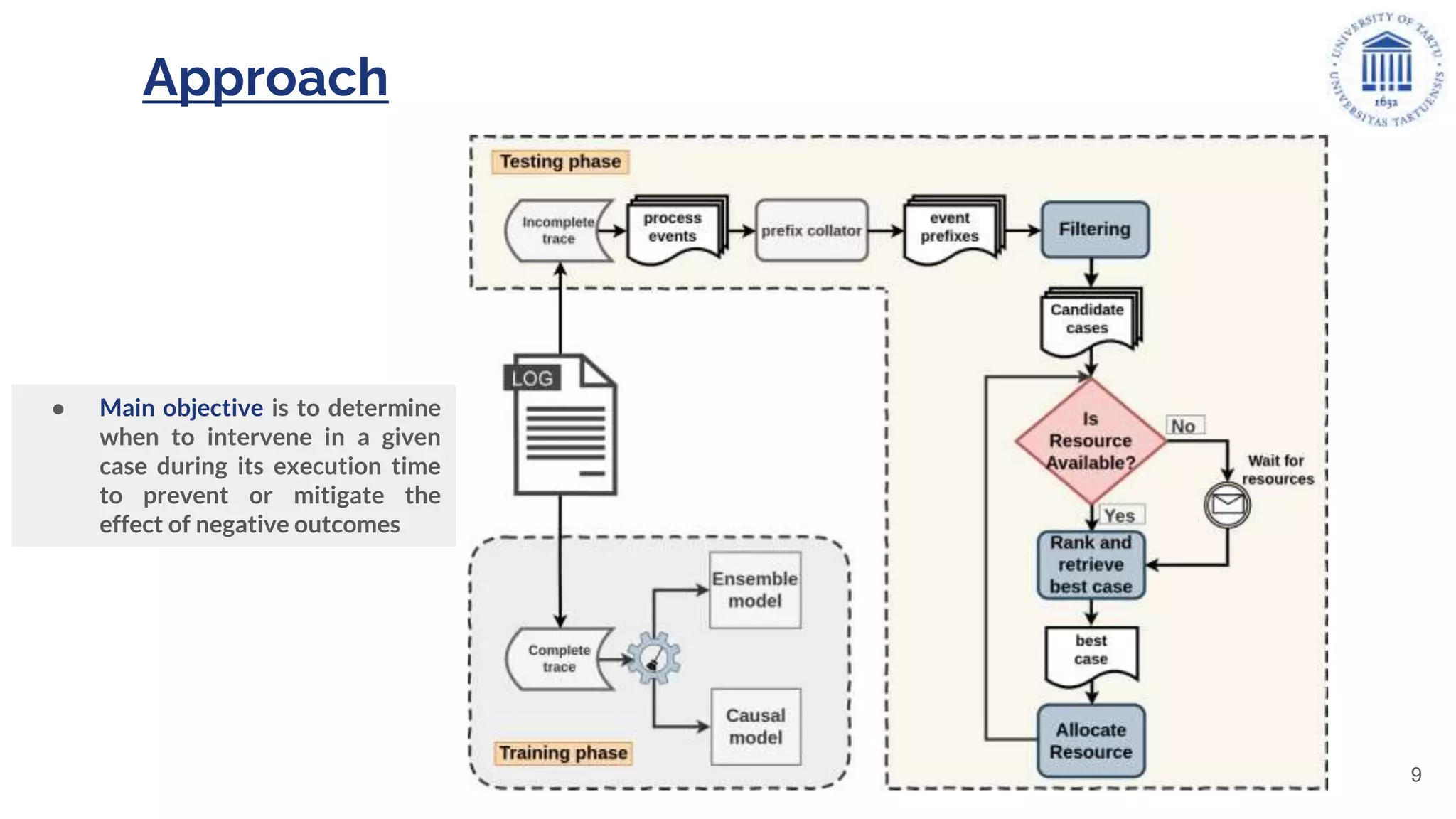
● Main objective is to determine
when to intervene in a given
case during its execution time
to prevent or mitigate the
effect of negative outcomes
9
Approach: Training phase
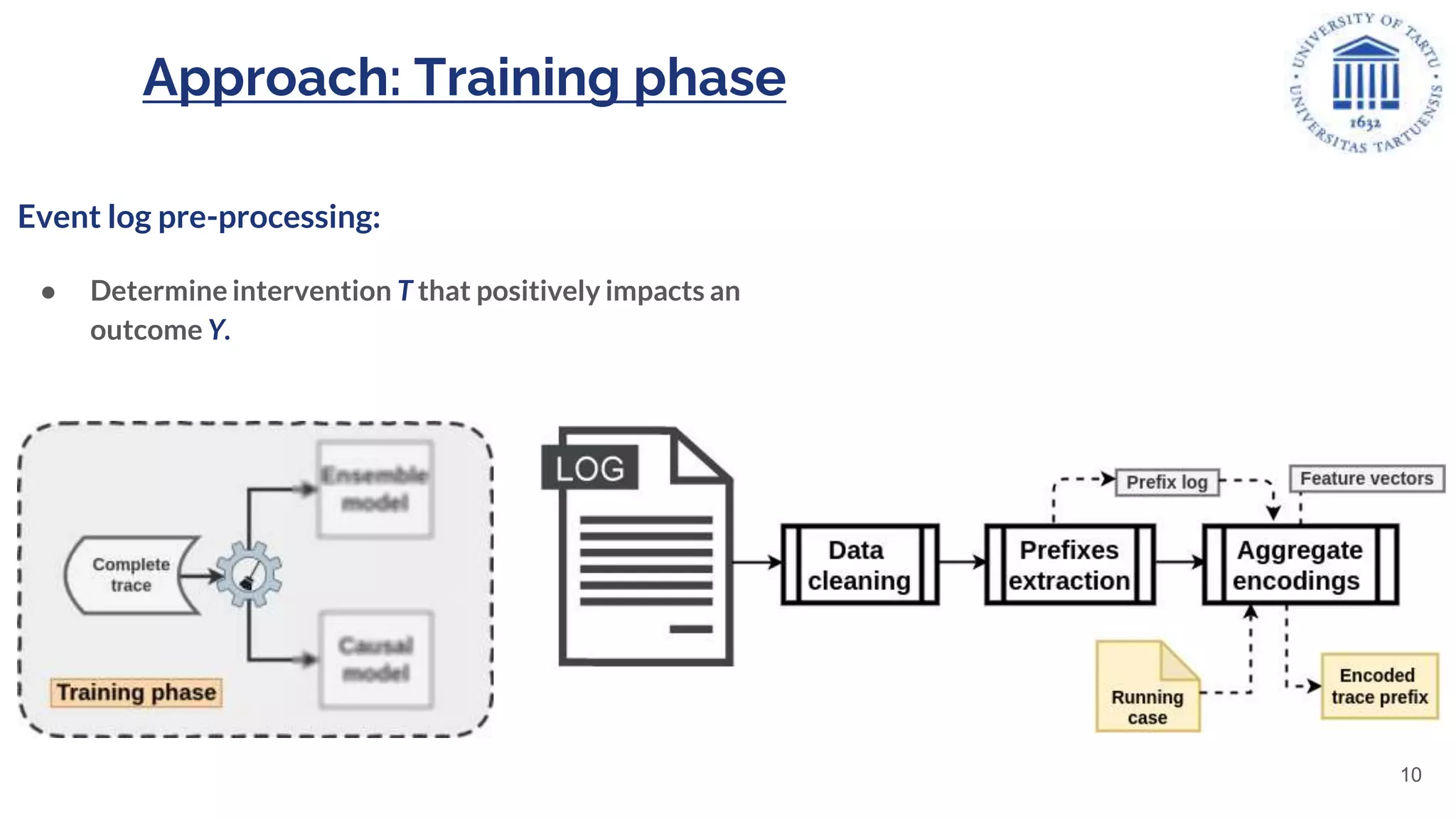
Event log pre-processing:
● Determine intervention T that positively impacts an
outcome Y.
10
Approach: Training phase
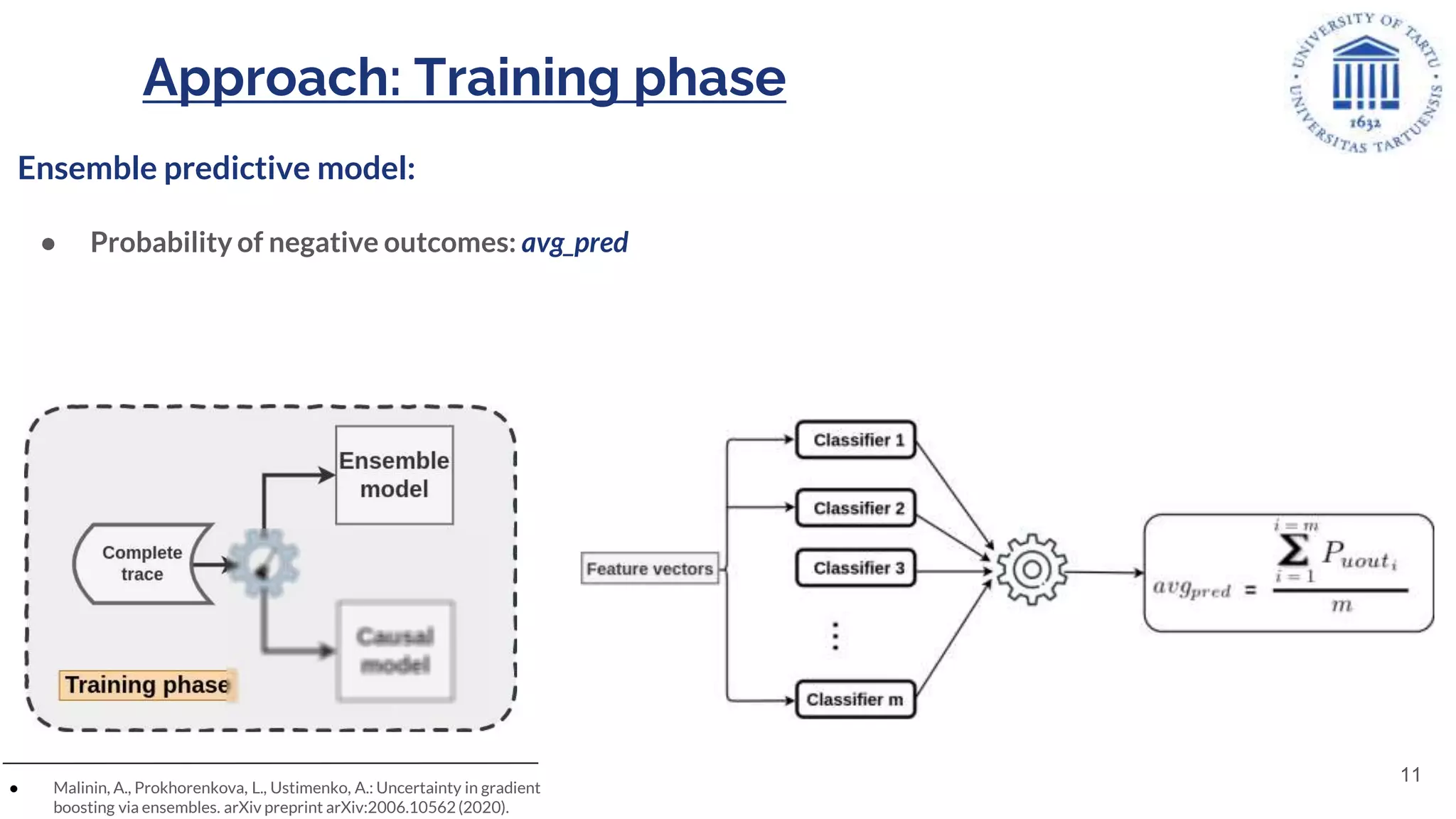
Ensemble predictive model:
● Probability of negative outcomes: avg_pred
● Malinin, A., Prokhorenkova, L., Ustimenko, A.: Uncertainty in gradient
boosting via ensembles. arXiv preprint arXiv:2006.10562(2020).
11
Approach: Training phase
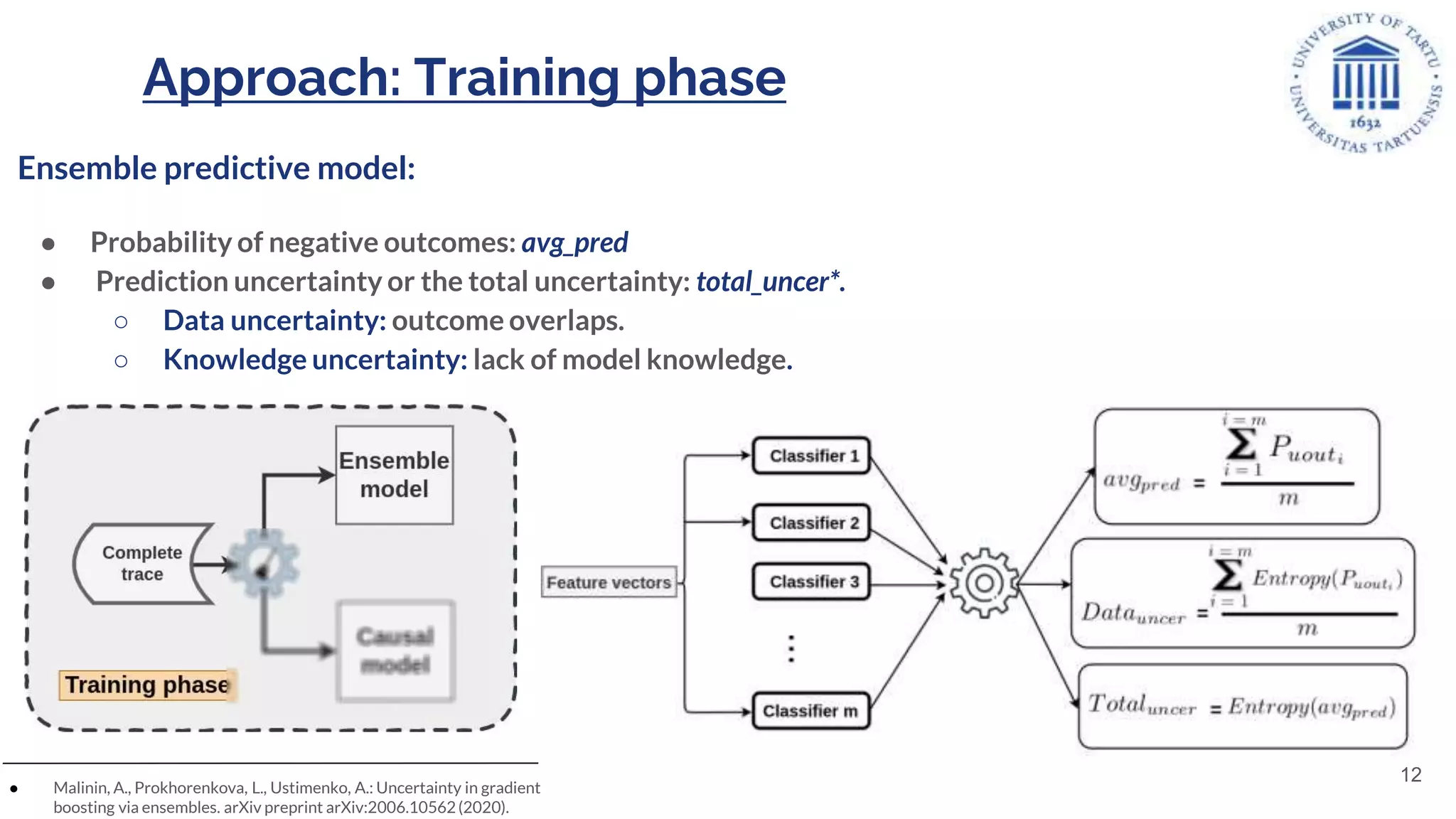
Ensemble predictive model:
● Probability of negative outcomes: avg_pred
● Prediction uncertainty or the total uncertainty: total_uncer*.
○ Data uncertainty: outcome overlaps.
○ Knowledge uncertainty: lack of model knowledge.
● Malinin, A., Prokhorenkova, L., Ustimenko, A.: Uncertainty in gradient
boosting via ensembles. arXiv preprint arXiv:2006.10562(2020).
12
Approach: Training phase
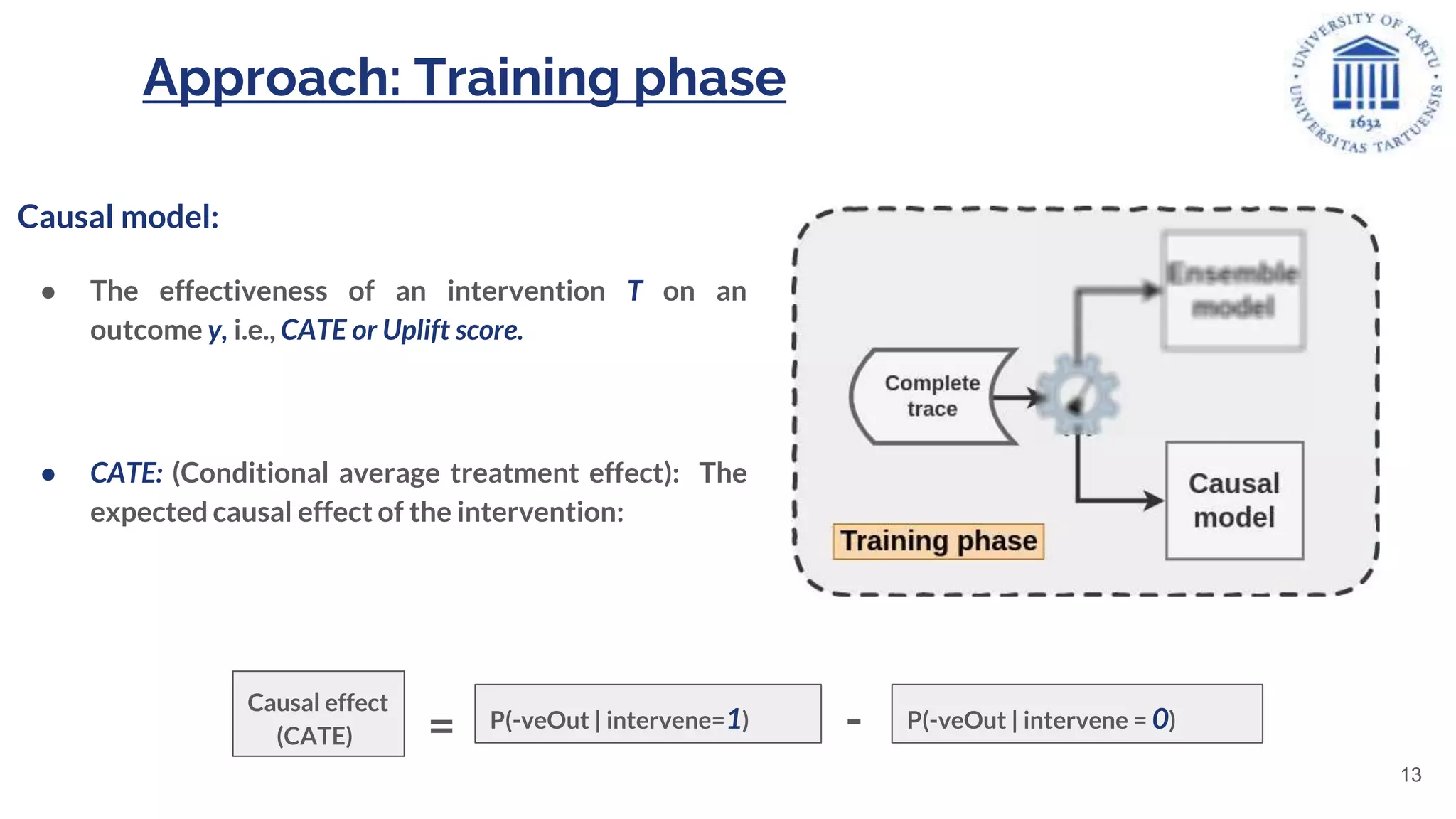
Causal model:
● The effectiveness of an intervention T on an
outcome y, i.e., CATE or Uplift score.
● CATE: (Conditional average treatment effect): The
expected causal effect of the intervention:
Causal effect
(CATE)
P(-veOut | intervene=1) - P(-veOut | intervene = 0)
=
13
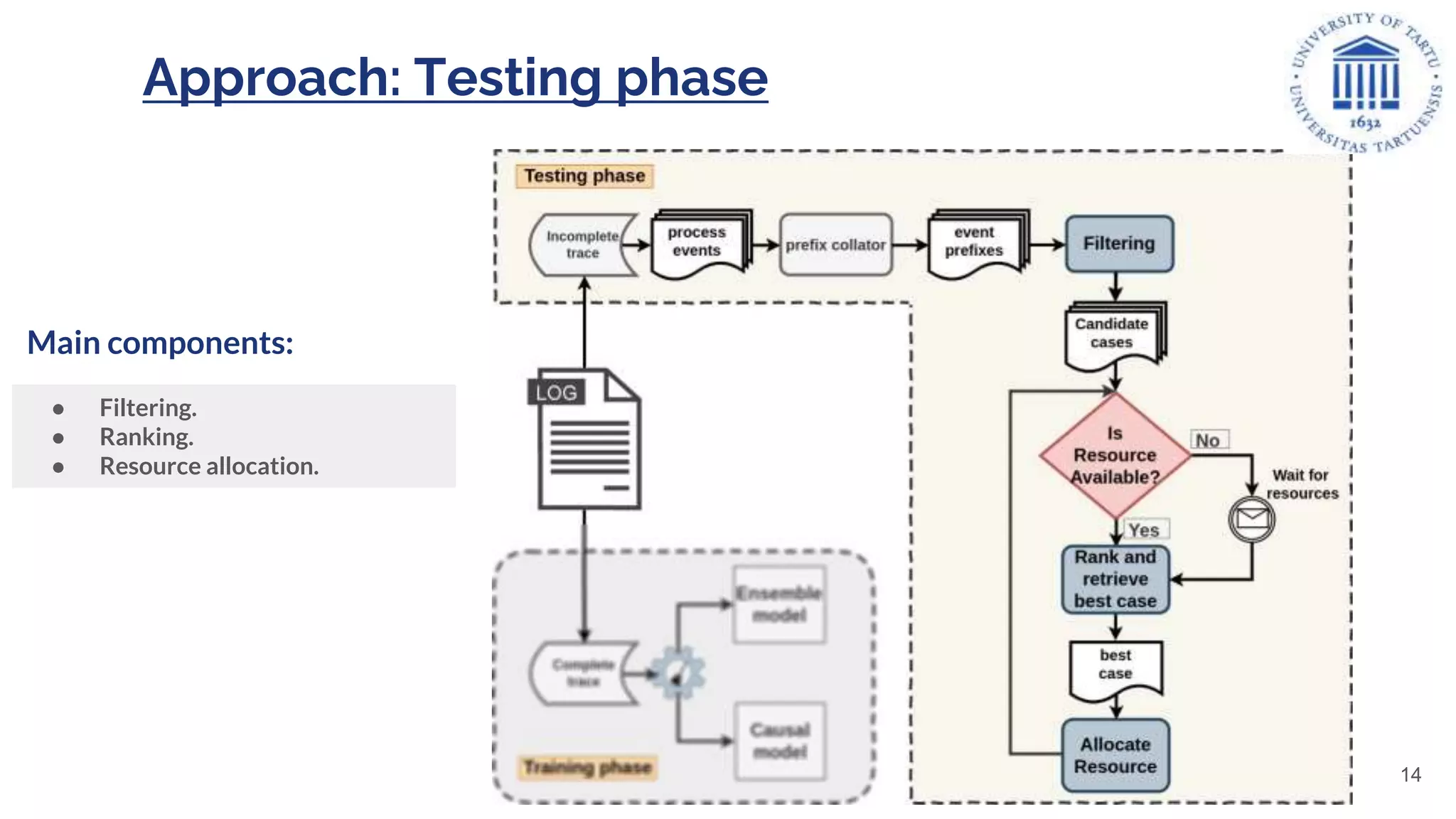
Approach: Testing phase
● Filtering.
● Ranking.
● Resource allocation.
Main components:
14
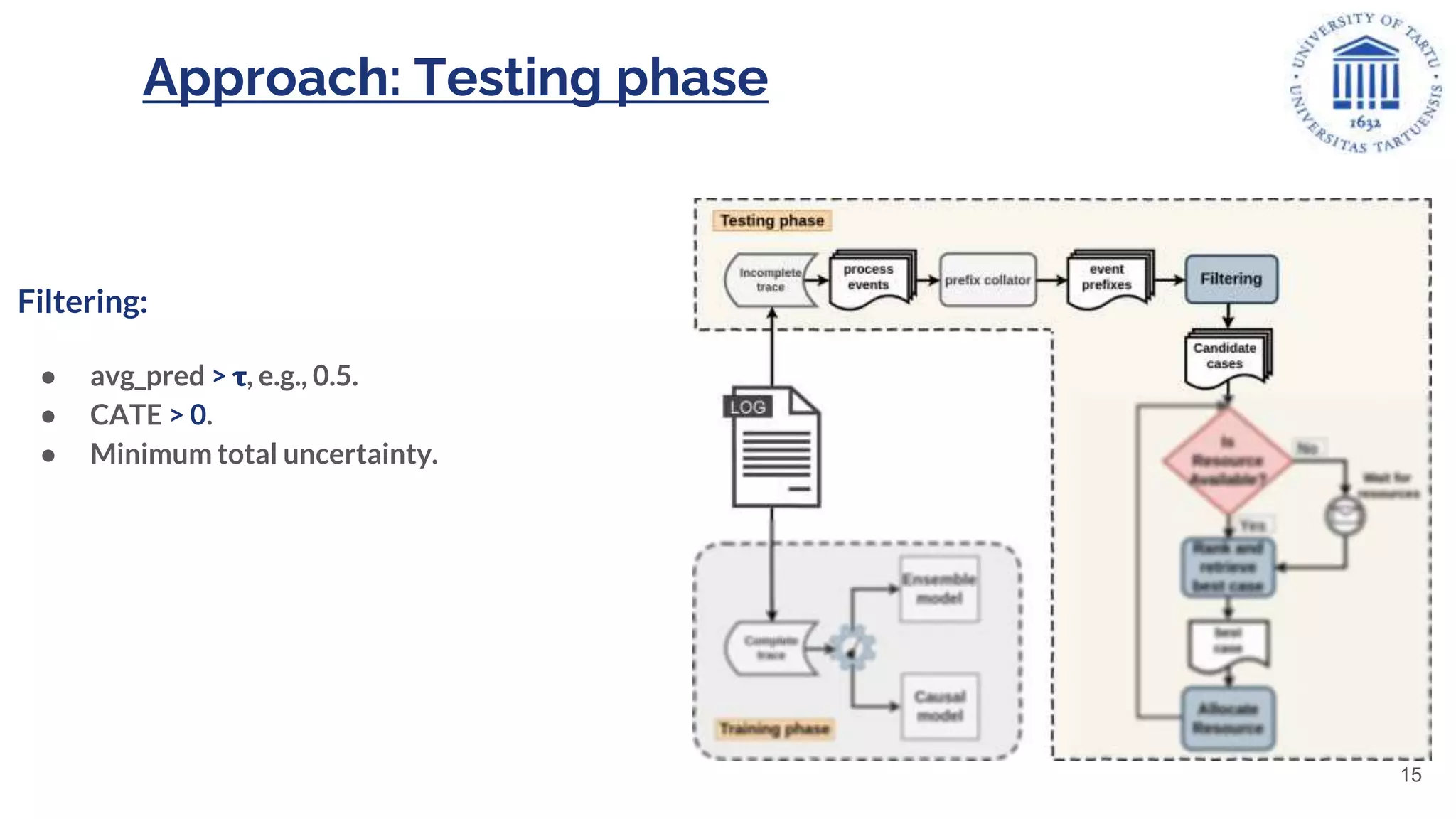
Approach: Testing phase
Filtering:
● avg_pred > 𝛕, e.g., 0.5.
● CATE > 0.
● Minimum total uncertainty.
15
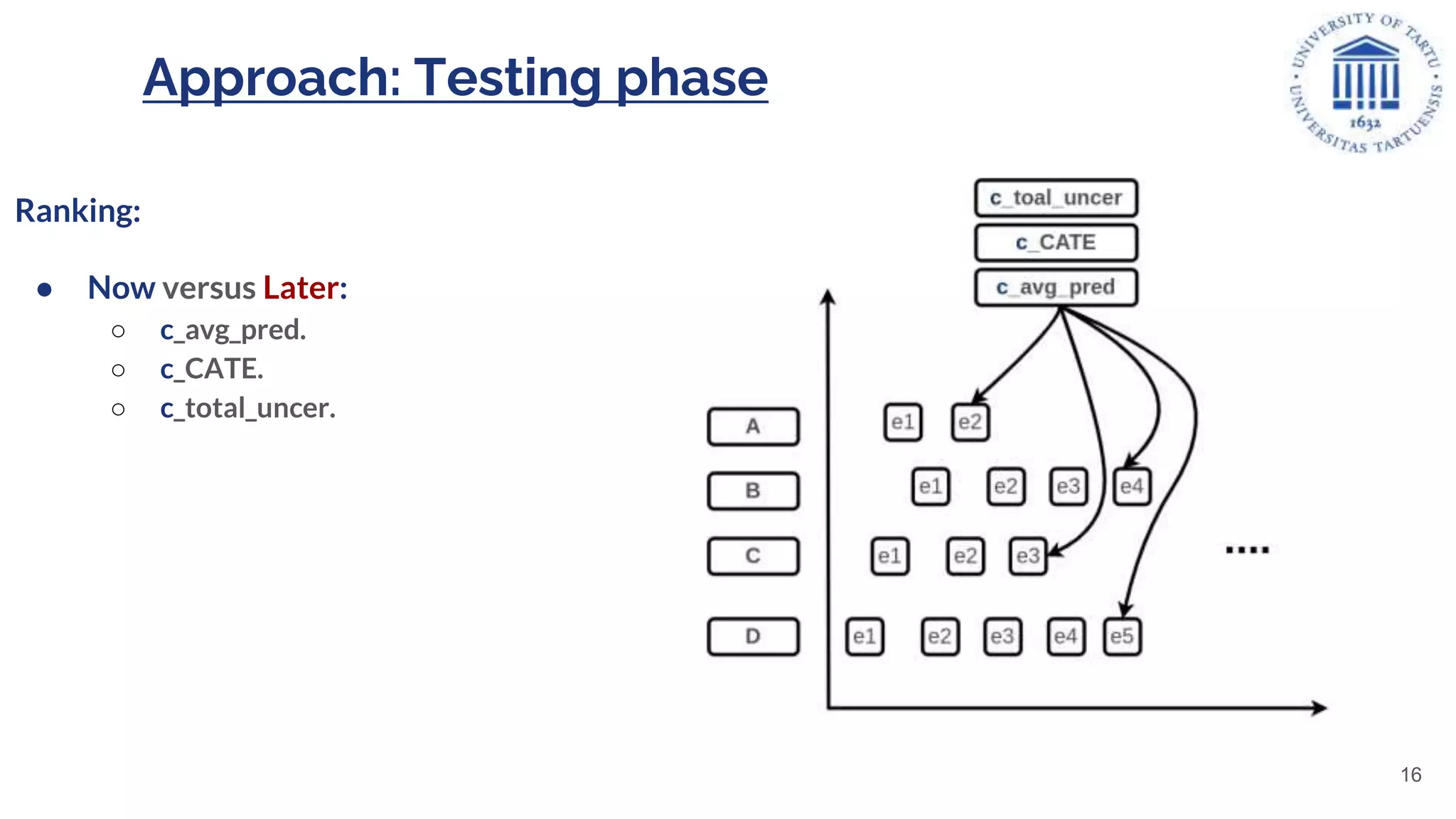
Approach: Testing phase
Ranking:
● Now versus Later:
○ c_avg_pred.
○ c_CATE.
○ c_total_uncer.
16
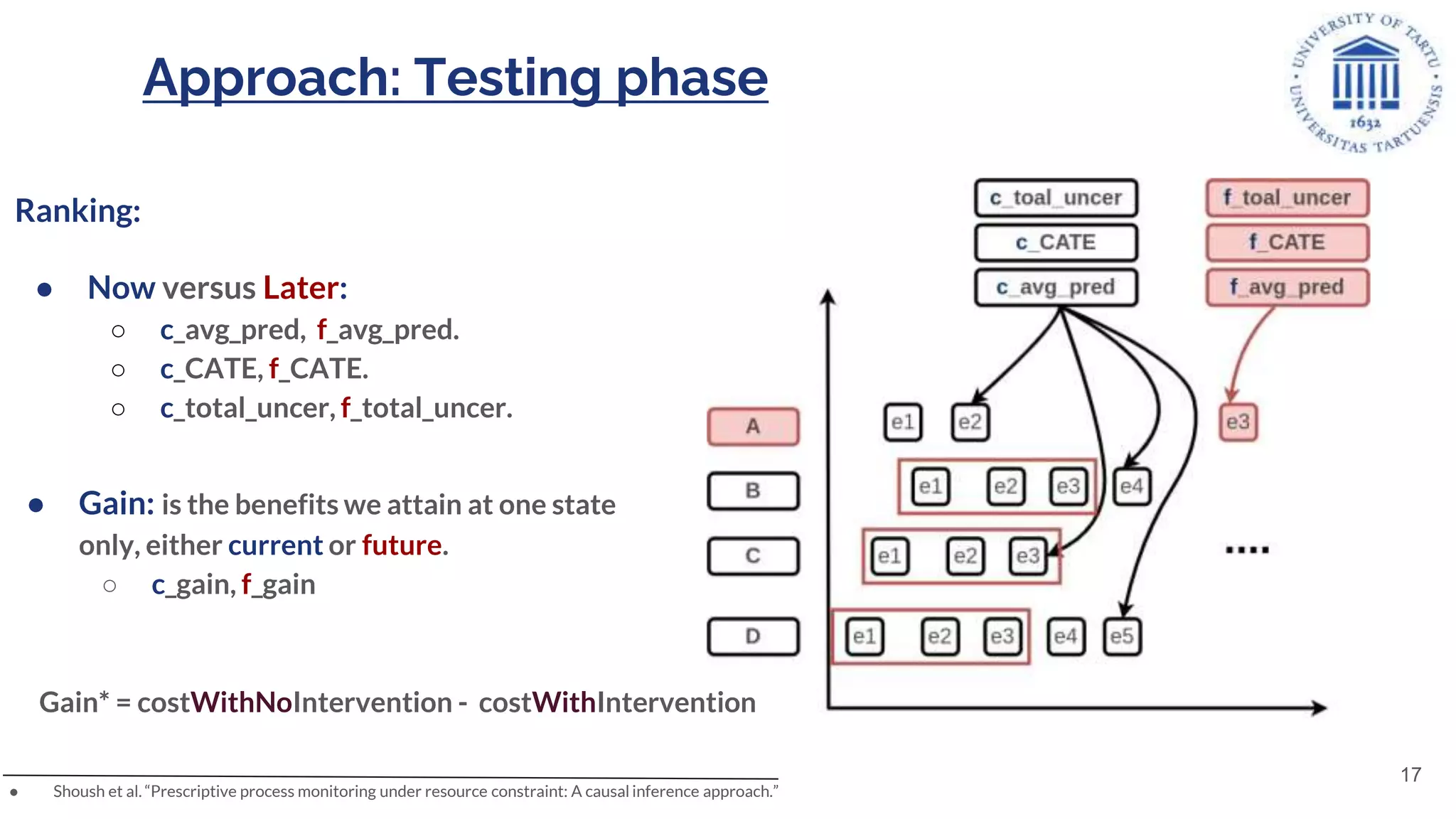
Approach: Testing phase
Ranking:
● Now versus Later:
○ c_avg_pred, f_avg_pred.
○ c_CATE, f_CATE.
○ c_total_uncer, f_total_uncer.
● Gain: is the benefits we attain at one state
only, either current or future.
○ c_gain, f_gain
17
● Shoush et al. “Prescriptive process monitoring under resource constraint: A causal inference approach.”
Gain* = costWithNoIntervention - costWithIntervention
Approach: Testing phase
Ranking:
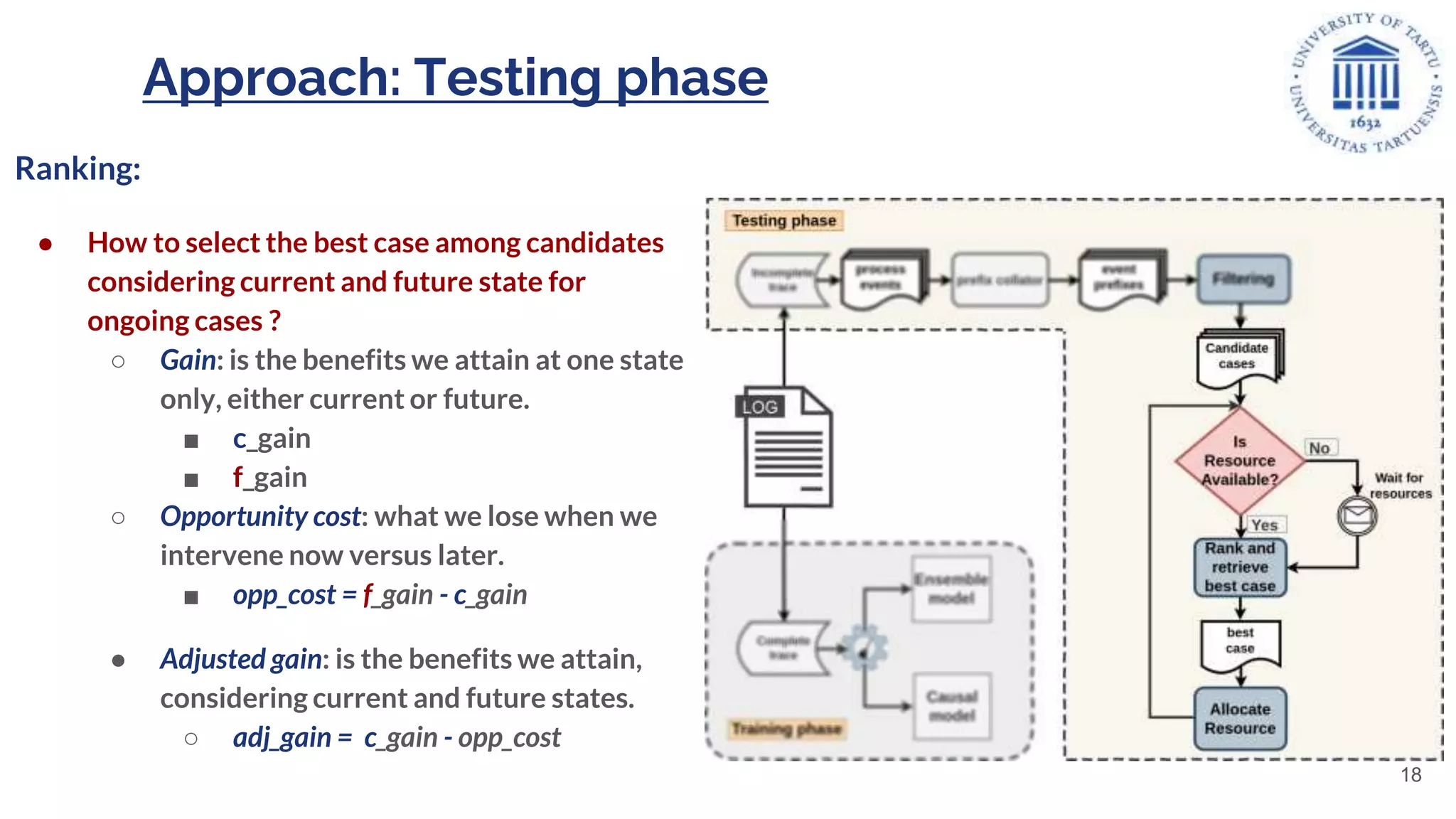
● How to select the best case among candidates
considering current and future state for
ongoing cases ?
○ Gain: is the benefits we attain at one state
only, either current or future.
■ c_gain
■ f_gain
○ Opportunity cost: what we lose when we
intervene now versus later.
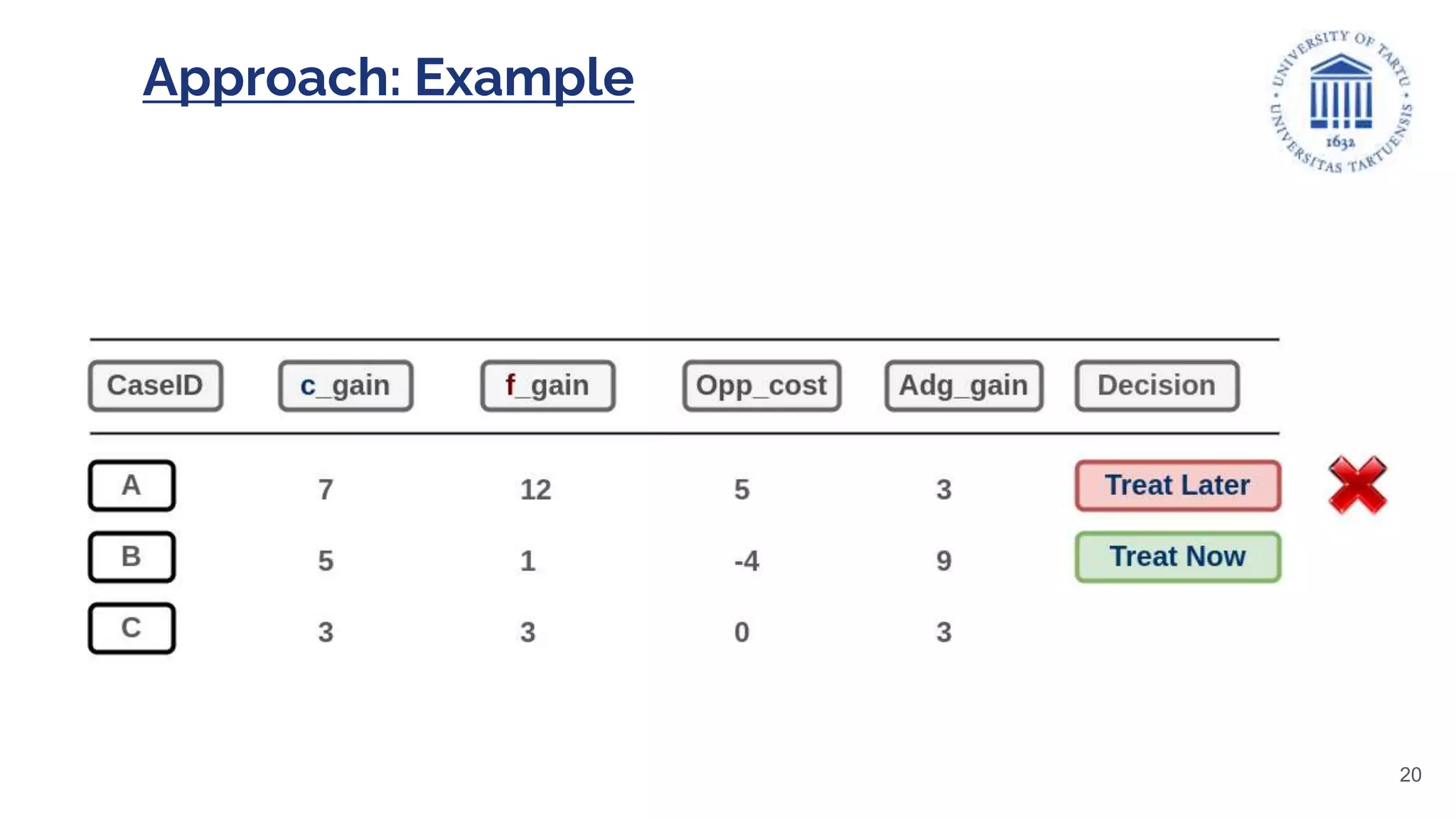
■ opp_cost = f_gain - c_gain
● Adjusted gain: is the benefits we attain,
considering current and future states.
○ adj_gain = c_gain - opp_cost
18
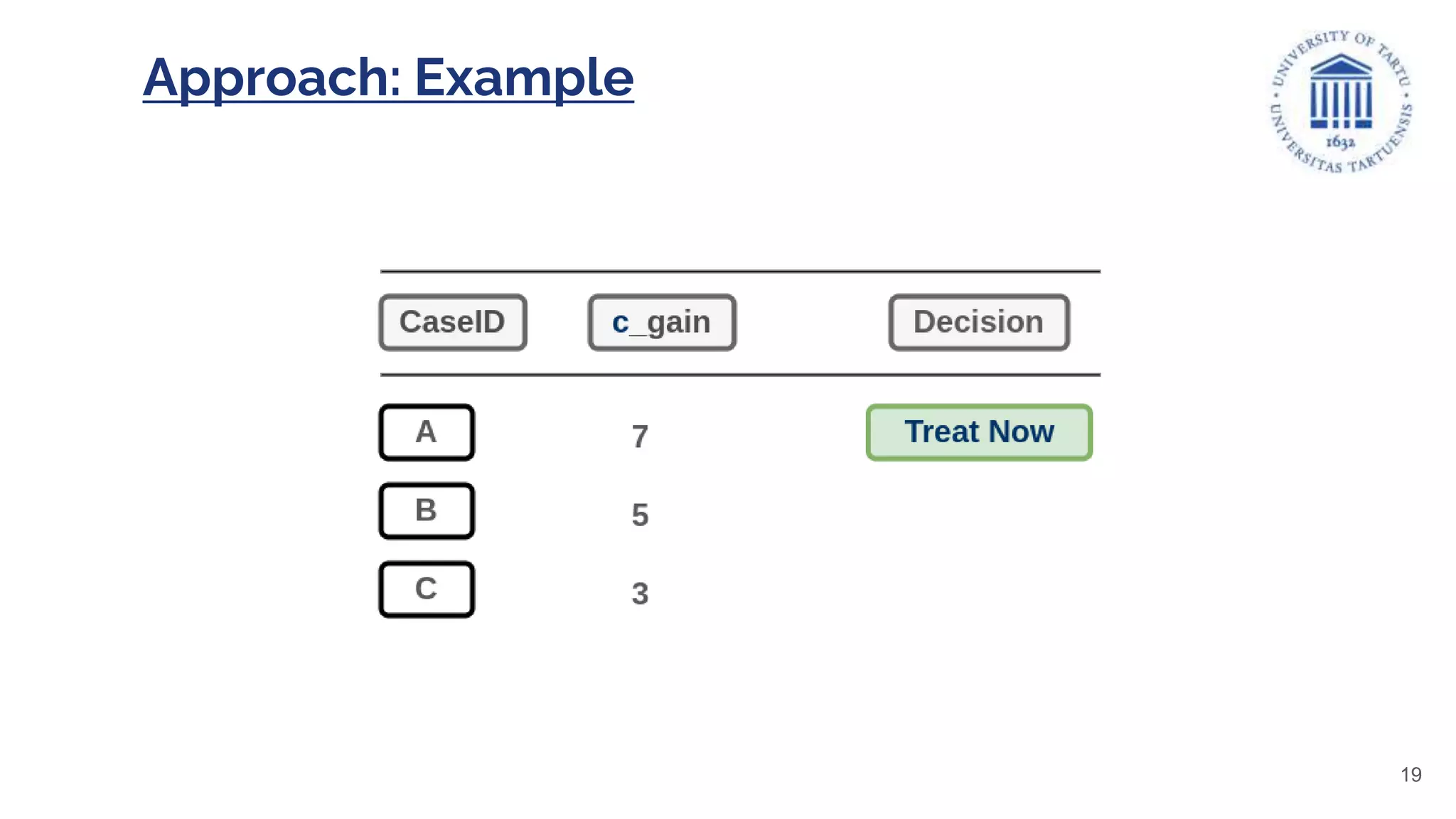
Approach: Example
19
Approach: Example
20
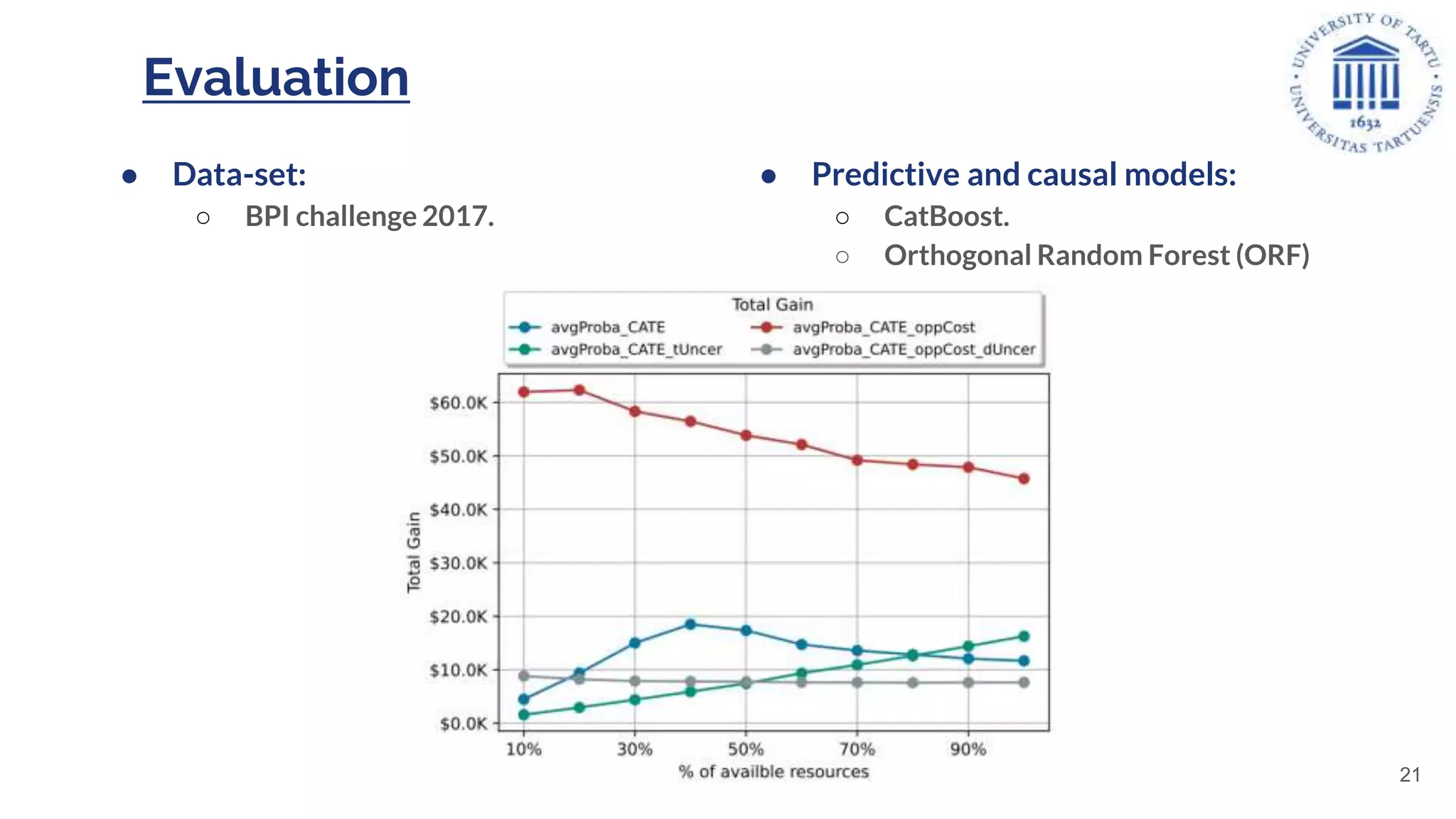
Evaluation
● Data-set:
○ BPI challenge 2017.
● Predictive and causal models:
○ CatBoost.
○ Orthogonal Random Forest (ORF)
21
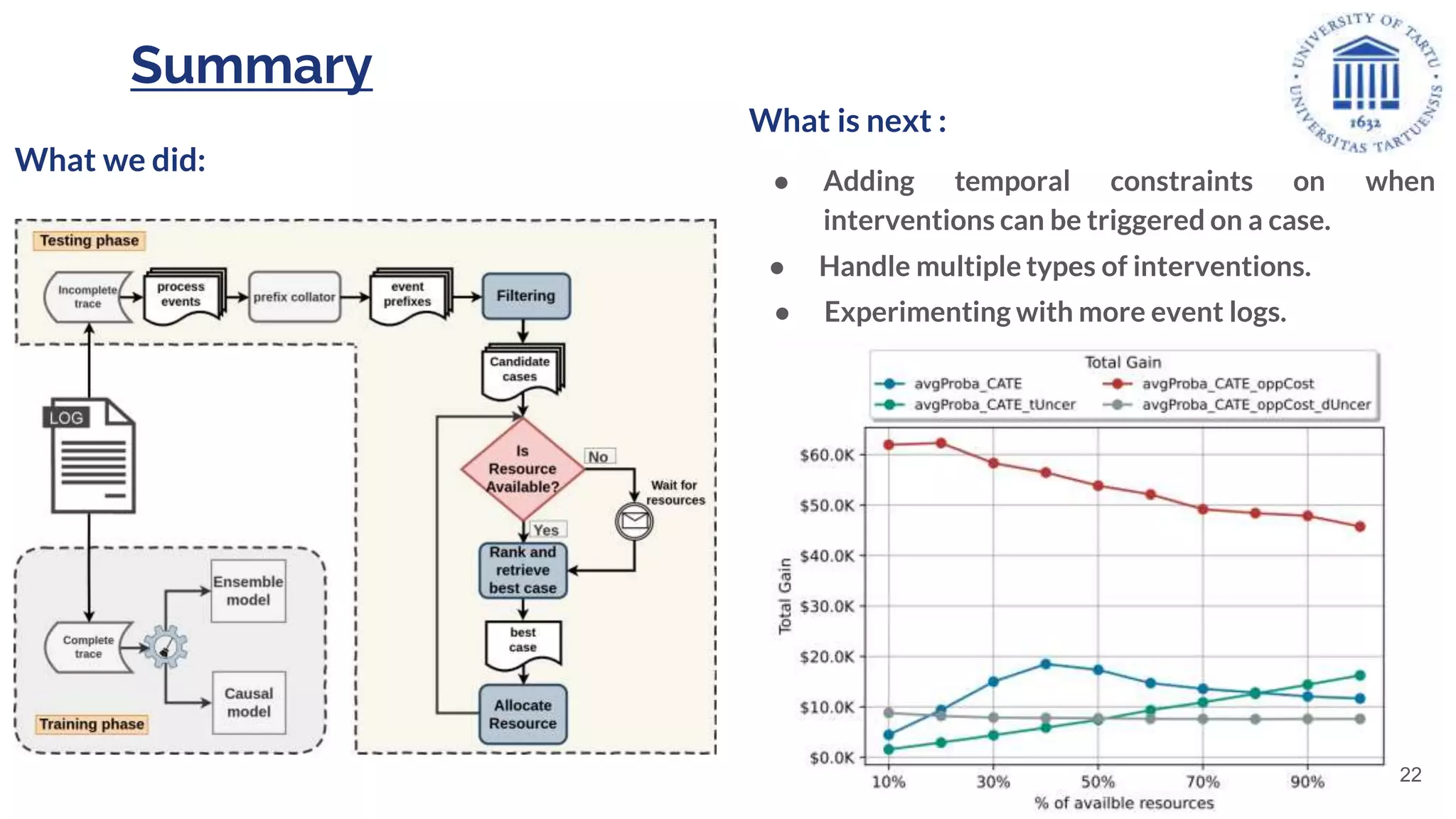
Summary
● Adding temporal constraints on when
interventions can be triggered on a case.
What we did:
What is next :
● Handle multiple types of interventions.
● Experimenting with more event logs.
22
Prescriptive Process Monitoring Under Uncertainty and Resource Constraints

Prescriptive Process Monitoring Under Uncertainty and Resource Constraints

  • 1.
    When to intervene? PrescriptiveProcess Monitoring Under Uncertainty and Resource Constraints Mahmoud Shoush, Marlon Dumas. {mahmoud.shoush, marlon.dumas}@ut.ee 1
  • 2.
    Refresh your mind:Intervention slide Source: shorturl.at/oPSTX
  • 3.
    Motivation 3 ● Positive outcome: ○Customer accepted the offer and signed the contract. ● Negative outcome: ○ Customer declined the offer, or launched a complaint Triggering interventions: • Call customer to make another offer.
  • 4.
    Problem Statement For whichcases in the process should we trigger an intervention and when in such a way that the total gain of this intervention is maximized? ● Every intervention has a cost and consumes resources, with limited capacity. 4
  • 5.
    Existing approaches*: ● Triggeran intervention based on the probability that a case will lead to a negative outcome. ● Fahrenkrog et al. “Fire now, fire later: alarm-based systems for prescriptive process monitoring.” ● Metzger et al . “Triggering proactive business process adaptations via online reinforcement learning.” ● Bozorgi et al. “Prescriptive process monitoring for cost-aware cycle time reduction.” ● Shoush et al. “Prescriptive process monitoring under resource constraint: A causal inference approach.” Problem Statement 5
  • 6.
    Existing approaches*: ● Triggeran intervention based on the probability that a case will lead to a negative outcome. Existing approaches limitations: ● Quantifying the quality of the prediction scores, i.e., Uncertainty. ● Fahrenkrog et al. “Fire now, fire later: alarm-based systems for prescriptive process monitoring.” ● Metzger et al . “Triggering proactive business process adaptations via online reinforcement learning.” ● Bozorgi et al. “Prescriptive process monitoring for cost-aware cycle time reduction.” ● Shoush et al. “Prescriptive process monitoring under resource constraint: A causal inference approach.” Problem Statement 6
  • 7.
    Existing approaches*: ● Triggeran intervention based on the probability that a case will lead to a negative outcome. Existing approaches limitations: ● Quantifying the quality of the prediction scores, i.e., Uncertainty. ● Fahrenkrog et al. “Fire now, fire later: alarm-based systems for prescriptive process monitoring.” ● Metzger et al . “Triggering proactive business process adaptations via online reinforcement learning.” ● Bozorgi et al. “Prescriptive process monitoring for cost-aware cycle time reduction.” ● Shoush et al. “Prescriptive process monitoring under resource constraint: A causal inference approach.” Problem Statement 7 ● Now versus Later.
  • 8.
    Existing approaches*: ● Triggeran intervention based on the probability that a case will lead to a negative outcome. Existing approaches limitations: ● Quantifying the quality of the prediction scores, i.e., Uncertainty. ● Now versus Later. ● Infinite resource capacity. ● Fahrenkrog et al. “Fire now, fire later: alarm-based systems for prescriptive process monitoring.” ● Metzger et al . “Triggering proactive business process adaptations via online reinforcement learning.” ● Bozorgi et al. “Prescriptive process monitoring for cost-aware cycle time reduction.” ● Shoush et al. “Prescriptive process monitoring under resource constraint: A causal inference approach.” Problem Statement 8
  • 9.
    Approach ● Main objectiveis to determine when to intervene in a given case during its execution time to prevent or mitigate the effect of negative outcomes 9
  • 10.
    Approach: Training phase Eventlog pre-processing: ● Determine intervention T that positively impacts an outcome Y. 10
  • 11.
    Approach: Training phase Ensemblepredictive model: ● Probability of negative outcomes: avg_pred ● Malinin, A., Prokhorenkova, L., Ustimenko, A.: Uncertainty in gradient boosting via ensembles. arXiv preprint arXiv:2006.10562(2020). 11
  • 12.
    Approach: Training phase Ensemblepredictive model: ● Probability of negative outcomes: avg_pred ● Prediction uncertainty or the total uncertainty: total_uncer*. ○ Data uncertainty: outcome overlaps. ○ Knowledge uncertainty: lack of model knowledge. ● Malinin, A., Prokhorenkova, L., Ustimenko, A.: Uncertainty in gradient boosting via ensembles. arXiv preprint arXiv:2006.10562(2020). 12
  • 13.
    Approach: Training phase Causalmodel: ● The effectiveness of an intervention T on an outcome y, i.e., CATE or Uplift score. ● CATE: (Conditional average treatment effect): The expected causal effect of the intervention: Causal effect (CATE) P(-veOut | intervene=1) - P(-veOut | intervene = 0) = 13
  • 14.
    Approach: Testing phase ●Filtering. ● Ranking. ● Resource allocation. Main components: 14
  • 15.
    Approach: Testing phase Filtering: ●avg_pred > 𝛕, e.g., 0.5. ● CATE > 0. ● Minimum total uncertainty. 15
  • 16.
    Approach: Testing phase Ranking: ●Now versus Later: ○ c_avg_pred. ○ c_CATE. ○ c_total_uncer. 16
  • 17.
    Approach: Testing phase Ranking: ●Now versus Later: ○ c_avg_pred, f_avg_pred. ○ c_CATE, f_CATE. ○ c_total_uncer, f_total_uncer. ● Gain: is the benefits we attain at one state only, either current or future. ○ c_gain, f_gain 17 ● Shoush et al. “Prescriptive process monitoring under resource constraint: A causal inference approach.” Gain* = costWithNoIntervention - costWithIntervention
  • 18.
    Approach: Testing phase Ranking: ●How to select the best case among candidates considering current and future state for ongoing cases ? ○ Gain: is the benefits we attain at one state only, either current or future. ■ c_gain ■ f_gain ○ Opportunity cost: what we lose when we intervene now versus later. ■ opp_cost = f_gain - c_gain ● Adjusted gain: is the benefits we attain, considering current and future states. ○ adj_gain = c_gain - opp_cost 18
  • 19.
  • 20.
  • 21.
    Evaluation ● Data-set: ○ BPIchallenge 2017. ● Predictive and causal models: ○ CatBoost. ○ Orthogonal Random Forest (ORF) 21
  • 22.
    Summary ● Adding temporalconstraints on when interventions can be triggered on a case. What we did: What is next : ● Handle multiple types of interventions. ● Experimenting with more event logs. 22