

1
Notre Dame University Bangladesh
Presented By:
Prapti Das-201120008
Rup Chowdhury-201120010
Aysha Siddiqua Khanam-182120005
Presented To:
Dr. Fernaz Narin Nur
Associate Professor,
Department of CSE
Notre Dame University Bangladesh
2
Outline
• Introduction
• Why ERP?
• Key Features of ERP
• Benefits of ERP
• Real life example of ERP
• Three main reasons firms adopt ERP
• ERP fit with E-commerce
• ERP in Supply Chain
• How do companies organize their ERP projects
• ERP Project progress
• The Hidden Costs of ERP
• Risks with ERP implementation
• Why ERP fails?
• Conclusion
3
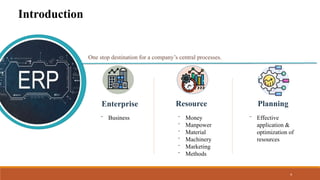
⁻ Business ⁻ Money
⁻ Manpower
⁻ Material
⁻ Machinery
⁻ Marketing
⁻ Methods
⁻ Effective
application &
optimization of
resources
Enterprise Resource Planning
One stop destination for a company’s central processes.
Introduction
4
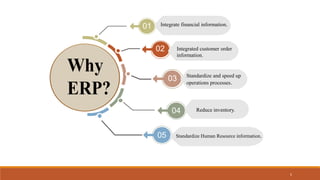
01
03
04
02
05
Integrate financial information.
Integrated customer order
information.
Standardize and speed up
operations processes.
Reduce inventory.
Standardize Human Resource information.
5
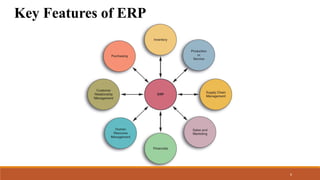
Key Features of ERP
6
Benefits Of
Enterprise Resource Planning
7
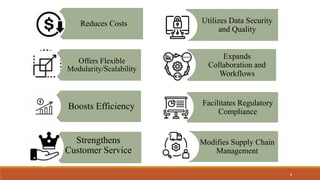
Reduces Costs
Offers Flexible
Modularity/Scalability
Boosts Efficiency
Utilizes Data Security
and Quality
Expands
Collaboration and
Workflows
Facilitates Regulatory
Compliance
Modifies Supply Chain
Management
Strengthens
Customer Service
8
9
Real life example of
ERP
10
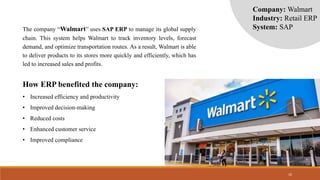
The company “Walmart” uses SAP ERP to manage its global supply
chain. This system helps Walmart to track inventory levels, forecast
demand, and optimize transportation routes. As a result, Walmart is able
to deliver products to its stores more quickly and efficiently, which has
led to increased sales and profits.
How ERP benefited the company:
• Increased efficiency and productivity
• Improved decision-making
• Reduced costs
• Enhanced customer service
• Improved compliance
Company: Walmart
Industry: Retail ERP
System: SAP
11
Company: Starbucks
Industry: Retail
System: Oracle ERP
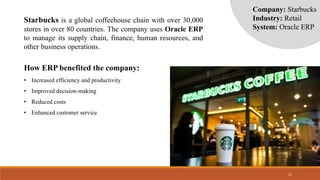
Starbucks is a global coffeehouse chain with over 30,000
stores in over 80 countries. The company uses Oracle ERP
to manage its supply chain, finance, human resources, and
other business operations.
How ERP benefited the company:
• Increased efficiency and productivity
• Improved decision-making
• Reduced costs
• Enhanced customer service
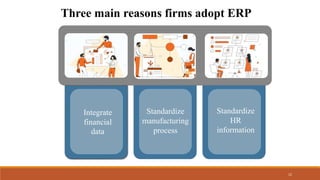
Three main reasons firms adopt ERP
12
Integrate
financial
data
Standardize
HR
information
Standardize
manufacturing
process
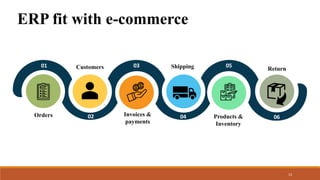
ERP fit with e-commerce
Orders
Customers
02
01 03
04
05
06
Invoices &
payments
Shipping
Products &
Inventory
Return
13
14
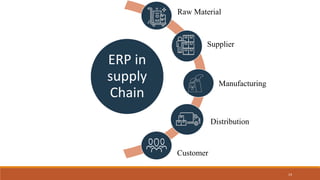
ERP in
supply
Chain
Raw Material
Customer
Supplier
Manufacturing
Distribution
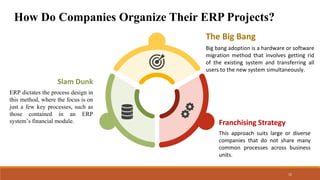
How Do Companies Organize Their ERP Projects?
The Big Bang
Big bang adoption is a hardware or software
migration method that involves getting rid
of the existing system and transferring all
users to the new system simultaneously.
Franchising Strategy
This approach suits large or diverse
companies that do not share many
common processes across business
units.
Slam Dunk
ERP dictates the process design in
this method, where the focus is on
just a few key processes, such as
those contained in an ERP
system’s financial module.
15
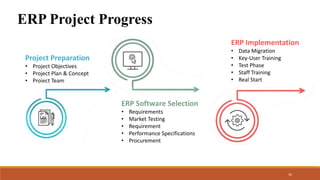
Project Preparation
• Project Objectives
• Project Plan & Concept
• Project Team
ERP Software Selection
• Requirements
• Market Testing
• Requirement
• Performance Specifications
• Procurement
ERP Implementation
• Data Migration
• Key-User Training
• Test Phase
• Staff Training
• Real Start
ERP Project Progress
16
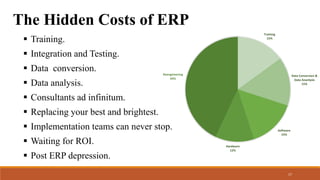
The Hidden Costs of ERP
 Training.
 Integration and Testing.
 Data conversion.
 Data analysis.
 Consultants ad infinitum.
 Replacing your best and brightest.
 Implementation teams can never stop.
 Waiting for ROI.
 Post ERP depression.
Training
15%
Data Conversion &
Data Ananlysis
15%
Software
15%
Hardware
12%
Reengineering
43%
17
Risks With ERP Implementation
• Expensive (can costs 100 thousands to millions of dollars).
• Time-consuming (can take months to years)
• Great risk for Organization
• Transfer of Knowledge
• Acceptance with the company
18
19
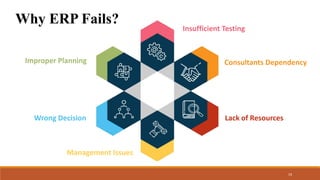
Wrong Decision
Management Issues
Consultants Dependency
Lack of Resources
Improper Planning
Insufficient Testing
Why ERP Fails?
Conclusion:
ERP is a software system that integrates all the core processes of an organization, such as
accounting, manufacturing, sales, and human resources. ERP systems can help organizations
improve efficiency, productivity, and decision-making. There are many factors to consider
when choosing an ERP system, such as the size and complexity of your organization, your
industry, and your budget. It is important to choose an ERP system that is right for your
specific needs. The implementation of an ERP system can be a complex and time-consuming
process. It is important to have a well-defined plan and to involve all stakeholders in the
implementation process.
20
1. https://paginas.fe.up.pt/~mgi00011/ERP/abcs_of_erp.htm
2. https://www.slideshare.net/khaledalhalabee/enterprise-resource-planning-234368353?from_search=1
3. https://www.oracle.com/erp/what-is-erp/
4. https://www.slideshare.net/RahulSinghRoop/erp-enterprise-resource-planning-230648882
5. https://www.slideshare.net/SiddharthModi1/complete-knowledge-of-enterprise-resource-planning-best-ppt
6. https://www.slideshare.net/SONYGURI/erp-ppt-45210884
7. https://www.slideshare.net/makansinghchauhan/enterprise-resource-planning-25849401
8. https://www.selecthub.com/enterprise-resource-planning/difference-between-scm-erp/#6
9. https://www.magestore.com/blog/erp-in-supply-chain-management
21
Reference:
22

Enterprise Resource Planning

  • 1.
  • 2.
    Notre Dame UniversityBangladesh Presented By: Prapti Das-201120008 Rup Chowdhury-201120010 Aysha Siddiqua Khanam-182120005 Presented To: Dr. Fernaz Narin Nur Associate Professor, Department of CSE Notre Dame University Bangladesh 2
  • 3.
    Outline • Introduction • WhyERP? • Key Features of ERP • Benefits of ERP • Real life example of ERP • Three main reasons firms adopt ERP • ERP fit with E-commerce • ERP in Supply Chain • How do companies organize their ERP projects • ERP Project progress • The Hidden Costs of ERP • Risks with ERP implementation • Why ERP fails? • Conclusion 3
  • 4.
    ⁻ Business ⁻Money ⁻ Manpower ⁻ Material ⁻ Machinery ⁻ Marketing ⁻ Methods ⁻ Effective application & optimization of resources Enterprise Resource Planning One stop destination for a company’s central processes. Introduction 4
  • 5.
    01 03 04 02 05 Integrate financial information. Integratedcustomer order information. Standardize and speed up operations processes. Reduce inventory. Standardize Human Resource information. 5
  • 6.
  • 7.
  • 8.
    Reduces Costs Offers Flexible Modularity/Scalability BoostsEfficiency Utilizes Data Security and Quality Expands Collaboration and Workflows Facilitates Regulatory Compliance Modifies Supply Chain Management Strengthens Customer Service 8
  • 9.
  • 10.
    10 The company “Walmart”uses SAP ERP to manage its global supply chain. This system helps Walmart to track inventory levels, forecast demand, and optimize transportation routes. As a result, Walmart is able to deliver products to its stores more quickly and efficiently, which has led to increased sales and profits. How ERP benefited the company: • Increased efficiency and productivity • Improved decision-making • Reduced costs • Enhanced customer service • Improved compliance Company: Walmart Industry: Retail ERP System: SAP
  • 11.
    11 Company: Starbucks Industry: Retail System:Oracle ERP Starbucks is a global coffeehouse chain with over 30,000 stores in over 80 countries. The company uses Oracle ERP to manage its supply chain, finance, human resources, and other business operations. How ERP benefited the company: • Increased efficiency and productivity • Improved decision-making • Reduced costs • Enhanced customer service
  • 12.
    Three main reasonsfirms adopt ERP 12 Integrate financial data Standardize HR information Standardize manufacturing process
  • 13.
    ERP fit withe-commerce Orders Customers 02 01 03 04 05 06 Invoices & payments Shipping Products & Inventory Return 13
  • 14.
  • 15.
    How Do CompaniesOrganize Their ERP Projects? The Big Bang Big bang adoption is a hardware or software migration method that involves getting rid of the existing system and transferring all users to the new system simultaneously. Franchising Strategy This approach suits large or diverse companies that do not share many common processes across business units. Slam Dunk ERP dictates the process design in this method, where the focus is on just a few key processes, such as those contained in an ERP system’s financial module. 15
  • 16.
    Project Preparation • ProjectObjectives • Project Plan & Concept • Project Team ERP Software Selection • Requirements • Market Testing • Requirement • Performance Specifications • Procurement ERP Implementation • Data Migration • Key-User Training • Test Phase • Staff Training • Real Start ERP Project Progress 16
  • 17.
    The Hidden Costsof ERP  Training.  Integration and Testing.  Data conversion.  Data analysis.  Consultants ad infinitum.  Replacing your best and brightest.  Implementation teams can never stop.  Waiting for ROI.  Post ERP depression. Training 15% Data Conversion & Data Ananlysis 15% Software 15% Hardware 12% Reengineering 43% 17
  • 18.
    Risks With ERPImplementation • Expensive (can costs 100 thousands to millions of dollars). • Time-consuming (can take months to years) • Great risk for Organization • Transfer of Knowledge • Acceptance with the company 18
  • 19.
    19 Wrong Decision Management Issues ConsultantsDependency Lack of Resources Improper Planning Insufficient Testing Why ERP Fails?
  • 20.
    Conclusion: ERP is asoftware system that integrates all the core processes of an organization, such as accounting, manufacturing, sales, and human resources. ERP systems can help organizations improve efficiency, productivity, and decision-making. There are many factors to consider when choosing an ERP system, such as the size and complexity of your organization, your industry, and your budget. It is important to choose an ERP system that is right for your specific needs. The implementation of an ERP system can be a complex and time-consuming process. It is important to have a well-defined plan and to involve all stakeholders in the implementation process. 20
  • 21.
    1. https://paginas.fe.up.pt/~mgi00011/ERP/abcs_of_erp.htm 2. https://www.slideshare.net/khaledalhalabee/enterprise-resource-planning-234368353?from_search=1 3.https://www.oracle.com/erp/what-is-erp/ 4. https://www.slideshare.net/RahulSinghRoop/erp-enterprise-resource-planning-230648882 5. https://www.slideshare.net/SiddharthModi1/complete-knowledge-of-enterprise-resource-planning-best-ppt 6. https://www.slideshare.net/SONYGURI/erp-ppt-45210884 7. https://www.slideshare.net/makansinghchauhan/enterprise-resource-planning-25849401 8. https://www.selecthub.com/enterprise-resource-planning/difference-between-scm-erp/#6 9. https://www.magestore.com/blog/erp-in-supply-chain-management 21 Reference:
  • 22.